Limited beta · What is this?

pgTrue is under active development: reports may contain significant mistakes, inaccuracies, or bugs. Please report anything you find to pgtrue@postgres.ai.

pgTrue is an independent fact-check of technical Postgres articles. Read the questions and answers.

Fact-check of

ElephantSeal DLimited coverage

Embed

The ElephantSeal always shows this report's latest edition and links here. Copies cached elsewhere may update later.

[![pgTrue fact-check](https://pgtrue.postgres.ai/badge/f03f1c24-e8ce-4d68-a613-d2fa932c25b1.svg?v=13&theme=light)](https://pgtrue.postgres.ai/shared/brief/f03f1c24-e8ce-4d68-a613-d2fa932c25b1)
<a href="https://pgtrue.postgres.ai/shared/brief/f03f1c24-e8ce-4d68-a613-d2fa932c25b1"><img src="https://pgtrue.postgres.ai/badge/f03f1c24-e8ce-4d68-a613-d2fa932c25b1.svg?v=13&amp;theme=light" alt="pgTrue fact-check" width="90" height="20" loading="lazy" decoding="async" style="display:inline-block;width:90px;height:20px"></a>
https://pgtrue.postgres.ai/badge/f03f1c24-e8ce-4d68-a613-d2fa932c25b1.svg?v=13&theme=light
.. image:: https://pgtrue.postgres.ai/badge/f03f1c24-e8ce-4d68-a613-d2fa932c25b1.svg?v=13&theme=light
   :target: https://pgtrue.postgres.ai/shared/brief/f03f1c24-e8ce-4d68-a613-d2fa932c25b1
   :alt: pgTrue fact-check
   :width: 90
   :height: 20
[![pgTrue fact-check](https://pgtrue.postgres.ai/badge/f03f1c24-e8ce-4d68-a613-d2fa932c25b1.svg?v=13&theme=dark)](https://pgtrue.postgres.ai/shared/brief/f03f1c24-e8ce-4d68-a613-d2fa932c25b1)
<a href="https://pgtrue.postgres.ai/shared/brief/f03f1c24-e8ce-4d68-a613-d2fa932c25b1"><img src="https://pgtrue.postgres.ai/badge/f03f1c24-e8ce-4d68-a613-d2fa932c25b1.svg?v=13&amp;theme=dark" alt="pgTrue fact-check" width="90" height="20" loading="lazy" decoding="async" style="display:inline-block;width:90px;height:20px"></a>
https://pgtrue.postgres.ai/badge/f03f1c24-e8ce-4d68-a613-d2fa932c25b1.svg?v=13&theme=dark
.. image:: https://pgtrue.postgres.ai/badge/f03f1c24-e8ce-4d68-a613-d2fa932c25b1.svg?v=13&theme=dark
   :target: https://pgtrue.postgres.ai/shared/brief/f03f1c24-e8ce-4d68-a613-d2fa932c25b1
   :alt: pgTrue fact-check
   :width: 90
   :height: 20
[![pgTrue fact-check](https://pgtrue.postgres.ai/badge/f03f1c24-e8ce-4d68-a613-d2fa932c25b1.svg?v=13)](https://pgtrue.postgres.ai/shared/brief/f03f1c24-e8ce-4d68-a613-d2fa932c25b1)
<a href="https://pgtrue.postgres.ai/shared/brief/f03f1c24-e8ce-4d68-a613-d2fa932c25b1"><img src="https://pgtrue.postgres.ai/badge/f03f1c24-e8ce-4d68-a613-d2fa932c25b1.svg?v=13" alt="pgTrue fact-check" width="90" height="20" loading="lazy" decoding="async" style="display:inline-block;width:90px;height:20px"></a>
https://pgtrue.postgres.ai/badge/f03f1c24-e8ce-4d68-a613-d2fa932c25b1.svg?v=13
.. image:: https://pgtrue.postgres.ai/badge/f03f1c24-e8ce-4d68-a613-d2fa932c25b1.svg?v=13
   :target: https://pgtrue.postgres.ai/shared/brief/f03f1c24-e8ce-4d68-a613-d2fa932c25b1
   :alt: pgTrue fact-check
   :width: 90
   :height: 20
[![pgTrue fact-check](https://pgtrue.postgres.ai/badge/f03f1c24-e8ce-4d68-a613-d2fa932c25b1/radar.svg?v=13&theme=light)](https://pgtrue.postgres.ai/shared/brief/f03f1c24-e8ce-4d68-a613-d2fa932c25b1)

<a href="https://pgtrue.postgres.ai/shared/brief/f03f1c24-e8ce-4d68-a613-d2fa932c25b1"><img src="https://pgtrue.postgres.ai/badge/f03f1c24-e8ce-4d68-a613-d2fa932c25b1/radar.svg?v=13&amp;theme=light" alt="pgTrue fact-check" width="240" height="240" loading="lazy" decoding="async" style="display:inline-block;width:240px;height:240px"></a>
https://pgtrue.postgres.ai/badge/f03f1c24-e8ce-4d68-a613-d2fa932c25b1/radar.svg?v=13&theme=light
.. image:: https://pgtrue.postgres.ai/badge/f03f1c24-e8ce-4d68-a613-d2fa932c25b1/radar.svg?v=13&theme=light
   :target: https://pgtrue.postgres.ai/shared/brief/f03f1c24-e8ce-4d68-a613-d2fa932c25b1
   :alt: pgTrue fact-check
   :width: 240
   :height: 240
[![pgTrue fact-check](https://pgtrue.postgres.ai/badge/f03f1c24-e8ce-4d68-a613-d2fa932c25b1/radar.svg?v=13&theme=dark)](https://pgtrue.postgres.ai/shared/brief/f03f1c24-e8ce-4d68-a613-d2fa932c25b1)

<a href="https://pgtrue.postgres.ai/shared/brief/f03f1c24-e8ce-4d68-a613-d2fa932c25b1"><img src="https://pgtrue.postgres.ai/badge/f03f1c24-e8ce-4d68-a613-d2fa932c25b1/radar.svg?v=13&amp;theme=dark" alt="pgTrue fact-check" width="240" height="240" loading="lazy" decoding="async" style="display:inline-block;width:240px;height:240px"></a>
https://pgtrue.postgres.ai/badge/f03f1c24-e8ce-4d68-a613-d2fa932c25b1/radar.svg?v=13&theme=dark
.. image:: https://pgtrue.postgres.ai/badge/f03f1c24-e8ce-4d68-a613-d2fa932c25b1/radar.svg?v=13&theme=dark
   :target: https://pgtrue.postgres.ai/shared/brief/f03f1c24-e8ce-4d68-a613-d2fa932c25b1
   :alt: pgTrue fact-check
   :width: 240
   :height: 240
[![pgTrue fact-check](https://pgtrue.postgres.ai/badge/f03f1c24-e8ce-4d68-a613-d2fa932c25b1/radar.svg?v=13)](https://pgtrue.postgres.ai/shared/brief/f03f1c24-e8ce-4d68-a613-d2fa932c25b1)

<a href="https://pgtrue.postgres.ai/shared/brief/f03f1c24-e8ce-4d68-a613-d2fa932c25b1"><img src="https://pgtrue.postgres.ai/badge/f03f1c24-e8ce-4d68-a613-d2fa932c25b1/radar.svg?v=13" alt="pgTrue fact-check" width="240" height="240" loading="lazy" decoding="async" style="display:inline-block;width:240px;height:240px"></a>
https://pgtrue.postgres.ai/badge/f03f1c24-e8ce-4d68-a613-d2fa932c25b1/radar.svg?v=13
.. image:: https://pgtrue.postgres.ai/badge/f03f1c24-e8ce-4d68-a613-d2fa932c25b1/radar.svg?v=13
   :target: https://pgtrue.postgres.ai/shared/brief/f03f1c24-e8ce-4d68-a613-d2fa932c25b1
   :alt: pgTrue fact-check
   :width: 240
   :height: 240
[![pgTrue fact-check](https://pgtrue.postgres.ai/badge/f03f1c24-e8ce-4d68-a613-d2fa932c25b1/wide.svg?v=13&theme=light)](https://pgtrue.postgres.ai/shared/brief/f03f1c24-e8ce-4d68-a613-d2fa932c25b1)
<a href="https://pgtrue.postgres.ai/shared/brief/f03f1c24-e8ce-4d68-a613-d2fa932c25b1"><img src="https://pgtrue.postgres.ai/badge/f03f1c24-e8ce-4d68-a613-d2fa932c25b1/wide.svg?v=13&amp;theme=light" alt="pgTrue fact-check" width="480" height="240" loading="lazy" decoding="async" style="display:inline-block;width:480px;height:240px"></a>
https://pgtrue.postgres.ai/badge/f03f1c24-e8ce-4d68-a613-d2fa932c25b1/wide.svg?v=13&theme=light
.. image:: https://pgtrue.postgres.ai/badge/f03f1c24-e8ce-4d68-a613-d2fa932c25b1/wide.svg?v=13&theme=light
   :target: https://pgtrue.postgres.ai/shared/brief/f03f1c24-e8ce-4d68-a613-d2fa932c25b1
   :alt: pgTrue fact-check
   :width: 480
   :height: 240
[![pgTrue fact-check](https://pgtrue.postgres.ai/badge/f03f1c24-e8ce-4d68-a613-d2fa932c25b1/wide.svg?v=13&theme=dark)](https://pgtrue.postgres.ai/shared/brief/f03f1c24-e8ce-4d68-a613-d2fa932c25b1)
<a href="https://pgtrue.postgres.ai/shared/brief/f03f1c24-e8ce-4d68-a613-d2fa932c25b1"><img src="https://pgtrue.postgres.ai/badge/f03f1c24-e8ce-4d68-a613-d2fa932c25b1/wide.svg?v=13&amp;theme=dark" alt="pgTrue fact-check" width="480" height="240" loading="lazy" decoding="async" style="display:inline-block;width:480px;height:240px"></a>
https://pgtrue.postgres.ai/badge/f03f1c24-e8ce-4d68-a613-d2fa932c25b1/wide.svg?v=13&theme=dark
.. image:: https://pgtrue.postgres.ai/badge/f03f1c24-e8ce-4d68-a613-d2fa932c25b1/wide.svg?v=13&theme=dark
   :target: https://pgtrue.postgres.ai/shared/brief/f03f1c24-e8ce-4d68-a613-d2fa932c25b1
   :alt: pgTrue fact-check
   :width: 480
   :height: 240
[![pgTrue fact-check](https://pgtrue.postgres.ai/badge/f03f1c24-e8ce-4d68-a613-d2fa932c25b1/wide.svg?v=13)](https://pgtrue.postgres.ai/shared/brief/f03f1c24-e8ce-4d68-a613-d2fa932c25b1)
<a href="https://pgtrue.postgres.ai/shared/brief/f03f1c24-e8ce-4d68-a613-d2fa932c25b1"><img src="https://pgtrue.postgres.ai/badge/f03f1c24-e8ce-4d68-a613-d2fa932c25b1/wide.svg?v=13" alt="pgTrue fact-check" width="480" height="240" loading="lazy" decoding="async" style="display:inline-block;width:480px;height:240px"></a>
https://pgtrue.postgres.ai/badge/f03f1c24-e8ce-4d68-a613-d2fa932c25b1/wide.svg?v=13
.. image:: https://pgtrue.postgres.ai/badge/f03f1c24-e8ce-4d68-a613-d2fa932c25b1/wide.svg?v=13
   :target: https://pgtrue.postgres.ai/shared/brief/f03f1c24-e8ce-4d68-a613-d2fa932c25b1
   :alt: pgTrue fact-check
   :width: 480
   :height: 240

Click the snippet to select all of it, then copy. Where SVG is stripped, as in some email clients and feed readers, change .svg to .png. PNG uses the light theme for Auto. For Markdown PNG embeds, use the HTML snippet where supported to preserve the display size.

Optional colours: append &color=26798E or &labelColor=333C47 after a theme query (use ? for the first parameter). Use 3- or 6-digit hex.

For pages with a light background.

For pages with a dark background. The ElephantSeal gets a thin edge so it does not blend in.

Auto follows the reader's light or dark setting where the host supports it, and shows the light ElephantSeal where it does not.

On a light page
On a dark page

Best practices for Amazon RDS PostgreSQL replication | Amazon Web Services (opens in new tab)

aws.amazon.com
Don't run its recipes as written: 2 can do harm.
0
inaccuracy
2
dangerous-recipe
2
misleading
3
imprecise
0
transcription
0
aged
0
withdrawn
6
verified-accurate

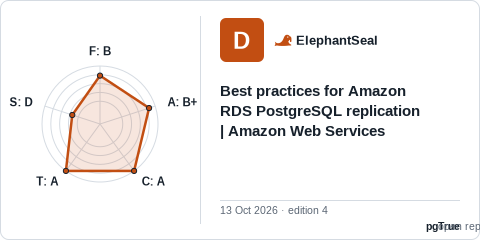
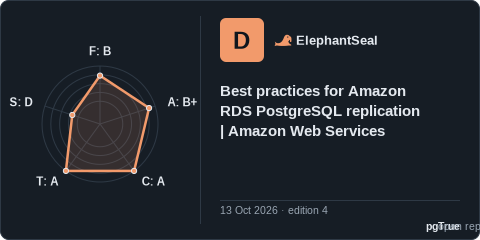
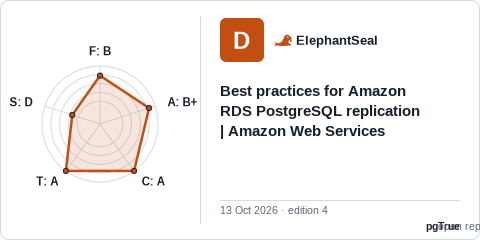
Factual B · Applicable B+ · Consistent A · Transparent A · Safe D

ReportTechnical fact-check, edition 4 Issued EditionUpdated after review. Corrections are listed below. SubmittedSubmitted by the PostgresAI team. Author responseNo written reply from the author. We re-audited this article 3 times; see Revisions below. Policy: right-of-reply and corrections policy. pgTrue versionaudit version not recorded

InaccuraciesNone in this edition.

Dangerous or recipe bugs

F1

The five-minute query also terminates idle connections

INACCURATESafe · holds up after review
Article · exact quote · open in article ↗ (opens in new tab)This query kills read transactions running longer than five minutes:…
Source · REL9_6_24 · doc/src/sgml/monitoring.sgml:633-635<entry>Time when the currently active query was started, or if <structfield>state</> is not <literal>active</>, when the last query was started

query_start records the last query's start even when a connection is idle. The predicate checks neither activity nor transaction age. pg_terminate_backend sends SIGTERM to selected backends. This can disconnect idle application sessions, not just long-running reads.

Charitable reading: Running this on a read replica limits write activity, but idle client connections still satisfy the predicate.

All sources and excerpts · 5
Evidence <entry>Time when the currently active query was started, or if <structfield>state</> is not <literal>active</>, when the last query was started

Version note: PostgreSQL 9.6.24

Evidencepg_terminate_backend(PG_FUNCTION_ARGS) { int r = pg_signal_backend(PG_GETARG_INT32(0), SIGTERM);

Version note: PostgreSQL 9.6.24

Evidence <entry>Time when the currently active query was started, or if <structfield>state</> is not <literal>active</>, when the last query was started

Version note: PostgreSQL 9.6.24

Evidence <entry>Time when this process' current transaction was started, or null if no transaction is active. If the current query is the first of its transaction, this column is equal to the <structfield>query_start</> column.

Version note: PostgreSQL 9.6.24

Evidencepg_terminate_backend(PG_FUNCTION_ARGS) { int r = pg_signal_backend(PG_GETARG_INT32(0), SIGTERM);

Version note: PostgreSQL 9.6.24

How the review tested this

Review: We re-read monitoring.sgml:633-635 at REL9_6_24: query_start keeps the last query's start when state is not active. The article's predicate filters on query_start only, with no state or backend_type filter. pg_terminate_backend sends SIGTERM (misc.c:307-309). Idle pooled sessions older than five minutes are terminated. The charitable reading (run only on the replica) does not remove that effect. Running on a replica does not exclude idle sessions. monitoring.sgml:633 preserves their last query start. misc.c:309 sends SIGTERM.

F2

Inactive replication slots are not necessarily disposable

INACCURATESafe · holds up after review
Article · exact quote · open in article ↗ (opens in new tab)…kill inactive ones…
Source · REL9_6_24 · doc/src/sgml/logicaldecoding.sgml:253-258Replication slots persist across crashes and know nothing about the state of their consumer(s). They will prevent removal of required resources even when there is no connection using them. This consumes storage because neither required WAL nor required rows from the system catalogs can be removed by <command>VACUUM</command> as long as they are required by a replication slot. So if a slot is no longer required it should be dropped.

active reflects whether a process currently uses the slot. Slots retain required resources across consumer disconnections. Dropping one removes that protection for a consumer that might resume. Confirm that the consumer no longer needs the slot before deleting it.

Charitable reading: Dropping abandoned slots is valid maintenance. The article instead selects every slot without an active consumer.

All sources and excerpts · 2
Evidence Replication slots persist across crashes and know nothing about the state of their consumer(s). They will prevent removal of required resources even when there is no connection using them. This consumes storage because neither required WAL nor required rows from the system catalogs can be removed by <command>VACUUM</command> as long as they are required by a replication slot. So if a slot is no longer required it should be dropped.

Version note: PostgreSQL 9.6.24

Evidence values[i++] = BoolGetDatum(active_pid != 0);

Version note: PostgreSQL 9.6.24

How the review tested this

Review: We re-read slotfuncs.c:272 at REL9_6_24: active is active_pid != 0, a point-in-time connection check. logicaldecoding.sgml:253-258 says slots know nothing about their consumer and should be dropped only when no longer required. A paused DMS task or a disconnected cross-region replica shows active = f and loses its slot under the article's rule. The charitable reading (abandoned slots) is narrower than the article's blanket instruction. I considered whether inactive meant abandoned. slotfuncs.c:272 tests current use only. logicaldecoding.sgml:253 explicitly preserves resources across disconnections.

Misleading / imprecise

F3

Misleading: “…SELECT pg_drop_replication_slot('slot_name') from pg_replication_slots where active…”

MISLEADINGFactual · partly holds after review
Article · exact quote · open in article ↗ (opens in new tab)…SELECT pg_drop_replication_slot('slot_name') from pg_replication_slots where active = 'f';…
Source · REL9_6_24 · src/backend/replication/slotfuncs.c:160-166Name name = PG_GETARG_NAME(0); check_permissions(); CheckSlotRequirements(); ReplicationSlotDrop(NameStr(*name));

pg_drop_replication_slot receives the constant 'slot_name' for every selected row (slotfuncs.c:158-166, REL9_6_24). It never receives the row's slot_name column. The statement errors on a nonexistent slot instead of bulk-dropping. Use the column, unquoted, and only after confirming the consumer is gone.

All sources and excerpts · 2
Evidence Name name = PG_GETARG_NAME(0); check_permissions(); CheckSlotRequirements(); ReplicationSlotDrop(NameStr(*name));

Version note: PostgreSQL 9.6.24

Evidencepg_drop_replication_slot(PG_FUNCTION_ARGS) { Name name = PG_GETARG_NAME(0); check_permissions(); CheckSlotRequirements(); ReplicationSlotDrop(NameStr(*name));

Version note: PostgreSQL 9.6.24

How the review tested this

Review: The mechanism is right: slotfuncs.c:158-166 passes the argument straight to ReplicationSlotDrop, and the SELECT supplies the constant 'slot_name' per row. But the printed statement is not dangerous. For each inactive slot it tries to drop a slot literally named slot_name, which raises a does-not-exist error unless such a slot exists. The practical result is a failed query, not an unintended drop. The danger of a corrected bulk drop is already carried by F2. Severity should be misleading. A placeholder reading fits the preceding example, but not automatic per-row selection. slotfuncs.c:166 drops the supplied constant name.

F5

wal_keep_size does not prevent WAL archival

MISLEADINGFactual · holds up after review
Article · exact quote · open in article ↗ (opens in new tab)Set this parameter high enough to prevent WAL files from archiving…
Source · REL_15_4 · doc/src/sgml/config.sgml:3545-3548When <varname>archive_mode</varname> is enabled, completed WAL segments are sent to archive storage by setting <xref linkend="guc-archive-command"/> or <xref linkend="guc-archive-library"/>.

wal_keep_size sets a minimum local retention size. archive_mode sends completed segments to archive storage independently. Increasing retention can keep segments available for streaming. It neither stops archival nor sets a maximum pg_wal directory size.

Charitable reading: Increasing local retention can avoid archive retrieval. That useful recommendation does not prevent archival.

All sources and excerpts · 2
Evidence When <varname>archive_mode</varname> is enabled, completed WAL segments are sent to archive storage by setting <xref linkend="guc-archive-command"/> or <xref linkend="guc-archive-library"/>.

Version note: PostgreSQL 15.4, available before the article's September 2023 review

Evidence This sets only the minimum size of segments retained in <filename>pg_wal</filename>; the system might need to retain more segments for WAL archival or to recover from a checkpoint.

Version note: PostgreSQL 15.4 wal_keep_size documentation

How the review tested this

Review: We re-read config.sgml:4254-4256 at REL_15_4: wal_keep_size is a minimum, and the system may retain more for archival. archive_mode ships every completed segment regardless. REL_15_4 is the right pin because wal_keep_size only exists from PostgreSQL 13 and the article's 2023 revision uses it. The article frames the claim as PostgreSQL behavior, so RDS internals do not rescue it. This overlaps F11 on the same article span. Avoiding archive recovery is a charitable reading. PostgreSQL 15.4 still distinguishes local retention from archival. It fits the September 2023 update.

F11

Misleading: “Set this parameter high enough to prevent WAL files from archiving when streaming…”

MISLEADINGApplicable · holds up after review
Article · exact quote · open in article ↗ (opens in new tab)Set this parameter high enough to prevent WAL files from archiving when streaming replication starts.
Source · https://www.postgresql.org/docs/current/warm-standby.htmlYou can avoid this by setting wal_keep_size to a value large enough to ensure that WAL segments are not recycled too early, or by configuring a replication slot for the standby.

wal_keep_size retains local WAL against early recycling. It does not stop completed segments from entering the archive. PostgreSQL 9.6.24 documents archiving completed segments in doc/src/sgml/backup.sgml:594. Size retention to avoid archive recovery, not to suppress archival copies.

Review correction: 2026-10-13: Folded one duplicate finding (F11 into F5): the same claim filed twice is charged once. Same issue as F5.

All sources and excerpts · 2
EvidenceYou can avoid this by setting wal_keep_size to a value large enough to ensure that WAL segments are not recycled too early, or by configuring a replication slot for the standby.
Evidence <productname>PostgreSQL</> tries not to make any assumptions about how the archiving will be done. Instead, <productname>PostgreSQL</> lets the administrator specify a shell command to be executed to copy a completed segment file to wherever it needs to go. The command could be

Version note: PostgreSQL 9.6.24 documentation describes archiving completed segments independently of retention.

How the review tested this

Review: backup.sgml:594-597 at REL9_6_24 describes archive_command copying each completed segment, and the current warm-standby page frames wal_keep_size as protection against early recycling. The finding stays inside that evidence. It covers the same article span as F5 (both start at char 4064); the two should be merged, but each stands. Reading archiving as archive recovery salvages the recommendation, not its explanation. The pinned documentation distinguishes completed-segment archival from retention. F5 duplicates this defect.

F4

hot_standby_feedback delays dead-row removal, not VACUUM itself

IMPRECISEFactual · holds up after review
Article · exact quote · open in article ↗ (opens in new tab)…postpone VACUUM on related tables…
Source · REL9_6_24 · src/backend/replication/walsender.c:1735-1738* Set the WalSender's xmin equal to the standby's requested xmin, so that * the xmin will be taken into account by GetOldestXmin. This will hold * back the removal of dead rows and thereby prevent the generation of * cleanup conflicts on the standby server.

walsender.c:1735 sets the cleanup horizon from the standby's xmin. VACUUM can run while that horizon prevents removal of protected dead rows. The article's bloat warning is valid, but its description of postponing VACUUM is not.

Charitable reading: The surrounding bloat warning correctly describes a consequence of delayed dead-row removal.

All sources and excerpts · 1
Evidence * Set the WalSender's xmin equal to the standby's requested xmin, so that * the xmin will be taken into account by GetOldestXmin. This will hold * back the removal of dead rows and thereby prevent the generation of * cleanup conflicts on the standby server.

Version note: PostgreSQL 9.6.24

How the review tested this

Review: We re-read walsender.c:1735-1738 at REL9_6_24: the standby xmin holds back removal of dead rows via GetOldestXmin. VACUUM still runs; it cannot remove rows above that horizon. The article's wording 'postpone VACUUM' describes the effect, not the mechanism. Imprecise is the right weight, and the report credits the bloat warning. I read postponing VACUUM as shorthand for postponing cleanup. walsender.c:1735 supports that narrower meaning. The imprecise grade already accommodates it.

F6

REINDEX does not take ACCESS EXCLUSIVE on the table

IMPRECISESafe · holds up after review
Article · exact quote · open in article ↗ (opens in new tab)…DROP TABLE , TRUNCATE , REINDEX , CLUSTER , VACUUM FULL…
Source · REL9_6_24 · src/backend/commands/indexcmds.c:1853-1859ReindexTable(RangeVar *relation, int options) { Oid heapOid; /* The lock level used here should match reindex_relation(). */ heapOid = RangeVarGetRelidExtended(relation, ShareLock, false, false, RangeVarCallbackOwnsTable, NULL);

ReindexTable takes ShareLock on the table in PostgreSQL 9.6. The article groups it with commands taking ACCESS EXCLUSIVE on tables. Older official documentation uses the same grouping. Distinguish the table lock from locks on its indexes when assessing blocking.

Charitable reading: The PostgreSQL 9.6 locking documentation lists REINDEX under ACCESS EXCLUSIVE. The article repeats that documentation.

All sources and excerpts · 2
EvidenceReindexTable(RangeVar *relation, int options) { Oid heapOid; /* The lock level used here should match reindex_relation(). */ heapOid = RangeVarGetRelidExtended(relation, ShareLock, false, false, RangeVarCallbackOwnsTable, NULL);

Version note: PostgreSQL 9.6.24

Evidence Acquired by the <command>DROP TABLE</>, <command>TRUNCATE</command>, <command>REINDEX</command>, <command>CLUSTER</command>, <command>VACUUM FULL</command>, and <command>REFRESH MATERIALIZED VIEW</command> (without <option>CONCURRENTLY</option>)

Version note: The older ACCESS EXCLUSIVE documentation includes REINDEX without distinguishing the table from its indexes.

How the review tested this

Review: We re-read indexcmds.c:1853-1859 at REL9_6_24: ReindexTable takes ShareLock on the heap. The 9.6 mvcc.sgml:1039-1043 lists REINDEX under ACCESS EXCLUSIVE, so the article repeats then-official documentation and the report gives it that fairness. REINDEX still takes ACCESS EXCLUSIVE on each index, which is WAL-logged and can conflict on the replica, so the article's lag warning keeps its practical force. Imprecise is correct. Official documentation supports the article's grouping. indexcmds.c:1858 takes ShareLock on the table. The finding preserves that documentation caveat.

F10

Imprecise: “You can confirm the data version by looking at the replication lag in Amazon CloudWatch…”

IMPRECISEApplicable · partly holds after review
Article · exact quote · open in article ↗ (opens in new tab)You can confirm the data version by looking at the replication lag in Amazon CloudWatch metrics…
Source · https://docs.aws.amazon.com/AmazonRDS/latest/UserGuide/USER_PostgreSQL.Replication.ReadReplicas.htmlIf no user transactions are running on the source DB instance, the associated PostgreSQL read replica reports a replication lag of up to five minutes.

RDS computes ReplicaLag from the last committed transaction timestamp and reports up to five minutes when the primary is idle. A high value can appear with no data difference. A low value does show recent commits applied. The article omits the idle-primary caveat.

All sources and excerpts · 1
EvidenceIf no user transactions are running on the source DB instance, the associated PostgreSQL read replica reports a replication lag of up to five minutes.
How the review tested this

Review: The RDS page says an idle primary makes ReplicaLag report up to five minutes. That is a false alarm in the stale direction: lag reads high while data is identical. It does not show a low lag value failing to confirm freshness, which is what the article asks the reader to do. The charge that the metric 'cannot establish whether data differs' goes beyond the evidence. The residue is a missing caveat about idle-primary inflation. Imprecise, not misleading. E-24 supports the metric limitation today. It does not establish when that behavior began or support wrong-at-publication dating.

Verified accurate

F8

Logical replication copies generated column values without sequence state

ACCURATEFactual · holds up after review
Article · exact quote · open in article ↗ (opens in new tab)…logical replication replicates sequence data in serial or identity columns…
Source · REL_15_4 · doc/src/sgml/logical-replication.sgml:1375-1378Sequence data is not replicated. The data in serial or identity columns backed by sequences will of course be replicated as part of the table, but the sequence itself would still show the start value on the subscriber.

PostgreSQL 15.4 replicates stored values in serial and identity columns. It does not replicate the backing sequence's state. The article correctly warns that promotion requires updating sequences.

Charitable reading: The phrase specifies values in serial or identity columns. The following warning distinguishes the underlying sequences.

All sources and excerpts · 1
Evidence Sequence data is not replicated. The data in serial or identity columns backed by sequences will of course be replicated as part of the table, but the sequence itself would still show the start value on the subscriber.

Version note: PostgreSQL 15.4

How the review tested this

Review: logical-replication.sgml:1375-1378 at REL_15_4 says column data replicates but the sequence itself keeps its start value on the subscriber. The article's full sentence warns that failover requires updating sequences. Accurate as filed. The surrounding sequence-update warning rules out a claim that sequence state replicates. logical-replication.sgml:1375 confirms stored column values replicate.

F9

pg_blocking_pids identifies lock blockers in PostgreSQL 9.6

ACCURATEFactual · holds up after review
Article · exact quote · open in article ↗ (opens in new tab)…the following query monitors locks in Postgres 9.6 and newer Postgres instances…
Source · REL9_6_24 · src/backend/utils/adt/lockfuncs.c:411-415* pg_blocking_pids - produce an array of the PIDs blocking given PID * * The reported PIDs are those that hold a lock conflicting with blocked_pid's * current request (hard block), or are requesting such a lock and are ahead * of blocked_pid in the lock's wait queue (soft block).

pg_blocking_pids returns processes blocking the requested PID. It includes conflicting lock holders and earlier conflicting waiters. Filtering nonempty arrays identifies blocked sessions in PostgreSQL 9.6.

Charitable reading: The query monitors blocked sessions, rather than listing every held lock. That matches its surrounding purpose.

All sources and excerpts · 1
Evidence * pg_blocking_pids - produce an array of the PIDs blocking given PID * * The reported PIDs are those that hold a lock conflicting with blocked_pid's * current request (hard block), or are requesting such a lock and are ahead * of blocked_pid in the lock's wait queue (soft block).

Version note: Checked at the article's PostgreSQL 9.6 floor

How the review tested this

Review: We re-read lockfuncs.c:411-415 at REL9_6_24: pg_blocking_pids reports hard and soft blockers. The function exists at the 9.6 floor the article names. Accurate. Duplicates F16. The query does not inventory every held lock. Its narrower blocked-session purpose matches lockfuncs.c:411, including conflicting waiters.

F12

Replication-slot retention can exhaust WAL storage

ACCURATEFactual · holds up after review
Article · exact quote · open in article ↗ (opens in new tab)…cross-region replication lag causes WAL accumulation at the source instance…
Source · https://www.postgresql.org/docs/current/warm-standby.htmlBeware that replication slots can cause the server to retain so many WAL segments that they fill up the space allocated for pg_wal .

Replication slots can retain enough WAL to fill pg_wal. PostgreSQL’s replication-slot documentation states this risk explicitly. Under the article’s stated retention hypothesis, monitoring source storage is justified.

Charitable reading: The preceding sentence explicitly assumes replication slots retain WAL. We checked the storage consequence under that hypothesis.

All sources and excerpts · 1
EvidenceBeware that replication slots can cause the server to retain so many WAL segments that they fill up the space allocated for pg_wal .
How the review tested this

Review: The warm-standby page states that slots can retain enough WAL to fill pg_wal. The article's sentence is conditional on slot retention, and the report judges it under that hypothesis. Accurate. I checked whether the finding treats every lag event as storage exhaustion. It states a conditional risk. E-29 supports that risk.

F13

ACCESS EXCLUSIVE conflicts with every table-lock mode

ACCURATEFactual · holds up after review
Article · exact quote · open in article ↗ (opens in new tab)ACCESS EXCLUSIVE is the most restrictive lock mode (conflicts with all other lock modes).
Source · https://www.postgresql.org/docs/current/explicit-locking.htmlThis mode guarantees that the holder is the only transaction accessing the table in any way.

ACCESS EXCLUSIVE excludes other transactions from accessing the same table. PostgreSQL’s explicit-locking documentation confirms that rule. Ordinary SELECT queries conflict with this lock.

Charitable reading: The sentence describes conflicts between transactions accessing the same table.

All sources and excerpts · 1
EvidenceThis mode guarantees that the holder is the only transaction accessing the table in any way.
How the review tested this

Review: The explicit-locking page says ACCESS EXCLUSIVE guarantees the holder is the only transaction accessing the table. The article's conflict statement matches. The report limits the check to the conflict rule and leaves the command list to F6. Accurate. I checked the same-table and other-transaction qualifications. E-31 supports both. This finding does not endorse the article's REINDEX grouping.

F14

RDS supports same-region and cross-region read replicas

ACCURATEFactual · holds up after review
Article · exact quote · open in article ↗ (opens in new tab)You can configure Read Replicas within the same Region as the source or in a different Region.
Source · https://docs.aws.amazon.com/AmazonRDS/latest/UserGuide/USER_ReadRepl.htmlThe information in this chapter applies to creating Amazon RDS read replicas either in the same AWS Region as the source DB instance, or in a separate AWS Region.

RDS documents read replicas within the source Region and in another Region. The article correctly identifies both placement options.

Charitable reading: The sentence claims support for regional placement options, without promising synchronous replication.

All sources and excerpts · 1
EvidenceThe information in this chapter applies to creating Amazon RDS read replicas either in the same AWS Region as the source DB instance, or in a separate AWS Region.
How the review tested this

Review: The RDS read-replica page covers replicas in the same Region and in a separate Region. The article's placement claim matches. Accurate. I checked for an implied synchronization guarantee. E-32 claims regional placement only. E-33 directly supports both placement options.

F16

The lock query selects blocked sessions

ACCURATEFactual · holds up after review
Article · exact quote · open in article ↗ (opens in new tab)…WHERE cardinality(pg_blocking_pids(pid)) > 0;…
Source · REL9_6_24 · doc/src/sgml/func.sgml:15782-15800<function>pg_blocking_pids</function> returns an array of the process IDs of the sessions that are blocking the server process with the specified process ID, or an empty array if there is no such server process or it is not blocked.

pg_blocking_pids returns blocker identifiers, or an empty array for an unblocked process. The cardinality predicate selects sessions with at least one blocker. PostgreSQL 9.6 supports this diagnostic.

Charitable reading: The query monitors sessions blocked on locks. It does not claim to list every held lock.

All sources and excerpts · 1
Evidence <function>pg_blocking_pids</function> returns an array of the process IDs of the sessions that are blocking the server process with the specified process ID, or an empty array if there is no such server process or it is not blocked.

Version note: PostgreSQL 9.6.24

How the review tested this

Review: func.sgml at REL9_6_24 documents pg_blocking_pids returning an empty array for an unblocked process, so cardinality > 0 selects blocked sessions. Accurate. Duplicates F9 on the same query. I checked the empty-array case against func.sgml:15782. Positive cardinality selects blocked sessions as stated. F9 duplicates this validation.

More in this report

Section checks · 7 sections

Section checks

AspectGradeFindings
Long-running query cleanupD1 dangerous-recipe
Replication-slot cleanupD1 dangerous-recipe · 1 misleading
Standby feedbackA1 imprecise
WAL retention and archivingB+1 misleading · 1 verified-accurate
Locking and diagnosticsA1 imprecise · 3 verified-accurate
Logical replication restrictionsA1 verified-accurate
Replica placement and freshnessA1 imprecise · 1 verified-accurate
Coverage and assessment

D — the findings address the article's main subject. What we did not check is listed below. We checked replica monitoring, WAL retention, standby feedback, and maintenance SQL that directly support the article’s replication recommendations.

We could not check everything in this article. What we did not check is listed below, in the words we recorded at the time. None of it moved the letter. We never charge our own limits to the article.

What we did not check

  • We did not verify the RDS defaults, CloudWatch metric units, or instance-sizing recommendations.
  • We did not reproduce the measurements or read the figures embedded in the article.
  • We did not fully check partition replication, schema-change ordering, or the source-storage effects attributed to replay delays.
  • We did not verify the RDS wal_keep_size default, metric units, or regional replication-slot implementation.
  • We did not establish release dates for changes to the article’s logical replication restrictions.
  • We did not reproduce the measurements or inspect the article’s figures.
  • We could not compare the July 2019 article with its September 2023 revision.
  • We could not verify the 11-minute replication lag or its timing because the charts were unavailable as readable images.
  • We did not reproduce the measurements or execute the SQL examples.

Overall D: 8 open issues among 14 claims checked, including 2 dangerous recipes. Serious issues lower the grade more than minor ones, and the grade reflects only the claims we checked.

Some explanatory text is not shown in this edition; the grade and findings are complete.

Scorecard · the five axes
FACTS scorecard Scorecard radar, 6 axes, bigger is better. Overall D. Factual B · 2 wrong · 1 caveat · 14 checked. Applicable B+ · 1 wrong · 1 caveat · 8 checked. Consistent A · 0 wrong · 0 caveats · 14 checked. Transparent A · 0 wrong · 0 caveats · 7 checked. Safe D · 2 wrong · 1 caveat · 3 checked. Locking and diagnostics: 4 of the above. Factual B2 wrong · 1 caveat14 checked Applicable B+1 wrong · 1 caveat8 checked Consistent A0 wrong · 0 caveats14 checked Transparent A0 wrong · 0 caveats7 checked Safe D2 wrong · 1 caveat3 checked Locking and diagnostics: 4 of the above

Topics regroup the same findings; each finding is counted once.

Further out is better. Each axis has its own letter, from the wrong claims and caveats among the claims we checked of that kind.

Checked on the FACTS: Factual, Applicable, Consistent, Transparent, Safe. Clockwise: Factual (is it true?), Applicable (does it apply to my setup, today?), Consistent (does it agree with itself?), Transparent (can I check it myself?), Safe (can I run this on prod?). Dashed spokes are this article's own topics and change from article to article.

We checked 14 claims, 2 commands scanned.

AxisLetterWrongCaveatsCheckedCoverage
FactualB2114assessed: B · 2 wrong · 1 caveat · 14 checked
ApplicableB+118assessed: B+ · 1 wrong · 1 caveat · 8 checked
ConsistentA0014assessed: A · 0 wrong · 0 caveats · 14 checked
TransparentA007assessed: A · 0 wrong · 0 caveats · 7 checked
SafeD213assessed: D · 2 wrong · 1 caveat · 3 checked
Topics · 7 topics

Topics

TopicFactualApplicableConsistentTransparentSafe
Long-running query cleanup0 issues 1 checked0 issues 1 checked1 issue 1 checked F1
Replication-slot cleanup1 issue 2 checked F30 issues 2 checked1 issue 1 checked F2
Standby feedback1 issue 1 checked F40 issues 1 checked
WAL retention and archiving1 issue 3 checked F5 F121 issue 2 checked F110 issues 3 checked0 issues 3 checked
Locking and diagnostics0 issues 4 checked F9 F13 F160 issues 3 checked0 issues 4 checked0 issues 1 checked1 issue 1 checked F6
Logical replication restrictions0 issues 1 checked F80 issues 1 checked0 issues 1 checked0 issues 1 checked
Replica placement and freshness0 issues 2 checked F141 issue 2 checked F100 issues 2 checked0 issues 2 checked

Issues found among the claims checked, per topic and axis. Each link goes to the finding behind the count.

Revisions: 4 · Not assessed -> Not assessed -> Not assessed -> D

We audited this article 4 times. Each row is the final edition of one audit. Letters and findings of earlier revisions stay readable at their own address.

  1. Revision 1 · Not assessed · audit version not recorded

    Details unavailable.

    ElephantSeal: Not assessed.

  2. Revision 2 · Not assessed · audit version not recorded

    Details unavailable.

    ElephantSeal: Not assessed.

  3. Revision 3 · Not assessed · audit version not recorded

    Details unavailable.

    ElephantSeal: Not assessed.

  4. Revision 4 · 2026-10-01 00:12 UTC · D · audit version not recorded · regrade version not recorded

    Same article text, re-audited. 6 accurate · 5 wrong · 3 caveats.

    ElephantSeal: D.

    Changes: Details unavailable.

First impression
Questions and answers

Questions and answers

What is pgTrue?

pgTrue is an independent fact-check of technical Postgres articles, made by PostgresAI. It helps you check advice before you use it.

What does the letter grade mean?

The letter grade summarizes the claims we checked. Five axes show what we checked:

  • Factual: is it true?
  • Applicable: does it apply to my setup, today?
  • Consistent: does it agree with itself?
  • Transparent: can I check it myself?
  • Safe: can I run this in production?

What is the ElephantSeal?

The ElephantSeal is the mark an article earns. It always shows the latest edition. “Open:” lists what is still open.

Can an author reply?

Authors can ask us to correct a finding, reply to it, or withdraw it. Right-of-reply policy.

Paste into your AI assistant to fix the article, then ask for a re-review.

Show the text
Fix the article with this report, then ask pgTrue for a re-review.

# pgTrue report: Best practices for Amazon RDS PostgreSQL replication \| Amazon Web Services

Article title: Best practices for Amazon RDS PostgreSQL replication \| Amazon Web Services
Article URL: https://aws.amazon.com/blogs/database/best-practices-for-amazon-rds-postgresql-replication
Report URL: https://pgtrue.postgres.ai/shared/brief/f03f1c24-e8ce-4d68-a613-d2fa932c25b1
Audited: 2026-10-01 00:12:09 UTC
Overall letter: D

## Axes

- Factual: B · 2 wrong · 14 checked · 1 caveats · assessed
- Applicable: B+ · 1 wrong · 8 checked · 1 caveats · assessed
- Consistent: A · 0 wrong · 14 checked · 0 caveats · assessed
- Transparent: A · 0 wrong · 7 checked · 0 caveats · assessed
- Safe: D · 2 wrong · 3 checked · 1 caveats · assessed

ElephantSeal: D.

## Report metadata

- Report: Technical fact-check, edition 4
- Issued: 2026-10-01
- Edition: Updated after review. Corrections are listed below.
- Submitted: Submitted by the PostgresAI team.
- Author response: No written reply from the author. We re-audited this article 3 times; see Revisions below. Policy: [right-of-reply and corrections policy](/pgtrue/security).
- pgTrue version: audit version not recorded

## Findings needing a change (8)

### F1 · Inaccurate · Safe · The five-minute query also terminates idle connections
Location: Article · exact quote · [open in article](https://aws.amazon.com/blogs/database/best-practices-for-amazon-rds-postgresql-replication#:~:text=This%20query%20kills%20read%20transactions%20running%20longer%20than%20five%20minutes%3A)
Article says:
```text
This query kills read transactions running longer than five minutes:…
```
Explanation: query_start records the last query's start even when a connection is idle. The predicate checks neither activity nor transaction age. pg_terminate_backend sends SIGTERM to selected backends. This can disconnect idle application sessions, not just long-running reads.
Explanation: Charitable reading: Running this on a read replica limits write activity, but idle client connections still satisfy the predicate.
Review: We re-read monitoring.sgml:633-635 at REL9_6_24: query_start keeps the last query's start when state is not active. The article's predicate filters on query_start only, with no state or backend_type filter. pg_terminate_backend sends SIGTERM (misc.c:307-309). Idle pooled sessions older than five minutes are terminated. The charitable reading (run only on the replica) does not remove that effect. Running on a replica does not exclude idle sessions. monitoring.sgml:633 preserves their last query start. misc.c:309 sends SIGTERM.

Sources:
- [REL9_6_24 · doc/src/sgml/monitoring.sgml:633-635](https://github.com/postgres/postgres/blob/a4116b8d5a4f68803452d8f1aa3f74f302049a90/doc/src/sgml/monitoring.sgml#L633-L635)
  Qualification: Version note: PostgreSQL 9.6.24
  Excerpt:
  ```text
  <entry>Time when the currently active query was started, or if
      <structfield>state</> is not <literal>active</>, when the last query
      was started
  ```
- [REL9_6_24 · src/backend/utils/adt/misc.c:307-309](https://github.com/postgres/postgres/blob/a4116b8d5a4f68803452d8f1aa3f74f302049a90/src/backend/utils/adt/misc.c#L307-L309)
  Qualification: Version note: PostgreSQL 9.6.24
  Excerpt:
  ```text
  pg_terminate_backend(PG_FUNCTION_ARGS)
{
	int			r = pg_signal_backend(PG_GETARG_INT32(0), SIGTERM);
  ```
- [REL9_6_24 · doc/src/sgml/monitoring.sgml:633-635](https://github.com/postgres/postgres/blob/a4116b8d5a4f68803452d8f1aa3f74f302049a90/doc/src/sgml/monitoring.sgml#L633-L635)
  Qualification: Version note: PostgreSQL 9.6.24
  Excerpt:
  ```text
  <entry>Time when the currently active query was started, or if
      <structfield>state</> is not <literal>active</>, when the last query
      was started
  ```
- [REL9_6_24 · doc/src/sgml/monitoring.sgml:624-627](https://github.com/postgres/postgres/blob/a4116b8d5a4f68803452d8f1aa3f74f302049a90/doc/src/sgml/monitoring.sgml#L624-L627)
  Qualification: Version note: PostgreSQL 9.6.24
  Excerpt:
  ```text
  <entry>Time when this process' current transaction was started, or null
      if no transaction is active. If the current
      query is the first of its transaction, this column is equal to the
      <structfield>query_start</> column.
  ```
- [REL9_6_24 · src/backend/utils/adt/misc.c:307-309](https://github.com/postgres/postgres/blob/a4116b8d5a4f68803452d8f1aa3f74f302049a90/src/backend/utils/adt/misc.c#L307-L309)
  Qualification: Version note: PostgreSQL 9.6.24
  Excerpt:
  ```text
  pg_terminate_backend(PG_FUNCTION_ARGS)
{
	int			r = pg_signal_backend(PG_GETARG_INT32(0), SIGTERM);
  ```

Finding URL: https://pgtrue.postgres.ai/shared/brief/f03f1c24-e8ce-4d68-a613-d2fa932c25b1#F1

### F2 · Inaccurate · Safe · Inactive replication slots are not necessarily disposable
Location: Article · exact quote · [open in article](https://aws.amazon.com/blogs/database/best-practices-for-amazon-rds-postgresql-replication#:~:text=kill%20inactive%20ones)
Article says:
```text
…kill inactive ones…
```
Explanation: active reflects whether a process currently uses the slot. Slots retain required resources across consumer disconnections. Dropping one removes that protection for a consumer that might resume. Confirm that the consumer no longer needs the slot before deleting it.
Explanation: Charitable reading: Dropping abandoned slots is valid maintenance. The article instead selects every slot without an active consumer.
Review: We re-read slotfuncs.c:272 at REL9_6_24: active is active_pid != 0, a point-in-time connection check. logicaldecoding.sgml:253-258 says slots know nothing about their consumer and should be dropped only when no longer required. A paused DMS task or a disconnected cross-region replica shows active = f and loses its slot under the article's rule. The charitable reading (abandoned slots) is narrower than the article's blanket instruction. I considered whether inactive meant abandoned. slotfuncs.c:272 tests current use only. logicaldecoding.sgml:253 explicitly preserves resources across disconnections.

Sources:
- [REL9_6_24 · doc/src/sgml/logicaldecoding.sgml:253-258](https://github.com/postgres/postgres/blob/a4116b8d5a4f68803452d8f1aa3f74f302049a90/doc/src/sgml/logicaldecoding.sgml#L253-L258)
  Qualification: Version note: PostgreSQL 9.6.24
  Excerpt:
  ```text
  Replication slots persist across crashes and know nothing about the state
      of their consumer(s). They will prevent removal of required resources
      even when there is no connection using them. This consumes storage
      because neither required WAL nor required rows from the system catalogs
      can be removed by <command>VACUUM</command> as long as they are required by a replication
      slot.  So if a slot is no longer required it should be dropped.
  ```
- [REL9_6_24 · src/backend/replication/slotfuncs.c:272-272](https://github.com/postgres/postgres/blob/a4116b8d5a4f68803452d8f1aa3f74f302049a90/src/backend/replication/slotfuncs.c#L272-L272)
  Qualification: Version note: PostgreSQL 9.6.24
  Excerpt:
  ```text
  values[i++] = BoolGetDatum(active_pid != 0);
  ```

Finding URL: https://pgtrue.postgres.ai/shared/brief/f03f1c24-e8ce-4d68-a613-d2fa932c25b1#F2

### F3 · Misleading · Factual · Misleading: “…SELECT pg_drop_replication_slot('slot_name') from pg_replication_slots where active…”
Location: Article · exact quote · [open in article](https://aws.amazon.com/blogs/database/best-practices-for-amazon-rds-postgresql-replication#:~:text=SELECT%20pg_drop_replication_slot%28%27slot_name%27%29%20from%20pg_replication_slots%20where%20active%20%3D%20%27f%27%3B)
Article says:
```text
…SELECT pg_drop_replication_slot('slot_name') from pg_replication_slots where active = 'f';…
```
Explanation: pg_drop_replication_slot receives the constant 'slot_name' for every selected row (slotfuncs.c:158-166, REL9_6_24). It never receives the row's slot_name column. The statement errors on a nonexistent slot instead of bulk-dropping. Use the column, unquoted, and only after confirming the consumer is gone.
Review: The mechanism is right: slotfuncs.c:158-166 passes the argument straight to ReplicationSlotDrop, and the SELECT supplies the constant 'slot_name' per row. But the printed statement is not dangerous. For each inactive slot it tries to drop a slot literally named slot_name, which raises a does-not-exist error unless such a slot exists. The practical result is a failed query, not an unintended drop. The danger of a corrected bulk drop is already carried by F2. Severity should be misleading. A placeholder reading fits the preceding example, but not automatic per-row selection. slotfuncs.c:166 drops the supplied constant name.

Sources:
- [REL9_6_24 · src/backend/replication/slotfuncs.c:160-166](https://github.com/postgres/postgres/blob/a4116b8d5a4f68803452d8f1aa3f74f302049a90/src/backend/replication/slotfuncs.c#L160-L166)
  Qualification: Version note: PostgreSQL 9.6.24
  Excerpt:
  ```text
  Name		name = PG_GETARG_NAME(0);

	check_permissions();

	CheckSlotRequirements();

	ReplicationSlotDrop(NameStr(*name));
  ```
- [REL9_6_24 · src/backend/replication/slotfuncs.c:158-166](https://github.com/postgres/postgres/blob/a4116b8d5a4f68803452d8f1aa3f74f302049a90/src/backend/replication/slotfuncs.c#L158-L166)
  Qualification: Version note: PostgreSQL 9.6.24
  Excerpt:
  ```text
  pg_drop_replication_slot(PG_FUNCTION_ARGS)
{
	Name		name = PG_GETARG_NAME(0);

	check_permissions();

	CheckSlotRequirements();

	ReplicationSlotDrop(NameStr(*name));
  ```

Finding URL: https://pgtrue.postgres.ai/shared/brief/f03f1c24-e8ce-4d68-a613-d2fa932c25b1#F3

### F5 · Misleading · Factual · wal_keep_size does not prevent WAL archival
Location: Article · exact quote · [open in article](https://aws.amazon.com/blogs/database/best-practices-for-amazon-rds-postgresql-replication#:~:text=Set%20this%20parameter%20high%20enough,prevent%20WAL%20files%20from%20archiving)
Article says:
```text
Set this parameter high enough to prevent WAL files from archiving…
```
Explanation: wal_keep_size sets a minimum local retention size. archive_mode sends completed segments to archive storage independently. Increasing retention can keep segments available for streaming. It neither stops archival nor sets a maximum pg_wal directory size.
Explanation: Charitable reading: Increasing local retention can avoid archive retrieval. That useful recommendation does not prevent archival.
Review: We re-read config.sgml:4254-4256 at REL_15_4: wal_keep_size is a minimum, and the system may retain more for archival. archive_mode ships every completed segment regardless. REL_15_4 is the right pin because wal_keep_size only exists from PostgreSQL 13 and the article's 2023 revision uses it. The article frames the claim as PostgreSQL behavior, so RDS internals do not rescue it. This overlaps F11 on the same article span. Avoiding archive recovery is a charitable reading. PostgreSQL 15.4 still distinguishes local retention from archival. It fits the September 2023 update.

Sources:
- [REL_15_4 · doc/src/sgml/config.sgml:3545-3548](https://github.com/postgres/postgres/blob/83ed1f71c88ae948a5b6ec6d2a4802cc54470102/doc/src/sgml/config.sgml#L3545-L3548)
  Qualification: Version note: PostgreSQL 15.4, available before the article's September 2023 review
  Excerpt:
  ```text
  When <varname>archive_mode</varname> is enabled, completed WAL segments
        are sent to archive storage by setting
        <xref linkend="guc-archive-command"/> or
        <xref linkend="guc-archive-library"/>.
  ```
- [REL_15_4 · doc/src/sgml/config.sgml:4254-4256](https://github.com/postgres/postgres/blob/83ed1f71c88ae948a5b6ec6d2a4802cc54470102/doc/src/sgml/config.sgml#L4254-L4256)
  Qualification: Version note: PostgreSQL 15.4 wal_keep_size documentation
  Excerpt:
  ```text
  This sets only the minimum size of segments retained in
        <filename>pg_wal</filename>; the system might need to retain more segments
        for WAL archival or to recover from a checkpoint.
  ```

Finding URL: https://pgtrue.postgres.ai/shared/brief/f03f1c24-e8ce-4d68-a613-d2fa932c25b1#F5

### F11 · Misleading · Applicable · Misleading: “Set this parameter high enough to prevent WAL files from archiving when streaming…”
Location: Article · exact quote · [open in article](https://aws.amazon.com/blogs/database/best-practices-for-amazon-rds-postgresql-replication#:~:text=Set%20this%20parameter%20high%20enough,archiving%20when%20streaming%20replication%20starts.)
Article says:
```text
Set this parameter high enough to prevent WAL files from archiving when streaming replication starts.
```
Explanation: wal_keep_size retains local WAL against early recycling. It does not stop completed segments from entering the archive. PostgreSQL 9.6.24 documents archiving completed segments in doc/src/sgml/backup.sgml:594. Size retention to avoid archive recovery, not to suppress archival copies.
Review: backup.sgml:594-597 at REL9_6_24 describes archive_command copying each completed segment, and the current warm-standby page frames wal_keep_size as protection against early recycling. The finding stays inside that evidence. It covers the same article span as F5 (both start at char 4064); the two should be merged, but each stands. Reading archiving as archive recovery salvages the recommendation, not its explanation. The pinned documentation distinguishes completed-segment archival from retention. F5 duplicates this defect.

Sources:
- [https://www.postgresql.org/docs/current/warm-standby.html](https://www.postgresql.org/docs/current/warm-standby.html)
  Excerpt:
  ```text
  You can avoid this by setting wal_keep_size to a value large enough to ensure that WAL segments are not recycled too early, or by configuring a replication slot for the standby.
  ```
- [REL9_6_24 · doc/src/sgml/backup.sgml:594-597](https://github.com/postgres/postgres/blob/a4116b8d5a4f68803452d8f1aa3f74f302049a90/doc/src/sgml/backup.sgml#L594-L597)
  Qualification: Version note: PostgreSQL 9.6.24 documentation describes archiving completed segments independently of retention.
  Excerpt:
  ```text
  <productname>PostgreSQL</> tries not to make any assumptions about how
    the archiving will be done.  Instead, <productname>PostgreSQL</> lets
    the administrator specify a shell command to be executed to copy a
    completed segment file to wherever it needs to go.  The command could be
  ```

Finding URL: https://pgtrue.postgres.ai/shared/brief/f03f1c24-e8ce-4d68-a613-d2fa932c25b1#F11

### F4 · Imprecise · Factual · hot_standby_feedback delays dead-row removal, not VACUUM itself
Location: Article · exact quote · [open in article](https://aws.amazon.com/blogs/database/best-practices-for-amazon-rds-postgresql-replication#:~:text=postpone%20VACUUM%20on%20related%20tables)
Article says:
```text
…postpone VACUUM on related tables…
```
Explanation: walsender.c:1735 sets the cleanup horizon from the standby's xmin. VACUUM can run while that horizon prevents removal of protected dead rows. The article's bloat warning is valid, but its description of postponing VACUUM is not.
Explanation: Charitable reading: The surrounding bloat warning correctly describes a consequence of delayed dead-row removal.
Review: We re-read walsender.c:1735-1738 at REL9_6_24: the standby xmin holds back removal of dead rows via GetOldestXmin. VACUUM still runs; it cannot remove rows above that horizon. The article's wording 'postpone VACUUM' describes the effect, not the mechanism. Imprecise is the right weight, and the report credits the bloat warning. I read postponing VACUUM as shorthand for postponing cleanup. walsender.c:1735 supports that narrower meaning. The imprecise grade already accommodates it.

Sources:
- [REL9_6_24 · src/backend/replication/walsender.c:1735-1738](https://github.com/postgres/postgres/blob/a4116b8d5a4f68803452d8f1aa3f74f302049a90/src/backend/replication/walsender.c#L1735-L1738)
  Qualification: Version note: PostgreSQL 9.6.24
  Excerpt:
  ```text
  * Set the WalSender's xmin equal to the standby's requested xmin, so that
	 * the xmin will be taken into account by GetOldestXmin.  This will hold
	 * back the removal of dead rows and thereby prevent the generation of
	 * cleanup conflicts on the standby server.
  ```

Finding URL: https://pgtrue.postgres.ai/shared/brief/f03f1c24-e8ce-4d68-a613-d2fa932c25b1#F4

### F6 · Imprecise · Safe · REINDEX does not take ACCESS EXCLUSIVE on the table
Location: Article · exact quote · [open in article](https://aws.amazon.com/blogs/database/best-practices-for-amazon-rds-postgresql-replication#:~:text=DROP%20TABLE%20%2C%20TRUNCATE%20%2C,%2C%20CLUSTER%20%2C%20VACUUM%20FULL)
Article says:
```text
…DROP TABLE , TRUNCATE , REINDEX , CLUSTER , VACUUM FULL…
```
Explanation: ReindexTable takes ShareLock on the table in PostgreSQL 9.6. The article groups it with commands taking ACCESS EXCLUSIVE on tables. Older official documentation uses the same grouping. Distinguish the table lock from locks on its indexes when assessing blocking.
Explanation: Charitable reading: The PostgreSQL 9.6 locking documentation lists REINDEX under ACCESS EXCLUSIVE. The article repeats that documentation.
Review: We re-read indexcmds.c:1853-1859 at REL9_6_24: ReindexTable takes ShareLock on the heap. The 9.6 mvcc.sgml:1039-1043 lists REINDEX under ACCESS EXCLUSIVE, so the article repeats then-official documentation and the report gives it that fairness. REINDEX still takes ACCESS EXCLUSIVE on each index, which is WAL-logged and can conflict on the replica, so the article's lag warning keeps its practical force. Imprecise is correct. Official documentation supports the article's grouping. indexcmds.c:1858 takes ShareLock on the table. The finding preserves that documentation caveat.

Sources:
- [REL9_6_24 · src/backend/commands/indexcmds.c:1853-1859](https://github.com/postgres/postgres/blob/a4116b8d5a4f68803452d8f1aa3f74f302049a90/src/backend/commands/indexcmds.c#L1853-L1859)
  Qualification: Version note: PostgreSQL 9.6.24
  Excerpt:
  ```text
  ReindexTable(RangeVar *relation, int options)
{
	Oid			heapOid;

	/* The lock level used here should match reindex_relation(). */
	heapOid = RangeVarGetRelidExtended(relation, ShareLock, false, false,
									   RangeVarCallbackOwnsTable, NULL);
  ```
- [REL9_6_24 · doc/src/sgml/mvcc.sgml:1039-1043](https://github.com/postgres/postgres/blob/a4116b8d5a4f68803452d8f1aa3f74f302049a90/doc/src/sgml/mvcc.sgml#L1039-L1043)
  Qualification: Version note: The older ACCESS EXCLUSIVE documentation includes REINDEX without distinguishing the table from its indexes.
  Excerpt:
  ```text
  Acquired by the <command>DROP TABLE</>,
         <command>TRUNCATE</command>, <command>REINDEX</command>,
         <command>CLUSTER</command>, <command>VACUUM FULL</command>,
         and <command>REFRESH MATERIALIZED VIEW</command> (without
         <option>CONCURRENTLY</option>)
  ```

Finding URL: https://pgtrue.postgres.ai/shared/brief/f03f1c24-e8ce-4d68-a613-d2fa932c25b1#F6

### F10 · Imprecise · Applicable · Imprecise: “You can confirm the data version by looking at the replication lag in Amazon CloudWatch…”
Location: Article · exact quote · [open in article](https://aws.amazon.com/blogs/database/best-practices-for-amazon-rds-postgresql-replication#:~:text=You%20can%20confirm%20the%20data,lag%20in%20Amazon%20CloudWatch%20metrics)
Article says:
```text
You can confirm the data version by looking at the replication lag in Amazon CloudWatch metrics…
```
Explanation: RDS computes ReplicaLag from the last committed transaction timestamp and reports up to five minutes when the primary is idle. A high value can appear with no data difference. A low value does show recent commits applied. The article omits the idle-primary caveat.
Review: The RDS page says an idle primary makes ReplicaLag report up to five minutes. That is a false alarm in the stale direction: lag reads high while data is identical. It does not show a low lag value failing to confirm freshness, which is what the article asks the reader to do. The charge that the metric 'cannot establish whether data differs' goes beyond the evidence. The residue is a missing caveat about idle-primary inflation. Imprecise, not misleading. E-24 supports the metric limitation today. It does not establish when that behavior began or support wrong-at-publication dating.

Sources:
- [https://docs.aws.amazon.com/AmazonRDS/latest/UserGuide/USER_PostgreSQL.Replication.ReadReplicas.html](https://docs.aws.amazon.com/AmazonRDS/latest/UserGuide/USER_PostgreSQL.Replication.ReadReplicas.html)
  Excerpt:
  ```text
  If no user transactions are running on the source DB instance, the associated PostgreSQL read replica reports a replication lag of up to five minutes.
  ```

Finding URL: https://pgtrue.postgres.ai/shared/brief/f03f1c24-e8ce-4d68-a613-d2fa932c25b1#F10

## Verified accurate claims (6)

### F8 · Accurate · Factual · Logical replication copies generated column values without sequence state
Location: Article · exact quote · [open in article](https://aws.amazon.com/blogs/database/best-practices-for-amazon-rds-postgresql-replication#:~:text=logical%20replication%20replicates%20sequence%20data%20in%20serial%20or%20identity%20columns)
Article says:
```text
…logical replication replicates sequence data in serial or identity columns…
```
Explanation: PostgreSQL 15.4 replicates stored values in serial and identity columns. It does not replicate the backing sequence's state. The article correctly warns that promotion requires updating sequences.
Explanation: Charitable reading: The phrase specifies values in serial or identity columns. The following warning distinguishes the underlying sequences.
Review: logical-replication.sgml:1375-1378 at REL_15_4 says column data replicates but the sequence itself keeps its start value on the subscriber. The article's full sentence warns that failover requires updating sequences. Accurate as filed. The surrounding sequence-update warning rules out a claim that sequence state replicates. logical-replication.sgml:1375 confirms stored column values replicate.

Sources:
- [REL_15_4 · doc/src/sgml/logical-replication.sgml:1375-1378](https://github.com/postgres/postgres/blob/83ed1f71c88ae948a5b6ec6d2a4802cc54470102/doc/src/sgml/logical-replication.sgml#L1375-L1378)
  Qualification: Version note: PostgreSQL 15.4
  Excerpt:
  ```text
  Sequence data is not replicated.  The data in serial or identity columns
     backed by sequences will of course be replicated as part of the table,
     but the sequence itself would still show the start value on the
     subscriber.
  ```

Finding URL: https://pgtrue.postgres.ai/shared/brief/f03f1c24-e8ce-4d68-a613-d2fa932c25b1#F8

### F9 · Accurate · Factual · pg_blocking_pids identifies lock blockers in PostgreSQL 9.6
Location: Article · exact quote · [open in article](https://aws.amazon.com/blogs/database/best-practices-for-amazon-rds-postgresql-replication#:~:text=the%20following%20query%20monitors%20locks,9.6%20and%20newer%20Postgres%20instances)
Article says:
```text
…the following query monitors locks in Postgres 9.6 and newer Postgres instances…
```
Explanation: pg_blocking_pids returns processes blocking the requested PID. It includes conflicting lock holders and earlier conflicting waiters. Filtering nonempty arrays identifies blocked sessions in PostgreSQL 9.6.
Explanation: Charitable reading: The query monitors blocked sessions, rather than listing every held lock. That matches its surrounding purpose.
Review: We re-read lockfuncs.c:411-415 at REL9_6_24: pg_blocking_pids reports hard and soft blockers. The function exists at the 9.6 floor the article names. Accurate. Duplicates F16. The query does not inventory every held lock. Its narrower blocked-session purpose matches lockfuncs.c:411, including conflicting waiters.

Sources:
- [REL9_6_24 · src/backend/utils/adt/lockfuncs.c:411-415](https://github.com/postgres/postgres/blob/a4116b8d5a4f68803452d8f1aa3f74f302049a90/src/backend/utils/adt/lockfuncs.c#L411-L415)
  Qualification: Version note: Checked at the article's PostgreSQL 9.6 floor
  Excerpt:
  ```text
  * pg_blocking_pids - produce an array of the PIDs blocking given PID
 *
 * The reported PIDs are those that hold a lock conflicting with blocked_pid's
 * current request (hard block), or are requesting such a lock and are ahead
 * of blocked_pid in the lock's wait queue (soft block).
  ```

Finding URL: https://pgtrue.postgres.ai/shared/brief/f03f1c24-e8ce-4d68-a613-d2fa932c25b1#F9

### F12 · Accurate · Factual · Replication-slot retention can exhaust WAL storage
Location: Article · exact quote · [open in article](https://aws.amazon.com/blogs/database/best-practices-for-amazon-rds-postgresql-replication#:~:text=cross%2Dregion%20replication%20lag%20causes%20WAL%20accumulation%20at%20the%20source%20instance)
Article says:
```text
…cross-region replication lag causes WAL accumulation at the source instance…
```
Explanation: Replication slots can retain enough WAL to fill pg_wal. PostgreSQL’s replication-slot documentation states this risk explicitly. Under the article’s stated retention hypothesis, monitoring source storage is justified.
Explanation: Charitable reading: The preceding sentence explicitly assumes replication slots retain WAL. We checked the storage consequence under that hypothesis.
Review: The warm-standby page states that slots can retain enough WAL to fill pg_wal. The article's sentence is conditional on slot retention, and the report judges it under that hypothesis. Accurate. I checked whether the finding treats every lag event as storage exhaustion. It states a conditional risk. E-29 supports that risk.

Sources:
- [https://www.postgresql.org/docs/current/warm-standby.html](https://www.postgresql.org/docs/current/warm-standby.html)
  Excerpt:
  ```text
  Beware that replication slots can cause the server to retain so many WAL segments that they fill up the space allocated for pg_wal .
  ```

Finding URL: https://pgtrue.postgres.ai/shared/brief/f03f1c24-e8ce-4d68-a613-d2fa932c25b1#F12

### F13 · Accurate · Factual · ACCESS EXCLUSIVE conflicts with every table-lock mode
Location: Article · exact quote · [open in article](https://aws.amazon.com/blogs/database/best-practices-for-amazon-rds-postgresql-replication#:~:text=ACCESS%20EXCLUSIVE%20is%20the%20most,with%20all%20other%20lock%20modes%29.)
Article says:
```text
ACCESS EXCLUSIVE is the most restrictive lock mode (conflicts with all other lock modes).
```
Explanation: ACCESS EXCLUSIVE excludes other transactions from accessing the same table. PostgreSQL’s explicit-locking documentation confirms that rule. Ordinary SELECT queries conflict with this lock.
Explanation: Charitable reading: The sentence describes conflicts between transactions accessing the same table.
Review: The explicit-locking page says ACCESS EXCLUSIVE guarantees the holder is the only transaction accessing the table. The article's conflict statement matches. The report limits the check to the conflict rule and leaves the command list to F6. Accurate. I checked the same-table and other-transaction qualifications. E-31 supports both. This finding does not endorse the article's REINDEX grouping.

Sources:
- [https://www.postgresql.org/docs/current/explicit-locking.html](https://www.postgresql.org/docs/current/explicit-locking.html)
  Excerpt:
  ```text
  This mode guarantees that the holder is the only transaction accessing the table in any way.
  ```

Finding URL: https://pgtrue.postgres.ai/shared/brief/f03f1c24-e8ce-4d68-a613-d2fa932c25b1#F13

### F14 · Accurate · Factual · RDS supports same-region and cross-region read replicas
Location: Article · exact quote · [open in article](https://aws.amazon.com/blogs/database/best-practices-for-amazon-rds-postgresql-replication#:~:text=You%20can%20configure%20Read%20Replicas,or%20in%20a%20different%20Region.)
Article says:
```text
You can configure Read Replicas within the same Region as the source or in a different Region.
```
Explanation: RDS documents read replicas within the source Region and in another Region. The article correctly identifies both placement options.
Explanation: Charitable reading: The sentence claims support for regional placement options, without promising synchronous replication.
Review: The RDS read-replica page covers replicas in the same Region and in a separate Region. The article's placement claim matches. Accurate. I checked for an implied synchronization guarantee. E-32 claims regional placement only. E-33 directly supports both placement options.

Sources:
- [https://docs.aws.amazon.com/AmazonRDS/latest/UserGuide/USER_ReadRepl.html](https://docs.aws.amazon.com/AmazonRDS/latest/UserGuide/USER_ReadRepl.html)
  Excerpt:
  ```text
  The information in this chapter applies to creating Amazon RDS read replicas either in the same AWS Region as the source DB instance, or in a separate AWS Region.
  ```

Finding URL: https://pgtrue.postgres.ai/shared/brief/f03f1c24-e8ce-4d68-a613-d2fa932c25b1#F14

### F16 · Accurate · Factual · The lock query selects blocked sessions
Location: Article · exact quote · [open in article](https://aws.amazon.com/blogs/database/best-practices-for-amazon-rds-postgresql-replication#:~:text=WHERE%20cardinality%28pg_blocking_pids%28pid%29%29%20%3E%200%3B)
Article says:
```text
…WHERE cardinality(pg_blocking_pids(pid)) > 0;…
```
Explanation: pg_blocking_pids returns blocker identifiers, or an empty array for an unblocked process. The cardinality predicate selects sessions with at least one blocker. PostgreSQL 9.6 supports this diagnostic.
Explanation: Charitable reading: The query monitors sessions blocked on locks. It does not claim to list every held lock.
Review: func.sgml at REL9_6_24 documents pg_blocking_pids returning an empty array for an unblocked process, so cardinality \> 0 selects blocked sessions. Accurate. Duplicates F9 on the same query. I checked the empty-array case against func.sgml:15782. Positive cardinality selects blocked sessions as stated. F9 duplicates this validation.

Sources:
- [REL9_6_24 · doc/src/sgml/func.sgml:15782-15800](https://github.com/postgres/postgres/blob/a4116b8d5a4f68803452d8f1aa3f74f302049a90/doc/src/sgml/func.sgml#L15782-L15800)
  Qualification: Version note: PostgreSQL 9.6.24
  Excerpt:
  ```text
  <function>pg_blocking_pids</function> returns an array of the process IDs
    of the sessions that are blocking the server process with the specified
    process ID, or an empty array if there is no such server process or it is
    not blocked.
  ```

Finding URL: https://pgtrue.postgres.ai/shared/brief/f03f1c24-e8ce-4d68-a613-d2fa932c25b1#F16

## Notes (not graded) (0)

None.

## Withdrawn findings (0)

None.

## Section checks

- Long-running query cleanup · D · 1 dangerous-recipe
- Replication-slot cleanup · D · 1 dangerous-recipe · 1 misleading
- Standby feedback · A · 1 imprecise
- WAL retention and archiving · B+ · 1 misleading · 1 verified-accurate
- Locking and diagnostics · A · 1 imprecise · 3 verified-accurate
- Logical replication restrictions · A · 1 verified-accurate
- Replica placement and freshness · A · 1 imprecise · 1 verified-accurate

## What we did not check

- We did not verify the RDS defaults, CloudWatch metric units, or instance-sizing recommendations.
- We did not reproduce the measurements or read the figures embedded in the article.
- We did not fully check partition replication, schema-change ordering, or the source-storage effects attributed to replay delays.
- We did not verify the RDS wal_keep_size default, metric units, or regional replication-slot implementation.
- We did not establish release dates for changes to the article’s logical replication restrictions.
- We did not reproduce the measurements or inspect the article’s figures.
- We could not compare the July 2019 article with its September 2023 revision.
- We could not verify the 11-minute replication lag or its timing because the charts were unavailable as readable images.
- We did not reproduce the measurements or execute the SQL examples.

## Notes

- D — the findings address the article's main subject. What we did not check is listed below. We checked replica monitoring, WAL retention, standby feedback, and maintenance SQL that directly support the article’s replication recommendations.
- We could not check everything in this article. What we did not check is listed below, in the words we recorded at the time. None of it moved the letter. We never charge our own limits to the article.
- Overall D: 8 open issues among 14 claims checked, including 2 dangerous recipes. Serious issues lower the grade more than minor ones, and the grade reflects only the claims we checked.
- Some explanatory text is not shown in this edition; the grade and findings are complete.
- Some checks did not happen for this edition, and each one we know of is listed above.
- Checked against: github.com/postgres/postgres REL9_6_24 at commit a4116b8d5a4f68803452d8f1aa3f74f302049a90 (pinned target); https://aws.amazon.com/blogs/database/category/database/amazon-rds/ (fetched 2026-10-01T00:12:33.915515Z); https://aws.amazon.com/blogs/database/category/database/amazon-rds/rds-for-postgresql/ (fetched 2026-10-01T00:12:35.496097Z); https://aws.amazon.com/blogs/database/tag/amazon-rds/ (fetched 2026-10-01T00:12:43.557725Z); https://aws.amazon.com/blogs/database/tag/aurora-postgresql/ (fetched 2026-10-01T00:12:45.192134Z); https://aws.amazon.com/dms (fetched 2026-10-01T00:12:41.950239Z); https://aws.amazon.com/rds/postgresql/ (fetched 2026-10-01T00:12:36.172985Z); https://docs.aws.amazon.com/AmazonRDS/latest/UserGuide/MonitoringOverview.html (fetched 2026-10-01T00:12:37.959917Z); https://docs.aws.amazon.com/AmazonRDS/latest/UserGuide/USER_PostgreSQL.Replication.ReadReplicas.html (fetched 2026-10-01T00:12:37.362007Z); https://docs.aws.amazon.com/AmazonRDS/latest/UserGuide/USER_ReadRepl.html (fetched 2026-10-01T00:12:36.785279Z); https://www.postgresql.org/docs/current/explicit-locking.html (fetched 2026-10-01T00:12:40.857661Z); https://www.postgresql.org/docs/current/warm-standby.html (fetched 2026-10-01T00:12:38.934714Z).
- Article captured 2026-10-01T00:12:09.299363Z · SHA-256 60aa52e81945a47d3ecb3f07074ba1a2f2813c98c0d1144d813b073ac4afdc4d · Text extracted from the article's HTML.
- Policy SHA-256 6e818c817d15c047f14a523a52c67f76091bcbaf6eaf126ca3dc904ead8d1500 · Grading rules SHA-256 185df34dda1162369273ac08f8d957b8e3caffd0e240f3c4e4a54c5e141afc50.
- We did not verify the wal_keep_size default, CloudWatch metric units, regional replication-slot implementation, or instance-sizing recommendations.
- We did not fully check partition replication, schema-change ordering, or source-storage effects attributed to replay delays.
- We did not execute the SQL examples or reproduce the displayed measurements.
- We could not verify the 11-minute replication lag or its timing because the charts were unavailable as readable images.
- We could not compare the July 2019 article with its September 2023 revision.
- PostgreSQL 15.4 documentation supports checks of the revised terminology and logical replication claims.
- We did not establish when the documented ReplicaLag limitation first appeared or when the logical replication restrictions changed.
- The article gives a publication date without a time. We list that date at midnight UTC.
- withheld: F7 — this finding failed a check this edition requires.
- review: the findings were written by one system and reviewed independently by a second system from a different maker.
- 2026-10-13: Regraded: the letter is now set by how many issues stand open (wrong, misleading, caveats), not by their share of the findings filed..
- 2026-10-13: Folded one duplicate finding (F11 into F5): the same claim filed twice is charged once..
- 6 passages in this edition fell short of our own plain-English rules.
- Built from the article text captured above, one pinned source tree, and 11 fetched pages.
- 12 survived · 2 weakened · 0 withdrawn.

## Edition changes

- F11 · recalibrated: 2026-10-13: Folded one duplicate finding (F11 into F5): the same claim filed twice is charged once. Same issue as F5.

## Revision history

- [Revision 1](https://pgtrue.postgres.ai/shared/brief/f03f1c24-e8ce-4d68-a613-d2fa932c25b1?v=2) · Not assessed · audit version not recorded
  Details unavailable.
  ElephantSeal: Not assessed.
- [Revision 2](https://pgtrue.postgres.ai/shared/brief/f03f1c24-e8ce-4d68-a613-d2fa932c25b1?v=4) · Not assessed · audit version not recorded
  Details unavailable.
  ElephantSeal: Not assessed.
- [Revision 3](https://pgtrue.postgres.ai/shared/brief/f03f1c24-e8ce-4d68-a613-d2fa932c25b1?v=6) · Not assessed · audit version not recorded
  Details unavailable.
  ElephantSeal: Not assessed.
- [Revision 4](https://pgtrue.postgres.ai/shared/brief/f03f1c24-e8ce-4d68-a613-d2fa932c25b1?v=24) · 2026-10-01 00:12 UTC · D · audit version not recorded · regrade version not recorded
  Same article text, re-audited. 6 accurate · 5 wrong · 3 caveats.
  ElephantSeal: D.
  Changes: Details unavailable.

Updated your article? Request a correction. A new edition appears at this address.