Limited beta · What is this?

pgTrue is under active development: reports may contain significant mistakes, inaccuracies, or bugs. Please report anything you find to pgtrue@postgres.ai.

pgTrue is an independent fact-check of technical Postgres articles. Read the questions and answers.

pgTrue fact-check

ElephantSeal BLimited coverage

Embed

The ElephantSeal always shows this report's latest edition and links here. Copies cached elsewhere may update later.

[![pgTrue fact-check](https://pgtrue.postgres.ai/badge/db9af505-830b-41da-b083-dcba80fc009c.svg?v=13&theme=light)](https://pgtrue.postgres.ai/shared/brief/db9af505-830b-41da-b083-dcba80fc009c)
<a href="https://pgtrue.postgres.ai/shared/brief/db9af505-830b-41da-b083-dcba80fc009c"><img src="https://pgtrue.postgres.ai/badge/db9af505-830b-41da-b083-dcba80fc009c.svg?v=13&amp;theme=light" alt="pgTrue fact-check" width="90" height="20" loading="lazy" decoding="async" style="display:inline-block;width:90px;height:20px"></a>
https://pgtrue.postgres.ai/badge/db9af505-830b-41da-b083-dcba80fc009c.svg?v=13&theme=light
.. image:: https://pgtrue.postgres.ai/badge/db9af505-830b-41da-b083-dcba80fc009c.svg?v=13&theme=light
   :target: https://pgtrue.postgres.ai/shared/brief/db9af505-830b-41da-b083-dcba80fc009c
   :alt: pgTrue fact-check
   :width: 90
   :height: 20
[![pgTrue fact-check](https://pgtrue.postgres.ai/badge/db9af505-830b-41da-b083-dcba80fc009c.svg?v=13&theme=dark)](https://pgtrue.postgres.ai/shared/brief/db9af505-830b-41da-b083-dcba80fc009c)
<a href="https://pgtrue.postgres.ai/shared/brief/db9af505-830b-41da-b083-dcba80fc009c"><img src="https://pgtrue.postgres.ai/badge/db9af505-830b-41da-b083-dcba80fc009c.svg?v=13&amp;theme=dark" alt="pgTrue fact-check" width="90" height="20" loading="lazy" decoding="async" style="display:inline-block;width:90px;height:20px"></a>
https://pgtrue.postgres.ai/badge/db9af505-830b-41da-b083-dcba80fc009c.svg?v=13&theme=dark
.. image:: https://pgtrue.postgres.ai/badge/db9af505-830b-41da-b083-dcba80fc009c.svg?v=13&theme=dark
   :target: https://pgtrue.postgres.ai/shared/brief/db9af505-830b-41da-b083-dcba80fc009c
   :alt: pgTrue fact-check
   :width: 90
   :height: 20
[![pgTrue fact-check](https://pgtrue.postgres.ai/badge/db9af505-830b-41da-b083-dcba80fc009c.svg?v=13)](https://pgtrue.postgres.ai/shared/brief/db9af505-830b-41da-b083-dcba80fc009c)
<a href="https://pgtrue.postgres.ai/shared/brief/db9af505-830b-41da-b083-dcba80fc009c"><img src="https://pgtrue.postgres.ai/badge/db9af505-830b-41da-b083-dcba80fc009c.svg?v=13" alt="pgTrue fact-check" width="90" height="20" loading="lazy" decoding="async" style="display:inline-block;width:90px;height:20px"></a>
https://pgtrue.postgres.ai/badge/db9af505-830b-41da-b083-dcba80fc009c.svg?v=13
.. image:: https://pgtrue.postgres.ai/badge/db9af505-830b-41da-b083-dcba80fc009c.svg?v=13
   :target: https://pgtrue.postgres.ai/shared/brief/db9af505-830b-41da-b083-dcba80fc009c
   :alt: pgTrue fact-check
   :width: 90
   :height: 20
[![pgTrue fact-check](https://pgtrue.postgres.ai/badge/db9af505-830b-41da-b083-dcba80fc009c/radar.svg?v=13&theme=light)](https://pgtrue.postgres.ai/shared/brief/db9af505-830b-41da-b083-dcba80fc009c)
<a href="https://pgtrue.postgres.ai/shared/brief/db9af505-830b-41da-b083-dcba80fc009c"><img src="https://pgtrue.postgres.ai/badge/db9af505-830b-41da-b083-dcba80fc009c/radar.svg?v=13&amp;theme=light" alt="pgTrue fact-check" width="240" height="240" loading="lazy" decoding="async" style="display:inline-block;width:240px;height:240px"></a>
https://pgtrue.postgres.ai/badge/db9af505-830b-41da-b083-dcba80fc009c/radar.svg?v=13&theme=light
.. image:: https://pgtrue.postgres.ai/badge/db9af505-830b-41da-b083-dcba80fc009c/radar.svg?v=13&theme=light
   :target: https://pgtrue.postgres.ai/shared/brief/db9af505-830b-41da-b083-dcba80fc009c
   :alt: pgTrue fact-check
   :width: 240
   :height: 240
[![pgTrue fact-check](https://pgtrue.postgres.ai/badge/db9af505-830b-41da-b083-dcba80fc009c/radar.svg?v=13&theme=dark)](https://pgtrue.postgres.ai/shared/brief/db9af505-830b-41da-b083-dcba80fc009c)
<a href="https://pgtrue.postgres.ai/shared/brief/db9af505-830b-41da-b083-dcba80fc009c"><img src="https://pgtrue.postgres.ai/badge/db9af505-830b-41da-b083-dcba80fc009c/radar.svg?v=13&amp;theme=dark" alt="pgTrue fact-check" width="240" height="240" loading="lazy" decoding="async" style="display:inline-block;width:240px;height:240px"></a>
https://pgtrue.postgres.ai/badge/db9af505-830b-41da-b083-dcba80fc009c/radar.svg?v=13&theme=dark
.. image:: https://pgtrue.postgres.ai/badge/db9af505-830b-41da-b083-dcba80fc009c/radar.svg?v=13&theme=dark
   :target: https://pgtrue.postgres.ai/shared/brief/db9af505-830b-41da-b083-dcba80fc009c
   :alt: pgTrue fact-check
   :width: 240
   :height: 240
[![pgTrue fact-check](https://pgtrue.postgres.ai/badge/db9af505-830b-41da-b083-dcba80fc009c/radar.svg?v=13)](https://pgtrue.postgres.ai/shared/brief/db9af505-830b-41da-b083-dcba80fc009c)
<a href="https://pgtrue.postgres.ai/shared/brief/db9af505-830b-41da-b083-dcba80fc009c"><img src="https://pgtrue.postgres.ai/badge/db9af505-830b-41da-b083-dcba80fc009c/radar.svg?v=13" alt="pgTrue fact-check" width="240" height="240" loading="lazy" decoding="async" style="display:inline-block;width:240px;height:240px"></a>
https://pgtrue.postgres.ai/badge/db9af505-830b-41da-b083-dcba80fc009c/radar.svg?v=13
.. image:: https://pgtrue.postgres.ai/badge/db9af505-830b-41da-b083-dcba80fc009c/radar.svg?v=13
   :target: https://pgtrue.postgres.ai/shared/brief/db9af505-830b-41da-b083-dcba80fc009c
   :alt: pgTrue fact-check
   :width: 240
   :height: 240
[![pgTrue fact-check](https://pgtrue.postgres.ai/badge/db9af505-830b-41da-b083-dcba80fc009c/wide.svg?v=13&theme=light)](https://pgtrue.postgres.ai/shared/brief/db9af505-830b-41da-b083-dcba80fc009c)
<a href="https://pgtrue.postgres.ai/shared/brief/db9af505-830b-41da-b083-dcba80fc009c"><img src="https://pgtrue.postgres.ai/badge/db9af505-830b-41da-b083-dcba80fc009c/wide.svg?v=13&amp;theme=light" alt="pgTrue fact-check" width="480" height="240" loading="lazy" decoding="async" style="display:inline-block;width:480px;height:240px"></a>
https://pgtrue.postgres.ai/badge/db9af505-830b-41da-b083-dcba80fc009c/wide.svg?v=13&theme=light
.. image:: https://pgtrue.postgres.ai/badge/db9af505-830b-41da-b083-dcba80fc009c/wide.svg?v=13&theme=light
   :target: https://pgtrue.postgres.ai/shared/brief/db9af505-830b-41da-b083-dcba80fc009c
   :alt: pgTrue fact-check
   :width: 480
   :height: 240
[![pgTrue fact-check](https://pgtrue.postgres.ai/badge/db9af505-830b-41da-b083-dcba80fc009c/wide.svg?v=13&theme=dark)](https://pgtrue.postgres.ai/shared/brief/db9af505-830b-41da-b083-dcba80fc009c)
<a href="https://pgtrue.postgres.ai/shared/brief/db9af505-830b-41da-b083-dcba80fc009c"><img src="https://pgtrue.postgres.ai/badge/db9af505-830b-41da-b083-dcba80fc009c/wide.svg?v=13&amp;theme=dark" alt="pgTrue fact-check" width="480" height="240" loading="lazy" decoding="async" style="display:inline-block;width:480px;height:240px"></a>
https://pgtrue.postgres.ai/badge/db9af505-830b-41da-b083-dcba80fc009c/wide.svg?v=13&theme=dark
.. image:: https://pgtrue.postgres.ai/badge/db9af505-830b-41da-b083-dcba80fc009c/wide.svg?v=13&theme=dark
   :target: https://pgtrue.postgres.ai/shared/brief/db9af505-830b-41da-b083-dcba80fc009c
   :alt: pgTrue fact-check
   :width: 480
   :height: 240
[![pgTrue fact-check](https://pgtrue.postgres.ai/badge/db9af505-830b-41da-b083-dcba80fc009c/wide.svg?v=13)](https://pgtrue.postgres.ai/shared/brief/db9af505-830b-41da-b083-dcba80fc009c)
<a href="https://pgtrue.postgres.ai/shared/brief/db9af505-830b-41da-b083-dcba80fc009c"><img src="https://pgtrue.postgres.ai/badge/db9af505-830b-41da-b083-dcba80fc009c/wide.svg?v=13" alt="pgTrue fact-check" width="480" height="240" loading="lazy" decoding="async" style="display:inline-block;width:480px;height:240px"></a>
https://pgtrue.postgres.ai/badge/db9af505-830b-41da-b083-dcba80fc009c/wide.svg?v=13
.. image:: https://pgtrue.postgres.ai/badge/db9af505-830b-41da-b083-dcba80fc009c/wide.svg?v=13
   :target: https://pgtrue.postgres.ai/shared/brief/db9af505-830b-41da-b083-dcba80fc009c
   :alt: pgTrue fact-check
   :width: 480
   :height: 240

Click the snippet to select all of it, then copy. Where SVG is stripped, as in some email clients and feed readers, change .svg to .png. PNG uses the light theme for Auto. For Markdown PNG embeds, use the HTML snippet where supported to preserve the display size.

Optional colours: append &color=26798E or &labelColor=333C47 after a theme query (use ? for the first parameter). Use 3- or 6-digit hex.

For pages with a light background.

For pages with a dark background. The ElephantSeal gets a thin edge so it does not blend in.

Auto follows the reader's light or dark setting where the host supports it, and shows the light ElephantSeal where it does not.

On a light page
On a dark page

Deploying the Multigres Operator (opens in new tab)

multigres.com
Check before you follow it: 2 claims are wrong.
1
inaccuracy
0
dangerous-recipe
1
misleading
1
imprecise
0
transcription
0
aged
0
withdrawn
12
verified-accurate

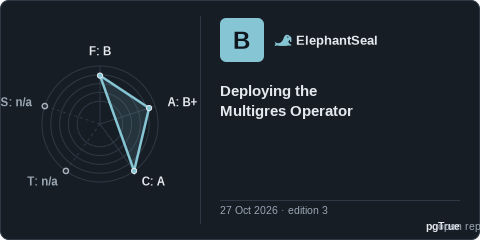
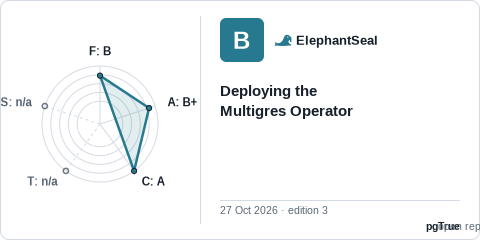
Factual B · Applicable B+ · Consistent A · Transparent — · Safe —

ReportTechnical fact-check, edition 3 Issued EditionUpdated after review. Corrections are listed below. SubmittedSubmitted by the PostgresAI team. Author responseNo written reply from the author. We re-audited this article 5 times; see Revisions below. Policy: right-of-reply and corrections policy. pgTrue versionaudited with v1.0.17 (approx.) · regraded with v1.1.0 (approx.)

Inaccuracies

F1

Primary-last maintenance does not guarantee uninterrupted writes

INACCURATEFactual · holds up after review

Claim ledger

Article says
…guarantees safe operations without interrupting writes on the primary.
What is true
Leader changes interrupt primary writes. go/services/multipooler/manager/rpc_consensus.go:239-250 specifies primary demotion and restart as a standby. The operator requests that transition during primary updates. Gateway buffering waits and retries eligible requests against the new primary.
So what
Plan for a write pause during primary maintenance or loss. Configure application transaction retries and suitable request timeouts.
Charitable reading
The gateway can buffer eligible requests during failover. Waiting and retrying do not preserve uninterrupted primary writes.

Source

Source · multigres@main@f247de0fe4 · go/services/multipooler/manager/rpc_consensus.go:286-294if err := pm.emergencyDemoteLocked(ctx, revokedBelowTerm, recruitDrainTimeout); err != nil {
In the article

In the article

Article · exact quote · open in article ↗ (opens in new tab)…guarantees safe operations without interrupting writes on the primary.
All sources and excerpts · 4
Evidence if err := pm.emergencyDemoteLocked(ctx, revokedBelowTerm, recruitDrainTimeout); err != nil {
Evidence// 2. Stop replication participation (primary: full demote + restart as standby; // standby: clear primary_conninfo + drain replay).
Evidence// the request waits before sending any query (avoids a wasted round-trip).
Evidence // If the only pod that needs updating is the PRIMARY, initiate a switchover. if waitPrimary != nil && waitPrimary.Annotations[metadata.AnnotationDrainState] == "" { if err := r.initiateDrain(ctx, waitPrimary); err != nil {
How the review tested this

Review: We tested whether gateway buffering preserves the guarantee. Demotion and restart interrupt primary writes even when eligible requests wait successfully. We tested whether gateway buffering preserves the guarantee. Buffering waits through primary replacement. Demotion and restart interrupt primary writes.

Dangerous or recipe bugsNone in this edition.

Misleading / imprecise

F10

Misleading: “…the other two keep operating without interruption.”

MISLEADINGApplicable · partly holds after review

Claim ledger

Article says
…the other two keep operating without interruption.
What is true
The gateway does not mask every query error during failover. pooler_gateway.go:64-71 classifies MTF01 and 25006 for buffering. Lines 172-177 return other execution errors. Proactive buffering also exists at lines 133-154. These paths support possible query interruptions, but do not establish mandatory client reconnection or measure zone-failure interruptions.
So what
Configure application reconnects and transaction retries before relying on the three-zone deployment for availability.

Source

Source · multigres@main@f247de0fe4 · go/services/multigateway/poolergateway/pooler_gateway.go:45-105func classifyError(err error, target *query.Target) errorAction { if target.PoolerType != clustermetadatapb.PoolerType_PRIMARY { return actionFail } if mterrors.IsErrorCode(err, mterrors.MTF01.ID, mterrors.PgSSReadOnlyTransaction) { return actionBuffer } return actionFail }
In the article

In the article

Article · exact quote · open in article ↗ (opens in new tab)…the other two keep operating without interruption.
All sources and excerpts · 2
Evidencefunc classifyError(err error, target *query.Target) errorAction { if target.PoolerType != clustermetadatapb.PoolerType_PRIMARY { return actionFail } if mterrors.IsErrorCode(err, mterrors.MTF01.ID, mterrors.PgSSReadOnlyTransaction) { return actionBuffer } return actionFail }
Evidence // Execute operation. err = inner(conn) if err != nil && classifyError(err, target) == actionBuffer { continue } return err
How the review tested this

Review: We tested whether surviving cells can continue operating while individual queries fail. E-33 includes proactive buffering. Other execution errors return to callers. These paths support a query-interruption caveat, but do not establish mandatory reconnection. Narrow the reader action to handling returned query errors and transaction retries.

F3

Kubernetes controls Multipooler as a separate sidecar

IMPRECISEApplicable · holds up after review

Claim ledger

Article says
…pgctld which owns the local Postgres process and Multipooler.
What is true
Kubernetes manages Multipooler as a native sidecar. pkg/resource-handler/controller/shard/containers.go:260-262 describes an init container with restartPolicy Always. Lines 303-308 construct its separate container specification. pgctld manages PostgreSQL.
So what
Inspect the Kubernetes multipooler container and its logs when diagnosing pooler lifecycle failures.
Charitable reading
pgctld manages the local PostgreSQL process. Multipooler shares its pod and must restart consistently with PostgreSQL.

Source

Source · multigres-operator@v0.10.3 · pkg/resource-handler/controller/shard/containers.go:260-262// buildMultiPoolerSidecar creates the multipooler sidecar container spec. // Implemented as native sidecar (init container with restartPolicy: Always) because // multipooler must restart with postgres to maintain connection pool consistency.
In the article · section “What the operator manages”

In the article

excerpt · section “What the operator manages” · as fetched 2026-10-21 · open in article ↗ (opens in new tab)

What the operator manages

Postgres pods themselves, managed by pgctld which owns the local Postgres process and Multipooler. One pooler per Postgres instance.

All sources and excerpts · 2
Evidence// buildMultiPoolerSidecar creates the multipooler sidecar container spec. // Implemented as native sidecar (init container with restartPolicy: Always) because // multipooler must restart with postgres to maintain connection pool consistency.
Evidence Name: "multipooler", Image: image, Args: args, Ports: buildMultiPoolerContainerPorts(), Resources: pool.Multipooler.Resources, RestartPolicy: &sidecarRestartPolicy,
How the review tested this

Review: We tested whether shared pod membership means pgctld owns Multipooler. Its separate container and restart policy support the lifecycle distinction. We considered shared-pod ownership. Kubernetes gives Multipooler a separate container and restart policy. The suggested container-log inspection addresses that distinction.

Verified accurate

F4

AT_LEAST_2 requires one synchronous standby acknowledgment

ACCURATEFactual · holds up after review · also flagged 1 more time

Claim ledger

Article says
…every committed write is acknowledged by one standby…
What is true
AT_LEAST_2 maps to AtLeastN(2). go/common/consensus/policy_at_least_n.go:115-116 subtracts the primary acknowledgment. The resulting configuration requires one standby and enables synchronous commit.
Charitable reading
The statement describes the default durability policy, without promising that acknowledgments cross cell boundaries.

Source

Source · multigres@main@f247de0fe4 · go/common/consensus/durability.go:30-35case "AT_LEAST_2": return topoclient.AtLeastN(2), nil
In the article

In the article

Article · exact quote · open in article ↗ (opens in new tab)…every committed write is acknowledged by one standby…
All sources and excerpts · 3
Evidence case "AT_LEAST_2": return topoclient.AtLeastN(2), nil
Evidence // num_sync = required_count - 1: the primary's own write counts as 1 ack. requiredNumSync := p.N - 1
Evidence SyncCommit: multipoolermanagerdatapb.SynchronousCommitLevel_SYNCHRONOUS_COMMIT_ON, SyncMethod: multipoolermanagerdatapb.SynchronousMethod_SYNCHRONOUS_METHOD_ANY, NumSync: requiredNumSync, SyncStandbyIDs: cohort,
How the review tested this

Review: We checked whether two acknowledgments meant two standbys. The policy subtracts the primary and configures one synchronous standby acknowledgment. We checked whether N counts standbys alone. The code subtracts the primary acknowledgment and enables synchronous commit.

F5

Bootstrap and failover share the leader-appointment workflow

ACCURATEFactual · holds up after review

Claim ledger

Article says
This is the same code path as every later failover…
What is true
coordinatorLedRuleChange serves bootstrap and normal failover in go/services/multiorch/consensus/rule_change.go:38-40. Initial cohort establishment also claims an exclusive initialization right before proceeding. Bootstrap-specific preparation does not contradict the shared election path.
Charitable reading
The shared path concerns consensus-backed leader appointment. Bootstrap still performs initialization-specific work.

Source

Source · multigres@main@f247de0fe4 · go/services/multiorch/consensus/rule_change.go:112-117for _, p := range cohort { go func() { recruited <- recruitResult{pooler: p, cs: r.recruit(ctx, p, revocation)} }() }
In the article

In the article

Article · exact quote · open in article ↗ (opens in new tab)This is the same code path as every later failover…
All sources and excerpts · 3
Evidence for _, p := range cohort { go func() { recruited <- recruitResult{pooler: p, cs: r.recruit(ctx, p, revocation)} }() }
Evidence// coordinatorLedRuleChange orchestrates the recruit → check → propose workflow // for a coordinator-initiated rule change. It is parameterized by action-specific // callbacks so the same workflow serves both normal failover and bootstrap.
Evidence // Claim the exclusive right to initialize this shard and persist the cohort. // On crash-retry the committed cohort is returned so we reuse the same members. won, committedIDs, err := a.topoStore.ClaimShardInitialization(ctx, problem.ShardKey, a.coordinator.GetCoordinatorID(), initializedIDs)
How the review tested this

Review: We tested whether bootstrap-specific initialization contradicts a shared election path. The finding correctly limits sameness to the parameterized workflow. We tested whether bootstrap-specific initialization contradicts the shared path. The finding correctly limits the shared workflow to leader appointment.

F6

Normal scale-down removes the standby before pod deletion

ACCURATEFactual · holds up after review

Claim ledger

Article says
…drains standbys out of the replication set before terminating their pods.
What is true
The operator sends STANDBY_UPDATE_OPERATION_REMOVE before advancing the drain state. pkg/data-handler/drain/drain.go:165-170 performs that request. The state machine later marks the pod ReadyForDeletion at line 250.
Charitable reading
The statement describes normal replica scale-down with a reachable, healthy primary.

Source

Source · multigres-operator@v0.10.3 · pkg/data-handler/drain/drain.go:165-170req := &multipoolermanagerdatapb.UpdateSynchronousStandbyListRequest{ Operation: multipoolermanagerdatapb.StandbyUpdateOperation_STANDBY_UPDATE_OPERATION_REMOVE, StandbyIds: []*clustermetadatapb.ID{myPooler.Id}, ReloadConfig: true, } _, rpcErr := rpcClient.UpdateSynchronousStandbyList(ctx, primary, req)
In the article · section “Scaling Replicas”

In the article

excerpt · section “Scaling Replicas” · as fetched 2026-10-21 · open in article ↗ (opens in new tab)

Scaling Replicas

The operator provisions new standby pods across all three zones simultaneously. Scale back down by patching the value to 1 . The operator drains standbys out of the replication set before terminating their pods.

All sources and excerpts · 2
Evidence req := &multipoolermanagerdatapb.UpdateSynchronousStandbyListRequest{ Operation: multipoolermanagerdatapb.StandbyUpdateOperation_STANDBY_UPDATE_OPERATION_REMOVE, StandbyIds: []*clustermetadatapb.ID{myPooler.Id}, ReloadConfig: true, } _, rpcErr := rpcClient.UpdateSynchronousStandbyList(ctx, primary, req)
Evidence return UpdateDrainState(ctx, k8sClient, pod, metadata.DrainStateReadyForDeletion)
How the review tested this

Review: We tested whether the finding promises successful draining in every failure case. It explicitly limits the claim to normal scale-down. We checked timeout and failed-primary exceptions. The finding explicitly covers normal scale-down, where standby removal precedes deletion readiness.

F7

The gateway communicates with poolers over gRPC

ACCURATEFactual · holds up after review

Claim ledger

Article says
…which forwards queries to the right Multipooler over gRPC.
What is true
The gateway creates its pooler connection with grpccommon.NewClient in go/services/multigateway/poolergateway/pooler_connection.go:171-175. The same function constructs the QueryService wrapper.
Charitable reading
The statement describes the gateway-to-pooler transport, rather than the application-facing PostgreSQL connection.

Source

Source · multigres@main@f247de0fe4 · go/services/multigateway/poolergateway/pooler_connection.go:165-185// Create gRPC connection with telemetry attributes conn, err := grpccommon.NewClient(addr, grpccommon.WithAttributes(rpcclient.PoolerSpanAttributes(pooler.Id)...), grpccommon.WithDialOptions(grpcDialOpt), )
In the article · section “What the operator manages”

In the article

excerpt · section “What the operator manages” · as fetched 2026-10-21 · open in article ↗ (opens in new tab)

What the operator manages

Multigateway speaks the Postgres wire protocol. Your application connects to a gateway, which forwards queries to the right Multipooler over gRPC. Adding more gateways scales Multigres’ connection capacity horizontally.

All sources and excerpts · 1
Evidence // Create gRPC connection with telemetry attributes conn, err := grpccommon.NewClient(addr, grpccommon.WithAttributes(rpcclient.PoolerSpanAttributes(pooler.Id)...), grpccommon.WithDialOptions(grpcDialOpt), )
How the review tested this

Review: We checked for confusion between application and pooler transport. The cited pooler connection explicitly creates a gRPC client. We checked whether gRPC appears only in commentary. The function constructs a gRPC client and QueryService wrapper.

F8

The example URI matches the generated gateway endpoint

ACCURATEFactual · holds up after review

Claim ledger

Article says
…postgresql://postgres:<password>@demo-multi-az-multigateway:5432/postgres…
What is true
The operator names the service <cluster>-multigateway and exposes TCP port 5432. pkg/cluster-handler/controller/multigrescluster/builders_global.go:430-467 constructs it. The linked EKS guide connects as postgres to the postgres database.
Charitable reading
The URI assumes the application uses the cluster's namespace and supplies the configured PostgreSQL password.

Source

Source · multigres-operator@v0.10.3 · pkg/cluster-handler/controller/multigrescluster/builders_global.go:430-467Name: fmt.Sprintf("%s-multigateway", cluster.Name),
In the article · section “Connecting”

In the article

excerpt · section “Connecting” · as fetched 2026-10-21 · open in article ↗ (opens in new tab)

Connecting

postgresql://postgres:<password>@demo-multi-az-multigateway:5432/postgres

All sources and excerpts · 3
Evidence Name: fmt.Sprintf("%s-multigateway", cluster.Name),
Evidence Name: "postgres", Port: 5432, TargetPort: intstr.FromString("postgres"),
Evidenceresult | current_database | current_user --------+------------------+-------------- 1 | postgres | postgres
How the review tested this

Review: We checked service naming, port, credentials, and namespace assumptions. The finding records the namespace caveat. E-29 matches the linked guide exactly. We checked service naming, port 5432, and the linked guide's credentials. Namespace and configured-password assumptions already appear in the finding.

F9

PRIMARY routing selects the observed leader's pooler

ACCURATEFactual · holds up after review

Claim ledger

Article says
The gateway routes writes to the primary's pooler…
What is true
PRIMARY targets use the observed leader ID to select a pooler connection. go/services/multigateway/poolergateway/load_balancer.go:235-272 implements that selection. Missing leader observations or connections return UNAVAILABLE.
Charitable reading
The statement describes normal PRIMARY routing after the gateway discovers a leader.

Source

Source · multigres@main@f247de0fe4 · go/services/multigateway/poolergateway/load_balancer.go:235-272leaderID := poolerIDString(leaderObs.LeaderId) conn, ok := lb.connections[leaderID]
In the article

In the article

Article · exact quote · open in article ↗ (opens in new tab)The gateway routes writes to the primary's pooler…
All sources and excerpts · 1
Evidence leaderID := poolerIDString(leaderObs.LeaderId) conn, ok := lb.connections[leaderID]
How the review tested this

Review: We tested whether leader selection proves uninterrupted availability. The finding instead limits itself to observed-leader routing and acknowledges unavailable connections. We checked missing-leader behavior. PRIMARY selection uses the observed leader's connection and returns UNAVAILABLE when necessary.

F11

Multigateway accepts PostgreSQL protocol connections

ACCURATEFactual · holds up after review

Claim ledger

Article says
Multigateway speaks the Postgres wire protocol.
What is true
Multigateway creates a PostgreSQL protocol listener in go/services/multigateway/init.go:509. The listener accepts PostgreSQL client connections.
Charitable reading
The statement concerns the client protocol, not complete PostgreSQL feature compatibility.

Source

Source · multigres@main@f247de0fe4 · go/services/multigateway/init.go:490-550mg.pgListener, err = server.NewListener(server.ListenerConfig{ Address: pgAddr, Handler: mg.pgHandler,
In the article · section “What the operator manages”

In the article

excerpt · section “What the operator manages” · as fetched 2026-10-21 · open in article ↗ (opens in new tab)

What the operator manages

Multigateway speaks the Postgres wire protocol. Your application connects to a gateway, which forwards queries to the right Multipooler over gRPC. Adding more gateways scales Multigres’ connection capacity horizontally.

All sources and excerpts · 2
Evidence mg.pgListener, err = server.NewListener(server.ListenerConfig{ Address: pgAddr, Handler: mg.pgHandler,
Evidence// Listener listens for incoming PostgreSQL client connections. type Listener struct { // listener is the network listener. listener net.Listener
How the review tested this

Review: We tested whether protocol acceptance implies full PostgreSQL compatibility. The finding makes only the narrower listener claim. We checked whether the finding confuses wire-protocol support with feature compatibility. It claims only PostgreSQL client connections.

F12

Multiorch checks replication health

ACCURATEFactual · holds up after review

Claim ledger

Article says
It watches replication health…
What is true
Multiorch checks WAL receipt and WAL receiver streaming state in go/services/multiorch/recovery/analysis/generator.go:384.
Charitable reading
Replication health means checking replication state, not guaranteeing zero replication lag.

Source

Source · multigres@main@f247de0fe4 · go/services/multiorch/recovery/analysis/generator.go:350-400// Replica must have received WAL (indicates connection was established) if rs.LastReceiveLsn == "" { return false } // WAL receiver must be in streaming state if rs.WalReceiverStatus != "streaming" { return false }
In the article

In the article

Article · exact quote · open in article ↗ (opens in new tab)It watches replication health…
All sources and excerpts · 1
Evidence // Replica must have received WAL (indicates connection was established) if rs.LastReceiveLsn == "" { return false } // WAL receiver must be in streaming state if rs.WalReceiverStatus != "streaming" { return false }
How the review tested this

Review: We checked whether replication health meant zero lag. The finding only asserts checks for received WAL and streaming state. We checked executable health conditions. The function tests WAL receipt and streaming state without promising zero replication lag.

F13

Multiorch orchestrates primary replacement

ACCURATEFactual · holds up after review

Claim ledger

Article says
…runs failovers…
What is true
Multiorch invokes consensus leader appointment from go/services/multiorch/recovery/actions/appoint_leader.go:118.
Charitable reading
Running failovers means orchestrating primary replacement through the consensus coordinator.

Source

Source · multigres@main@f247de0fe4 · go/services/multiorch/recovery/actions/appoint_leader.go:37-125// Use the coordinator's AppointLeader to handle the election. // Use the problem code as the reason for the election. reason := string(problem.Code) if err := a.consensus.AppointLeader(ctx, problem.ShardKey, cohort, reason); err != nil { return mterrors.Wrap(err, "failed to appoint leader") }
In the article

In the article

Article · exact quote · open in article ↗ (opens in new tab)…runs failovers…
All sources and excerpts · 1
Evidence // Use the coordinator's AppointLeader to handle the election. // Use the problem code as the reason for the election. reason := string(problem.Code) if err := a.consensus.AppointLeader(ctx, problem.ShardKey, cohort, reason); err != nil { return mterrors.Wrap(err, "failed to appoint leader") }
How the review tested this

Review: We tested whether invoking an election guarantees successful failover. The finding only asserts orchestration through AppointLeader. We checked whether leader appointment appears only in comments. The recovery action calls consensus.AppointLeader.

F14

Replica reads require an optional replica endpoint

ACCURATEFactual · holds up after review

Claim ledger

Article says
…if the application opts in, routes reads to replicas.
What is true
Multigateway creates an optional replica listener in go/services/multigateway/init.go:526. Its handler selects replica targets.
Charitable reading
The application opts in through a separate replica connection endpoint.

Source

Source · multigres@main@f247de0fe4 · go/services/multigateway/init.go:490-550if replicaPort := mg.pgReplicaPort.Get(); replicaPort > 0 { replicaHandler := handler.NewMultiGatewayHandler(mg.executor, logger, mg.statementTimeout.Get()) replicaHandler.SetTargetReplica(true)
In the article

In the article

Article · exact quote · open in article ↗ (opens in new tab)…if the application opts in, routes reads to replicas.
All sources and excerpts · 1
Evidence if replicaPort := mg.pgReplicaPort.Get(); replicaPort > 0 { replicaHandler := handler.NewMultiGatewayHandler(mg.executor, logger, mg.statementTimeout.Get()) replicaHandler.SetTargetReplica(true)
How the review tested this

Review: We checked whether replica routing happens automatically on the default endpoint. The finding correctly identifies the optional replica listener. We checked whether replica routing requires configuration. A positive replica port creates a separate handler with replica targets enabled.

F15

Each Postgres pool pod has one Multipooler

ACCURATEFactual · holds up after review

Claim ledger

Article says
One pooler per Postgres instance.
What is true
Each pool pod has one Multipooler sidecar and one pgctld container. The constructor confirms the pairing in pkg/resource-handler/controller/shard/pool_pod.go:94.
Charitable reading
The statement describes pool pods created by the operator.

Source

Source · multigres-operator@v0.10.3 · pkg/resource-handler/controller/shard/pool_pod.go:94-99InitContainers: []corev1.Container{ buildMultiPoolerSidecar(shard, poolSpec, poolName, cellName, serviceID), }, Containers: []corev1.Container{ buildPgctldContainer(shard, poolSpec), },
In the article · section “What the operator manages”

In the article

excerpt · section “What the operator manages” · as fetched 2026-10-21 · open in article ↗ (opens in new tab)

What the operator manages

Postgres pods themselves, managed by pgctld which owns the local Postgres process and Multipooler. One pooler per Postgres instance.

All sources and excerpts · 1
Evidence InitContainers: []corev1.Container{ buildMultiPoolerSidecar(shard, poolSpec, poolName, cellName, serviceID), }, Containers: []corev1.Container{ buildPgctldContainer(shard, poolSpec), },
How the review tested this

Review: We checked whether the constructor permits multiple poolers in this pod specification. It lists one Multipooler and one pgctld container. We counted the constructor's containers. Each pool pod contains one Multipooler sidecar and one pgctld container.

F17

The scaling patch adds three pool pods

ACCURATEFactual · holds up after review

Claim ledger

Article says
To add a replica per cell:…
What is true
Setting replicasPerCell to 2 requests six pool pods across three cells (derived: 3×2). The original value requests three pods. api/v1alpha1/shard_types.go:77 defines the per-cell count. Restoring 1 requests three pods again.
Charitable reading
The patch changes replicasPerCell from the example's initial value of 1 to 2.

Source

Source · multigres-operator@v0.10.3 · api/v1alpha1/shard_types.go:77-78// ReplicasPerCell is the desired number of Postgres data pods PER CELL in this pool. // Sidecars (like Multipooler) will scale alongside the Postgres pods.
In the article

In the article

Article · exact quote · open in article ↗ (opens in new tab)To add a replica per cell:…
All sources and excerpts · 2
Evidence // ReplicasPerCell is the desired number of Postgres data pods PER CELL in this pool. // Sidecars (like Multipooler) will scale alongside the Postgres pods.
Evidence replicas := DefaultPoolReplicas if poolSpec.ReplicasPerCell != nil { replicas = *poolSpec.ReplicasPerCell }
How the review tested this

Review: We checked whether replicasPerCell excludes the primary. It counts data pods. Three cells increase from three requested pods to six. We checked whether replicasPerCell excludes the primary. It counts data pods. Three cells increase from three pods to six.

Notes

1 not graded: findings no reader would act on differently
F2

Note: “…always acts on standbys first and the primary last…”

NOTEpartly holds after review

Claim ledger

Article says
…always acts on standbys first and the primary last…
What is true
v0.10.3 passes a cell name into reconcilePoolPods and constructs cell-specific selectors. The recorded excerpts establish local selection scope. They do not establish complete cross-cell update sequencing or an outage. Concurrent cohort recruitment describes consensus work, not pod restart ordering.
So what
Do not approve multi-cell maintenance based on a shard-wide primary-last guarantee. Validate cross-cell update sequencing and remaining standby availability.

Source

Source · multigres-operator@v0.10.3 · pkg/resource-handler/controller/shard/reconcile_pool_pods.go:582-584// If the only pod that needs updating is the PRIMARY, initiate a switchover. if waitPrimary != nil && waitPrimary.Annotations[metadata.AnnotationDrainState] == "" { if err := r.initiateDrain(ctx, waitPrimary); err != nil {

Not graded: no reader would act differently on it.

In the article

In the article

Article · exact quote · open in article ↗ (opens in new tab)…always acts on standbys first and the primary last…
All sources and excerpts · 4
Evidence // If the only pod that needs updating is the PRIMARY, initiate a switchover. if waitPrimary != nil && waitPrimary.Annotations[metadata.AnnotationDrainState] == "" { if err := r.initiateDrain(ctx, waitPrimary); err != nil {
Evidence for _, cell := range poolSpec.Cells { cellName := string(cell) // Reconcile pool Pods and PVCs for this cell if err := r.reconcilePoolPods(ctx, shard, poolName, cellName, poolSpec); err != nil {
Evidence labels := buildPoolLabelsWithCell(shard, poolName, cellName) selector := metadata.GetSelectorLabels(labels)
Evidence for _, p := range cohort { go func() { recruited <- recruitResult{pooler: p, cs: r.recruit(ctx, p, revocation)} }() }
How the review tested this

Review: We tested whether local selection proves unsafe cross-cell sequencing. The excerpts omit broader coordination and do not establish an outage. Concurrent recruitment also does not establish pod restart order. We checked for shard-wide sequencing. The code establishes per-cell candidate selection and concurrent recruitment. These excerpts do not establish the assigned outage consequence.

More in this report

Section checks · 4 sections

Section checks

AspectGradeFindingsCoverage
Managed componentsB1 inaccuracy · 1 imprecise · 5 verified-accurate100% of claims (17 of 17, plus 2 that need data we do not have)
EKS deploymentB+1 misleading · 1 verified-accurate100% of claims (2 of 2, plus 1 that need data we do not have)
Replica scalingA2 verified-accurate100% of claims (2 of 2)
ConnectionsA4 verified-accurate100% of claims (3 of 3)
Coverage and assessment · Checked 24 of 24 Postgres claims across 7 sections

B — the findings address the article's main subject. What we did not check is listed below. The findings directly check operator maintenance, durability, bootstrap, replica scaling, and gateway routing for the three-cell deployment.

We did not check everything in this article. What we did not check is listed below, in the words we recorded at the time. None of it moved the letter. We never charge our own limits to the article.

What we did not check

  • We did not reproduce the one-minute deployment time or measure interruptions during zone failures.
  • We did not verify that an isolated cell can continue serving the article's workload.
  • We did not establish cluster-wide ordering for rolling updates, scaling, or failover.
  • We did not verify isolated-cell query availability or actual EKS zone-failure isolation.
  • We did not verify connection-capacity scaling or new-standby initialization.
  • We did not inspect the linked demo manifest or demo video.
  • We did not verify release changes after May 29, 2026.
  • We did not inspect the demonstration video or compare output identities because the article text contains no output rows.
  • Section “Connections”: our checked-claim count (4) exceeds our extracted total (3); the count needs review.
  • We could not decide whether the article depends on finding F1.
Checked 24 of 24 Postgres claims across 7 sections
  • Introduction: no checkable claims; not counted: 11 product or opinion, 1 duplicate, 3 not a claim
  • Operator: no checkable claims; not counted: 5 product or opinion, 1 not a claim
  • Managed components: 17 of 17 Postgres claims checked, plus 2 that need data we do not have; not counted: 19 product or opinion, 1 not a claim
  • EKS deployment: 2 of 2 Postgres claims checked, plus 1 that need data we do not have; not counted: 15 product or opinion, 4 duplicate, 1 not a claim
  • Verification: no checkable claims; not counted: 3 product or opinion, 1 not a claim
  • Replica scaling: 2 of 2 Postgres claims checked; not counted: 6 product or opinion, 1 not a claim; not checked: 1 for other reasons
  • Connections: 3 of 3 Postgres claims checked; not counted: 2 duplicate, 1 not a claim

Average of 3 axes: 3.43 · one load-bearing error · result B

Some explanatory text is not shown in this edition; the grade and findings are complete.

Scorecard · the five axes
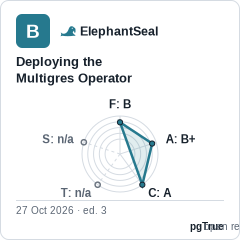
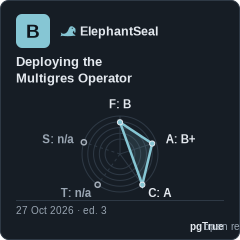
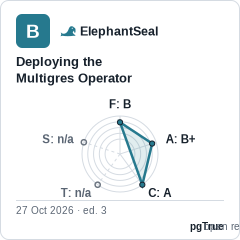
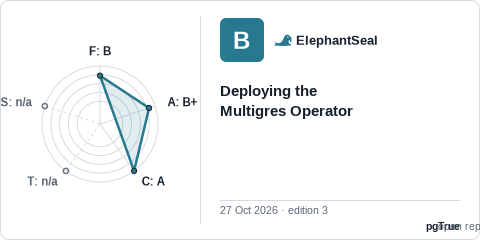
FACTS scorecard Scorecard radar, 5 axes, bigger is better. Overall B. Factual B · 1 wrong of 15 checked · 0 caveats. Applicable B+ · 1 wrong of 6 checked · 1 caveat. Consistent A · 0 wrong of 15 checked · 0 caveats. Transparent 1 checked, too few for a letter. Safe not applicable (n/a). B 1 wrong of 15 checked · 0 caveatsFactual B1 wrong of 150 caveats B+ 1 wrong of 6 checked · 1 caveatApplicable B+1 wrong of 61 caveat A 0 wrong of 15 checked · 0 caveatsConsistent A0 wrong of 150 caveats 1 checked, too few for a letterTransparent n/a0 wrong of 10 caveats not applicable (n/a), 4 commands scanned none riskySafe n/a4 commands scannednone risky

By topic: Managed components — 7 findings, 1 wrong · EKS deployment — 2 findings, 1 wrong · Replica scaling — 2 findings, 0 wrong · Connections — 4 findings, 0 wrong

Further out is better. Each axis has its own letter, from the wrong claims and caveats among the claims we checked of that kind.

Checked on the FACTS: Factual, Applicable, Consistent, Transparent, Safe. Clockwise: Factual (is it true?), Applicable (does it apply to my setup, today?), Consistent (does it agree with itself?), Transparent (can I check it myself?), Safe (can I run this on prod?).

We checked 15 claims, 4 commands scanned.

AxisLetterWrongCaveatsCheckedCoverage
FactualB1015assessed: B · 1 wrong of 15 checked · 0 caveats
ApplicableB+116assessed: B+ · 1 wrong of 6 checked · 1 caveat
ConsistentA0015assessed: A · 0 wrong of 15 checked · 0 caveats
Transparent—001assessed: 0 wrong · 0 caveats · 1 checked
Safe—000assessed
Topics · 4 topics

Topics

TopicFactualApplicableConsistentTransparentSafe
Managed components1 issue 7 checked F1 F5 F7 F12 F13 F151 issue 1 checked F30 issues 7 checked
EKS deployment0 issues 2 checked F41 issue 2 checked F100 issues 2 checked
Replica scaling0 issues 2 checked F6 F170 issues 1 checked0 issues 2 checked
Connections0 issues 4 checked F8 F9 F11 F140 issues 2 checked0 issues 4 checked0 issues 1 checked

Issues found among the claims checked, per topic and axis. Each link goes to the finding behind the count.

Revisions: 6 · Not assessed -> Not assessed -> Not assessed -> A- -> B- -> B

We audited this article 6 times. Each row is the final edition of one audit. Letters and findings of earlier revisions stay readable at their own address.

  1. Revision 1 · Not assessed · audit version not recorded

    Details unavailable.

    ElephantSeal: Not assessed.

  2. Revision 2 · Not assessed · audit version not recorded

    Details unavailable.

    ElephantSeal: Not assessed.

  3. Revision 3 · Not assessed · audit version not recorded

    Details unavailable.

    ElephantSeal: Not assessed.

  4. Revision 4 · 2026-10-01 05:58 UTC · A- · audit version not recorded · regrade version not recorded

    Same article text, re-audited. 6 accurate · 2 wrong · 0 caveats.

    ElephantSeal: A-.

    Changes: Details unavailable.

  5. Revision 5 · 2026-10-19 21:22 UTC · B- · audited with v1.0.16 (approx.)

    Same article text, re-audited. 13 accurate · 3 wrong · 0 caveats.

    ElephantSeal: B-.

    Changes: No longer reported: “Primary-last updates do not guarantee uninterrupted writes”. New: F1 “Primary-last maintenance does not guarantee uninterrupted writes” (false); F3 “pgctld manages PostgreSQL, while Kubernetes manages the Multipooler sidecar” (misleading).

  6. Revision 6 · this page · 2026-10-21 05:22 UTC · B · audited with v1.0.17 (approx.) · regraded with v1.1.0 (approx.)

    Same article text, re-audited. 12 accurate · 2 wrong · 1 caveat.

    ElephantSeal: B.

    Changes: No longer reported: “v0.10.3 does not deploy independent per-cell topology servers”; “pgctld manages PostgreSQL, while Kubernetes manages the Multipooler sidecar”. New: F10 “…the other two keep operating without interruption.” (misleading); F3 “Kubernetes controls Multipooler as a separate sidecar” (mostly accurate).

Questions and answers

Questions and answers

What is pgTrue?

pgTrue is an independent fact-check of technical Postgres articles, made by PostgresAI. It helps you check advice before you use it.

What does the letter grade mean?

The letter grade summarizes the claims we checked. Five axes show what we checked:

  • Factual: is it true?
  • Applicable: does it apply to my setup, today?
  • Consistent: does it agree with itself?
  • Transparent: can I check it myself?
  • Safe: can I run this in production?

What is the ElephantSeal?

The ElephantSeal is the mark an article earns. It always shows the latest edition. “Open:” lists what is still open.

Can an author reply?

Authors can ask us to correct a finding, reply to it, or withdraw it. Right-of-reply policy.

Paste into your AI assistant to fix the article, then ask for a re-review.

Show the text
Fix the article with this report, then ask pgTrue for a re-review.

# pgTrue report: Deploying the Multigres Operator

Article title: Deploying the Multigres Operator
Article URL: https://multigres.com/blog/deploying-the-multigres-operator
Report URL: https://pgtrue.postgres.ai/shared/brief/db9af505-830b-41da-b083-dcba80fc009c
Audited revision: 6 of 6, 2026-10-21 05:22:04 UTC
Overall letter: B

## Axes

- Factual: B · 1 wrong · 15 checked · 0 caveats · assessed
- Applicable: B+ · 1 wrong · 6 checked · 1 caveats · assessed
- Consistent: A · 0 wrong · 15 checked · 0 caveats · assessed
- Transparent: — · 0 wrong · 1 checked · 0 caveats · assessed
- Safe: — · 0 wrong · 0 checked · 0 caveats · assessed

ElephantSeal: B.

## Report metadata

- Report: Technical fact-check, edition 3
- Issued: 2026-10-21
- Edition: Updated after review. Corrections are listed below.
- Submitted: Submitted by the PostgresAI team.
- Author response: No written reply from the author. We re-audited this article 5 times; see Revisions below. Policy: [right-of-reply and corrections policy](/pgtrue/security).
- pgTrue version: audited with v1.0.17 (approx.) · regraded with v1.1.0 (approx.)

## Findings needing a change (3)

### F1 · Inaccurate · Factual · Primary-last maintenance does not guarantee uninterrupted writes
Location: Article · exact quote · [open in article](https://multigres.com/blog/deploying-the-multigres-operator#:~:text=guarantees%20safe%20operations%20without%20interrupting%20writes%20on%20the%20primary.)
Article says:
```text
…guarantees safe operations without interrupting writes on the primary.
```
What is true:
Leader changes interrupt primary writes. go/services/multipooler/manager/rpc_consensus.go:239-250 specifies primary demotion and restart as a standby. The operator requests that transition during primary updates. Gateway buffering waits and retries eligible requests against the new primary.
So what:
Plan for a write pause during primary maintenance or loss. Configure application transaction retries and suitable request timeouts.
Charitable reading:
The gateway can buffer eligible requests during failover. Waiting and retrying do not preserve uninterrupted primary writes.
Review: We tested whether gateway buffering preserves the guarantee. Demotion and restart interrupt primary writes even when eligible requests wait successfully. We tested whether gateway buffering preserves the guarantee. Buffering waits through primary replacement. Demotion and restart interrupt primary writes.

Sources:
- [multigres@main@f247de0fe4 · go/services/multipooler/manager/rpc_consensus.go:286-294](https://github.com/multigres/multigres/blob/f247de0fe41d49332ab787eb0a600c5ac5eb0964/go/services/multipooler/manager/rpc_consensus.go#L286-L294)
  Excerpt:
  ```text
  if err := pm.emergencyDemoteLocked(ctx, revokedBelowTerm, recruitDrainTimeout); err != nil {
  ```
- [multigres@main@f247de0fe4 · go/services/multipooler/manager/rpc_consensus.go:239-250](https://github.com/multigres/multigres/blob/f247de0fe41d49332ab787eb0a600c5ac5eb0964/go/services/multipooler/manager/rpc_consensus.go#L239-L250)
  Excerpt:
  ```text
  //  2. Stop replication participation (primary: full demote + restart as standby;
//     standby: clear primary_conninfo + drain replay).
  ```
- [multigres@main@f247de0fe4 · go/services/multigateway/poolergateway/pooler_gateway.go:99-108](https://github.com/multigres/multigres/blob/f247de0fe41d49332ab787eb0a600c5ac5eb0964/go/services/multigateway/poolergateway/pooler_gateway.go#L99-L108)
  Excerpt:
  ```text
  //     the request waits before sending any query (avoids a wasted round-trip).
  ```
- [[email protected] · pkg/resource-handler/controller/shard/reconcile_pool_pods.go:582-584](https://github.com/multigres/multigres-operator/blob/e66b2e6c3457469129c2840c14dab19a8a97645c/pkg/resource-handler/controller/shard/reconcile_pool_pods.go#L582-L584)
  Excerpt:
  ```text
  // If the only pod that needs updating is the PRIMARY, initiate a switchover.
	if waitPrimary != nil && waitPrimary.Annotations[metadata.AnnotationDrainState] == "" {
		if err := r.initiateDrain(ctx, waitPrimary); err != nil {
  ```

Finding URL: https://pgtrue.postgres.ai/shared/brief/db9af505-830b-41da-b083-dcba80fc009c#F1

### F10 · Misleading · Applicable · Misleading: “…the other two keep operating without interruption.”
Location: Article · exact quote · [open in article](https://multigres.com/blog/deploying-the-multigres-operator#:~:text=the%20other%20two%20keep%20operating%20without%20interruption.)
Article says:
```text
…the other two keep operating without interruption.
```
What is true:
The gateway does not mask every query error during failover. pooler_gateway.go:64-71 classifies MTF01 and 25006 for buffering. Lines 172-177 return other execution errors. Proactive buffering also exists at lines 133-154. These paths support possible query interruptions, but do not establish mandatory client reconnection or measure zone-failure interruptions.
So what:
Configure application reconnects and transaction retries before relying on the three-zone deployment for availability.
Review: We tested whether surviving cells can continue operating while individual queries fail. E-33 includes proactive buffering. Other execution errors return to callers. These paths support a query-interruption caveat, but do not establish mandatory reconnection. Narrow the reader action to handling returned query errors and transaction retries.

Sources:
- [multigres@main@f247de0fe4 · go/services/multigateway/poolergateway/pooler_gateway.go:45-105](https://github.com/multigres/multigres/blob/f247de0fe41d49332ab787eb0a600c5ac5eb0964/go/services/multigateway/poolergateway/pooler_gateway.go#L45-L105)
  Excerpt:
  ```text
  func classifyError(err error, target *query.Target) errorAction {
	if target.PoolerType != clustermetadatapb.PoolerType_PRIMARY {
		return actionFail
	}
	if mterrors.IsErrorCode(err, mterrors.MTF01.ID, mterrors.PgSSReadOnlyTransaction) {
		return actionBuffer
	}
	return actionFail
}
  ```
- [multigres@main@f247de0fe4 · go/services/multigateway/poolergateway/pooler_gateway.go:110-192](https://github.com/multigres/multigres/blob/f247de0fe41d49332ab787eb0a600c5ac5eb0964/go/services/multigateway/poolergateway/pooler_gateway.go#L110-L192)
  Excerpt:
  ```text
  // Execute operation.
		err = inner(conn)
		if err != nil && classifyError(err, target) == actionBuffer {
			continue
		}
		return err
  ```

Finding URL: https://pgtrue.postgres.ai/shared/brief/db9af505-830b-41da-b083-dcba80fc009c#F10

### F3 · Imprecise · Applicable · Kubernetes controls Multipooler as a separate sidecar
Location: excerpt · section “What the operator manages” · as fetched 2026-10-21 · [open in article](https://multigres.com/blog/deploying-the-multigres-operator#:~:text=pgctld%20which%20owns%20the%20local%20Postgres%20process%20and%20Multipooler.)
Article says:
```text
…pgctld which owns the local Postgres process and Multipooler.
```
What is true:
Kubernetes manages Multipooler as a native sidecar. pkg/resource-handler/controller/shard/containers.go:260-262 describes an init container with restartPolicy Always. Lines 303-308 construct its separate container specification. pgctld manages PostgreSQL.
So what:
Inspect the Kubernetes multipooler container and its logs when diagnosing pooler lifecycle failures.
Charitable reading:
pgctld manages the local PostgreSQL process. Multipooler shares its pod and must restart consistently with PostgreSQL.
Review: We tested whether shared pod membership means pgctld owns Multipooler. Its separate container and restart policy support the lifecycle distinction. We considered shared-pod ownership. Kubernetes gives Multipooler a separate container and restart policy. The suggested container-log inspection addresses that distinction.

Sources:
- [[email protected] · pkg/resource-handler/controller/shard/containers.go:260-262](https://github.com/multigres/multigres-operator/blob/e66b2e6c3457469129c2840c14dab19a8a97645c/pkg/resource-handler/controller/shard/containers.go#L260-L262)
  Excerpt:
  ```text
  // buildMultiPoolerSidecar creates the multipooler sidecar container spec.
// Implemented as native sidecar (init container with restartPolicy: Always) because
// multipooler must restart with postgres to maintain connection pool consistency.
  ```
- [[email protected] · pkg/resource-handler/controller/shard/containers.go:302-309](https://github.com/multigres/multigres-operator/blob/e66b2e6c3457469129c2840c14dab19a8a97645c/pkg/resource-handler/controller/shard/containers.go#L302-L309)
  Excerpt:
  ```text
  Name:            "multipooler",
		Image:           image,
		Args:            args,
		Ports:           buildMultiPoolerContainerPorts(),
		Resources:       pool.Multipooler.Resources,
		RestartPolicy:   &sidecarRestartPolicy,
  ```

Finding URL: https://pgtrue.postgres.ai/shared/brief/db9af505-830b-41da-b083-dcba80fc009c#F3

## Verified accurate claims (12)

### F4 · Accurate · Factual · AT_LEAST_2 requires one synchronous standby acknowledgment
Location: Article · exact quote · [open in article](https://multigres.com/blog/deploying-the-multigres-operator#:~:text=every%20committed%20write%20is%20acknowledged%20by%20one%20standby)
Article says:
```text
…every committed write is acknowledged by one standby…
```
What is true:
AT_LEAST_2 maps to AtLeastN(2). go/common/consensus/policy_at_least_n.go:115-116 subtracts the primary acknowledgment. The resulting configuration requires one standby and enables synchronous commit.
Charitable reading:
The statement describes the default durability policy, without promising that acknowledgments cross cell boundaries.
Review: We checked whether two acknowledgments meant two standbys. The policy subtracts the primary and configures one synchronous standby acknowledgment. We checked whether N counts standbys alone. The code subtracts the primary acknowledgment and enables synchronous commit.

Sources:
- [multigres@main@f247de0fe4 · go/common/consensus/durability.go:30-35](https://github.com/multigres/multigres/blob/f247de0fe41d49332ab787eb0a600c5ac5eb0964/go/common/consensus/durability.go#L30-L35)
  Excerpt:
  ```text
  case "AT_LEAST_2":
		return topoclient.AtLeastN(2), nil
  ```
- [multigres@main@f247de0fe4 · go/common/consensus/policy_at_least_n.go:112-135](https://github.com/multigres/multigres/blob/f247de0fe41d49332ab787eb0a600c5ac5eb0964/go/common/consensus/policy_at_least_n.go#L112-L135)
  Excerpt:
  ```text
  // num_sync = required_count - 1: the primary's own write counts as 1 ack.
	requiredNumSync := p.N - 1
  ```
- [multigres@main@f247de0fe4 · go/common/consensus/policy_at_least_n.go:112-135](https://github.com/multigres/multigres/blob/f247de0fe41d49332ab787eb0a600c5ac5eb0964/go/common/consensus/policy_at_least_n.go#L112-L135)
  Excerpt:
  ```text
  SyncCommit:     multipoolermanagerdatapb.SynchronousCommitLevel_SYNCHRONOUS_COMMIT_ON,
		SyncMethod:     multipoolermanagerdatapb.SynchronousMethod_SYNCHRONOUS_METHOD_ANY,
		NumSync:        requiredNumSync,
		SyncStandbyIDs: cohort,
  ```

Finding URL: https://pgtrue.postgres.ai/shared/brief/db9af505-830b-41da-b083-dcba80fc009c#F4

### F5 · Accurate · Factual · Bootstrap and failover share the leader-appointment workflow
Location: Article · exact quote · [open in article](https://multigres.com/blog/deploying-the-multigres-operator#:~:text=This%20is%20the%20same%20code%20path%20as%20every%20later%20failover)
Article says:
```text
This is the same code path as every later failover…
```
What is true:
coordinatorLedRuleChange serves bootstrap and normal failover in go/services/multiorch/consensus/rule_change.go:38-40. Initial cohort establishment also claims an exclusive initialization right before proceeding. Bootstrap-specific preparation does not contradict the shared election path.
Charitable reading:
The shared path concerns consensus-backed leader appointment. Bootstrap still performs initialization-specific work.
Review: We tested whether bootstrap-specific initialization contradicts a shared election path. The finding correctly limits sameness to the parameterized workflow. We tested whether bootstrap-specific initialization contradicts the shared path. The finding correctly limits the shared workflow to leader appointment.

Sources:
- [multigres@main@f247de0fe4 · go/services/multiorch/consensus/rule_change.go:112-117](https://github.com/multigres/multigres/blob/f247de0fe41d49332ab787eb0a600c5ac5eb0964/go/services/multiorch/consensus/rule_change.go#L112-L117)
  Excerpt:
  ```text
  for _, p := range cohort {
		go func() {
			recruited <- recruitResult{pooler: p, cs: r.recruit(ctx, p, revocation)}
		}()
	}
  ```
- [multigres@main@f247de0fe4 · go/services/multiorch/consensus/rule_change.go:38-40](https://github.com/multigres/multigres/blob/f247de0fe41d49332ab787eb0a600c5ac5eb0964/go/services/multiorch/consensus/rule_change.go#L38-L40)
  Excerpt:
  ```text
  // coordinatorLedRuleChange orchestrates the recruit → check → propose workflow
// for a coordinator-initiated rule change. It is parameterized by action-specific
// callbacks so the same workflow serves both normal failover and bootstrap.
  ```
- [multigres@main@f247de0fe4 · go/services/multiorch/recovery/actions/shard_init_action.go:78-135](https://github.com/multigres/multigres/blob/f247de0fe41d49332ab787eb0a600c5ac5eb0964/go/services/multiorch/recovery/actions/shard_init_action.go#L78-L135)
  Excerpt:
  ```text
  // Claim the exclusive right to initialize this shard and persist the cohort.
	// On crash-retry the committed cohort is returned so we reuse the same members.
	won, committedIDs, err := a.topoStore.ClaimShardInitialization(ctx, problem.ShardKey, a.coordinator.GetCoordinatorID(), initializedIDs)
  ```

Finding URL: https://pgtrue.postgres.ai/shared/brief/db9af505-830b-41da-b083-dcba80fc009c#F5

### F6 · Accurate · Factual · Normal scale-down removes the standby before pod deletion
Location: excerpt · section “Scaling Replicas” · as fetched 2026-10-21 · [open in article](https://multigres.com/blog/deploying-the-multigres-operator#:~:text=drains%20standbys%20out%20of%20the,set%20before%20terminating%20their%20pods.)
Article says:
```text
…drains standbys out of the replication set before terminating their pods.
```
What is true:
The operator sends STANDBY_UPDATE_OPERATION_REMOVE before advancing the drain state. pkg/data-handler/drain/drain.go:165-170 performs that request. The state machine later marks the pod ReadyForDeletion at line 250.
Charitable reading:
The statement describes normal replica scale-down with a reachable, healthy primary.
Review: We tested whether the finding promises successful draining in every failure case. It explicitly limits the claim to normal scale-down. We checked timeout and failed-primary exceptions. The finding explicitly covers normal scale-down, where standby removal precedes deletion readiness.

Sources:
- [[email protected] · pkg/data-handler/drain/drain.go:165-170](https://github.com/multigres/multigres-operator/blob/e66b2e6c3457469129c2840c14dab19a8a97645c/pkg/data-handler/drain/drain.go#L165-L170)
  Excerpt:
  ```text
  req := &multipoolermanagerdatapb.UpdateSynchronousStandbyListRequest{
						Operation:    multipoolermanagerdatapb.StandbyUpdateOperation_STANDBY_UPDATE_OPERATION_REMOVE,
						StandbyIds:   []*clustermetadatapb.ID{myPooler.Id},
						ReloadConfig: true,
					}
					_, rpcErr := rpcClient.UpdateSynchronousStandbyList(ctx, primary, req)
  ```
- [[email protected] · pkg/data-handler/drain/drain.go:240-250](https://github.com/multigres/multigres-operator/blob/e66b2e6c3457469129c2840c14dab19a8a97645c/pkg/data-handler/drain/drain.go#L240-L250)
  Excerpt:
  ```text
  return UpdateDrainState(ctx, k8sClient, pod, metadata.DrainStateReadyForDeletion)
  ```

Finding URL: https://pgtrue.postgres.ai/shared/brief/db9af505-830b-41da-b083-dcba80fc009c#F6

### F7 · Accurate · Factual · The gateway communicates with poolers over gRPC
Location: excerpt · section “What the operator manages” · as fetched 2026-10-21 · [open in article](https://multigres.com/blog/deploying-the-multigres-operator#:~:text=which%20forwards%20queries%20to%20the%20right%20Multipooler%20over%20gRPC.)
Article says:
```text
…which forwards queries to the right Multipooler over gRPC.
```
What is true:
The gateway creates its pooler connection with grpccommon.NewClient in go/services/multigateway/poolergateway/pooler_connection.go:171-175. The same function constructs the QueryService wrapper.
Charitable reading:
The statement describes the gateway-to-pooler transport, rather than the application-facing PostgreSQL connection.
Review: We checked for confusion between application and pooler transport. The cited pooler connection explicitly creates a gRPC client. We checked whether gRPC appears only in commentary. The function constructs a gRPC client and QueryService wrapper.

Sources:
- [multigres@main@f247de0fe4 · go/services/multigateway/poolergateway/pooler_connection.go:165-185](https://github.com/multigres/multigres/blob/f247de0fe41d49332ab787eb0a600c5ac5eb0964/go/services/multigateway/poolergateway/pooler_connection.go#L165-L185)
  Excerpt:
  ```text
  // Create gRPC connection with telemetry attributes
	conn, err := grpccommon.NewClient(addr,
		grpccommon.WithAttributes(rpcclient.PoolerSpanAttributes(pooler.Id)...),
		grpccommon.WithDialOptions(grpcDialOpt),
	)
  ```

Finding URL: https://pgtrue.postgres.ai/shared/brief/db9af505-830b-41da-b083-dcba80fc009c#F7

### F8 · Accurate · Factual · The example URI matches the generated gateway endpoint
Location: excerpt · section “Connecting” · as fetched 2026-10-21 · [open in article](https://multigres.com/blog/deploying-the-multigres-operator#:~:text=postgresql%3A%2F%2Fpostgres%3A%3Cpassword%3E%40demo%2Dmulti%2Daz%2Dmultigateway%3A5432%2Fpostgres)
Article says:
```text
…postgresql://postgres:<password>@demo-multi-az-multigateway:5432/postgres…
```
What is true:
The operator names the service \<cluster\>-multigateway and exposes TCP port 5432. pkg/cluster-handler/controller/multigrescluster/builders_global.go:430-467 constructs it. The linked EKS guide connects as postgres to the postgres database.
Charitable reading:
The URI assumes the application uses the cluster's namespace and supplies the configured PostgreSQL password.
Review: We checked service naming, port, credentials, and namespace assumptions. The finding records the namespace caveat. E-29 matches the linked guide exactly. We checked service naming, port 5432, and the linked guide's credentials. Namespace and configured-password assumptions already appear in the finding.

Sources:
- [[email protected] · pkg/cluster-handler/controller/multigrescluster/builders_global.go:430-467](https://github.com/multigres/multigres-operator/blob/e66b2e6c3457469129c2840c14dab19a8a97645c/pkg/cluster-handler/controller/multigrescluster/builders_global.go#L430-L467)
  Excerpt:
  ```text
  Name:        fmt.Sprintf("%s-multigateway", cluster.Name),
  ```
- [[email protected] · pkg/cluster-handler/controller/multigrescluster/builders_global.go:430-467](https://github.com/multigres/multigres-operator/blob/e66b2e6c3457469129c2840c14dab19a8a97645c/pkg/cluster-handler/controller/multigrescluster/builders_global.go#L430-L467)
  Excerpt:
  ```text
  Name:       "postgres",
					Port:       5432,
					TargetPort: intstr.FromString("postgres"),
  ```
- [https://github.com/multigres/multigres/blob/9fcd28b847810612601f5cacd5b3d0689834f912/docs/kubernetes/eks.md](https://github.com/multigres/multigres/blob/9fcd28b847810612601f5cacd5b3d0689834f912/docs/kubernetes/eks.md)
  Excerpt:
  ```text
  result | current_database | current_user
--------+------------------+--------------
      1 | postgres         | postgres
  ```

Finding URL: https://pgtrue.postgres.ai/shared/brief/db9af505-830b-41da-b083-dcba80fc009c#F8

### F9 · Accurate · Factual · PRIMARY routing selects the observed leader's pooler
Location: Article · exact quote · [open in article](https://multigres.com/blog/deploying-the-multigres-operator#:~:text=The%20gateway%20routes%20writes%20to%20the%20primary%27s%20pooler)
Article says:
```text
The gateway routes writes to the primary's pooler…
```
What is true:
PRIMARY targets use the observed leader ID to select a pooler connection. go/services/multigateway/poolergateway/load_balancer.go:235-272 implements that selection. Missing leader observations or connections return UNAVAILABLE.
Charitable reading:
The statement describes normal PRIMARY routing after the gateway discovers a leader.
Review: We tested whether leader selection proves uninterrupted availability. The finding instead limits itself to observed-leader routing and acknowledges unavailable connections. We checked missing-leader behavior. PRIMARY selection uses the observed leader's connection and returns UNAVAILABLE when necessary.

Sources:
- [multigres@main@f247de0fe4 · go/services/multigateway/poolergateway/load_balancer.go:235-272](https://github.com/multigres/multigres/blob/f247de0fe41d49332ab787eb0a600c5ac5eb0964/go/services/multigateway/poolergateway/load_balancer.go#L235-L272)
  Excerpt:
  ```text
  leaderID := poolerIDString(leaderObs.LeaderId)
		conn, ok := lb.connections[leaderID]
  ```

Finding URL: https://pgtrue.postgres.ai/shared/brief/db9af505-830b-41da-b083-dcba80fc009c#F9

### F11 · Accurate · Factual · Multigateway accepts PostgreSQL protocol connections
Location: excerpt · section “What the operator manages” · as fetched 2026-10-21 · [open in article](https://multigres.com/blog/deploying-the-multigres-operator#:~:text=Multigateway%20speaks%20the%20Postgres%20wire%20protocol.)
Article says:
```text
Multigateway speaks the Postgres wire protocol.
```
What is true:
Multigateway creates a PostgreSQL protocol listener in go/services/multigateway/init.go:509. The listener accepts PostgreSQL client connections.
Charitable reading:
The statement concerns the client protocol, not complete PostgreSQL feature compatibility.
Review: We tested whether protocol acceptance implies full PostgreSQL compatibility. The finding makes only the narrower listener claim. We checked whether the finding confuses wire-protocol support with feature compatibility. It claims only PostgreSQL client connections.

Sources:
- [multigres@main@f247de0fe4 · go/services/multigateway/init.go:490-550](https://github.com/multigres/multigres/blob/f247de0fe41d49332ab787eb0a600c5ac5eb0964/go/services/multigateway/init.go#L490-L550)
  Excerpt:
  ```text
  mg.pgListener, err = server.NewListener(server.ListenerConfig{
		Address:               pgAddr,
		Handler:               mg.pgHandler,
  ```
- [multigres@main@f247de0fe4 · go/common/pgprotocol/server/listener.go:1-80](https://github.com/multigres/multigres/blob/f247de0fe41d49332ab787eb0a600c5ac5eb0964/go/common/pgprotocol/server/listener.go#L1-L80)
  Excerpt:
  ```text
  // Listener listens for incoming PostgreSQL client connections.
type Listener struct {
	// listener is the network listener.
	listener net.Listener
  ```

Finding URL: https://pgtrue.postgres.ai/shared/brief/db9af505-830b-41da-b083-dcba80fc009c#F11

### F12 · Accurate · Factual · Multiorch checks replication health
Location: Article · exact quote · [open in article](https://multigres.com/blog/deploying-the-multigres-operator#:~:text=It%20watches%20replication%20health)
Article says:
```text
It watches replication health…
```
What is true:
Multiorch checks WAL receipt and WAL receiver streaming state in go/services/multiorch/recovery/analysis/generator.go:384.
Charitable reading:
Replication health means checking replication state, not guaranteeing zero replication lag.
Review: We checked whether replication health meant zero lag. The finding only asserts checks for received WAL and streaming state. We checked executable health conditions. The function tests WAL receipt and streaming state without promising zero replication lag.

Sources:
- [multigres@main@f247de0fe4 · go/services/multiorch/recovery/analysis/generator.go:350-400](https://github.com/multigres/multigres/blob/f247de0fe41d49332ab787eb0a600c5ac5eb0964/go/services/multiorch/recovery/analysis/generator.go#L350-L400)
  Excerpt:
  ```text
  // Replica must have received WAL (indicates connection was established)
	if rs.LastReceiveLsn == "" {
		return false
	}

	// WAL receiver must be in streaming state
	if rs.WalReceiverStatus != "streaming" {
		return false
	}
  ```

Finding URL: https://pgtrue.postgres.ai/shared/brief/db9af505-830b-41da-b083-dcba80fc009c#F12

### F13 · Accurate · Factual · Multiorch orchestrates primary replacement
Location: Article · exact quote · [open in article](https://multigres.com/blog/deploying-the-multigres-operator#:~:text=runs%20failovers)
Article says:
```text
…runs failovers…
```
What is true:
Multiorch invokes consensus leader appointment from go/services/multiorch/recovery/actions/appoint_leader.go:118.
Charitable reading:
Running failovers means orchestrating primary replacement through the consensus coordinator.
Review: We tested whether invoking an election guarantees successful failover. The finding only asserts orchestration through AppointLeader. We checked whether leader appointment appears only in comments. The recovery action calls consensus.AppointLeader.

Sources:
- [multigres@main@f247de0fe4 · go/services/multiorch/recovery/actions/appoint_leader.go:37-125](https://github.com/multigres/multigres/blob/f247de0fe41d49332ab787eb0a600c5ac5eb0964/go/services/multiorch/recovery/actions/appoint_leader.go#L37-L125)
  Excerpt:
  ```text
  // Use the coordinator's AppointLeader to handle the election.
	// Use the problem code as the reason for the election.
	reason := string(problem.Code)
	if err := a.consensus.AppointLeader(ctx, problem.ShardKey, cohort, reason); err != nil {
		return mterrors.Wrap(err, "failed to appoint leader")
	}
  ```

Finding URL: https://pgtrue.postgres.ai/shared/brief/db9af505-830b-41da-b083-dcba80fc009c#F13

### F14 · Accurate · Factual · Replica reads require an optional replica endpoint
Location: Article · exact quote · [open in article](https://multigres.com/blog/deploying-the-multigres-operator#:~:text=if%20the%20application%20opts%20in%2C%20routes%20reads%20to%20replicas.)
Article says:
```text
…if the application opts in, routes reads to replicas.
```
What is true:
Multigateway creates an optional replica listener in go/services/multigateway/init.go:526. Its handler selects replica targets.
Charitable reading:
The application opts in through a separate replica connection endpoint.
Review: We checked whether replica routing happens automatically on the default endpoint. The finding correctly identifies the optional replica listener. We checked whether replica routing requires configuration. A positive replica port creates a separate handler with replica targets enabled.

Sources:
- [multigres@main@f247de0fe4 · go/services/multigateway/init.go:490-550](https://github.com/multigres/multigres/blob/f247de0fe41d49332ab787eb0a600c5ac5eb0964/go/services/multigateway/init.go#L490-L550)
  Excerpt:
  ```text
  if replicaPort := mg.pgReplicaPort.Get(); replicaPort > 0 {
		replicaHandler := handler.NewMultiGatewayHandler(mg.executor, logger, mg.statementTimeout.Get())
		replicaHandler.SetTargetReplica(true)
  ```

Finding URL: https://pgtrue.postgres.ai/shared/brief/db9af505-830b-41da-b083-dcba80fc009c#F14

### F15 · Accurate · Factual · Each Postgres pool pod has one Multipooler
Location: excerpt · section “What the operator manages” · as fetched 2026-10-21 · [open in article](https://multigres.com/blog/deploying-the-multigres-operator#:~:text=One%20pooler%20per%20Postgres%20instance.)
Article says:
```text
One pooler per Postgres instance.
```
What is true:
Each pool pod has one Multipooler sidecar and one pgctld container. The constructor confirms the pairing in pkg/resource-handler/controller/shard/pool_pod.go:94.
Charitable reading:
The statement describes pool pods created by the operator.
Review: We checked whether the constructor permits multiple poolers in this pod specification. It lists one Multipooler and one pgctld container. We counted the constructor's containers. Each pool pod contains one Multipooler sidecar and one pgctld container.

Sources:
- [[email protected] · pkg/resource-handler/controller/shard/pool_pod.go:94-99](https://github.com/multigres/multigres-operator/blob/e66b2e6c3457469129c2840c14dab19a8a97645c/pkg/resource-handler/controller/shard/pool_pod.go#L94-L99)
  Excerpt:
  ```text
  InitContainers: []corev1.Container{
				buildMultiPoolerSidecar(shard, poolSpec, poolName, cellName, serviceID),
			},
			Containers: []corev1.Container{
				buildPgctldContainer(shard, poolSpec),
			},
  ```

Finding URL: https://pgtrue.postgres.ai/shared/brief/db9af505-830b-41da-b083-dcba80fc009c#F15

### F17 · Accurate · Factual · The scaling patch adds three pool pods
Location: Article · exact quote · [open in article](https://multigres.com/blog/deploying-the-multigres-operator#:~:text=To%20add%20a%20replica%20per%20cell%3A)
Article says:
```text
To add a replica per cell:…
```
What is true:
Setting replicasPerCell to 2 requests six pool pods across three cells (derived: 3×2). The original value requests three pods. api/v1alpha1/shard_types.go:77 defines the per-cell count. Restoring 1 requests three pods again.
Charitable reading:
The patch changes replicasPerCell from the example's initial value of 1 to 2.
Review: We checked whether replicasPerCell excludes the primary. It counts data pods. Three cells increase from three requested pods to six. We checked whether replicasPerCell excludes the primary. It counts data pods. Three cells increase from three pods to six.

Sources:
- [[email protected] · api/v1alpha1/shard_types.go:77-78](https://github.com/multigres/multigres-operator/blob/e66b2e6c3457469129c2840c14dab19a8a97645c/api/v1alpha1/shard_types.go#L77-L78)
  Excerpt:
  ```text
  // ReplicasPerCell is the desired number of Postgres data pods PER CELL in this pool.
	// Sidecars (like Multipooler) will scale alongside the Postgres pods.
  ```
- [[email protected] · pkg/resource-handler/controller/shard/reconcile_pool_pods.go:37-40](https://github.com/multigres/multigres-operator/blob/e66b2e6c3457469129c2840c14dab19a8a97645c/pkg/resource-handler/controller/shard/reconcile_pool_pods.go#L37-L40)
  Excerpt:
  ```text
  replicas := DefaultPoolReplicas
	if poolSpec.ReplicasPerCell != nil {
		replicas = *poolSpec.ReplicasPerCell
	}
  ```

Finding URL: https://pgtrue.postgres.ai/shared/brief/db9af505-830b-41da-b083-dcba80fc009c#F17

## Notes (not graded) (1)

### F2 · Note ·  · Note: “…always acts on standbys first and the primary last…”
Location: Article · exact quote · [open in article](https://multigres.com/blog/deploying-the-multigres-operator#:~:text=always%20acts%20on%20standbys%20first%20and%20the%20primary%20last)
Article says:
```text
…always acts on standbys first and the primary last…
```
What is true:
v0.10.3 passes a cell name into reconcilePoolPods and constructs cell-specific selectors. The recorded excerpts establish local selection scope. They do not establish complete cross-cell update sequencing or an outage. Concurrent cohort recruitment describes consensus work, not pod restart ordering.
So what:
Do not approve multi-cell maintenance based on a shard-wide primary-last guarantee. Validate cross-cell update sequencing and remaining standby availability.
Explanation: Not graded: no reader would act differently on it.
Review: We tested whether local selection proves unsafe cross-cell sequencing. The excerpts omit broader coordination and do not establish an outage. Concurrent recruitment also does not establish pod restart order. We checked for shard-wide sequencing. The code establishes per-cell candidate selection and concurrent recruitment. These excerpts do not establish the assigned outage consequence.

Sources:
- [[email protected] · pkg/resource-handler/controller/shard/reconcile_pool_pods.go:582-584](https://github.com/multigres/multigres-operator/blob/e66b2e6c3457469129c2840c14dab19a8a97645c/pkg/resource-handler/controller/shard/reconcile_pool_pods.go#L582-L584)
  Excerpt:
  ```text
  // If the only pod that needs updating is the PRIMARY, initiate a switchover.
	if waitPrimary != nil && waitPrimary.Annotations[metadata.AnnotationDrainState] == "" {
		if err := r.initiateDrain(ctx, waitPrimary); err != nil {
  ```
- [[email protected] · pkg/resource-handler/controller/shard/shard_controller.go:370-376](https://github.com/multigres/multigres-operator/blob/e66b2e6c3457469129c2840c14dab19a8a97645c/pkg/resource-handler/controller/shard/shard_controller.go#L370-L376)
  Excerpt:
  ```text
  for _, cell := range poolSpec.Cells {
		cellName := string(cell)

		// Reconcile pool Pods and PVCs for this cell
		if err := r.reconcilePoolPods(ctx, shard, poolName, cellName, poolSpec); err != nil {
  ```
- [[email protected] · pkg/resource-handler/controller/shard/reconcile_pool_pods.go:42-52](https://github.com/multigres/multigres-operator/blob/e66b2e6c3457469129c2840c14dab19a8a97645c/pkg/resource-handler/controller/shard/reconcile_pool_pods.go#L42-L52)
  Excerpt:
  ```text
  labels := buildPoolLabelsWithCell(shard, poolName, cellName)
	selector := metadata.GetSelectorLabels(labels)
  ```
- [multigres@main@f247de0fe4 · go/services/multiorch/consensus/rule_change.go:112-117](https://github.com/multigres/multigres/blob/f247de0fe41d49332ab787eb0a600c5ac5eb0964/go/services/multiorch/consensus/rule_change.go#L112-L117)
  Excerpt:
  ```text
  for _, p := range cohort {
		go func() {
			recruited <- recruitResult{pooler: p, cs: r.recruit(ctx, p, revocation)}
		}()
	}
  ```

Finding URL: https://pgtrue.postgres.ai/shared/brief/db9af505-830b-41da-b083-dcba80fc009c#F2

## Withdrawn findings (0)

None.

## Section checks

- Managed components · B · 1 inaccuracy · 1 imprecise · 5 verified-accurate · 100% of claims (17 of 17, plus 2 that need data we do not have)
- EKS deployment · B+ · 1 misleading · 1 verified-accurate · 100% of claims (2 of 2, plus 1 that need data we do not have)
- Replica scaling · A · 2 verified-accurate · 100% of claims (2 of 2)
- Connections · A · 4 verified-accurate · 100% of claims (3 of 3)

## Claim coverage

- Introduction: no checkable claims; not counted: 11 product or opinion, 1 duplicate, 3 not a claim
- Operator: no checkable claims; not counted: 5 product or opinion, 1 not a claim
- Managed components: 17 of 17 Postgres claims checked, plus 2 that need data we do not have; not counted: 19 product or opinion, 1 not a claim
- EKS deployment: 2 of 2 Postgres claims checked, plus 1 that need data we do not have; not counted: 15 product or opinion, 4 duplicate, 1 not a claim
- Verification: no checkable claims; not counted: 3 product or opinion, 1 not a claim
- Replica scaling: 2 of 2 Postgres claims checked; not counted: 6 product or opinion, 1 not a claim; not checked: 1 for other reasons
- Connections: 3 of 3 Postgres claims checked; not counted: 2 duplicate, 1 not a claim

## What we did not check

- We did not reproduce the one-minute deployment time or measure interruptions during zone failures.
- We did not verify that an isolated cell can continue serving the article's workload.
- We did not establish cluster-wide ordering for rolling updates, scaling, or failover.
- We did not verify isolated-cell query availability or actual EKS zone-failure isolation.
- We did not verify connection-capacity scaling or new-standby initialization.
- We did not inspect the linked demo manifest or demo video.
- We did not verify release changes after May 29, 2026.
- We did not inspect the demonstration video or compare output identities because the article text contains no output rows.
- Section “Connections”: our checked-claim count (4) exceeds our extracted total (3); the count needs review.
- We could not decide whether the article depends on finding F1.

## Notes

- B — the findings address the article's main subject. What we did not check is listed below. The findings directly check operator maintenance, durability, bootstrap, replica scaling, and gateway routing for the three-cell deployment.
- We did not check everything in this article. What we did not check is listed below, in the words we recorded at the time. None of it moved the letter. We never charge our own limits to the article.
- Average of 3 axes: 3.43 · one load-bearing error · result B
- Some explanatory text is not shown in this edition; the grade and findings are complete.
- Some checks did not happen for this edition, and each one we know of is listed above.
- Checked against: github.com/postgres/postgres REL_18_4 at commit f5cc81719e6da4cbdb1f797c48b693e91018153a (pinned target); github.com/multigres/multigres main@f247de0fe4 at commit f247de0fe41d49332ab787eb0a600c5ac5eb0964 (pinned target); github.com/multigres/multigres-operator v0.10.3 at commit e66b2e6c3457469129c2840c14dab19a8a97645c (pinned target); https://github.com/multigres/multigres/blob/9fcd28b847810612601f5cacd5b3d0689834f912/docs/kubernetes/eks.md (fetched 2026-10-21T05:22:23.650240Z).
- Article captured 2026-10-21T05:22:04.312591Z · SHA-256 9062afbcee1434786caa9d21c13f0e4cdf48ec0ec3e67c7a8ec8793be7415e9b · Text extracted from the article's HTML.
- Policy SHA-256 fd3a1a5e5d069734f465c0405866e3c16fc3dfc2789201299d40fed7522c54af · Grading rules SHA-256 6fb334e79d6b9e7ed81d3238cc10d9de602ff87ed65ff2fa781f53bac5798765.
- We did not reproduce the one-minute deployment time or measure interruptions during zone failures.
- We did not verify isolated-cell query availability or EKS zone-failure isolation.
- We did not verify connection-capacity scaling or new-standby initialization.
- We did not inspect the linked demo manifest or demonstration video.
- We did not verify release changes after May 29, 2026.
- The article gives May 29, 2026 without a time. We list that date at midnight UTC.
- source: multigres had no release when the article was published, so it was read at main@f247de0fe4, the commit its main branch was at that day
- source: the article names no postgres release, so it was read at REL_18_4, the latest release when it was published
- source: the article names no multigres-operator release, so it was read at v0.10.3, the latest release when it was published
- One fetched page is not listed above, because our policy does not allow linking it.
- review: the findings were written by one model and reviewed independently by a different model.
- 2026-10-27: Regraded under the current grading rules: the letter is the average of the axis letters, with every cap stated under it.
- 5 passages in this edition fell short of our own plain-English rules.
- Built from the article text captured above, 3 pinned source trees, and one fetched page.
- 15 survived · 2 weakened · 0 withdrawn.

## Revision history

- [Revision 1](https://pgtrue.postgres.ai/shared/brief/db9af505-830b-41da-b083-dcba80fc009c?v=2) · Not assessed · audit version not recorded
  Details unavailable.
  ElephantSeal: Not assessed.
- [Revision 2](https://pgtrue.postgres.ai/shared/brief/db9af505-830b-41da-b083-dcba80fc009c?v=5) · Not assessed · audit version not recorded
  Details unavailable.
  ElephantSeal: Not assessed.
- [Revision 3](https://pgtrue.postgres.ai/shared/brief/db9af505-830b-41da-b083-dcba80fc009c?v=8) · Not assessed · audit version not recorded
  Details unavailable.
  ElephantSeal: Not assessed.
- [Revision 4](https://pgtrue.postgres.ai/shared/brief/db9af505-830b-41da-b083-dcba80fc009c?v=30) · 2026-10-01 05:58 UTC · A- · audit version not recorded · regrade version not recorded
  Same article text, re-audited. 6 accurate · 2 wrong · 0 caveats.
  ElephantSeal: A-.
  Changes: Details unavailable.
- [Revision 5](https://pgtrue.postgres.ai/shared/brief/db9af505-830b-41da-b083-dcba80fc009c?v=33) · 2026-10-19 21:22 UTC · B- · audited with v1.0.16 (approx.)
  Same article text, re-audited. 13 accurate · 3 wrong · 0 caveats.
  ElephantSeal: B-.
  Changes: No longer reported: “Primary-last updates do not guarantee uninterrupted writes”. New: F1 “Primary-last maintenance does not guarantee uninterrupted writes” (false); F3 “pgctld manages PostgreSQL, while Kubernetes manages the Multipooler sidecar” (misleading).
- [Revision 6](https://pgtrue.postgres.ai/shared/brief/db9af505-830b-41da-b083-dcba80fc009c?v=36) · this page · 2026-10-21 05:22 UTC · B · audited with v1.0.17 (approx.) · regraded with v1.1.0 (approx.)
  Same article text, re-audited. 12 accurate · 2 wrong · 1 caveat.
  ElephantSeal: B.
  Changes: No longer reported: “v0.10.3 does not deploy independent per-cell topology servers”; “pgctld manages PostgreSQL, while Kubernetes manages the Multipooler sidecar”. New: F10 “…the other two keep operating without interruption.” (misleading); F3 “Kubernetes controls Multipooler as a separate sidecar” (mostly accurate).

Updated your article? Request a correction. A new edition appears at this address.