Limited beta · What is this?

pgTrue is under active development: reports may contain significant mistakes, inaccuracies, or bugs. Please report anything you find to pgtrue@postgres.ai.

pgTrue is an independent fact-check of technical Postgres articles. Read the questions and answers.

pgTrue fact-check

ElephantSeal A-Limited coverage

Embed

The ElephantSeal always shows this report's latest edition and links here. Copies cached elsewhere may update later.

[![pgTrue fact-check](https://pgtrue.postgres.ai/badge/d8f920e4-b547-48d5-9a7d-296af3619285.svg?v=13&theme=light)](https://pgtrue.postgres.ai/shared/brief/d8f920e4-b547-48d5-9a7d-296af3619285)
<a href="https://pgtrue.postgres.ai/shared/brief/d8f920e4-b547-48d5-9a7d-296af3619285"><img src="https://pgtrue.postgres.ai/badge/d8f920e4-b547-48d5-9a7d-296af3619285.svg?v=13&amp;theme=light" alt="pgTrue fact-check" width="90" height="20" loading="lazy" decoding="async" style="display:inline-block;width:90px;height:20px"></a>
https://pgtrue.postgres.ai/badge/d8f920e4-b547-48d5-9a7d-296af3619285.svg?v=13&theme=light
.. image:: https://pgtrue.postgres.ai/badge/d8f920e4-b547-48d5-9a7d-296af3619285.svg?v=13&theme=light
   :target: https://pgtrue.postgres.ai/shared/brief/d8f920e4-b547-48d5-9a7d-296af3619285
   :alt: pgTrue fact-check
   :width: 90
   :height: 20
[![pgTrue fact-check](https://pgtrue.postgres.ai/badge/d8f920e4-b547-48d5-9a7d-296af3619285.svg?v=13&theme=dark)](https://pgtrue.postgres.ai/shared/brief/d8f920e4-b547-48d5-9a7d-296af3619285)
<a href="https://pgtrue.postgres.ai/shared/brief/d8f920e4-b547-48d5-9a7d-296af3619285"><img src="https://pgtrue.postgres.ai/badge/d8f920e4-b547-48d5-9a7d-296af3619285.svg?v=13&amp;theme=dark" alt="pgTrue fact-check" width="90" height="20" loading="lazy" decoding="async" style="display:inline-block;width:90px;height:20px"></a>
https://pgtrue.postgres.ai/badge/d8f920e4-b547-48d5-9a7d-296af3619285.svg?v=13&theme=dark
.. image:: https://pgtrue.postgres.ai/badge/d8f920e4-b547-48d5-9a7d-296af3619285.svg?v=13&theme=dark
   :target: https://pgtrue.postgres.ai/shared/brief/d8f920e4-b547-48d5-9a7d-296af3619285
   :alt: pgTrue fact-check
   :width: 90
   :height: 20
[![pgTrue fact-check](https://pgtrue.postgres.ai/badge/d8f920e4-b547-48d5-9a7d-296af3619285.svg?v=13)](https://pgtrue.postgres.ai/shared/brief/d8f920e4-b547-48d5-9a7d-296af3619285)
<a href="https://pgtrue.postgres.ai/shared/brief/d8f920e4-b547-48d5-9a7d-296af3619285"><img src="https://pgtrue.postgres.ai/badge/d8f920e4-b547-48d5-9a7d-296af3619285.svg?v=13" alt="pgTrue fact-check" width="90" height="20" loading="lazy" decoding="async" style="display:inline-block;width:90px;height:20px"></a>
https://pgtrue.postgres.ai/badge/d8f920e4-b547-48d5-9a7d-296af3619285.svg?v=13
.. image:: https://pgtrue.postgres.ai/badge/d8f920e4-b547-48d5-9a7d-296af3619285.svg?v=13
   :target: https://pgtrue.postgres.ai/shared/brief/d8f920e4-b547-48d5-9a7d-296af3619285
   :alt: pgTrue fact-check
   :width: 90
   :height: 20
[![pgTrue fact-check](https://pgtrue.postgres.ai/badge/d8f920e4-b547-48d5-9a7d-296af3619285/radar.svg?v=13&theme=light)](https://pgtrue.postgres.ai/shared/brief/d8f920e4-b547-48d5-9a7d-296af3619285)
<a href="https://pgtrue.postgres.ai/shared/brief/d8f920e4-b547-48d5-9a7d-296af3619285"><img src="https://pgtrue.postgres.ai/badge/d8f920e4-b547-48d5-9a7d-296af3619285/radar.svg?v=13&amp;theme=light" alt="pgTrue fact-check" width="240" height="240" loading="lazy" decoding="async" style="display:inline-block;width:240px;height:240px"></a>
https://pgtrue.postgres.ai/badge/d8f920e4-b547-48d5-9a7d-296af3619285/radar.svg?v=13&theme=light
.. image:: https://pgtrue.postgres.ai/badge/d8f920e4-b547-48d5-9a7d-296af3619285/radar.svg?v=13&theme=light
   :target: https://pgtrue.postgres.ai/shared/brief/d8f920e4-b547-48d5-9a7d-296af3619285
   :alt: pgTrue fact-check
   :width: 240
   :height: 240
[![pgTrue fact-check](https://pgtrue.postgres.ai/badge/d8f920e4-b547-48d5-9a7d-296af3619285/radar.svg?v=13&theme=dark)](https://pgtrue.postgres.ai/shared/brief/d8f920e4-b547-48d5-9a7d-296af3619285)
<a href="https://pgtrue.postgres.ai/shared/brief/d8f920e4-b547-48d5-9a7d-296af3619285"><img src="https://pgtrue.postgres.ai/badge/d8f920e4-b547-48d5-9a7d-296af3619285/radar.svg?v=13&amp;theme=dark" alt="pgTrue fact-check" width="240" height="240" loading="lazy" decoding="async" style="display:inline-block;width:240px;height:240px"></a>
https://pgtrue.postgres.ai/badge/d8f920e4-b547-48d5-9a7d-296af3619285/radar.svg?v=13&theme=dark
.. image:: https://pgtrue.postgres.ai/badge/d8f920e4-b547-48d5-9a7d-296af3619285/radar.svg?v=13&theme=dark
   :target: https://pgtrue.postgres.ai/shared/brief/d8f920e4-b547-48d5-9a7d-296af3619285
   :alt: pgTrue fact-check
   :width: 240
   :height: 240
[![pgTrue fact-check](https://pgtrue.postgres.ai/badge/d8f920e4-b547-48d5-9a7d-296af3619285/radar.svg?v=13)](https://pgtrue.postgres.ai/shared/brief/d8f920e4-b547-48d5-9a7d-296af3619285)
<a href="https://pgtrue.postgres.ai/shared/brief/d8f920e4-b547-48d5-9a7d-296af3619285"><img src="https://pgtrue.postgres.ai/badge/d8f920e4-b547-48d5-9a7d-296af3619285/radar.svg?v=13" alt="pgTrue fact-check" width="240" height="240" loading="lazy" decoding="async" style="display:inline-block;width:240px;height:240px"></a>
https://pgtrue.postgres.ai/badge/d8f920e4-b547-48d5-9a7d-296af3619285/radar.svg?v=13
.. image:: https://pgtrue.postgres.ai/badge/d8f920e4-b547-48d5-9a7d-296af3619285/radar.svg?v=13
   :target: https://pgtrue.postgres.ai/shared/brief/d8f920e4-b547-48d5-9a7d-296af3619285
   :alt: pgTrue fact-check
   :width: 240
   :height: 240
[![pgTrue fact-check](https://pgtrue.postgres.ai/badge/d8f920e4-b547-48d5-9a7d-296af3619285/wide.svg?v=13&theme=light)](https://pgtrue.postgres.ai/shared/brief/d8f920e4-b547-48d5-9a7d-296af3619285)
<a href="https://pgtrue.postgres.ai/shared/brief/d8f920e4-b547-48d5-9a7d-296af3619285"><img src="https://pgtrue.postgres.ai/badge/d8f920e4-b547-48d5-9a7d-296af3619285/wide.svg?v=13&amp;theme=light" alt="pgTrue fact-check" width="480" height="240" loading="lazy" decoding="async" style="display:inline-block;width:480px;height:240px"></a>
https://pgtrue.postgres.ai/badge/d8f920e4-b547-48d5-9a7d-296af3619285/wide.svg?v=13&theme=light
.. image:: https://pgtrue.postgres.ai/badge/d8f920e4-b547-48d5-9a7d-296af3619285/wide.svg?v=13&theme=light
   :target: https://pgtrue.postgres.ai/shared/brief/d8f920e4-b547-48d5-9a7d-296af3619285
   :alt: pgTrue fact-check
   :width: 480
   :height: 240
[![pgTrue fact-check](https://pgtrue.postgres.ai/badge/d8f920e4-b547-48d5-9a7d-296af3619285/wide.svg?v=13&theme=dark)](https://pgtrue.postgres.ai/shared/brief/d8f920e4-b547-48d5-9a7d-296af3619285)
<a href="https://pgtrue.postgres.ai/shared/brief/d8f920e4-b547-48d5-9a7d-296af3619285"><img src="https://pgtrue.postgres.ai/badge/d8f920e4-b547-48d5-9a7d-296af3619285/wide.svg?v=13&amp;theme=dark" alt="pgTrue fact-check" width="480" height="240" loading="lazy" decoding="async" style="display:inline-block;width:480px;height:240px"></a>
https://pgtrue.postgres.ai/badge/d8f920e4-b547-48d5-9a7d-296af3619285/wide.svg?v=13&theme=dark
.. image:: https://pgtrue.postgres.ai/badge/d8f920e4-b547-48d5-9a7d-296af3619285/wide.svg?v=13&theme=dark
   :target: https://pgtrue.postgres.ai/shared/brief/d8f920e4-b547-48d5-9a7d-296af3619285
   :alt: pgTrue fact-check
   :width: 480
   :height: 240
[![pgTrue fact-check](https://pgtrue.postgres.ai/badge/d8f920e4-b547-48d5-9a7d-296af3619285/wide.svg?v=13)](https://pgtrue.postgres.ai/shared/brief/d8f920e4-b547-48d5-9a7d-296af3619285)
<a href="https://pgtrue.postgres.ai/shared/brief/d8f920e4-b547-48d5-9a7d-296af3619285"><img src="https://pgtrue.postgres.ai/badge/d8f920e4-b547-48d5-9a7d-296af3619285/wide.svg?v=13" alt="pgTrue fact-check" width="480" height="240" loading="lazy" decoding="async" style="display:inline-block;width:480px;height:240px"></a>
https://pgtrue.postgres.ai/badge/d8f920e4-b547-48d5-9a7d-296af3619285/wide.svg?v=13
.. image:: https://pgtrue.postgres.ai/badge/d8f920e4-b547-48d5-9a7d-296af3619285/wide.svg?v=13
   :target: https://pgtrue.postgres.ai/shared/brief/d8f920e4-b547-48d5-9a7d-296af3619285
   :alt: pgTrue fact-check
   :width: 480
   :height: 240

Click the snippet to select all of it, then copy. Where SVG is stripped, as in some email clients and feed readers, change .svg to .png. PNG uses the light theme for Auto. For Markdown PNG embeds, use the HTML snippet where supported to preserve the display size.

Optional colours: append &color=26798E or &labelColor=333C47 after a theme query (use ? for the first parameter). Use 3- or 6-digit hex.

For pages with a light background.

For pages with a dark background. The ElephantSeal gets a thin edge so it does not blend in.

Auto follows the reader's light or dark setting where the host supports it, and shows the light ElephantSeal where it does not.

On a light page
On a dark page

How Bits Database Optimization proves a query rewrite is faster (opens in new tab)

datadoghq.com
Check before you follow it: 1 claim is wrong.
0
inaccuracy
0
dangerous-recipe
1
misleading
1
imprecise
0
transcription
0
aged
0
withdrawn
9
verified-accurate

Central claim not verified: Validating query rewrites through synthetic database benchmarks. We could not verify this, and the article gives no method to reproduce it.

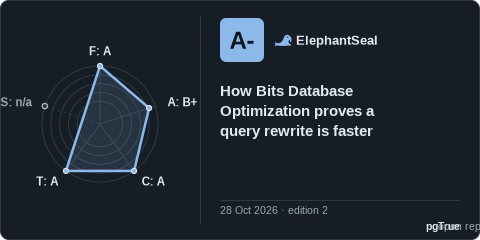
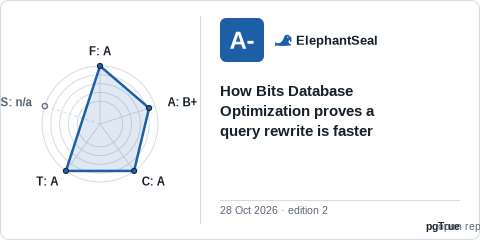
Factual A · Applicable B+ · Consistent A · Transparent A · Safe —

ReportTechnical fact-check, edition 2 Issued EditionUpdated after review. Corrections are listed below. SubmittedSubmitted by the PostgresAI team. Author responseNo written reply from the author. We re-audited this article 4 times; see Revisions below. Policy: right-of-reply and corrections policy. pgTrue versionaudited with v1.0.19 (approx.)

InaccuraciesNone in this edition.

Dangerous or recipe bugsNone in this edition.

Misleading / imprecise

F2

Misleading: “…Dirtied blocks: The number of blocks modified during query execution that must eventually…”

MISLEADINGApplicable · holds up after review

Claim ledger

Article says
…Dirtied blocks: The number of blocks modified during query execution that must eventually be persisted to storage…
What is true
shared_blks_dirtied counts clean-to-dirty transitions. src/backend/storage/buffer/bufmgr.c:3010 increments the counter only when BM_DIRTY was unset. Repeated writes to an already dirty buffer add no dirtied-block count. The article's definition overstates what this benchmark metric measures.
So what
Control initial buffer dirtiness when comparing write queries. Do not interpret shared_blks_dirtied as a count of all modified blocks.

Source

Source · https://docs.datadoghq.com/database_monitoring/bits_database_optimization/The table shows the average, median, P95, and maximum for each metric.

Review correction: see "How the review tested this" below.

In the article · section “How Datadog measures a query improvement”

In the article

excerpt · section “How Datadog measures a query improvement” · as fetched 2026-10-28 · open in article ↗ (opens in new tab)

How Datadog measures a query improvement

Dirtied blocks: The number of blocks modified during query execution that must eventually be persisted to storage

All sources and excerpts · 3
EvidenceThe table shows the average, median, P95, and maximum for each metric.
Evidence The number of blocks <emphasis>dirtied</emphasis> indicates the number of previously unmodified blocks that were changed by this query; while the
Evidence if (!(old_buf_state & BM_DIRTY)) { pgBufferUsage.shared_blks_dirtied++;
How the review tested this

Review: We tested the clean-buffer interpretation. E-7 explicitly excludes buffers already marked dirty. The page containing E-42 identifies shared blocks dirtied as the product metric. Controlling initial buffer dirtiness is a concrete benchmark decision. The finding does not allege incorrect product measurements. We tested the clean-buffer interpretation. It works under that condition, but the definition omits it. Both documentation and code exclude already dirty buffers.

F1

Rollback does not restore every database state

IMPRECISEApplicable · holds up after review

Claim ledger

Article says
…restoring the database to its pre-warm-up state…
What is true
ROLLBACK restores row visibility, but sequence advances survive aborts. PostgreSQL 18.6 documents this in doc/src/sgml/func.sgml:19952. Aborted inserts can also leave dead tuples for cleanup. Write benchmarks can therefore start with different sequence values and physical storage state.
So what
Reset sequence values and storage state when preparing equivalent disposable databases for baseline and rewrite trials.
Charitable reading
The passage correctly describes undoing ordinary row changes. Its broader state-restoration claim omits sequence advances and physical tuple effects.

Source

Source · REL_18_6 · doc/src/sgml/func.sgml:19952-19953the same sequence, the value obtained by <function>nextval</function> is not reclaimed for re-use if the calling transaction later aborts.

Review correction: see "How the review tested this" below.

In the article · section “Simulating databases using real schemas and synthetic data”

In the article

excerpt · section “Simulating databases using real schemas and synthetic data” · as fetched 2026-10-28 · open in article ↗ (opens in new tab)

Simulating databases using real schemas and synthetic data

Under these controlled conditions, we can keep more variables consistent between benchmark runs. For example, prior to benchmarking the query, we warm up the cache to prevent the first measured run from paying a cold-cache penalty. However, if the query inserts or updates rows, the warm-up itself changes the simulated database state, which could cause a subsequent run to violate a uniqueness constraint or otherwise execute against different data. As a result, the warm-up query is run inside a transaction that we roll back, warming the cache while restoring the database to its pre-warm-up state.

All sources and excerpts · 3
Evidence the same sequence, the value obtained by <function>nextval</function> is not reclaimed for re-use if the calling transaction later aborts.
Evidence /* Now update sequence tuple to the intended final state */ seq->last_value = last; /* last fetched number */ seq->is_called = true; seq->log_cnt = log; /* how much is logged */
Evidence * If the inserting transaction aborted, then the tuple was never visible * to any other transaction, so we can delete it immediately. */ if (!HeapTupleHeaderXminCommitted(tuple)) { if (HeapTupleHeaderXminInvalid(tuple)) return HEAPTUPLE_DEAD;
How the review tested this

Review: We tested the reading that state means visible rows. E-2 still establishes surviving sequence advances. E-4 supports possible dead tuples. The imprecise classification preserves the distinction between rollback semantics and unverified product reset procedures. We tested the narrower reading that rollback restores ordinary row changes. Sequence advances still defeat complete restoration. The finding avoids alleging missing product reset procedures.

Verified accurate

F3

The planner uses estimated costs to select execution paths

ACCURATEFactual · holds up after review

Claim ledger

Article says
…uses these estimates to determine which plan to select…
What is true
PostgreSQL 18.6 builds candidate paths and converts a selected path into an execution plan. src/backend/optimizer/util/pathnode.c:364 compares total costs when selecting the cheapest path. The article correctly distinguishes these estimates from measured execution.
Charitable reading
The article describes cost-based planning without claiming exhaustive enumeration or perfect runtime prediction.

Source

Source · REL_18_6 · src/backend/optimizer/util/pathnode.c:364-369cmp = compare_path_costs(cheapest_total_path, path, TOTAL_COST); if (cmp > 0 || (cmp == 0 && compare_pathkeys(cheapest_total_path->pathkeys, path->pathkeys) == PATHKEYS_BETTER2)) cheapest_total_path = path;

Review correction: see "How the review tested this" below.

In the article · section “How accurate is the database simulation?”

In the article

excerpt · section “How accurate is the database simulation?” · as fetched 2026-10-28 · open in article ↗ (opens in new tab)

How accurate is the database simulation?

Before a database can execute a query, it needs to select an execution plan, which outlines the sequence of operations the database will use to execute the query. The database’s query planner estimates the cost of potential execution plans and uses these estimates to determine which plan to select.

All sources and excerpts · 2
Evidence cmp = compare_path_costs(cheapest_total_path, path, TOTAL_COST); if (cmp > 0 || (cmp == 0 && compare_pathkeys(cheapest_total_path->pathkeys, path->pathkeys) == PATHKEYS_BETTER2)) cheapest_total_path = path;
EvidenceDuring the planning/optimizing process, we build "Path" trees representing the different ways of doing a query. We select the cheapest Path that generates the desired relation and turn it into a Plan to pass to the executor. (There is pretty nearly a one-to-one correspondence between the
How the review tested this

Review: We checked whether F3 promises exhaustive optimization or accurate runtime prediction. It promises neither. E-9 describes path selection and plan construction. E-10 shows an actual cost comparison. We checked whether cost-based selection implied exhaustive search or accurate runtime prediction. Neither claim appears. Path selection supports the finding.

F4

Single-column statistics omit cross-column correlation

ACCURATEFactual · holds up after review

Claim ledger

Article says
…may not be accurately represented by statistics collected for each column independently…
What is true
PostgreSQL 18.6 documents this limitation in doc/src/sgml/perform.sgml:1398. Extended statistics can represent cross-column relationships. src/backend/statistics/dependencies.c:1352 describes combining predicate selectivities using functional dependency strength.
Charitable reading
The claim concerns correlated predicates. It does not claim that extended statistics capture every possible relationship.

Source

Source · REL_18_6 · doc/src/sgml/perform.sgml:1398-1402Regular statistics, because of their per-individual-column nature, cannot capture any knowledge about cross-column correlation. However, <productname>PostgreSQL</productname> has the ability to compute <firstterm>multivariate statistics</firstterm>, which can capture such information.

Review correction: see "How the review tested this" below.

In the article · section “How accurate is the database simulation?”

In the article

excerpt · section “How accurate is the database simulation?” · as fetched 2026-10-28 · open in article ↗ (opens in new tab)

How accurate is the database simulation?

These evaluations help us determine where the synthetic data accurately reproduces the source database’s query behavior—and, just as importantly, where the simulation still has room to improve. For example, our engineers are working on ingesting PostgreSQL extended statistics to improve fidelity for queries with AND conditions across multiple columns. When these columns are correlated, their combined behavior may not be accurately represented by statistics collected for each column independently. By ingesting extended statistics, Bits will be able to more accurately reproduce relationships among multiple columns, improving read fidelity for these queries.

All sources and excerpts · 2
Evidence Regular statistics, because of their per-individual-column nature, cannot capture any knowledge about cross-column correlation. However, <productname>PostgreSQL</productname> has the ability to compute <firstterm>multivariate statistics</firstterm>, which can capture such information.
Evidence * Given equality clauses on attributes (a,b) we find the strongest dependency * between them, i.e. either (a=>b) or (b=>a). Assuming (a=>b) is the selected * dependency, we then combine the per-clause selectivities using the formula * * P(a,b) = f * P(a) + (1-f) * P(a) * P(b)
How the review tested this

Review: We tested whether PostgreSQL statistics support establishes synthetic-data fidelity. F4 makes no such claim. E-12 directly supports the cross-column limitation. E-13 supports the narrower functional-dependency mechanism. We checked whether the finding promised complete correlation modeling. It does not. PostgreSQL documents the single-column limitation and dependency-based selectivity calculation.

F5

Logical reads include cache hits and storage reads

ACCURATEFactual · holds up after review

Claim ledger

Article says
…whether served from cache or read from storage…
What is true
PostgreSQL 18.6 counts buffer cache hits separately from reads. src/backend/storage/buffer/bufmgr.c:1148 increments the shared-hit counter. Its read path increments shared_blks_read. Including both categories matches the article's description of logical reads.
Charitable reading
Blocks accessed means buffer accesses. It does not mean distinct blocks or physical device reads.

Source

Source · REL_18_6 · doc/src/sgml/ref/explain.sgml:191-192<emphasis>hit</emphasis> means that a read was avoided because the block was found already in cache when needed.

Review correction: see "How the review tested this" below.

In the article · section “How Datadog measures a query improvement”

In the article

excerpt · section “How Datadog measures a query improvement” · as fetched 2026-10-28 · open in article ↗ (opens in new tab)

How Datadog measures a query improvement

Logical reads: The number of blocks accessed during query execution, whether served from cache or read from storage

All sources and excerpts · 3
Evidence <emphasis>hit</emphasis> means that a read was avoided because the block was found already in cache when needed.
Evidence bufHdr = BufferAlloc(smgr, persistence, forkNum, blockNum, strategy, foundPtr, io_context); if (*foundPtr) pgBufferUsage.shared_blks_hit++;
Evidence if (persistence == RELPERSISTENCE_TEMP) pgBufferUsage.local_blks_read += io_buffers_len; else pgBufferUsage.shared_blks_read += io_buffers_len;
How the review tested this

Review: We tested distinct-block and physical-device interpretations. F5 avoids both. E-25 and E-26 show separate hit and read counters. The finding expressly leaves product aggregation unverified. We tested whether logical reads meant distinct blocks or physical device reads. The finding excludes those interpretations. Separate hit and read counters support it.

F7

Cache state and shared resources can affect timing comparisons

ACCURATEFactual · holds up after review

Claim ledger

Article says
…cache states, concurrent queries competing for CPU and I/O, and noisy neighbors can mask the true performance difference…
What is true
Shared resources let one workload degrade another workload's performance. PostgreSQL also distinguishes cached access from storage access costs. These effects support controlling benchmark conditions.
Charitable reading
The article says interference can obscure differences. It does not claim every benchmark suffers interference.

Source

Source · https://learn.microsoft.com/en-us/azure/architecture/antipatterns/noisy-neighbor/noisy-neighborBecause tenants use the same shared resources, the activity of one tenant can negatively affect another tenant's use of the system.

Review correction: see "How the review tested this" below.

In the article

In the article

Article · exact quote · open in article ↗ (opens in new tab)…cache states, concurrent queries competing for CPU and I/O, and noisy neighbors can mask the true performance difference…
All sources and excerpts · 2
EvidenceBecause tenants use the same shared resources, the activity of one tenant can negatively affect another tenant's use of the system.
Evidence used (4.0) because the majority of random accesses to storage, such as indexed reads, are assumed to be in cache. Also, the
How the review tested this

Review: We tested whether F7 implies unavoidable interference or quantifies its effects. It does neither. E-30 supports shared-resource interference. E-31 supports distinguishing cached access from storage access. We tested whether the article claimed interference always occurs. Its conditional wording avoids that claim. Shared-resource interference and cache-dependent costs support the finding.

F8

The announcement predates the article within 2026

ACCURATEFactual · holds up after review

Claim ledger

Article says
Earlier this year, Datadog announced Bits Database Optimization…
What is true
The linked announcement is dated June 9, 2026. That precedes the article's August 31, 2026 publication.
Charitable reading
The announcement date is checked separately from the product's internal implementation claims.

Source

Source · https://www.datadoghq.com/blog/bits-database-optimization/Published Jun 9, 2026

Review correction: see "How the review tested this" below.

In the article

In the article

Article · exact quote · open in article ↗ (opens in new tab)Earlier this year, Datadog announced Bits Database Optimization…
All sources and excerpts · 1
EvidencePublished Jun 9, 2026
How the review tested this

Review: We checked the announcement page's date directly. E-33 gives June 9, 2026, before the article's August 31, 2026 date. F8 does not use that date to validate implementation claims. We checked the announcement date against the article date. June 9 precedes August 31 within 2026.

F9

The linked setup documents column statistics collection

ACCURATEFactual · holds up after review

Claim ledger

Article says
…configure the Agent to collect these statistics from your databases…
What is true
The linked setup requires a column statistics function in every database. It also documents enabling collect_column_statistics.enabled. This supports the configuration instruction, not the claimed fidelity gains.
Charitable reading
The article links setup instructions rather than claiming column statistics collection requires no configuration.

Source

Source · https://docs.datadoghq.com/database_monitoring/setup_postgres/selfhosted/?tab=postgres15Create the following function **in every database** to enable the Agent to collect column-level table statistics from `pg_stats`:

Review correction: see "How the review tested this" below.

In the article

In the article

Article · exact quote · open in article ↗ (opens in new tab)…configure the Agent to collect these statistics from your databases…
All sources and excerpts · 1
EvidenceCreate the following function **in every database** to enable the Agent to collect column-level table statistics from `pg_stats`:
How the review tested this

Review: We checked the surrounding setup instructions on the page containing E-35. They include the function and collect_column_statistics.enabled. F9 confirms documented configuration, without claiming successful execution or measured fidelity gains. We checked the linked setup for both prerequisites. It specifies the per-database function and collect_column_statistics.enabled. The finding excludes runtime and fidelity validation.

F10

Concurrent transactions can delay benchmark statements

ACCURATEFactual · holds up after review

Claim ledger

Article says
…the query being benchmarked may need to wait on database locks…
What is true
PostgreSQL can make an updater wait for another updating transaction to commit or roll back. REL_18_6 documents this in doc/src/sgml/mvcc.sgml:343.
Charitable reading
The conditional claim includes statements that conflict with concurrent updates. It does not say every SELECT waits.

Source

Source · REL_18_6 · doc/src/sgml/mvcc.sgml:343-344would-be updater will wait for the first updating transaction to commit or roll back (if it is still in progress). If the first updater rolls back,

Review correction: see "How the review tested this" below.

In the article

In the article

Article · exact quote · open in article ↗ (opens in new tab)…the query being benchmarked may need to wait on database locks…
All sources and excerpts · 1
Evidence would-be updater will wait for the first updating transaction to commit or roll back (if it is still in progress). If the first updater rolls back,
How the review tested this

Review: We tested whether the evidence applies only to updaters while F10 claims every query waits. F10 remains conditional. E-37 supplies a concrete supported case. We tested ordinary nonblocking SELECT behavior as a counterexample. The article says queries may wait. PostgreSQL's documented updater wait supports that conditional claim.

F11

Write warm-ups can change later executions

ACCURATEFactual · holds up after review

Claim ledger

Article says
…warm-up itself changes the simulated database state…
What is true
INSERT adds rows. Unique constraints reject duplicate constrained values. A committed warm-up can change later input data or make a repeated INSERT fail. These statements support the article's conditional warning.
Charitable reading
The article says repeated writes could violate uniqueness. It does not claim every INSERT or UPDATE does.

Source

Source · REL_18_6 · doc/src/sgml/ref/insert.sgml:52-52<command>INSERT</command> inserts new rows into a table.

Review correction: see "How the review tested this" below.

In the article · section “Simulating databases using real schemas and synthetic data”

In the article

excerpt · section “Simulating databases using real schemas and synthetic data” · as fetched 2026-10-28 · open in article ↗ (opens in new tab)

Simulating databases using real schemas and synthetic data

Under these controlled conditions, we can keep more variables consistent between benchmark runs. For example, prior to benchmarking the query, we warm up the cache to prevent the first measured run from paying a cold-cache penalty. However, if the query inserts or updates rows, the warm-up itself changes the simulated database state, which could cause a subsequent run to violate a uniqueness constraint or otherwise execute against different data. As a result, the warm-up query is run inside a transaction that we roll back, warming the cache while restoring the database to its pre-warm-up state.

All sources and excerpts · 2
Evidence <command>INSERT</command> inserts new rows into a table.
Evidence Unique constraints ensure that the data contained in a column, or a group of columns, is unique among all the rows in the table. The syntax is:
How the review tested this

Review: We tested inserts that generate new keys or avoid conflicts. Those cases do not defeat the conditional warning. E-39 and E-40 support possible repeated-insert failures after a committed warm-up. We tested writes that cause no uniqueness conflict. The article claims only possible conflicts. INSERT behavior and unique constraints support that warning.

F12

The four benchmark summaries match the product documentation

ACCURATEFactual · holds up after review

Claim ledger

Article says
…then evaluates the average, median, p95, and maximum values across those runs.
What is true
The documentation lists average, median, P95, and maximum for each metric. These match the article's four summaries.
Charitable reading
The claim names four summaries, rather than four independent statistical tests.

Source

Source · https://docs.datadoghq.com/database_monitoring/bits_database_optimization/The table shows the average, median, P95, and maximum for each metric.

Review correction: see "How the review tested this" below.

In the article

In the article

Article · exact quote · open in article ↗ (opens in new tab)…then evaluates the average, median, p95, and maximum values across those runs.
All sources and excerpts · 1
EvidenceThe table shows the average, median, P95, and maximum for each metric.
How the review tested this

Review: We checked whether matching summary names validates 50 executions or the 20% acceptance threshold. F12 validates neither. E-42 corroborates exactly the four named summaries. We checked whether documentation corroboration implied implementation verification. The finding only confirms matching summaries. E-42 names all 4 summaries.

Notes

1 not graded: findings no reader would act on differently
F6

Note: “…currently supports Postgres, with future support planned for MySQL…”

NOTEpartly holds after review

Claim ledger

Article says
…currently supports Postgres, with future support planned for MySQL…
What is true
Current documentation lists PostgreSQL and MySQL support (E-28). The article describes MySQL support as planned (E-27). No cited evidence dates MySQL availability. We cannot establish whether the article was wrong at publication or became outdated afterward.
So what
Evaluate Bits Database Optimization for MySQL instead of waiting for a future MySQL release.

Source

Source · https://docs.datadoghq.com/database_monitoring/bits_database_optimization/Bits Database Optimization is only available for PostgreSQL and MySQL.

Not graded: no reader would act differently on it.

Review correction: see "How the review tested this" below.

In the article

In the article

Article · exact quote · open in article ↗ (opens in new tab)…currently supports Postgres, with future support planned for MySQL…
All sources and excerpts · 1
EvidenceBits Database Optimization is only available for PostgreSQL and MySQL.
How the review tested this

Review: We checked whether E-28 dates MySQL availability. It does not. The documentation difference stands, but aged-since requires chronology the evidence lacks. We checked whether current availability proves an error on August 31, 2026. It does not. F6 already states that limitation. E-28 supports the narrower conclusion that the article's availability statement is outdated now.

More in this report

Section checks · 6 sections

Section checks

AspectGradeFindingsCoverage
IntroductionA2 verified-accurate100% of claims (4 of 4)
Database simulationA1 imprecise · 2 verified-accurate100% of claims (10 of 10, plus 1 that need data we do not have)
Simulation accuracyA1 verified-accurate50% of claims (4 of 8, plus 1 that need data we do not have)provisional
Simulation improvementsA2 verified-accurate100% of claims (1 of 1, plus 1 that need data we do not have)
Improvement measurementB+1 misleading · 2 verified-accurate100% of claims (4 of 4)
Product availabilityAnoneno checkable claims
Coverage and assessment · Checked 37 of 42 Postgres claims across 9 sections

Central claim not verified. The findings check PostgreSQL mechanisms and documented metrics, but do not establish that synthetic benchmarks predict production speedups.

We did not check everything in this article. What we did not check is listed below, in the words we recorded at the time. None of it moved the letter. We never charge our own limits to the article.

What we did not check

  • We did not reproduce the article's 50-run benchmarks or fidelity measurements.
  • We did not verify the product's implementation of warm-up, timing, or database reset procedures.
  • We did not verify whether the proposed synthetic-data generator reproduces multicolumn relationships.
  • We did not reproduce the fidelity measurements or verify the 50-run benchmark implementation.
  • We did not verify whether simulated performance improvements predict improvements under production load.
  • We did not establish when MySQL support shipped or verify the remaining database support plans.
  • We did not verify the planned ingestion of PostgreSQL extended statistics.
  • We did not assess security risks for benchmarks against a specific production database.
  • We did not complete the comparison of estimated costs and accessed blocks.
  • We did not verify the underlying measurements in the two fidelity tables.
  • We did not verify the implementation of the 50-run benchmark or the 20% acceptance threshold.
  • We did not check the article's images.
  • Section “Simulation accuracy”: we checked 4 of 9 checkable claims.
  • We could not decide whether the article contains a material benchmark.

Script checks

  • No fenced or preformatted code blocks were identified. Inline snippets and other setup instructions were not checked for syntax.
Checked 37 of 42 Postgres claims across 9 sections
  • Introduction: 4 of 4 Postgres claims checked; not counted: 8 product or opinion, 3 not a claim
  • Database simulation: 10 of 10 Postgres claims checked, plus 1 that need data we do not have; not counted: 19 product or opinion, 4 duplicate, 1 not a claim
  • Simulation accuracy: 4 of 8 Postgres claims checked, plus 1 that need data we do not have; not counted: 4 product or opinion, 2 not a claim; not checked: 4 for other reasons
  • Cost fidelity results: 9 of 9 Postgres claims checked, plus 37 that need data we do not have
  • Read fidelity results: 5 of 6 Postgres claims checked, plus 36 that need data we do not have; not counted: 2 product or opinion; not checked: 1 for other reasons
  • Simulation improvements: 1 of 1 Postgres claims checked, plus 1 that need data we do not have; not counted: 5 product or opinion
  • Improvement measurement: 4 of 4 Postgres claims checked; not counted: 17 product or opinion, 1 not a claim
  • Product availability: no checkable claims; not counted: 5 product or opinion, 3 duplicate, 2 not a claim
  • Page furniture: no checkable claims; not counted: 3 product or opinion, 3 not a claim

Average of 4 axes: 3.83 · result A-

Some explanatory text is not shown in this edition; the grade and findings are complete.

Scorecard · the five axes
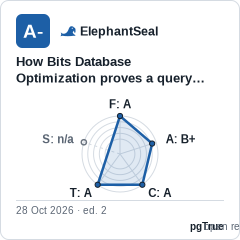
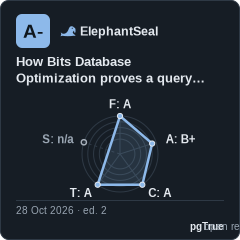
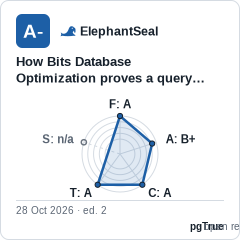
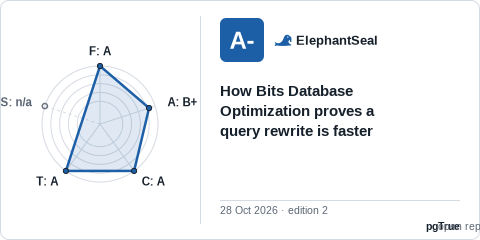
FACTS scorecard Scorecard radar, 5 axes, bigger is better. Overall A-. Factual A · 0 wrong of 11 checked · 0 caveats. Applicable B+ · 1 wrong of 4 checked · 1 caveat. Consistent A · 0 wrong of 11 checked · 0 caveats. Transparent A · 0 wrong of 4 checked · 0 caveats. Safe 1 checked, too few for a letter. A 0 wrong of 11 checked · 0 caveatsFactual A0 wrong of 110 caveats B+ 1 wrong of 4 checked · 1 caveatApplicable B+1 wrong of 41 caveat A 0 wrong of 11 checked · 0 caveatsConsistent A0 wrong of 110 caveats A 0 wrong of 4 checked · 0 caveatsTransparent A0 wrong of 40 caveats 1 checked, too few for a letterSafe n/a0 wrong of 10 caveats

By topic: Introduction — 2 findings, 0 wrong · Database simulation — 3 findings, 0 wrong · Simulation accuracy — 1 finding, 0 wrong · Simulation improvements — 2 findings, 0 wrong · Improvement measurement — 3 findings, 1 wrong

Further out is better. Each axis has its own letter, from the wrong claims and caveats among the claims we checked of that kind.

Checked on the FACTS: Factual, Applicable, Consistent, Transparent, Safe. Clockwise: Factual (is it true?), Applicable (does it apply to my setup, today?), Consistent (does it agree with itself?), Transparent (can I check it myself?), Safe (can I run this on prod?).

We checked 11 claims.

AxisLetterWrongCaveatsCheckedCoverage
FactualA0011assessed: A · 0 wrong of 11 checked · 0 caveats
ApplicableB+114assessed: B+ · 1 wrong of 4 checked · 1 caveat
ConsistentA0011assessed: A · 0 wrong of 11 checked · 0 caveats
TransparentA004assessed: A · 0 wrong of 4 checked · 0 caveats
Safe—001assessed: 0 wrong · 0 caveats · 1 checked
Topics · 6 topics

Topics

TopicFactualApplicableConsistentTransparentSafe
Introduction0 issues 2 checked F7 F80 issues 1 checked0 issues 2 checked0 issues 2 checked
Database simulation0 issues 3 checked F10 F111 issue 1 checked F10 issues 3 checked
Simulation accuracy0 issues 1 checked F30 issues 1 checked
Simulation improvements0 issues 2 checked F4 F90 issues 1 checked0 issues 2 checked0 issues 1 checked
Improvement measurement0 issues 3 checked F5 F121 issue 1 checked F20 issues 3 checked0 issues 1 checked
Product availability

Issues found among the claims checked, per topic and axis. Each link goes to the finding behind the count.

Revisions: 5 · A- -> A- -> B- -> A -> A-

We audited this article 5 times. Each row is the final edition of one audit. Letters and findings of earlier revisions stay readable at their own address.

  1. Revision 1 · 2026-09-10 03:44 UTC · A- · audit version not recorded · regrade version not recorded

    Article as first submitted. 12 accurate · 0 wrong · 7 caveats.

    ElephantSeal: A-.

    Changes: First audit. Open: F3 “…including cardinality and column-level distributions…” (mostly accurate); F4 “…strong read fidelity at the median across most query classes…” (mostly accurate); F11 “…Execution time: The database’s own server-reported time, not the wall-clock time…” (mostly accurate); F12 “It runs both the baseline query and proposed rewrite 50 times…” (mostly accurate); F13 “…approximate key characteristics of the production dataset, including cardinality and column-level distributions…” (mostly accurate); F18 “…could cause a subsequent run to violate a uniqueness constraint…” (mostly accurate); F19 “…only recommend optimizations that we can prove to be more performant…” (mostly accurate).

  2. Revision 2 · 2026-10-19 06:26 UTC · A- · audited with v1.0.14 (approx.)

    Same article text, re-audited. 9 accurate · 1 wrong · 0 caveats.

    ElephantSeal: A-.

    Changes: No longer reported: “…including cardinality and column-level distributions…”; “…strong read fidelity at the median across most query classes…”; “…Execution time: The database’s own server-reported time, not the wall-clock time…”; “It runs both the baseline query and proposed rewrite 50 times…”; “…approximate key characteristics of the production dataset, including cardinality and column-level distributions…”; “…could cause a subsequent run to violate a uniqueness constraint…”; “…only recommend optimizations that we can prove to be more performant…”. New: F2 “…Dirtied blocks: The number of blocks modified during query execution…” (false).

  3. Revision 3 · 2026-10-19 21:34 UTC · B- · audited with v1.0.16 (approx.)

    Same article text, re-audited. 10 accurate · 1 wrong · 0 caveats.

    ElephantSeal: B-. Open: the benchmark cannot yet be rerun from what is published.

    Changes: No longer reported: “…Dirtied blocks: The number of blocks modified during query execution…”. New: F2 “Dirtied blocks exclude changes to already-dirty buffers” (misleading).

  4. Revision 4 · 2026-10-21 05:00 UTC · A · audited with v1.0.17 (approx.) · regraded with v1.1.0 (approx.)

    Same article text, re-audited. 12 accurate · 0 wrong · 3 caveats.

    ElephantSeal: A.

    Changes: No longer reported: “Dirtied blocks exclude changes to already-dirty buffers”. New: F1 “…restoring the database to its pre-warm-up state.” (mostly accurate); F2 “Dirtied blocks count clean-to-dirty transitions” (mostly accurate); F8 “MySQL support is now documented” (outdated).

  5. Revision 5 · this page · 2026-10-28 09:21 UTC · A- · audited with v1.0.19 (approx.)

    Same article text, re-audited. 9 accurate · 1 wrong · 1 caveat.

    ElephantSeal: A-.

    Changes: No longer reported: “…restoring the database to its pre-warm-up state.”; “Dirtied blocks count clean-to-dirty transitions”; “MySQL support is now documented”. New: F2 “…Dirtied blocks: The number of blocks modified during query execution that must eventually be persisted to storage…” (misleading); F1 “Rollback does not restore every database state” (mostly accurate).

First impression
Questions and answers

Questions and answers

What is pgTrue?

pgTrue is an independent fact-check of technical Postgres articles, made by PostgresAI. It helps you check advice before you use it.

What does the letter grade mean?

The letter grade summarizes the claims we checked. Five axes show what we checked:

  • Factual: is it true?
  • Applicable: does it apply to my setup, today?
  • Consistent: does it agree with itself?
  • Transparent: can I check it myself?
  • Safe: can I run this in production?

What is the ElephantSeal?

The ElephantSeal is the mark an article earns. It always shows the latest edition. “Open:” lists what is still open.

Can an author reply?

Authors can ask us to correct a finding, reply to it, or withdraw it. Right-of-reply policy.

Paste into your AI assistant to fix the article, then ask for a re-review.

Show the text
Fix the article with this report, then ask pgTrue for a re-review.

# pgTrue report: How Bits Database Optimization proves a query rewrite is faster

Article title: How Bits Database Optimization proves a query rewrite is faster
Article URL: https://www.datadoghq.com/blog/how-bits-database-optimization-proves-a-query-rewrite-is-faster
Report URL: https://pgtrue.postgres.ai/shared/brief/d8f920e4-b547-48d5-9a7d-296af3619285
Audited revision: 5 of 5, 2026-10-28 09:21:59 UTC
Overall letter: A-

## Axes

- Factual: A · 0 wrong · 11 checked · 0 caveats · assessed
- Applicable: B+ · 1 wrong · 4 checked · 1 caveats · assessed
- Consistent: A · 0 wrong · 11 checked · 0 caveats · assessed
- Transparent: A · 0 wrong · 4 checked · 0 caveats · assessed
- Safe: — · 0 wrong · 1 checked · 0 caveats · assessed

ElephantSeal: A-.

## Report metadata

- Report: Technical fact-check, edition 2
- Issued: 2026-10-28
- Edition: Updated after review. Corrections are listed below.
- Submitted: Submitted by the PostgresAI team.
- Author response: No written reply from the author. We re-audited this article 4 times; see Revisions below. Policy: [right-of-reply and corrections policy](/pgtrue/security).
- pgTrue version: audited with v1.0.19 (approx.)

## Findings needing a change (2)

### F2 · Misleading · Applicable · Misleading: “…Dirtied blocks: The number of blocks modified during query execution that must eventually…”
Location: excerpt · section “How Datadog measures a query improvement” · as fetched 2026-10-28 · [open in article](https://www.datadoghq.com/blog/how-bits-database-optimization-proves-a-query-rewrite-is-faster#:~:text=Dirtied%20blocks%3A%20The%20number%20of,eventually%20be%20persisted%20to%20storage)
Article says:
```text
…Dirtied blocks: The number of blocks modified during query execution that must eventually be persisted to storage…
```
What is true:
shared_blks_dirtied counts clean-to-dirty transitions. src/backend/storage/buffer/bufmgr.c:3010 increments the counter only when BM_DIRTY was unset. Repeated writes to an already dirty buffer add no dirtied-block count. The article's definition overstates what this benchmark metric measures.
So what:
Control initial buffer dirtiness when comparing write queries. Do not interpret shared_blks_dirtied as a count of all modified blocks.
Review: We tested the clean-buffer interpretation. E-7 explicitly excludes buffers already marked dirty. The page containing E-42 identifies shared blocks dirtied as the product metric. Controlling initial buffer dirtiness is a concrete benchmark decision. The finding does not allege incorrect product measurements. We tested the clean-buffer interpretation. It works under that condition, but the definition omits it. Both documentation and code exclude already dirty buffers.

Sources:
- [https://docs.datadoghq.com/database_monitoring/bits_database_optimization/](https://docs.datadoghq.com/database_monitoring/bits_database_optimization/)
  Excerpt:
  ```text
  The table shows the average, median, P95, and maximum for each metric.
  ```
- [REL_18_6 · doc/src/sgml/ref/explain.sgml:197-198](https://github.com/postgres/postgres/blob/724edf9bde9d356724ad384a2e196edc3c9f80f7/doc/src/sgml/ref/explain.sgml#L197-L198)
  Excerpt:
  ```text
  The number of blocks <emphasis>dirtied</emphasis> indicates the number of
      previously unmodified blocks that were changed by this query; while the
  ```
- [REL_18_6 · src/backend/storage/buffer/bufmgr.c:3010-3012](https://github.com/postgres/postgres/blob/724edf9bde9d356724ad384a2e196edc3c9f80f7/src/backend/storage/buffer/bufmgr.c#L3010-L3012)
  Excerpt:
  ```text
  if (!(old_buf_state & BM_DIRTY))
	{
		pgBufferUsage.shared_blks_dirtied++;
  ```

Finding URL: https://pgtrue.postgres.ai/shared/brief/d8f920e4-b547-48d5-9a7d-296af3619285#F2

### F1 · Imprecise · Applicable · Rollback does not restore every database state
Location: excerpt · section “Simulating databases using real schemas and synthetic data” · as fetched 2026-10-28 · [open in article](https://www.datadoghq.com/blog/how-bits-database-optimization-proves-a-query-rewrite-is-faster#:~:text=restoring%20the%20database%20to%20its%20pre%2Dwarm%2Dup%20state)
Article says:
```text
…restoring the database to its pre-warm-up state…
```
What is true:
ROLLBACK restores row visibility, but sequence advances survive aborts. PostgreSQL 18.6 documents this in doc/src/sgml/func.sgml:19952. Aborted inserts can also leave dead tuples for cleanup. Write benchmarks can therefore start with different sequence values and physical storage state.
So what:
Reset sequence values and storage state when preparing equivalent disposable databases for baseline and rewrite trials.
Charitable reading:
The passage correctly describes undoing ordinary row changes. Its broader state-restoration claim omits sequence advances and physical tuple effects.
Review: We tested the reading that state means visible rows. E-2 still establishes surviving sequence advances. E-4 supports possible dead tuples. The imprecise classification preserves the distinction between rollback semantics and unverified product reset procedures. We tested the narrower reading that rollback restores ordinary row changes. Sequence advances still defeat complete restoration. The finding avoids alleging missing product reset procedures.

Sources:
- [REL_18_6 · doc/src/sgml/func.sgml:19952-19953](https://github.com/postgres/postgres/blob/724edf9bde9d356724ad384a2e196edc3c9f80f7/doc/src/sgml/func.sgml#L19952-L19953)
  Excerpt:
  ```text
  the same sequence, the value obtained by <function>nextval</function>
    is not reclaimed for re-use if the calling transaction later aborts.
  ```
- [REL_18_6 · src/backend/commands/sequence.c:851-854](https://github.com/postgres/postgres/blob/724edf9bde9d356724ad384a2e196edc3c9f80f7/src/backend/commands/sequence.c#L851-L854)
  Excerpt:
  ```text
  /* Now update sequence tuple to the intended final state */
	seq->last_value = last;		/* last fetched number */
	seq->is_called = true;
	seq->log_cnt = log;			/* how much is logged */
  ```
- [REL_18_6 · src/backend/access/heap/heapam_visibility.c:1218-1224](https://github.com/postgres/postgres/blob/724edf9bde9d356724ad384a2e196edc3c9f80f7/src/backend/access/heap/heapam_visibility.c#L1218-L1224)
  Excerpt:
  ```text
  * If the inserting transaction aborted, then the tuple was never visible
	 * to any other transaction, so we can delete it immediately.
	 */
	if (!HeapTupleHeaderXminCommitted(tuple))
	{
		if (HeapTupleHeaderXminInvalid(tuple))
			return HEAPTUPLE_DEAD;
  ```

Finding URL: https://pgtrue.postgres.ai/shared/brief/d8f920e4-b547-48d5-9a7d-296af3619285#F1

## Verified accurate claims (9)

### F3 · Accurate · Factual · The planner uses estimated costs to select execution paths
Location: excerpt · section “How accurate is the database simulation?” · as fetched 2026-10-28 · [open in article](https://www.datadoghq.com/blog/how-bits-database-optimization-proves-a-query-rewrite-is-faster#:~:text=uses%20these%20estimates%20to%20determine%20which%20plan%20to%20select)
Article says:
```text
…uses these estimates to determine which plan to select…
```
What is true:
PostgreSQL 18.6 builds candidate paths and converts a selected path into an execution plan. src/backend/optimizer/util/pathnode.c:364 compares total costs when selecting the cheapest path. The article correctly distinguishes these estimates from measured execution.
Charitable reading:
The article describes cost-based planning without claiming exhaustive enumeration or perfect runtime prediction.
Review: We checked whether F3 promises exhaustive optimization or accurate runtime prediction. It promises neither. E-9 describes path selection and plan construction. E-10 shows an actual cost comparison. We checked whether cost-based selection implied exhaustive search or accurate runtime prediction. Neither claim appears. Path selection supports the finding.

Sources:
- [REL_18_6 · src/backend/optimizer/util/pathnode.c:364-369](https://github.com/postgres/postgres/blob/724edf9bde9d356724ad384a2e196edc3c9f80f7/src/backend/optimizer/util/pathnode.c#L364-L369)
  Excerpt:
  ```text
  cmp = compare_path_costs(cheapest_total_path, path, TOTAL_COST);
			if (cmp > 0 ||
				(cmp == 0 &&
				 compare_pathkeys(cheapest_total_path->pathkeys,
								  path->pathkeys) == PATHKEYS_BETTER2))
				cheapest_total_path = path;
  ```
- [REL_18_6 · src/backend/optimizer/README:20-23](https://github.com/postgres/postgres/blob/724edf9bde9d356724ad384a2e196edc3c9f80f7/src/backend/optimizer/README#L20-L23)
  Excerpt:
  ```text
  During the planning/optimizing process, we build "Path" trees representing
the different ways of doing a query.  We select the cheapest Path that
generates the desired relation and turn it into a Plan to pass to the
executor.  (There is pretty nearly a one-to-one correspondence between the
  ```

Finding URL: https://pgtrue.postgres.ai/shared/brief/d8f920e4-b547-48d5-9a7d-296af3619285#F3

### F4 · Accurate · Factual · Single-column statistics omit cross-column correlation
Location: excerpt · section “How accurate is the database simulation?” · as fetched 2026-10-28 · [open in article](https://www.datadoghq.com/blog/how-bits-database-optimization-proves-a-query-rewrite-is-faster#:~:text=may%20not%20be%20accurately%20represented,collected%20for%20each%20column%20independently)
Article says:
```text
…may not be accurately represented by statistics collected for each column independently…
```
What is true:
PostgreSQL 18.6 documents this limitation in doc/src/sgml/perform.sgml:1398. Extended statistics can represent cross-column relationships. src/backend/statistics/dependencies.c:1352 describes combining predicate selectivities using functional dependency strength.
Charitable reading:
The claim concerns correlated predicates. It does not claim that extended statistics capture every possible relationship.
Review: We tested whether PostgreSQL statistics support establishes synthetic-data fidelity. F4 makes no such claim. E-12 directly supports the cross-column limitation. E-13 supports the narrower functional-dependency mechanism. We checked whether the finding promised complete correlation modeling. It does not. PostgreSQL documents the single-column limitation and dependency-based selectivity calculation.

Sources:
- [REL_18_6 · doc/src/sgml/perform.sgml:1398-1402](https://github.com/postgres/postgres/blob/724edf9bde9d356724ad384a2e196edc3c9f80f7/doc/src/sgml/perform.sgml#L1398-L1402)
  Excerpt:
  ```text
  Regular statistics, because of their per-individual-column nature,
    cannot capture any knowledge about cross-column correlation.
    However, <productname>PostgreSQL</productname> has the ability to compute
    <firstterm>multivariate statistics</firstterm>, which can capture
    such information.
  ```
- [REL_18_6 · src/backend/statistics/dependencies.c:1352-1356](https://github.com/postgres/postgres/blob/724edf9bde9d356724ad384a2e196edc3c9f80f7/src/backend/statistics/dependencies.c#L1352-L1356)
  Excerpt:
  ```text
  * Given equality clauses on attributes (a,b) we find the strongest dependency
 * between them, i.e. either (a=>b) or (b=>a). Assuming (a=>b) is the selected
 * dependency, we then combine the per-clause selectivities using the formula
 *
 *	   P(a,b) = f * P(a) + (1-f) * P(a) * P(b)
  ```

Finding URL: https://pgtrue.postgres.ai/shared/brief/d8f920e4-b547-48d5-9a7d-296af3619285#F4

### F5 · Accurate · Factual · Logical reads include cache hits and storage reads
Location: excerpt · section “How Datadog measures a query improvement” · as fetched 2026-10-28 · [open in article](https://www.datadoghq.com/blog/how-bits-database-optimization-proves-a-query-rewrite-is-faster#:~:text=whether%20served%20from%20cache%20or%20read%20from%20storage)
Article says:
```text
…whether served from cache or read from storage…
```
What is true:
PostgreSQL 18.6 counts buffer cache hits separately from reads. src/backend/storage/buffer/bufmgr.c:1148 increments the shared-hit counter. Its read path increments shared_blks_read. Including both categories matches the article's description of logical reads.
Charitable reading:
Blocks accessed means buffer accesses. It does not mean distinct blocks or physical device reads.
Review: We tested distinct-block and physical-device interpretations. F5 avoids both. E-25 and E-26 show separate hit and read counters. The finding expressly leaves product aggregation unverified. We tested whether logical reads meant distinct blocks or physical device reads. The finding excludes those interpretations. Separate hit and read counters support it.

Sources:
- [REL_18_6 · doc/src/sgml/ref/explain.sgml:191-192](https://github.com/postgres/postgres/blob/724edf9bde9d356724ad384a2e196edc3c9f80f7/doc/src/sgml/ref/explain.sgml#L191-L192)
  Excerpt:
  ```text
  <emphasis>hit</emphasis> means that a read was avoided because the block
      was found already in cache when needed.
  ```
- [REL_18_6 · src/backend/storage/buffer/bufmgr.c:1145-1148](https://github.com/postgres/postgres/blob/724edf9bde9d356724ad384a2e196edc3c9f80f7/src/backend/storage/buffer/bufmgr.c#L1145-L1148)
  Excerpt:
  ```text
  bufHdr = BufferAlloc(smgr, persistence, forkNum, blockNum,
							 strategy, foundPtr, io_context);
		if (*foundPtr)
			pgBufferUsage.shared_blks_hit++;
  ```
- [REL_18_6 · src/backend/storage/buffer/bufmgr.c:1969-1972](https://github.com/postgres/postgres/blob/724edf9bde9d356724ad384a2e196edc3c9f80f7/src/backend/storage/buffer/bufmgr.c#L1969-L1972)
  Excerpt:
  ```text
  if (persistence == RELPERSISTENCE_TEMP)
			pgBufferUsage.local_blks_read += io_buffers_len;
		else
			pgBufferUsage.shared_blks_read += io_buffers_len;
  ```

Finding URL: https://pgtrue.postgres.ai/shared/brief/d8f920e4-b547-48d5-9a7d-296af3619285#F5

### F7 · Accurate · Factual · Cache state and shared resources can affect timing comparisons
Location: Article · exact quote · [open in article](https://www.datadoghq.com/blog/how-bits-database-optimization-proves-a-query-rewrite-is-faster#:~:text=cache%20states%2C%20concurrent%20queries%20competing,mask%20the%20true%20performance%20difference)
Article says:
```text
…cache states, concurrent queries competing for CPU and I/O, and noisy neighbors can mask the true performance difference…
```
What is true:
Shared resources let one workload degrade another workload's performance. PostgreSQL also distinguishes cached access from storage access costs. These effects support controlling benchmark conditions.
Charitable reading:
The article says interference can obscure differences. It does not claim every benchmark suffers interference.
Review: We tested whether F7 implies unavoidable interference or quantifies its effects. It does neither. E-30 supports shared-resource interference. E-31 supports distinguishing cached access from storage access. We tested whether the article claimed interference always occurs. Its conditional wording avoids that claim. Shared-resource interference and cache-dependent costs support the finding.

Sources:
- [https://learn.microsoft.com/en-us/azure/architecture/antipatterns/noisy-neighbor/noisy-neighbor](https://learn.microsoft.com/en-us/azure/architecture/antipatterns/noisy-neighbor/noisy-neighbor)
  Excerpt:
  ```text
  Because tenants use the same shared resources, the activity of one tenant can negatively affect another tenant's use of the system.
  ```
- [REL_18_6 · doc/src/sgml/config.sgml:6033-6034](https://github.com/postgres/postgres/blob/724edf9bde9d356724ad384a2e196edc3c9f80f7/doc/src/sgml/config.sgml#L6033-L6034)
  Excerpt:
  ```text
  used (4.0) because the majority of random accesses to storage,
        such as indexed reads, are assumed to be in cache.  Also, the
  ```

Finding URL: https://pgtrue.postgres.ai/shared/brief/d8f920e4-b547-48d5-9a7d-296af3619285#F7

### F8 · Accurate · Factual · The announcement predates the article within 2026
Location: Article · exact quote · [open in article](https://www.datadoghq.com/blog/how-bits-database-optimization-proves-a-query-rewrite-is-faster#:~:text=Earlier%20this%20year%2C%20Datadog%20announced%20Bits%20Database%20Optimization)
Article says:
```text
Earlier this year, Datadog announced Bits Database Optimization…
```
What is true:
The linked announcement is dated June 9, 2026. That precedes the article's August 31, 2026 publication.
Charitable reading:
The announcement date is checked separately from the product's internal implementation claims.
Review: We checked the announcement page's date directly. E-33 gives June 9, 2026, before the article's August 31, 2026 date. F8 does not use that date to validate implementation claims. We checked the announcement date against the article date. June 9 precedes August 31 within 2026.

Sources:
- [https://www.datadoghq.com/blog/bits-database-optimization/](https://www.datadoghq.com/blog/bits-database-optimization/)
  Excerpt:
  ```text
  Published Jun 9, 2026
  ```

Finding URL: https://pgtrue.postgres.ai/shared/brief/d8f920e4-b547-48d5-9a7d-296af3619285#F8

### F9 · Accurate · Factual · The linked setup documents column statistics collection
Location: Article · exact quote · [open in article](https://www.datadoghq.com/blog/how-bits-database-optimization-proves-a-query-rewrite-is-faster#:~:text=configure%20the%20Agent%20to%20collect%20these%20statistics%20from%20your%20databases)
Article says:
```text
…configure the Agent to collect these statistics from your databases…
```
What is true:
The linked setup requires a column statistics function in every database. It also documents enabling collect_column_statistics.enabled. This supports the configuration instruction, not the claimed fidelity gains.
Charitable reading:
The article links setup instructions rather than claiming column statistics collection requires no configuration.
Review: We checked the surrounding setup instructions on the page containing E-35. They include the function and collect_column_statistics.enabled. F9 confirms documented configuration, without claiming successful execution or measured fidelity gains. We checked the linked setup for both prerequisites. It specifies the per-database function and collect_column_statistics.enabled. The finding excludes runtime and fidelity validation.

Sources:
- [https://docs.datadoghq.com/database_monitoring/setup_postgres/selfhosted/?tab=postgres15](https://docs.datadoghq.com/database_monitoring/setup_postgres/selfhosted/?tab=postgres15)
  Excerpt:
  ```text
  Create the following function **in every database** to enable the Agent to collect column-level table statistics from `pg_stats`:
  ```

Finding URL: https://pgtrue.postgres.ai/shared/brief/d8f920e4-b547-48d5-9a7d-296af3619285#F9

### F10 · Accurate · Factual · Concurrent transactions can delay benchmark statements
Location: Article · exact quote · [open in article](https://www.datadoghq.com/blog/how-bits-database-optimization-proves-a-query-rewrite-is-faster#:~:text=the%20query%20being%20benchmarked%20may,to%20wait%20on%20database%20locks)
Article says:
```text
…the query being benchmarked may need to wait on database locks…
```
What is true:
PostgreSQL can make an updater wait for another updating transaction to commit or roll back. REL_18_6 documents this in doc/src/sgml/mvcc.sgml:343.
Charitable reading:
The conditional claim includes statements that conflict with concurrent updates. It does not say every SELECT waits.
Review: We tested whether the evidence applies only to updaters while F10 claims every query waits. F10 remains conditional. E-37 supplies a concrete supported case. We tested ordinary nonblocking SELECT behavior as a counterexample. The article says queries may wait. PostgreSQL's documented updater wait supports that conditional claim.

Sources:
- [REL_18_6 · doc/src/sgml/mvcc.sgml:343-344](https://github.com/postgres/postgres/blob/724edf9bde9d356724ad384a2e196edc3c9f80f7/doc/src/sgml/mvcc.sgml#L343-L344)
  Excerpt:
  ```text
  would-be updater will wait for the first updating transaction to commit or
    roll back (if it is still in progress).  If the first updater rolls back,
  ```

Finding URL: https://pgtrue.postgres.ai/shared/brief/d8f920e4-b547-48d5-9a7d-296af3619285#F10

### F11 · Accurate · Factual · Write warm-ups can change later executions
Location: excerpt · section “Simulating databases using real schemas and synthetic data” · as fetched 2026-10-28 · [open in article](https://www.datadoghq.com/blog/how-bits-database-optimization-proves-a-query-rewrite-is-faster#:~:text=warm%2Dup%20itself%20changes%20the%20simulated%20database%20state)
Article says:
```text
…warm-up itself changes the simulated database state…
```
What is true:
INSERT adds rows. Unique constraints reject duplicate constrained values. A committed warm-up can change later input data or make a repeated INSERT fail. These statements support the article's conditional warning.
Charitable reading:
The article says repeated writes could violate uniqueness. It does not claim every INSERT or UPDATE does.
Review: We tested inserts that generate new keys or avoid conflicts. Those cases do not defeat the conditional warning. E-39 and E-40 support possible repeated-insert failures after a committed warm-up. We tested writes that cause no uniqueness conflict. The article claims only possible conflicts. INSERT behavior and unique constraints support that warning.

Sources:
- [REL_18_6 · doc/src/sgml/ref/insert.sgml:52-52](https://github.com/postgres/postgres/blob/724edf9bde9d356724ad384a2e196edc3c9f80f7/doc/src/sgml/ref/insert.sgml#L52-L52)
  Excerpt:
  ```text
  <command>INSERT</command> inserts new rows into a table.
  ```
- [REL_18_6 · doc/src/sgml/ddl.sgml:906-908](https://github.com/postgres/postgres/blob/724edf9bde9d356724ad384a2e196edc3c9f80f7/doc/src/sgml/ddl.sgml#L906-L908)
  Excerpt:
  ```text
  Unique constraints ensure that the data contained in a column, or a
    group of columns, is unique among all the rows in the
    table.  The syntax is:
  ```

Finding URL: https://pgtrue.postgres.ai/shared/brief/d8f920e4-b547-48d5-9a7d-296af3619285#F11

### F12 · Accurate · Factual · The four benchmark summaries match the product documentation
Location: Article · exact quote · [open in article](https://www.datadoghq.com/blog/how-bits-database-optimization-proves-a-query-rewrite-is-faster#:~:text=then%20evaluates%20the%20average%2C%20median%2C,maximum%20values%20across%20those%20runs.)
Article says:
```text
…then evaluates the average, median, p95, and maximum values across those runs.
```
What is true:
The documentation lists average, median, P95, and maximum for each metric. These match the article's four summaries.
Charitable reading:
The claim names four summaries, rather than four independent statistical tests.
Review: We checked whether matching summary names validates 50 executions or the 20% acceptance threshold. F12 validates neither. E-42 corroborates exactly the four named summaries. We checked whether documentation corroboration implied implementation verification. The finding only confirms matching summaries. E-42 names all 4 summaries.

Sources:
- [https://docs.datadoghq.com/database_monitoring/bits_database_optimization/](https://docs.datadoghq.com/database_monitoring/bits_database_optimization/)
  Excerpt:
  ```text
  The table shows the average, median, P95, and maximum for each metric.
  ```

Finding URL: https://pgtrue.postgres.ai/shared/brief/d8f920e4-b547-48d5-9a7d-296af3619285#F12

## Notes (not graded) (1)

### F6 · Note ·  · Note: “…currently supports Postgres, with future support planned for MySQL…”
Location: Article · exact quote · [open in article](https://www.datadoghq.com/blog/how-bits-database-optimization-proves-a-query-rewrite-is-faster#:~:text=currently%20supports%20Postgres%2C%20with%20future%20support%20planned%20for%20MySQL)
Article says:
```text
…currently supports Postgres, with future support planned for MySQL…
```
What is true:
Current documentation lists PostgreSQL and MySQL support (E-28). The article describes MySQL support as planned (E-27). No cited evidence dates MySQL availability. We cannot establish whether the article was wrong at publication or became outdated afterward.
So what:
Evaluate Bits Database Optimization for MySQL instead of waiting for a future MySQL release.
Explanation: Not graded: no reader would act differently on it.
Review: We checked whether E-28 dates MySQL availability. It does not. The documentation difference stands, but aged-since requires chronology the evidence lacks. We checked whether current availability proves an error on August 31, 2026. It does not. F6 already states that limitation. E-28 supports the narrower conclusion that the article's availability statement is outdated now.

Sources:
- [https://docs.datadoghq.com/database_monitoring/bits_database_optimization/](https://docs.datadoghq.com/database_monitoring/bits_database_optimization/)
  Excerpt:
  ```text
  Bits Database Optimization is only available for PostgreSQL and MySQL.
  ```

Finding URL: https://pgtrue.postgres.ai/shared/brief/d8f920e4-b547-48d5-9a7d-296af3619285#F6

## Withdrawn findings (0)

None.

## Section checks

- Introduction · A · 2 verified-accurate · 100% of claims (4 of 4)
- Database simulation · A · 1 imprecise · 2 verified-accurate · 100% of claims (10 of 10, plus 1 that need data we do not have)
- Simulation accuracy · A · 1 verified-accurate · 50% of claims (4 of 8, plus 1 that need data we do not have) provisional
- Simulation improvements · A · 2 verified-accurate · 100% of claims (1 of 1, plus 1 that need data we do not have)
- Improvement measurement · B+ · 1 misleading · 2 verified-accurate · 100% of claims (4 of 4)
- Product availability · A · none · no checkable claims

## Claim coverage

- Introduction: 4 of 4 Postgres claims checked; not counted: 8 product or opinion, 3 not a claim
- Database simulation: 10 of 10 Postgres claims checked, plus 1 that need data we do not have; not counted: 19 product or opinion, 4 duplicate, 1 not a claim
- Simulation accuracy: 4 of 8 Postgres claims checked, plus 1 that need data we do not have; not counted: 4 product or opinion, 2 not a claim; not checked: 4 for other reasons
- Cost fidelity results: 9 of 9 Postgres claims checked, plus 37 that need data we do not have
- Read fidelity results: 5 of 6 Postgres claims checked, plus 36 that need data we do not have; not counted: 2 product or opinion; not checked: 1 for other reasons
- Simulation improvements: 1 of 1 Postgres claims checked, plus 1 that need data we do not have; not counted: 5 product or opinion
- Improvement measurement: 4 of 4 Postgres claims checked; not counted: 17 product or opinion, 1 not a claim
- Product availability: no checkable claims; not counted: 5 product or opinion, 3 duplicate, 2 not a claim
- Page furniture: no checkable claims; not counted: 3 product or opinion, 3 not a claim

## What we did not check

- We did not reproduce the article's 50-run benchmarks or fidelity measurements.
- We did not verify the product's implementation of warm-up, timing, or database reset procedures.
- We did not verify whether the proposed synthetic-data generator reproduces multicolumn relationships.
- We did not reproduce the fidelity measurements or verify the 50-run benchmark implementation.
- We did not verify whether simulated performance improvements predict improvements under production load.
- We did not establish when MySQL support shipped or verify the remaining database support plans.
- We did not verify the planned ingestion of PostgreSQL extended statistics.
- We did not assess security risks for benchmarks against a specific production database.
- We did not complete the comparison of estimated costs and accessed blocks.
- We did not verify the underlying measurements in the two fidelity tables.
- We did not verify the implementation of the 50-run benchmark or the 20% acceptance threshold.
- We did not check the article's images.
- Section “Simulation accuracy”: we checked 4 of 9 checkable claims.
- We could not decide whether the article contains a material benchmark.
- No fenced or preformatted code blocks were identified. Inline snippets and other setup instructions were not checked for syntax.

## Notes

- Central claim not verified. The findings check PostgreSQL mechanisms and documented metrics, but do not establish that synthetic benchmarks predict production speedups.
- We did not check everything in this article. What we did not check is listed below, in the words we recorded at the time. None of it moved the letter. We never charge our own limits to the article.
- Average of 4 axes: 3.83 · result A-
- Some explanatory text is not shown in this edition; the grade and findings are complete.
- Some checks did not happen for this edition, and each one we know of is listed above.
- Checked against: github.com/postgres/postgres REL_18_6 at commit 724edf9bde9d356724ad384a2e196edc3c9f80f7 (pinned target); https://docs.datadoghq.com/database_monitoring/bits_database_optimization/ (fetched 2026-10-28T09:22:33.494478Z); https://docs.datadoghq.com/database_monitoring/setup_postgres/selfhosted/?tab=postgres15 (fetched 2026-10-28T09:22:31.100395Z); https://learn.microsoft.com/en-us/azure/architecture/antipatterns/noisy-neighbor/noisy-neighbor (fetched 2026-10-28T09:22:29.209231Z); https://www.datadoghq.com/blog/ (fetched 2026-10-28T09:22:25.233932Z); https://www.datadoghq.com/blog/bits-database-optimization/ (fetched 2026-10-28T09:22:30.052656Z); https://www.datadoghq.com/blog/search/?tag=database (fetched 2026-10-28T09:22:26.591753Z); https://www.datadoghq.com/blog/search/?tag=database%20monitoring (fetched 2026-10-28T09:22:25.913606Z); https://www.datadoghq.com/blog/search/?tag=performance (fetched 2026-10-28T09:22:28.091456Z); https://www.datadoghq.com/blog/search/?tag=sql (fetched 2026-10-28T09:22:27.267147Z); https://www.datadoghq.com/resources/gartner-magic-quadrant-observability-platforms-2026/?utm_source=inbound&utm_medium=corpsite-display&utm_campaign=dg-content-analystreport-mq-2026-coreplatform-multi-ww-en-gartner-magic-quadrant-2026-&utm_content=gartner-magic-quadrant-2026&utm_term=blog-display (fetched 2026-10-28T09:22:36.104716Z); https://www.postgresql.org/docs/current/view-pg-stats-ext.html (fetched 2026-10-28T09:22:32.705537Z).
- Article captured 2026-10-28T09:21:59.436773Z · SHA-256 a3929584d2df4541ef18c065eebaaf628b5c641ac5fcaf9b0faa4bee6c18f095 · Text extracted from the article's HTML.
- Policy SHA-256 acc4d5c40669233f44497faf660dea777d610a603625771506d0774c52489fe5 · Grading rules SHA-256 6fb334e79d6b9e7ed81d3238cc10d9de602ff87ed65ff2fa781f53bac5798765.
- We did not reproduce the fidelity tables or the 50-run benchmarks.
- We did not verify the product's warm-up, timing, database reset, or 20% acceptance procedures.
- We did not verify whether simulated improvements predict performance under production load.
- We did not verify whether synthetic data reproduces cross-column relationships or check the planned ingestion of PostgreSQL extended statistics.
- We did not complete the comparison of estimated costs and accessed blocks.
- We did not establish when MySQL support shipped or verify the remaining database support plans.
- We did not assess security risks for benchmarks against a specific production database.
- We did not check the article's images.
- We did not execute the linked column-statistics setup or verify collection in a running installation.
- No fenced or preformatted scripts were identified. Inline snippets and setup instructions received no syntax check.
- Five independent corroborations of the four benchmark summaries were unavailable.
- The article gives August 31, 2026 without a time. We list midnight UTC.
- source: the article names no postgres release, so it was read at REL_18_6, the latest release when it was published
- review: the findings were written by one model and reviewed independently by a different model.
- 5 passages in this edition fell short of our own plain-English rules.
- Built from the article text captured above, one pinned source tree, and 11 fetched pages.
- 11 survived · 1 weakened · 0 withdrawn.

## Edition changes

- F1 · recalibrated.
- F2 · recalibrated.
- F3 · recalibrated.
- F4 · recalibrated.
- F5 · recalibrated.
- F6 · weakened.
- F7 · recalibrated.
- F8 · recalibrated.
- F9 · recalibrated.
- F10 · recalibrated.
- F11 · recalibrated.
- F12 · recalibrated.

## Revision history

- [Revision 1](https://pgtrue.postgres.ai/shared/brief/d8f920e4-b547-48d5-9a7d-296af3619285?v=45) · 2026-09-10 03:44 UTC · A- · audit version not recorded · regrade version not recorded
  Article as first submitted. 12 accurate · 0 wrong · 7 caveats.
  ElephantSeal: A-.
  Changes: First audit. Open: F3 “…including cardinality and column-level distributions…” (mostly accurate); F4 “…strong read fidelity at the median across most query classes…” (mostly accurate); F11 “…Execution time: The database’s own server-reported time, not the wall-clock time…” (mostly accurate); F12 “It runs both the baseline query and proposed rewrite 50 times…” (mostly accurate); F13 “…approximate key characteristics of the production dataset, including cardinality and column-level distributions…” (mostly accurate); F18 “…could cause a subsequent run to violate a uniqueness constraint…” (mostly accurate); F19 “…only recommend optimizations that we can prove to be more performant…” (mostly accurate).
- [Revision 2](https://pgtrue.postgres.ai/shared/brief/d8f920e4-b547-48d5-9a7d-296af3619285?v=51) · 2026-10-19 06:26 UTC · A- · audited with v1.0.14 (approx.)
  Same article text, re-audited. 9 accurate · 1 wrong · 0 caveats.
  ElephantSeal: A-.
  Changes: No longer reported: “…including cardinality and column-level distributions…”; “…strong read fidelity at the median across most query classes…”; “…Execution time: The database’s own server-reported time, not the wall-clock time…”; “It runs both the baseline query and proposed rewrite 50 times…”; “…approximate key characteristics of the production dataset, including cardinality and column-level distributions…”; “…could cause a subsequent run to violate a uniqueness constraint…”; “…only recommend optimizations that we can prove to be more performant…”. New: F2 “…Dirtied blocks: The number of blocks modified during query execution…” (false).
- [Revision 3](https://pgtrue.postgres.ai/shared/brief/d8f920e4-b547-48d5-9a7d-296af3619285?v=53) · 2026-10-19 21:34 UTC · B- · audited with v1.0.16 (approx.)
  Same article text, re-audited. 10 accurate · 1 wrong · 0 caveats.
  ElephantSeal: B-. Open: the benchmark cannot yet be rerun from what is published.
  Changes: No longer reported: “…Dirtied blocks: The number of blocks modified during query execution…”. New: F2 “Dirtied blocks exclude changes to already-dirty buffers” (misleading).
- [Revision 4](https://pgtrue.postgres.ai/shared/brief/d8f920e4-b547-48d5-9a7d-296af3619285?v=56) · 2026-10-21 05:00 UTC · A · audited with v1.0.17 (approx.) · regraded with v1.1.0 (approx.)
  Same article text, re-audited. 12 accurate · 0 wrong · 3 caveats.
  ElephantSeal: A.
  Changes: No longer reported: “Dirtied blocks exclude changes to already-dirty buffers”. New: F1 “…restoring the database to its pre-warm-up state.” (mostly accurate); F2 “Dirtied blocks count clean-to-dirty transitions” (mostly accurate); F8 “MySQL support is now documented” (outdated).
- [Revision 5](https://pgtrue.postgres.ai/shared/brief/d8f920e4-b547-48d5-9a7d-296af3619285?v=58) · this page · 2026-10-28 09:21 UTC · A- · audited with v1.0.19 (approx.)
  Same article text, re-audited. 9 accurate · 1 wrong · 1 caveat.
  ElephantSeal: A-.
  Changes: No longer reported: “…restoring the database to its pre-warm-up state.”; “Dirtied blocks count clean-to-dirty transitions”; “MySQL support is now documented”. New: F2 “…Dirtied blocks: The number of blocks modified during query execution that must eventually be persisted to storage…” (misleading); F1 “Rollback does not restore every database state” (mostly accurate).

Updated your article? Request a correction. A new edition appears at this address.