Limited beta · What is this?

pgTrue is under active development: reports may contain significant mistakes, inaccuracies, or bugs. Please report anything you find to pgtrue@postgres.ai.

pgTrue is an independent fact-check of technical Postgres articles. Read the questions and answers.

pgTrue fact-check

ElephantSeal A-Limited coverage

Embed

The ElephantSeal always shows this report's latest edition and links here. Copies cached elsewhere may update later.

[![pgTrue fact-check](https://pgtrue.postgres.ai/badge/c6cbff31-ef76-46d8-8a67-e20c21c56757.svg?v=13&theme=light)](https://pgtrue.postgres.ai/shared/brief/c6cbff31-ef76-46d8-8a67-e20c21c56757)
<a href="https://pgtrue.postgres.ai/shared/brief/c6cbff31-ef76-46d8-8a67-e20c21c56757"><img src="https://pgtrue.postgres.ai/badge/c6cbff31-ef76-46d8-8a67-e20c21c56757.svg?v=13&amp;theme=light" alt="pgTrue fact-check" width="90" height="20" loading="lazy" decoding="async" style="display:inline-block;width:90px;height:20px"></a>
https://pgtrue.postgres.ai/badge/c6cbff31-ef76-46d8-8a67-e20c21c56757.svg?v=13&theme=light
.. image:: https://pgtrue.postgres.ai/badge/c6cbff31-ef76-46d8-8a67-e20c21c56757.svg?v=13&theme=light
   :target: https://pgtrue.postgres.ai/shared/brief/c6cbff31-ef76-46d8-8a67-e20c21c56757
   :alt: pgTrue fact-check
   :width: 90
   :height: 20
[![pgTrue fact-check](https://pgtrue.postgres.ai/badge/c6cbff31-ef76-46d8-8a67-e20c21c56757.svg?v=13&theme=dark)](https://pgtrue.postgres.ai/shared/brief/c6cbff31-ef76-46d8-8a67-e20c21c56757)
<a href="https://pgtrue.postgres.ai/shared/brief/c6cbff31-ef76-46d8-8a67-e20c21c56757"><img src="https://pgtrue.postgres.ai/badge/c6cbff31-ef76-46d8-8a67-e20c21c56757.svg?v=13&amp;theme=dark" alt="pgTrue fact-check" width="90" height="20" loading="lazy" decoding="async" style="display:inline-block;width:90px;height:20px"></a>
https://pgtrue.postgres.ai/badge/c6cbff31-ef76-46d8-8a67-e20c21c56757.svg?v=13&theme=dark
.. image:: https://pgtrue.postgres.ai/badge/c6cbff31-ef76-46d8-8a67-e20c21c56757.svg?v=13&theme=dark
   :target: https://pgtrue.postgres.ai/shared/brief/c6cbff31-ef76-46d8-8a67-e20c21c56757
   :alt: pgTrue fact-check
   :width: 90
   :height: 20
[![pgTrue fact-check](https://pgtrue.postgres.ai/badge/c6cbff31-ef76-46d8-8a67-e20c21c56757.svg?v=13)](https://pgtrue.postgres.ai/shared/brief/c6cbff31-ef76-46d8-8a67-e20c21c56757)
<a href="https://pgtrue.postgres.ai/shared/brief/c6cbff31-ef76-46d8-8a67-e20c21c56757"><img src="https://pgtrue.postgres.ai/badge/c6cbff31-ef76-46d8-8a67-e20c21c56757.svg?v=13" alt="pgTrue fact-check" width="90" height="20" loading="lazy" decoding="async" style="display:inline-block;width:90px;height:20px"></a>
https://pgtrue.postgres.ai/badge/c6cbff31-ef76-46d8-8a67-e20c21c56757.svg?v=13
.. image:: https://pgtrue.postgres.ai/badge/c6cbff31-ef76-46d8-8a67-e20c21c56757.svg?v=13
   :target: https://pgtrue.postgres.ai/shared/brief/c6cbff31-ef76-46d8-8a67-e20c21c56757
   :alt: pgTrue fact-check
   :width: 90
   :height: 20
[![pgTrue fact-check](https://pgtrue.postgres.ai/badge/c6cbff31-ef76-46d8-8a67-e20c21c56757/radar.svg?v=13&theme=light)](https://pgtrue.postgres.ai/shared/brief/c6cbff31-ef76-46d8-8a67-e20c21c56757)

<a href="https://pgtrue.postgres.ai/shared/brief/c6cbff31-ef76-46d8-8a67-e20c21c56757"><img src="https://pgtrue.postgres.ai/badge/c6cbff31-ef76-46d8-8a67-e20c21c56757/radar.svg?v=13&amp;theme=light" alt="pgTrue fact-check" width="240" height="240" loading="lazy" decoding="async" style="display:inline-block;width:240px;height:240px"></a>
https://pgtrue.postgres.ai/badge/c6cbff31-ef76-46d8-8a67-e20c21c56757/radar.svg?v=13&theme=light
.. image:: https://pgtrue.postgres.ai/badge/c6cbff31-ef76-46d8-8a67-e20c21c56757/radar.svg?v=13&theme=light
   :target: https://pgtrue.postgres.ai/shared/brief/c6cbff31-ef76-46d8-8a67-e20c21c56757
   :alt: pgTrue fact-check
   :width: 240
   :height: 240
[![pgTrue fact-check](https://pgtrue.postgres.ai/badge/c6cbff31-ef76-46d8-8a67-e20c21c56757/radar.svg?v=13&theme=dark)](https://pgtrue.postgres.ai/shared/brief/c6cbff31-ef76-46d8-8a67-e20c21c56757)

<a href="https://pgtrue.postgres.ai/shared/brief/c6cbff31-ef76-46d8-8a67-e20c21c56757"><img src="https://pgtrue.postgres.ai/badge/c6cbff31-ef76-46d8-8a67-e20c21c56757/radar.svg?v=13&amp;theme=dark" alt="pgTrue fact-check" width="240" height="240" loading="lazy" decoding="async" style="display:inline-block;width:240px;height:240px"></a>
https://pgtrue.postgres.ai/badge/c6cbff31-ef76-46d8-8a67-e20c21c56757/radar.svg?v=13&theme=dark
.. image:: https://pgtrue.postgres.ai/badge/c6cbff31-ef76-46d8-8a67-e20c21c56757/radar.svg?v=13&theme=dark
   :target: https://pgtrue.postgres.ai/shared/brief/c6cbff31-ef76-46d8-8a67-e20c21c56757
   :alt: pgTrue fact-check
   :width: 240
   :height: 240
[![pgTrue fact-check](https://pgtrue.postgres.ai/badge/c6cbff31-ef76-46d8-8a67-e20c21c56757/radar.svg?v=13)](https://pgtrue.postgres.ai/shared/brief/c6cbff31-ef76-46d8-8a67-e20c21c56757)

<a href="https://pgtrue.postgres.ai/shared/brief/c6cbff31-ef76-46d8-8a67-e20c21c56757"><img src="https://pgtrue.postgres.ai/badge/c6cbff31-ef76-46d8-8a67-e20c21c56757/radar.svg?v=13" alt="pgTrue fact-check" width="240" height="240" loading="lazy" decoding="async" style="display:inline-block;width:240px;height:240px"></a>
https://pgtrue.postgres.ai/badge/c6cbff31-ef76-46d8-8a67-e20c21c56757/radar.svg?v=13
.. image:: https://pgtrue.postgres.ai/badge/c6cbff31-ef76-46d8-8a67-e20c21c56757/radar.svg?v=13
   :target: https://pgtrue.postgres.ai/shared/brief/c6cbff31-ef76-46d8-8a67-e20c21c56757
   :alt: pgTrue fact-check
   :width: 240
   :height: 240
[![pgTrue fact-check](https://pgtrue.postgres.ai/badge/c6cbff31-ef76-46d8-8a67-e20c21c56757/wide.svg?v=13&theme=light)](https://pgtrue.postgres.ai/shared/brief/c6cbff31-ef76-46d8-8a67-e20c21c56757)
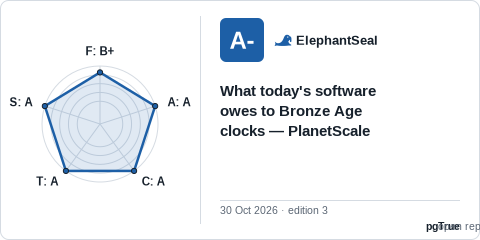
<a href="https://pgtrue.postgres.ai/shared/brief/c6cbff31-ef76-46d8-8a67-e20c21c56757"><img src="https://pgtrue.postgres.ai/badge/c6cbff31-ef76-46d8-8a67-e20c21c56757/wide.svg?v=13&amp;theme=light" alt="pgTrue fact-check" width="480" height="240" loading="lazy" decoding="async" style="display:inline-block;width:480px;height:240px"></a>
https://pgtrue.postgres.ai/badge/c6cbff31-ef76-46d8-8a67-e20c21c56757/wide.svg?v=13&theme=light
.. image:: https://pgtrue.postgres.ai/badge/c6cbff31-ef76-46d8-8a67-e20c21c56757/wide.svg?v=13&theme=light
   :target: https://pgtrue.postgres.ai/shared/brief/c6cbff31-ef76-46d8-8a67-e20c21c56757
   :alt: pgTrue fact-check
   :width: 480
   :height: 240
[![pgTrue fact-check](https://pgtrue.postgres.ai/badge/c6cbff31-ef76-46d8-8a67-e20c21c56757/wide.svg?v=13&theme=dark)](https://pgtrue.postgres.ai/shared/brief/c6cbff31-ef76-46d8-8a67-e20c21c56757)
<a href="https://pgtrue.postgres.ai/shared/brief/c6cbff31-ef76-46d8-8a67-e20c21c56757"><img src="https://pgtrue.postgres.ai/badge/c6cbff31-ef76-46d8-8a67-e20c21c56757/wide.svg?v=13&amp;theme=dark" alt="pgTrue fact-check" width="480" height="240" loading="lazy" decoding="async" style="display:inline-block;width:480px;height:240px"></a>
https://pgtrue.postgres.ai/badge/c6cbff31-ef76-46d8-8a67-e20c21c56757/wide.svg?v=13&theme=dark
.. image:: https://pgtrue.postgres.ai/badge/c6cbff31-ef76-46d8-8a67-e20c21c56757/wide.svg?v=13&theme=dark
   :target: https://pgtrue.postgres.ai/shared/brief/c6cbff31-ef76-46d8-8a67-e20c21c56757
   :alt: pgTrue fact-check
   :width: 480
   :height: 240
[![pgTrue fact-check](https://pgtrue.postgres.ai/badge/c6cbff31-ef76-46d8-8a67-e20c21c56757/wide.svg?v=13)](https://pgtrue.postgres.ai/shared/brief/c6cbff31-ef76-46d8-8a67-e20c21c56757)
<a href="https://pgtrue.postgres.ai/shared/brief/c6cbff31-ef76-46d8-8a67-e20c21c56757"><img src="https://pgtrue.postgres.ai/badge/c6cbff31-ef76-46d8-8a67-e20c21c56757/wide.svg?v=13" alt="pgTrue fact-check" width="480" height="240" loading="lazy" decoding="async" style="display:inline-block;width:480px;height:240px"></a>
https://pgtrue.postgres.ai/badge/c6cbff31-ef76-46d8-8a67-e20c21c56757/wide.svg?v=13
.. image:: https://pgtrue.postgres.ai/badge/c6cbff31-ef76-46d8-8a67-e20c21c56757/wide.svg?v=13
   :target: https://pgtrue.postgres.ai/shared/brief/c6cbff31-ef76-46d8-8a67-e20c21c56757
   :alt: pgTrue fact-check
   :width: 480
   :height: 240

Click the snippet to select all of it, then copy. Where SVG is stripped, as in some email clients and feed readers, change .svg to .png. PNG uses the light theme for Auto. For Markdown PNG embeds, use the HTML snippet where supported to preserve the display size.

Optional colours: append &color=26798E or &labelColor=333C47 after a theme query (use ? for the first parameter). Use 3- or 6-digit hex.

For pages with a light background.

For pages with a dark background. The ElephantSeal gets a thin edge so it does not blend in.

Auto follows the reader's light or dark setting where the host supports it, and shows the light ElephantSeal where it does not.

On a light page
On a dark page

What today's software owes to Bronze Age clocks — PlanetScale (opens in new tab)

planetscale.com
Check before you follow it: 1 claim is wrong.
1
inaccuracy
0
dangerous-recipe
0
misleading
0
imprecise
0
transcription
0
aged
0
withdrawn
7
verified-accurate

Factual B+ · Applicable A · Consistent A · Transparent A · Safe A

ReportTechnical fact-check, edition 3 pgTrue versionaudited with v1.0.14 (approx.) · regraded with v1.1.3 Issued EditionUpdated after review. Corrections are listed below. SubmittedSubmitted by the PostgresAI team. Author responseNo written reply from the author. We re-audited this article 2 times; see Revisions below. Policy: right-of-reply and corrections policy.

Inaccuracies

F1

The concurrency limit covers matching traffic, not one query

INACCURATEFactual · holds up after review

Claim ledger

Article says
Maximum concurrent workers similarly controls the resources a single query can consume…
What is true
Maximum concurrent queries limits the policy's percentage of available worker processes. It applies across matching traffic. Treating it as a single-query worker cap can produce unexpected rejections when several matching queries run.
So what
Size Maximum concurrent queries for all traffic matching the budget. Use Per-query limit for individual query cost.
Charitable reading
Each query receives an admission decision. The concurrency threshold still covers matching traffic collectively.

Source

Source · https://planetscale.com/docs/postgres/traffic-control/conceptsMaximum concurrent queries - Percentage of available worker processes this policy can use
In the article · section “Admission controls but for traffic”

In the article

excerpt · section “Admission controls but for traffic” · as fetched 2026-10-19 · open in article ↗ (opens in new tab)

Admission controls but for traffic

Maximum concurrent workers similarly controls the resources a single query can consume, but measures it by available workers instead of execution time.

All sources and excerpts · 1
EvidenceMaximum concurrent queries - Percentage of available worker processes this policy can use
How the review tested this

Review: We tested whether individual admission decisions justify the wording. E-2 assigns available workers to the policy collectively. The article instead describes individual query consumption. Sizing the shared concurrency limit is a concrete corrective action. Wasted configuration work is a proportionate consequence. We tested the per-query admission reading. E-2 still assigns worker capacity to the policy collectively. The sizing action is concrete.

Dangerous or recipe bugsNone in this edition.

Misleading / impreciseNone in this edition.

Verified accurate

F3

statement_timeout limits elapsed statement time

ACCURATEFactual · holds up after review

Claim ledger

Article says
…configuration options to control expensive queries that have already consumed resources, such as statement_timeout…
What is true
PostgreSQL 18.6 measures statement_timeout from command arrival through completion. postgres.c:5213 enables its elapsed-time timer. The setting does not reserve resources or reject queries by estimated execution cost.
Charitable reading
The article contrasts elapsed-time cancellation with estimated-cost admission. It does not claim that timing starts after execution.

Source

Source · REL_18_6 · doc/src/sgml/config.sgml:10216-10250Abort any statement that takes more than the specified amount of time.
In the article · section “Admission controls and databases”

In the article

excerpt · section “Admission controls and databases” · as fetched 2026-10-19 · open in article ↗ (opens in new tab)

Admission controls and databases

Postgres has some configuration options to control expensive queries that have already consumed resources, such as statement_timeout , but nothing to prevent expensive work before it happens. And so in 2026, PlanetScale brought decision gates to Postgres with Database Traffic Control®.

All sources and excerpts · 4
Evidence Abort any statement that takes more than the specified amount of time.
Evidence enable_timeout_after(STATEMENT_TIMEOUT, StatementTimeout);
Evidence The timeout is measured from the time a command arrives at the server until it is completed by the server.
Evidence if (StatementTimeout > 0 && (StatementTimeout < TransactionTimeout || TransactionTimeout == 0)) { if (!get_timeout_active(STATEMENT_TIMEOUT)) enable_timeout_after(STATEMENT_TIMEOUT, StatementTimeout);
How the review tested this

Review: We checked whether timing before execution contradicts the finding. REL_18_6 confirms elapsed-time cancellation rather than estimated-cost admission. The finding validates statement_timeout, without validating the article's broader assertion about all PostgreSQL admission controls. We reread the timer implementation and checked whether timing includes planning. Elapsed-time cancellation supports the finding's distinction from estimated-cost admission.

F5

Every matching enforced budget must permit the query

ACCURATEConsistent · holds up after review · also flagged 1 more time

Claim ledger

Article says
A query may be targeted by multiple resource budgets and must satisfy all of them to proceed.
What is true
Traffic Control combines matching resource budgets with AND logic. Any matching enforced budget can block the query.
Charitable reading
The statement describes admission under active, enforced budgets.

Source

Source · https://planetscale.com/docs/postgres/traffic-control/conceptsWhen a query matches multiple resource budgets, it must satisfy all of them.
In the article · section “Admission controls but for traffic”

In the article

excerpt · section “Admission controls but for traffic” · as fetched 2026-10-19 · open in article ↗ (opens in new tab)

Admission controls but for traffic

A query may be targeted by multiple resource budgets and must satisfy all of them to proceed.

All sources and excerpts · 2
EvidenceWhen a query matches multiple resource budgets, it must satisfy all of them.
EvidenceMultiple matching budgets all apply simultaneously and queries must satisfy every budget they match.
How the review tested this

Review: We tested Warn and Off modes as counterexamples. The finding explicitly limits blocking to enforced budgets. E-12 and E-26 confirm that matching budgets combine with AND logic. We tested Warn and Off modes as counterexamples. The finding explicitly limits blocking to enforced budgets.

F6

Warning mode matches the documented rollout

ACCURATEFactual · holds up after review

Claim ledger

Article says
…we recommend creating a new budget in warning mode first…
What is true
Traffic Control documentation recommends creating budgets in Warn mode, observing violations, adjusting limits, and then switching to Enforce.
Charitable reading
Warning mode measures potential violations before enforcement. Application preparation remains necessary before blocked queries become errors.

Source

Source · https://planetscale.com/docs/postgres/traffic-control/conceptsCreate a resource budget in Warn mode Observe violation patterns and adjust limits Switch to Enforce once you are confident in the configuration
In the article · section “Database Traffic Control”

In the article

excerpt · section “Database Traffic Control” · as fetched 2026-10-19 · open in article ↗ (opens in new tab)

Database Traffic Control

Creating a resource budget opts you into an expected failure state, so it forces you to reason about the behavior your application should exhibit when queries are blocked. For this reason, we recommend creating a new budget in warning mode first, monitoring how much traffic is affected, preparing your application for blocked queries, and then updating the mode.

All sources and excerpts · 2
EvidenceCreate a resource budget in Warn mode Observe violation patterns and adjust limits Switch to Enforce once you are confident in the configuration
EvidenceCreate a resource budget in Warn mode
How the review tested this

Review: We checked whether the finding promises safety merely from warning mode. It makes no such promise. E-14 explicitly recommends Warn, observation and adjustment, then Enforce. We checked whether warning-first rollout was mandatory or recommended. Both the article and documentation present it as a recommendation.

F7

GraphQL Admin API quotas use app-and-store scope

ACCURATEFactual · holds up after review

Claim ledger

Article says
Each app on each store gets a bucket with a fixed size and restore rate.
What is true
The GraphQL Admin API documentation assigns rate limits to each app-and-store combination. The article describes that scope correctly.
Charitable reading
Fixed describes the configured bucket, not an identical allowance across every store plan.

Source

Source · https://shopify.dev/docs/apps/build/apis/graphql-admin/rate-limitsrate limits are based on the combination of the app and store.
In the article · section “Leaky buckets in API design”

In the article

excerpt · section “Leaky buckets in API design” · as fetched 2026-10-19 · open in article ↗ (opens in new tab)

Leaky buckets in API design

Shopify's GraphQL Admin API implements rate limiting with a documented leaky bucket . Each app on each store gets a bucket with a fixed size and restore rate.

All sources and excerpts · 1
Evidencerate limits are based on the combination of the app and store.
How the review tested this

Review: We tested whether different store plans contradict fixed bucket settings. They do not contradict app-and-store scope. E-16 confirms that scope, which is the finding's limited conclusion. We tested whether plan-dependent rates contradict fixed bucket configuration. They do not contradict the verified app-and-store scope.

F8

GraphQL admission requires capacity for requested cost

ACCURATEFactual · holds up after review

Claim ledger

Article says
Before a query runs, the bucket must have room for its estimated cost.
What is true
The GraphQL Admin API documentation requires available bucket capacity for requested query cost before execution. The quoted admission rule matches that requirement.
Charitable reading
Estimated cost refers to the API's documented requested cost.

Source

Source · https://shopify.dev/docs/apps/build/apis/graphql-admin/rate-limitsan app's bucket must have enough capacity for the requested cost of a query.
In the article · section “Leaky buckets in API design”

In the article

excerpt · section “Leaky buckets in API design” · as fetched 2026-10-19 · open in article ↗ (opens in new tab)

Leaky buckets in API design

Each request costs a different amount based on what the query asks for, not how many requests are made. Before a query runs, the bucket must have room for its estimated cost. Once it completes, the bucket is refunded or charged any difference between the estimated and actual cost. Apps can burst faster than the restore rate until the bucket has no room left, at which point requests are throttled.

All sources and excerpts · 1
Evidencean app's bucket must have enough capacity for the requested cost of a query.
How the review tested this

Review: We tested the distinction between estimated and requested cost. Requested cost is the pre-execution quantity reserved by the API. E-18 supports the finding without validating the separate post-execution charging claim. We compared estimated cost with requested cost in context. Both describe the capacity required before execution.

F11

Verified accurate: “…a 25% server share means a quarter of your server's capacity drains back every second…”

ACCURATEFactual · partly holds after review

Claim ledger

Article says
…a 25% server share means a quarter of your server's capacity drains back every second…
What is true
The 25% example correctly expresses one-quarter of server capacity. Concepts defines server share as a percentage of overall system resources. E-25 supports those proportions. It does not establish CPU-core allocations or verify the article's per-second refill rate.

Source

Source · https://planetscale.com/docs/postgres/traffic-control/conceptsServer share - The max percentage of overall system resources available to queries managed by this budget.
In the article · section “Admission controls but for traffic”

In the article

excerpt · section “Admission controls but for traffic” · as fetched 2026-10-19 · open in article ↗ (opens in new tab)

Admission controls but for traffic

Why is the refill rate measured in server capacity instead of seconds? Because not all time spent executing a query is equal. A query that took 8 cores a single second is different from a query that took one core a single second. Consider different server sizes as well: a 25% server share means a quarter of your server's capacity drains back every second, whether that server has 2 cores or 64.

All sources and excerpts · 1
EvidenceServer share - The max percentage of overall system resources available to queries managed by this budget.
How the review tested this

Review: E-25 supports proportional server capacity. We checked the arithmetic: 25% of 2 cores is 0.5 cores, and 25% of 64 is 16. Those calculations require treating overall resource share as CPU-core allocation. E-25 does not establish that equivalence or the per-second refill formula.

F12

A changed query plan can exhaust CPU resources

ACCURATEFactual · holds up after review

Claim ledger

Article says
…failure of the query planner can ask more of your database than it can reasonably be expected to handle…
What is true
The linked incident describes an index-using query changing to full table scans and consuming all available CPU resources. That supports the article's overload claim about PostgreSQL plan choices.
Charitable reading
Failure means a harmful plan choice, rather than a planner crash.

Source

Source · https://planetscale.com/blog/when-the-postgres-query-planner-goes-rogueA query that was happily using one and running at millisecond latency abruptly starts skipping the index, doing full table scans, and consuming all available CPU resources.
In the article · section “Database Traffic Control”

In the article

excerpt · section “Database Traffic Control” · as fetched 2026-10-19 · open in article ↗ (opens in new tab)

Database Traffic Control

The health of your Postgres database is laid bare at the mercy of your applications. An unexpected connection storm or failure of the query planner can ask more of your database than it can reasonably be expected to handle.

All sources and excerpts · 1
EvidenceA query that was happily using one and running at millisecond latency abruptly starts skipping the index, doing full table scans, and consuming all available CPU resources.
How the review tested this

Review: We tested whether failure requires a planner crash. The article permits a harmful plan choice. E-10 describes that event. The finding attributes the incident account and does not claim independent measurement. We tested whether failure meant a planner crash. The context supports a harmful plan choice. F12 attributes the incident account.

Notes

2 not graded: findings no reader would act on differently
F2

Shopify documents a refund after execution

NOTEholds up after review

Claim ledger

Article says
…the bucket is refunded or charged any difference between the estimated and actual cost.
What is true
Shopify reserves requested query cost before execution. After execution, it refunds requested cost minus actual cost. Its documentation does not describe an additional debit after execution.
Charitable reading
The article describes generic cost reconciliation. Shopify documents reservation followed by a refund.

Source

Source · https://shopify.dev/docs/apps/build/apis/graphql-admin/rate-limitsWhen execution is complete, the bucket is refunded the difference between the requested cost and the actual cost of the query.

Not graded: knowing this would not change what a reader does.

In the article · section “Leaky buckets in API design”

In the article

excerpt · section “Leaky buckets in API design” · as fetched 2026-10-19 · open in article ↗ (opens in new tab)

Leaky buckets in API design

Each request costs a different amount based on what the query asks for, not how many requests are made. Before a query runs, the bucket must have room for its estimated cost. Once it completes, the bucket is refunded or charged any difference between the estimated and actual cost. Apps can burst faster than the restore rate until the bucket has no room left, at which point requests are throttled.

All sources and excerpts · 1
EvidenceWhen execution is complete, the bucket is refunded the difference between the requested cost and the actual cost of the query.
How the review tested this

Review: We tested generic cost reconciliation as a charitable reading. E-4 documents a refund, without describing an additional debit. The finding confines itself to documentation and assigns no material penalty. We tested generic cost reconciliation as shorthand. E-4 documents refunds only. The finding correctly limits its conclusion to documentation.

F4

Note: “An unexpected connection storm or failure of the query planner can ask more of your…”

NOTEpartly holds after review

Claim ledger

Article says
An unexpected connection storm or failure of the query planner can ask more of your database…
What is true
The linked incident describes CPU saturation after a query switched from index access to table scans. PostgreSQL 18.6 documents increased resource allocation when max_connections increases. That configuration statement does not independently establish the article's connection-storm claim.

Source

Source · https://planetscale.com/blog/when-the-postgres-query-planner-goes-rogueA query that was happily using one and running at millisecond latency abruptly starts skipping the index, doing full table scans, and consuming all available CPU resources.

Not graded: no reader would act differently on it.

In the article · section “Database Traffic Control”

In the article

excerpt · section “Database Traffic Control” · as fetched 2026-10-19 · open in article ↗ (opens in new tab)

Database Traffic Control

The health of your Postgres database is laid bare at the mercy of your applications. An unexpected connection storm or failure of the query planner can ask more of your database than it can reasonably be expected to handle.

All sources and excerpts · 2
EvidenceA query that was happily using one and running at millisecond latency abruptly starts skipping the index, doing full table scans, and consuming all available CPU resources.
Evidence <productname>PostgreSQL</productname> sizes certain resources based directly on the value of <varname>max_connections</varname>. Increasing its value leads to higher allocation of those resources, including shared memory.
How the review tested this

Review: E-9 describes allocations caused by increasing max_connections. It does not establish connection-storm behavior at a fixed setting. E-10 supports the query-plan example. Verifying both overload mechanisms exceeds these citations. E-9 describes configured resource allocation. It does not establish connection-storm behavior, so F4 verifies only part of E-8.

More in this report

Section checks · 5 sections

Section checks

AspectGradeFindingsCoverage
Shopify APIA2 verified-accurateno checkable claims
Database admissionA2 verified-accurate100% of claims (3 of 3)
Traffic Control budgetsA2 verified-accurate100% of claims (2 of 2)
Budget settingsA1 verified-accurateno checkable claims
Per-query and concurrency limitsB+1 inaccuracyno checkable claims
Coverage and assessment · Checked 5 of 5 Postgres claims across 12 sections

A- — the findings address the article's main subject. What we did not check is listed below. F1, F5, F6, and F11 directly check Traffic Control's concurrency scope, budget composition, rollout, and server-share settings.

We did not check everything in this article. What we did not check is listed below, in the words we recorded at the time. None of it moved the letter. We never charge our own limits to the article.

What we did not check

  • We did not verify whether Traffic Control uses query plans or reconciles estimated costs against measured execution costs.
  • We did not check MySQL, Oracle Database Resource Manager, or SQL Server Resource Governor.
  • We did not reproduce the customer incident described in the linked query-planner article.
  • We did not verify the water-clock history, the 1986 attribution, or the 1907 neuron-model attribution.
  • We did not verify the Oracle and SQL Server release dates or their workload-rejection capabilities.
  • We did not verify the classification service's launch date, cost, or response latency.
  • We checked Traffic Control's documented configuration semantics, but did not verify its internal cost estimation or resource accounting.
  • We did not establish which linked documentation changed between October 7 and October 19, 2026.
  • We did not reach the author's social profile or the linked social post.
  • We did not verify native PostgreSQL admission controls beyond statement_timeout.
  • We did not check how PostgreSQL handles connection storms.
  • We did not reproduce Traffic Control behavior or the reported overload incident.
  • We did not verify the historical dates or the classification service's response times.
  • We could not decide whether the evidence backs the central claim.
  • We could not decide whether the article depends on finding F1.
Checked 5 of 5 Postgres claims across 12 sections
  • Introduction: no checkable claims; not counted: 4 product or opinion, 8 not a claim
  • Clock history: no checkable claims; not counted: 19 product or opinion, 1 not a claim
  • Software buckets: no checkable claims; not counted: 16 product or opinion, 2 duplicate, 4 not a claim
  • Shopify API: no checkable claims; not counted: 10 product or opinion, 1 not a claim
  • Classification: no checkable claims; not counted: 9 product or opinion, 3 not a claim
  • Lazy draining: no checkable claims; not counted: 9 product or opinion, 1 duplicate, 1 not a claim
  • Database admission: 3 of 3 Postgres claims checked; not counted: 13 product or opinion, 1 duplicate, 1 not a claim
  • Traffic Control budgets: 2 of 2 Postgres claims checked; not counted: 13 product or opinion, 1 not a claim
  • Budget settings: no checkable claims; not counted: 15 product or opinion, 3 not a claim
  • Token buckets: no checkable claims; not counted: 6 product or opinion, 2 not a claim
  • Per-query and concurrency limits: no checkable claims; not counted: 6 product or opinion, 1 not a claim
  • Summary: no checkable claims; not counted: 3 duplicate, 2 not a claim

Average of 5 axes: 3.86 · worst of factual, consistent: B+ · result A-

Some explanatory text is not shown in this edition; the grade and findings are complete.

Scorecard · the five axes
FACTS scorecard Scorecard radar, 5 axes, bigger is better. Overall A-. Factual B+ · 1 wrong of 8 checked · 0 caveats. Applicable A · 0 wrong of 3 checked · 0 caveats. Consistent A · 0 wrong of 8 checked · 0 caveats. Transparent A · 0 wrong of 7 checked · 0 caveats. Safe A · 0 wrong of 4 checked · 0 caveats. B+ 1 wrong of 8 checked · 0 caveatsFactual B+1 wrong of 80 caveats A 0 wrong of 3 checked · 0 caveatsApplicable A0 wrong of 30 caveats A 0 wrong of 8 checked · 0 caveatsConsistent A0 wrong of 80 caveats A 0 wrong of 7 checked · 0 caveatsTransparent A0 wrong of 70 caveats A 0 wrong of 4 checked · 0 caveatsSafe A0 wrong of 40 caveats A-

By topic: Shopify API — 2 findings, 0 wrong · Database admission — 2 findings, 0 wrong · Traffic Control budgets — 2 findings, 0 wrong · Budget settings — 1 finding, 0 wrong · Per-query and concurrency limits — 1 finding, 1 wrong

Further out is better. Each axis has its own letter, from the wrong claims and caveats among the claims we checked of that kind.

Checked on the FACTS: Factual, Applicable, Consistent, Transparent, Safe. Clockwise: Factual (is it true?), Applicable (does it apply to my setup, today?), Consistent (does it agree with itself?), Transparent (can I check it myself?), Safe (can I run this on prod?).

We checked 8 claims.

AxisLetterWrongCaveatsCheckedCoverage
FactualB+108assessed: B+ · 1 wrong of 8 checked · 0 caveats
ApplicableA003assessed: A · 0 wrong of 3 checked · 0 caveats
ConsistentA008assessed: A · 0 wrong of 8 checked · 0 caveats
TransparentA007assessed: A · 0 wrong of 7 checked · 0 caveats
SafeA004assessed: A · 0 wrong of 4 checked · 0 caveats
Topics · 5 topics

Topics

TopicFactualApplicableConsistentTransparentSafe
Shopify API0 issues 2 checked F7 F80 issues 2 checked0 issues 2 checked
Database admission0 issues 2 checked F3 F120 issues 2 checked0 issues 2 checked0 issues 1 checked
Traffic Control budgets0 issues 2 checked F60 issues 1 checked0 issues 2 checked F50 issues 2 checked
Budget settings0 issues 1 checked F110 issues 1 checked0 issues 1 checked
Per-query and concurrency limits1 issue 1 checked F10 issues 1 checked0 issues 1 checked

Issues found among the claims checked, per topic and axis. Each link goes to the finding behind the count.

Revisions: 3 · Not assessed -> A- -> A-

We audited this article 3 times. Each row is the final edition of one audit. Letters and findings of earlier revisions stay readable at their own address.

  1. Revision 1 · Not assessed · audit version not recorded

    Details unavailable.

    ElephantSeal: Not assessed.

  2. Revision 2 · 2026-10-11 03:59 UTC · A- · audit version not recorded · regrade version not recorded

    Same article text, re-audited. 8 accurate · 0 wrong · 3 caveats.

    ElephantSeal: A-.

    Changes: Details unavailable.

  3. Revision 3 · this page · 2026-10-19 07:56 UTC · A- · audited with v1.0.14 (approx.) · regraded with v1.1.3

    Same article text, re-audited. 7 accurate · 1 wrong · 0 caveats.

    ElephantSeal: A-.

    Changes: No longer reported: “Maximum concurrent workers similarly controls the resources a single query can consume…”; “The GraphQL API refunds excess reserved cost”; “…the bucket is refunded or charged any difference between the estimated and actual cost.”. New: F1 “The concurrency limit covers matching traffic, not one query” (false).

Questions and answers

Questions and answers

What is pgTrue?

pgTrue is an independent fact-check of technical Postgres articles, made by PostgresAI. It helps you check advice before you use it.

What does the letter grade mean?

The letter grade summarizes the claims we checked. Five axes show what we checked:

  • Factual: is it true?
  • Applicable: does it apply to my setup, today?
  • Consistent: does it agree with itself?
  • Transparent: can I check it myself?
  • Safe: can I run this in production?

What is the ElephantSeal?

The ElephantSeal is the mark an article earns. It always shows the latest edition. “Open:” lists what is still open.

Can an author reply?

Authors can ask us to correct a finding, reply to it, or withdraw it. Right-of-reply policy.

Paste into your AI assistant to fix the article, then ask for a re-review.

Show the text
Fix the article with this report, then ask pgTrue for a re-review.

# pgTrue report: What today's software owes to Bronze Age clocks — PlanetScale

Article title: What today's software owes to Bronze Age clocks — PlanetScale
Article URL: https://planetscale.com/blog/leaky-buckets-in-software-explained
Report URL: https://pgtrue.postgres.ai/shared/brief/c6cbff31-ef76-46d8-8a67-e20c21c56757
Audited revision: 3 of 3, 2026-10-19 07:56:02 UTC
Overall letter: A-

## Axes

- Factual: B+ · 1 wrong · 8 checked · 0 caveats · assessed
- Applicable: A · 0 wrong · 3 checked · 0 caveats · assessed
- Consistent: A · 0 wrong · 8 checked · 0 caveats · assessed
- Transparent: A · 0 wrong · 7 checked · 0 caveats · assessed
- Safe: A · 0 wrong · 4 checked · 0 caveats · assessed

ElephantSeal: A-.

## Report metadata

- Report: Technical fact-check, edition 3
- pgTrue version: audited with v1.0.14 (approx.) · regraded with v1.1.3
- Issued: 2026-10-19
- Edition: Updated after review. Corrections are listed below.
- Submitted: Submitted by the PostgresAI team.
- Author response: No written reply from the author. We re-audited this article 2 times; see Revisions below. Policy: [right-of-reply and corrections policy](/pgtrue/security).

## Findings needing a change (1)

### F1 · Inaccurate · Factual · The concurrency limit covers matching traffic, not one query
Location: excerpt · section “Admission controls but for traffic” · as fetched 2026-10-19 · [open in article](https://planetscale.com/blog/leaky-buckets-in-software-explained#:~:text=Maximum%20concurrent%20workers%20similarly%20controls,a%20single%20query%20can%20consume)
Article says:
```text
Maximum concurrent workers similarly controls the resources a single query can consume…
```
What is true:
Maximum concurrent queries limits the policy's percentage of available worker processes. It applies across matching traffic. Treating it as a single-query worker cap can produce unexpected rejections when several matching queries run.
So what:
Size Maximum concurrent queries for all traffic matching the budget. Use Per-query limit for individual query cost.
Charitable reading:
Each query receives an admission decision. The concurrency threshold still covers matching traffic collectively.
Review: We tested whether individual admission decisions justify the wording. E-2 assigns available workers to the policy collectively. The article instead describes individual query consumption. Sizing the shared concurrency limit is a concrete corrective action. Wasted configuration work is a proportionate consequence. We tested the per-query admission reading. E-2 still assigns worker capacity to the policy collectively. The sizing action is concrete.

Sources:
- [https://planetscale.com/docs/postgres/traffic-control/concepts](https://planetscale.com/docs/postgres/traffic-control/concepts)
  Excerpt:
  ```text
  Maximum concurrent queries - Percentage of available worker processes this policy can use
  ```

Finding URL: https://pgtrue.postgres.ai/shared/brief/c6cbff31-ef76-46d8-8a67-e20c21c56757#F1

## Verified accurate claims (7)

### F3 · Accurate · Factual · statement_timeout limits elapsed statement time
Location: excerpt · section “Admission controls and databases” · as fetched 2026-10-19 · [open in article](https://planetscale.com/blog/leaky-buckets-in-software-explained#:~:text=configuration%20options%20to%20control%20expensive,consumed%20resources%2C%20such%20as%20statement_timeout)
Article says:
```text
…configuration options to control expensive queries that have already consumed resources, such as statement_timeout…
```
What is true:
PostgreSQL 18.6 measures statement_timeout from command arrival through completion. postgres.c:5213 enables its elapsed-time timer. The setting does not reserve resources or reject queries by estimated execution cost.
Charitable reading:
The article contrasts elapsed-time cancellation with estimated-cost admission. It does not claim that timing starts after execution.
Review: We checked whether timing before execution contradicts the finding. REL_18_6 confirms elapsed-time cancellation rather than estimated-cost admission. The finding validates statement_timeout, without validating the article's broader assertion about all PostgreSQL admission controls. We reread the timer implementation and checked whether timing includes planning. Elapsed-time cancellation supports the finding's distinction from estimated-cost admission.

Sources:
- [REL_18_6 · doc/src/sgml/config.sgml:10216-10250](https://github.com/postgres/postgres/blob/724edf9bde9d356724ad384a2e196edc3c9f80f7/doc/src/sgml/config.sgml#L10216-L10250)
  Excerpt:
  ```text
  Abort any statement that takes more than the specified amount of time.
  ```
- [REL_18_6 · src/backend/tcop/postgres.c:5200-5224](https://github.com/postgres/postgres/blob/724edf9bde9d356724ad384a2e196edc3c9f80f7/src/backend/tcop/postgres.c#L5200-L5224)
  Excerpt:
  ```text
  enable_timeout_after(STATEMENT_TIMEOUT, StatementTimeout);
  ```
- [REL_18_6 · doc/src/sgml/config.sgml:10233-10234](https://github.com/postgres/postgres/blob/724edf9bde9d356724ad384a2e196edc3c9f80f7/doc/src/sgml/config.sgml#L10233-L10234)
  Excerpt:
  ```text
  The timeout is measured from the time a command arrives at the
        server until it is completed by the server.
  ```
- [REL_18_6 · src/backend/tcop/postgres.c:5213-5217](https://github.com/postgres/postgres/blob/724edf9bde9d356724ad384a2e196edc3c9f80f7/src/backend/tcop/postgres.c#L5213-L5217)
  Excerpt:
  ```text
  if (StatementTimeout > 0
		&& (StatementTimeout < TransactionTimeout || TransactionTimeout == 0))
	{
		if (!get_timeout_active(STATEMENT_TIMEOUT))
			enable_timeout_after(STATEMENT_TIMEOUT, StatementTimeout);
  ```

Finding URL: https://pgtrue.postgres.ai/shared/brief/c6cbff31-ef76-46d8-8a67-e20c21c56757#F3

### F5 · Accurate · Consistent · Every matching enforced budget must permit the query
Location: excerpt · section “Admission controls but for traffic” · as fetched 2026-10-19 · [open in article](https://planetscale.com/blog/leaky-buckets-in-software-explained#:~:text=A%20query%20may%20be%20targeted,all%20of%20them%20to%20proceed.)
Article says:
```text
A query may be targeted by multiple resource budgets and must satisfy all of them to proceed.
```
What is true:
Traffic Control combines matching resource budgets with AND logic. Any matching enforced budget can block the query.
Charitable reading:
The statement describes admission under active, enforced budgets.
Review: We tested Warn and Off modes as counterexamples. The finding explicitly limits blocking to enforced budgets. E-12 and E-26 confirm that matching budgets combine with AND logic. We tested Warn and Off modes as counterexamples. The finding explicitly limits blocking to enforced budgets.

Sources:
- [https://planetscale.com/docs/postgres/traffic-control/concepts](https://planetscale.com/docs/postgres/traffic-control/concepts)
  Excerpt:
  ```text
  When a query matches multiple resource budgets, it must satisfy all of them.
  ```
- [https://planetscale.com/blog/patterns-for-postgres-traffic-control](https://planetscale.com/blog/patterns-for-postgres-traffic-control)
  Excerpt:
  ```text
  Multiple matching budgets all apply simultaneously and queries must satisfy every budget they match.
  ```

Finding URL: https://pgtrue.postgres.ai/shared/brief/c6cbff31-ef76-46d8-8a67-e20c21c56757#F5

### F6 · Accurate · Factual · Warning mode matches the documented rollout
Location: excerpt · section “Database Traffic Control” · as fetched 2026-10-19 · [open in article](https://planetscale.com/blog/leaky-buckets-in-software-explained#:~:text=we%20recommend%20creating%20a%20new%20budget%20in%20warning%20mode%20first)
Article says:
```text
…we recommend creating a new budget in warning mode first…
```
What is true:
Traffic Control documentation recommends creating budgets in Warn mode, observing violations, adjusting limits, and then switching to Enforce.
Charitable reading:
Warning mode measures potential violations before enforcement. Application preparation remains necessary before blocked queries become errors.
Review: We checked whether the finding promises safety merely from warning mode. It makes no such promise. E-14 explicitly recommends Warn, observation and adjustment, then Enforce. We checked whether warning-first rollout was mandatory or recommended. Both the article and documentation present it as a recommendation.

Sources:
- [https://planetscale.com/docs/postgres/traffic-control/concepts](https://planetscale.com/docs/postgres/traffic-control/concepts)
  Excerpt:
  ```text
  Create a resource budget in Warn mode Observe violation patterns and adjust limits Switch to Enforce once you are confident in the configuration
  ```
- [https://planetscale.com/docs/postgres/traffic-control/concepts](https://planetscale.com/docs/postgres/traffic-control/concepts)
  Excerpt:
  ```text
  Create a resource budget in Warn mode
  ```

Finding URL: https://pgtrue.postgres.ai/shared/brief/c6cbff31-ef76-46d8-8a67-e20c21c56757#F6

### F7 · Accurate · Factual · GraphQL Admin API quotas use app-and-store scope
Location: excerpt · section “Leaky buckets in API design” · as fetched 2026-10-19 · [open in article](https://planetscale.com/blog/leaky-buckets-in-software-explained#:~:text=Each%20app%20on%20each%20store,fixed%20size%20and%20restore%20rate.)
Article says:
```text
Each app on each store gets a bucket with a fixed size and restore rate.
```
What is true:
The GraphQL Admin API documentation assigns rate limits to each app-and-store combination. The article describes that scope correctly.
Charitable reading:
Fixed describes the configured bucket, not an identical allowance across every store plan.
Review: We tested whether different store plans contradict fixed bucket settings. They do not contradict app-and-store scope. E-16 confirms that scope, which is the finding's limited conclusion. We tested whether plan-dependent rates contradict fixed bucket configuration. They do not contradict the verified app-and-store scope.

Sources:
- [https://shopify.dev/docs/apps/build/apis/graphql-admin/rate-limits](https://shopify.dev/docs/apps/build/apis/graphql-admin/rate-limits)
  Excerpt:
  ```text
  rate limits are based on the combination of the app and store.
  ```

Finding URL: https://pgtrue.postgres.ai/shared/brief/c6cbff31-ef76-46d8-8a67-e20c21c56757#F7

### F8 · Accurate · Factual · GraphQL admission requires capacity for requested cost
Location: excerpt · section “Leaky buckets in API design” · as fetched 2026-10-19 · [open in article](https://planetscale.com/blog/leaky-buckets-in-software-explained#:~:text=Before%20a%20query%20runs%2C%20the,room%20for%20its%20estimated%20cost.)
Article says:
```text
Before a query runs, the bucket must have room for its estimated cost.
```
What is true:
The GraphQL Admin API documentation requires available bucket capacity for requested query cost before execution. The quoted admission rule matches that requirement.
Charitable reading:
Estimated cost refers to the API's documented requested cost.
Review: We tested the distinction between estimated and requested cost. Requested cost is the pre-execution quantity reserved by the API. E-18 supports the finding without validating the separate post-execution charging claim. We compared estimated cost with requested cost in context. Both describe the capacity required before execution.

Sources:
- [https://shopify.dev/docs/apps/build/apis/graphql-admin/rate-limits](https://shopify.dev/docs/apps/build/apis/graphql-admin/rate-limits)
  Excerpt:
  ```text
  an app's bucket must have enough capacity for the requested cost of a query.
  ```

Finding URL: https://pgtrue.postgres.ai/shared/brief/c6cbff31-ef76-46d8-8a67-e20c21c56757#F8

### F11 · Accurate · Factual · Verified accurate: “…a 25% server share means a quarter of your server's capacity drains back every second…”
Location: excerpt · section “Admission controls but for traffic” · as fetched 2026-10-19 · [open in article](https://planetscale.com/blog/leaky-buckets-in-software-explained#:~:text=a%2025%25%20server%20share%20means,capacity%20drains%20back%20every%20second)
Article says:
```text
…a 25% server share means a quarter of your server's capacity drains back every second…
```
What is true:
The 25% example correctly expresses one-quarter of server capacity. Concepts defines server share as a percentage of overall system resources. E-25 supports those proportions. It does not establish CPU-core allocations or verify the article's per-second refill rate.
Review: E-25 supports proportional server capacity. We checked the arithmetic: 25% of 2 cores is 0.5 cores, and 25% of 64 is 16. Those calculations require treating overall resource share as CPU-core allocation. E-25 does not establish that equivalence or the per-second refill formula.

Sources:
- [https://planetscale.com/docs/postgres/traffic-control/concepts](https://planetscale.com/docs/postgres/traffic-control/concepts)
  Excerpt:
  ```text
  Server share - The max percentage of overall system resources available to queries managed by this budget.
  ```

Finding URL: https://pgtrue.postgres.ai/shared/brief/c6cbff31-ef76-46d8-8a67-e20c21c56757#F11

### F12 · Accurate · Factual · A changed query plan can exhaust CPU resources
Location: excerpt · section “Database Traffic Control” · as fetched 2026-10-19 · [open in article](https://planetscale.com/blog/leaky-buckets-in-software-explained#:~:text=failure%20of%20the%20query%20planner,reasonably%20be%20expected%20to%20handle)
Article says:
```text
…failure of the query planner can ask more of your database than it can reasonably be expected to handle…
```
What is true:
The linked incident describes an index-using query changing to full table scans and consuming all available CPU resources. That supports the article's overload claim about PostgreSQL plan choices.
Charitable reading:
Failure means a harmful plan choice, rather than a planner crash.
Review: We tested whether failure requires a planner crash. The article permits a harmful plan choice. E-10 describes that event. The finding attributes the incident account and does not claim independent measurement. We tested whether failure meant a planner crash. The context supports a harmful plan choice. F12 attributes the incident account.

Sources:
- [https://planetscale.com/blog/when-the-postgres-query-planner-goes-rogue](https://planetscale.com/blog/when-the-postgres-query-planner-goes-rogue)
  Excerpt:
  ```text
  A query that was happily using one and running at millisecond latency abruptly starts skipping the index, doing full table scans, and consuming all available CPU resources.
  ```

Finding URL: https://pgtrue.postgres.ai/shared/brief/c6cbff31-ef76-46d8-8a67-e20c21c56757#F12

## Notes (not graded) (2)

### F2 · Note ·  · Shopify documents a refund after execution
Location: excerpt · section “Leaky buckets in API design” · as fetched 2026-10-19 · [open in article](https://planetscale.com/blog/leaky-buckets-in-software-explained#:~:text=the%20bucket%20is%20refunded%20or,the%20estimated%20and%20actual%20cost.)
Article says:
```text
…the bucket is refunded or charged any difference between the estimated and actual cost.
```
What is true:
Shopify reserves requested query cost before execution. After execution, it refunds requested cost minus actual cost. Its documentation does not describe an additional debit after execution.
Charitable reading:
The article describes generic cost reconciliation. Shopify documents reservation followed by a refund.
Explanation: Not graded: knowing this would not change what a reader does.
Review: We tested generic cost reconciliation as a charitable reading. E-4 documents a refund, without describing an additional debit. The finding confines itself to documentation and assigns no material penalty. We tested generic cost reconciliation as shorthand. E-4 documents refunds only. The finding correctly limits its conclusion to documentation.

Sources:
- [https://shopify.dev/docs/apps/build/apis/graphql-admin/rate-limits](https://shopify.dev/docs/apps/build/apis/graphql-admin/rate-limits)
  Excerpt:
  ```text
  When execution is complete, the bucket is refunded the difference between the requested cost and the actual cost of the query.
  ```

Finding URL: https://pgtrue.postgres.ai/shared/brief/c6cbff31-ef76-46d8-8a67-e20c21c56757#F2

### F4 · Note ·  · Note: “An unexpected connection storm or failure of the query planner can ask more of your…”
Location: excerpt · section “Database Traffic Control” · as fetched 2026-10-19 · [open in article](https://planetscale.com/blog/leaky-buckets-in-software-explained#:~:text=An%20unexpected%20connection%20storm%20or,ask%20more%20of%20your%20database)
Article says:
```text
An unexpected connection storm or failure of the query planner can ask more of your database…
```
What is true:
The linked incident describes CPU saturation after a query switched from index access to table scans. PostgreSQL 18.6 documents increased resource allocation when max_connections increases. That configuration statement does not independently establish the article's connection-storm claim.
Explanation: Not graded: no reader would act differently on it.
Review: E-9 describes allocations caused by increasing max_connections. It does not establish connection-storm behavior at a fixed setting. E-10 supports the query-plan example. Verifying both overload mechanisms exceeds these citations. E-9 describes configured resource allocation. It does not establish connection-storm behavior, so F4 verifies only part of E-8.

Sources:
- [https://planetscale.com/blog/when-the-postgres-query-planner-goes-rogue](https://planetscale.com/blog/when-the-postgres-query-planner-goes-rogue)
  Excerpt:
  ```text
  A query that was happily using one and running at millisecond latency abruptly starts skipping the index, doing full table scans, and consuming all available CPU resources.
  ```
- [REL_18_6 · doc/src/sgml/config.sgml:711-713](https://github.com/postgres/postgres/blob/724edf9bde9d356724ad384a2e196edc3c9f80f7/doc/src/sgml/config.sgml#L711-L713)
  Excerpt:
  ```text
  <productname>PostgreSQL</productname> sizes certain resources based directly on the value of
        <varname>max_connections</varname>. Increasing its value leads to
        higher allocation of those resources, including shared memory.
  ```

Finding URL: https://pgtrue.postgres.ai/shared/brief/c6cbff31-ef76-46d8-8a67-e20c21c56757#F4

## Withdrawn findings (0)

None.

## Section checks

- Shopify API · A · 2 verified-accurate · no checkable claims
- Database admission · A · 2 verified-accurate · 100% of claims (3 of 3)
- Traffic Control budgets · A · 2 verified-accurate · 100% of claims (2 of 2)
- Budget settings · A · 1 verified-accurate · no checkable claims
- Per-query and concurrency limits · B+ · 1 inaccuracy · no checkable claims

## Claim coverage

- Introduction: no checkable claims; not counted: 4 product or opinion, 8 not a claim
- Clock history: no checkable claims; not counted: 19 product or opinion, 1 not a claim
- Software buckets: no checkable claims; not counted: 16 product or opinion, 2 duplicate, 4 not a claim
- Shopify API: no checkable claims; not counted: 10 product or opinion, 1 not a claim
- Classification: no checkable claims; not counted: 9 product or opinion, 3 not a claim
- Lazy draining: no checkable claims; not counted: 9 product or opinion, 1 duplicate, 1 not a claim
- Database admission: 3 of 3 Postgres claims checked; not counted: 13 product or opinion, 1 duplicate, 1 not a claim
- Traffic Control budgets: 2 of 2 Postgres claims checked; not counted: 13 product or opinion, 1 not a claim
- Budget settings: no checkable claims; not counted: 15 product or opinion, 3 not a claim
- Token buckets: no checkable claims; not counted: 6 product or opinion, 2 not a claim
- Per-query and concurrency limits: no checkable claims; not counted: 6 product or opinion, 1 not a claim
- Summary: no checkable claims; not counted: 3 duplicate, 2 not a claim

## What we did not check

- We did not verify whether Traffic Control uses query plans or reconciles estimated costs against measured execution costs.
- We did not check MySQL, Oracle Database Resource Manager, or SQL Server Resource Governor.
- We did not reproduce the customer incident described in the linked query-planner article.
- We did not verify the water-clock history, the 1986 attribution, or the 1907 neuron-model attribution.
- We did not verify the Oracle and SQL Server release dates or their workload-rejection capabilities.
- We did not verify the classification service's launch date, cost, or response latency.
- We checked Traffic Control's documented configuration semantics, but did not verify its internal cost estimation or resource accounting.
- We did not establish which linked documentation changed between October 7 and October 19, 2026.
- We did not reach the author's social profile or the linked social post.
- We did not verify native PostgreSQL admission controls beyond statement_timeout.
- We did not check how PostgreSQL handles connection storms.
- We did not reproduce Traffic Control behavior or the reported overload incident.
- We did not verify the historical dates or the classification service's response times.
- We could not decide whether the evidence backs the central claim.
- We could not decide whether the article depends on finding F1.

## Notes

- A- — the findings address the article's main subject. What we did not check is listed below. F1, F5, F6, and F11 directly check Traffic Control's concurrency scope, budget composition, rollout, and server-share settings.
- We did not check everything in this article. What we did not check is listed below, in the words we recorded at the time. None of it moved the letter. We never charge our own limits to the article.
- Average of 5 axes: 3.86 · worst of factual, consistent: B+ · result A-
- Some explanatory text is not shown in this edition; the grade and findings are complete.
- Some checks did not happen for this edition, and each one we know of is listed above.
- Checked against: github.com/postgres/postgres REL_18_6 at commit 724edf9bde9d356724ad384a2e196edc3c9f80f7 (pinned target); https://planetscale.com/blog/author/simeon (fetched 2026-10-19T07:56:18.053690Z); https://planetscale.com/blog/patterns-for-postgres-traffic-control (fetched 2026-10-19T07:56:23.481829Z); https://planetscale.com/blog/when-the-postgres-query-planner-goes-rogue (fetched 2026-10-19T07:56:20.622583Z); https://planetscale.com/docs/postgres/traffic-control (fetched 2026-10-19T07:56:24.758114Z); https://planetscale.com/docs/postgres/traffic-control/concepts (fetched 2026-10-19T07:56:21.809629Z); https://shopify.dev/docs/apps/build/apis/graphql-admin/rate-limits (fetched 2026-10-19T07:56:19.322610Z).
- Article captured 2026-10-19T07:56:02.372994Z · SHA-256 40283fa40842b8c6a8b7bc6f126a5dff4da4ed9d473620b250c3c44bd157ef50 · Text extracted from the article's HTML.
- Policy SHA-256 825c1fe3b8250f792b633f58632d3c05441c5987c61ef0c70eda17e1e8e22d44 · Grading rules SHA-256 6fb334e79d6b9e7ed81d3238cc10d9de602ff87ed65ff2fa781f53bac5798765.
- We did not verify Traffic Control's internal query-plan estimates, cost reconciliation, or resource accounting.
- We did not reproduce Traffic Control behavior or the linked overload incident.
- We did not check PostgreSQL admission controls beyond statement_timeout or the MySQL, Oracle, and SQL Server comparisons.
- We did not verify the water-clock history, the 1986 attribution, or the 1907 neuron-model attribution.
- We did not verify the classification service's launch date, cost, or response latency.
- We did not establish which linked documentation changed between October 7 and October 19, 2026.
- We did not reach the author's social profile or the linked social post.
- The article gives a date without a time. We list October 7, 2026, at midnight UTC.
- review: the findings were written by one model and reviewed independently by a different model.
- 2026-10-30: Regraded under the current grading rules: the letter is the average of the axis letters, with every cap stated under it.
- 4 passages in this edition fell short of our own plain-English rules.
- Built from the article text captured above, one pinned source tree, and 6 fetched pages.
- 9 survived · 2 weakened · 0 withdrawn.

## Revision history

- [Revision 1](https://pgtrue.postgres.ai/shared/brief/c6cbff31-ef76-46d8-8a67-e20c21c56757?v=1) · Not assessed · audit version not recorded
  Details unavailable.
  ElephantSeal: Not assessed.
- [Revision 2](https://pgtrue.postgres.ai/shared/brief/c6cbff31-ef76-46d8-8a67-e20c21c56757?v=21) · 2026-10-11 03:59 UTC · A- · audit version not recorded · regrade version not recorded
  Same article text, re-audited. 8 accurate · 0 wrong · 3 caveats.
  ElephantSeal: A-.
  Changes: Details unavailable.
- [Revision 3](https://pgtrue.postgres.ai/shared/brief/c6cbff31-ef76-46d8-8a67-e20c21c56757?v=28) · this page · 2026-10-19 07:56 UTC · A- · audited with v1.0.14 (approx.) · regraded with v1.1.3
  Same article text, re-audited. 7 accurate · 1 wrong · 0 caveats.
  ElephantSeal: A-.
  Changes: No longer reported: “Maximum concurrent workers similarly controls the resources a single query can consume…”; “The GraphQL API refunds excess reserved cost”; “…the bucket is refunded or charged any difference between the estimated and actual cost.”. New: F1 “The concurrency limit covers matching traffic, not one query” (false).

Updated your article? Request a correction. A new edition appears at this address.