Limited beta · What is this?

pgTrue is under active development: reports may contain significant mistakes, inaccuracies, or bugs. Please report anything you find to pgtrue@postgres.ai.

pgTrue is an independent fact-check of technical Postgres articles. Read the questions and answers.

pgTrue fact-check

ElephantSeal ALimited coverage

Embed

The ElephantSeal always shows this report's latest edition and links here. Copies cached elsewhere may update later.

[![pgTrue fact-check](https://pgtrue.postgres.ai/badge/c0f8019e-7ce4-4284-8254-dd0a5003f83f.svg?v=13&theme=light)](https://pgtrue.postgres.ai/shared/brief/c0f8019e-7ce4-4284-8254-dd0a5003f83f)
<a href="https://pgtrue.postgres.ai/shared/brief/c0f8019e-7ce4-4284-8254-dd0a5003f83f"><img src="https://pgtrue.postgres.ai/badge/c0f8019e-7ce4-4284-8254-dd0a5003f83f.svg?v=13&amp;theme=light" alt="pgTrue fact-check" width="90" height="20" loading="lazy" decoding="async" style="display:inline-block;width:90px;height:20px"></a>
https://pgtrue.postgres.ai/badge/c0f8019e-7ce4-4284-8254-dd0a5003f83f.svg?v=13&theme=light
.. image:: https://pgtrue.postgres.ai/badge/c0f8019e-7ce4-4284-8254-dd0a5003f83f.svg?v=13&theme=light
   :target: https://pgtrue.postgres.ai/shared/brief/c0f8019e-7ce4-4284-8254-dd0a5003f83f
   :alt: pgTrue fact-check
   :width: 90
   :height: 20
[![pgTrue fact-check](https://pgtrue.postgres.ai/badge/c0f8019e-7ce4-4284-8254-dd0a5003f83f.svg?v=13&theme=dark)](https://pgtrue.postgres.ai/shared/brief/c0f8019e-7ce4-4284-8254-dd0a5003f83f)
<a href="https://pgtrue.postgres.ai/shared/brief/c0f8019e-7ce4-4284-8254-dd0a5003f83f"><img src="https://pgtrue.postgres.ai/badge/c0f8019e-7ce4-4284-8254-dd0a5003f83f.svg?v=13&amp;theme=dark" alt="pgTrue fact-check" width="90" height="20" loading="lazy" decoding="async" style="display:inline-block;width:90px;height:20px"></a>
https://pgtrue.postgres.ai/badge/c0f8019e-7ce4-4284-8254-dd0a5003f83f.svg?v=13&theme=dark
.. image:: https://pgtrue.postgres.ai/badge/c0f8019e-7ce4-4284-8254-dd0a5003f83f.svg?v=13&theme=dark
   :target: https://pgtrue.postgres.ai/shared/brief/c0f8019e-7ce4-4284-8254-dd0a5003f83f
   :alt: pgTrue fact-check
   :width: 90
   :height: 20
[![pgTrue fact-check](https://pgtrue.postgres.ai/badge/c0f8019e-7ce4-4284-8254-dd0a5003f83f.svg?v=13)](https://pgtrue.postgres.ai/shared/brief/c0f8019e-7ce4-4284-8254-dd0a5003f83f)
<a href="https://pgtrue.postgres.ai/shared/brief/c0f8019e-7ce4-4284-8254-dd0a5003f83f"><img src="https://pgtrue.postgres.ai/badge/c0f8019e-7ce4-4284-8254-dd0a5003f83f.svg?v=13" alt="pgTrue fact-check" width="90" height="20" loading="lazy" decoding="async" style="display:inline-block;width:90px;height:20px"></a>
https://pgtrue.postgres.ai/badge/c0f8019e-7ce4-4284-8254-dd0a5003f83f.svg?v=13
.. image:: https://pgtrue.postgres.ai/badge/c0f8019e-7ce4-4284-8254-dd0a5003f83f.svg?v=13
   :target: https://pgtrue.postgres.ai/shared/brief/c0f8019e-7ce4-4284-8254-dd0a5003f83f
   :alt: pgTrue fact-check
   :width: 90
   :height: 20
[![pgTrue fact-check](https://pgtrue.postgres.ai/badge/c0f8019e-7ce4-4284-8254-dd0a5003f83f/radar.svg?v=13&theme=light)](https://pgtrue.postgres.ai/shared/brief/c0f8019e-7ce4-4284-8254-dd0a5003f83f)
<a href="https://pgtrue.postgres.ai/shared/brief/c0f8019e-7ce4-4284-8254-dd0a5003f83f"><img src="https://pgtrue.postgres.ai/badge/c0f8019e-7ce4-4284-8254-dd0a5003f83f/radar.svg?v=13&amp;theme=light" alt="pgTrue fact-check" width="240" height="240" loading="lazy" decoding="async" style="display:inline-block;width:240px;height:240px"></a>
https://pgtrue.postgres.ai/badge/c0f8019e-7ce4-4284-8254-dd0a5003f83f/radar.svg?v=13&theme=light
.. image:: https://pgtrue.postgres.ai/badge/c0f8019e-7ce4-4284-8254-dd0a5003f83f/radar.svg?v=13&theme=light
   :target: https://pgtrue.postgres.ai/shared/brief/c0f8019e-7ce4-4284-8254-dd0a5003f83f
   :alt: pgTrue fact-check
   :width: 240
   :height: 240
[![pgTrue fact-check](https://pgtrue.postgres.ai/badge/c0f8019e-7ce4-4284-8254-dd0a5003f83f/radar.svg?v=13&theme=dark)](https://pgtrue.postgres.ai/shared/brief/c0f8019e-7ce4-4284-8254-dd0a5003f83f)
<a href="https://pgtrue.postgres.ai/shared/brief/c0f8019e-7ce4-4284-8254-dd0a5003f83f"><img src="https://pgtrue.postgres.ai/badge/c0f8019e-7ce4-4284-8254-dd0a5003f83f/radar.svg?v=13&amp;theme=dark" alt="pgTrue fact-check" width="240" height="240" loading="lazy" decoding="async" style="display:inline-block;width:240px;height:240px"></a>
https://pgtrue.postgres.ai/badge/c0f8019e-7ce4-4284-8254-dd0a5003f83f/radar.svg?v=13&theme=dark
.. image:: https://pgtrue.postgres.ai/badge/c0f8019e-7ce4-4284-8254-dd0a5003f83f/radar.svg?v=13&theme=dark
   :target: https://pgtrue.postgres.ai/shared/brief/c0f8019e-7ce4-4284-8254-dd0a5003f83f
   :alt: pgTrue fact-check
   :width: 240
   :height: 240
[![pgTrue fact-check](https://pgtrue.postgres.ai/badge/c0f8019e-7ce4-4284-8254-dd0a5003f83f/radar.svg?v=13)](https://pgtrue.postgres.ai/shared/brief/c0f8019e-7ce4-4284-8254-dd0a5003f83f)
<a href="https://pgtrue.postgres.ai/shared/brief/c0f8019e-7ce4-4284-8254-dd0a5003f83f"><img src="https://pgtrue.postgres.ai/badge/c0f8019e-7ce4-4284-8254-dd0a5003f83f/radar.svg?v=13" alt="pgTrue fact-check" width="240" height="240" loading="lazy" decoding="async" style="display:inline-block;width:240px;height:240px"></a>
https://pgtrue.postgres.ai/badge/c0f8019e-7ce4-4284-8254-dd0a5003f83f/radar.svg?v=13
.. image:: https://pgtrue.postgres.ai/badge/c0f8019e-7ce4-4284-8254-dd0a5003f83f/radar.svg?v=13
   :target: https://pgtrue.postgres.ai/shared/brief/c0f8019e-7ce4-4284-8254-dd0a5003f83f
   :alt: pgTrue fact-check
   :width: 240
   :height: 240
[![pgTrue fact-check](https://pgtrue.postgres.ai/badge/c0f8019e-7ce4-4284-8254-dd0a5003f83f/wide.svg?v=13&theme=light)](https://pgtrue.postgres.ai/shared/brief/c0f8019e-7ce4-4284-8254-dd0a5003f83f)
<a href="https://pgtrue.postgres.ai/shared/brief/c0f8019e-7ce4-4284-8254-dd0a5003f83f"><img src="https://pgtrue.postgres.ai/badge/c0f8019e-7ce4-4284-8254-dd0a5003f83f/wide.svg?v=13&amp;theme=light" alt="pgTrue fact-check" width="480" height="240" loading="lazy" decoding="async" style="display:inline-block;width:480px;height:240px"></a>
https://pgtrue.postgres.ai/badge/c0f8019e-7ce4-4284-8254-dd0a5003f83f/wide.svg?v=13&theme=light
.. image:: https://pgtrue.postgres.ai/badge/c0f8019e-7ce4-4284-8254-dd0a5003f83f/wide.svg?v=13&theme=light
   :target: https://pgtrue.postgres.ai/shared/brief/c0f8019e-7ce4-4284-8254-dd0a5003f83f
   :alt: pgTrue fact-check
   :width: 480
   :height: 240
[![pgTrue fact-check](https://pgtrue.postgres.ai/badge/c0f8019e-7ce4-4284-8254-dd0a5003f83f/wide.svg?v=13&theme=dark)](https://pgtrue.postgres.ai/shared/brief/c0f8019e-7ce4-4284-8254-dd0a5003f83f)
<a href="https://pgtrue.postgres.ai/shared/brief/c0f8019e-7ce4-4284-8254-dd0a5003f83f"><img src="https://pgtrue.postgres.ai/badge/c0f8019e-7ce4-4284-8254-dd0a5003f83f/wide.svg?v=13&amp;theme=dark" alt="pgTrue fact-check" width="480" height="240" loading="lazy" decoding="async" style="display:inline-block;width:480px;height:240px"></a>
https://pgtrue.postgres.ai/badge/c0f8019e-7ce4-4284-8254-dd0a5003f83f/wide.svg?v=13&theme=dark
.. image:: https://pgtrue.postgres.ai/badge/c0f8019e-7ce4-4284-8254-dd0a5003f83f/wide.svg?v=13&theme=dark
   :target: https://pgtrue.postgres.ai/shared/brief/c0f8019e-7ce4-4284-8254-dd0a5003f83f
   :alt: pgTrue fact-check
   :width: 480
   :height: 240
[![pgTrue fact-check](https://pgtrue.postgres.ai/badge/c0f8019e-7ce4-4284-8254-dd0a5003f83f/wide.svg?v=13)](https://pgtrue.postgres.ai/shared/brief/c0f8019e-7ce4-4284-8254-dd0a5003f83f)
<a href="https://pgtrue.postgres.ai/shared/brief/c0f8019e-7ce4-4284-8254-dd0a5003f83f"><img src="https://pgtrue.postgres.ai/badge/c0f8019e-7ce4-4284-8254-dd0a5003f83f/wide.svg?v=13" alt="pgTrue fact-check" width="480" height="240" loading="lazy" decoding="async" style="display:inline-block;width:480px;height:240px"></a>
https://pgtrue.postgres.ai/badge/c0f8019e-7ce4-4284-8254-dd0a5003f83f/wide.svg?v=13
.. image:: https://pgtrue.postgres.ai/badge/c0f8019e-7ce4-4284-8254-dd0a5003f83f/wide.svg?v=13
   :target: https://pgtrue.postgres.ai/shared/brief/c0f8019e-7ce4-4284-8254-dd0a5003f83f
   :alt: pgTrue fact-check
   :width: 480
   :height: 240

Click the snippet to select all of it, then copy. Where SVG is stripped, as in some email clients and feed readers, change .svg to .png. PNG uses the light theme for Auto. For Markdown PNG embeds, use the HTML snippet where supported to preserve the display size.

Optional colours: append &color=26798E or &labelColor=333C47 after a theme query (use ? for the first parameter). Use 3- or 6-digit hex.

For pages with a light background.

For pages with a dark background. The ElephantSeal gets a thin edge so it does not blend in.

Auto follows the reader's light or dark setting where the host supports it, and shows the light ElephantSeal where it does not.

On a light page
On a dark page

pg_upgrade (opens in new tab)

postgresql.org
Sound as far as we checked.
0
inaccuracy
0
dangerous-recipe
0
misleading
0
imprecise
0
transcription
0
aged
0
withdrawn
23
verified-accurate

Factual A · Applicable A · Consistent A · Transparent — · Safe A

ReportTechnical fact-check, edition 3 Issued EditionUpdated after review. Corrections are listed below. SubmittedSubmitted by the PostgresAI team. Author responseNo written reply from the author. The article changed 1 time after our first audit; we re-audited each version. See Revisions below. Policy: right-of-reply and corrections policy. pgTrue versionaudited with v1.0.17 (approx.) · regraded with v1.1.0 (approx.)

InaccuraciesNone in this edition.

Dangerous or recipe bugsNone in this edition.

Misleading / impreciseNone in this edition.

Verified accurate

F2

Verified accurate: “pg_upgrade defaults to running servers on port 50432…”

ACCURATEFactual · partly holds after review

Claim ledger

Article says
pg_upgrade defaults to running servers on port 50432…
What is true
pg_upgrade.h:20 defines port 50432. option.c:82-83 assigns that default to both clusters unless PGPORTOLD or PGPORTNEW supplies another value.

Source

Source · REL_18_6 · src/bin/pg_upgrade/pg_upgrade.h:20-20#define DEF_PGUPORT 50432
In the article · section “Note”

In the article

excerpt · section “Note” · as fetched 2026-10-21 · open in article ↗ (opens in new tab)

Note

Obviously, no one should be accessing the clusters during the upgrade. pg_upgrade defaults to running servers on port 50432 to avoid unintended client connections. You can use the same port number for both clusters when doing an upgrade because the old and new clusters will not be running at the same time. However, when checking an old running server, the old and new port numbers must be different.

All sources and excerpts · 2
Evidence#define DEF_PGUPORT 50432
Evidence old_cluster.port = getenv("PGPORTOLD") ? atoi(getenv("PGPORTOLD")) : DEF_PGUPORT; new_cluster.port = getenv("PGPORTNEW") ? atoi(getenv("PGPORTNEW")) : DEF_PGUPORT;
How the review tested this

Review: We checked initialization and environment overrides. E-8 covers those assignments, but excludes command-line parsing. Remove the additional override claim.

F3

Verified accurate: “See recovery_init_sync_method for information about the caveats…”

ACCURATEFactual · partly holds after review

Claim ledger

Article says
See recovery_init_sync_method for information about the caveats…
What is true
config.sgml:11771-11774 warns that Linux before 5.8 may omit reporting write errors to PostgreSQL. fd.c:3640-3646 describes filesystem-wide syncfs synchronization. These support the article's cross-reference.

Source

Source · REL_18_6 · doc/src/sgml/config.sgml:11771-11774Furthermore, on versions of Linux before 5.8, I/O errors encountered while writing data to disk may not be reported to <productname>PostgreSQL</productname>, and relevant error messages may appear only in kernel logs.
In the article · section “Options”

In the article

excerpt · section “Options” · as fetched 2026-10-21 · open in article ↗ (opens in new tab)

Options

On Linux, syncfs may be used instead to ask the operating system to synchronize the whole file systems that contain the upgraded cluster's data directory, its WAL files, and each tablespace. See recovery_init_sync_method for information about the caveats to be aware of when using syncfs .

All sources and excerpts · 2
Evidence Furthermore, on versions of Linux before 5.8, I/O errors encountered while writing data to disk may not be reported to <productname>PostgreSQL</productname>, and relevant error messages may appear only in kernel logs.
Evidence * can use syncfs() to sync whole filesystems. We only expect
How the review tested this

Review: We tested whether the cross-reference confuses configuration settings. The cited ranges support the caveat and filesystem scope, but exclude pg_upgrade option selection.

F4

Physical standbys require wal_level above minimal

ACCURATEFactual · holds up after review

Claim ledger

Article says
…wal_level is not set to minimal…
What is true
postmaster.c:852-854 rejects startup when max_wal_senders exceeds zero and wal_level equals minimal. The article correctly excludes minimal for the new primary serving physical standbys.
Charitable reading
The instruction states a necessary condition for physical replication. It does not claim that condition completes replication configuration.

Source

Source · REL_18_6 · src/backend/postmaster/postmaster.c:852-854if (max_wal_senders > 0 && wal_level == WAL_LEVEL_MINIMAL)
In the article · section “Note”

In the article

excerpt · section “Note” · as fetched 2026-10-21 · open in article ↗ (opens in new tab)

Note

If you are upgrading standby servers using methods outlined in section Step 11 , verify that the old standby servers are caught up by running pg_controldata against the old primary and standby clusters. Verify that the “ Latest checkpoint location ” values match in all clusters. Also, make sure wal_level is not set to minimal in the postgresql.conf file on the new primary cluster.

All sources and excerpts · 1
Evidence if (max_wal_senders > 0 && wal_level == WAL_LEVEL_MINIMAL)
How the review tested this

Review: We checked the max_wal_senders condition. The finding correctly treats nonminimal WAL as necessary for the stated streaming setup. We checked the max_wal_senders condition. The article states a necessary replication prerequisite, and the startup rejection supports it.

F5

The documented standby upgrade does not require pg_backup_start

ACCURATEFactual · holds up after review

Claim ledger

Article says
…You do not need to run pg_backup_start() and pg_backup_stop()…
What is true
pgupgrade.sgml:766-769 explicitly exempts this synchronized standby procedure from pg_backup_start. The exemption applies after the preceding shutdown and synchronization steps.
Charitable reading
The exemption follows shutdown, checkpoint matching, link-mode upgrade, and standby synchronization.

Source

Source · REL_18_6 · doc/src/sgml/ref/pgupgrade.sgml:766-769Configure the servers for log shipping. (You do not need to run <function>pg_backup_start()</function> and <function>pg_backup_stop()</function> or take a file system backup as the standbys are still synchronized
In the article · section “Note”

In the article

excerpt · section “Note” · as fetched 2026-10-21 · open in article ↗ (opens in new tab)

Note

Configure the servers for log shipping. (You do not need to run pg_backup_start() and pg_backup_stop() or take a file system backup as the standbys are still synchronized with the primary.) If the old primary is prior to version 17.0, then no slots on the primary are copied to the new standby, so all the slots on the old standby must be recreated manually. If the old primary is version 17.0 or later, then only logical slots on the primary are copied to the new standby, but other slots on the old standby are not copied, so must be recreated manually.

All sources and excerpts · 1
Evidence Configure the servers for log shipping. (You do not need to run <function>pg_backup_start()</function> and <function>pg_backup_stop()</function> or take a file system backup as the standbys are still synchronized
How the review tested this

Review: We tested the exemption against its shutdown and synchronization prerequisites. The finding preserves those conditions. We tested the exemption as conditional standby guidance. The source explicitly limits it to standbys still synchronized with the primary.

F6

Verified accurate: “…PGOPTIONS='-c vacuum_cost_delay=0' vacuumdb…”

ACCURATEFactual · partly holds after review

Claim ledger

Article says
…PGOPTIONS='-c vacuum_cost_delay=0' vacuumdb…
What is true
config.sgml:9360-9364 defines zero as disabling cost-based vacuum delay. autovacuum.c:1681-1687 clears VacuumCostActive when vacuum_cost_delay is zero. These ranges establish the zero-delay behavior.

Source

Source · REL_18_6 · doc/src/sgml/config.sgml:9360-9364limit has been exceeded. If this value is specified without units, it is taken as milliseconds. The default value is <literal>0</literal>, which disables the cost-based vacuum delay feature. Positive values enable cost-based vacuuming.
In the article · section “Caution”

In the article

excerpt · section “Caution” · as fetched 2026-10-21 · open in article ↗ (opens in new tab)

Caution

First, use vacuumdb --all --analyze-in-stages --missing-stats-only to quickly generate minimal optimizer statistics for relations without any. Then, use vacuumdb --all --analyze-only to ensure all relations have updated cumulative statistics for triggering vacuum and analyze. For both commands, the use of --jobs can speed it up. If vacuum_cost_delay is set to a non-zero value, this can be overridden to speed up statistics generation using PGOPTIONS , e.g., PGOPTIONS='-c vacuum_cost_delay=0' vacuumdb ... .

All sources and excerpts · 2
Evidence limit has been exceeded. If this value is specified without units, it is taken as milliseconds. The default value is <literal>0</literal>, which disables the cost-based vacuum delay feature. Positive values enable cost-based vacuuming.
Evidence else if (vacuum_cost_delay > 0) VacuumCostActive = true; else { VacuumCostActive = false; VacuumCostBalance = 0; }
How the review tested this

Review: We preserved the article's positive-delay condition. E-18 shows delay activation, but excludes the preceding assignment for explicit ANALYZE. Narrow the explanation.

F7

Verified accurate: “If you did start the new cluster, it has written to shared files…”

ACCURATEFactual · partly holds after review

Claim ledger

Article says
If you did start the new cluster, it has written to shared files…
What is true
pg_upgrade.c:176-179 states that link mode makes restarting the old cluster unsafe after the new cluster starts. This matches the article's link-mode rollback warning.

Source

Source · REL_18_6 · src/bin/pg_upgrade/pg_upgrade.c:176-179* this point. We do this here because it is just before file transfer, * which for --link will make it unsafe to start the old cluster once the * new cluster is started, and for --swap will make it unsafe to start the * old cluster at all.
In the article · section “Caution”

In the article

excerpt · section “Caution” · as fetched 2026-10-21 · open in article ↗ (opens in new tab)

Caution

If you did start the new cluster, it has written to shared files and it is unsafe to use the old cluster. The old cluster will need to be restored from backup in this case.

All sources and excerpts · 1
Evidence * this point. We do this here because it is just before file transfer, * which for --link will make it unsafe to start the old cluster once the * new cluster is started, and for --swap will make it unsafe to start the * old cluster at all.
How the review tested this

Review: We checked the link-mode qualification. E-20 states the rollback boundary, but contains neither relation-file linking nor control-file renaming.

F8

Verified accurate: “…Unless the --no-statistics option is specified, pg_upgrade will transfer most optimizer…”

ACCURATEFactual · partly holds after review

Claim ledger

Article says
…Unless the --no-statistics option is specified, pg_upgrade will transfer most optimizer statistics…
What is true
PostgreSQL 18.6 enables statistics transfer in option.c:76. dump.c:65 selects --statistics unless the user disables it. These checks establish the default, not which statistics transfer or which regeneration commands complete the upgrade.

Source

Source · REL_18_6 · src/bin/pg_upgrade/option.c:75-76user_opts.transfer_mode = TRANSFER_MODE_COPY; user_opts.do_statistics = true;
In the article · section “Caution”

In the article

excerpt · section “Caution” · as fetched 2026-10-21 · open in article ↗ (opens in new tab)

Caution

Unless the --no-statistics option is specified, pg_upgrade will transfer most optimizer statistics from the old cluster to the new cluster. This does not transfer all statistics, such as those created explicitly with CREATE STATISTICS , custom statistics added by an extension, or statistics collected by the cumulative statistics system.

All sources and excerpts · 2
Evidence user_opts.transfer_mode = TRANSFER_MODE_COPY; user_opts.do_statistics = true;
Evidence user_opts.do_statistics ? "--statistics" : "--no-statistics",
How the review tested this

Review: The default and dump argument check out. The recorded evidence does not include check.c:825-831 or verify its regeneration recommendations. The default and dump option match. No recorded source range supports the additional check.c:825-831 recommendation. We remove that assertion.

F9

Verified accurate: “…regcollation regconfig regdictionary regnamespace regoper regoperator regproc…”

ACCURATEFactual · partly holds after review

Claim ledger

Article says
…regcollation regconfig regdictionary regnamespace regoper regoperator regproc regprocedure…
What is true
check.c:170-177 lists regcollation, regconfig, regdictionary, regnamespace, regoper, regoperator, regproc, and regprocedure. All 8 names match the article's unsupported column-type list.

Source

Source · REL_18_6 · src/bin/pg_upgrade/check.c:170-177" 'regcollation', " " 'regconfig', " " 'regdictionary', " " 'regnamespace', " " 'regoper', " " 'regoperator', " " 'regproc', " " 'regprocedure' "
In the article · section “Notes”

In the article

excerpt · section “Notes” · as fetched 2026-10-21 · open in article ↗ (opens in new tab)

Notes

regcollation regconfig regdictionary regnamespace regoper regoperator regproc regprocedure
All sources and excerpts · 1
Evidence " 'regcollation', " " 'regconfig', " " 'regdictionary', " " 'regnamespace', " " 'regoper', " " 'regoperator', " " 'regproc', " " 'regprocedure' "
How the review tested this

Review: We compared all 8 type names. They match. The comments explaining regclass, regrole, and regtype fall outside E-25's lines 170-177.

F11

PostgreSQL 18 retains the 9.2 source-version floor

ACCURATEFactual · holds up after review

Claim ledger

Article says
…supports upgrades from 9.2.X and later…
What is true
PostgreSQL 18.6 rejects source versions below 9.2 in src/bin/pg_upgrade/check.c:863. The same function requires the destination major version to match the utility. It also rejects downgrades.
Charitable reading
The source-version floor applies to PostgreSQL 18's utility, subject to its other compatibility checks.

Source

Source · REL_18_6 · src/bin/pg_upgrade/check.c:850-879if (GET_MAJOR_VERSION(old_cluster.major_version) < 902) pg_fatal("This utility can only upgrade from PostgreSQL version %s and later.", "9.2");
In the article · section “Description”

In the article

excerpt · section “Description” · as fetched 2026-10-21 · open in article ↗ (opens in new tab)

Description

pg_upgrade supports upgrades from 9.2.X and later to the current major release of PostgreSQL , including snapshot and beta releases.

All sources and excerpts · 1
Evidence if (GET_MAJOR_VERSION(old_cluster.major_version) < 902) pg_fatal("This utility can only upgrade from PostgreSQL version %s and later.", "9.2");
How the review tested this

Review: We checked destination-version and downgrade restrictions. The finding preserves them alongside the 9.2 source floor. We checked destination-version and downgrade restrictions. Neither contradicts the PostgreSQL 9.2 source-version floor.

F12

PostgreSQL 18 stores cluster char signedness

ACCURATEFactual · holds up after review

Claim ledger

Article says
Starting from PostgreSQL 18, database clusters maintain their own default char signedness setting…
What is true
PostgreSQL 18.0 and 18.6 store default_char_signedness in src/include/catalog/pg_control.h:228. PostgreSQL 18.0's upgrade code states that earlier clusters lack this information. It derives their initial value from the platform where pg_upgrade was built.
Charitable reading
The claim concerns the stored cluster setting, rather than changing the C compiler's char defaults.

Source

Source · REL_18_0 · src/include/catalog/pg_control.h:218-231bool default_char_signedness;
In the article · section “Options”

In the article

excerpt · section “Options” · as fetched 2026-10-21 · open in article ↗ (opens in new tab)

Options

Starting from PostgreSQL 18, database clusters maintain their own default char signedness setting, which can be used to ensure consistent behavior across platforms with different default char signedness. By default, pg_upgrade preserves the char signedness setting when upgrading from an existing cluster. However, when upgrading from PostgreSQL 17 or earlier, pg_upgrade adopts the char signedness of the platform on which it was built.

All sources and excerpts · 3
Evidence bool default_char_signedness;

Version note: Checked the PostgreSQL 18.0 release boundary.

Evidence bool default_char_signedness;
Evidence * Pre-v18 database clusters don't have the default char signedness * information. We use the char signedness of the platform where * pg_upgrade was built.

Version note: Checked the PostgreSQL 18.0 release boundary.

How the review tested this

Review: We tested whether the field appeared only in a later minor release. PostgreSQL 18.0 contains it and handles earlier clusters separately. We distinguished stored cluster signedness from compiler behavior. Both PostgreSQL 18 releases contain the field and earlier-cluster handling.

F13

The PostgreSQL 17 slot migration boundary holds

ACCURATEFactual · holds up after review

Claim ledger

Article says
…only logical slots on the primary are copied…
What is true
PostgreSQL 17.0 and 18.6 restrict slot migration to logical slots. Their upgrade checks identify PostgreSQL 17 as the source-version boundary. Physical slots require recreation. The article states this distinction.
Charitable reading
The sentence applies when the old primary is PostgreSQL 17.0 or later. It does not promise migration of every logical slot.

Source

Source · REL_17_0 · src/bin/pg_upgrade/info.c:650-678"WHERE slot_type = 'logical' AND "
In the article · section “Note”

In the article

excerpt · section “Note” · as fetched 2026-10-21 · open in article ↗ (opens in new tab)

Note

Configure the servers for log shipping. (You do not need to run pg_backup_start() and pg_backup_stop() or take a file system backup as the standbys are still synchronized with the primary.) If the old primary is prior to version 17.0, then no slots on the primary are copied to the new standby, so all the slots on the old standby must be recreated manually. If the old primary is version 17.0 or later, then only logical slots on the primary are copied to the new standby, but other slots on the old standby are not copied, so must be recreated manually.

All sources and excerpts · 4
Evidence "WHERE slot_type = 'logical' AND "

Version note: Checked the PostgreSQL 17.0 release boundary.

Evidence "WHERE slot_type = 'logical' AND "
Evidence if (GET_MAJOR_VERSION(old_cluster.major_version) >= 1700)

Version note: Checked the PostgreSQL 17.0 release boundary.

Evidence if (GET_MAJOR_VERSION(old_cluster.major_version) >= 1700)
How the review tested this

Review: We checked temporary-slot exclusions and the PostgreSQL 17 boundary. Neither contradicts the claim that only logical slots migrate. We tested whether 'only logical' promises every logical slot. It does not. The source excludes temporary slots and confirms the PostgreSQL 17 boundary.

F14

Link mode prevents safe rollback after the upgraded cluster starts

ACCURATEFactual · holds up after review

Claim ledger

Article says
…it has written to shared files and it is unsafe to use the old cluster.
What is true
pg_upgrade.c:177-179 confirms the link-mode restart boundary. controldata.c:765-766 renames the old control file with a .old suffix. The article's rollback warning matches PostgreSQL 18.6.
Charitable reading
The warning concerns starting the upgraded cluster after a link-mode upgrade.

Source

Source · REL_18_6 · src/bin/pg_upgrade/pg_upgrade.c:139-228* which for --link will make it unsafe to start the old cluster once the * new cluster is started, and for --swap will make it unsafe to start the * old cluster at all.
In the article · section “Caution”

In the article

excerpt · section “Caution” · as fetched 2026-10-21 · open in article ↗ (opens in new tab)

Caution

If you did start the new cluster, it has written to shared files and it is unsafe to use the old cluster. The old cluster will need to be restored from backup in this case.

All sources and excerpts · 2
Evidence * which for --link will make it unsafe to start the old cluster once the * new cluster is started, and for --swap will make it unsafe to start the * old cluster at all.
Evidence snprintf(new_path, sizeof(new_path), "%s/%s.old", old_cluster.pgdata, XLOG_CONTROL_FILE); if (pg_mv_file(old_path, new_path) != 0)
How the review tested this

Review: We checked whether renaming pg_control alone makes rollback unsafe. The finding correctly identifies the later link-mode startup boundary. We checked the warning's link-mode context. Source comments and the control-file warning state the same rollback boundary.

F15

Swap mode has an earlier rollback boundary than link mode

ACCURATEFactual · holds up after review

Claim ledger

Article says
…once the file transfer step begins, the old cluster will be destructively modified…
What is true
pg_upgrade.c:178-179 warns that swap mode makes the old cluster unsafe to start during file transfer. The article distinguishes this boundary from link mode's later restart boundary.
Charitable reading
The statement applies to --swap after file transfer begins.

Source

Source · REL_18_6 · src/bin/pg_upgrade/pg_upgrade.c:139-228* which for --link will make it unsafe to start the old cluster once the * new cluster is started, and for --swap will make it unsafe to start the * old cluster at all.
In the article · section “Options”

In the article

excerpt · section “Options” · as fetched 2026-10-21 · open in article ↗ (opens in new tab)

Options

Additionally, once the file transfer step begins, the old cluster will be destructively modified and therefore will no longer be safe to start. See Step 17 for details.

All sources and excerpts · 1
Evidence * which for --link will make it unsafe to start the old cluster once the * new cluster is started, and for --swap will make it unsafe to start the * old cluster at all.
How the review tested this

Review: We compared swap and link handling before transfer. The code states their different rollback boundaries. We compared swap and link timing. pg_upgrade.c explicitly distinguishes destructive transfer from subsequent startup.

F16

The check mode supports a running old server

ACCURATEFactual · holds up after review

Claim ledger

Article says
…perform only the checks, even if the old server is still running.
What is true
pg_upgrade.c:381-385 enables live checking when --check is set. check.c:775-782 exits after compatibility checks. The upgrade does not proceed into file transfer.
Charitable reading
The old cluster may remain running during --check. The new cluster must remain available for temporary startup.

Source

Source · REL_18_6 · src/bin/pg_upgrade/pg_upgrade.c:355-392if (!user_opts.check) pg_fatal("There seems to be a postmaster servicing the old cluster.\n" "Please shutdown that postmaster and try again."); else user_opts.live_check = true;
In the article · section “Note”

In the article

excerpt · section “Note” · as fetched 2026-10-21 · open in article ↗ (opens in new tab)

Note

Once started, pg_upgrade will verify the two clusters are compatible and then do the upgrade. You can use pg_upgrade --check to perform only the checks, even if the old server is still running. pg_upgrade --check will also outline any manual adjustments you will need to make after the upgrade. If you are going to be using link, clone, copy-file-range, or swap mode, you should use the option --link , --clone , --copy-file-range , or --swap with --check to enable mode-specific checks. pg_upgrade requires write permission in the current directory.

All sources and excerpts · 2
Evidence if (!user_opts.check) pg_fatal("There seems to be a postmaster servicing the old cluster.\n" "Please shutdown that postmaster and try again."); else user_opts.live_check = true;
Evidence if (user_opts.check) { pg_log(PG_REPORT, "\n*Clusters are compatible*"); /* stops new cluster */ stop_postmaster(false); cleanup_output_dirs(); exit(0); }
How the review tested this

Review: We checked whether --check can continue into transfer. report_clusters_compatible exits first, and the old-server branch permits live checking. We checked whether live checking proceeds into transfer. The compatibility function exits when --check is set.

F17

Live checks require different old and new ports

ACCURATEFactual · holds up after review

Claim ledger

Article says
…when checking an old running server, the old and new port numbers must be different.
What is true
check.c:912-914 rejects equal port numbers when live_check is true. The article states the condition correctly.
Charitable reading
The different-port requirement applies to checking a running old server.

Source

Source · REL_18_6 · src/bin/pg_upgrade/check.c:900-917if (user_opts.live_check && old_cluster.port == new_cluster.port) pg_fatal("When checking a live server, " "the old and new port numbers must be different.");
In the article · section “Note”

In the article

excerpt · section “Note” · as fetched 2026-10-21 · open in article ↗ (opens in new tab)

Note

Obviously, no one should be accessing the clusters during the upgrade. pg_upgrade defaults to running servers on port 50432 to avoid unintended client connections. You can use the same port number for both clusters when doing an upgrade because the old and new clusters will not be running at the same time. However, when checking an old running server, the old and new port numbers must be different.

All sources and excerpts · 1
Evidence if (user_opts.live_check && old_cluster.port == new_cluster.port) pg_fatal("When checking a live server, " "the old and new port numbers must be different.");
How the review tested this

Review: We tested whether different ports are mandatory for every upgrade. The rejection explicitly requires live_check. We tested the live-server qualification. Equal ports trigger rejection only when live_check is true.

F18

Link and swap modes require compatible data-directory file systems

ACCURATEFactual · holds up after review

Claim ledger

Article says
Link mode also requires that the old and new cluster data directories be in the same file system.
What is true
file.c:446-453 tests a hard link between the old and new data directories. Both link and swap modes fail when that prerequisite fails.
Charitable reading
The requirement concerns the old and new data directories. It does not require every tablespace to share that file system.

Source

Source · REL_18_6 · src/bin/pg_upgrade/file.c:432-456if (link(existing_file, new_link_file) < 0) { if (transfer_mode == TRANSFER_MODE_LINK) pg_fatal("could not create hard link between old and new data directories: %m\n" "In link mode the old and new data directories must be on the same file system."); else if (transfer_mode == TRANSFER_MODE_SWAP) pg_fatal("could not create hard link between old and new data directories: %m\n" "In swap mode the old and new data directories must be on the same file system.");
In the article

In the article

Article · exact quote · open in article ↗ (opens in new tab)Link mode also requires that the old and new cluster data directories be in the same file system.
All sources and excerpts · 1
Evidence if (link(existing_file, new_link_file) < 0) { if (transfer_mode == TRANSFER_MODE_LINK) pg_fatal("could not create hard link between old and new data directories: %m\n" "In link mode the old and new data directories must be on the same file system."); else if (transfer_mode == TRANSFER_MODE_SWAP) pg_fatal("could not create hard link between old and new data directories: %m\n" "In swap mode the old and new data directories must be on the same file system.");
How the review tested this

Review: We checked the tested paths and both transfer-mode branches. The requirement concerns data directories, without forcing every tablespace onto that filesystem. We checked whether the condition covers every tablespace. The test concerns old and new data directories and handles both modes.

F19

Two or more jobs enable parallel upgrade work

ACCURATEFactual · holds up after review

Claim ledger

Article says
Setting --jobs to 2 or higher allows pg_upgrade to process multiple databases and tablespaces in parallel.
What is true
parallel.c:183-187 selects the parallel branch above 1 job. relfilenumber.c:131-135 describes parallel transfer across tablespaces. The article's threshold of 2 jobs matches PostgreSQL 18.6.
Charitable reading
Two jobs enable parallel processing. The claim does not guarantee a specific speedup.

Source

Source · REL_18_6 · src/bin/pg_upgrade/relfilenumber.c:125-158* Transferring files by tablespace is tricky because a single database * can use multiple tablespaces. For non-parallel mode, we just pass a * NULL tablespace path, which matches all tablespaces. In parallel mode, * we pass the default tablespace and all user-created tablespaces and let * those operations happen in parallel.
In the article · section “Note”

In the article

excerpt · section “Note” · as fetched 2026-10-21 · open in article ↗ (opens in new tab)

Note

Setting --jobs to 2 or higher allows pg_upgrade to process multiple databases and tablespaces in parallel. A good starting point is the number of CPU cores on the machine. This option can substantially reduce the upgrade time for multi-database and multi-tablespace servers.

pg_upgrade.exe
        --old-datadir "C:/Program Files/PostgreSQL/12/data"
        --new-datadir "C:/Program Files/PostgreSQL/18/data"
        --old-bindir "C:/Program Files/PostgreSQL/12/bin"
        --new-bindir "C:/Program Files/PostgreSQL/18/bin"
All sources and excerpts · 2
Evidence * Transferring files by tablespace is tricky because a single database * can use multiple tablespaces. For non-parallel mode, we just pass a * NULL tablespace path, which matches all tablespaces. In parallel mode, * we pass the default tablespace and all user-created tablespaces and let * those operations happen in parallel.
Evidence if (user_opts.jobs <= 1) transfer_all_new_dbs(old_db_arr, new_db_arr, old_pgdata, new_pgdata, NULL); else { /* parallel */
How the review tested this

Review: We checked the exact branch threshold and tablespace iteration. Two jobs enable parallel work without guaranteeing a speedup. We tested the threshold and any implied speed guarantee. More than 1 job selects parallel transfer without guaranteeing speedup.

F20

Disabling synchronization bypasses the selected synchronization method

ACCURATEFactual · holds up after review

Claim ledger

Article says
This option has no effect when --no-sync is used.
What is true
pg_upgrade.c:216-227 runs the synchronization command only when do_sync is true. A synchronization-method selection has no effect when that block does not run.
Charitable reading
This statement concerns --sync-method when --no-sync disables synchronization.

Source

Source · REL_18_6 · src/bin/pg_upgrade/pg_upgrade.c:139-228if (user_opts.do_sync) { prep_status("Sync data directory to disk");
In the article · section “Options”

In the article

excerpt · section “Options” · as fetched 2026-10-21 · open in article ↗ (opens in new tab)

Options

This option has no effect when --no-sync is used.

All sources and excerpts · 1
Evidence if (user_opts.do_sync) { prep_status("Sync data directory to disk");
How the review tested this

Review: We checked where sync_method is consumed. The synchronization command sits entirely inside the do_sync condition. We checked where pg_upgrade uses sync_method. The synchronization command sits inside the do_sync condition.

F21

Unsupported clone mode fails instead of falling back to copying

ACCURATEFactual · holds up after review

Claim ledger

Article says
If it is selected but not supported, the pg_upgrade run will error.
What is true
file.c:360-396 tests file cloning and raises fatal errors when cloning fails or the platform lacks support. The article states that failure behavior correctly.
Charitable reading
The claim covers unsupported platforms and unsupported file systems. It does not promise automatic fallback to copying.

Source

Source · REL_18_6 · src/bin/pg_upgrade/file.c:320-399#else pg_fatal("file cloning not supported on this platform"); #endif
In the article · section “Options”

In the article

excerpt · section “Options” · as fetched 2026-10-21 · open in article ↗ (opens in new tab)

Options

File cloning is only supported on some operating systems and file systems. If it is selected but not supported, the pg_upgrade run will error. At present, it is supported on Linux (kernel 4.5 or later) with Btrfs and XFS (on file systems created with reflink support), and on macOS with APFS.

All sources and excerpts · 1
Evidence#else pg_fatal("file cloning not supported on this platform"); #endif
How the review tested this

Review: We checked unsupported-platform and filesystem-failure branches. Both terminate instead of falling back to copying. We checked platform and filesystem failures. Both cloning branches raise fatal errors, and unsupported platforms also fail.

F22

The vacuum cost delay also applies to explicit ANALYZE

ACCURATEFactual · holds up after review

Claim ledger

Article says
…this can be overridden to speed up statistics generation using PGOPTIONS…
What is true
autovacuum.c:1670-1674 assigns VacuumCostDelay to explicit VACUUM and ANALYZE operations. Setting vacuum_cost_delay=0 can remove that delay during statistics generation.
Charitable reading
The suggested override applies when a positive vacuum_cost_delay throttles explicit statistics collection.

Source

Source · REL_18_6 · src/backend/postmaster/autovacuum.c:1647-1712/* Must be explicit VACUUM or ANALYZE */ vacuum_cost_delay = VacuumCostDelay; vacuum_cost_limit = VacuumCostLimit;
In the article · section “Caution”

In the article

excerpt · section “Caution” · as fetched 2026-10-21 · open in article ↗ (opens in new tab)

Caution

First, use vacuumdb --all --analyze-in-stages --missing-stats-only to quickly generate minimal optimizer statistics for relations without any. Then, use vacuumdb --all --analyze-only to ensure all relations have updated cumulative statistics for triggering vacuum and analyze. For both commands, the use of --jobs can speed it up. If vacuum_cost_delay is set to a non-zero value, this can be overridden to speed up statistics generation using PGOPTIONS , e.g., PGOPTIONS='-c vacuum_cost_delay=0' vacuumdb ... .

All sources and excerpts · 1
Evidence /* Must be explicit VACUUM or ANALYZE */ vacuum_cost_delay = VacuumCostDelay; vacuum_cost_limit = VacuumCostLimit;
How the review tested this

Review: We tested whether the setting affects only autovacuum workers. The explicit VACUUM or ANALYZE branch uses VacuumCostDelay. We tested whether the setting affects only VACUUM. The function explicitly handles ANALYZE and disables costs at zero.

F23

The supported reg* exceptions match preserved catalog OIDs

ACCURATEFactual · holds up after review

Claim ledger

Article says
…regclass , regrole , and regtype can be upgraded.
What is true
check.c:169-179 lists eight rejected reg* types. It exempts regclass, regrole, and regtype because their referenced catalog OIDs remain preserved.
Charitable reading
The article distinguishes supported OID-reference types from eight unsupported reg* types.

Source

Source · REL_18_6 · src/bin/pg_upgrade/check.c:155-186/* pg_class.oid is preserved, so 'regclass' is OK */ " 'regcollation', " " 'regconfig', " " 'regdictionary', " " 'regnamespace', " " 'regoper', " " 'regoperator', " " 'regproc', " " 'regprocedure' " /* pg_authid.oid is preserved, so 'regrole' is OK */ /* pg_type.oid is (mostly) preserved, so 'regtype' is OK */
In the article · section “Notes”

In the article

excerpt · section “Notes” · as fetched 2026-10-21 · open in article ↗ (opens in new tab)

Notes

( regclass , regrole , and regtype can be upgraded.)

All sources and excerpts · 1
Evidence /* pg_class.oid is preserved, so 'regclass' is OK */ " 'regcollation', " " 'regconfig', " " 'regdictionary', " " 'regnamespace', " " 'regoper', " " 'regoperator', " " 'regproc', " " 'regprocedure' " /* pg_authid.oid is preserved, so 'regrole' is OK */ /* pg_type.oid is (mostly) preserved, so 'regtype' is OK */
How the review tested this

Review: We checked each named exception against the rejection list and preservation comments. All 3 exceptions match. We checked all 3 exceptions against the rejection query. Source comments explain each preserved catalog identifier.

F24

The current directory requires write access

ACCURATEFactual · holds up after review

Claim ledger

Article says
pg_upgrade requires write permission in the current directory.
What is true
exec.c:266-270 checks current-directory permissions and rejects insufficient access. The article correctly names write permission as a requirement.
Charitable reading
The statement describes a prerequisite. It does not claim write permission alone is sufficient.

Source

Source · REL_18_6 · src/bin/pg_upgrade/exec.c:260-273pg_fatal("You must have read and write access in the current directory.");
In the article · section “Note”

In the article

excerpt · section “Note” · as fetched 2026-10-21 · open in article ↗ (opens in new tab)

Note

Once started, pg_upgrade will verify the two clusters are compatible and then do the upgrade. You can use pg_upgrade --check to perform only the checks, even if the old server is still running. pg_upgrade --check will also outline any manual adjustments you will need to make after the upgrade. If you are going to be using link, clone, copy-file-range, or swap mode, you should use the option --link , --clone , --copy-file-range , or --swap with --check to enable mode-specific checks. pg_upgrade requires write permission in the current directory.

All sources and excerpts · 1
Evidence pg_fatal("You must have read and write access in the current directory.");
How the review tested this

Review: We checked whether additional permission requirements invalidate the claim. Write access remains necessary, and the finding does not call it sufficient. We tested whether additional access requirements contradict the statement. Write access remains necessary even though Unix also requires read and search access.

F25

Repeated server-option arguments accumulate

ACCURATEFactual · holds up after review

Claim ledger

Article says
…multiple option invocations are appended…
What is true
option.c:149-173 appends repeated -o and -O values with a separating space. Later occurrences do not replace earlier server options.
Charitable reading
The statement concerns repeated -o and -O options.

Source

Source · REL_18_6 · src/bin/pg_upgrade/option.c:148-190old_cluster.pgopts = psprintf("%s %s", old_pgopts, optarg);
In the article · section “Options”

In the article

excerpt · section “Options” · as fetched 2026-10-21 · open in article ↗ (opens in new tab)

Options

options to be passed directly to the old postgres command; multiple option invocations are appended

All sources and excerpts · 1
Evidence old_cluster.pgopts = psprintf("%s %s", old_pgopts, optarg);
How the review tested this

Review: We checked both -o and -O branches. Each appends later arguments with a separating space. We checked both -o and -O branches. Each appends subsequent arguments with a space.

Notes

2 not graded: findings no reader would act on differently
F1

The tablespace example uses an incorrect PostgreSQL 18 directory

NOTEholds up after review

Claim ledger

Article says
…PG_18_202307071…
What is true
PostgreSQL 18 uses PG_18_202506291. catversion.h:60 defines the suffix, and relpath.h:33-34 constructs the directory name. The REL_18_6 manual repeats the incorrect example at pgupgrade.sgml:753. Copying that path prevents the example from locating the new tablespace directory.
So what
Replace PG_18_202307071 with the actual PostgreSQL 18 tablespace directory, PG_18_202506291, before running rsync.
Charitable reading
The command is an example. PostgreSQL's own REL_18_6 manual repeats its incorrect directory suffix.

Source

Source · REL_18_6 · src/include/catalog/catversion.h:60-60#define CATALOG_VERSION_NO 202506291

Not graded: no reader would act differently on it.

In the article · section “Note”

In the article

excerpt · section “Note” · as fetched 2026-10-21 · open in article ↗ (opens in new tab)

Note

rsync --archive --delete --hard-links --size-only --no-inc-recursive /vol1/pg_tblsp/PG_12_201909212 \
      /vol1/pg_tblsp/PG_18_202307071 standby.example.com:/vol1/pg_tblsp
All sources and excerpts · 4
Evidence#define CATALOG_VERSION_NO 202506291
Evidence#define TABLESPACE_VERSION_DIRECTORY "PG_" PG_MAJORVERSION "_" \ CppAsString2(CATALOG_VERSION_NO)
Evidence /vol1/pg_tblsp/PG_&majorversion;_202307071 standby.example.com:/vol1/pg_tblsp
Evidence#define CATALOG_VERSION_NO 202506291

Version note: PostgreSQL 18.0 uses the same catalog suffix.

How the review tested this

Review: We tested whether an earlier PostgreSQL 18 release used the example suffix. Both releases use 202506291. The note acknowledges the documentation error. We tested whether the suffix was valid in PostgreSQL 18.0. Both releases require 202506291. The note acknowledges the official example.

F10

Note: “…/vol1/pg_tblsp/PG_18_202307071…”

NOTEpartly holds after review

Claim ledger

Article says
…/vol1/pg_tblsp/PG_18_202307071…
What is true
PostgreSQL 18.0 and 18.6 use PG_18_202506291. The official PostgreSQL 18 manual contains the same incorrect PG_18_202307071 example. This duplicates F1's documentation correction. Replace the example suffix with the actual tablespace directory before running rsync.
So what
Replace PG_18_202307071 with the actual PG_18_202506291 tablespace directory before running rsync.

Source

Source · REL_18_6 · src/include/common/relpath.h:30-35#define TABLESPACE_VERSION_DIRECTORY "PG_" PG_MAJORVERSION "_" \ CppAsString2(CATALOG_VERSION_NO)

Not graded: no reader would act differently on it.

In the article · section “Note”

In the article

excerpt · section “Note” · as fetched 2026-10-21 · open in article ↗ (opens in new tab)

Note

rsync --archive --delete --hard-links --size-only --no-inc-recursive /vol1/pg_tblsp/PG_12_201909212 \
      /vol1/pg_tblsp/PG_18_202307071 standby.example.com:/vol1/pg_tblsp
All sources and excerpts · 7
Evidence#define TABLESPACE_VERSION_DIRECTORY "PG_" PG_MAJORVERSION "_" \ CppAsString2(CATALOG_VERSION_NO)
Evidence#define CATALOG_VERSION_NO 202506291

Version note: Checked the PostgreSQL 18.0 release boundary.

Evidence /vol1/pg_tblsp/PG_&majorversion;_202307071 standby.example.com:/vol1/pg_tblsp
Evidence#define CATALOG_VERSION_NO 202506291
Evidence#define TABLESPACE_VERSION_DIRECTORY "PG_" PG_MAJORVERSION "_" \ CppAsString2(CATALOG_VERSION_NO)
Evidence/vol1/pg_tblsp/PG_18_202307071 standby.example.com:/vol1/pg_tblsp
How the review tested this

Review: The path error is real. E-47 and E-4 establish the official documentation origin. Apply F1's fairness treatment consistently. The path error survives. F10 duplicates F1's official documentation error but assigns a graded charge. The same fairness note applies.

More in this report

Section checks · 12 sections

Section checks

AspectGradeFindingsCoverage
Standby file transferAnone71% of claims (10 of 14, plus 4 that need data we do not have)
Running the upgradeA6 verified-accurate64% of claims (16 of 25, plus 3 that need data we do not have)
Swap and synchronizationA3 verified-accurate81% of claims (9 of 11, plus 2 that need data we do not have)
Shutdown and standby preparationA1 verified-accurate100% of claims (7 of 7)
Standby configurationA2 verified-accurate85% of claims (6 of 7)
Statistics regenerationA3 verified-accurate60% of claims (6 of 10, plus 1 that need data we do not have)
RevertingA2 verified-accurate70% of claims (7 of 10)
Unsupported data typesA2 verified-accurate100% of claims (10 of 10)
PurposeA1 verified-accurate60% of claims (6 of 10, plus 1 that need data we do not have)
Character signednessA1 verified-accurate83% of claims (10 of 12)
Transfer modesA1 verified-accurate62% of claims (5 of 8, plus 4 that need data we do not have)
Command optionsA1 verified-accurate95% of claims (23 of 24)
Coverage and assessment · Checked 170 of 223 Postgres claims across 25 sections; 4 sections below half

A — the findings address the article's main subject. What we did not check is listed below. The checks directly test pg_upgrade compatibility, transfer prerequisites, live checks, rollback boundaries, statistics defaults, and standby slot handling.

We did not check everything in this article. What we did not check is listed below, in the words we recorded at the time. None of it moved the letter. We never charge our own limits to the article.

What we did not check

  • We did not check rsync's hard-link handling or timestamp comparison implementation.
  • We did not verify that identical schemas always require identical post-upgrade steps.
  • We did not run the upgrade or rsync commands.
  • We did not verify Linux 4.5 cloning support against kernel and filesystem implementations.
  • We did not measure the claimed performance advantages of --link, --clone, --copy-file-range, or --swap.
  • We did not check all platform restrictions, statistics transfers, standby synchronization guarantees, or post-upgrade script requirements.
  • Section “Post-upgrade processing”: we checked 2 of 8 checkable claims.
  • Section “Environment”: we checked 0 of 1 checkable claims.
  • Section “Working files and sockets”: we checked 4 of 9 checkable claims.
  • Section “Automation and limitations”: we checked 1 of 4 checkable claims.
Checked 170 of 223 Postgres claims across 25 sections; 4 sections below half
  • Page metadata: 3 of 3 Postgres claims checked; not counted: 7 not a claim
  • Purpose: 6 of 10 Postgres claims checked, plus 1 that need data we do not have; not counted: 1 product or opinion; not checked: 4 for other reasons
  • Compatibility and security: 4 of 6 Postgres claims checked; not checked: 2 for other reasons
  • Command options: 23 of 24 Postgres claims checked; not checked: 1 for other reasons
  • Transfer modes: 5 of 8 Postgres claims checked, plus 4 that need data we do not have; not checked: 3 for other reasons
  • Statistics options: 1 of 1 Postgres claims checked
  • Character signedness: 10 of 12 Postgres claims checked; not counted: 3 product or opinion; not checked: 2 for other reasons
  • Swap and synchronization: 9 of 11 Postgres claims checked, plus 2 that need data we do not have; not checked: 2 for other reasons
  • Preparation: 12 of 12 Postgres claims checked; not counted: 2 product or opinion, 1 not a claim
  • Extensions and authentication: 6 of 8 Postgres claims checked; not checked: 2 for other reasons
  • Shutdown and standby preparation: 7 of 7 Postgres claims checked
  • Running the upgrade: 16 of 25 Postgres claims checked, plus 3 that need data we do not have; not counted: 5 duplicate; not checked: 9 for other reasons
  • Standby upgrade: 10 of 10 Postgres claims checked
  • Standby file transfer: 10 of 14 Postgres claims checked, plus 4 that need data we do not have; not counted: 2 duplicate; not checked: 4 for other reasons
  • Standby configuration: 6 of 7 Postgres claims checked; not checked: 1 for other reasons
  • Post-upgrade startup: 3 of 3 Postgres claims checked
  • Post-upgrade processing: 2 of 8 Postgres claims checked; not checked: 6 for other reasons
  • Statistics regeneration: 6 of 10 Postgres claims checked, plus 1 that need data we do not have; not checked: 4 for other reasons
  • Old-cluster deletion: 2 of 3 Postgres claims checked; not checked: 1 for other reasons
  • Reverting: 7 of 10 Postgres claims checked; not counted: 2 duplicate; not checked: 3 for other reasons
  • Environment: 0 of 1 Postgres claims checked; not counted: 8 duplicate; not checked: 1 for other reasons
  • Working files and sockets: 4 of 9 Postgres claims checked; not counted: 1 duplicate; not checked: 5 for other reasons
  • Automation and limitations: 1 of 4 Postgres claims checked; not counted: 1 duplicate; not checked: 3 for other reasons
  • Unsupported data types: 10 of 10 Postgres claims checked
  • Preserving an old-cluster copy: 7 of 7 Postgres claims checked, plus 1 that need data we do not have

Average of 4 axes: 4 · result A

Some explanatory text is not shown in this edition; the grade and findings are complete.

Scorecard · the five axes
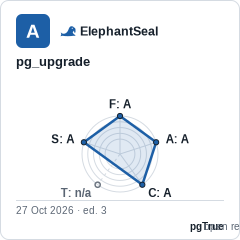
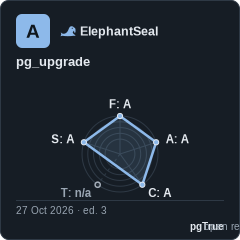
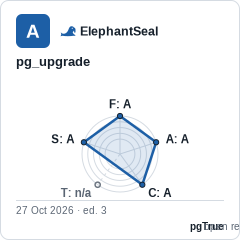
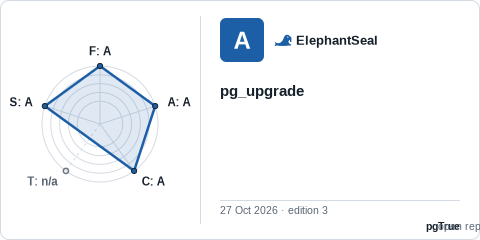
FACTS scorecard Scorecard radar, 5 axes, bigger is better. Overall A. Factual A · 0 wrong of 23 checked · 0 caveats. Applicable A · 0 wrong of 15 checked · 0 caveats. Consistent A · 0 wrong of 23 checked · 0 caveats. Transparent 2 checked, too few for a letter. Safe A · 0 wrong of 60 checked · 0 caveats. A 0 wrong of 23 checked · 0 caveatsFactual A0 wrong of 230 caveats A 0 wrong of 15 checked · 0 caveatsApplicable A0 wrong of 150 caveats A 0 wrong of 23 checked · 0 caveatsConsistent A0 wrong of 230 caveats 2 checked, too few for a letterTransparent n/a0 wrong of 20 caveats A 0 wrong of 60 checked · 0 caveatsSafe A0 wrong of 600 caveats

By topic: Running the upgrade — 6 findings, 0 wrong · Swap and synchronization — 3 findings, 0 wrong · Shutdown and standby preparation — 1 finding, 0 wrong · Standby configuration — 2 findings, 0 wrong · Statistics regeneration — 3 findings, 0 wrong · Reverting — 2 findings, 0 wrong · Unsupported data types — 2 findings, 0 wrong · Purpose — 1 finding, 0 wrong · Character signedness — 1 finding, 0 wrong · Transfer modes — 1 finding, 0 wrong · Command options — 1 finding, 0 wrong

Further out is better. Each axis has its own letter, from the wrong claims and caveats among the claims we checked of that kind.

Checked on the FACTS: Factual, Applicable, Consistent, Transparent, Safe. Clockwise: Factual (is it true?), Applicable (does it apply to my setup, today?), Consistent (does it agree with itself?), Transparent (can I check it myself?), Safe (can I run this on prod?).

We checked 23 claims, 5 commands scanned.

AxisLetterWrongCaveatsCheckedCoverage
FactualA0023assessed: A · 0 wrong of 23 checked · 0 caveats
ApplicableA0015assessed: A · 0 wrong of 15 checked · 0 caveats
ConsistentA0023assessed: A · 0 wrong of 23 checked · 0 caveats
Transparent—002assessed: 0 wrong · 0 caveats · 2 checked
SafeA0060assessed: A · 0 wrong of 60 checked · 0 caveats
Topics · 12 topics

Topics

TopicFactualApplicableConsistentTransparentSafe
Standby file transfer
Running the upgrade0 issues 6 checked F2 F16 F17 F18 F19 F240 issues 4 checked0 issues 6 checked
Swap and synchronization0 issues 3 checked F3 F15 F200 issues 1 checked0 issues 3 checked0 issues 1 checked
Shutdown and standby preparation0 issues 1 checked F40 issues 1 checked0 issues 1 checked
Standby configuration0 issues 2 checked F5 F130 issues 1 checked0 issues 2 checked0 issues 1 checked
Statistics regeneration0 issues 3 checked F6 F8 F220 issues 3 checked0 issues 3 checked
Reverting0 issues 2 checked F7 F140 issues 2 checked0 issues 2 checked
Unsupported data types0 issues 2 checked F9 F230 issues 2 checked
Purpose0 issues 1 checked F110 issues 1 checked0 issues 1 checked
Character signedness0 issues 1 checked F120 issues 1 checked0 issues 1 checked
Transfer modes0 issues 1 checked F210 issues 1 checked0 issues 1 checked
Command options0 issues 1 checked F250 issues 1 checked

Issues found among the claims checked, per topic and axis. Each link goes to the finding behind the count.

Revisions: 4 · A- -> A -> A -> A

We audited this article 4 times. Each row is the final edition of one audit. Letters and findings of earlier revisions stay readable at their own address.

  1. Revision 1 · 2026-10-13 03:46 UTC · A- · audit version not recorded · regrade version not recorded

    Article as first submitted. 14 accurate · 1 wrong · 1 caveat.

    ElephantSeal: A-.

    Changes: First audit. Open: F1 “The tablespace rsync example names the wrong PostgreSQL 18 directory” (misleading); F2 “--swap requires a source cluster on PostgreSQL 10 or later” (mostly accurate).

  2. Revision 2 · 2026-10-19 08:13 UTC · A · audited with v1.0.14 (approx.)

    Article text changed. 12 accurate · 0 wrong · 0 caveats.

    ElephantSeal: A.

    Changes: No longer reported: “The tablespace rsync example names the wrong PostgreSQL 18 directory”; “--swap requires a source cluster on PostgreSQL 10 or later”. New: none.

  3. Revision 3 · 2026-10-19 21:11 UTC · A · audited with v1.0.16 (approx.)

    Same article text, re-audited. 16 accurate · 0 wrong · 0 caveats.

    ElephantSeal: A.

    Changes: No change in findings.

  4. Revision 4 · this page · 2026-10-21 05:34 UTC · A · audited with v1.0.17 (approx.) · regraded with v1.1.0 (approx.)

    Same article text, re-audited. 23 accurate · 0 wrong · 0 caveats.

    ElephantSeal: A.

    Changes: No change in findings.

Questions and answers

Questions and answers

What is pgTrue?

pgTrue is an independent fact-check of technical Postgres articles, made by PostgresAI. It helps you check advice before you use it.

What does the letter grade mean?

The letter grade summarizes the claims we checked. Five axes show what we checked:

  • Factual: is it true?
  • Applicable: does it apply to my setup, today?
  • Consistent: does it agree with itself?
  • Transparent: can I check it myself?
  • Safe: can I run this in production?

What is the ElephantSeal?

The ElephantSeal is the mark an article earns. It always shows the latest edition. “Open:” lists what is still open.

Can an author reply?

Authors can ask us to correct a finding, reply to it, or withdraw it. Right-of-reply policy.

Paste into your AI assistant to fix the article, then ask for a re-review.

Show the text
Fix the article with this report, then ask pgTrue for a re-review.

# pgTrue report: pg_upgrade

Article title: pg_upgrade
Article URL: https://www.postgresql.org/docs/current/pgupgrade.html
Report URL: https://pgtrue.postgres.ai/shared/brief/c0f8019e-7ce4-4284-8254-dd0a5003f83f
Audited revision: 4 of 4, 2026-10-21 05:34:27 UTC
Overall letter: A

## Axes

- Factual: A · 0 wrong · 23 checked · 0 caveats · assessed
- Applicable: A · 0 wrong · 15 checked · 0 caveats · assessed
- Consistent: A · 0 wrong · 23 checked · 0 caveats · assessed
- Transparent: — · 0 wrong · 2 checked · 0 caveats · assessed
- Safe: A · 0 wrong · 60 checked · 0 caveats · assessed

ElephantSeal: A.

## Report metadata

- Report: Technical fact-check, edition 3
- Issued: 2026-10-21
- Edition: Updated after review. Corrections are listed below.
- Submitted: Submitted by the PostgresAI team.
- Author response: No written reply from the author. The article changed 1 time after our first audit; we re-audited each version. See Revisions below. Policy: [right-of-reply and corrections policy](/pgtrue/security).
- pgTrue version: audited with v1.0.17 (approx.) · regraded with v1.1.0 (approx.)

## Findings needing a change (0)

None.

## Verified accurate claims (23)

### F2 · Accurate · Factual · Verified accurate: “pg_upgrade defaults to running servers on port 50432…”
Location: excerpt · section “Note” · as fetched 2026-10-21 · [open in article](https://www.postgresql.org/docs/current/pgupgrade.html#:~:text=pg_upgrade%20defaults%20to%20running%20servers%20on%20port%2050432)
Article says:
```text
pg_upgrade defaults to running servers on port 50432…
```
What is true:
pg_upgrade.h:20 defines port 50432. option.c:82-83 assigns that default to both clusters unless PGPORTOLD or PGPORTNEW supplies another value.
Review: We checked initialization and environment overrides. E-8 covers those assignments, but excludes command-line parsing. Remove the additional override claim.

Sources:
- [REL_18_6 · src/bin/pg_upgrade/pg_upgrade.h:20-20](https://github.com/postgres/postgres/blob/724edf9bde9d356724ad384a2e196edc3c9f80f7/src/bin/pg_upgrade/pg_upgrade.h#L20-L20)
  Excerpt:
  ```text
  #define DEF_PGUPORT			50432
  ```
- [REL_18_6 · src/bin/pg_upgrade/option.c:82-83](https://github.com/postgres/postgres/blob/724edf9bde9d356724ad384a2e196edc3c9f80f7/src/bin/pg_upgrade/option.c#L82-L83)
  Excerpt:
  ```text
  old_cluster.port = getenv("PGPORTOLD") ? atoi(getenv("PGPORTOLD")) : DEF_PGUPORT;
	new_cluster.port = getenv("PGPORTNEW") ? atoi(getenv("PGPORTNEW")) : DEF_PGUPORT;
  ```

Finding URL: https://pgtrue.postgres.ai/shared/brief/c0f8019e-7ce4-4284-8254-dd0a5003f83f#F2

### F3 · Accurate · Factual · Verified accurate: “See recovery_init_sync_method for information about the caveats…”
Location: excerpt · section “Options” · as fetched 2026-10-21 · [open in article](https://www.postgresql.org/docs/current/pgupgrade.html#:~:text=See%20recovery_init_sync_method%20for%20information%20about%20the%20caveats)
Article says:
```text
See recovery_init_sync_method for information about the caveats…
```
What is true:
config.sgml:11771-11774 warns that Linux before 5.8 may omit reporting write errors to PostgreSQL. fd.c:3640-3646 describes filesystem-wide syncfs synchronization. These support the article's cross-reference.
Review: We tested whether the cross-reference confuses configuration settings. The cited ranges support the caveat and filesystem scope, but exclude pg_upgrade option selection.

Sources:
- [REL_18_6 · doc/src/sgml/config.sgml:11771-11774](https://github.com/postgres/postgres/blob/724edf9bde9d356724ad384a2e196edc3c9f80f7/doc/src/sgml/config.sgml#L11771-L11774)
  Excerpt:
  ```text
  Furthermore, on versions of Linux before 5.8, I/O errors encountered
        while writing data to disk may not be reported to
        <productname>PostgreSQL</productname>, and relevant error messages may
        appear only in kernel logs.
  ```
- [REL_18_6 · src/backend/storage/file/fd.c:3640-3646](https://github.com/postgres/postgres/blob/724edf9bde9d356724ad384a2e196edc3c9f80f7/src/backend/storage/file/fd.c#L3640-L3646)
  Excerpt:
  ```text
  * can use syncfs() to sync whole filesystems.  We only expect
  ```

Finding URL: https://pgtrue.postgres.ai/shared/brief/c0f8019e-7ce4-4284-8254-dd0a5003f83f#F3

### F4 · Accurate · Factual · Physical standbys require wal_level above minimal
Location: excerpt · section “Note” · as fetched 2026-10-21 · [open in article](https://www.postgresql.org/docs/current/pgupgrade.html#:~:text=wal_level%20is%20not%20set%20to%20minimal)
Article says:
```text
…wal_level is not set to minimal…
```
What is true:
postmaster.c:852-854 rejects startup when max_wal_senders exceeds zero and wal_level equals minimal. The article correctly excludes minimal for the new primary serving physical standbys.
Charitable reading:
The instruction states a necessary condition for physical replication. It does not claim that condition completes replication configuration.
Review: We checked the max_wal_senders condition. The finding correctly treats nonminimal WAL as necessary for the stated streaming setup. We checked the max_wal_senders condition. The article states a necessary replication prerequisite, and the startup rejection supports it.

Sources:
- [REL_18_6 · src/backend/postmaster/postmaster.c:852-854](https://github.com/postgres/postgres/blob/724edf9bde9d356724ad384a2e196edc3c9f80f7/src/backend/postmaster/postmaster.c#L852-L854)
  Excerpt:
  ```text
  if (max_wal_senders > 0 && wal_level == WAL_LEVEL_MINIMAL)
  ```

Finding URL: https://pgtrue.postgres.ai/shared/brief/c0f8019e-7ce4-4284-8254-dd0a5003f83f#F4

### F5 · Accurate · Factual · The documented standby upgrade does not require pg_backup_start
Location: excerpt · section “Note” · as fetched 2026-10-21 · [open in article](https://www.postgresql.org/docs/current/pgupgrade.html#:~:text=You%20do%20not%20need%20to%20run%20pg_backup_start%28%29%20and%20pg_backup_stop%28%29)
Article says:
```text
…You do not need to run pg_backup_start() and pg_backup_stop()…
```
What is true:
pgupgrade.sgml:766-769 explicitly exempts this synchronized standby procedure from pg_backup_start. The exemption applies after the preceding shutdown and synchronization steps.
Charitable reading:
The exemption follows shutdown, checkpoint matching, link-mode upgrade, and standby synchronization.
Review: We tested the exemption against its shutdown and synchronization prerequisites. The finding preserves those conditions. We tested the exemption as conditional standby guidance. The source explicitly limits it to standbys still synchronized with the primary.

Sources:
- [REL_18_6 · doc/src/sgml/ref/pgupgrade.sgml:766-769](https://github.com/postgres/postgres/blob/724edf9bde9d356724ad384a2e196edc3c9f80f7/doc/src/sgml/ref/pgupgrade.sgml#L766-L769)
  Excerpt:
  ```text
  Configure the servers for log shipping.  (You do not need to run
       <function>pg_backup_start()</function> and <function>pg_backup_stop()</function>
       or take a file system backup as the standbys are still synchronized
  ```

Finding URL: https://pgtrue.postgres.ai/shared/brief/c0f8019e-7ce4-4284-8254-dd0a5003f83f#F5

### F6 · Accurate · Factual · Verified accurate: “…PGOPTIONS='-c vacuum_cost_delay=0' vacuumdb…”
Location: excerpt · section “Caution” · as fetched 2026-10-21 · [open in article](https://www.postgresql.org/docs/current/pgupgrade.html#:~:text=PGOPTIONS%3D%27%2Dc%20vacuum_cost_delay%3D0%27%20vacuumdb)
Article says:
```text
…PGOPTIONS='-c vacuum_cost_delay=0' vacuumdb…
```
What is true:
config.sgml:9360-9364 defines zero as disabling cost-based vacuum delay. autovacuum.c:1681-1687 clears VacuumCostActive when vacuum_cost_delay is zero. These ranges establish the zero-delay behavior.
Review: We preserved the article's positive-delay condition. E-18 shows delay activation, but excludes the preceding assignment for explicit ANALYZE. Narrow the explanation.

Sources:
- [REL_18_6 · doc/src/sgml/config.sgml:9360-9364](https://github.com/postgres/postgres/blob/724edf9bde9d356724ad384a2e196edc3c9f80f7/doc/src/sgml/config.sgml#L9360-L9364)
  Excerpt:
  ```text
  limit has been exceeded. If this value is specified without
         units, it is taken as milliseconds. The default value is
         <literal>0</literal>, which disables the cost-based vacuum delay
         feature.  Positive values enable cost-based vacuuming.
  ```
- [REL_18_6 · src/backend/postmaster/autovacuum.c:1681-1687](https://github.com/postgres/postgres/blob/724edf9bde9d356724ad384a2e196edc3c9f80f7/src/backend/postmaster/autovacuum.c#L1681-L1687)
  Excerpt:
  ```text
  else if (vacuum_cost_delay > 0)
		VacuumCostActive = true;
	else
	{
		VacuumCostActive = false;
		VacuumCostBalance = 0;
	}
  ```

Finding URL: https://pgtrue.postgres.ai/shared/brief/c0f8019e-7ce4-4284-8254-dd0a5003f83f#F6

### F7 · Accurate · Factual · Verified accurate: “If you did start the new cluster, it has written to shared files…”
Location: excerpt · section “Caution” · as fetched 2026-10-21 · [open in article](https://www.postgresql.org/docs/current/pgupgrade.html#:~:text=If%20you%20did%20start%20the,has%20written%20to%20shared%20files)
Article says:
```text
If you did start the new cluster, it has written to shared files…
```
What is true:
pg_upgrade.c:176-179 states that link mode makes restarting the old cluster unsafe after the new cluster starts. This matches the article's link-mode rollback warning.
Review: We checked the link-mode qualification. E-20 states the rollback boundary, but contains neither relation-file linking nor control-file renaming.

Sources:
- [REL_18_6 · src/bin/pg_upgrade/pg_upgrade.c:176-179](https://github.com/postgres/postgres/blob/724edf9bde9d356724ad384a2e196edc3c9f80f7/src/bin/pg_upgrade/pg_upgrade.c#L176-L179)
  Excerpt:
  ```text
  * this point.  We do this here because it is just before file transfer,
	 * which for --link will make it unsafe to start the old cluster once the
	 * new cluster is started, and for --swap will make it unsafe to start the
	 * old cluster at all.
  ```

Finding URL: https://pgtrue.postgres.ai/shared/brief/c0f8019e-7ce4-4284-8254-dd0a5003f83f#F7

### F8 · Accurate · Factual · Verified accurate: “…Unless the --no-statistics option is specified, pg_upgrade will transfer most optimizer…”
Location: excerpt · section “Caution” · as fetched 2026-10-21 · [open in article](https://www.postgresql.org/docs/current/pgupgrade.html#:~:text=Unless%20the%20%2D%2Dno%2Dstatistics%20option%20is,will%20transfer%20most%20optimizer%20statistics)
Article says:
```text
…Unless the --no-statistics option is specified, pg_upgrade will transfer most optimizer statistics…
```
What is true:
PostgreSQL 18.6 enables statistics transfer in option.c:76. dump.c:65 selects --statistics unless the user disables it. These checks establish the default, not which statistics transfer or which regeneration commands complete the upgrade.
Review: The default and dump argument check out. The recorded evidence does not include check.c:825-831 or verify its regeneration recommendations. The default and dump option match. No recorded source range supports the additional check.c:825-831 recommendation. We remove that assertion.

Sources:
- [REL_18_6 · src/bin/pg_upgrade/option.c:75-76](https://github.com/postgres/postgres/blob/724edf9bde9d356724ad384a2e196edc3c9f80f7/src/bin/pg_upgrade/option.c#L75-L76)
  Excerpt:
  ```text
  user_opts.transfer_mode = TRANSFER_MODE_COPY;
	user_opts.do_statistics = true;
  ```
- [REL_18_6 · src/bin/pg_upgrade/dump.c:65-65](https://github.com/postgres/postgres/blob/724edf9bde9d356724ad384a2e196edc3c9f80f7/src/bin/pg_upgrade/dump.c#L65-L65)
  Excerpt:
  ```text
  user_opts.do_statistics ? "--statistics" : "--no-statistics",
  ```

Finding URL: https://pgtrue.postgres.ai/shared/brief/c0f8019e-7ce4-4284-8254-dd0a5003f83f#F8

### F9 · Accurate · Factual · Verified accurate: “…regcollation regconfig regdictionary regnamespace regoper regoperator regproc…”
Location: excerpt · section “Notes” · as fetched 2026-10-21 · [open in article](https://www.postgresql.org/docs/current/pgupgrade.html#:~:text=regcollation%20regconfig%20regdictionary%20regnamespace%20regoper%20regoperator%20regproc%20regprocedure)
Article says:
```text
…regcollation regconfig regdictionary regnamespace regoper regoperator regproc regprocedure…
```
What is true:
check.c:170-177 lists regcollation, regconfig, regdictionary, regnamespace, regoper, regoperator, regproc, and regprocedure. All 8 names match the article's unsupported column-type list.
Review: We compared all 8 type names. They match. The comments explaining regclass, regrole, and regtype fall outside E-25's lines 170-177.

Sources:
- [REL_18_6 · src/bin/pg_upgrade/check.c:170-177](https://github.com/postgres/postgres/blob/724edf9bde9d356724ad384a2e196edc3c9f80f7/src/bin/pg_upgrade/check.c#L170-L177)
  Excerpt:
  ```text
  "           'regcollation', "
		"           'regconfig', "
		"           'regdictionary', "
		"           'regnamespace', "
		"           'regoper', "
		"           'regoperator', "
		"           'regproc', "
		"           'regprocedure' "
  ```

Finding URL: https://pgtrue.postgres.ai/shared/brief/c0f8019e-7ce4-4284-8254-dd0a5003f83f#F9

### F11 · Accurate · Factual · PostgreSQL 18 retains the 9.2 source-version floor
Location: excerpt · section “Description” · as fetched 2026-10-21 · [open in article](https://www.postgresql.org/docs/current/pgupgrade.html#:~:text=supports%20upgrades%20from%209.2.X%20and%20later)
Article says:
```text
…supports upgrades from 9.2.X and later…
```
What is true:
PostgreSQL 18.6 rejects source versions below 9.2 in src/bin/pg_upgrade/check.c:863. The same function requires the destination major version to match the utility. It also rejects downgrades.
Charitable reading:
The source-version floor applies to PostgreSQL 18's utility, subject to its other compatibility checks.
Review: We checked destination-version and downgrade restrictions. The finding preserves them alongside the 9.2 source floor. We checked destination-version and downgrade restrictions. Neither contradicts the PostgreSQL 9.2 source-version floor.

Sources:
- [REL_18_6 · src/bin/pg_upgrade/check.c:850-879](https://github.com/postgres/postgres/blob/724edf9bde9d356724ad384a2e196edc3c9f80f7/src/bin/pg_upgrade/check.c#L850-L879)
  Excerpt:
  ```text
  if (GET_MAJOR_VERSION(old_cluster.major_version) < 902)
		pg_fatal("This utility can only upgrade from PostgreSQL version %s and later.",
				 "9.2");
  ```

Finding URL: https://pgtrue.postgres.ai/shared/brief/c0f8019e-7ce4-4284-8254-dd0a5003f83f#F11

### F12 · Accurate · Factual · PostgreSQL 18 stores cluster char signedness
Location: excerpt · section “Options” · as fetched 2026-10-21 · [open in article](https://www.postgresql.org/docs/current/pgupgrade.html#:~:text=Starting%20from%20PostgreSQL%2018%2C%20database,own%20default%20char%20signedness%20setting)
Article says:
```text
Starting from PostgreSQL 18, database clusters maintain their own default char signedness setting…
```
What is true:
PostgreSQL 18.0 and 18.6 store default_char_signedness in src/include/catalog/pg_control.h:228. PostgreSQL 18.0's upgrade code states that earlier clusters lack this information. It derives their initial value from the platform where pg_upgrade was built.
Charitable reading:
The claim concerns the stored cluster setting, rather than changing the C compiler's char defaults.
Review: We tested whether the field appeared only in a later minor release. PostgreSQL 18.0 contains it and handles earlier clusters separately. We distinguished stored cluster signedness from compiler behavior. Both PostgreSQL 18 releases contain the field and earlier-cluster handling.

Sources:
- [REL_18_0 · src/include/catalog/pg_control.h:218-231](https://github.com/postgres/postgres/blob/3d6a828938a5fa0444275d3d2f67b64ec3199eb7/src/include/catalog/pg_control.h#L218-L231)
  Qualification: Version note: Checked the PostgreSQL 18.0 release boundary.
  Excerpt:
  ```text
  bool		default_char_signedness;
  ```
- [REL_18_6 · src/include/catalog/pg_control.h:228-228](https://github.com/postgres/postgres/blob/724edf9bde9d356724ad384a2e196edc3c9f80f7/src/include/catalog/pg_control.h#L228-L228)
  Excerpt:
  ```text
  bool		default_char_signedness;
  ```
- [REL_18_0 · src/bin/pg_upgrade/controldata.c:580-603](https://github.com/postgres/postgres/blob/3d6a828938a5fa0444275d3d2f67b64ec3199eb7/src/bin/pg_upgrade/controldata.c#L580-L603)
  Qualification: Version note: Checked the PostgreSQL 18.0 release boundary.
  Excerpt:
  ```text
  * Pre-v18 database clusters don't have the default char signedness
	 * information. We use the char signedness of the platform where
	 * pg_upgrade was built.
  ```

Finding URL: https://pgtrue.postgres.ai/shared/brief/c0f8019e-7ce4-4284-8254-dd0a5003f83f#F12

### F13 · Accurate · Factual · The PostgreSQL 17 slot migration boundary holds
Location: excerpt · section “Note” · as fetched 2026-10-21 · [open in article](https://www.postgresql.org/docs/current/pgupgrade.html#:~:text=only%20logical%20slots%20on%20the%20primary%20are%20copied)
Article says:
```text
…only logical slots on the primary are copied…
```
What is true:
PostgreSQL 17.0 and 18.6 restrict slot migration to logical slots. Their upgrade checks identify PostgreSQL 17 as the source-version boundary. Physical slots require recreation. The article states this distinction.
Charitable reading:
The sentence applies when the old primary is PostgreSQL 17.0 or later. It does not promise migration of every logical slot.
Review: We checked temporary-slot exclusions and the PostgreSQL 17 boundary. Neither contradicts the claim that only logical slots migrate. We tested whether 'only logical' promises every logical slot. It does not. The source excludes temporary slots and confirms the PostgreSQL 17 boundary.

Sources:
- [REL_17_0 · src/bin/pg_upgrade/info.c:650-678](https://github.com/postgres/postgres/blob/d7ec59a63d745ba74fba0e280bbf85dc6d1caa3e/src/bin/pg_upgrade/info.c#L650-L678)
  Qualification: Version note: Checked the PostgreSQL 17.0 release boundary.
  Excerpt:
  ```text
  "WHERE slot_type = 'logical' AND "
  ```
- [REL_18_6 · src/bin/pg_upgrade/info.c:655-680](https://github.com/postgres/postgres/blob/724edf9bde9d356724ad384a2e196edc3c9f80f7/src/bin/pg_upgrade/info.c#L655-L680)
  Excerpt:
  ```text
  "WHERE slot_type = 'logical' AND "
  ```
- [REL_17_0 · src/bin/pg_upgrade/check.c:592-614](https://github.com/postgres/postgres/blob/d7ec59a63d745ba74fba0e280bbf85dc6d1caa3e/src/bin/pg_upgrade/check.c#L592-L614)
  Qualification: Version note: Checked the PostgreSQL 17.0 release boundary.
  Excerpt:
  ```text
  if (GET_MAJOR_VERSION(old_cluster.major_version) >= 1700)
  ```
- [REL_18_6 · src/bin/pg_upgrade/check.c:610-632](https://github.com/postgres/postgres/blob/724edf9bde9d356724ad384a2e196edc3c9f80f7/src/bin/pg_upgrade/check.c#L610-L632)
  Excerpt:
  ```text
  if (GET_MAJOR_VERSION(old_cluster.major_version) >= 1700)
  ```

Finding URL: https://pgtrue.postgres.ai/shared/brief/c0f8019e-7ce4-4284-8254-dd0a5003f83f#F13

### F14 · Accurate · Factual · Link mode prevents safe rollback after the upgraded cluster starts
Location: excerpt · section “Caution” · as fetched 2026-10-21 · [open in article](https://www.postgresql.org/docs/current/pgupgrade.html#:~:text=it%20has%20written%20to%20shared,to%20use%20the%20old%20cluster.)
Article says:
```text
…it has written to shared files and it is unsafe to use the old cluster.
```
What is true:
pg_upgrade.c:177-179 confirms the link-mode restart boundary. controldata.c:765-766 renames the old control file with a .old suffix. The article's rollback warning matches PostgreSQL 18.6.
Charitable reading:
The warning concerns starting the upgraded cluster after a link-mode upgrade.
Review: We checked whether renaming pg_control alone makes rollback unsafe. The finding correctly identifies the later link-mode startup boundary. We checked the warning's link-mode context. Source comments and the control-file warning state the same rollback boundary.

Sources:
- [REL_18_6 · src/bin/pg_upgrade/pg_upgrade.c:139-228](https://github.com/postgres/postgres/blob/724edf9bde9d356724ad384a2e196edc3c9f80f7/src/bin/pg_upgrade/pg_upgrade.c#L139-L228)
  Excerpt:
  ```text
  * which for --link will make it unsafe to start the old cluster once the
	 * new cluster is started, and for --swap will make it unsafe to start the
	 * old cluster at all.
  ```
- [REL_18_6 · src/bin/pg_upgrade/controldata.c:754-779](https://github.com/postgres/postgres/blob/724edf9bde9d356724ad384a2e196edc3c9f80f7/src/bin/pg_upgrade/controldata.c#L754-L779)
  Excerpt:
  ```text
  snprintf(new_path, sizeof(new_path), "%s/%s.old", old_cluster.pgdata, XLOG_CONTROL_FILE);
	if (pg_mv_file(old_path, new_path) != 0)
  ```

Finding URL: https://pgtrue.postgres.ai/shared/brief/c0f8019e-7ce4-4284-8254-dd0a5003f83f#F14

### F15 · Accurate · Factual · Swap mode has an earlier rollback boundary than link mode
Location: excerpt · section “Options” · as fetched 2026-10-21 · [open in article](https://www.postgresql.org/docs/current/pgupgrade.html#:~:text=once%20the%20file%20transfer%20step,cluster%20will%20be%20destructively%20modified)
Article says:
```text
…once the file transfer step begins, the old cluster will be destructively modified…
```
What is true:
pg_upgrade.c:178-179 warns that swap mode makes the old cluster unsafe to start during file transfer. The article distinguishes this boundary from link mode's later restart boundary.
Charitable reading:
The statement applies to --swap after file transfer begins.
Review: We compared swap and link handling before transfer. The code states their different rollback boundaries. We compared swap and link timing. pg_upgrade.c explicitly distinguishes destructive transfer from subsequent startup.

Sources:
- [REL_18_6 · src/bin/pg_upgrade/pg_upgrade.c:139-228](https://github.com/postgres/postgres/blob/724edf9bde9d356724ad384a2e196edc3c9f80f7/src/bin/pg_upgrade/pg_upgrade.c#L139-L228)
  Excerpt:
  ```text
  * which for --link will make it unsafe to start the old cluster once the
	 * new cluster is started, and for --swap will make it unsafe to start the
	 * old cluster at all.
  ```

Finding URL: https://pgtrue.postgres.ai/shared/brief/c0f8019e-7ce4-4284-8254-dd0a5003f83f#F15

### F16 · Accurate · Factual · The check mode supports a running old server
Location: excerpt · section “Note” · as fetched 2026-10-21 · [open in article](https://www.postgresql.org/docs/current/pgupgrade.html#:~:text=perform%20only%20the%20checks%2C%20even,old%20server%20is%20still%20running.)
Article says:
```text
…perform only the checks, even if the old server is still running.
```
What is true:
pg_upgrade.c:381-385 enables live checking when --check is set. check.c:775-782 exits after compatibility checks. The upgrade does not proceed into file transfer.
Charitable reading:
The old cluster may remain running during --check. The new cluster must remain available for temporary startup.
Review: We checked whether --check can continue into transfer. report_clusters_compatible exits first, and the old-server branch permits live checking. We checked whether live checking proceeds into transfer. The compatibility function exits when --check is set.

Sources:
- [REL_18_6 · src/bin/pg_upgrade/pg_upgrade.c:355-392](https://github.com/postgres/postgres/blob/724edf9bde9d356724ad384a2e196edc3c9f80f7/src/bin/pg_upgrade/pg_upgrade.c#L355-L392)
  Excerpt:
  ```text
  if (!user_opts.check)
				pg_fatal("There seems to be a postmaster servicing the old cluster.\n"
						 "Please shutdown that postmaster and try again.");
			else
				user_opts.live_check = true;
  ```
- [REL_18_6 · src/bin/pg_upgrade/check.c:769-787](https://github.com/postgres/postgres/blob/724edf9bde9d356724ad384a2e196edc3c9f80f7/src/bin/pg_upgrade/check.c#L769-L787)
  Excerpt:
  ```text
  if (user_opts.check)
	{
		pg_log(PG_REPORT, "\n*Clusters are compatible*");
		/* stops new cluster */
		stop_postmaster(false);

		cleanup_output_dirs();
		exit(0);
	}
  ```

Finding URL: https://pgtrue.postgres.ai/shared/brief/c0f8019e-7ce4-4284-8254-dd0a5003f83f#F16

### F17 · Accurate · Factual · Live checks require different old and new ports
Location: excerpt · section “Note” · as fetched 2026-10-21 · [open in article](https://www.postgresql.org/docs/current/pgupgrade.html#:~:text=when%20checking%20an%20old%20running,port%20numbers%20must%20be%20different.)
Article says:
```text
…when checking an old running server, the old and new port numbers must be different.
```
What is true:
check.c:912-914 rejects equal port numbers when live_check is true. The article states the condition correctly.
Charitable reading:
The different-port requirement applies to checking a running old server.
Review: We tested whether different ports are mandatory for every upgrade. The rejection explicitly requires live_check. We tested the live-server qualification. Equal ports trigger rejection only when live_check is true.

Sources:
- [REL_18_6 · src/bin/pg_upgrade/check.c:900-917](https://github.com/postgres/postgres/blob/724edf9bde9d356724ad384a2e196edc3c9f80f7/src/bin/pg_upgrade/check.c#L900-L917)
  Excerpt:
  ```text
  if (user_opts.live_check && old_cluster.port == new_cluster.port)
		pg_fatal("When checking a live server, "
				 "the old and new port numbers must be different.");
  ```

Finding URL: https://pgtrue.postgres.ai/shared/brief/c0f8019e-7ce4-4284-8254-dd0a5003f83f#F17

### F18 · Accurate · Factual · Link and swap modes require compatible data-directory file systems
Location: Article · exact quote · [open in article](https://www.postgresql.org/docs/current/pgupgrade.html#:~:text=Link%20mode%20also%20requires%20that,in%20the%20same%20file%20system.)
Article says:
```text
Link mode also requires that the old and new cluster data directories be in the same file system.
```
What is true:
file.c:446-453 tests a hard link between the old and new data directories. Both link and swap modes fail when that prerequisite fails.
Charitable reading:
The requirement concerns the old and new data directories. It does not require every tablespace to share that file system.
Review: We checked the tested paths and both transfer-mode branches. The requirement concerns data directories, without forcing every tablespace onto that filesystem. We checked whether the condition covers every tablespace. The test concerns old and new data directories and handles both modes.

Sources:
- [REL_18_6 · src/bin/pg_upgrade/file.c:432-456](https://github.com/postgres/postgres/blob/724edf9bde9d356724ad384a2e196edc3c9f80f7/src/bin/pg_upgrade/file.c#L432-L456)
  Excerpt:
  ```text
  if (link(existing_file, new_link_file) < 0)
	{
		if (transfer_mode == TRANSFER_MODE_LINK)
			pg_fatal("could not create hard link between old and new data directories: %m\n"
					 "In link mode the old and new data directories must be on the same file system.");
		else if (transfer_mode == TRANSFER_MODE_SWAP)
			pg_fatal("could not create hard link between old and new data directories: %m\n"
					 "In swap mode the old and new data directories must be on the same file system.");
  ```

Finding URL: https://pgtrue.postgres.ai/shared/brief/c0f8019e-7ce4-4284-8254-dd0a5003f83f#F18

### F19 · Accurate · Factual · Two or more jobs enable parallel upgrade work
Location: excerpt · section “Note” · as fetched 2026-10-21 · [open in article](https://www.postgresql.org/docs/current/pgupgrade.html#:~:text=Setting%20%2D%2Djobs%20to%202%20or,databases%20and%20tablespaces%20in%20parallel.)
Article says:
```text
Setting --jobs to 2 or higher allows pg_upgrade to process multiple databases and tablespaces in parallel.
```
What is true:
parallel.c:183-187 selects the parallel branch above 1 job. relfilenumber.c:131-135 describes parallel transfer across tablespaces. The article's threshold of 2 jobs matches PostgreSQL 18.6.
Charitable reading:
Two jobs enable parallel processing. The claim does not guarantee a specific speedup.
Review: We checked the exact branch threshold and tablespace iteration. Two jobs enable parallel work without guaranteeing a speedup. We tested the threshold and any implied speed guarantee. More than 1 job selects parallel transfer without guaranteeing speedup.

Sources:
- [REL_18_6 · src/bin/pg_upgrade/relfilenumber.c:125-158](https://github.com/postgres/postgres/blob/724edf9bde9d356724ad384a2e196edc3c9f80f7/src/bin/pg_upgrade/relfilenumber.c#L125-L158)
  Excerpt:
  ```text
  * Transferring files by tablespace is tricky because a single database
	 * can use multiple tablespaces.  For non-parallel mode, we just pass a
	 * NULL tablespace path, which matches all tablespaces.  In parallel mode,
	 * we pass the default tablespace and all user-created tablespaces and let
	 * those operations happen in parallel.
  ```
- [REL_18_6 · src/bin/pg_upgrade/parallel.c:172-222](https://github.com/postgres/postgres/blob/724edf9bde9d356724ad384a2e196edc3c9f80f7/src/bin/pg_upgrade/parallel.c#L172-L222)
  Excerpt:
  ```text
  if (user_opts.jobs <= 1)
		transfer_all_new_dbs(old_db_arr, new_db_arr, old_pgdata, new_pgdata, NULL);
	else
	{
		/* parallel */
  ```

Finding URL: https://pgtrue.postgres.ai/shared/brief/c0f8019e-7ce4-4284-8254-dd0a5003f83f#F19

### F20 · Accurate · Factual · Disabling synchronization bypasses the selected synchronization method
Location: excerpt · section “Options” · as fetched 2026-10-21 · [open in article](https://www.postgresql.org/docs/current/pgupgrade.html#:~:text=This%20option%20has%20no%20effect%20when%20%2D%2Dno%2Dsync%20is%20used.)
Article says:
```text
This option has no effect when --no-sync is used.
```
What is true:
pg_upgrade.c:216-227 runs the synchronization command only when do_sync is true. A synchronization-method selection has no effect when that block does not run.
Charitable reading:
This statement concerns --sync-method when --no-sync disables synchronization.
Review: We checked where sync_method is consumed. The synchronization command sits entirely inside the do_sync condition. We checked where pg_upgrade uses sync_method. The synchronization command sits inside the do_sync condition.

Sources:
- [REL_18_6 · src/bin/pg_upgrade/pg_upgrade.c:139-228](https://github.com/postgres/postgres/blob/724edf9bde9d356724ad384a2e196edc3c9f80f7/src/bin/pg_upgrade/pg_upgrade.c#L139-L228)
  Excerpt:
  ```text
  if (user_opts.do_sync)
	{
		prep_status("Sync data directory to disk");
  ```

Finding URL: https://pgtrue.postgres.ai/shared/brief/c0f8019e-7ce4-4284-8254-dd0a5003f83f#F20

### F21 · Accurate · Factual · Unsupported clone mode fails instead of falling back to copying
Location: excerpt · section “Options” · as fetched 2026-10-21 · [open in article](https://www.postgresql.org/docs/current/pgupgrade.html#:~:text=If%20it%20is%20selected%20but,the%20pg_upgrade%20run%20will%20error.)
Article says:
```text
If it is selected but not supported, the pg_upgrade run will error.
```
What is true:
file.c:360-396 tests file cloning and raises fatal errors when cloning fails or the platform lacks support. The article states that failure behavior correctly.
Charitable reading:
The claim covers unsupported platforms and unsupported file systems. It does not promise automatic fallback to copying.
Review: We checked unsupported-platform and filesystem-failure branches. Both terminate instead of falling back to copying. We checked platform and filesystem failures. Both cloning branches raise fatal errors, and unsupported platforms also fail.

Sources:
- [REL_18_6 · src/bin/pg_upgrade/file.c:320-399](https://github.com/postgres/postgres/blob/724edf9bde9d356724ad384a2e196edc3c9f80f7/src/bin/pg_upgrade/file.c#L320-L399)
  Excerpt:
  ```text
  #else
	pg_fatal("file cloning not supported on this platform");
#endif
  ```

Finding URL: https://pgtrue.postgres.ai/shared/brief/c0f8019e-7ce4-4284-8254-dd0a5003f83f#F21

### F22 · Accurate · Factual · The vacuum cost delay also applies to explicit ANALYZE
Location: excerpt · section “Caution” · as fetched 2026-10-21 · [open in article](https://www.postgresql.org/docs/current/pgupgrade.html#:~:text=this%20can%20be%20overridden%20to,up%20statistics%20generation%20using%20PGOPTIONS)
Article says:
```text
…this can be overridden to speed up statistics generation using PGOPTIONS…
```
What is true:
autovacuum.c:1670-1674 assigns VacuumCostDelay to explicit VACUUM and ANALYZE operations. Setting vacuum_cost_delay=0 can remove that delay during statistics generation.
Charitable reading:
The suggested override applies when a positive vacuum_cost_delay throttles explicit statistics collection.
Review: We tested whether the setting affects only autovacuum workers. The explicit VACUUM or ANALYZE branch uses VacuumCostDelay. We tested whether the setting affects only VACUUM. The function explicitly handles ANALYZE and disables costs at zero.

Sources:
- [REL_18_6 · src/backend/postmaster/autovacuum.c:1647-1712](https://github.com/postgres/postgres/blob/724edf9bde9d356724ad384a2e196edc3c9f80f7/src/backend/postmaster/autovacuum.c#L1647-L1712)
  Excerpt:
  ```text
  /* Must be explicit VACUUM or ANALYZE */
		vacuum_cost_delay = VacuumCostDelay;
		vacuum_cost_limit = VacuumCostLimit;
  ```

Finding URL: https://pgtrue.postgres.ai/shared/brief/c0f8019e-7ce4-4284-8254-dd0a5003f83f#F22

### F23 · Accurate · Factual · The supported reg\* exceptions match preserved catalog OIDs
Location: excerpt · section “Notes” · as fetched 2026-10-21 · [open in article](https://www.postgresql.org/docs/current/pgupgrade.html#:~:text=regclass%20%2C%20regrole%20%2C%20and%20regtype%20can%20be%20upgraded.)
Article says:
```text
…regclass , regrole , and regtype can be upgraded.
```
What is true:
check.c:169-179 lists eight rejected reg\* types. It exempts regclass, regrole, and regtype because their referenced catalog OIDs remain preserved.
Charitable reading:
The article distinguishes supported OID-reference types from eight unsupported reg\* types.
Review: We checked each named exception against the rejection list and preservation comments. All 3 exceptions match. We checked all 3 exceptions against the rejection query. Source comments explain each preserved catalog identifier.

Sources:
- [REL_18_6 · src/bin/pg_upgrade/check.c:155-186](https://github.com/postgres/postgres/blob/724edf9bde9d356724ad384a2e196edc3c9f80f7/src/bin/pg_upgrade/check.c#L155-L186)
  Excerpt:
  ```text
  /* pg_class.oid is preserved, so 'regclass' is OK */
		"           'regcollation', "
		"           'regconfig', "
		"           'regdictionary', "
		"           'regnamespace', "
		"           'regoper', "
		"           'regoperator', "
		"           'regproc', "
		"           'regprocedure' "
		/* pg_authid.oid is preserved, so 'regrole' is OK */
		/* pg_type.oid is (mostly) preserved, so 'regtype' is OK */
  ```

Finding URL: https://pgtrue.postgres.ai/shared/brief/c0f8019e-7ce4-4284-8254-dd0a5003f83f#F23

### F24 · Accurate · Factual · The current directory requires write access
Location: excerpt · section “Note” · as fetched 2026-10-21 · [open in article](https://www.postgresql.org/docs/current/pgupgrade.html#:~:text=pg_upgrade%20requires%20write%20permission%20in%20the%20current%20directory.)
Article says:
```text
pg_upgrade requires write permission in the current directory.
```
What is true:
exec.c:266-270 checks current-directory permissions and rejects insufficient access. The article correctly names write permission as a requirement.
Charitable reading:
The statement describes a prerequisite. It does not claim write permission alone is sufficient.
Review: We checked whether additional permission requirements invalidate the claim. Write access remains necessary, and the finding does not call it sufficient. We tested whether additional access requirements contradict the statement. Write access remains necessary even though Unix also requires read and search access.

Sources:
- [REL_18_6 · src/bin/pg_upgrade/exec.c:260-273](https://github.com/postgres/postgres/blob/724edf9bde9d356724ad384a2e196edc3c9f80f7/src/bin/pg_upgrade/exec.c#L260-L273)
  Excerpt:
  ```text
  pg_fatal("You must have read and write access in the current directory.");
  ```

Finding URL: https://pgtrue.postgres.ai/shared/brief/c0f8019e-7ce4-4284-8254-dd0a5003f83f#F24

### F25 · Accurate · Factual · Repeated server-option arguments accumulate
Location: excerpt · section “Options” · as fetched 2026-10-21 · [open in article](https://www.postgresql.org/docs/current/pgupgrade.html#:~:text=multiple%20option%20invocations%20are%20appended)
Article says:
```text
…multiple option invocations are appended…
```
What is true:
option.c:149-173 appends repeated -o and -O values with a separating space. Later occurrences do not replace earlier server options.
Charitable reading:
The statement concerns repeated -o and -O options.
Review: We checked both -o and -O branches. Each appends later arguments with a separating space. We checked both -o and -O branches. Each appends subsequent arguments with a space.

Sources:
- [REL_18_6 · src/bin/pg_upgrade/option.c:148-190](https://github.com/postgres/postgres/blob/724edf9bde9d356724ad384a2e196edc3c9f80f7/src/bin/pg_upgrade/option.c#L148-L190)
  Excerpt:
  ```text
  old_cluster.pgopts = psprintf("%s %s", old_pgopts, optarg);
  ```

Finding URL: https://pgtrue.postgres.ai/shared/brief/c0f8019e-7ce4-4284-8254-dd0a5003f83f#F25

## Notes (not graded) (2)

### F1 · Note ·  · The tablespace example uses an incorrect PostgreSQL 18 directory
Location: excerpt · section “Note” · as fetched 2026-10-21 · [open in article](https://www.postgresql.org/docs/current/pgupgrade.html#:~:text=PG_18_202307071)
Article says:
```text
…PG_18_202307071…
```
What is true:
PostgreSQL 18 uses PG_18_202506291. catversion.h:60 defines the suffix, and relpath.h:33-34 constructs the directory name. The REL_18_6 manual repeats the incorrect example at pgupgrade.sgml:753. Copying that path prevents the example from locating the new tablespace directory.
So what:
Replace PG_18_202307071 with the actual PostgreSQL 18 tablespace directory, PG_18_202506291, before running rsync.
Charitable reading:
The command is an example. PostgreSQL's own REL_18_6 manual repeats its incorrect directory suffix.
Explanation: Not graded: no reader would act differently on it.
Review: We tested whether an earlier PostgreSQL 18 release used the example suffix. Both releases use 202506291. The note acknowledges the documentation error. We tested whether the suffix was valid in PostgreSQL 18.0. Both releases require 202506291. The note acknowledges the official example.

Sources:
- [REL_18_6 · src/include/catalog/catversion.h:60-60](https://github.com/postgres/postgres/blob/724edf9bde9d356724ad384a2e196edc3c9f80f7/src/include/catalog/catversion.h#L60-L60)
  Excerpt:
  ```text
  #define CATALOG_VERSION_NO	202506291
  ```
- [REL_18_6 · src/include/common/relpath.h:33-34](https://github.com/postgres/postgres/blob/724edf9bde9d356724ad384a2e196edc3c9f80f7/src/include/common/relpath.h#L33-L34)
  Excerpt:
  ```text
  #define TABLESPACE_VERSION_DIRECTORY	"PG_" PG_MAJORVERSION "_" \
									CppAsString2(CATALOG_VERSION_NO)
  ```
- [REL_18_6 · doc/src/sgml/ref/pgupgrade.sgml:753-753](https://github.com/postgres/postgres/blob/724edf9bde9d356724ad384a2e196edc3c9f80f7/doc/src/sgml/ref/pgupgrade.sgml#L753-L753)
  Excerpt:
  ```text
  /vol1/pg_tblsp/PG_&majorversion;_202307071 standby.example.com:/vol1/pg_tblsp
  ```
- [REL_18_0 · src/include/catalog/catversion.h:60-60](https://github.com/postgres/postgres/blob/3d6a828938a5fa0444275d3d2f67b64ec3199eb7/src/include/catalog/catversion.h#L60-L60)
  Qualification: Version note: PostgreSQL 18.0 uses the same catalog suffix.
  Excerpt:
  ```text
  #define CATALOG_VERSION_NO	202506291
  ```

Finding URL: https://pgtrue.postgres.ai/shared/brief/c0f8019e-7ce4-4284-8254-dd0a5003f83f#F1

### F10 · Note ·  · Note: “…/vol1/pg_tblsp/PG_18_202307071…”
Location: excerpt · section “Note” · as fetched 2026-10-21 · [open in article](https://www.postgresql.org/docs/current/pgupgrade.html#:~:text=%2Fvol1%2Fpg_tblsp%2FPG_18_202307071)
Article says:
```text
…/vol1/pg_tblsp/PG_18_202307071…
```
What is true:
PostgreSQL 18.0 and 18.6 use PG_18_202506291. The official PostgreSQL 18 manual contains the same incorrect PG_18_202307071 example. This duplicates F1's documentation correction. Replace the example suffix with the actual tablespace directory before running rsync.
So what:
Replace PG_18_202307071 with the actual PG_18_202506291 tablespace directory before running rsync.
Explanation: Not graded: no reader would act differently on it.
Review: The path error is real. E-47 and E-4 establish the official documentation origin. Apply F1's fairness treatment consistently. The path error survives. F10 duplicates F1's official documentation error but assigns a graded charge. The same fairness note applies.

Sources:
- [REL_18_6 · src/include/common/relpath.h:30-35](https://github.com/postgres/postgres/blob/724edf9bde9d356724ad384a2e196edc3c9f80f7/src/include/common/relpath.h#L30-L35)
  Excerpt:
  ```text
  #define TABLESPACE_VERSION_DIRECTORY	"PG_" PG_MAJORVERSION "_" \
									CppAsString2(CATALOG_VERSION_NO)
  ```
- [REL_18_6 · src/include/catalog/catversion.h:60-60](https://github.com/postgres/postgres/blob/724edf9bde9d356724ad384a2e196edc3c9f80f7/src/include/catalog/catversion.h#L60-L60)
  Excerpt:
  ```text
  #define CATALOG_VERSION_NO	202506291
  ```
- [REL_18_0 · src/include/catalog/catversion.h:60-60](https://github.com/postgres/postgres/blob/3d6a828938a5fa0444275d3d2f67b64ec3199eb7/src/include/catalog/catversion.h#L60-L60)
  Qualification: Version note: Checked the PostgreSQL 18.0 release boundary.
  Excerpt:
  ```text
  #define CATALOG_VERSION_NO	202506291
  ```
- [REL_18_6 · doc/src/sgml/ref/pgupgrade.sgml:753-753](https://github.com/postgres/postgres/blob/724edf9bde9d356724ad384a2e196edc3c9f80f7/doc/src/sgml/ref/pgupgrade.sgml#L753-L753)
  Excerpt:
  ```text
  /vol1/pg_tblsp/PG_&majorversion;_202307071 standby.example.com:/vol1/pg_tblsp
  ```
- [REL_18_6 · src/include/catalog/catversion.h:60-60](https://github.com/postgres/postgres/blob/724edf9bde9d356724ad384a2e196edc3c9f80f7/src/include/catalog/catversion.h#L60-L60)
  Excerpt:
  ```text
  #define CATALOG_VERSION_NO	202506291
  ```
- [REL_18_6 · src/include/common/relpath.h:29-34](https://github.com/postgres/postgres/blob/724edf9bde9d356724ad384a2e196edc3c9f80f7/src/include/common/relpath.h#L29-L34)
  Excerpt:
  ```text
  #define TABLESPACE_VERSION_DIRECTORY	"PG_" PG_MAJORVERSION "_" \
									CppAsString2(CATALOG_VERSION_NO)
  ```
- [https://www.postgresql.org/docs/18/pgupgrade.html](https://www.postgresql.org/docs/18/pgupgrade.html)
  Excerpt:
  ```text
  /vol1/pg_tblsp/PG_18_202307071 standby.example.com:/vol1/pg_tblsp
  ```

Finding URL: https://pgtrue.postgres.ai/shared/brief/c0f8019e-7ce4-4284-8254-dd0a5003f83f#F10

## Withdrawn findings (0)

None.

## Section checks

- Standby file transfer · A · none · 71% of claims (10 of 14, plus 4 that need data we do not have)
- Running the upgrade · A · 6 verified-accurate · 64% of claims (16 of 25, plus 3 that need data we do not have)
- Swap and synchronization · A · 3 verified-accurate · 81% of claims (9 of 11, plus 2 that need data we do not have)
- Shutdown and standby preparation · A · 1 verified-accurate · 100% of claims (7 of 7)
- Standby configuration · A · 2 verified-accurate · 85% of claims (6 of 7)
- Statistics regeneration · A · 3 verified-accurate · 60% of claims (6 of 10, plus 1 that need data we do not have)
- Reverting · A · 2 verified-accurate · 70% of claims (7 of 10)
- Unsupported data types · A · 2 verified-accurate · 100% of claims (10 of 10)
- Purpose · A · 1 verified-accurate · 60% of claims (6 of 10, plus 1 that need data we do not have)
- Character signedness · A · 1 verified-accurate · 83% of claims (10 of 12)
- Transfer modes · A · 1 verified-accurate · 62% of claims (5 of 8, plus 4 that need data we do not have)
- Command options · A · 1 verified-accurate · 95% of claims (23 of 24)

## Claim coverage

- Page metadata: 3 of 3 Postgres claims checked; not counted: 7 not a claim
- Purpose: 6 of 10 Postgres claims checked, plus 1 that need data we do not have; not counted: 1 product or opinion; not checked: 4 for other reasons
- Compatibility and security: 4 of 6 Postgres claims checked; not checked: 2 for other reasons
- Command options: 23 of 24 Postgres claims checked; not checked: 1 for other reasons
- Transfer modes: 5 of 8 Postgres claims checked, plus 4 that need data we do not have; not checked: 3 for other reasons
- Statistics options: 1 of 1 Postgres claims checked
- Character signedness: 10 of 12 Postgres claims checked; not counted: 3 product or opinion; not checked: 2 for other reasons
- Swap and synchronization: 9 of 11 Postgres claims checked, plus 2 that need data we do not have; not checked: 2 for other reasons
- Preparation: 12 of 12 Postgres claims checked; not counted: 2 product or opinion, 1 not a claim
- Extensions and authentication: 6 of 8 Postgres claims checked; not checked: 2 for other reasons
- Shutdown and standby preparation: 7 of 7 Postgres claims checked
- Running the upgrade: 16 of 25 Postgres claims checked, plus 3 that need data we do not have; not counted: 5 duplicate; not checked: 9 for other reasons
- Standby upgrade: 10 of 10 Postgres claims checked
- Standby file transfer: 10 of 14 Postgres claims checked, plus 4 that need data we do not have; not counted: 2 duplicate; not checked: 4 for other reasons
- Standby configuration: 6 of 7 Postgres claims checked; not checked: 1 for other reasons
- Post-upgrade startup: 3 of 3 Postgres claims checked
- Post-upgrade processing: 2 of 8 Postgres claims checked; not checked: 6 for other reasons
- Statistics regeneration: 6 of 10 Postgres claims checked, plus 1 that need data we do not have; not checked: 4 for other reasons
- Old-cluster deletion: 2 of 3 Postgres claims checked; not checked: 1 for other reasons
- Reverting: 7 of 10 Postgres claims checked; not counted: 2 duplicate; not checked: 3 for other reasons
- Environment: 0 of 1 Postgres claims checked; not counted: 8 duplicate; not checked: 1 for other reasons
- Working files and sockets: 4 of 9 Postgres claims checked; not counted: 1 duplicate; not checked: 5 for other reasons
- Automation and limitations: 1 of 4 Postgres claims checked; not counted: 1 duplicate; not checked: 3 for other reasons
- Unsupported data types: 10 of 10 Postgres claims checked
- Preserving an old-cluster copy: 7 of 7 Postgres claims checked, plus 1 that need data we do not have

## What we did not check

- We did not check rsync's hard-link handling or timestamp comparison implementation.
- We did not verify that identical schemas always require identical post-upgrade steps.
- We did not run the upgrade or rsync commands.
- We did not verify Linux 4.5 cloning support against kernel and filesystem implementations.
- We did not measure the claimed performance advantages of --link, --clone, --copy-file-range, or --swap.
- We did not check all platform restrictions, statistics transfers, standby synchronization guarantees, or post-upgrade script requirements.
- Section “Post-upgrade processing”: we checked 2 of 8 checkable claims.
- Section “Environment”: we checked 0 of 1 checkable claims.
- Section “Working files and sockets”: we checked 4 of 9 checkable claims.
- Section “Automation and limitations”: we checked 1 of 4 checkable claims.

## Notes

- A — the findings address the article's main subject. What we did not check is listed below. The checks directly test pg_upgrade compatibility, transfer prerequisites, live checks, rollback boundaries, statistics defaults, and standby slot handling.
- We did not check everything in this article. What we did not check is listed below, in the words we recorded at the time. None of it moved the letter. We never charge our own limits to the article.
- Average of 4 axes: 4 · result A
- Some explanatory text is not shown in this edition; the grade and findings are complete.
- Some checks did not happen for this edition, and each one we know of is listed above.
- Checked against: github.com/postgres/postgres REL_18_6 at commit 724edf9bde9d356724ad384a2e196edc3c9f80f7 (pinned target); https://www.postgresql.org/ (fetched 2026-10-21T05:34:40.065578Z); https://www.postgresql.org/about/ (fetched 2026-10-21T05:34:41.158494Z); https://www.postgresql.org/about/donate/ (fetched 2026-10-21T05:34:49.718827Z); https://www.postgresql.org/about/news/postgresql-19-rc-1-released-3409/ (fetched 2026-10-21T05:34:51.917798Z); https://www.postgresql.org/developer/ (fetched 2026-10-21T05:34:47.346959Z); https://www.postgresql.org/docs/ (fetched 2026-10-21T05:34:43.831945Z); https://www.postgresql.org/docs/10/pgupgrade.html (fetched 2026-10-21T05:35:09.419516Z); https://www.postgresql.org/docs/11/pgupgrade.html (fetched 2026-10-21T05:35:08.214679Z); https://www.postgresql.org/docs/12/pgupgrade.html (fetched 2026-10-21T05:35:06.626200Z); https://www.postgresql.org/docs/13/pgupgrade.html (fetched 2026-10-21T05:35:04.930345Z); https://www.postgresql.org/docs/14/pgupgrade.html (fetched 2026-10-21T05:35:01.683284Z); https://www.postgresql.org/docs/15/pgupgrade.html (fetched 2026-10-21T05:35:00.428690Z); https://www.postgresql.org/docs/16/pgupgrade.html (fetched 2026-10-21T05:34:58.566148Z); https://www.postgresql.org/docs/17/pgupgrade.html (fetched 2026-10-21T05:34:56.516333Z); https://www.postgresql.org/docs/18/index.html (fetched 2026-10-21T05:34:53.673168Z); https://www.postgresql.org/docs/18/pgupgrade.html (fetched 2026-10-21T05:34:55.068423Z); https://www.postgresql.org/docs/19/pgupgrade.html (fetched 2026-10-21T05:35:03.354643Z); https://www.postgresql.org/docs/9.0/pgupgrade.html (fetched 2026-10-21T05:35:18.375313Z); https://www.postgresql.org/docs/9.1/pgupgrade.html (fetched 2026-10-21T05:35:17.309110Z); https://www.postgresql.org/docs/9.2/pgupgrade.html (fetched 2026-10-21T05:35:16.026759Z); https://www.postgresql.org/docs/9.3/pgupgrade.html (fetched 2026-10-21T05:35:14.535932Z); https://www.postgresql.org/docs/9.4/pgupgrade.html (fetched 2026-10-21T05:35:13.414085Z); https://www.postgresql.org/docs/9.5/pgupgrade.html (fetched 2026-10-21T05:35:11.873330Z); https://www.postgresql.org/docs/9.6/pgupgrade.html (fetched 2026-10-21T05:35:10.670840Z); https://www.postgresql.org/docs/current/pgtesttiming.html (fetched 2026-10-21T05:35:19.376928Z); https://www.postgresql.org/download/ (fetched 2026-10-21T05:34:42.330397Z); https://www.postgresql.org/support/ (fetched 2026-10-21T05:34:48.609338Z).
- Article captured 2026-10-21T05:34:27.765916Z · SHA-256 658e856dc6538a7b3d0f28bb0dd574e3d1dee4ef5f8f820e47a9f9eea4fe3ca9 · Text extracted from the article's HTML.
- Policy SHA-256 852a1939150b0b14f41b2e81de99d2d6281db079343714415f459d8e44841f76 · Grading rules SHA-256 6fb334e79d6b9e7ed81d3238cc10d9de602ff87ed65ff2fa781f53bac5798765.
- The page gives no publication date or author byline, so those fields remain empty. October 15, 2026 labels a release announcement.
- We checked PostgreSQL 18.6 source, with selected comparisons against PostgreSQL 18.0 and 17.0.
- We did not run the upgrade or rsync commands.
- We did not check rsync's hard-link handling or timestamp comparison implementation.
- We did not verify that identical schemas always require identical post-upgrade steps.
- We did not measure performance gains from --link, --clone, --copy-file-range, or --swap.
- We did not verify Linux 4.5 cloning support against kernel and filesystem implementations.
- We did not check every platform restriction, statistics transfer case, standby synchronization guarantee, or post-upgrade script requirement.
- article target version: bound to the most-cited major; also named 19 (1×), 17 (1×), 12 (1×)
- review: the findings were written by one model and reviewed independently by a different model.
- 2026-10-27: Regraded under the current grading rules: the letter is the average of the axis letters, with every cap stated under it.
- 5 passages in this edition fell short of our own plain-English rules.
- Built from the article text captured above, one pinned source tree, and 27 fetched pages.
- 18 survived · 7 weakened · 0 withdrawn.

## Revision history

- [Revision 1](https://pgtrue.postgres.ai/shared/brief/c0f8019e-7ce4-4284-8254-dd0a5003f83f?v=14) · 2026-10-13 03:46 UTC · A- · audit version not recorded · regrade version not recorded
  Article as first submitted. 14 accurate · 1 wrong · 1 caveat.
  ElephantSeal: A-.
  Changes: First audit. Open: F1 “The tablespace rsync example names the wrong PostgreSQL 18 directory” (misleading); F2 “--swap requires a source cluster on PostgreSQL 10 or later” (mostly accurate).
- [Revision 2](https://pgtrue.postgres.ai/shared/brief/c0f8019e-7ce4-4284-8254-dd0a5003f83f?v=18) · 2026-10-19 08:13 UTC · A · audited with v1.0.14 (approx.)
  Article text changed. 12 accurate · 0 wrong · 0 caveats.
  ElephantSeal: A.
  Changes: No longer reported: “The tablespace rsync example names the wrong PostgreSQL 18 directory”; “--swap requires a source cluster on PostgreSQL 10 or later”. New: none.
- [Revision 3](https://pgtrue.postgres.ai/shared/brief/c0f8019e-7ce4-4284-8254-dd0a5003f83f?v=20) · 2026-10-19 21:11 UTC · A · audited with v1.0.16 (approx.)
  Same article text, re-audited. 16 accurate · 0 wrong · 0 caveats.
  ElephantSeal: A.
  Changes: No change in findings.
- [Revision 4](https://pgtrue.postgres.ai/shared/brief/c0f8019e-7ce4-4284-8254-dd0a5003f83f?v=23) · this page · 2026-10-21 05:34 UTC · A · audited with v1.0.17 (approx.) · regraded with v1.1.0 (approx.)
  Same article text, re-audited. 23 accurate · 0 wrong · 0 caveats.
  ElephantSeal: A.
  Changes: No change in findings.

Updated your article? Request a correction. A new edition appears at this address.