Limited beta · What is this?

pgTrue is under active development: reports may contain significant mistakes, inaccuracies, or bugs. Please report anything you find to pgtrue@postgres.ai.

pgTrue is an independent fact-check of technical Postgres articles. Read the questions and answers.

pgTrue fact-check

ElephantSeal A-Limited coverageOpen: the benchmark cannot yet be rerun from what is published

Embed

The ElephantSeal always shows this report's latest edition and links here. Copies cached elsewhere may update later.

[![pgTrue fact-check](https://pgtrue.postgres.ai/badge/b36b68c0-1262-47cd-8d13-b530fc749f6b.svg?v=13&theme=light)](https://pgtrue.postgres.ai/shared/brief/b36b68c0-1262-47cd-8d13-b530fc749f6b)
<a href="https://pgtrue.postgres.ai/shared/brief/b36b68c0-1262-47cd-8d13-b530fc749f6b"><img src="https://pgtrue.postgres.ai/badge/b36b68c0-1262-47cd-8d13-b530fc749f6b.svg?v=13&amp;theme=light" alt="pgTrue fact-check" width="90" height="20" loading="lazy" decoding="async" style="display:inline-block;width:90px;height:20px"></a>
https://pgtrue.postgres.ai/badge/b36b68c0-1262-47cd-8d13-b530fc749f6b.svg?v=13&theme=light
.. image:: https://pgtrue.postgres.ai/badge/b36b68c0-1262-47cd-8d13-b530fc749f6b.svg?v=13&theme=light
   :target: https://pgtrue.postgres.ai/shared/brief/b36b68c0-1262-47cd-8d13-b530fc749f6b
   :alt: pgTrue fact-check
   :width: 90
   :height: 20
[![pgTrue fact-check](https://pgtrue.postgres.ai/badge/b36b68c0-1262-47cd-8d13-b530fc749f6b.svg?v=13&theme=dark)](https://pgtrue.postgres.ai/shared/brief/b36b68c0-1262-47cd-8d13-b530fc749f6b)
<a href="https://pgtrue.postgres.ai/shared/brief/b36b68c0-1262-47cd-8d13-b530fc749f6b"><img src="https://pgtrue.postgres.ai/badge/b36b68c0-1262-47cd-8d13-b530fc749f6b.svg?v=13&amp;theme=dark" alt="pgTrue fact-check" width="90" height="20" loading="lazy" decoding="async" style="display:inline-block;width:90px;height:20px"></a>
https://pgtrue.postgres.ai/badge/b36b68c0-1262-47cd-8d13-b530fc749f6b.svg?v=13&theme=dark
.. image:: https://pgtrue.postgres.ai/badge/b36b68c0-1262-47cd-8d13-b530fc749f6b.svg?v=13&theme=dark
   :target: https://pgtrue.postgres.ai/shared/brief/b36b68c0-1262-47cd-8d13-b530fc749f6b
   :alt: pgTrue fact-check
   :width: 90
   :height: 20
[![pgTrue fact-check](https://pgtrue.postgres.ai/badge/b36b68c0-1262-47cd-8d13-b530fc749f6b.svg?v=13)](https://pgtrue.postgres.ai/shared/brief/b36b68c0-1262-47cd-8d13-b530fc749f6b)
<a href="https://pgtrue.postgres.ai/shared/brief/b36b68c0-1262-47cd-8d13-b530fc749f6b"><img src="https://pgtrue.postgres.ai/badge/b36b68c0-1262-47cd-8d13-b530fc749f6b.svg?v=13" alt="pgTrue fact-check" width="90" height="20" loading="lazy" decoding="async" style="display:inline-block;width:90px;height:20px"></a>
https://pgtrue.postgres.ai/badge/b36b68c0-1262-47cd-8d13-b530fc749f6b.svg?v=13
.. image:: https://pgtrue.postgres.ai/badge/b36b68c0-1262-47cd-8d13-b530fc749f6b.svg?v=13
   :target: https://pgtrue.postgres.ai/shared/brief/b36b68c0-1262-47cd-8d13-b530fc749f6b
   :alt: pgTrue fact-check
   :width: 90
   :height: 20
[![pgTrue fact-check](https://pgtrue.postgres.ai/badge/b36b68c0-1262-47cd-8d13-b530fc749f6b/radar.svg?v=13&theme=light)](https://pgtrue.postgres.ai/shared/brief/b36b68c0-1262-47cd-8d13-b530fc749f6b)
<a href="https://pgtrue.postgres.ai/shared/brief/b36b68c0-1262-47cd-8d13-b530fc749f6b"><img src="https://pgtrue.postgres.ai/badge/b36b68c0-1262-47cd-8d13-b530fc749f6b/radar.svg?v=13&amp;theme=light" alt="pgTrue fact-check" width="240" height="240" loading="lazy" decoding="async" style="display:inline-block;width:240px;height:240px"></a>
https://pgtrue.postgres.ai/badge/b36b68c0-1262-47cd-8d13-b530fc749f6b/radar.svg?v=13&theme=light
.. image:: https://pgtrue.postgres.ai/badge/b36b68c0-1262-47cd-8d13-b530fc749f6b/radar.svg?v=13&theme=light
   :target: https://pgtrue.postgres.ai/shared/brief/b36b68c0-1262-47cd-8d13-b530fc749f6b
   :alt: pgTrue fact-check
   :width: 240
   :height: 240
[![pgTrue fact-check](https://pgtrue.postgres.ai/badge/b36b68c0-1262-47cd-8d13-b530fc749f6b/radar.svg?v=13&theme=dark)](https://pgtrue.postgres.ai/shared/brief/b36b68c0-1262-47cd-8d13-b530fc749f6b)
<a href="https://pgtrue.postgres.ai/shared/brief/b36b68c0-1262-47cd-8d13-b530fc749f6b"><img src="https://pgtrue.postgres.ai/badge/b36b68c0-1262-47cd-8d13-b530fc749f6b/radar.svg?v=13&amp;theme=dark" alt="pgTrue fact-check" width="240" height="240" loading="lazy" decoding="async" style="display:inline-block;width:240px;height:240px"></a>
https://pgtrue.postgres.ai/badge/b36b68c0-1262-47cd-8d13-b530fc749f6b/radar.svg?v=13&theme=dark
.. image:: https://pgtrue.postgres.ai/badge/b36b68c0-1262-47cd-8d13-b530fc749f6b/radar.svg?v=13&theme=dark
   :target: https://pgtrue.postgres.ai/shared/brief/b36b68c0-1262-47cd-8d13-b530fc749f6b
   :alt: pgTrue fact-check
   :width: 240
   :height: 240
[![pgTrue fact-check](https://pgtrue.postgres.ai/badge/b36b68c0-1262-47cd-8d13-b530fc749f6b/radar.svg?v=13)](https://pgtrue.postgres.ai/shared/brief/b36b68c0-1262-47cd-8d13-b530fc749f6b)
<a href="https://pgtrue.postgres.ai/shared/brief/b36b68c0-1262-47cd-8d13-b530fc749f6b"><img src="https://pgtrue.postgres.ai/badge/b36b68c0-1262-47cd-8d13-b530fc749f6b/radar.svg?v=13" alt="pgTrue fact-check" width="240" height="240" loading="lazy" decoding="async" style="display:inline-block;width:240px;height:240px"></a>
https://pgtrue.postgres.ai/badge/b36b68c0-1262-47cd-8d13-b530fc749f6b/radar.svg?v=13
.. image:: https://pgtrue.postgres.ai/badge/b36b68c0-1262-47cd-8d13-b530fc749f6b/radar.svg?v=13
   :target: https://pgtrue.postgres.ai/shared/brief/b36b68c0-1262-47cd-8d13-b530fc749f6b
   :alt: pgTrue fact-check
   :width: 240
   :height: 240
[![pgTrue fact-check](https://pgtrue.postgres.ai/badge/b36b68c0-1262-47cd-8d13-b530fc749f6b/wide.svg?v=13&theme=light)](https://pgtrue.postgres.ai/shared/brief/b36b68c0-1262-47cd-8d13-b530fc749f6b)
<a href="https://pgtrue.postgres.ai/shared/brief/b36b68c0-1262-47cd-8d13-b530fc749f6b"><img src="https://pgtrue.postgres.ai/badge/b36b68c0-1262-47cd-8d13-b530fc749f6b/wide.svg?v=13&amp;theme=light" alt="pgTrue fact-check" width="480" height="240" loading="lazy" decoding="async" style="display:inline-block;width:480px;height:240px"></a>
https://pgtrue.postgres.ai/badge/b36b68c0-1262-47cd-8d13-b530fc749f6b/wide.svg?v=13&theme=light
.. image:: https://pgtrue.postgres.ai/badge/b36b68c0-1262-47cd-8d13-b530fc749f6b/wide.svg?v=13&theme=light
   :target: https://pgtrue.postgres.ai/shared/brief/b36b68c0-1262-47cd-8d13-b530fc749f6b
   :alt: pgTrue fact-check
   :width: 480
   :height: 240
[![pgTrue fact-check](https://pgtrue.postgres.ai/badge/b36b68c0-1262-47cd-8d13-b530fc749f6b/wide.svg?v=13&theme=dark)](https://pgtrue.postgres.ai/shared/brief/b36b68c0-1262-47cd-8d13-b530fc749f6b)
<a href="https://pgtrue.postgres.ai/shared/brief/b36b68c0-1262-47cd-8d13-b530fc749f6b"><img src="https://pgtrue.postgres.ai/badge/b36b68c0-1262-47cd-8d13-b530fc749f6b/wide.svg?v=13&amp;theme=dark" alt="pgTrue fact-check" width="480" height="240" loading="lazy" decoding="async" style="display:inline-block;width:480px;height:240px"></a>
https://pgtrue.postgres.ai/badge/b36b68c0-1262-47cd-8d13-b530fc749f6b/wide.svg?v=13&theme=dark
.. image:: https://pgtrue.postgres.ai/badge/b36b68c0-1262-47cd-8d13-b530fc749f6b/wide.svg?v=13&theme=dark
   :target: https://pgtrue.postgres.ai/shared/brief/b36b68c0-1262-47cd-8d13-b530fc749f6b
   :alt: pgTrue fact-check
   :width: 480
   :height: 240
[![pgTrue fact-check](https://pgtrue.postgres.ai/badge/b36b68c0-1262-47cd-8d13-b530fc749f6b/wide.svg?v=13)](https://pgtrue.postgres.ai/shared/brief/b36b68c0-1262-47cd-8d13-b530fc749f6b)
<a href="https://pgtrue.postgres.ai/shared/brief/b36b68c0-1262-47cd-8d13-b530fc749f6b"><img src="https://pgtrue.postgres.ai/badge/b36b68c0-1262-47cd-8d13-b530fc749f6b/wide.svg?v=13" alt="pgTrue fact-check" width="480" height="240" loading="lazy" decoding="async" style="display:inline-block;width:480px;height:240px"></a>
https://pgtrue.postgres.ai/badge/b36b68c0-1262-47cd-8d13-b530fc749f6b/wide.svg?v=13
.. image:: https://pgtrue.postgres.ai/badge/b36b68c0-1262-47cd-8d13-b530fc749f6b/wide.svg?v=13
   :target: https://pgtrue.postgres.ai/shared/brief/b36b68c0-1262-47cd-8d13-b530fc749f6b
   :alt: pgTrue fact-check
   :width: 480
   :height: 240

Click the snippet to select all of it, then copy. Where SVG is stripped, as in some email clients and feed readers, change .svg to .png. PNG uses the light theme for Auto. For Markdown PNG embeds, use the HTML snippet where supported to preserve the display size.

Optional colours: append &color=26798E or &labelColor=333C47 after a theme query (use ? for the first parameter). Use 3- or 6-digit hex.

For pages with a light background.

For pages with a dark background. The ElephantSeal gets a thin edge so it does not blend in.

Auto follows the reader's light or dark setting where the host supports it, and shows the light ElephantSeal where it does not.

On a light page
On a dark page

Highlights of Fujitsu's contribution in PostgreSQL 19 (opens in new tab)

postgresql.fastware.com
Sound as far as we checked.
0
inaccuracy
0
dangerous-recipe
0
misleading
0
imprecise
0
transcription
0
aged
0
withdrawn
11
verified-accurate

Central claim not verified: the team's PostgreSQL 19 contributions, community recognition, contribution statistics, and logical replication improvements. We could not verify this, and the article gives no method to reproduce it.

Factual A · Applicable A · Consistent A · Transparent A · Safe —

ReportTechnical fact-check, edition 2 Issued EditionUpdated after review. Corrections are listed below. SubmittedSubmitted by the PostgresAI team. Author responseNo written reply from the author. The article changed 1 time after our first audit; we re-audited each version. See Revisions below. Policy: right-of-reply and corrections policy. pgTrue versionaudited with v1.0.17 (approx.)

InaccuraciesNone in this edition.

Dangerous or recipe bugsNone in this edition.

Misleading / impreciseNone in this edition.

Verified accurate

F2

Logical slots dynamically control the effective WAL level

ACCURATEFactual · holds up after review

Claim ledger

Article says
Creating the first logical slot raises the effective WAL level to logical…
What is true
PostgreSQL 19 activates logical decoding when the first logical slot appears with wal_level=replica. logicalctl.c:390 performs activation. checkpointer.c:575 handles requested deactivation. logicaldecoding.sgml:283-291 confirms asynchronous deactivation after the last logical slot disappears.
Charitable reading
We read the activation and deactivation statements under the paragraph's wal_level=replica condition.

Source

Source · REL_19_STABLE@48b43081e5 · doc/src/sgml/logicaldecoding.sgml:283-291logical decoding is automatically activated upon creation of the first logical replication slot.

Review correction: see "How the review tested this" below.

In the article · section “Allow dynamically adjusting wal_level”

In the article

excerpt · section “Allow dynamically adjusting wal_level” · as fetched 2026-10-21 · open in article ↗ (opens in new tab)

Allow dynamically adjusting wal_level

We allow dynamically adjusting wal_level based on the existence of logical slots. Creating the first logical slot raises the effective WAL level to logical, even if wal_level is configured as replica. Dropping or invalidating the last logical slot causes it to be lowered asynchronously by the checkpointer process. This makes logical replication available seamlessly, improving efficiency and usability.

All sources and excerpts · 3
Evidence logical decoding is automatically activated upon creation of the first logical replication slot.

Version note: PostgreSQL 19 documentation source. The surrounding paragraph specifies wal_level=replica.

Evidence EnableLogicalDecoding(InvalidXLogRecPtr);

Version note: PostgreSQL 19 branch snapshot.

Evidence /* * Disable logical decoding if someone requested it. See comments atop * logicalctl.c. */ DisableLogicalDecodingIfNecessary();

Version note: PostgreSQL 19 branch snapshot.

How the review tested this

Review: We tested whether configured wal_level must change. The finding correctly distinguishes effective behavior and preserves the wal_level=replica condition. E-6 confirms asynchronous deactivation. We tested the distinction between configured and effective WAL levels. Under wal_level=replica, the documentation confirms activation and asynchronous checkpointer deactivation.

F3

REFRESH SEQUENCES synchronizes subscribed sequence values

ACCURATEFactual · holds up after review

Claim ledger

Article says
…ALTER SUBSCRIPTION ... REFRESH SEQUENCES…
What is true
PostgreSQL 19 implements ALTER SUBSCRIPTION ... REFRESH SEQUENCES. subscriptioncmds.c:2238-2246 dispatches the command to AlterSubscription_refresh_seq. alter_subscription.sgml:243-246 specifies synchronization of currently subscribed sequence data.
Charitable reading
The article describes an explicit synchronization command, rather than continuous sequence replication.

Source

Source · REL_19_STABLE@48b43081e5 · doc/src/sgml/ref/alter_subscription.sgml:243-246<literal>REFRESH SEQUENCES</literal> will re-synchronize the sequence data for all currently subscribed sequences without changing which sequences are subscribed.

Review correction: see "How the review tested this" below.

In the article · section “Logical replication of sequences”

In the article

excerpt · section “Logical replication of sequences” · as fetched 2026-10-21 · open in article ↗ (opens in new tab)

Logical replication of sequences

We allow sequence synchronization in logical replication, which has long been recognized as one of its main challenges. The main use case for logical replication is instance upgrades, but users must manually synchronize sequence values across instances. In PostgreSQL 19, the synchronization can be done by running a new SQL command: ALTER SUBSCRIPTION ... REFRESH SEQUENCES . This solves a long-standing weakness in PostgreSQL's logical replication story and makes the online upgrade easier.

All sources and excerpts · 3
Evidence <literal>REFRESH SEQUENCES</literal> will re-synchronize the sequence data for all currently subscribed sequences without changing which sequences are subscribed.

Version note: PostgreSQL 19 documentation source.

Evidence case ALTER_SUBSCRIPTION_REFRESH_SEQUENCES: { if (!sub->enabled) ereport(ERROR, errcode(ERRCODE_OBJECT_NOT_IN_PREREQUISITE_STATE), errmsg("%s is not allowed for disabled subscriptions", "ALTER SUBSCRIPTION ... REFRESH SEQUENCES")); AlterSubscription_refresh_seq(sub, orig_conninfo);

Version note: PostgreSQL 19 branch snapshot.

Evidence2025-10-23 [f0b3573c3] Introduce "REFRESH SEQUENCES" for subscriptions.
How the review tested this

Review: We checked whether REFRESH SEQUENCES changes membership or promises continuous replication. The finding makes neither claim. Documentation and dispatch code support synchronization of currently subscribed sequences. We checked whether REFRESH SEQUENCES changes membership or provides continuous replication. The finding correctly limits it to resynchronizing currently subscribed sequences.

F4

FOR ALL TABLES publications support table exclusions

ACCURATEFactual · holds up after review

Claim ledger

Article says
…excluding specific tables from FOR ALL TABLES publications…
What is true
PostgreSQL 19 supports EXCEPT in FOR ALL TABLES publications. pg_publication.c:1114-1117 excludes listed relations from publication membership. create_publication.sgml:174-176 confirms that other eligible tables, including future tables, remain covered.
Charitable reading
The article's reference to all tables means tables eligible for logical publication.

Source

Source · REL_19_STABLE@48b43081e5 · doc/src/sgml/ref/create_publication.sgml:174-176Marks the publication as one that replicates changes for all tables in the database, including tables created in the future. Tables listed in <literal>EXCEPT</literal> clause are excluded from the publication.

Review correction: see "How the review tested this" below.

In the article · section “Allow table exclusions in publications”

In the article

excerpt · section “Allow table exclusions in publications” · as fetched 2026-10-21 · open in article ↗ (opens in new tab)

Allow table exclusions in publications

We allow excluding specific tables from FOR ALL TABLES publications. Previously, a FOR ALL TABLES publication included every table in the database, requiring users to create publications with explicit table lists if they wanted to omit a few tables. This feature makes FOR ALL TABLES publications more flexible by allowing users to exclude selected tables while continuing to publish all others.

All sources and excerpts · 2
Evidence Marks the publication as one that replicates changes for all tables in the database, including tables created in the future. Tables listed in <literal>EXCEPT</literal> clause are excluded from the publication.

Version note: PostgreSQL 19 documentation source.

Evidence if (is_publishable_class(relid, relForm) && !(relForm->relispartition && pubviaroot) && !list_member_oid(exceptlist, relid)) result = lappend_oid(result, relid);

Version note: PostgreSQL 19 branch snapshot.

How the review tested this

Review: We checked whether all tables includes ineligible relations. The finding explicitly limits coverage to eligible tables. The membership filter applies exceptlist. We checked whether exclusions affect actual membership. pg_publication.c filters the exclusion list, and the documentation includes future eligible tables.

F5

The slot synchronization SQL function retries pending slots

ACCURATEFactual · holds up after review

Claim ledger

Article says
…the SQL interface has been improved to retry synchronization on failure…
What is true
PostgreSQL 19's pg_sync_replication_slots retries until the initial failover slots synchronize. slotsync.c:2139-2146 exits when persistence finishes and waits otherwise. func-admin.sgml:1499-1501 documents cyclic retries.
Charitable reading
Failure means slots are not yet ready for persistent synchronization. The article does not promise recovery from every SQL error.

Source

Source · REL_19_STABLE@48b43081e5 · doc/src/sgml/func/func-admin.sgml:1499-1501retries cyclically until all the failover slots that existed on primary at the start of the function call are synchronized.

Review correction: see "How the review tested this" below.

In the article · section “Improve several points for slot synchronization”

In the article

excerpt · section “Improve several points for slot synchronization” · as fetched 2026-10-21 · open in article ↗ (opens in new tab)

Improve several points for slot synchronization

The slot synchronization feature was introduced in PostgreSQL 17 and can be used for fault-tolerant logical decoding and replication even after a failover. In PostgreSQL 19, we provide new statistics that show how many times synchronization was skipped and the reasons for each skip. Also, the SQL interface has been improved to retry synchronization on failure. This feature improves the availability of the logical replication system and makes it more usable for enterprise systems.

All sources and excerpts · 3
Evidence retries cyclically until all the failover slots that existed on primary at the start of the function call are synchronized.

Version note: PostgreSQL 19 documentation source.

Evidence /* Done if all slots are persisted i.e are sync-ready */ if (!slot_persistence_pending) break; /* wait before retrying again */ wait_for_slot_activity(some_slot_updated);

Version note: PostgreSQL 19 branch snapshot.

Evidence retries cyclically until all the failover slots that existed on
How the review tested this

Review: We tested whether the finding promises retries after every SQL error. It limits retries to pending synchronization. The loop and documentation support that reading. We challenged whether retry covers arbitrary SQL errors. The finding limits retry to pending slot synchronization, matching the loop and documentation.

F6

Slot synchronization exposes skip counts and a skip reason

ACCURATEFactual · holds up after review

Claim ledger

Article says
…statistics that show how many times synchronization was skipped…
What is true
PostgreSQL 19 counts slot synchronization skips and records a reason. slotsync.c:199-211 updates both statistics. pgstat_replslot.c:128 increments slotsync_skip_count. system-views.sgml:3139 identifies slotsync_skip_reason as the latest skip reason.
Charitable reading
The statistics expose a cumulative count and the latest skip reason. The article does not explicitly promise historical event storage.

Source

Source · REL_19_STABLE@48b43081e5 · src/backend/replication/logical/slotsync.c:199-211if (skip_reason != SS_SKIP_NONE) pgstat_report_replslotsync(slot); /* Update the slot sync skip reason */ if (slot->slotsync_skip_reason != skip_reason) { SpinLockAcquire(&slot->mutex); slot->slotsync_skip_reason = skip_reason; SpinLockRelease(&slot->mutex); }

Review correction: see "How the review tested this" below.

In the article · section “Improve several points for slot synchronization”

In the article

excerpt · section “Improve several points for slot synchronization” · as fetched 2026-10-21 · open in article ↗ (opens in new tab)

Improve several points for slot synchronization

The slot synchronization feature was introduced in PostgreSQL 17 and can be used for fault-tolerant logical decoding and replication even after a failover. In PostgreSQL 19, we provide new statistics that show how many times synchronization was skipped and the reasons for each skip. Also, the SQL interface has been improved to retry synchronization on failure. This feature improves the availability of the logical replication system and makes it more usable for enterprise systems.

All sources and excerpts · 3
Evidence if (skip_reason != SS_SKIP_NONE) pgstat_report_replslotsync(slot); /* Update the slot sync skip reason */ if (slot->slotsync_skip_reason != skip_reason) { SpinLockAcquire(&slot->mutex); slot->slotsync_skip_reason = skip_reason; SpinLockRelease(&slot->mutex); }

Version note: PostgreSQL 19 branch snapshot.

Evidence statent->slotsync_skip_count += 1;

Version note: PostgreSQL 19 branch snapshot.

Evidence The reason for the last slot synchronization skip.

Version note: PostgreSQL 19 documentation source.

How the review tested this

Review: We checked whether count and reason imply an event history. The finding explicitly limits the reason to the latest skip. Source increments the counter and replaces the reason. We checked counter increments and reason retention separately. The code updates both, and the finding correctly identifies the latest reason.

F8

Slot synchronization shipped in PostgreSQL 17

ACCURATEFactual · holds up after review

Claim ledger

Article says
…The slot synchronization feature was introduced in PostgreSQL 17…
What is true
REL_17_0 introduces pg_sync_replication_slots(). Its failover documentation permits continued subscriptions after promotion. Synchronization runs asynchronously, so failover still requires readiness checks.
Charitable reading
The article describes a failover capability rather than promising identical slot state at every instant.

Source

Source · REL_17_0 · doc/src/sgml/release-17.sgml:1321-1324to synchronize logical replication slots

Review correction: see "How the review tested this" below.

In the article · section “Improve several points for slot synchronization”

In the article

excerpt · section “Improve several points for slot synchronization” · as fetched 2026-10-21 · open in article ↗ (opens in new tab)

Improve several points for slot synchronization

The slot synchronization feature was introduced in PostgreSQL 17 and can be used for fault-tolerant logical decoding and replication even after a failover. In PostgreSQL 19, we provide new statistics that show how many times synchronization was skipped and the reasons for each skip. Also, the SQL interface has been improved to retry synchronization on failure. This feature improves the availability of the logical replication system and makes it more usable for enterprise systems.

All sources and excerpts · 2
Evidence to synchronize logical replication slots

Version note: Checked the PostgreSQL 17.0 version floor.

EvidenceThey can continue subscribing to publications

Version note: Checked failover support at PostgreSQL 17.0.

How the review tested this

Review: We checked the PostgreSQL 17 version floor and asynchronous failover caveat. REL_17_0 supports both. The finding does not promise identical slot state continuously. We checked the PostgreSQL 17 version floor and asynchronous synchronization caveat. Both sources support failover capability with readiness checks.

F9

PostgreSQL 19 supports publication table exclusions

ACCURATEFactual · holds up after review

Claim ledger

Article says
…We allow excluding specific tables from FOR ALL TABLES publications.
What is true
FOR ALL TABLES supports EXCEPT in PostgreSQL 19. doc/src/sgml/ref/create_publication.sgml:170–176 explicitly excludes listed tables from that publication.
Charitable reading
The claim concerns publication membership. Other publications can still include an excluded table.

Source

Source · REL_19_STABLE@48b43081e5 · doc/src/sgml/ref/create_publication.sgml:170-176<literal>EXCEPT</literal> clause are excluded from the publication.

Review correction: see "How the review tested this" below.

In the article · section “Allow table exclusions in publications”

In the article

excerpt · section “Allow table exclusions in publications” · as fetched 2026-10-21 · open in article ↗ (opens in new tab)

Allow table exclusions in publications

We allow excluding specific tables from FOR ALL TABLES publications. Previously, a FOR ALL TABLES publication included every table in the database, requiring users to create publications with explicit table lists if they wanted to omit a few tables. This feature makes FOR ALL TABLES publications more flexible by allowing users to exclude selected tables while continuing to publish all others.

All sources and excerpts · 1
Evidence <literal>EXCEPT</literal> clause are excluded from the publication.
How the review tested this

Review: We tested whether exclusions apply across every publication. The finding limits exclusion to that publication. E-27 explicitly supports EXCEPT with FOR ALL TABLES. We checked whether EXCEPT applies to FOR ALL TABLES. The cited parameter documentation states that relationship directly.

F10

PostgreSQL 19 adds update_deleted detection

ACCURATEFactual · holds up after review

Claim ledger

Article says
…adding detection of the update_deleted conflict…
What is true
PostgreSQL 19 adds update_deleted conflict reporting. doc/src/sgml/release-19.sgml:1033–1043 identifies the addition and its retain_dead_tuples requirement.
Charitable reading
The article identifies a new conflict category. It does not provide a complete configuration procedure.

Source

Source · REL_19_STABLE@48b43081e5 · doc/src/sgml/release-19.sgml:1033-10432025-08-04 [fd5a1a0c3] Detect and report update_deleted conflicts.

Review correction: see "How the review tested this" below.

In the article · section “Detect update_deleted conflict”

In the article

excerpt · section “Detect update_deleted conflict” · as fetched 2026-10-21 · open in article ↗ (opens in new tab)

Detect update_deleted conflict

Conflict Detection in Logical Replication was introduced by our team. In PostgreSQL 19, we extend this capability by adding detection of the update_deleted conflict, a case that has traditionally been hard to distinguish from the existing update_missing conflict.

All sources and excerpts · 1
Evidence2025-08-04 [fd5a1a0c3] Detect and report update_deleted conflicts.
How the review tested this

Review: We checked whether PostgreSQL 19 adds only a statistic without the claimed detection capability. The release entry identifies detection and reporting. It also states the retention prerequisite. We checked whether the release notes establish detection rather than only a label. The range identifies reporting concurrent deletes and requires retain_dead_tuples.

F11

PostgreSQL 19 counts skipped slot synchronizations

ACCURATEFactual · holds up after review

Claim ledger

Article says
…new statistics that show how many times synchronization was skipped…
What is true
slotsync_skip_count counts skipped synchronization attempts. doc/src/sgml/monitoring.sgml:1694–1699 defines the counter and limits its meaning to standby servers.
Charitable reading
The counter describes skipped synchronization attempts on standby servers.

Source

Source · REL_19_STABLE@48b43081e5 · doc/src/sgml/monitoring.sgml:1694-1699Number of times the slot synchronization is skipped.

Review correction: see "How the review tested this" below.

In the article · section “Improve several points for slot synchronization”

In the article

excerpt · section “Improve several points for slot synchronization” · as fetched 2026-10-21 · open in article ↗ (opens in new tab)

Improve several points for slot synchronization

The slot synchronization feature was introduced in PostgreSQL 17 and can be used for fault-tolerant logical decoding and replication even after a failover. In PostgreSQL 19, we provide new statistics that show how many times synchronization was skipped and the reasons for each skip. Also, the SQL interface has been improved to retry synchronization on failure. This feature improves the availability of the logical replication system and makes it more usable for enterprise systems.

All sources and excerpts · 1
Evidence Number of times the slot synchronization is skipped.
How the review tested this

Review: We checked the counter's server scope. E-32 limits its meaning to standby servers, and the finding preserves that restriction. We checked the counter's population. The documentation counts skipped slot synchronizations and limits its meaning to standby servers.

F12

Earlier upgrades required separate sequence synchronization

ACCURATEFactual · holds up after review

Claim ledger

Article says
…users must manually synchronize sequence values across instances…
What is true
PostgreSQL 18 does not replicate sequence state. doc/src/sgml/logical-replication.sgml:2075–2084 requires sequence updates before switching writes to the subscriber.
Charitable reading
The sentence describes the upgrade workflow before PostgreSQL 19, rather than denying the new command.

Source

Source · REL_18_0 · doc/src/sgml/logical-replication.sgml:2075-2084Sequence data is not replicated.

Review correction: see "How the review tested this" below.

In the article · section “Logical replication of sequences”

In the article

excerpt · section “Logical replication of sequences” · as fetched 2026-10-21 · open in article ↗ (opens in new tab)

Logical replication of sequences

We allow sequence synchronization in logical replication, which has long been recognized as one of its main challenges. The main use case for logical replication is instance upgrades, but users must manually synchronize sequence values across instances. In PostgreSQL 19, the synchronization can be done by running a new SQL command: ALTER SUBSCRIPTION ... REFRESH SEQUENCES . This solves a long-standing weakness in PostgreSQL's logical replication story and makes the online upgrade easier.

All sources and excerpts · 1
Evidence Sequence data is not replicated.

Version note: Checked behavior before PostgreSQL 19.

How the review tested this

Review: We tested the sentence as a present-tense claim about PostgreSQL 19. Its surrounding upgrade discussion contrasts earlier behavior with the new command. REL_18_0 confirms separate sequence updates. We tested the historical reading against the following PostgreSQL 19 command. PostgreSQL 18 documentation requires separate sequence updates before switchover.

F13

The table supports the rounded 1.8× contribution ratio

ACCURATEFactual · holds up after review

Claim ledger

Article says
…increased by around 1.8 times…
What is true
PostgreSQL 15 totals 90 authored and reviewed credits. PostgreSQL 19 totals 164 credits. The ratio rounds to 1.8× (derived: 164 / 90 = 1.82).
Charitable reading
Total contributions means authored credits plus reviewed credits. Around 1.8 times describes the final total divided by the initial total.

Checked for internal consistency: the evidence is the article itself.

Review correction: see "How the review tested this" below.

In the article

In the article

Article · exact quote · open in article ↗ (opens in new tab)…increased by around 1.8 times…
How the review tested this

Review: We recalculated 49 + 41 = 90 and 83 + 81 = 164. Their ratio rounds to 1.8. The finding correctly limits verification to arithmetic. Only two numerical quotations support this check. We recalculated both totals and tested the interpretation of increased by. Totals are 90 and 164 credits. Their ratio is 1.82. The finding expressly verifies arithmetic rather than contribution attribution.

Notes

2 not graded: findings no reader would act on differently
F1

Note: “The update_deleted conflict is reported when a subscriber subscribes to multiple…”

NOTEpartly holds after review

Claim ledger

Article says
The update_deleted conflict is reported when a subscriber subscribes to multiple publishers…
What is true
PostgreSQL 19 requires track_commit_timestamp and retain_dead_tuples for update_deleted detection. worker.c:3334-3335 returns false when either setting is disabled. retain_dead_tuples defaults to false. The article's feature overview omits these prerequisites.
So what
Enable track_commit_timestamp and restart the subscriber. Enable retain_dead_tuples on the subscription before testing update_deleted detection.

Source

Source · REL_19_STABLE@48b43081e5 · src/backend/replication/logical/worker.c:3329-3335 /* * Return false if either dead tuples are not retained or commit timestamp * data is not available. */ if (!MySubscription->retaindeadtuples || !track_commit_timestamp) return false;

Not graded: no reader would act differently on it.

Review correction: see "How the review tested this" below.

In the article · section “Detect update_deleted conflict”

In the article

excerpt · section “Detect update_deleted conflict” · as fetched 2026-10-21 · open in article ↗ (opens in new tab)

Detect update_deleted conflict

The update_deleted conflict is reported when a subscriber subscribes to multiple publishers, or when the subscriber itself updates tuples, and the tuple being updated has been concurrently deleted by another origin. This provides the infrastructure for conflict resolution in logical replication, which is an important building block toward multi-master replication.

All sources and excerpts · 3
Evidence /* * Return false if either dead tuples are not retained or commit timestamp * data is not available. */ if (!MySubscription->retaindeadtuples || !track_commit_timestamp) return false;

Version note: PostgreSQL 19 branch snapshot.

Evidence The tuple to be updated was concurrently deleted by another origin. The update will simply be skipped in this scenario. Note that this conflict can only be detected when <link linkend="guc-track-commit-timestamp"><varname>track_commit_timestamp</varname></link> and <link linkend="sql-createsubscription-params-with-retain-dead-tuples"><literal>retain_dead_tuples</literal></link> are enabled.

Version note: PostgreSQL 19 documentation source.

Evidence <term><literal>retain_dead_tuples</literal> (<type>boolean</type>)</term> <listitem> <para> Specifies whether the information (e.g., dead tuples, commit timestamps, and origins) required for conflict detection on the subscriber is retained. The default is <literal>false</literal>.

Version note: PostgreSQL 19 documentation source.

How the review tested this

Review: The prerequisites are correct. The article describes the conflict category without presenting a configuration procedure. The cited evidence establishes prerequisites, not failed tests. Keep the configuration caveat as a note. We tested the feature-overview reading. The diagnostic statement still omits two required settings. Both requirements and the false default match source. The concrete setup action supports the limited wasted-work consequence.

F7

Note: “…the reasons for each skip…”

NOTEpartly holds after review

Claim ledger

Article says
…the reasons for each skip…
What is true
PostgreSQL 19 stores the latest skip reason in slotsync_skip_reason and clears it after successful synchronization. system-views.sgml:3136–3144 documents this limit. The article does not explicitly promise historical records. Record events separately when historical diagnosis is required.
So what
Record synchronization events in monitoring instead of relying on slotsync_skip_reason to reconstruct every skipped attempt.

Source

Source · REL_19_STABLE@48b43081e5 · doc/src/sgml/system-views.sgml:3136-3144The reason for the last slot synchronization skip.

Not graded: no reader would act differently on it.

Review correction: see "How the review tested this" below.

In the article · section “Improve several points for slot synchronization”

In the article

excerpt · section “Improve several points for slot synchronization” · as fetched 2026-10-21 · open in article ↗ (opens in new tab)

Improve several points for slot synchronization

The slot synchronization feature was introduced in PostgreSQL 17 and can be used for fault-tolerant logical decoding and replication even after a failover. In PostgreSQL 19, we provide new statistics that show how many times synchronization was skipped and the reasons for each skip. Also, the SQL interface has been improved to retry synchronization on failure. This feature improves the availability of the logical replication system and makes it more usable for enterprise systems.

All sources and excerpts · 1
Evidence The reason for the last slot synchronization skip.
How the review tested this

Review: E-23 establishes the latest-reason limitation. E-22 does not explicitly promise retained history. The charitable reading supports an operational caveat, not a graded error. We tried reading each skip as reason categories. The wording still implies reasons remain available for individual attempts. E-23 documents only the last reason and clears it after success. Recording events separately is concrete.

More in this report

Section checks · 6 sections

Section checks

AspectGradeFindingsCoverage
Contribution statisticsA1 verified-accurateno checkable claims
Publication exclusionsA2 verified-accurate100% of claims (4 of 4)
Sequence synchronizationA2 verified-accurate100% of claims (3 of 3)
Conflict detectionA1 verified-accurate100% of claims (4 of 4, plus 2 that need data we do not have)
Dynamic WAL levelA1 verified-accurate100% of claims (3 of 3)
Slot synchronizationA4 verified-accurate100% of claims (5 of 5)
Coverage and assessment · Checked 21 of 21 Postgres claims across 13 sections

Central claim not verified. We checked PostgreSQL 19 feature behavior and the 1.8× arithmetic, but did not verify contribution counts, attribution, or contributor recognition.

We did not check everything in this article. What we did not check is listed below, in the words we recorded at the time. None of it moved the letter. We never charge our own limits to the article.

What we did not check

  • We did not verify the listed features against the exact PostgreSQL 19 beta build available on July 28, 2026.
  • We did not verify the multi-master architecture claims without a concrete implementation or design.
  • We could not identify the article's original page URL.
  • We did not establish the exact July 2026 beta contents or the complete reversion history of its listed features.
  • We did not independently verify contributor recognition, contribution totals, or the parallel-apply benchmark.
  • We did not check the linked feature articles or the team contribution article.
  • We did not verify the 25–40% parallel-apply gain without workload details and benchmark timings.
  • We checked the contribution-table arithmetic but could not independently verify the PostgreSQL 15–19 commit counts.
  • We did not inspect the contribution graph's plotted values.
Checked 21 of 21 Postgres claims across 13 sections
  • Navigation: no checkable claims; not counted: 1 not a claim
  • Introduction: no checkable claims; not counted: 1 product or opinion, 1 duplicate, 3 not a claim
  • Community journey: 1 claim is the author's own account; nothing checkable; not counted: 14 product or opinion, 2 not a claim
  • Contribution statistics: no checkable claims; not counted: 17 product or opinion, 4 duplicate, 2 not a claim
  • Contributor recognition: 2 of 2 Postgres claims checked, plus 1 that need data we do not have; not counted: 14 product or opinion, 1 duplicate, 3 not a claim
  • Feature status: 2 claims are the author's own account; nothing checkable; not counted: 2 not a claim
  • Publication exclusions: 4 of 4 Postgres claims checked; not counted: 2 not a claim
  • Sequence synchronization: 3 of 3 Postgres claims checked; not counted: 3 product or opinion, 2 not a claim
  • Conflict detection: 4 of 4 Postgres claims checked, plus 2 that need data we do not have; not counted: 1 product or opinion, 1 not a claim
  • Dynamic WAL level: 3 of 3 Postgres claims checked; not counted: 1 product or opinion, 2 not a claim
  • Slot synchronization: 5 of 5 Postgres claims checked; not counted: 1 product or opinion, 1 duplicate, 1 not a claim
  • Future work: no checkable claims; not counted: 5 product or opinion, 3 duplicate, 1 not a claim
  • Footer and biography: no checkable claims; not counted: 1 product or opinion, 1 duplicate, 12 not a claim

Average of 4 axes: 4 · central claim not backed by evidence, at most A− · result A-

Some explanatory text is not shown in this edition; the grade and findings are complete.

Scorecard · the five axes
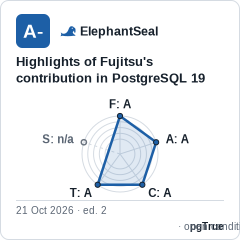
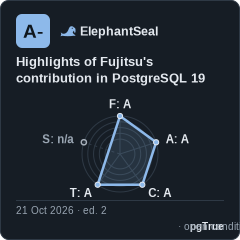
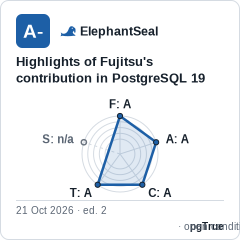
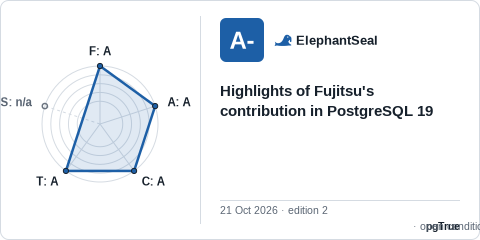
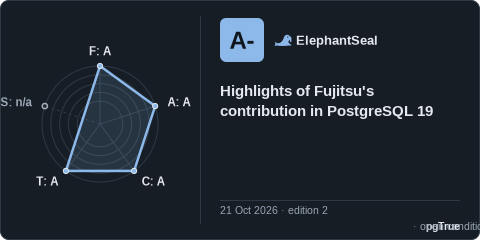
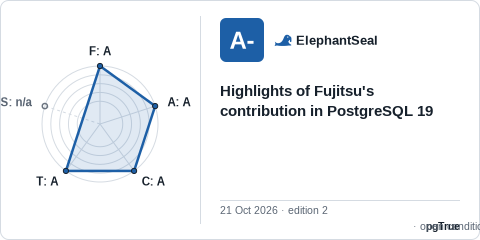
FACTS scorecard Scorecard radar, 5 axes, bigger is better. Overall A-. Factual A · 0 wrong of 11 checked · 0 caveats. Applicable A · 0 wrong of 10 checked · 0 caveats. Consistent A · 0 wrong of 11 checked · 0 caveats. Transparent A · 0 wrong of 6 checked · 0 caveats. Safe not applicable (n/a). Factual A0 wrong of 110 caveats Applicable A0 wrong of 100 caveats Consistent A0 wrong of 110 caveats Transparent A0 wrong of 60 caveats Safe n/anothingto check

By topic: Contribution statistics — 1 finding, 0 wrong · Publication exclusions — 2 findings, 0 wrong · Sequence synchronization — 2 findings, 0 wrong · Conflict detection — 1 finding, 0 wrong · Dynamic WAL level — 1 finding, 0 wrong · Slot synchronization — 4 findings, 0 wrong

Further out is better. Each axis has its own letter, from the wrong claims and caveats among the claims we checked of that kind.

Checked on the FACTS: Factual, Applicable, Consistent, Transparent, Safe. Clockwise: Factual (is it true?), Applicable (does it apply to my setup, today?), Consistent (does it agree with itself?), Transparent (can I check it myself?), Safe (can I run this on prod?).

We checked 11 claims.

AxisLetterWrongCaveatsCheckedCoverage
FactualA0011assessed: A · 0 wrong of 11 checked · 0 caveats
ApplicableA0010assessed: A · 0 wrong of 10 checked · 0 caveats
ConsistentA0011assessed: A · 0 wrong of 11 checked · 0 caveats
TransparentA006assessed: A · 0 wrong of 6 checked · 0 caveats
Safe—000not applicable
Topics · 6 topics

Topics

TopicFactualApplicableConsistentTransparentSafe
Contribution statistics0 issues 1 checked F130 issues 1 checked0 issues 1 checked
Publication exclusions0 issues 2 checked F4 F90 issues 2 checked0 issues 2 checked0 issues 1 checked
Sequence synchronization0 issues 2 checked F3 F120 issues 2 checked0 issues 2 checked0 issues 1 checked
Conflict detection0 issues 1 checked F100 issues 1 checked0 issues 1 checked0 issues 1 checked
Dynamic WAL level0 issues 1 checked F20 issues 1 checked0 issues 1 checked
Slot synchronization0 issues 4 checked F5 F6 F8 F110 issues 4 checked0 issues 4 checked0 issues 2 checked

Issues found among the claims checked, per topic and axis. Each link goes to the finding behind the count.

Revisions: 5 · Not assessed -> Not assessed -> A- -> A- -> A-

We audited this article 5 times. Each row is the final edition of one audit. Letters and findings of earlier revisions stay readable at their own address.

  1. Revision 1 · Not assessed · audit version not recorded

    Details unavailable.

    ElephantSeal: Not assessed.

  2. Revision 2 · Not assessed · audit version not recorded

    Details unavailable.

    ElephantSeal: Not assessed.

  3. Revision 3 · 2026-09-23 22:59 UTC · A- · audit version not recorded · regrade version not recorded

    Same article text, re-audited. 9 accurate · 0 wrong · 1 caveat.

    ElephantSeal: A-. Open: the benchmark cannot yet be rerun from what is published.

    Changes: Details unavailable.

  4. Revision 4 · 2026-10-19 21:11 UTC · A- · audited with v1.0.16 (approx.)

    Article text changed. 9 accurate · 0 wrong · 0 caveats.

    ElephantSeal: A-. Open: the benchmark cannot yet be rerun from what is published.

    Changes: No longer reported: “…new statistics that show how many times synchronization was skipped and the reasons for each skip.”. New: none.

  5. Revision 5 · this page · 2026-10-21 05:13 UTC · A- · audited with v1.0.17 (approx.)

    Same article text, re-audited. 11 accurate · 0 wrong · 0 caveats.

    ElephantSeal: A-. Open: the benchmark cannot yet be rerun from what is published.

    Changes: No change in findings.

First impression
Questions and answers

Questions and answers

What is pgTrue?

pgTrue is an independent fact-check of technical Postgres articles, made by PostgresAI. It helps you check advice before you use it.

What does the letter grade mean?

The letter grade summarizes the claims we checked. Five axes show what we checked:

  • Factual: is it true?
  • Applicable: does it apply to my setup, today?
  • Consistent: does it agree with itself?
  • Transparent: can I check it myself?
  • Safe: can I run this in production?

What is the ElephantSeal?

The ElephantSeal is the mark an article earns. It always shows the latest edition. “Open:” lists what is still open.

Can an author reply?

Authors can ask us to correct a finding, reply to it, or withdraw it. Right-of-reply policy.

Paste into your AI assistant to fix the article, then ask for a re-review.

Show the text
Fix the article with this report, then ask pgTrue for a re-review.

# pgTrue report: Highlights of Fujitsu's contribution in PostgreSQL 19

Article title: Highlights of Fujitsu's contribution in PostgreSQL 19
Article URL: https://www.postgresql.fastware.com/blog/highlights-of-fujitsu-contribution-in-postgresql-19
Report URL: https://pgtrue.postgres.ai/shared/brief/b36b68c0-1262-47cd-8d13-b530fc749f6b
Audited revision: 5 of 5, 2026-10-21 05:13:30 UTC
Overall letter: A-

## Axes

- Factual: A · 0 wrong · 11 checked · 0 caveats · assessed
- Applicable: A · 0 wrong · 10 checked · 0 caveats · assessed
- Consistent: A · 0 wrong · 11 checked · 0 caveats · assessed
- Transparent: A · 0 wrong · 6 checked · 0 caveats · assessed
- Safe: — · 0 wrong · 0 checked · 0 caveats · not applicable

ElephantSeal: A-.
Open conditions: the benchmark cannot yet be rerun from what is published.

## Report metadata

- Report: Technical fact-check, edition 2
- Issued: 2026-10-21
- Edition: Updated after review. Corrections are listed below.
- Submitted: Submitted by the PostgresAI team.
- Author response: No written reply from the author. The article changed 1 time after our first audit; we re-audited each version. See Revisions below. Policy: [right-of-reply and corrections policy](/pgtrue/security).
- pgTrue version: audited with v1.0.17 (approx.)

## Findings needing a change (0)

None.

## Verified accurate claims (11)

### F2 · Accurate · Factual · Logical slots dynamically control the effective WAL level
Location: excerpt · section “Allow dynamically adjusting wal_level” · as fetched 2026-10-21 · [open in article](https://www.postgresql.fastware.com/blog/highlights-of-fujitsu-contribution-in-postgresql-19#:~:text=Creating%20the%20first%20logical%20slot,effective%20WAL%20level%20to%20logical)
Article says:
```text
Creating the first logical slot raises the effective WAL level to logical…
```
What is true:
PostgreSQL 19 activates logical decoding when the first logical slot appears with wal_level=replica. logicalctl.c:390 performs activation. checkpointer.c:575 handles requested deactivation. logicaldecoding.sgml:283-291 confirms asynchronous deactivation after the last logical slot disappears.
Charitable reading:
We read the activation and deactivation statements under the paragraph's wal_level=replica condition.
Review: We tested whether configured wal_level must change. The finding correctly distinguishes effective behavior and preserves the wal_level=replica condition. E-6 confirms asynchronous deactivation. We tested the distinction between configured and effective WAL levels. Under wal_level=replica, the documentation confirms activation and asynchronous checkpointer deactivation.

Sources:
- [REL_19_STABLE@48b43081e5 · doc/src/sgml/logicaldecoding.sgml:283-291](https://github.com/postgres/postgres/blob/48b43081e550f9e4b04e1184ed6d3fed4f850691/doc/src/sgml/logicaldecoding.sgml#L283-L291)
  Qualification: Version note: PostgreSQL 19 documentation source. The surrounding paragraph specifies wal_level=replica.
  Excerpt:
  ```text
  logical decoding is automatically activated upon creation of the first
     logical replication slot.
  ```
- [REL_19_STABLE@48b43081e5 · src/backend/replication/logical/logicalctl.c:384-393](https://github.com/postgres/postgres/blob/48b43081e550f9e4b04e1184ed6d3fed4f850691/src/backend/replication/logical/logicalctl.c#L384-L393)
  Qualification: Version note: PostgreSQL 19 branch snapshot.
  Excerpt:
  ```text
  EnableLogicalDecoding(InvalidXLogRecPtr);
  ```
- [REL_19_STABLE@48b43081e5 · src/backend/postmaster/checkpointer.c:571-576](https://github.com/postgres/postgres/blob/48b43081e550f9e4b04e1184ed6d3fed4f850691/src/backend/postmaster/checkpointer.c#L571-L576)
  Qualification: Version note: PostgreSQL 19 branch snapshot.
  Excerpt:
  ```text
  /*
		 * Disable logical decoding if someone requested it. See comments atop
		 * logicalctl.c.
		 */
		DisableLogicalDecodingIfNecessary();
  ```

Finding URL: https://pgtrue.postgres.ai/shared/brief/b36b68c0-1262-47cd-8d13-b530fc749f6b#F2

### F3 · Accurate · Factual · REFRESH SEQUENCES synchronizes subscribed sequence values
Location: excerpt · section “Logical replication of sequences” · as fetched 2026-10-21 · [open in article](https://www.postgresql.fastware.com/blog/highlights-of-fujitsu-contribution-in-postgresql-19#:~:text=ALTER%20SUBSCRIPTION,REFRESH%20SEQUENCES)
Article says:
```text
…ALTER SUBSCRIPTION ... REFRESH SEQUENCES…
```
What is true:
PostgreSQL 19 implements ALTER SUBSCRIPTION ... REFRESH SEQUENCES. subscriptioncmds.c:2238-2246 dispatches the command to AlterSubscription_refresh_seq. alter_subscription.sgml:243-246 specifies synchronization of currently subscribed sequence data.
Charitable reading:
The article describes an explicit synchronization command, rather than continuous sequence replication.
Review: We checked whether REFRESH SEQUENCES changes membership or promises continuous replication. The finding makes neither claim. Documentation and dispatch code support synchronization of currently subscribed sequences. We checked whether REFRESH SEQUENCES changes membership or provides continuous replication. The finding correctly limits it to resynchronizing currently subscribed sequences.

Sources:
- [REL_19_STABLE@48b43081e5 · doc/src/sgml/ref/alter_subscription.sgml:243-246](https://github.com/postgres/postgres/blob/48b43081e550f9e4b04e1184ed6d3fed4f850691/doc/src/sgml/ref/alter_subscription.sgml#L243-L246)
  Qualification: Version note: PostgreSQL 19 documentation source.
  Excerpt:
  ```text
  <literal>REFRESH SEQUENCES</literal> will re-synchronize the sequence
      data for all currently subscribed sequences without changing which
      sequences are subscribed.
  ```
- [REL_19_STABLE@48b43081e5 · src/backend/commands/subscriptioncmds.c:2238-2246](https://github.com/postgres/postgres/blob/48b43081e550f9e4b04e1184ed6d3fed4f850691/src/backend/commands/subscriptioncmds.c#L2238-L2246)
  Qualification: Version note: PostgreSQL 19 branch snapshot.
  Excerpt:
  ```text
  case ALTER_SUBSCRIPTION_REFRESH_SEQUENCES:
			{
				if (!sub->enabled)
					ereport(ERROR,
							errcode(ERRCODE_OBJECT_NOT_IN_PREREQUISITE_STATE),
							errmsg("%s is not allowed for disabled subscriptions",
								   "ALTER SUBSCRIPTION ... REFRESH SEQUENCES"));

				AlterSubscription_refresh_seq(sub, orig_conninfo);
  ```
- [REL_19_STABLE@48b43081e5 · doc/src/sgml/release-19.sgml:1518-1518](https://github.com/postgres/postgres/blob/48b43081e550f9e4b04e1184ed6d3fed4f850691/doc/src/sgml/release-19.sgml#L1518-L1518)
  Excerpt:
  ```text
  2025-10-23 [f0b3573c3] Introduce "REFRESH SEQUENCES" for subscriptions.
  ```

Finding URL: https://pgtrue.postgres.ai/shared/brief/b36b68c0-1262-47cd-8d13-b530fc749f6b#F3

### F4 · Accurate · Factual · FOR ALL TABLES publications support table exclusions
Location: excerpt · section “Allow table exclusions in publications” · as fetched 2026-10-21 · [open in article](https://www.postgresql.fastware.com/blog/highlights-of-fujitsu-contribution-in-postgresql-19#:~:text=excluding%20specific%20tables%20from%20FOR%20ALL%20TABLES%20publications)
Article says:
```text
…excluding specific tables from FOR ALL TABLES publications…
```
What is true:
PostgreSQL 19 supports EXCEPT in FOR ALL TABLES publications. pg_publication.c:1114-1117 excludes listed relations from publication membership. create_publication.sgml:174-176 confirms that other eligible tables, including future tables, remain covered.
Charitable reading:
The article's reference to all tables means tables eligible for logical publication.
Review: We checked whether all tables includes ineligible relations. The finding explicitly limits coverage to eligible tables. The membership filter applies exceptlist. We checked whether exclusions affect actual membership. pg_publication.c filters the exclusion list, and the documentation includes future eligible tables.

Sources:
- [REL_19_STABLE@48b43081e5 · doc/src/sgml/ref/create_publication.sgml:174-176](https://github.com/postgres/postgres/blob/48b43081e550f9e4b04e1184ed6d3fed4f850691/doc/src/sgml/ref/create_publication.sgml#L174-L176)
  Qualification: Version note: PostgreSQL 19 documentation source.
  Excerpt:
  ```text
  Marks the publication as one that replicates changes for all tables in
      the database, including tables created in the future. Tables listed in
      <literal>EXCEPT</literal> clause are excluded from the publication.
  ```
- [REL_19_STABLE@48b43081e5 · src/backend/catalog/pg_publication.c:1114-1117](https://github.com/postgres/postgres/blob/48b43081e550f9e4b04e1184ed6d3fed4f850691/src/backend/catalog/pg_publication.c#L1114-L1117)
  Qualification: Version note: PostgreSQL 19 branch snapshot.
  Excerpt:
  ```text
  if (is_publishable_class(relid, relForm) &&
			!(relForm->relispartition && pubviaroot) &&
			!list_member_oid(exceptlist, relid))
			result = lappend_oid(result, relid);
  ```

Finding URL: https://pgtrue.postgres.ai/shared/brief/b36b68c0-1262-47cd-8d13-b530fc749f6b#F4

### F5 · Accurate · Factual · The slot synchronization SQL function retries pending slots
Location: excerpt · section “Improve several points for slot synchronization” · as fetched 2026-10-21 · [open in article](https://www.postgresql.fastware.com/blog/highlights-of-fujitsu-contribution-in-postgresql-19#:~:text=the%20SQL%20interface%20has%20been,to%20retry%20synchronization%20on%20failure)
Article says:
```text
…the SQL interface has been improved to retry synchronization on failure…
```
What is true:
PostgreSQL 19's pg_sync_replication_slots retries until the initial failover slots synchronize. slotsync.c:2139-2146 exits when persistence finishes and waits otherwise. func-admin.sgml:1499-1501 documents cyclic retries.
Charitable reading:
Failure means slots are not yet ready for persistent synchronization. The article does not promise recovery from every SQL error.
Review: We tested whether the finding promises retries after every SQL error. It limits retries to pending synchronization. The loop and documentation support that reading. We challenged whether retry covers arbitrary SQL errors. The finding limits retry to pending slot synchronization, matching the loop and documentation.

Sources:
- [REL_19_STABLE@48b43081e5 · doc/src/sgml/func/func-admin.sgml:1499-1501](https://github.com/postgres/postgres/blob/48b43081e550f9e4b04e1184ed6d3fed4f850691/doc/src/sgml/func/func-admin.sgml#L1499-L1501)
  Qualification: Version note: PostgreSQL 19 documentation source.
  Excerpt:
  ```text
  retries cyclically until all the failover slots that existed on
        primary at the start of the function call are synchronized.
  ```
- [REL_19_STABLE@48b43081e5 · src/backend/replication/logical/slotsync.c:2139-2146](https://github.com/postgres/postgres/blob/48b43081e550f9e4b04e1184ed6d3fed4f850691/src/backend/replication/logical/slotsync.c#L2139-L2146)
  Qualification: Version note: PostgreSQL 19 branch snapshot.
  Excerpt:
  ```text
  /* Done if all slots are persisted i.e are sync-ready */
			if (!slot_persistence_pending)
				break;

			/* wait before retrying again */
			wait_for_slot_activity(some_slot_updated);
  ```
- [REL_19_STABLE@48b43081e5 · doc/src/sgml/func/func-admin.sgml:1495-1501](https://github.com/postgres/postgres/blob/48b43081e550f9e4b04e1184ed6d3fed4f850691/doc/src/sgml/func/func-admin.sgml#L1495-L1501)
  Excerpt:
  ```text
  retries cyclically until all the failover slots that existed on
  ```

Finding URL: https://pgtrue.postgres.ai/shared/brief/b36b68c0-1262-47cd-8d13-b530fc749f6b#F5

### F6 · Accurate · Factual · Slot synchronization exposes skip counts and a skip reason
Location: excerpt · section “Improve several points for slot synchronization” · as fetched 2026-10-21 · [open in article](https://www.postgresql.fastware.com/blog/highlights-of-fujitsu-contribution-in-postgresql-19#:~:text=statistics%20that%20show%20how%20many%20times%20synchronization%20was%20skipped)
Article says:
```text
…statistics that show how many times synchronization was skipped…
```
What is true:
PostgreSQL 19 counts slot synchronization skips and records a reason. slotsync.c:199-211 updates both statistics. pgstat_replslot.c:128 increments slotsync_skip_count. system-views.sgml:3139 identifies slotsync_skip_reason as the latest skip reason.
Charitable reading:
The statistics expose a cumulative count and the latest skip reason. The article does not explicitly promise historical event storage.
Review: We checked whether count and reason imply an event history. The finding explicitly limits the reason to the latest skip. Source increments the counter and replaces the reason. We checked counter increments and reason retention separately. The code updates both, and the finding correctly identifies the latest reason.

Sources:
- [REL_19_STABLE@48b43081e5 · src/backend/replication/logical/slotsync.c:199-211](https://github.com/postgres/postgres/blob/48b43081e550f9e4b04e1184ed6d3fed4f850691/src/backend/replication/logical/slotsync.c#L199-L211)
  Qualification: Version note: PostgreSQL 19 branch snapshot.
  Excerpt:
  ```text
  if (skip_reason != SS_SKIP_NONE)
		pgstat_report_replslotsync(slot);

	/* Update the slot sync skip reason */
	if (slot->slotsync_skip_reason != skip_reason)
	{
		SpinLockAcquire(&slot->mutex);
		slot->slotsync_skip_reason = skip_reason;
		SpinLockRelease(&slot->mutex);
	}
  ```
- [REL_19_STABLE@48b43081e5 · src/backend/utils/activity/pgstat_replslot.c:128-128](https://github.com/postgres/postgres/blob/48b43081e550f9e4b04e1184ed6d3fed4f850691/src/backend/utils/activity/pgstat_replslot.c#L128-L128)
  Qualification: Version note: PostgreSQL 19 branch snapshot.
  Excerpt:
  ```text
  statent->slotsync_skip_count += 1;
  ```
- [REL_19_STABLE@48b43081e5 · doc/src/sgml/system-views.sgml:3139-3144](https://github.com/postgres/postgres/blob/48b43081e550f9e4b04e1184ed6d3fed4f850691/doc/src/sgml/system-views.sgml#L3139-L3144)
  Qualification: Version note: PostgreSQL 19 documentation source.
  Excerpt:
  ```text
  The reason for the last slot synchronization skip.
  ```

Finding URL: https://pgtrue.postgres.ai/shared/brief/b36b68c0-1262-47cd-8d13-b530fc749f6b#F6

### F8 · Accurate · Factual · Slot synchronization shipped in PostgreSQL 17
Location: excerpt · section “Improve several points for slot synchronization” · as fetched 2026-10-21 · [open in article](https://www.postgresql.fastware.com/blog/highlights-of-fujitsu-contribution-in-postgresql-19#:~:text=The%20slot%20synchronization%20feature%20was%20introduced%20in%20PostgreSQL%2017)
Article says:
```text
…The slot synchronization feature was introduced in PostgreSQL 17…
```
What is true:
REL_17_0 introduces pg_sync_replication_slots(). Its failover documentation permits continued subscriptions after promotion. Synchronization runs asynchronously, so failover still requires readiness checks.
Charitable reading:
The article describes a failover capability rather than promising identical slot state at every instant.
Review: We checked the PostgreSQL 17 version floor and asynchronous failover caveat. REL_17_0 supports both. The finding does not promise identical slot state continuously. We checked the PostgreSQL 17 version floor and asynchronous synchronization caveat. Both sources support failover capability with readiness checks.

Sources:
- [REL_17_0 · doc/src/sgml/release-17.sgml:1321-1324](https://github.com/postgres/postgres/blob/d7ec59a63d745ba74fba0e280bbf85dc6d1caa3e/doc/src/sgml/release-17.sgml#L1321-L1324)
  Qualification: Version note: Checked the PostgreSQL 17.0 version floor.
  Excerpt:
  ```text
  to synchronize logical replication slots
  ```
- [REL_17_0 · doc/src/sgml/logical-replication.sgml:694-714](https://github.com/postgres/postgres/blob/d7ec59a63d745ba74fba0e280bbf85dc6d1caa3e/doc/src/sgml/logical-replication.sgml#L694-L714)
  Qualification: Version note: Checked failover support at PostgreSQL 17.0.
  Excerpt:
  ```text
  They can continue subscribing to publications
  ```

Finding URL: https://pgtrue.postgres.ai/shared/brief/b36b68c0-1262-47cd-8d13-b530fc749f6b#F8

### F9 · Accurate · Factual · PostgreSQL 19 supports publication table exclusions
Location: excerpt · section “Allow table exclusions in publications” · as fetched 2026-10-21 · [open in article](https://www.postgresql.fastware.com/blog/highlights-of-fujitsu-contribution-in-postgresql-19#:~:text=We%20allow%20excluding%20specific%20tables%20from%20FOR%20ALL%20TABLES%20publications.)
Article says:
```text
…We allow excluding specific tables from FOR ALL TABLES publications.
```
What is true:
FOR ALL TABLES supports EXCEPT in PostgreSQL 19. doc/src/sgml/ref/create_publication.sgml:170–176 explicitly excludes listed tables from that publication.
Charitable reading:
The claim concerns publication membership. Other publications can still include an excluded table.
Review: We tested whether exclusions apply across every publication. The finding limits exclusion to that publication. E-27 explicitly supports EXCEPT with FOR ALL TABLES. We checked whether EXCEPT applies to FOR ALL TABLES. The cited parameter documentation states that relationship directly.

Sources:
- [REL_19_STABLE@48b43081e5 · doc/src/sgml/ref/create_publication.sgml:170-176](https://github.com/postgres/postgres/blob/48b43081e550f9e4b04e1184ed6d3fed4f850691/doc/src/sgml/ref/create_publication.sgml#L170-L176)
  Excerpt:
  ```text
  <literal>EXCEPT</literal> clause are excluded from the publication.
  ```

Finding URL: https://pgtrue.postgres.ai/shared/brief/b36b68c0-1262-47cd-8d13-b530fc749f6b#F9

### F10 · Accurate · Factual · PostgreSQL 19 adds update_deleted detection
Location: excerpt · section “Detect update_deleted conflict” · as fetched 2026-10-21 · [open in article](https://www.postgresql.fastware.com/blog/highlights-of-fujitsu-contribution-in-postgresql-19#:~:text=adding%20detection%20of%20the%20update_deleted%20conflict)
Article says:
```text
…adding detection of the update_deleted conflict…
```
What is true:
PostgreSQL 19 adds update_deleted conflict reporting. doc/src/sgml/release-19.sgml:1033–1043 identifies the addition and its retain_dead_tuples requirement.
Charitable reading:
The article identifies a new conflict category. It does not provide a complete configuration procedure.
Review: We checked whether PostgreSQL 19 adds only a statistic without the claimed detection capability. The release entry identifies detection and reporting. It also states the retention prerequisite. We checked whether the release notes establish detection rather than only a label. The range identifies reporting concurrent deletes and requires retain_dead_tuples.

Sources:
- [REL_19_STABLE@48b43081e5 · doc/src/sgml/release-19.sgml:1033-1043](https://github.com/postgres/postgres/blob/48b43081e550f9e4b04e1184ed6d3fed4f850691/doc/src/sgml/release-19.sgml#L1033-L1043)
  Excerpt:
  ```text
  2025-08-04 [fd5a1a0c3] Detect and report update_deleted conflicts.
  ```

Finding URL: https://pgtrue.postgres.ai/shared/brief/b36b68c0-1262-47cd-8d13-b530fc749f6b#F10

### F11 · Accurate · Factual · PostgreSQL 19 counts skipped slot synchronizations
Location: excerpt · section “Improve several points for slot synchronization” · as fetched 2026-10-21 · [open in article](https://www.postgresql.fastware.com/blog/highlights-of-fujitsu-contribution-in-postgresql-19#:~:text=new%20statistics%20that%20show%20how%20many%20times%20synchronization%20was%20skipped)
Article says:
```text
…new statistics that show how many times synchronization was skipped…
```
What is true:
slotsync_skip_count counts skipped synchronization attempts. doc/src/sgml/monitoring.sgml:1694–1699 defines the counter and limits its meaning to standby servers.
Charitable reading:
The counter describes skipped synchronization attempts on standby servers.
Review: We checked the counter's server scope. E-32 limits its meaning to standby servers, and the finding preserves that restriction. We checked the counter's population. The documentation counts skipped slot synchronizations and limits its meaning to standby servers.

Sources:
- [REL_19_STABLE@48b43081e5 · doc/src/sgml/monitoring.sgml:1694-1699](https://github.com/postgres/postgres/blob/48b43081e550f9e4b04e1184ed6d3fed4f850691/doc/src/sgml/monitoring.sgml#L1694-L1699)
  Excerpt:
  ```text
  Number of times the slot synchronization is skipped.
  ```

Finding URL: https://pgtrue.postgres.ai/shared/brief/b36b68c0-1262-47cd-8d13-b530fc749f6b#F11

### F12 · Accurate · Factual · Earlier upgrades required separate sequence synchronization
Location: excerpt · section “Logical replication of sequences” · as fetched 2026-10-21 · [open in article](https://www.postgresql.fastware.com/blog/highlights-of-fujitsu-contribution-in-postgresql-19#:~:text=users%20must%20manually%20synchronize%20sequence%20values%20across%20instances)
Article says:
```text
…users must manually synchronize sequence values across instances…
```
What is true:
PostgreSQL 18 does not replicate sequence state. doc/src/sgml/logical-replication.sgml:2075–2084 requires sequence updates before switching writes to the subscriber.
Charitable reading:
The sentence describes the upgrade workflow before PostgreSQL 19, rather than denying the new command.
Review: We tested the sentence as a present-tense claim about PostgreSQL 19. Its surrounding upgrade discussion contrasts earlier behavior with the new command. REL_18_0 confirms separate sequence updates. We tested the historical reading against the following PostgreSQL 19 command. PostgreSQL 18 documentation requires separate sequence updates before switchover.

Sources:
- [REL_18_0 · doc/src/sgml/logical-replication.sgml:2075-2084](https://github.com/postgres/postgres/blob/3d6a828938a5fa0444275d3d2f67b64ec3199eb7/doc/src/sgml/logical-replication.sgml#L2075-L2084)
  Qualification: Version note: Checked behavior before PostgreSQL 19.
  Excerpt:
  ```text
  Sequence data is not replicated.
  ```

Finding URL: https://pgtrue.postgres.ai/shared/brief/b36b68c0-1262-47cd-8d13-b530fc749f6b#F12

### F13 · Accurate · Factual · The table supports the rounded 1.8× contribution ratio
Location: Article · exact quote · [open in article](https://www.postgresql.fastware.com/blog/highlights-of-fujitsu-contribution-in-postgresql-19#:~:text=increased%20by%20around%201.8%20times)
Article says:
```text
…increased by around 1.8 times…
```
What is true:
PostgreSQL 15 totals 90 authored and reviewed credits. PostgreSQL 19 totals 164 credits. The ratio rounds to 1.8× (derived: 164 / 90 = 1.82).
Charitable reading:
Total contributions means authored credits plus reviewed credits. Around 1.8 times describes the final total divided by the initial total.
Explanation: Checked for internal consistency: the evidence is the article itself.
Review: We recalculated 49 + 41 = 90 and 83 + 81 = 164. Their ratio rounds to 1.8. The finding correctly limits verification to arithmetic. Only two numerical quotations support this check. We recalculated both totals and tested the interpretation of increased by. Totals are 90 and 164 credits. Their ratio is 1.82. The finding expressly verifies arithmetic rather than contribution attribution.

Finding URL: https://pgtrue.postgres.ai/shared/brief/b36b68c0-1262-47cd-8d13-b530fc749f6b#F13

## Notes (not graded) (2)

### F1 · Note ·  · Note: “The update_deleted conflict is reported when a subscriber subscribes to multiple…”
Location: excerpt · section “Detect update_deleted conflict” · as fetched 2026-10-21 · [open in article](https://www.postgresql.fastware.com/blog/highlights-of-fujitsu-contribution-in-postgresql-19#:~:text=The%20update_deleted%20conflict%20is%20reported,subscriber%20subscribes%20to%20multiple%20publishers)
Article says:
```text
The update_deleted conflict is reported when a subscriber subscribes to multiple publishers…
```
What is true:
PostgreSQL 19 requires track_commit_timestamp and retain_dead_tuples for update_deleted detection. worker.c:3334-3335 returns false when either setting is disabled. retain_dead_tuples defaults to false. The article's feature overview omits these prerequisites.
So what:
Enable track_commit_timestamp and restart the subscriber. Enable retain_dead_tuples on the subscription before testing update_deleted detection.
Explanation: Not graded: no reader would act differently on it.
Review: The prerequisites are correct. The article describes the conflict category without presenting a configuration procedure. The cited evidence establishes prerequisites, not failed tests. Keep the configuration caveat as a note. We tested the feature-overview reading. The diagnostic statement still omits two required settings. Both requirements and the false default match source. The concrete setup action supports the limited wasted-work consequence.

Sources:
- [REL_19_STABLE@48b43081e5 · src/backend/replication/logical/worker.c:3329-3335](https://github.com/postgres/postgres/blob/48b43081e550f9e4b04e1184ed6d3fed4f850691/src/backend/replication/logical/worker.c#L3329-L3335)
  Qualification: Version note: PostgreSQL 19 branch snapshot.
  Excerpt:
  ```text
  /*
	 * Return false if either dead tuples are not retained or commit timestamp
	 * data is not available.
	 */
	if (!MySubscription->retaindeadtuples || !track_commit_timestamp)
		return false;
  ```
- [REL_19_STABLE@48b43081e5 · doc/src/sgml/logical-replication.sgml:2072-2077](https://github.com/postgres/postgres/blob/48b43081e550f9e4b04e1184ed6d3fed4f850691/doc/src/sgml/logical-replication.sgml#L2072-L2077)
  Qualification: Version note: PostgreSQL 19 documentation source.
  Excerpt:
  ```text
  The tuple to be updated was concurrently deleted by another origin. The
       update will simply be skipped in this scenario. Note that this conflict
       can only be detected when
       <link linkend="guc-track-commit-timestamp"><varname>track_commit_timestamp</varname></link>
       and <link linkend="sql-createsubscription-params-with-retain-dead-tuples"><literal>retain_dead_tuples</literal></link>
       are enabled.
  ```
- [REL_19_STABLE@48b43081e5 · doc/src/sgml/ref/create_subscription.sgml:466-471](https://github.com/postgres/postgres/blob/48b43081e550f9e4b04e1184ed6d3fed4f850691/doc/src/sgml/ref/create_subscription.sgml#L466-L471)
  Qualification: Version note: PostgreSQL 19 documentation source.
  Excerpt:
  ```text
  <term><literal>retain_dead_tuples</literal> (<type>boolean</type>)</term>
        <listitem>
         <para>
          Specifies whether the information (e.g., dead tuples, commit
          timestamps, and origins) required for conflict detection on the
          subscriber is retained. The default is <literal>false</literal>.
  ```

Finding URL: https://pgtrue.postgres.ai/shared/brief/b36b68c0-1262-47cd-8d13-b530fc749f6b#F1

### F7 · Note ·  · Note: “…the reasons for each skip…”
Location: excerpt · section “Improve several points for slot synchronization” · as fetched 2026-10-21 · [open in article](https://www.postgresql.fastware.com/blog/highlights-of-fujitsu-contribution-in-postgresql-19#:~:text=the%20reasons%20for%20each%20skip)
Article says:
```text
…the reasons for each skip…
```
What is true:
PostgreSQL 19 stores the latest skip reason in slotsync_skip_reason and clears it after successful synchronization. system-views.sgml:3136–3144 documents this limit. The article does not explicitly promise historical records. Record events separately when historical diagnosis is required.
So what:
Record synchronization events in monitoring instead of relying on slotsync_skip_reason to reconstruct every skipped attempt.
Explanation: Not graded: no reader would act differently on it.
Review: E-23 establishes the latest-reason limitation. E-22 does not explicitly promise retained history. The charitable reading supports an operational caveat, not a graded error. We tried reading each skip as reason categories. The wording still implies reasons remain available for individual attempts. E-23 documents only the last reason and clears it after success. Recording events separately is concrete.

Sources:
- [REL_19_STABLE@48b43081e5 · doc/src/sgml/system-views.sgml:3136-3144](https://github.com/postgres/postgres/blob/48b43081e550f9e4b04e1184ed6d3fed4f850691/doc/src/sgml/system-views.sgml#L3136-L3144)
  Excerpt:
  ```text
  The reason for the last slot synchronization skip.
  ```

Finding URL: https://pgtrue.postgres.ai/shared/brief/b36b68c0-1262-47cd-8d13-b530fc749f6b#F7

## Withdrawn findings (0)

None.

## Section checks

- Contribution statistics · A · 1 verified-accurate · no checkable claims
- Publication exclusions · A · 2 verified-accurate · 100% of claims (4 of 4)
- Sequence synchronization · A · 2 verified-accurate · 100% of claims (3 of 3)
- Conflict detection · A · 1 verified-accurate · 100% of claims (4 of 4, plus 2 that need data we do not have)
- Dynamic WAL level · A · 1 verified-accurate · 100% of claims (3 of 3)
- Slot synchronization · A · 4 verified-accurate · 100% of claims (5 of 5)

## Claim coverage

- Navigation: no checkable claims; not counted: 1 not a claim
- Introduction: no checkable claims; not counted: 1 product or opinion, 1 duplicate, 3 not a claim
- Community journey: 1 claim is the author's own account; nothing checkable; not counted: 14 product or opinion, 2 not a claim
- Contribution statistics: no checkable claims; not counted: 17 product or opinion, 4 duplicate, 2 not a claim
- Contributor recognition: 2 of 2 Postgres claims checked, plus 1 that need data we do not have; not counted: 14 product or opinion, 1 duplicate, 3 not a claim
- Feature status: 2 claims are the author's own account; nothing checkable; not counted: 2 not a claim
- Publication exclusions: 4 of 4 Postgres claims checked; not counted: 2 not a claim
- Sequence synchronization: 3 of 3 Postgres claims checked; not counted: 3 product or opinion, 2 not a claim
- Conflict detection: 4 of 4 Postgres claims checked, plus 2 that need data we do not have; not counted: 1 product or opinion, 1 not a claim
- Dynamic WAL level: 3 of 3 Postgres claims checked; not counted: 1 product or opinion, 2 not a claim
- Slot synchronization: 5 of 5 Postgres claims checked; not counted: 1 product or opinion, 1 duplicate, 1 not a claim
- Future work: no checkable claims; not counted: 5 product or opinion, 3 duplicate, 1 not a claim
- Footer and biography: no checkable claims; not counted: 1 product or opinion, 1 duplicate, 12 not a claim

## What we did not check

- We did not verify the listed features against the exact PostgreSQL 19 beta build available on July 28, 2026.
- We did not verify the multi-master architecture claims without a concrete implementation or design.
- We could not identify the article's original page URL.
- We did not establish the exact July 2026 beta contents or the complete reversion history of its listed features.
- We did not independently verify contributor recognition, contribution totals, or the parallel-apply benchmark.
- We did not check the linked feature articles or the team contribution article.
- We did not verify the 25–40% parallel-apply gain without workload details and benchmark timings.
- We checked the contribution-table arithmetic but could not independently verify the PostgreSQL 15–19 commit counts.
- We did not inspect the contribution graph's plotted values.

## Notes

- Central claim not verified. We checked PostgreSQL 19 feature behavior and the 1.8× arithmetic, but did not verify contribution counts, attribution, or contributor recognition.
- We did not check everything in this article. What we did not check is listed below, in the words we recorded at the time. None of it moved the letter. We never charge our own limits to the article.
- Average of 4 axes: 4 · central claim not backed by evidence, at most A− · result A-
- Some explanatory text is not shown in this edition; the grade and findings are complete.
- Some checks did not happen for this edition, and each one we know of is listed above.
- Checked against: github.com/postgres/postgres REL_19_STABLE@48b43081e5 at commit 48b43081e550f9e4b04e1184ed6d3fed4f850691 (pinned target); https://www.postgresql.fastware.com/ (fetched 2026-10-21T05:13:44.389358Z); https://www.postgresql.fastware.com/5-key-enterprise-capabilities (fetched 2026-10-21T05:13:52.494742Z); https://www.postgresql.fastware.com/compare-fujitsu-enterprise-postgres-with-postgresql (fetched 2026-10-21T05:13:49.079593Z); https://www.postgresql.fastware.com/enhanced-security-for-enterprises (fetched 2026-10-21T05:13:46.272859Z); https://www.postgresql.fastware.com/fep-overview (fetched 2026-10-21T05:13:47.217846Z); https://www.postgresql.fastware.com/fep-training (fetched 2026-10-21T05:14:08.594442Z); https://www.postgresql.fastware.com/fep-training-certification (fetched 2026-10-21T05:14:12.127743Z); https://www.postgresql.fastware.com/fep-training-contact-us (fetched 2026-10-21T05:14:13.113691Z); https://www.postgresql.fastware.com/fep-training-instructor-led (fetched 2026-10-21T05:14:09.419118Z); https://www.postgresql.fastware.com/fep-training-on-demand (fetched 2026-10-21T05:14:10.294401Z); https://www.postgresql.fastware.com/fep-training-on-demand-curriculum (fetched 2026-10-21T05:14:11.119896Z); https://www.postgresql.fastware.com/fujitsu-enterprise-postgres-features (fetched 2026-10-21T05:13:47.975727Z); https://www.postgresql.fastware.com/fujitsu-enterprise-postgres-for-kubernetes (fetched 2026-10-21T05:13:55.115014Z); https://www.postgresql.fastware.com/fujitsu-enterprise-postgres-on-ibm-linuxone (fetched 2026-10-21T05:13:54.229654Z); https://www.postgresql.fastware.com/fujitsu-enterprise-postgres-on-ibm-power (fetched 2026-10-21T05:13:53.390213Z); https://www.postgresql.fastware.com/fujitsu-enterprise-postgres-specifications (fetched 2026-10-21T05:13:50.112865Z); https://www.postgresql.fastware.com/key-features-in-fujitsu-enterprise-postgres (fetched 2026-10-21T05:13:45.312046Z); https://www.postgresql.fastware.com/postgresql-consulting-services (fetched 2026-10-21T05:13:57.251238Z); https://www.postgresql.fastware.com/postgresql-support (fetched 2026-10-21T05:13:59.276755Z); https://www.postgresql.fastware.com/product-manuals (fetched 2026-10-21T05:13:56.148576Z); https://www.postgresql.fastware.com/resource-center (fetched 2026-10-21T05:14:14.467220Z); https://www.postgresql.fastware.com/resources/brochures (fetched 2026-10-21T05:14:17.150880Z); https://www.postgresql.fastware.com/resources/ebooks (fetched 2026-10-21T05:14:20.012359Z); https://www.postgresql.fastware.com/resources/tip-sheets (fetched 2026-10-21T05:14:19.018221Z); https://www.postgresql.fastware.com/resources/videos (fetched 2026-10-21T05:14:18.214230Z); https://www.postgresql.fastware.com/resources/white-papers (fetched 2026-10-21T05:14:15.503111Z); https://www.postgresql.fastware.com/services-overview (fetched 2026-10-21T05:13:58.354417Z); https://www.postgresql.fastware.com/support (fetched 2026-10-21T05:14:00.569041Z); https://www.postgresql.fastware.com/what-is-postgresql (fetched 2026-10-21T05:13:51.424174Z).
- Article captured 2026-10-21T05:13:30.793385Z · SHA-256 e8d886dedabf521a10a3ea90bb887331be4d50bdbcc508ae29db5228480d63d5 · Text extracted from the article's HTML.
- Policy SHA-256 b3ea7287627240addbd15878edbf43704b5a1b166438909b81206d8fa77c9481 · Grading rules SHA-256 6fb334e79d6b9e7ed81d3238cc10d9de602ff87ed65ff2fa781f53bac5798765.
- We did not verify the exact PostgreSQL 19 beta contents available on July 28, 2026.
- Feature checks use PostgreSQL 19 commit 48b43081e550f9e4b04e1184ed6d3fed4f850691.
- We did not independently verify contribution counts, contribution attribution, or contributor recognition.
- We checked the contribution arithmetic using 2 article passages. We did not read the graph's plotted values.
- We did not verify the claimed 25–40% parallel-apply improvement or reproduce displayed measurements.
- We did not check the linked feature articles, team contribution article, or multi-master architecture claims.
- article target version: bound to the most-cited major; also named 17 (2×), 20 (1×), 18 (1×), 16 (1×), 15 (1×)
- review: the findings were written by one model and reviewed independently by a different model.
- 3 passages in this edition fell short of our own plain-English rules.
- Built from the article text captured above, one pinned source tree, and 29 fetched pages.
- 11 survived · 2 weakened · 0 withdrawn.

## Edition changes

- F1 · weakened.
- F2 · recalibrated.
- F3 · recalibrated.
- F4 · recalibrated.
- F5 · recalibrated.
- F6 · recalibrated.
- F7 · weakened.
- F8 · recalibrated.
- F9 · recalibrated.
- F10 · recalibrated.
- F11 · recalibrated.
- F12 · recalibrated.
- F13 · recalibrated.

## Revision history

- [Revision 1](https://pgtrue.postgres.ai/shared/brief/b36b68c0-1262-47cd-8d13-b530fc749f6b?v=2) · Not assessed · audit version not recorded
  Details unavailable.
  ElephantSeal: Not assessed.
- [Revision 2](https://pgtrue.postgres.ai/shared/brief/b36b68c0-1262-47cd-8d13-b530fc749f6b?v=4) · Not assessed · audit version not recorded
  Details unavailable.
  ElephantSeal: Not assessed.
- [Revision 3](https://pgtrue.postgres.ai/shared/brief/b36b68c0-1262-47cd-8d13-b530fc749f6b?v=32) · 2026-09-23 22:59 UTC · A- · audit version not recorded · regrade version not recorded
  Same article text, re-audited. 9 accurate · 0 wrong · 1 caveat.
  ElephantSeal: A-. Open: the benchmark cannot yet be rerun from what is published.
  Changes: Details unavailable.
- [Revision 4](https://pgtrue.postgres.ai/shared/brief/b36b68c0-1262-47cd-8d13-b530fc749f6b?v=35) · 2026-10-19 21:11 UTC · A- · audited with v1.0.16 (approx.)
  Article text changed. 9 accurate · 0 wrong · 0 caveats.
  ElephantSeal: A-. Open: the benchmark cannot yet be rerun from what is published.
  Changes: No longer reported: “…new statistics that show how many times synchronization was skipped and the reasons for each skip.”. New: none.
- [Revision 5](https://pgtrue.postgres.ai/shared/brief/b36b68c0-1262-47cd-8d13-b530fc749f6b?v=37) · this page · 2026-10-21 05:13 UTC · A- · audited with v1.0.17 (approx.)
  Same article text, re-audited. 11 accurate · 0 wrong · 0 caveats.
  ElephantSeal: A-. Open: the benchmark cannot yet be rerun from what is published.
  Changes: No change in findings.

Updated your article? Request a correction. A new edition appears at this address.