Limited beta · What is this?

pgTrue is under active development: reports may contain significant mistakes, inaccuracies, or bugs. Please report anything you find to pgtrue@postgres.ai.

pgTrue is an independent fact-check of technical Postgres articles. Read the questions and answers.

pgTrue fact-check

ElephantSeal ALimited coverageOpen: the benchmark cannot yet be rerun from what is published

Embed

The ElephantSeal always shows this report's latest edition and links here. Copies cached elsewhere may update later.

[![pgTrue fact-check](https://pgtrue.postgres.ai/badge/ae842701-c128-49d3-a00c-a2bc9fe1ad92.svg?v=13&theme=light)](https://pgtrue.postgres.ai/shared/brief/ae842701-c128-49d3-a00c-a2bc9fe1ad92)
<a href="https://pgtrue.postgres.ai/shared/brief/ae842701-c128-49d3-a00c-a2bc9fe1ad92"><img src="https://pgtrue.postgres.ai/badge/ae842701-c128-49d3-a00c-a2bc9fe1ad92.svg?v=13&amp;theme=light" alt="pgTrue fact-check" width="90" height="20" loading="lazy" decoding="async" style="display:inline-block;width:90px;height:20px"></a>
https://pgtrue.postgres.ai/badge/ae842701-c128-49d3-a00c-a2bc9fe1ad92.svg?v=13&theme=light
.. image:: https://pgtrue.postgres.ai/badge/ae842701-c128-49d3-a00c-a2bc9fe1ad92.svg?v=13&theme=light
   :target: https://pgtrue.postgres.ai/shared/brief/ae842701-c128-49d3-a00c-a2bc9fe1ad92
   :alt: pgTrue fact-check
   :width: 90
   :height: 20
[![pgTrue fact-check](https://pgtrue.postgres.ai/badge/ae842701-c128-49d3-a00c-a2bc9fe1ad92.svg?v=13&theme=dark)](https://pgtrue.postgres.ai/shared/brief/ae842701-c128-49d3-a00c-a2bc9fe1ad92)
<a href="https://pgtrue.postgres.ai/shared/brief/ae842701-c128-49d3-a00c-a2bc9fe1ad92"><img src="https://pgtrue.postgres.ai/badge/ae842701-c128-49d3-a00c-a2bc9fe1ad92.svg?v=13&amp;theme=dark" alt="pgTrue fact-check" width="90" height="20" loading="lazy" decoding="async" style="display:inline-block;width:90px;height:20px"></a>
https://pgtrue.postgres.ai/badge/ae842701-c128-49d3-a00c-a2bc9fe1ad92.svg?v=13&theme=dark
.. image:: https://pgtrue.postgres.ai/badge/ae842701-c128-49d3-a00c-a2bc9fe1ad92.svg?v=13&theme=dark
   :target: https://pgtrue.postgres.ai/shared/brief/ae842701-c128-49d3-a00c-a2bc9fe1ad92
   :alt: pgTrue fact-check
   :width: 90
   :height: 20
[![pgTrue fact-check](https://pgtrue.postgres.ai/badge/ae842701-c128-49d3-a00c-a2bc9fe1ad92.svg?v=13)](https://pgtrue.postgres.ai/shared/brief/ae842701-c128-49d3-a00c-a2bc9fe1ad92)
<a href="https://pgtrue.postgres.ai/shared/brief/ae842701-c128-49d3-a00c-a2bc9fe1ad92"><img src="https://pgtrue.postgres.ai/badge/ae842701-c128-49d3-a00c-a2bc9fe1ad92.svg?v=13" alt="pgTrue fact-check" width="90" height="20" loading="lazy" decoding="async" style="display:inline-block;width:90px;height:20px"></a>
https://pgtrue.postgres.ai/badge/ae842701-c128-49d3-a00c-a2bc9fe1ad92.svg?v=13
.. image:: https://pgtrue.postgres.ai/badge/ae842701-c128-49d3-a00c-a2bc9fe1ad92.svg?v=13
   :target: https://pgtrue.postgres.ai/shared/brief/ae842701-c128-49d3-a00c-a2bc9fe1ad92
   :alt: pgTrue fact-check
   :width: 90
   :height: 20
[![pgTrue fact-check](https://pgtrue.postgres.ai/badge/ae842701-c128-49d3-a00c-a2bc9fe1ad92/radar.svg?v=13&theme=light)](https://pgtrue.postgres.ai/shared/brief/ae842701-c128-49d3-a00c-a2bc9fe1ad92)
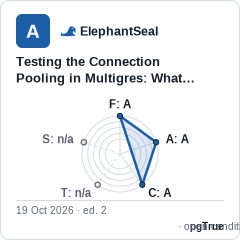
<a href="https://pgtrue.postgres.ai/shared/brief/ae842701-c128-49d3-a00c-a2bc9fe1ad92"><img src="https://pgtrue.postgres.ai/badge/ae842701-c128-49d3-a00c-a2bc9fe1ad92/radar.svg?v=13&amp;theme=light" alt="pgTrue fact-check" width="240" height="240" loading="lazy" decoding="async" style="display:inline-block;width:240px;height:240px"></a>
https://pgtrue.postgres.ai/badge/ae842701-c128-49d3-a00c-a2bc9fe1ad92/radar.svg?v=13&theme=light
.. image:: https://pgtrue.postgres.ai/badge/ae842701-c128-49d3-a00c-a2bc9fe1ad92/radar.svg?v=13&theme=light
   :target: https://pgtrue.postgres.ai/shared/brief/ae842701-c128-49d3-a00c-a2bc9fe1ad92
   :alt: pgTrue fact-check
   :width: 240
   :height: 240
[![pgTrue fact-check](https://pgtrue.postgres.ai/badge/ae842701-c128-49d3-a00c-a2bc9fe1ad92/radar.svg?v=13&theme=dark)](https://pgtrue.postgres.ai/shared/brief/ae842701-c128-49d3-a00c-a2bc9fe1ad92)
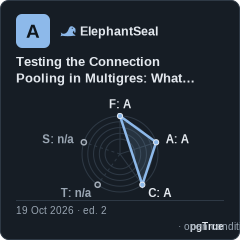
<a href="https://pgtrue.postgres.ai/shared/brief/ae842701-c128-49d3-a00c-a2bc9fe1ad92"><img src="https://pgtrue.postgres.ai/badge/ae842701-c128-49d3-a00c-a2bc9fe1ad92/radar.svg?v=13&amp;theme=dark" alt="pgTrue fact-check" width="240" height="240" loading="lazy" decoding="async" style="display:inline-block;width:240px;height:240px"></a>
https://pgtrue.postgres.ai/badge/ae842701-c128-49d3-a00c-a2bc9fe1ad92/radar.svg?v=13&theme=dark
.. image:: https://pgtrue.postgres.ai/badge/ae842701-c128-49d3-a00c-a2bc9fe1ad92/radar.svg?v=13&theme=dark
   :target: https://pgtrue.postgres.ai/shared/brief/ae842701-c128-49d3-a00c-a2bc9fe1ad92
   :alt: pgTrue fact-check
   :width: 240
   :height: 240
[![pgTrue fact-check](https://pgtrue.postgres.ai/badge/ae842701-c128-49d3-a00c-a2bc9fe1ad92/radar.svg?v=13)](https://pgtrue.postgres.ai/shared/brief/ae842701-c128-49d3-a00c-a2bc9fe1ad92)
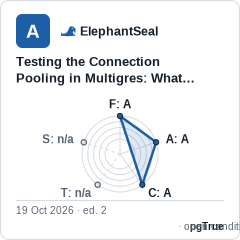
<a href="https://pgtrue.postgres.ai/shared/brief/ae842701-c128-49d3-a00c-a2bc9fe1ad92"><img src="https://pgtrue.postgres.ai/badge/ae842701-c128-49d3-a00c-a2bc9fe1ad92/radar.svg?v=13" alt="pgTrue fact-check" width="240" height="240" loading="lazy" decoding="async" style="display:inline-block;width:240px;height:240px"></a>
https://pgtrue.postgres.ai/badge/ae842701-c128-49d3-a00c-a2bc9fe1ad92/radar.svg?v=13
.. image:: https://pgtrue.postgres.ai/badge/ae842701-c128-49d3-a00c-a2bc9fe1ad92/radar.svg?v=13
   :target: https://pgtrue.postgres.ai/shared/brief/ae842701-c128-49d3-a00c-a2bc9fe1ad92
   :alt: pgTrue fact-check
   :width: 240
   :height: 240
[![pgTrue fact-check](https://pgtrue.postgres.ai/badge/ae842701-c128-49d3-a00c-a2bc9fe1ad92/wide.svg?v=13&theme=light)](https://pgtrue.postgres.ai/shared/brief/ae842701-c128-49d3-a00c-a2bc9fe1ad92)
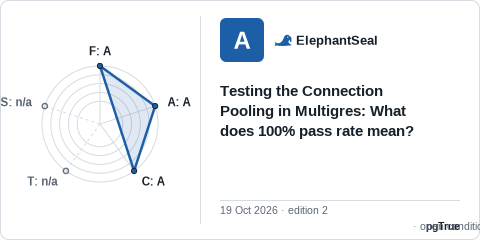
<a href="https://pgtrue.postgres.ai/shared/brief/ae842701-c128-49d3-a00c-a2bc9fe1ad92"><img src="https://pgtrue.postgres.ai/badge/ae842701-c128-49d3-a00c-a2bc9fe1ad92/wide.svg?v=13&amp;theme=light" alt="pgTrue fact-check" width="480" height="240" loading="lazy" decoding="async" style="display:inline-block;width:480px;height:240px"></a>
https://pgtrue.postgres.ai/badge/ae842701-c128-49d3-a00c-a2bc9fe1ad92/wide.svg?v=13&theme=light
.. image:: https://pgtrue.postgres.ai/badge/ae842701-c128-49d3-a00c-a2bc9fe1ad92/wide.svg?v=13&theme=light
   :target: https://pgtrue.postgres.ai/shared/brief/ae842701-c128-49d3-a00c-a2bc9fe1ad92
   :alt: pgTrue fact-check
   :width: 480
   :height: 240
[![pgTrue fact-check](https://pgtrue.postgres.ai/badge/ae842701-c128-49d3-a00c-a2bc9fe1ad92/wide.svg?v=13&theme=dark)](https://pgtrue.postgres.ai/shared/brief/ae842701-c128-49d3-a00c-a2bc9fe1ad92)
<a href="https://pgtrue.postgres.ai/shared/brief/ae842701-c128-49d3-a00c-a2bc9fe1ad92"><img src="https://pgtrue.postgres.ai/badge/ae842701-c128-49d3-a00c-a2bc9fe1ad92/wide.svg?v=13&amp;theme=dark" alt="pgTrue fact-check" width="480" height="240" loading="lazy" decoding="async" style="display:inline-block;width:480px;height:240px"></a>
https://pgtrue.postgres.ai/badge/ae842701-c128-49d3-a00c-a2bc9fe1ad92/wide.svg?v=13&theme=dark
.. image:: https://pgtrue.postgres.ai/badge/ae842701-c128-49d3-a00c-a2bc9fe1ad92/wide.svg?v=13&theme=dark
   :target: https://pgtrue.postgres.ai/shared/brief/ae842701-c128-49d3-a00c-a2bc9fe1ad92
   :alt: pgTrue fact-check
   :width: 480
   :height: 240
[![pgTrue fact-check](https://pgtrue.postgres.ai/badge/ae842701-c128-49d3-a00c-a2bc9fe1ad92/wide.svg?v=13)](https://pgtrue.postgres.ai/shared/brief/ae842701-c128-49d3-a00c-a2bc9fe1ad92)
<a href="https://pgtrue.postgres.ai/shared/brief/ae842701-c128-49d3-a00c-a2bc9fe1ad92"><img src="https://pgtrue.postgres.ai/badge/ae842701-c128-49d3-a00c-a2bc9fe1ad92/wide.svg?v=13" alt="pgTrue fact-check" width="480" height="240" loading="lazy" decoding="async" style="display:inline-block;width:480px;height:240px"></a>
https://pgtrue.postgres.ai/badge/ae842701-c128-49d3-a00c-a2bc9fe1ad92/wide.svg?v=13
.. image:: https://pgtrue.postgres.ai/badge/ae842701-c128-49d3-a00c-a2bc9fe1ad92/wide.svg?v=13
   :target: https://pgtrue.postgres.ai/shared/brief/ae842701-c128-49d3-a00c-a2bc9fe1ad92
   :alt: pgTrue fact-check
   :width: 480
   :height: 240

Click the snippet to select all of it, then copy. Where SVG is stripped, as in some email clients and feed readers, change .svg to .png. PNG uses the light theme for Auto. For Markdown PNG embeds, use the HTML snippet where supported to preserve the display size.

Optional colours: append &color=26798E or &labelColor=333C47 after a theme query (use ? for the first parameter). Use 3- or 6-digit hex.

For pages with a light background.

For pages with a dark background. The ElephantSeal gets a thin edge so it does not blend in.

Auto follows the reader's light or dark setting where the host supports it, and shows the light ElephantSeal where it does not.

On a light page
On a dark page

Testing the Connection Pooling in Multigres: What does 100% pass rate mean? (opens in new tab)

multigres.com
Sound as far as we checked.
0
inaccuracy
0
dangerous-recipe
0
misleading
0
imprecise
0
transcription
0
aged
0
withdrawn
11
verified-accurate

Central claim not verified. We could not verify the article's central claim. The article gives a method to reproduce it.

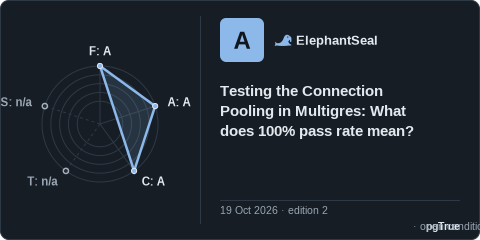
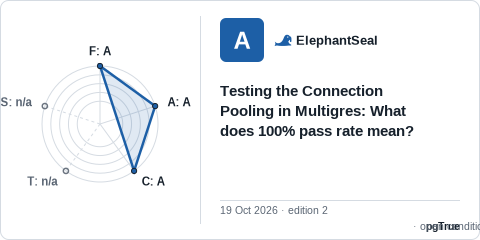
Factual A · Applicable A · Consistent A · Transparent — · Safe —

ReportTechnical fact-check, edition 2 Issued EditionUpdated after review. Corrections are listed below. SubmittedSubmitted by the PostgresAI team. Author responseNo written reply from the author. We re-audited this article 2 times; see Revisions below. Policy: right-of-reply and corrections policy. pgTrue versionaudited with v1.0.14 (approx.)

InaccuraciesNone in this edition.

Dangerous or recipe bugsNone in this edition.

Misleading / impreciseNone in this edition.

Verified accurate

F3

The gateway rejects CREATE LANGUAGE

ACCURATEFactual · holds up after review
Article · exact quote · open in article ↗ (opens in new tab)…Multigres does not support creating new languages at this point.
Source · multigres@v0.1.0 · go/services/multigateway/planner/unsafe_stmt.go:25-74case ast.T_CreatePLangStmt: return mterrors.NewFeatureNotSupported( "CREATE LANGUAGE is not supported: installing procedural languages is not permitted through the connection pooler")

Multigres v0.1.0 rejects CREATE LANGUAGE during planning. go/services/multigateway/planner/unsafe_stmt.go:60-62 returns the article's feature-not-supported message.

Charitable reading: The claim concerns CREATE LANGUAGE through the gateway, rather than installed language availability.

Review correction: We distinguished language installation from installed-language availability. The rejection matches, and the finding explicitly limits itself to Multigres v0.1.0. We checked whether the finding confused installed languages with CREATE LANGUAGE. The v0.1.0 planner rejects CREATE LANGUAGE with the quoted message.

All sources and excerpts · 1
Evidence case ast.T_CreatePLangStmt: return mterrors.NewFeatureNotSupported( "CREATE LANGUAGE is not supported: installing procedural languages is not permitted through the connection pooler")

Version note: Confirms the released implementation, without identifying the article's tested revision.

How the review tested this

Review: We distinguished language installation from installed-language availability. The rejection matches, and the finding explicitly limits itself to Multigres v0.1.0. We checked whether the finding confused installed languages with CREATE LANGUAGE. The v0.1.0 planner rejects CREATE LANGUAGE with the quoted message.

F4

Verified accurate: “…the names visible are the internal prepared statement names…”

ACCURATEFactual · partly holds after review
Article · exact quote · open in article ↗ (opens in new tab)…the names visible are the internal prepared statement names…
Source · multigres@v0.1.0 · go/common/preparedstatement/pooler_consolidator.go:58-65name := fmt.Sprintf("ppstmt%d", pc.lastID) pc.lastID++ pc.stmts[key] = name return name

Multigres v0.1.0 generates ppstmt names in pooler_consolidator.go:62-65. PostgreSQL 18.6 exposes current-session prepared statements and scans prepared_queries in prepare.c:701-702. These checks support the described mechanism at those releases. They do not establish the article's exact tested combination.

Review correction: We tested whether every client must see cached statements. The finding correctly limits visibility, but combines different release baselines. We tested the stronger claim that every fresh client sees residual statements. F4 instead verifies internal names and backend-dependent visibility.

All sources and excerpts · 4
Evidence name := fmt.Sprintf("ppstmt%d", pc.lastID) pc.lastID++ pc.stmts[key] = name return name
Evidence The <structname>pg_prepared_statements</structname> view displays all the prepared statements that are available in the current session.
Evidence hash_seq_init(&hash_seq, prepared_queries); while ((prep_stmt = hash_seq_search(&hash_seq)) != NULL)
Evidence tables. However, they are not crash-safe: an unlogged table is automatically truncated after a crash or unclean shutdown. The contents of an unlogged table are also not replicated to standby servers.

Version note: PostgreSQL 17.6 documentation, matching the linked testing strategy's stated baseline.

How the review tested this

Review: We tested whether every client must see cached statements. The finding correctly limits visibility, but combines different release baselines. We tested the stronger claim that every fresh client sees residual statements. F4 instead verifies internal names and backend-dependent visibility.

F5

Verified accurate: “…RESET enable_seqscan;…”

ACCURATEFactual · partly holds after review
Article · exact quote · open in article ↗ (opens in new tab)…RESET enable_seqscan;…
Source · REL_18_6 · doc/src/sgml/config.sgml:5920-5924Enables or disables the query planner's use of sequential scan plan types. It is impossible to suppress sequential scans entirely, but turning this variable off discourages the planner from using one if there are other methods available. The default is <literal>on</literal>.

In PostgreSQL 18.6, RESET restores parameter defaults. enable_seqscan affects planning, as doc/src/sgml/config.sgml:5920-5924 explains. costsize.c:357 records disabled sequential-scan paths. This verifies the cited release, not the linked harness's PostgreSQL 17.6 implementation.

Review correction: We checked whether RESET forbids sequential scans. The explanation holds, but its implementation citation belongs to PostgreSQL 18.6. We checked whether RESET or enable_seqscan implied an execution prohibition. The finding correctly describes default restoration and planner behavior.

All sources and excerpts · 4
Evidence Enables or disables the query planner's use of sequential scan plan types. It is impossible to suppress sequential scans entirely, but turning this variable off discourages the planner from using one if there are other methods available. The default is <literal>on</literal>.
Evidence path->disabled_nodes = enable_seqscan ? 0 : 1;
Evidence <command>RESET</command> restores run-time parameters to their default values.
Evidence tables. However, they are not crash-safe: an unlogged table is automatically truncated after a crash or unclean shutdown. The contents of an unlogged table are also not replicated to standby servers.

Version note: PostgreSQL 17.6 documentation, matching the linked testing strategy's stated baseline.

How the review tested this

Review: We checked whether RESET forbids sequential scans. The explanation holds, but its implementation citation belongs to PostgreSQL 18.6. We checked whether RESET or enable_seqscan implied an execution prohibition. The finding correctly describes default restoration and planner behavior.

F6

Verified accurate: “RETURN v_relfilenode <> (SELECT relfilenode FROM pg_class WHERE oid = p_tablename);…”

ACCURATEFactual · partly holds after review
Article · exact quote · open in article ↗ (opens in new tab)RETURN v_relfilenode <> (SELECT relfilenode FROM pg_class WHERE oid = p_tablename);…
Source · REL_18_6 · src/include/catalog/pg_class.h:55-61/* identifier of physical storage file */ /* relfilenode == 0 means it is a "mapped" relation, see relmapper.c */ Oid relfilenode BKI_DEFAULT(0);

PostgreSQL 18.6's alter_table.sql:1683-1687 saves relfilenode, executes p_ddl, and compares the new value. The article reproduces its RETURN expression. This confirms a matching upstream helper in 18.6 without establishing the article's PostgreSQL 17.6 test revision.

Review correction: We checked the surrounding function for missing declarations and comparison errors. The helper matches PostgreSQL 18.6, not an established historical baseline. We checked the surrounding helper for missing declarations and operations. It saves relfilenode, executes p_ddl, and compares the current value.

All sources and excerpts · 3
Evidence /* identifier of physical storage file */ /* relfilenode == 0 means it is a "mapped" relation, see relmapper.c */ Oid relfilenode BKI_DEFAULT(0);
Evidence v_relfilenode := relfilenode FROM pg_class WHERE oid = p_tablename; EXECUTE p_ddl; RETURN v_relfilenode <> (SELECT relfilenode FROM pg_class WHERE oid = p_tablename);
Evidence tables. However, they are not crash-safe: an unlogged table is automatically truncated after a crash or unclean shutdown. The contents of an unlogged table are also not replicated to standby servers.

Version note: PostgreSQL 17.6 documentation, matching the linked testing strategy's stated baseline.

How the review tested this

Review: We checked the surrounding function for missing declarations and comparison errors. The helper matches PostgreSQL 18.6, not an established historical baseline. We checked the surrounding helper for missing declarations and operations. It saves relfilenode, executes p_ddl, and compares the current value.

F7

Standbys do not receive unlogged table contents

ACCURATEFactual · holds up after review
Article · exact quote · open in article ↗ (opens in new tab)…unlogged data is not replicated…
Source · REL_17_6 · doc/src/sgml/ref/create_table.sgml:209-216tables. However, they are not crash-safe: an unlogged table is automatically truncated after a crash or unclean shutdown. The contents of an unlogged table are also not replicated to standby servers.

PostgreSQL 17.6 does not replicate unlogged table contents to standby servers. doc/src/sgml/ref/create_table.sgml:212-214 also documents truncation after a crash or unclean shutdown. A failover cannot preserve those contents through standby replication.

Charitable reading: The warning concerns unlogged table contents. It does not claim that PostgreSQL omits their catalog definitions.

Review correction: We distinguished table contents from catalog definitions. PostgreSQL 17.6 confirms the contents claim without establishing Multigres table-deletion behavior. We tested whether F7 incorrectly verified table deletion. It verifies unlogged contents only, matching the PostgreSQL 17.6 documentation.

All sources and excerpts · 1
Evidence tables. However, they are not crash-safe: an unlogged table is automatically truncated after a crash or unclean shutdown. The contents of an unlogged table are also not replicated to standby servers.

Version note: PostgreSQL 17.6 documentation, matching the linked testing strategy's stated baseline.

How the review tested this

Review: We distinguished table contents from catalog definitions. PostgreSQL 17.6 confirms the contents claim without establishing Multigres table-deletion behavior. We tested whether F7 incorrectly verified table deletion. It verifies unlogged contents only, matching the PostgreSQL 17.6 documentation.

F8

Verified accurate: “That value comes straight from whichever postgres connection ran the NOTIFY statement.”

ACCURATEFactual · partly holds after review
Article · exact quote · open in article ↗ (opens in new tab)That value comes straight from whichever postgres connection ran the NOTIFY statement.
Source · REL_17_6 · doc/src/sgml/ref/create_table.sgml:209-216tables. However, they are not crash-safe: an unlogged table is automatically truncated after a crash or unclean shutdown. The contents of an unlogged table are also not replicated to standby servers.

PostgreSQL 18.6 records MyProcPid in async.c:1334 and serializes srcPid at lines 2354-2357. Multigres v0.1.0 passes notif.PID to its notification writer in conn.go:1491. These checks support physical sender PIDs at those releases without establishing the article's tested revision.

Review correction: We checked physical-PID generation and notification serialization. Both match, but the PostgreSQL evidence uses 18.6. We checked sender-PID assignment and notification serialization. PostgreSQL writes MyProcPid, and the v0.1.0 notification writer forwards notif.PID.

All sources and excerpts · 4
Evidence tables. However, they are not crash-safe: an unlogged table is automatically truncated after a crash or unclean shutdown. The contents of an unlogged table are also not replicated to standby servers.

Version note: PostgreSQL 17.6 documentation, matching the linked testing strategy's stated baseline.

Evidence qe->srcPid = MyProcPid;
Evidence pq_beginmessage(&buf, PqMsg_NotificationResponse); pq_sendint32(&buf, srcPid); pq_sendstring(&buf, channel); pq_sendstring(&buf, payload);
Evidence if err := c.writeNotificationResponseMsg(notif.PID, notif.Channel, notif.Payload); err != nil {
How the review tested this

Review: We checked physical-PID generation and notification serialization. Both match, but the PostgreSQL evidence uses 18.6. We checked sender-PID assignment and notification serialization. PostgreSQL writes MyProcPid, and the v0.1.0 notification writer forwards notif.PID.

F9

Verified accurate: “LOAD pulls a shared library into the backend process.”

ACCURATEFactual · partly holds after review
Article · exact quote · open in article ↗ (opens in new tab)LOAD pulls a shared library into the backend process.
Source · REL_17_6 · doc/src/sgml/ref/create_table.sgml:209-216tables. However, they are not crash-safe: an unlogged table is automatically truncated after a crash or unclean shutdown. The contents of an unlogged table are also not replicated to standby servers.

PostgreSQL 18.6 documents LOAD loading a shared library into the server process in doc/src/sgml/ref/load.sgml:32-35. Already-loaded libraries require no additional load. dfmgr.c:160-161 calls internal_load_library. These citations verify 18.6, not the linked harness's PostgreSQL 17.6 baseline.

Review correction: We checked the already-loaded-library exception. It does not contradict the article's general description, but the evidence checks PostgreSQL 18.6. We checked LOAD semantics and repeated-loading behavior. The documentation and internal_load_library call support the stated backend address-space effect.

All sources and excerpts · 3
Evidence tables. However, they are not crash-safe: an unlogged table is automatically truncated after a crash or unclean shutdown. The contents of an unlogged table are also not replicated to standby servers.

Version note: PostgreSQL 17.6 documentation, matching the linked testing strategy's stated baseline.

Evidence This command loads a shared library file into the <productname>PostgreSQL</productname> server's address space.
Evidence /* Load the shared library, unless we already did */ (void) internal_load_library(fullname);
How the review tested this

Review: We checked the already-loaded-library exception. It does not contradict the article's general description, but the evidence checks PostgreSQL 18.6. We checked LOAD semantics and repeated-loading behavior. The documentation and internal_load_library call support the stated backend address-space effect.

F10

Verified accurate: “…CREATE UNLOGGED TABLE brintest_unlogged (n numrange);…”

ACCURATEFactual · partly holds after review
Article · exact quote · open in article ↗ (opens in new tab)…CREATE UNLOGGED TABLE brintest_unlogged (n numrange);…
Source · REL_17_6 · doc/src/sgml/ref/create_table.sgml:209-216tables. However, they are not crash-safe: an unlogged table is automatically truncated after a crash or unclean shutdown. The contents of an unlogged table are also not replicated to standby servers.

The article's four BRIN commands match PostgreSQL 18.6's src/test/regress/expected/brin.out:581-584. This confirms matching upstream SQL in that release. It does not verify the PostgreSQL 17.6 patch or its added warning and hint.

Review correction: We compared all four commands and their order. They match PostgreSQL 18.6, which does not identify the article's baseline. We compared all 4 displayed SQL commands with brin.out. They match. F10 does not claim to verify the added warning.

All sources and excerpts · 2
Evidence tables. However, they are not crash-safe: an unlogged table is automatically truncated after a crash or unclean shutdown. The contents of an unlogged table are also not replicated to standby servers.

Version note: PostgreSQL 17.6 documentation, matching the linked testing strategy's stated baseline.

EvidenceCREATE UNLOGGED TABLE brintest_unlogged (n numrange); CREATE INDEX brinidx_unlogged ON brintest_unlogged USING brin (n); INSERT INTO brintest_unlogged VALUES (numrange(0, 2^1000::numeric)); DROP TABLE brintest_unlogged;
How the review tested this

Review: We compared all four commands and their order. They match PostgreSQL 18.6, which does not identify the article's baseline. We compared all 4 displayed SQL commands with brin.out. They match. F10 does not claim to verify the added warning.

F11

Verified accurate: “…PostgreSQL login event triggers fire when a new connection is created.”

ACCURATEFactual · partly holds after review
Article · exact quote · open in article ↗ (opens in new tab)…PostgreSQL login event triggers fire when a new connection is created.
Source · REL_17_6 · doc/src/sgml/event-trigger.sgml:38-48The <literal>login</literal> event occurs when an authenticated user logs into the system.

PostgreSQL 17.6 documents login events for authenticated users in doc/src/sgml/event-trigger.sgml:40-41. Separate PostgreSQL 18.6 checks show EventTriggerOnLogin before the command loop and an enabled-trigger reconnection example. The implementation and example checks do not establish the 17.6 baseline.

Review correction: We distinguished authenticated backend logins from pooled client connections. The documentation matches 17.6, but implementation and example citations use 18.6. We tested whether F11 confused gateway connections with authenticated backend connections. Its qualification, startup call, and reconnection example agree.

All sources and excerpts · 3
Evidence The <literal>login</literal> event occurs when an authenticated user logs into the system.

Version note: PostgreSQL 17.6 documentation.

Evidence /* Fire any defined login event triggers, if appropriate */ EventTriggerOnLogin();
EvidenceALTER EVENT TRIGGER on_login_trigger ENABLE ALWAYS; \c NOTICE: You are welcome! SELECT COUNT(*) FROM user_logins; count ------- 1 (1 row)
How the review tested this

Review: We distinguished authenticated backend logins from pooled client connections. The documentation matches 17.6, but implementation and example citations use 18.6. We tested whether F11 confused gateway connections with authenticated backend connections. Its qualification, startup call, and reconnection example agree.

F12

Verified accurate: “…the output of the statements run are recorded into an .out file…”

ACCURATEFactual · partly holds after review
Article · exact quote · open in article ↗ (opens in new tab)…the output of the statements run are recorded into an .out file…
Source · REL_18_6 · src/test/isolation/isolation_main.c:57-73snprintf(infile, sizeof(infile), "%s/specs/%s.spec", outputdir, testname); if (!file_exists(infile)) snprintf(infile, sizeof(infile), "%s/specs/%s.spec", inputdir, testname); snprintf(outfile, sizeof(outfile), "%s/results/%s.out", outputdir, testname);

PostgreSQL 18.6 uses results/<test>.out in pg_regress_main.c:53-54 and isolation_main.c:67-68. These citations confirm both output-file patterns at 18.6. They do not check the linked harness's PostgreSQL 17.6 baseline.

Review correction: We checked both harnesses independently. Both use .out files in PostgreSQL 18.6, the release the citations actually establish. We checked whether different input formats undermined the output claim. Both harnesses select results/<test>.out, as F12 states.

All sources and excerpts · 3
Evidence snprintf(infile, sizeof(infile), "%s/specs/%s.spec", outputdir, testname); if (!file_exists(infile)) snprintf(infile, sizeof(infile), "%s/specs/%s.spec", inputdir, testname); snprintf(outfile, sizeof(outfile), "%s/results/%s.out", outputdir, testname);
Evidence tables. However, they are not crash-safe: an unlogged table is automatically truncated after a crash or unclean shutdown. The contents of an unlogged table are also not replicated to standby servers.

Version note: PostgreSQL 17.6 documentation, matching the linked testing strategy's stated baseline.

Evidence snprintf(outfile, sizeof(outfile), "%s/results/%s.out", outputdir, testname);
How the review tested this

Review: We checked both harnesses independently. Both use .out files in PostgreSQL 18.6, the release the citations actually establish. We checked whether different input formats undermined the output claim. Both harnesses select results/<test>.out, as F12 states.

F13

Multigateway and multipooler manage separate connection layers

ACCURATEFactual · holds up after review
Article · exact quote · open in article ↗ (opens in new tab)…keeping the client session to Multigateway separate from Postgres backends.
Source · https://multigres.com/blog/two-jobs-two-processesMultigateway accepts clients; multipooler manages backends.

Multigateway accepts client connections. Multipooler manages PostgreSQL backend connections. The cited architecture description confirms both responsibilities.

Charitable reading: The claim describes separate client and backend connection layers.

Review correction: We checked whether architectural separation implies pooling correctness. The finding makes no such inference and matches the cited service responsibilities. We checked the architecture quotation against the fetched page. It confirms separate connection responsibilities without establishing pooling safety or test results.

All sources and excerpts · 1
EvidenceMultigateway accepts clients; multipooler manages backends.
How the review tested this

Review: We checked whether architectural separation implies pooling correctness. The finding makes no such inference and matches the cited service responsibilities. We checked the architecture quotation against the fetched page. It confirms separate connection responsibilities without establishing pooling safety or test results.

Notes

2 not graded: findings no reader would act on differently
F1

Note: “…open a connection out of the database…”

NOTEpartly holds after review
Article · exact quote · open in article ↗ (opens in new tab)…open a connection out of the database…
Source · REL_18_6 · doc/src/sgml/file-fdw.sgml:9-18The <filename>file_fdw</filename> module provides the foreign-data wrapper <function>file_fdw</function>, which can be used to access data files in the server's file system, or to execute programs on the server and read their output.

PostgreSQL 18.6 documents file_fdw reading server-local files in doc/src/sgml/file-fdw.sgml:11-15. This qualifies the general definition without contradicting Multigres's restriction. The citation does not check the linked harness's PostgreSQL 17.6 baseline.

Not graded: knowing this would not change what a reader does.

Review correction: We tested the outbound-access reading. file_fdw remains a counterexample, but the citation checks PostgreSQL 18.6. We tested the outbound-wrapper reading. file_fdw supplies a local-file counterexample, but the finding correctly preserves the restriction and NOTE severity.

All sources and excerpts · 2
Evidence The <filename>file_fdw</filename> module provides the foreign-data wrapper <function>file_fdw</function>, which can be used to access data files in the server's file system, or to execute programs on the server and read their output.
Evidence tables. However, they are not crash-safe: an unlogged table is automatically truncated after a crash or unclean shutdown. The contents of an unlogged table are also not replicated to standby servers.

Version note: PostgreSQL 17.6 documentation, matching the linked testing strategy's stated baseline.

How the review tested this

Review: We tested the outbound-access reading. file_fdw remains a counterexample, but the citation checks PostgreSQL 18.6. We tested the outbound-wrapper reading. file_fdw supplies a local-file counterexample, but the finding correctly preserves the restriction and NOTE severity.

F2

Note: “…they have a sql file that the harness runs…”

NOTEpartly holds after review
Article · exact quote · open in article ↗ (opens in new tab)…they have a sql file that the harness runs…
Source · REL_18_6 · src/test/isolation/isolation_main.c:57-73snprintf(infile, sizeof(infile), "%s/specs/%s.spec", outputdir, testname); if (!file_exists(infile)) snprintf(infile, sizeof(infile), "%s/specs/%s.spec", inputdir, testname); snprintf(outfile, sizeof(outfile), "%s/results/%s.out", outputdir, testname);

PostgreSQL 18.6's isolation harness reads specs/<test>.spec and writes results/<test>.out. src/test/isolation/isolation_main.c:60-68 confirms those paths. The article's SQL-file description fits pg_regress. This citation does not establish the PostgreSQL 17.6 harness.

Not graded: knowing this would not change what a reader does.

Review correction: We read the SQL-file wording as a regression-suite summary. The format qualification stands, with a PostgreSQL 18.6 scope. We tested whether SQL inside isolation specifications justified the wording. isolation_main.c selects .spec inputs. NOTE severity accommodates the shorthand.

All sources and excerpts · 2
Evidence snprintf(infile, sizeof(infile), "%s/specs/%s.spec", outputdir, testname); if (!file_exists(infile)) snprintf(infile, sizeof(infile), "%s/specs/%s.spec", inputdir, testname); snprintf(outfile, sizeof(outfile), "%s/results/%s.out", outputdir, testname);
Evidence tables. However, they are not crash-safe: an unlogged table is automatically truncated after a crash or unclean shutdown. The contents of an unlogged table are also not replicated to standby servers.

Version note: PostgreSQL 17.6 documentation, matching the linked testing strategy's stated baseline.

How the review tested this

Review: We read the SQL-file wording as a regression-suite summary. The format qualification stands, with a PostgreSQL 18.6 scope. We tested whether SQL inside isolation specifications justified the wording. isolation_main.c selects .spec inputs. NOTE severity accommodates the shorthand.

More in this report

Section checks · 9 sections

Section checks

AspectGradeFindingsCoverage
Proxy differencesA1 verified-accurateno checkable claims
Pass criteriaA4 verified-accurate100% of claims (8 of 8)
Foreign dataAnone100% of claims (2 of 2)
LanguagesA1 verified-accurate100% of claims (1 of 1)
Library loadingA1 verified-accurate100% of claims (2 of 2)
Procedural safetyA1 verified-accurate25% of claims (1 of 4)provisional
Login triggersA1 verified-accurate100% of claims (4 of 4)
Virtual PIDsA1 verified-accurate100% of claims (2 of 2)
Prepared statementsA1 verified-accurate100% of claims (1 of 1)
Coverage and assessment

Central claim not verified. The checks confirm several pooling mechanisms, but do not verify the patch rules or the reported 100% suite results.

We did not check everything in this article. What we did not check is listed below, in the words we recorded at the time. None of it moved the letter. We never charge our own limits to the article.

Part of this audit returned no findings, so our coverage of the article is thinner than usual.

What we did not check

  • We did not reproduce the article's 222 regression, 117 isolation, 103 contrib, or 539 external test results.
  • We could not verify the procedural safety checks or unsafe_connection bypass against the article's tested Multigres revision.
  • We could not verify the unlogged-table deletion behavior against the article's tested Multigres revision.
  • We did not verify query normalization, virtual-PID uniqueness, or cancellation routing for the article's tested revision.
  • We did not establish exhaustive PostgreSQL feature coverage or verify the described external-extension harness.
  • We did not independently verify the 222/222, 117/117, 103/103, or 539/539 suite results.
  • We could not retrieve the linked brin.patch to verify its quoted warning and hint.
  • We did not establish whether testing_strategy.md matched the article on September 8, 2026.
  • We did not verify which Multigres limitations changed between September 8 and October 19, 2026.
  • We did not verify five distinct primary sources for the article's external claims.
  • We did not reproduce the 981 reported test outcomes or the displayed SQL outputs.
  • We did not independently verify the PostgreSQL test definitions and error paths behind the displayed excerpts.
  • We could not corroborate five independent behavior claims with primary evidence.
  • Provisional: we checked 1 of 4 claims in Procedural safety
  • Provisional: we checked 2 of 4 claims in Test suites
  • Provisional: we checked 0 of 1 claims in Cosmetic differences
  • Provisional: we checked 1 of 2 claims in Database lifecycle
  • Provisional: we checked 1 of 2 claims in Database names

Claims checked by section

  • Introduction: no checkable claims; not counted: 8 product or opinion, 8 not a claim
  • Proxy differences: no checkable claims; not counted: 17 product or opinion, 2 duplicate, 1 not a claim
  • Test suites: 2 of 4 Postgres claims checked; not counted: 5 product or opinion, 1 duplicate, 1 not a claim; not checked: 2 need data we do not have
  • Pass criteria: 8 of 8 Postgres claims checked; not counted: 14 product or opinion, 3 duplicate, 2 not a claim
  • Difference categories: no checkable claims; not counted: 1 product or opinion, 2 not a claim
  • Cosmetic differences: 0 of 1 Postgres claims checked; not counted: 4 product or opinion, 12 duplicate, 1 not a claim; not checked: 1 need data we do not have
  • Blocked statements: no checkable claims; not counted: 1 product or opinion, 1 not a claim
  • Foreign data: 2 of 2 Postgres claims checked; not counted: 1 product or opinion, 2 duplicate
  • Languages: 1 of 1 Postgres claims checked; not counted: 1 product or opinion, 2 duplicate
  • Library loading: 2 of 2 Postgres claims checked; not counted: 1 product or opinion, 2 duplicate
  • Database lifecycle: 1 of 2 Postgres claims checked; not counted: 5 product or opinion, 2 duplicate; not checked: 1 need data we do not have
  • Procedural safety: 1 of 4 Postgres claims checked; not counted: 11 product or opinion, 1 duplicate; not checked: 3 need data we do not have
  • Database names: 1 of 2 Postgres claims checked; not counted: 4 product or opinion, 1 duplicate, 1 not a claim; not checked: 1 need data we do not have
  • Login triggers: 4 of 4 Postgres claims checked; not counted: 3 product or opinion, 1 duplicate
  • Virtual PIDs: 2 of 2 Postgres claims checked; not counted: 9 product or opinion, 1 duplicate, 1 not a claim
  • Prepared statements: 1 of 1 Postgres claims checked; not counted: 8 product or opinion, 2 duplicate, 1 not a claim; not checked: 1 need data we do not have
  • Summary: no checkable claims; not counted: 4 product or opinion, 5 duplicate, 4 not a claim

Average of 3 axes: 4 · result A

Some explanatory text is not shown in this edition; the grade and findings are complete.

Scorecard · the five axes
FACTS scorecard Scorecard radar, 5 axes, bigger is better. Overall A. Factual A · 0 wrong of 11 checked · 0 wrong · 0 caveats. Applicable A · 0 wrong of 10 checked · 0 wrong · 0 caveats. Consistent A · 0 wrong of 11 checked · 0 wrong · 0 caveats. Transparent 2 checked, too few for a letter. Safe not applicable (n/a). Factual A0 wrong of 110 caveats Applicable A0 wrong of 100 caveats Consistent A0 wrong of 110 caveats Transparent n/a0 wrong · 0 caveats2 checked Safe n/anothingto check

By topic: Proxy differences — 1 finding, 0 wrong · Pass criteria — 4 findings, 0 wrong · Languages — 1 finding, 0 wrong · Library loading — 1 finding, 0 wrong · Procedural safety — 1 finding, 0 wrong · Login triggers — 1 finding, 0 wrong · Virtual PIDs — 1 finding, 0 wrong · Prepared statements — 1 finding, 0 wrong

Further out is better. Each axis has its own letter, from the wrong claims and caveats among the claims we checked of that kind.

Checked on the FACTS: Factual, Applicable, Consistent, Transparent, Safe. Clockwise: Factual (is it true?), Applicable (does it apply to my setup, today?), Consistent (does it agree with itself?), Transparent (can I check it myself?), Safe (can I run this on prod?).

We checked 11 claims, 13 commands scanned.

AxisLetterWrongCaveatsCheckedCoverage
FactualA
0 wrong of 11 checked
0011assessed: A · 0 wrong of 11 checked · 0 wrong · 0 caveats
ApplicableA
0 wrong of 10 checked
0010assessed: A · 0 wrong of 10 checked · 0 wrong · 0 caveats
ConsistentA
0 wrong of 11 checked
0011assessed: A · 0 wrong of 11 checked · 0 wrong · 0 caveats
Transparent—002assessed: 0 wrong · 0 caveats · 2 checked
Safe—000assessed
Topics · 9 topics

Topics

TopicFactualApplicableConsistentTransparentSafe
Proxy differences0 issues 1 checked F130 issues 1 checked0 issues 1 checked
Pass criteria0 issues 4 checked F5 F7 F10 F120 issues 4 checked0 issues 4 checked0 issues 1 checked
Foreign data
Languages0 issues 1 checked F30 issues 1 checked0 issues 1 checked
Library loading0 issues 1 checked F90 issues 1 checked0 issues 1 checked
Procedural safety0 issues 1 checked F60 issues 1 checked0 issues 1 checked
Login triggers0 issues 1 checked F110 issues 1 checked0 issues 1 checked
Virtual PIDs0 issues 1 checked F80 issues 1 checked0 issues 1 checked
Prepared statements0 issues 1 checked F40 issues 1 checked0 issues 1 checked

Issues found among the claims checked, per topic and axis. Each link goes to the finding behind the count.

Revisions: 3 · Not assessed -> A -> A

We audited this article 3 times. Each row is the final edition of one audit. Letters and findings of earlier revisions stay readable at their own address.

  1. Revision 1 · Not assessed · audit version not recorded

    Details unavailable.

    ElephantSeal: Not assessed.

  2. Revision 2 · 2026-09-23 16:24 UTC · A · audit version not recorded · regrade version not recorded

    Same article text, re-audited. 7 accurate · 0 wrong · 1 caveat.

    ElephantSeal: A. Open: the benchmark cannot yet be rerun from what is published.

    Changes: Details unavailable.

  3. Revision 3 · this page · 2026-10-19 07:25 UTC · A · audited with v1.0.14 (approx.)

    Same article text, re-audited. 11 accurate · 0 wrong · 0 caveats.

    ElephantSeal: A. Open: the benchmark cannot yet be rerun from what is published.

    Changes: No longer reported: “…producing identical .out files…”. New: none.

First impression
Questions and answers

Questions and answers

What is pgTrue?

pgTrue is an independent fact-check of technical Postgres articles, made by PostgresAI. It helps you check advice before you use it.

What does the letter grade mean?

The letter grade summarizes the claims we checked. Five axes show what we checked:

  • Factual: is it true?
  • Applicable: does it apply to my setup, today?
  • Consistent: does it agree with itself?
  • Transparent: can I check it myself?
  • Safe: can I run this in production?

What is the ElephantSeal?

The ElephantSeal is the mark an article earns. It always shows the latest edition. “Open:” lists what is still open.

Can an author reply?

Authors can ask us to correct a finding, reply to it, or withdraw it. Right-of-reply policy.

Paste into your AI assistant to fix the article, then ask for a re-review.

Show the text
Fix the article with this report, then ask pgTrue for a re-review.

# pgTrue report: Testing the Connection Pooling in Multigres: What does 100% pass rate mean?

Article title: Testing the Connection Pooling in Multigres: What does 100% pass rate mean?
Article URL: https://multigres.com/blog/testing-connection-pooling-multigres
Report URL: https://pgtrue.postgres.ai/shared/brief/ae842701-c128-49d3-a00c-a2bc9fe1ad92
Audited revision: 3 of 3, 2026-10-19 07:25:14 UTC
Overall letter: A

## Axes

- Factual: A · 0 wrong · 11 checked · 0 caveats · assessed
- Applicable: A · 0 wrong · 10 checked · 0 caveats · assessed
- Consistent: A · 0 wrong · 11 checked · 0 caveats · assessed
- Transparent: — · 0 wrong · 2 checked · 0 caveats · assessed
- Safe: — · 0 wrong · 0 checked · 0 caveats · assessed

ElephantSeal: A.
Open conditions: the benchmark cannot yet be rerun from what is published.

## Report metadata

- Report: Technical fact-check, edition 2
- Issued: 2026-10-19
- Edition: Updated after review. Corrections are listed below.
- Submitted: Submitted by the PostgresAI team.
- Author response: No written reply from the author. We re-audited this article 2 times; see Revisions below. Policy: [right-of-reply and corrections policy](/pgtrue/security).
- pgTrue version: audited with v1.0.14 (approx.)

## Findings needing a change (0)

None.

## Verified accurate claims (11)

### F3 · Accurate · Factual · The gateway rejects CREATE LANGUAGE
Location: Article · exact quote · [open in article](https://multigres.com/blog/testing-connection-pooling-multigres#:~:text=Multigres%20does%20not%20support%20creating%20new%20languages%20at%20this%20point.)
Article says:
```text
…Multigres does not support creating new languages at this point.
```
Explanation: Multigres v0.1.0 rejects CREATE LANGUAGE during planning. go/services/multigateway/planner/unsafe_stmt.go:60-62 returns the article's feature-not-supported message.
Explanation: Charitable reading: The claim concerns CREATE LANGUAGE through the gateway, rather than installed language availability.
Review: We distinguished language installation from installed-language availability. The rejection matches, and the finding explicitly limits itself to Multigres v0.1.0. We checked whether the finding confused installed languages with CREATE LANGUAGE. The v0.1.0 planner rejects CREATE LANGUAGE with the quoted message.

Sources:
- [[email protected] · go/services/multigateway/planner/unsafe_stmt.go:25-74](https://github.com/multigres/multigres/blob/e7b558ad425262a63f9c17a18b90312b68ae9a03/go/services/multigateway/planner/unsafe_stmt.go#L25-L74)
  Qualification: Version note: Confirms the released implementation, without identifying the article's tested revision.
  Excerpt:
  ```text
  case ast.T_CreatePLangStmt:
		return mterrors.NewFeatureNotSupported(
			"CREATE LANGUAGE is not supported: installing procedural languages is not permitted through the connection pooler")
  ```

Finding URL: https://pgtrue.postgres.ai/shared/brief/ae842701-c128-49d3-a00c-a2bc9fe1ad92#F3

### F4 · Accurate · Factual · Verified accurate: “…the names visible are the internal prepared statement names…”
Location: Article · exact quote · [open in article](https://multigres.com/blog/testing-connection-pooling-multigres#:~:text=the%20names%20visible%20are%20the%20internal%20prepared%20statement%20names)
Article says:
```text
…the names visible are the internal prepared statement names…
```
Explanation: Multigres v0.1.0 generates ppstmt names in pooler_consolidator.go:62-65. PostgreSQL 18.6 exposes current-session prepared statements and scans prepared_queries in prepare.c:701-702. These checks support the described mechanism at those releases. They do not establish the article's exact tested combination.
Review: We tested whether every client must see cached statements. The finding correctly limits visibility, but combines different release baselines. We tested the stronger claim that every fresh client sees residual statements. F4 instead verifies internal names and backend-dependent visibility.

Sources:
- [[email protected] · go/common/preparedstatement/pooler_consolidator.go:58-65](https://github.com/multigres/multigres/blob/e7b558ad425262a63f9c17a18b90312b68ae9a03/go/common/preparedstatement/pooler_consolidator.go#L58-L65)
  Excerpt:
  ```text
  name := fmt.Sprintf("ppstmt%d", pc.lastID)
	pc.lastID++
	pc.stmts[key] = name
	return name
  ```
- [REL_18_6 · doc/src/sgml/system-views.sgml:2250-2329](https://github.com/postgres/postgres/blob/724edf9bde9d356724ad384a2e196edc3c9f80f7/doc/src/sgml/system-views.sgml#L2250-L2329)
  Excerpt:
  ```text
  The <structname>pg_prepared_statements</structname> view displays
   all the prepared statements that are available in the current
   session.
  ```
- [REL_18_6 · src/backend/commands/prepare.c:695-713](https://github.com/postgres/postgres/blob/724edf9bde9d356724ad384a2e196edc3c9f80f7/src/backend/commands/prepare.c#L695-L713)
  Excerpt:
  ```text
  hash_seq_init(&hash_seq, prepared_queries);
		while ((prep_stmt = hash_seq_search(&hash_seq)) != NULL)
  ```
- [REL_17_6 · doc/src/sgml/ref/create_table.sgml:209-216](https://github.com/postgres/postgres/blob/7885b94dd81b98bbab9ed878680d156df7bf857f/doc/src/sgml/ref/create_table.sgml#L209-L216)
  Qualification: Version note: PostgreSQL 17.6 documentation, matching the linked testing strategy's stated baseline.
  Excerpt:
  ```text
  tables.  However, they are not crash-safe: an unlogged table is
      automatically truncated after a crash or unclean shutdown.  The contents
      of an unlogged table are also not replicated to standby servers.
  ```

Finding URL: https://pgtrue.postgres.ai/shared/brief/ae842701-c128-49d3-a00c-a2bc9fe1ad92#F4

### F5 · Accurate · Factual · Verified accurate: “…RESET enable_seqscan;…”
Location: Article · exact quote · [open in article](https://multigres.com/blog/testing-connection-pooling-multigres#:~:text=RESET%20enable_seqscan%3B)
Article says:
```text
…RESET enable_seqscan;…
```
Explanation: In PostgreSQL 18.6, RESET restores parameter defaults. enable_seqscan affects planning, as doc/src/sgml/config.sgml:5920-5924 explains. costsize.c:357 records disabled sequential-scan paths. This verifies the cited release, not the linked harness's PostgreSQL 17.6 implementation.
Review: We checked whether RESET forbids sequential scans. The explanation holds, but its implementation citation belongs to PostgreSQL 18.6. We checked whether RESET or enable_seqscan implied an execution prohibition. The finding correctly describes default restoration and planner behavior.

Sources:
- [REL_18_6 · doc/src/sgml/config.sgml:5920-5924](https://github.com/postgres/postgres/blob/724edf9bde9d356724ad384a2e196edc3c9f80f7/doc/src/sgml/config.sgml#L5920-L5924)
  Excerpt:
  ```text
  Enables or disables the query planner's use of sequential scan
        plan types. It is impossible to suppress sequential scans
        entirely, but turning this variable off discourages the planner
        from using one if there are other methods available. The
        default is <literal>on</literal>.
  ```
- [REL_18_6 · src/backend/optimizer/path/costsize.c:357-360](https://github.com/postgres/postgres/blob/724edf9bde9d356724ad384a2e196edc3c9f80f7/src/backend/optimizer/path/costsize.c#L357-L360)
  Excerpt:
  ```text
  path->disabled_nodes = enable_seqscan ? 0 : 1;
  ```
- [REL_18_6 · doc/src/sgml/ref/reset.sgml:30-44](https://github.com/postgres/postgres/blob/724edf9bde9d356724ad384a2e196edc3c9f80f7/doc/src/sgml/ref/reset.sgml#L30-L44)
  Excerpt:
  ```text
  <command>RESET</command> restores run-time parameters to their
   default values.
  ```
- [REL_17_6 · doc/src/sgml/ref/create_table.sgml:209-216](https://github.com/postgres/postgres/blob/7885b94dd81b98bbab9ed878680d156df7bf857f/doc/src/sgml/ref/create_table.sgml#L209-L216)
  Qualification: Version note: PostgreSQL 17.6 documentation, matching the linked testing strategy's stated baseline.
  Excerpt:
  ```text
  tables.  However, they are not crash-safe: an unlogged table is
      automatically truncated after a crash or unclean shutdown.  The contents
      of an unlogged table are also not replicated to standby servers.
  ```

Finding URL: https://pgtrue.postgres.ai/shared/brief/ae842701-c128-49d3-a00c-a2bc9fe1ad92#F5

### F6 · Accurate · Factual · Verified accurate: “RETURN v_relfilenode \<\> (SELECT relfilenode FROM pg_class WHERE oid = p_tablename);…”
Location: Article · exact quote · [open in article](https://multigres.com/blog/testing-connection-pooling-multigres#:~:text=RETURN%20v_relfilenode%20%3C%3E%20%28SELECT%20relfilenode,pg_class%20WHERE%20oid%20%3D%20p_tablename%29%3B)
Article says:
```text
RETURN v_relfilenode <> (SELECT relfilenode FROM pg_class WHERE oid = p_tablename);…
```
Explanation: PostgreSQL 18.6's alter_table.sql:1683-1687 saves relfilenode, executes p_ddl, and compares the new value. The article reproduces its RETURN expression. This confirms a matching upstream helper in 18.6 without establishing the article's PostgreSQL 17.6 test revision.
Review: We checked the surrounding function for missing declarations and comparison errors. The helper matches PostgreSQL 18.6, not an established historical baseline. We checked the surrounding helper for missing declarations and operations. It saves relfilenode, executes p_ddl, and compares the current value.

Sources:
- [REL_18_6 · src/include/catalog/pg_class.h:55-61](https://github.com/postgres/postgres/blob/724edf9bde9d356724ad384a2e196edc3c9f80f7/src/include/catalog/pg_class.h#L55-L61)
  Excerpt:
  ```text
  /* identifier of physical storage file */
	/* relfilenode == 0 means it is a "mapped" relation, see relmapper.c */
	Oid			relfilenode BKI_DEFAULT(0);
  ```
- [REL_18_6 · src/test/regress/sql/alter_table.sql:1670-1689](https://github.com/postgres/postgres/blob/724edf9bde9d356724ad384a2e196edc3c9f80f7/src/test/regress/sql/alter_table.sql#L1670-L1689)
  Excerpt:
  ```text
  v_relfilenode := relfilenode FROM pg_class WHERE oid = p_tablename;

    EXECUTE p_ddl;

    RETURN v_relfilenode <> (SELECT relfilenode FROM pg_class WHERE oid = p_tablename);
  ```
- [REL_17_6 · doc/src/sgml/ref/create_table.sgml:209-216](https://github.com/postgres/postgres/blob/7885b94dd81b98bbab9ed878680d156df7bf857f/doc/src/sgml/ref/create_table.sgml#L209-L216)
  Qualification: Version note: PostgreSQL 17.6 documentation, matching the linked testing strategy's stated baseline.
  Excerpt:
  ```text
  tables.  However, they are not crash-safe: an unlogged table is
      automatically truncated after a crash or unclean shutdown.  The contents
      of an unlogged table are also not replicated to standby servers.
  ```

Finding URL: https://pgtrue.postgres.ai/shared/brief/ae842701-c128-49d3-a00c-a2bc9fe1ad92#F6

### F7 · Accurate · Factual · Standbys do not receive unlogged table contents
Location: Article · exact quote · [open in article](https://multigres.com/blog/testing-connection-pooling-multigres#:~:text=unlogged%20data%20is%20not%20replicated)
Article says:
```text
…unlogged data is not replicated…
```
Explanation: PostgreSQL 17.6 does not replicate unlogged table contents to standby servers. doc/src/sgml/ref/create_table.sgml:212-214 also documents truncation after a crash or unclean shutdown. A failover cannot preserve those contents through standby replication.
Explanation: Charitable reading: The warning concerns unlogged table contents. It does not claim that PostgreSQL omits their catalog definitions.
Review: We distinguished table contents from catalog definitions. PostgreSQL 17.6 confirms the contents claim without establishing Multigres table-deletion behavior. We tested whether F7 incorrectly verified table deletion. It verifies unlogged contents only, matching the PostgreSQL 17.6 documentation.

Sources:
- [REL_17_6 · doc/src/sgml/ref/create_table.sgml:209-216](https://github.com/postgres/postgres/blob/7885b94dd81b98bbab9ed878680d156df7bf857f/doc/src/sgml/ref/create_table.sgml#L209-L216)
  Qualification: Version note: PostgreSQL 17.6 documentation, matching the linked testing strategy's stated baseline.
  Excerpt:
  ```text
  tables.  However, they are not crash-safe: an unlogged table is
      automatically truncated after a crash or unclean shutdown.  The contents
      of an unlogged table are also not replicated to standby servers.
  ```

Finding URL: https://pgtrue.postgres.ai/shared/brief/ae842701-c128-49d3-a00c-a2bc9fe1ad92#F7

### F8 · Accurate · Factual · Verified accurate: “That value comes straight from whichever postgres connection ran the NOTIFY statement.”
Location: Article · exact quote · [open in article](https://multigres.com/blog/testing-connection-pooling-multigres#:~:text=That%20value%20comes%20straight%20from,connection%20ran%20the%20NOTIFY%20statement.)
Article says:
```text
That value comes straight from whichever postgres connection ran the NOTIFY statement.
```
Explanation: PostgreSQL 18.6 records MyProcPid in async.c:1334 and serializes srcPid at lines 2354-2357. Multigres v0.1.0 passes notif.PID to its notification writer in conn.go:1491. These checks support physical sender PIDs at those releases without establishing the article's tested revision.
Review: We checked physical-PID generation and notification serialization. Both match, but the PostgreSQL evidence uses 18.6. We checked sender-PID assignment and notification serialization. PostgreSQL writes MyProcPid, and the v0.1.0 notification writer forwards notif.PID.

Sources:
- [REL_17_6 · doc/src/sgml/ref/create_table.sgml:209-216](https://github.com/postgres/postgres/blob/7885b94dd81b98bbab9ed878680d156df7bf857f/doc/src/sgml/ref/create_table.sgml#L209-L216)
  Qualification: Version note: PostgreSQL 17.6 documentation, matching the linked testing strategy's stated baseline.
  Excerpt:
  ```text
  tables.  However, they are not crash-safe: an unlogged table is
      automatically truncated after a crash or unclean shutdown.  The contents
      of an unlogged table are also not replicated to standby servers.
  ```
- [REL_18_6 · src/backend/commands/async.c:1334-1334](https://github.com/postgres/postgres/blob/724edf9bde9d356724ad384a2e196edc3c9f80f7/src/backend/commands/async.c#L1334-L1334)
  Excerpt:
  ```text
  qe->srcPid = MyProcPid;
  ```
- [REL_18_6 · src/backend/commands/async.c:2351-2359](https://github.com/postgres/postgres/blob/724edf9bde9d356724ad384a2e196edc3c9f80f7/src/backend/commands/async.c#L2351-L2359)
  Excerpt:
  ```text
  pq_beginmessage(&buf, PqMsg_NotificationResponse);
		pq_sendint32(&buf, srcPid);
		pq_sendstring(&buf, channel);
		pq_sendstring(&buf, payload);
  ```
- [[email protected] · go/common/pgprotocol/server/conn.go:1488-1493](https://github.com/multigres/multigres/blob/e7b558ad425262a63f9c17a18b90312b68ae9a03/go/common/pgprotocol/server/conn.go#L1488-L1493)
  Excerpt:
  ```text
  if err := c.writeNotificationResponseMsg(notif.PID, notif.Channel, notif.Payload); err != nil {
  ```

Finding URL: https://pgtrue.postgres.ai/shared/brief/ae842701-c128-49d3-a00c-a2bc9fe1ad92#F8

### F9 · Accurate · Factual · Verified accurate: “LOAD pulls a shared library into the backend process.”
Location: Article · exact quote · [open in article](https://multigres.com/blog/testing-connection-pooling-multigres#:~:text=LOAD%20pulls%20a%20shared%20library%20into%20the%20backend%20process.)
Article says:
```text
LOAD pulls a shared library into the backend process.
```
Explanation: PostgreSQL 18.6 documents LOAD loading a shared library into the server process in doc/src/sgml/ref/load.sgml:32-35. Already-loaded libraries require no additional load. dfmgr.c:160-161 calls internal_load_library. These citations verify 18.6, not the linked harness's PostgreSQL 17.6 baseline.
Review: We checked the already-loaded-library exception. It does not contradict the article's general description, but the evidence checks PostgreSQL 18.6. We checked LOAD semantics and repeated-loading behavior. The documentation and internal_load_library call support the stated backend address-space effect.

Sources:
- [REL_17_6 · doc/src/sgml/ref/create_table.sgml:209-216](https://github.com/postgres/postgres/blob/7885b94dd81b98bbab9ed878680d156df7bf857f/doc/src/sgml/ref/create_table.sgml#L209-L216)
  Qualification: Version note: PostgreSQL 17.6 documentation, matching the linked testing strategy's stated baseline.
  Excerpt:
  ```text
  tables.  However, they are not crash-safe: an unlogged table is
      automatically truncated after a crash or unclean shutdown.  The contents
      of an unlogged table are also not replicated to standby servers.
  ```
- [REL_18_6 · doc/src/sgml/ref/load.sgml:30-40](https://github.com/postgres/postgres/blob/724edf9bde9d356724ad384a2e196edc3c9f80f7/doc/src/sgml/ref/load.sgml#L30-L40)
  Excerpt:
  ```text
  This command loads a shared library file into the <productname>PostgreSQL</productname>
   server's address space.
  ```
- [REL_18_6 · src/backend/utils/fmgr/dfmgr.c:147-170](https://github.com/postgres/postgres/blob/724edf9bde9d356724ad384a2e196edc3c9f80f7/src/backend/utils/fmgr/dfmgr.c#L147-L170)
  Excerpt:
  ```text
  /* Load the shared library, unless we already did */
	(void) internal_load_library(fullname);
  ```

Finding URL: https://pgtrue.postgres.ai/shared/brief/ae842701-c128-49d3-a00c-a2bc9fe1ad92#F9

### F10 · Accurate · Factual · Verified accurate: “…CREATE UNLOGGED TABLE brintest_unlogged (n numrange);…”
Location: Article · exact quote · [open in article](https://multigres.com/blog/testing-connection-pooling-multigres#:~:text=CREATE%20UNLOGGED%20TABLE%20brintest_unlogged%20%28n%20numrange%29%3B)
Article says:
```text
…CREATE UNLOGGED TABLE brintest_unlogged (n numrange);…
```
Explanation: The article's four BRIN commands match PostgreSQL 18.6's src/test/regress/expected/brin.out:581-584. This confirms matching upstream SQL in that release. It does not verify the PostgreSQL 17.6 patch or its added warning and hint.
Review: We compared all four commands and their order. They match PostgreSQL 18.6, which does not identify the article's baseline. We compared all 4 displayed SQL commands with brin.out. They match. F10 does not claim to verify the added warning.

Sources:
- [REL_17_6 · doc/src/sgml/ref/create_table.sgml:209-216](https://github.com/postgres/postgres/blob/7885b94dd81b98bbab9ed878680d156df7bf857f/doc/src/sgml/ref/create_table.sgml#L209-L216)
  Qualification: Version note: PostgreSQL 17.6 documentation, matching the linked testing strategy's stated baseline.
  Excerpt:
  ```text
  tables.  However, they are not crash-safe: an unlogged table is
      automatically truncated after a crash or unclean shutdown.  The contents
      of an unlogged table are also not replicated to standby servers.
  ```
- [REL_18_6 · src/test/regress/expected/brin.out:581-584](https://github.com/postgres/postgres/blob/724edf9bde9d356724ad384a2e196edc3c9f80f7/src/test/regress/expected/brin.out#L581-L584)
  Excerpt:
  ```text
  CREATE UNLOGGED TABLE brintest_unlogged (n numrange);
CREATE INDEX brinidx_unlogged ON brintest_unlogged USING brin (n);
INSERT INTO brintest_unlogged VALUES (numrange(0, 2^1000::numeric));
DROP TABLE brintest_unlogged;
  ```

Finding URL: https://pgtrue.postgres.ai/shared/brief/ae842701-c128-49d3-a00c-a2bc9fe1ad92#F10

### F11 · Accurate · Factual · Verified accurate: “…PostgreSQL login event triggers fire when a new connection is created.”
Location: Article · exact quote · [open in article](https://multigres.com/blog/testing-connection-pooling-multigres#:~:text=PostgreSQL%20login%20event%20triggers%20fire,a%20new%20connection%20is%20created.)
Article says:
```text
…PostgreSQL login event triggers fire when a new connection is created.
```
Explanation: PostgreSQL 17.6 documents login events for authenticated users in doc/src/sgml/event-trigger.sgml:40-41. Separate PostgreSQL 18.6 checks show EventTriggerOnLogin before the command loop and an enabled-trigger reconnection example. The implementation and example checks do not establish the 17.6 baseline.
Review: We distinguished authenticated backend logins from pooled client connections. The documentation matches 17.6, but implementation and example citations use 18.6. We tested whether F11 confused gateway connections with authenticated backend connections. Its qualification, startup call, and reconnection example agree.

Sources:
- [REL_17_6 · doc/src/sgml/event-trigger.sgml:38-48](https://github.com/postgres/postgres/blob/7885b94dd81b98bbab9ed878680d156df7bf857f/doc/src/sgml/event-trigger.sgml#L38-L48)
  Qualification: Version note: PostgreSQL 17.6 documentation.
  Excerpt:
  ```text
  The <literal>login</literal> event occurs when an authenticated user logs
     into the system.
  ```
- [REL_18_6 · src/backend/tcop/postgres.c:4365-4376](https://github.com/postgres/postgres/blob/724edf9bde9d356724ad384a2e196edc3c9f80f7/src/backend/tcop/postgres.c#L4365-L4376)
  Excerpt:
  ```text
  /* Fire any defined login event triggers, if appropriate */
	EventTriggerOnLogin();
  ```
- [REL_18_6 · src/test/regress/expected/event_trigger_login.out:9-20](https://github.com/postgres/postgres/blob/724edf9bde9d356724ad384a2e196edc3c9f80f7/src/test/regress/expected/event_trigger_login.out#L9-L20)
  Excerpt:
  ```text
  ALTER EVENT TRIGGER on_login_trigger ENABLE ALWAYS;
\c
NOTICE:  You are welcome!
SELECT COUNT(*) FROM user_logins;
 count 
-------
     1
(1 row)
  ```

Finding URL: https://pgtrue.postgres.ai/shared/brief/ae842701-c128-49d3-a00c-a2bc9fe1ad92#F11

### F12 · Accurate · Factual · Verified accurate: “…the output of the statements run are recorded into an .out file…”
Location: Article · exact quote · [open in article](https://multigres.com/blog/testing-connection-pooling-multigres#:~:text=the%20output%20of%20the%20statements,recorded%20into%20an%20.out%20file)
Article says:
```text
…the output of the statements run are recorded into an .out file…
```
Explanation: PostgreSQL 18.6 uses results/\<test\>.out in pg_regress_main.c:53-54 and isolation_main.c:67-68. These citations confirm both output-file patterns at 18.6. They do not check the linked harness's PostgreSQL 17.6 baseline.
Review: We checked both harnesses independently. Both use .out files in PostgreSQL 18.6, the release the citations actually establish. We checked whether different input formats undermined the output claim. Both harnesses select results/\<test\>.out, as F12 states.

Sources:
- [REL_18_6 · src/test/isolation/isolation_main.c:57-73](https://github.com/postgres/postgres/blob/724edf9bde9d356724ad384a2e196edc3c9f80f7/src/test/isolation/isolation_main.c#L57-L73)
  Excerpt:
  ```text
  snprintf(infile, sizeof(infile), "%s/specs/%s.spec",
			 outputdir, testname);
	if (!file_exists(infile))
		snprintf(infile, sizeof(infile), "%s/specs/%s.spec",
				 inputdir, testname);

	snprintf(outfile, sizeof(outfile), "%s/results/%s.out",
			 outputdir, testname);
  ```
- [REL_17_6 · doc/src/sgml/ref/create_table.sgml:209-216](https://github.com/postgres/postgres/blob/7885b94dd81b98bbab9ed878680d156df7bf857f/doc/src/sgml/ref/create_table.sgml#L209-L216)
  Qualification: Version note: PostgreSQL 17.6 documentation, matching the linked testing strategy's stated baseline.
  Excerpt:
  ```text
  tables.  However, they are not crash-safe: an unlogged table is
      automatically truncated after a crash or unclean shutdown.  The contents
      of an unlogged table are also not replicated to standby servers.
  ```
- [REL_18_6 · src/test/regress/pg_regress_main.c:44-60](https://github.com/postgres/postgres/blob/724edf9bde9d356724ad384a2e196edc3c9f80f7/src/test/regress/pg_regress_main.c#L44-L60)
  Excerpt:
  ```text
  snprintf(outfile, sizeof(outfile), "%s/results/%s.out",
			 outputdir, testname);
  ```

Finding URL: https://pgtrue.postgres.ai/shared/brief/ae842701-c128-49d3-a00c-a2bc9fe1ad92#F12

### F13 · Accurate · Factual · Multigateway and multipooler manage separate connection layers
Location: Article · exact quote · [open in article](https://multigres.com/blog/testing-connection-pooling-multigres#:~:text=keeping%20the%20client%20session%20to%20Multigateway%20separate%20from%20Postgres%20backends.)
Article says:
```text
…keeping the client session to Multigateway separate from Postgres backends.
```
Explanation: Multigateway accepts client connections. Multipooler manages PostgreSQL backend connections. The cited architecture description confirms both responsibilities.
Explanation: Charitable reading: The claim describes separate client and backend connection layers.
Review: We checked whether architectural separation implies pooling correctness. The finding makes no such inference and matches the cited service responsibilities. We checked the architecture quotation against the fetched page. It confirms separate connection responsibilities without establishing pooling safety or test results.

Sources:
- [https://multigres.com/blog/two-jobs-two-processes](https://multigres.com/blog/two-jobs-two-processes)
  Excerpt:
  ```text
  Multigateway accepts clients; multipooler manages backends.
  ```

Finding URL: https://pgtrue.postgres.ai/shared/brief/ae842701-c128-49d3-a00c-a2bc9fe1ad92#F13

## Notes (not graded) (2)

### F1 · Note ·  · Note: “…open a connection out of the database…”
Location: Article · exact quote · [open in article](https://multigres.com/blog/testing-connection-pooling-multigres#:~:text=open%20a%20connection%20out%20of%20the%20database)
Article says:
```text
…open a connection out of the database…
```
Explanation: PostgreSQL 18.6 documents file_fdw reading server-local files in doc/src/sgml/file-fdw.sgml:11-15. This qualifies the general definition without contradicting Multigres's restriction. The citation does not check the linked harness's PostgreSQL 17.6 baseline.
Explanation: Not graded: knowing this would not change what a reader does.
Review: We tested the outbound-access reading. file_fdw remains a counterexample, but the citation checks PostgreSQL 18.6. We tested the outbound-wrapper reading. file_fdw supplies a local-file counterexample, but the finding correctly preserves the restriction and NOTE severity.

Sources:
- [REL_18_6 · doc/src/sgml/file-fdw.sgml:9-18](https://github.com/postgres/postgres/blob/724edf9bde9d356724ad384a2e196edc3c9f80f7/doc/src/sgml/file-fdw.sgml#L9-L18)
  Excerpt:
  ```text
  The <filename>file_fdw</filename> module provides the foreign-data wrapper
  <function>file_fdw</function>, which can be used to access data
  files in the server's file system, or to execute programs on the server
  and read their output.
  ```
- [REL_17_6 · doc/src/sgml/ref/create_table.sgml:209-216](https://github.com/postgres/postgres/blob/7885b94dd81b98bbab9ed878680d156df7bf857f/doc/src/sgml/ref/create_table.sgml#L209-L216)
  Qualification: Version note: PostgreSQL 17.6 documentation, matching the linked testing strategy's stated baseline.
  Excerpt:
  ```text
  tables.  However, they are not crash-safe: an unlogged table is
      automatically truncated after a crash or unclean shutdown.  The contents
      of an unlogged table are also not replicated to standby servers.
  ```

Finding URL: https://pgtrue.postgres.ai/shared/brief/ae842701-c128-49d3-a00c-a2bc9fe1ad92#F1

### F2 · Note ·  · Note: “…they have a sql file that the harness runs…”
Location: Article · exact quote · [open in article](https://multigres.com/blog/testing-connection-pooling-multigres#:~:text=they%20have%20a%20sql%20file%20that%20the%20harness%20runs)
Article says:
```text
…they have a sql file that the harness runs…
```
Explanation: PostgreSQL 18.6's isolation harness reads specs/\<test\>.spec and writes results/\<test\>.out. src/test/isolation/isolation_main.c:60-68 confirms those paths. The article's SQL-file description fits pg_regress. This citation does not establish the PostgreSQL 17.6 harness.
Explanation: Not graded: knowing this would not change what a reader does.
Review: We read the SQL-file wording as a regression-suite summary. The format qualification stands, with a PostgreSQL 18.6 scope. We tested whether SQL inside isolation specifications justified the wording. isolation_main.c selects .spec inputs. NOTE severity accommodates the shorthand.

Sources:
- [REL_18_6 · src/test/isolation/isolation_main.c:57-73](https://github.com/postgres/postgres/blob/724edf9bde9d356724ad384a2e196edc3c9f80f7/src/test/isolation/isolation_main.c#L57-L73)
  Excerpt:
  ```text
  snprintf(infile, sizeof(infile), "%s/specs/%s.spec",
			 outputdir, testname);
	if (!file_exists(infile))
		snprintf(infile, sizeof(infile), "%s/specs/%s.spec",
				 inputdir, testname);

	snprintf(outfile, sizeof(outfile), "%s/results/%s.out",
			 outputdir, testname);
  ```
- [REL_17_6 · doc/src/sgml/ref/create_table.sgml:209-216](https://github.com/postgres/postgres/blob/7885b94dd81b98bbab9ed878680d156df7bf857f/doc/src/sgml/ref/create_table.sgml#L209-L216)
  Qualification: Version note: PostgreSQL 17.6 documentation, matching the linked testing strategy's stated baseline.
  Excerpt:
  ```text
  tables.  However, they are not crash-safe: an unlogged table is
      automatically truncated after a crash or unclean shutdown.  The contents
      of an unlogged table are also not replicated to standby servers.
  ```

Finding URL: https://pgtrue.postgres.ai/shared/brief/ae842701-c128-49d3-a00c-a2bc9fe1ad92#F2

## Withdrawn findings (0)

None.

## Section checks

- Proxy differences · A · 1 verified-accurate · no checkable claims
- Pass criteria · A · 4 verified-accurate · 100% of claims (8 of 8)
- Foreign data · A · none · 100% of claims (2 of 2)
- Languages · A · 1 verified-accurate · 100% of claims (1 of 1)
- Library loading · A · 1 verified-accurate · 100% of claims (2 of 2)
- Procedural safety · A · 1 verified-accurate · 25% of claims (1 of 4) provisional
- Login triggers · A · 1 verified-accurate · 100% of claims (4 of 4)
- Virtual PIDs · A · 1 verified-accurate · 100% of claims (2 of 2)
- Prepared statements · A · 1 verified-accurate · 100% of claims (1 of 1)

## What we did not check

- We did not reproduce the article's 222 regression, 117 isolation, 103 contrib, or 539 external test results.
- We could not verify the procedural safety checks or unsafe_connection bypass against the article's tested Multigres revision.
- We could not verify the unlogged-table deletion behavior against the article's tested Multigres revision.
- We did not verify query normalization, virtual-PID uniqueness, or cancellation routing for the article's tested revision.
- We did not establish exhaustive PostgreSQL feature coverage or verify the described external-extension harness.
- We did not independently verify the 222/222, 117/117, 103/103, or 539/539 suite results.
- We could not retrieve the linked brin.patch to verify its quoted warning and hint.
- We did not establish whether testing_strategy.md matched the article on September 8, 2026.
- We did not verify which Multigres limitations changed between September 8 and October 19, 2026.
- We did not verify five distinct primary sources for the article's external claims.
- We did not reproduce the 981 reported test outcomes or the displayed SQL outputs.
- We did not independently verify the PostgreSQL test definitions and error paths behind the displayed excerpts.
- We could not corroborate five independent behavior claims with primary evidence.
- Provisional: we checked 1 of 4 claims in Procedural safety
- Provisional: we checked 2 of 4 claims in Test suites
- Provisional: we checked 0 of 1 claims in Cosmetic differences
- Provisional: we checked 1 of 2 claims in Database lifecycle
- Provisional: we checked 1 of 2 claims in Database names

## Notes

- Central claim not verified. The checks confirm several pooling mechanisms, but do not verify the patch rules or the reported 100% suite results.
- We did not check everything in this article. What we did not check is listed below, in the words we recorded at the time. None of it moved the letter. We never charge our own limits to the article.
- Part of this audit returned no findings, so our coverage of the article is thinner than usual.
- Average of 3 axes: 4 · result A
- Some explanatory text is not shown in this edition; the grade and findings are complete.
- Some checks did not happen for this edition, and each one we know of is listed above.
- Checked against: github.com/postgres/postgres REL_18_6 at commit 724edf9bde9d356724ad384a2e196edc3c9f80f7 (pinned target); github.com/multigres/multigres v0.1.0 at commit e7b558ad425262a63f9c17a18b90312b68ae9a03 (pinned target); https://multigres.com/blog/two-jobs-two-processes (fetched 2026-10-19T07:25:33.798625Z).
- Article captured 2026-10-19T07:25:14.722618Z · SHA-256 6ca958386f90259b674011df8b89151a0b56ab614597930bd4302a6fe82df10a · Text extracted from the article's HTML.
- Policy SHA-256 11ebba0cae7ab11a8bd0bec3dc35dde8c20d50441598aebbe47712b18aa7bb6e · Grading rules SHA-256 6fb334e79d6b9e7ed81d3238cc10d9de602ff87ed65ff2fa781f53bac5798765.
- We did not reproduce the reported regression, isolation, contrib, or external test results.
- We did not reproduce the displayed SQL outputs.
- We could not retrieve brin.patch to verify its quoted warning and hint.
- We did not establish whether testing_strategy.md matched the article on September 8, 2026.
- We did not verify the procedural safety checks, unsafe_connection bypass, or unlogged-table deletion behavior against the article's tested revision.
- We did not verify query normalization, virtual-PID uniqueness, or cancellation routing for the article's tested revision.
- We did not establish exhaustive PostgreSQL feature coverage or verify the external-extension harness.
- We did not verify which limitations changed between September 8 and October 19, 2026.
- We did not verify five distinct primary sources for the article's external claims.
- The source checks use PostgreSQL REL_18_6, PostgreSQL REL_17_6, and Multigres v0.1.0. The article does not identify its tested revision.
- The article gives September 8, 2026 without a publication time. We list that date at midnight UTC.
- source: the article names no postgres release, so it was read at REL_18_6, the latest release when it was published
- source: the article names no multigres release, so it was read at v0.1.0, the latest release when it was published
- 3 fetched pages are not listed above, because our policy does not allow linking them.
- review: the findings were written by one model and reviewed independently by a different model.
- 6 passages in this edition fell short of our own plain-English rules.
- Built from the article text captured above, 2 pinned source trees, and one fetched page.
- 3 survived · 10 weakened · 0 withdrawn.

## Edition changes

- F1 · weakened.
- F2 · weakened.
- F3 · recalibrated.
- F4 · weakened.
- F5 · weakened.
- F6 · weakened.
- F7 · recalibrated.
- F8 · weakened.
- F9 · weakened.
- F10 · weakened.
- F11 · weakened.
- F12 · weakened.
- F13 · recalibrated.

## Revision history

- [Revision 1](https://pgtrue.postgres.ai/shared/brief/ae842701-c128-49d3-a00c-a2bc9fe1ad92?v=2) · Not assessed · audit version not recorded
  Details unavailable.
  ElephantSeal: Not assessed.
- [Revision 2](https://pgtrue.postgres.ai/shared/brief/ae842701-c128-49d3-a00c-a2bc9fe1ad92?v=26) · 2026-09-23 16:24 UTC · A · audit version not recorded · regrade version not recorded
  Same article text, re-audited. 7 accurate · 0 wrong · 1 caveat.
  ElephantSeal: A. Open: the benchmark cannot yet be rerun from what is published.
  Changes: Details unavailable.
- [Revision 3](https://pgtrue.postgres.ai/shared/brief/ae842701-c128-49d3-a00c-a2bc9fe1ad92?v=28) · this page · 2026-10-19 07:25 UTC · A · audited with v1.0.14 (approx.)
  Same article text, re-audited. 11 accurate · 0 wrong · 0 caveats.
  ElephantSeal: A. Open: the benchmark cannot yet be rerun from what is published.
  Changes: No longer reported: “…producing identical .out files…”. New: none.

Updated your article? Request a correction. A new edition appears at this address.