Limited beta · What is this?

pgTrue is under active development: reports may contain significant mistakes, inaccuracies, or bugs. Please report anything you find to pgtrue@postgres.ai.

pgTrue is an independent fact-check of technical Postgres articles. Read the questions and answers.

pgTrue fact-check

ElephantSeal ALimited coverage

Embed

The ElephantSeal always shows this report's latest edition and links here. Copies cached elsewhere may update later.

[![pgTrue fact-check](https://pgtrue.postgres.ai/badge/aab2a118-9c43-480c-86e7-7198d55a075c.svg?v=13&theme=light)](https://pgtrue.postgres.ai/shared/brief/aab2a118-9c43-480c-86e7-7198d55a075c)
<a href="https://pgtrue.postgres.ai/shared/brief/aab2a118-9c43-480c-86e7-7198d55a075c"><img src="https://pgtrue.postgres.ai/badge/aab2a118-9c43-480c-86e7-7198d55a075c.svg?v=13&amp;theme=light" alt="pgTrue fact-check" width="90" height="20" loading="lazy" decoding="async" style="display:inline-block;width:90px;height:20px"></a>
https://pgtrue.postgres.ai/badge/aab2a118-9c43-480c-86e7-7198d55a075c.svg?v=13&theme=light
.. image:: https://pgtrue.postgres.ai/badge/aab2a118-9c43-480c-86e7-7198d55a075c.svg?v=13&theme=light
   :target: https://pgtrue.postgres.ai/shared/brief/aab2a118-9c43-480c-86e7-7198d55a075c
   :alt: pgTrue fact-check
   :width: 90
   :height: 20
[![pgTrue fact-check](https://pgtrue.postgres.ai/badge/aab2a118-9c43-480c-86e7-7198d55a075c.svg?v=13&theme=dark)](https://pgtrue.postgres.ai/shared/brief/aab2a118-9c43-480c-86e7-7198d55a075c)
<a href="https://pgtrue.postgres.ai/shared/brief/aab2a118-9c43-480c-86e7-7198d55a075c"><img src="https://pgtrue.postgres.ai/badge/aab2a118-9c43-480c-86e7-7198d55a075c.svg?v=13&amp;theme=dark" alt="pgTrue fact-check" width="90" height="20" loading="lazy" decoding="async" style="display:inline-block;width:90px;height:20px"></a>
https://pgtrue.postgres.ai/badge/aab2a118-9c43-480c-86e7-7198d55a075c.svg?v=13&theme=dark
.. image:: https://pgtrue.postgres.ai/badge/aab2a118-9c43-480c-86e7-7198d55a075c.svg?v=13&theme=dark
   :target: https://pgtrue.postgres.ai/shared/brief/aab2a118-9c43-480c-86e7-7198d55a075c
   :alt: pgTrue fact-check
   :width: 90
   :height: 20
[![pgTrue fact-check](https://pgtrue.postgres.ai/badge/aab2a118-9c43-480c-86e7-7198d55a075c.svg?v=13)](https://pgtrue.postgres.ai/shared/brief/aab2a118-9c43-480c-86e7-7198d55a075c)
<a href="https://pgtrue.postgres.ai/shared/brief/aab2a118-9c43-480c-86e7-7198d55a075c"><img src="https://pgtrue.postgres.ai/badge/aab2a118-9c43-480c-86e7-7198d55a075c.svg?v=13" alt="pgTrue fact-check" width="90" height="20" loading="lazy" decoding="async" style="display:inline-block;width:90px;height:20px"></a>
https://pgtrue.postgres.ai/badge/aab2a118-9c43-480c-86e7-7198d55a075c.svg?v=13
.. image:: https://pgtrue.postgres.ai/badge/aab2a118-9c43-480c-86e7-7198d55a075c.svg?v=13
   :target: https://pgtrue.postgres.ai/shared/brief/aab2a118-9c43-480c-86e7-7198d55a075c
   :alt: pgTrue fact-check
   :width: 90
   :height: 20
[![pgTrue fact-check](https://pgtrue.postgres.ai/badge/aab2a118-9c43-480c-86e7-7198d55a075c/radar.svg?v=13&theme=light)](https://pgtrue.postgres.ai/shared/brief/aab2a118-9c43-480c-86e7-7198d55a075c)
<a href="https://pgtrue.postgres.ai/shared/brief/aab2a118-9c43-480c-86e7-7198d55a075c"><img src="https://pgtrue.postgres.ai/badge/aab2a118-9c43-480c-86e7-7198d55a075c/radar.svg?v=13&amp;theme=light" alt="pgTrue fact-check" width="240" height="240" loading="lazy" decoding="async" style="display:inline-block;width:240px;height:240px"></a>
https://pgtrue.postgres.ai/badge/aab2a118-9c43-480c-86e7-7198d55a075c/radar.svg?v=13&theme=light
.. image:: https://pgtrue.postgres.ai/badge/aab2a118-9c43-480c-86e7-7198d55a075c/radar.svg?v=13&theme=light
   :target: https://pgtrue.postgres.ai/shared/brief/aab2a118-9c43-480c-86e7-7198d55a075c
   :alt: pgTrue fact-check
   :width: 240
   :height: 240
[![pgTrue fact-check](https://pgtrue.postgres.ai/badge/aab2a118-9c43-480c-86e7-7198d55a075c/radar.svg?v=13&theme=dark)](https://pgtrue.postgres.ai/shared/brief/aab2a118-9c43-480c-86e7-7198d55a075c)
<a href="https://pgtrue.postgres.ai/shared/brief/aab2a118-9c43-480c-86e7-7198d55a075c"><img src="https://pgtrue.postgres.ai/badge/aab2a118-9c43-480c-86e7-7198d55a075c/radar.svg?v=13&amp;theme=dark" alt="pgTrue fact-check" width="240" height="240" loading="lazy" decoding="async" style="display:inline-block;width:240px;height:240px"></a>
https://pgtrue.postgres.ai/badge/aab2a118-9c43-480c-86e7-7198d55a075c/radar.svg?v=13&theme=dark
.. image:: https://pgtrue.postgres.ai/badge/aab2a118-9c43-480c-86e7-7198d55a075c/radar.svg?v=13&theme=dark
   :target: https://pgtrue.postgres.ai/shared/brief/aab2a118-9c43-480c-86e7-7198d55a075c
   :alt: pgTrue fact-check
   :width: 240
   :height: 240
[![pgTrue fact-check](https://pgtrue.postgres.ai/badge/aab2a118-9c43-480c-86e7-7198d55a075c/radar.svg?v=13)](https://pgtrue.postgres.ai/shared/brief/aab2a118-9c43-480c-86e7-7198d55a075c)
<a href="https://pgtrue.postgres.ai/shared/brief/aab2a118-9c43-480c-86e7-7198d55a075c"><img src="https://pgtrue.postgres.ai/badge/aab2a118-9c43-480c-86e7-7198d55a075c/radar.svg?v=13" alt="pgTrue fact-check" width="240" height="240" loading="lazy" decoding="async" style="display:inline-block;width:240px;height:240px"></a>
https://pgtrue.postgres.ai/badge/aab2a118-9c43-480c-86e7-7198d55a075c/radar.svg?v=13
.. image:: https://pgtrue.postgres.ai/badge/aab2a118-9c43-480c-86e7-7198d55a075c/radar.svg?v=13
   :target: https://pgtrue.postgres.ai/shared/brief/aab2a118-9c43-480c-86e7-7198d55a075c
   :alt: pgTrue fact-check
   :width: 240
   :height: 240
[![pgTrue fact-check](https://pgtrue.postgres.ai/badge/aab2a118-9c43-480c-86e7-7198d55a075c/wide.svg?v=13&theme=light)](https://pgtrue.postgres.ai/shared/brief/aab2a118-9c43-480c-86e7-7198d55a075c)
<a href="https://pgtrue.postgres.ai/shared/brief/aab2a118-9c43-480c-86e7-7198d55a075c"><img src="https://pgtrue.postgres.ai/badge/aab2a118-9c43-480c-86e7-7198d55a075c/wide.svg?v=13&amp;theme=light" alt="pgTrue fact-check" width="480" height="240" loading="lazy" decoding="async" style="display:inline-block;width:480px;height:240px"></a>
https://pgtrue.postgres.ai/badge/aab2a118-9c43-480c-86e7-7198d55a075c/wide.svg?v=13&theme=light
.. image:: https://pgtrue.postgres.ai/badge/aab2a118-9c43-480c-86e7-7198d55a075c/wide.svg?v=13&theme=light
   :target: https://pgtrue.postgres.ai/shared/brief/aab2a118-9c43-480c-86e7-7198d55a075c
   :alt: pgTrue fact-check
   :width: 480
   :height: 240
[![pgTrue fact-check](https://pgtrue.postgres.ai/badge/aab2a118-9c43-480c-86e7-7198d55a075c/wide.svg?v=13&theme=dark)](https://pgtrue.postgres.ai/shared/brief/aab2a118-9c43-480c-86e7-7198d55a075c)
<a href="https://pgtrue.postgres.ai/shared/brief/aab2a118-9c43-480c-86e7-7198d55a075c"><img src="https://pgtrue.postgres.ai/badge/aab2a118-9c43-480c-86e7-7198d55a075c/wide.svg?v=13&amp;theme=dark" alt="pgTrue fact-check" width="480" height="240" loading="lazy" decoding="async" style="display:inline-block;width:480px;height:240px"></a>
https://pgtrue.postgres.ai/badge/aab2a118-9c43-480c-86e7-7198d55a075c/wide.svg?v=13&theme=dark
.. image:: https://pgtrue.postgres.ai/badge/aab2a118-9c43-480c-86e7-7198d55a075c/wide.svg?v=13&theme=dark
   :target: https://pgtrue.postgres.ai/shared/brief/aab2a118-9c43-480c-86e7-7198d55a075c
   :alt: pgTrue fact-check
   :width: 480
   :height: 240
[![pgTrue fact-check](https://pgtrue.postgres.ai/badge/aab2a118-9c43-480c-86e7-7198d55a075c/wide.svg?v=13)](https://pgtrue.postgres.ai/shared/brief/aab2a118-9c43-480c-86e7-7198d55a075c)
<a href="https://pgtrue.postgres.ai/shared/brief/aab2a118-9c43-480c-86e7-7198d55a075c"><img src="https://pgtrue.postgres.ai/badge/aab2a118-9c43-480c-86e7-7198d55a075c/wide.svg?v=13" alt="pgTrue fact-check" width="480" height="240" loading="lazy" decoding="async" style="display:inline-block;width:480px;height:240px"></a>
https://pgtrue.postgres.ai/badge/aab2a118-9c43-480c-86e7-7198d55a075c/wide.svg?v=13
.. image:: https://pgtrue.postgres.ai/badge/aab2a118-9c43-480c-86e7-7198d55a075c/wide.svg?v=13
   :target: https://pgtrue.postgres.ai/shared/brief/aab2a118-9c43-480c-86e7-7198d55a075c
   :alt: pgTrue fact-check
   :width: 480
   :height: 240

Click the snippet to select all of it, then copy. Where SVG is stripped, as in some email clients and feed readers, change .svg to .png. PNG uses the light theme for Auto. For Markdown PNG embeds, use the HTML snippet where supported to preserve the display size.

Optional colours: append &color=26798E or &labelColor=333C47 after a theme query (use ? for the first parameter). Use 3- or 6-digit hex.

For pages with a light background.

For pages with a dark background. The ElephantSeal gets a thin edge so it does not blend in.

Auto follows the reader's light or dark setting where the host supports it, and shows the light ElephantSeal where it does not.

On a light page
On a dark page

Part 2/6 | Breaking the Postgres Superuser Guardrails: Attacking Security-Hardening Extensions |Systemic Risks in the Managed PostgreSQL Industry (opens in new tab)

mehmetince.net
Sound as far as we checked.
0
inaccuracy
0
dangerous-recipe
0
misleading
0
imprecise
0
transcription
0
aged
0
withdrawn
12
verified-accurate

Central claim not verified: Bypassing managed PostgreSQL security extensions through privilege delegation, FDW name resolution, and server-code execution. We could not verify this, and the article gives no method to reproduce it.

Factual A · Applicable A · Consistent A · Transparent A · Safe —

ReportTechnical fact-check, edition 3 pgTrue versionaudited with v1.0.17 (approx.) · regraded with v1.1.3 Issued EditionUpdated after review. Corrections are listed below. SubmittedSubmitted by the PostgresAI team. Author responseNo written reply from the author. We re-audited this article 2 times; see Revisions below. Policy: right-of-reply and corrections policy.

InaccuraciesNone in this edition.

Dangerous or recipe bugsNone in this edition.

Misleading / impreciseNone in this edition.

Verified accurate

F1

Core resolves and invokes FDW validators during creation

ACCURATEFactual · holds up after review

Claim ledger

Article says
Core resolves the validator name to an OID and invokes that validator…
What is true
PostgreSQL requires superuser status before creating a wrapper. CreateFdwStmt carries function options rather than resolved function OIDs. src/backend/commands/foreigncmds.c:521 resolves the validator name. Line 202 invokes it, including when options are empty. These checks support the stated execution window.
Charitable reading
The statement describes core behavior after the extension delegates the command under a superuser identity.

Source

Source · REL_18_6 · src/backend/commands/foreigncmds.c:450-568return LookupFuncName((List *) validator->arg, 2, funcargtypes, false);
In the article · section “Case study #1: CREATE FOREIGN DATA WRAPPER Privilege Escalation to the Superuser”

In the article

excerpt · section “Case study #1: CREATE FOREIGN DATA WRAPPER Privilege Escalation to the Superuser” · as fetched 2026-10-21 · open in article ↗ (opens in new tab)

Case study #1: CREATE FOREIGN DATA WRAPPER Privilege Escalation to the Superuser

PostgreSQL then continues processing the command. Because the identity has already changed, its superuser check succeeds. Core resolves the validator name to an OID and invokes that validator before returning control to Supautils.

All sources and excerpts · 5
Evidence return LookupFuncName((List *) validator->arg, 2, funcargtypes, false);
Evidence OidFunctionCall2(fdwvalidator, valarg, ObjectIdGetDatum(catalogId));
Evidence /* Must be superuser */ if (!superuser()) ereport(ERROR,
Evidencetypedef struct CreateFdwStmt { NodeTag type; char *fdwname; /* foreign-data wrapper name */ List *func_options; /* HANDLER/VALIDATOR options */ List *options; /* generic options to FDW */ } CreateFdwStmt;
EvidenceDECLARE_UNIQUE_INDEX(pg_proc_proname_args_nsp_index, 2691, ProcedureNameArgsNspIndexId, pg_proc, btree(proname name_ops, proargtypes oidvector_ops, pronamespace oid_ops));
How the review tested this

Review: We tested whether core resolves names before privilege checking or skips validators with empty options. E-2 through E-5 support the stated order and invocation. The finding confines verification to core behavior. We tested whether the finding incorrectly verifies the provider's privilege transition. It limits verification to core name resolution and validator invocation. The recorded excerpts support that distinction.

F2

The $user schema follows the effective current user

ACCURATEFactual · holds up after review

Claim ledger

Article says
…the same "$user" entry now represents the attacker-created postgres schema…
What is true
The $user entry expands using CURRENT_USER. doc/src/sgml/config.sgml:9773 documents this behavior. namespace.c derives the path using GetUserId() and resolves the matching schema. Under current_user postgres, an existing postgres schema can replace the original user's schema.
Charitable reading
The surrounding explanation describes changed $user expansion under the elevated identity, rather than importing that role's configuration.

Source

Source · REL_18_6 · src/backend/catalog/namespace.c:4110-4160rname = NameStr(((Form_pg_authid) GETSTRUCT(tuple))->rolname); namespaceId = get_namespace_oid(rname, true);
In the article · section “Case Study #2 – Same mistakes that everybody falls into one way or another”

In the article

excerpt · section “Case Study #2 – Same mistakes that everybody falls into one way or another” · as fetched 2026-10-21 · open in article ↗ (opens in new tab)

Case Study #2 – Same mistakes that everybody falls into one way or another

postgres_fdw_validator is the built-in option validation function for the postgres_fdw foreign-data wrapper in PostgreSQL. The handler is explicitly qualified customer.postgres_fdw_handler therefore it resolves to the genuine function during both stages. Both OIDs belong to the same allowlisted extension, so every check passes. The extension then discards neither name nor the checked OIDs. It forwards the original statement VALIDATOR postgres_fdw_validator After current_user becomes postgres , the same "$user" entry now represents the attacker-created postgres schema. PostgreSQL performs its own lookup and obtains the attacker’s different OID. Core does not know about or repeat the vendor’s extension-membership checks

All sources and excerpts · 3
Evidence rname = NameStr(((Form_pg_authid) GETSTRUCT(tuple))->rolname); namespaceId = get_namespace_oid(rname, true);
Evidence If one of the list items is the special name <literal>$user</literal>, then the schema having the name returned by <function>CURRENT_USER</function> is substituted, if there is such a schema and the user has <literal>USAGE</literal> permission for it.
Evidence Oid roleid = GetUserId();
How the review tested this

Review: We tested whether switching identity imports another role's search_path setting. E-9 retains the configured string but recalculates its schemas for GetUserId(). The finding correctly describes $user expansion. We tested whether changing current_user imports another role's search_path setting. The finding instead describes $user expansion under the effective identity. E-8 explicitly supports that behavior.

F3

A schema name does not select its owner role

ACCURATEFactual · holds up after review

Claim ledger

Article says
Roles and schemas are separate PostgreSQL objects…
What is true
CREATE SCHEMA treats its name and authorization role separately. src/backend/commands/schemacmds.c:73 selects the explicit authorization role or the current user. Naming a schema postgres does not assign ownership to the postgres role.
Charitable reading
The claim concerns naming a schema postgres, rather than assigning schema ownership to the postgres role.

Source

Source · REL_18_6 · src/backend/commands/schemacmds.c:69-78if (stmt->authrole) owner_uid = get_rolespec_oid(stmt->authrole, false); else owner_uid = saved_uid;
In the article · section “Case Study #2 – Same mistakes that everybody falls into one way or another”

In the article

excerpt · section “Case Study #2 – Same mistakes that everybody falls into one way or another” · as fetched 2026-10-21 · open in article ↗ (opens in new tab)

Case Study #2 – Same mistakes that everybody falls into one way or another

Due to the nature of this whole “not so quite superuser role” design, every vendor provides CREATE permission on database-level to the default user. Roles and schemas are separate PostgreSQL objects, so creating a schema named postgres does not require control of the postgres role! So we can actually create such a function at postgres schema!

All sources and excerpts · 1
Evidence if (stmt->authrole) owner_uid = get_rolespec_oid(stmt->authrole, false); else owner_uid = saved_uid;
How the review tested this

Review: We tested whether naming a schema postgres assigns ownership to that role. E-12 selects ownership from AUTHORIZATION or the current identity. The finding does not promise unconditional schema creation. We tested whether a postgres schema name requires ownership of the postgres role. E-12 selects ownership separately through AUTHORIZATION or the current user. The finding retains the database-permission prerequisite.

F4

lo_export writes large-object bytes to the server filesystem

ACCURATEFactual · holds up after review

Claim ledger

Article says
The lo_export() function takes those bytes and writes them to a chosen filesystem path.
What is true
lo_export opens the requested server path and writes bytes from the large object. src/backend/libpq/be-fsstubs.c:532 reads object chunks and passes them to write(). The function provides a file-write primitive within server filesystem permissions.
Charitable reading
The claimed filesystem primitive operates within the server process's operating-system permissions.

Source

Source · REL_18_6 · src/backend/libpq/be-fsstubs.c:480-560while ((nbytes = inv_read(lobj, buf, BUFSIZE)) > 0) { tmp = write(fd, buf, nbytes);
In the article · section “Why blocking lo_export() matters”

In the article

excerpt · section “Why blocking lo_export() matters” · as fetched 2026-10-21 · open in article ↗ (opens in new tab)

Why blocking lo_export() matters

PostgreSQL large objects can store arbitrary bytes inside the database. The lo_export() function takes those bytes and writes them to a chosen filesystem path. This is not a direct code execution but its write to the file-system primitive that can give us a further capabilities.

All sources and excerpts · 1
Evidence while ((nbytes = inv_read(lobj, buf, BUFSIZE)) > 0) { tmp = write(fd, buf, nbytes);
How the review tested this

Review: We tested whether lo_export writes client-side files or guarantees unrestricted filesystem access. E-14 opens the server path and writes object bytes. The finding preserves the filesystem-permission qualification. We tested whether the finding promises unrestricted filesystem access. It confines lo_export writes to server filesystem permissions. E-14 supports copying large-object bytes through write().

F5

Internal aliases resolve their implementation through pg_proc.prosrc

ACCURATEFactual · holds up after review

Claim ledger

Article says
…PostgreSQL stores the name of an internal function’s implementation…
What is true
pg_proc.prosrc stores the implementation symbol for compiled functions. doc/src/sgml/catalogs.sgml:6290 documents the field. src/backend/utils/fmgr/fmgr.c:231 reads that symbol and resolves it through fmgr_lookupByName(). The SQL alias name can differ from the implementation symbol.
Charitable reading
The catalog discussion refers to the implementation symbol stored in pg_proc, rather than the function's SQL name.

Source

Source · REL_18_6 · doc/src/sgml/catalogs.sgml:6287-6294For compiled functions, both built-in and dynamically loaded, <structfield>prosrc</structfield> contains the function's C-language name (link symbol).
In the article · section “Bypassing the blacklisted functions through pg_catalog.pg_proc”

In the article

excerpt · section “Bypassing the blacklisted functions through pg_catalog.pg_proc” · as fetched 2026-10-21 · open in article ↗ (opens in new tab)

Bypassing the blacklisted functions through pg_catalog.pg_proc

PostgreSQL stores the name of an internal function’s implementation in , which we can update because we are a superuser. If the security hardening extension does NOT block the LANGUAGE internal, we can actually have a pretty simple way to bypass that blacklist.

All sources and excerpts · 2
Evidence For compiled functions, both built-in and dynamically loaded, <structfield>prosrc</structfield> contains the function's C-language name (link symbol).
Evidence prosrc = TextDatumGetCString(prosrcdatum); fbp = fmgr_lookupByName(prosrc);
How the review tested this

Review: We tested whether ordinary built-in dispatch invalidates the alias explanation. E-17 explicitly distinguishes aliases and resolves their prosrc symbols. The finding does not verify provider catalog-update permissions. We tested whether SQL names and implementation symbols were confused. E-16 distinguishes prosrc's implementation symbol. E-17 supports internal lookup by that symbol. The finding does not verify provider catalog permissions.

F6

LANGUAGE C loads functions from shared libraries

ACCURATEFactual · holds up after review

Claim ledger

Article says
…access its methods via LANGUAGE C.
What is true
LANGUAGE C resolves a library filename and exported symbol. src/backend/utils/fmgr/fmgr.c:386 passes those values to load_external_function(). This supports the stated loading step when permissions, binary compatibility, and library validation permit it.
Charitable reading
The article first assumes a compatible module and an already elevated database identity.

Source

Source · REL_18_6 · src/backend/utils/fmgr/fmgr.c:349-430user_fn = load_external_function(probinstring, prosrcstring, true,
In the article · section “Why blocking lo_export() matters”

In the article

excerpt · section “Why blocking lo_export() matters” · as fetched 2026-10-21 · open in article ↗ (opens in new tab)

Why blocking lo_export() matters

The idea of abusing lo object is quite simple. We will dump a custom .so module to the filesystem of postgres and access its methods via LANGUAGE C.

All sources and excerpts · 1
Evidence user_fn = load_external_function(probinstring, prosrcstring, true,
How the review tested this

Review: We tested whether the loading mechanism establishes successful exploitation. E-19 supports library and symbol loading only. The finding explicitly conditions success on permissions, compatibility, and validation. We tested whether library loading establishes successful exploitation. The finding explicitly requires permissions, binary compatibility, and library validation. E-19 supports the narrower native-loading mechanism.

F7

postgres_fdw installs postgres_fdw_validator as its validator

ACCURATEFactual · holds up after review

Claim ledger

Article says
…postgres_fdw_validator is the built-in option validation function…
What is true
postgres_fdw supplies postgres_fdw_validator(text[], oid). contrib/postgres_fdw/postgres_fdw--1.0.sql:16 installs the wrapper with that function as its VALIDATOR.
Charitable reading
Built-in means supplied with postgres_fdw, rather than installed in every database without that extension.

Source

Source · REL_18_6 · contrib/postgres_fdw/postgres_fdw--1.0.sql:6-18CREATE FOREIGN DATA WRAPPER postgres_fdw HANDLER postgres_fdw_handler VALIDATOR postgres_fdw_validator;
In the article · section “Case Study #2 – Same mistakes that everybody falls into one way or another”

In the article

excerpt · section “Case Study #2 – Same mistakes that everybody falls into one way or another” · as fetched 2026-10-21 · open in article ↗ (opens in new tab)

Case Study #2 – Same mistakes that everybody falls into one way or another

postgres_fdw_validator is the built-in option validation function for the postgres_fdw foreign-data wrapper in PostgreSQL. The handler is explicitly qualified customer.postgres_fdw_handler therefore it resolves to the genuine function during both stages. Both OIDs belong to the same allowlisted extension, so every check passes. The extension then discards neither name nor the checked OIDs. It forwards the original statement VALIDATOR postgres_fdw_validator After current_user becomes postgres , the same "$user" entry now represents the attacker-created postgres schema. PostgreSQL performs its own lookup and obtains the attacker’s different OID. Core does not know about or repeat the vendor’s extension-membership checks

All sources and excerpts · 1
EvidenceCREATE FOREIGN DATA WRAPPER postgres_fdw HANDLER postgres_fdw_handler VALIDATOR postgres_fdw_validator;
How the review tested this

Review: We tested whether built-in incorrectly implies installation in every database. E-21 installs the function through postgres_fdw. The finding uses that narrower, supported meaning. We tested whether built-in incorrectly means installed in every database. The finding identifies the postgres_fdw extension's installation script. E-21 explicitly assigns postgres_fdw_validator as its validator.

F8

COPY PROGRAM executes commands on the database server

ACCURATEFactual · holds up after review

Claim ledger

Article says
The COPY TO/FROM PROGRAM.
What is true
COPY PROGRAM executes a command under the database server's operating-system identity. doc/src/sgml/ref/copy.sgml:566 documents server-side execution. src/backend/commands/copy.c:81 checks pg_execute_server_program privileges before allowing that operation.
Charitable reading
The article describes server-side command execution as a possible infrastructure attack primitive, rather than guaranteed cross-tenant access.

Source

Source · REL_18_6 · doc/src/sgml/ref/copy.sgml:563-582the command specified with <literal>PROGRAM</literal> is executed directly by the server, not by the client application, must be executable by the <productname>PostgreSQL</productname> user.
In the article · section “Expectations and managed-PostgreSQL Services Threat Model 101”

In the article

excerpt · section “Expectations and managed-PostgreSQL Services Threat Model 101” · as fetched 2026-10-21 · open in article ↗ (opens in new tab)

Expectations and managed-PostgreSQL Services Threat Model 101

And the last one is attacking the infra through Postgres box using the most beautiful feature ever added to the PostgreSQL. The COPY TO/FROM PROGRAM. Running operating system commands on the server where Postgres is running can open the door to deeper attacks on the control plane, backup process and all of these inner working mechanisms.

All sources and excerpts · 2
Evidence the command specified with <literal>PROGRAM</literal> is executed directly by the server, not by the client application, must be executable by the <productname>PostgreSQL</productname> user.
Evidence if (!has_privs_of_role(GetUserId(), ROLE_PG_EXECUTE_SERVER_PROGRAM))
How the review tested this

Review: We tested whether COPY PROGRAM executes locally to the client or proves infrastructure compromise. E-23 specifies server execution. E-24 checks execution privileges. The finding claims neither client execution nor guaranteed compromise. We tested whether server command execution implies infrastructure compromise. The finding verifies server-side execution and its privilege check. It leaves infrastructure reach dependent on provider isolation.

F9

The FDW definition matches its cited documentation

ACCURATEFactual · holds up after review

Claim ledger

Article says
…access and query data stored in external data sources as if they were native Postgres tables…
What is true
FDWs expose external data through PostgreSQL tables. The cited Wrappers overview uses the same definition.
Charitable reading
The sentence defines FDWs. It does not promise identical performance or behavior for every remote system.

Source

Source · https://supabase.com/docs/guides/database/extensions/wrappers/overviewaccess and query data stored in external data sources as if they were native Postgres tables.
In the article · section “Case study #1: CREATE FOREIGN DATA WRAPPER Privilege Escalation to the Superuser”

In the article

excerpt · section “Case study #1: CREATE FOREIGN DATA WRAPPER Privilege Escalation to the Superuser” · as fetched 2026-10-21 · open in article ↗ (opens in new tab)

Case study #1: CREATE FOREIGN DATA WRAPPER Privilege Escalation to the Superuser

Foreign Data Wrappers FDW are a core feature of Postgres that allow you to access and query data stored in external data sources as if they were native Postgres tables[1]. It is normally allows only a superuser to run CREATE FOREIGN DATA WRAPPER to enable these features. This means every vendor needs to have an implementation that delegates the operation to its superuser role, because of the same reason. We don’t get the superuser.

All sources and excerpts · 1
Evidenceaccess and query data stored in external data sources as if they were native Postgres tables.
How the review tested this

Review: We tested whether the FDW definition promises identical remote behavior or performance. E-26 gives the same table-access definition. The finding adds no such guarantee. We compared E-26 directly with the recorded documentation page. Its quotation and metadata match. The finding verifies the FDW definition without promising identical remote-system behavior.

F10

Aiven documents the aiven_extras extension

ACCURATEFactual · holds up after review

Claim ledger

Article says
…Aiven has aiven_extras extension…
What is true
Aiven documents aiven_extras and its superuser-like administrative functions for avnadmin. This confirms the extension name and delegation purpose.
Charitable reading
We checked the extension's name and documented delegation purpose, rather than assuming it implements every claimed restriction.

Source

Source · https://aiven.io/docs/products/postgresql/concepts/dba-tasks-pgThe aiven_extras extension, developed and maintained by Aiven, enables the avnadmin to perform superuser-like functionalities
In the article · section “How do they actually do this?”

In the article

excerpt · section “How do they actually do this?” · as fetched 2026-10-21 · open in article ↗ (opens in new tab)

How do they actually do this?

Aiven has aiven_extras extension

All sources and excerpts · 1
EvidenceThe aiven_extras extension, developed and maintained by Aiven, enables the avnadmin to perform superuser-like functionalities
How the review tested this

Review: We tested whether administrative documentation proves the claimed security restrictions. E-28 establishes aiven_extras and avnadmin functionality. The finding limits its conclusion to identity and purpose. We tested whether administrative delegation proves security-hardening internals. The finding verifies only aiven_extras and its documented purpose. E-28 matches the recorded page exactly, including its newline.

F11

PlanetScale documents pg_pscale_utils

ACCURATEFactual · holds up after review

Claim ledger

Article says
…PlanetScale has pg_pscale_utils…
What is true
PlanetScale lists pg_pscale_utils as its utility extension for handling superuser actions.
Charitable reading
We checked the extension's identity and stated purpose. We did not infer its blacklist or privilege-transition implementation.

Source

Source · https://planetscale.com/docs/postgres/extensionspg_pscale_utils Utility extension to handle superuser actions in PlanetScale Postgres
In the article · section “How do they actually do this?”

In the article

excerpt · section “How do they actually do this?” · as fetched 2026-10-21 · open in article ↗ (opens in new tab)

How do they actually do this?

PlanetScale has pg_pscale_utils

All sources and excerpts · 1
Evidencepg_pscale_utils Utility extension to handle superuser actions in PlanetScale Postgres
How the review tested this

Review: We tested whether the extension listing establishes blacklist behavior. E-30 names pg_pscale_utils and its superuser-action purpose. The finding claims only those documented facts. We tested whether the extension listing establishes its implementation or vulnerability. The finding claims only its name and documented purpose. E-30 matches the recorded extension table and page metadata.

F13

CREATE FOREIGN DATA WRAPPER requires superuser privileges

ACCURATEFactual · holds up after review

Claim ledger

Article says
It is normally allows only a superuser to run CREATE FOREIGN DATA WRAPPER…
What is true
PostgreSQL 18.6 documents that only superusers can create foreign-data wrappers. See doc/src/sgml/ref/create_foreign_data_wrapper.sgml:45.
Charitable reading
The word normally distinguishes PostgreSQL's native requirement from managed-service delegation.

Source

Source · REL_18_6 · doc/src/sgml/ref/create_foreign_data_wrapper.sgml:35-85Only superusers can create foreign-data wrappers.
In the article · section “Case study #1: CREATE FOREIGN DATA WRAPPER Privilege Escalation to the Superuser”

In the article

excerpt · section “Case study #1: CREATE FOREIGN DATA WRAPPER Privilege Escalation to the Superuser” · as fetched 2026-10-21 · open in article ↗ (opens in new tab)

Case study #1: CREATE FOREIGN DATA WRAPPER Privilege Escalation to the Superuser

Foreign Data Wrappers FDW are a core feature of Postgres that allow you to access and query data stored in external data sources as if they were native Postgres tables[1]. It is normally allows only a superuser to run CREATE FOREIGN DATA WRAPPER to enable these features. This means every vendor needs to have an implementation that delegates the operation to its superuser role, because of the same reason. We don’t get the superuser.

All sources and excerpts · 1
Evidence Only superusers can create foreign-data wrappers.
How the review tested this

Review: We tested whether managed-service delegation contradicts the native privilege requirement. E-34 explicitly restricts wrapper creation to superusers. The article's normally qualification accommodates delegation. We tested whether managed-service delegation contradicts the superuser requirement. The article says normally. E-34 states PostgreSQL's native requirement, which the finding confines to PostgreSQL 18.6.

More in this report

Section checks · 6 sections

Section checks

AspectGradeFindingsCoverage
Threat modelA1 verified-accurate100% of claims (1 of 1, plus 3 that need data we do not have)
Vendor implementationsA2 verified-accurate2 checked · 4 need data we do not have
FDW escalationA3 verified-accurate100% of claims (8 of 8, plus 11 that need data we do not have)
FDW name resolutionA3 verified-accurate81% of claims (9 of 11, plus 16 that need data we do not have)
Large object exportA1 verified-accurate33% of claims (1 of 3, plus 3 that need data we do not have)provisional
Catalog alias bypassA2 verified-accurate66% of claims (2 of 3, plus 9 that need data we do not have)
Coverage and assessment · Checked 21 of 26 Postgres claims across 13 sections; 1 section below half

Central claim not verified. The checks establish PostgreSQL mechanisms, but they do not verify the managed-service extension bypasses that form the article’s central subject.

We did not check everything in this article. What we did not check is listed below, in the words we recorded at the time. None of it moved the letter. We never charge our own limits to the article.

Part of this audit returned no findings, so our coverage of the article is thinner than usual.

What we did not check

  • We did not verify the extensions’ historical privilege switching, validation, cleanup, or blacklist implementations.
  • We did not verify that Azure uses azure.so or that every provider blocks pg_read_file for superusers.
  • We did not verify the reported LANGUAGE internal memory exploit.
  • We did not check the exact SQL and code examples referenced by the article.
  • We did not reproduce the privilege-escalation or native-code demonstrations.
  • We did not verify default privileges across every named provider or the reported account’s database access.
  • We did not verify the private interviews, vulnerability reports, vendor responses, or incident-specific account permissions.
  • We did not establish that every named provider implements the restrictions or privilege transitions the article describes.
  • We could not retrieve the Databricks response or verify the Drupal CVE-2026-9082 example.
  • We did not reproduce the exploits or inspect the article's missing code images and embeds.
  • We did not establish release dates for the reported fixes or changes since publication.
  • We did not verify the counts of 2 protected providers, 4 fixes, or 16 reported vulnerabilities.
  • We could not compare repeated identifiers or command outputs in the FDW and lo_export demonstrations because their transcripts were unavailable.
  • We did not establish whether the conference’s 50-minute slot included the article’s stated 40-minute talk.
  • We did not obtain five distinct primary quotations supporting the article’s numerical claims.
  • Safe: we did not complete every applicable check.
  • Section “Large object export”: we checked 1 of 6 checkable claims.
  • We could not decide whether the evidence backs the central claim.
Checked 21 of 26 Postgres claims across 13 sections; 1 section below half
  • Introduction: 3 claims are the author's own account; nothing checkable; not counted: 5 product or opinion, 4 not a claim
  • Security extensions: 7 claims are the author's own account; nothing checkable; not counted: 1 product or opinion, 1 duplicate, 1 not a claim
  • Threat model: 1 of 1 Postgres claims checked, plus 3 that need data we do not have; not counted: 12 product or opinion, 1 duplicate, 3 not a claim
  • Vendor implementations: 2 checked, plus 4 that need data we do not have; not counted: 10 product or opinion, 2 not a claim
  • Privilege windows: 7 claims are the author's own account; nothing checkable; not counted: 2 product or opinion, 1 duplicate, 1 not a claim
  • FDW escalation: 8 of 8 Postgres claims checked, plus 11 that need data we do not have; not counted: 2 product or opinion, 2 duplicate, 3 not a claim
  • FDW name resolution: 9 of 11 Postgres claims checked, plus 16 that need data we do not have; not counted: 1 product or opinion, 1 duplicate, 3 not a claim; not checked: 2 for other reasons
  • Operating system access: no checkable claims; not counted: 2 duplicate, 2 not a claim
  • Large object export: 1 of 3 Postgres claims checked, plus 3 that need data we do not have; not counted: 1 product or opinion, 1 duplicate, 1 not a claim; not checked: 2 for other reasons
  • Catalog alias bypass: 2 of 3 Postgres claims checked, plus 9 that need data we do not have; not counted: 1 product or opinion, 1 not a claim; not checked: 1 for other reasons
  • Internal language boundary: 9 claims are the author's own account; nothing checkable; not counted: 7 product or opinion, 1 duplicate, 2 not a claim
  • Closing threat model: 6 claims are the author's own account; nothing checkable; not counted: 7 product or opinion, 7 not a claim
  • References: no checkable claims; not counted: 3 not a claim

Average of 4 axes: 4 · result A

Some explanatory text is not shown in this edition; the grade and findings are complete.

Scorecard · the five axes
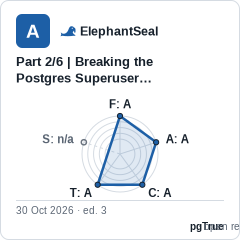
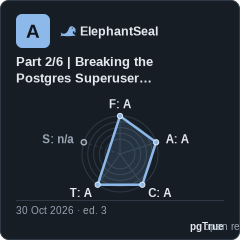
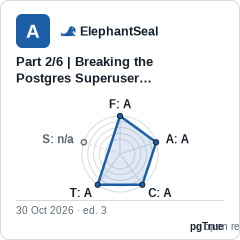
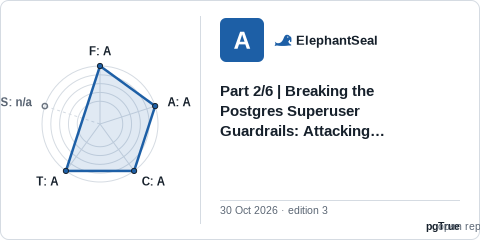
FACTS scorecard Scorecard radar, 5 axes, bigger is better. Overall A. Factual A · 0 wrong of 12 checked · 0 caveats. Applicable A · 0 wrong of 7 checked · 0 caveats. Consistent A · 0 wrong of 12 checked · 0 caveats. Transparent A · 0 wrong of 4 checked · 0 caveats. Safe not applicable (n/a). A 0 wrong of 12 checked · 0 caveatsFactual A0 wrong of 120 caveats A 0 wrong of 7 checked · 0 caveatsApplicable A0 wrong of 70 caveats A 0 wrong of 12 checked · 0 caveatsConsistent A0 wrong of 120 caveats A 0 wrong of 4 checked · 0 caveatsTransparent A0 wrong of 40 caveats not applicable (n/a), 40 commands scanned none riskySafe n/a40 commands scannednone risky A

By topic: Threat model — 1 finding, 0 wrong · Vendor implementations — 2 findings, 0 wrong · FDW escalation — 3 findings, 0 wrong · FDW name resolution — 3 findings, 0 wrong · Large object export — 1 finding, 0 wrong · Catalog alias bypass — 2 findings, 0 wrong

Further out is better. Each axis has its own letter, from the wrong claims and caveats among the claims we checked of that kind.

Checked on the FACTS: Factual, Applicable, Consistent, Transparent, Safe. Clockwise: Factual (is it true?), Applicable (does it apply to my setup, today?), Consistent (does it agree with itself?), Transparent (can I check it myself?), Safe (can I run this on prod?).

We checked 12 claims, 40 commands scanned.

AxisLetterWrongCaveatsCheckedCoverage
FactualA0012assessed: A · 0 wrong of 12 checked · 0 caveats
ApplicableA007assessed: A · 0 wrong of 7 checked · 0 caveats
ConsistentA0012assessed: A · 0 wrong of 12 checked · 0 caveats
TransparentA004assessed: A · 0 wrong of 4 checked · 0 caveats
Safe—000partly assessed
Topics · 6 topics

Topics

TopicFactualApplicableConsistentTransparentSafe
Threat model0 issues 1 checked F80 issues 1 checked0 issues 1 checked
Vendor implementations0 issues 2 checked F10 F110 issues 2 checked0 issues 2 checked0 issues 2 checked
FDW escalation0 issues 3 checked F1 F9 F130 issues 1 checked0 issues 3 checked0 issues 2 checked
FDW name resolution0 issues 3 checked F2 F3 F70 issues 1 checked0 issues 3 checked
Large object export0 issues 1 checked F40 issues 1 checked0 issues 1 checked
Catalog alias bypass0 issues 2 checked F5 F60 issues 1 checked0 issues 2 checked

Issues found among the claims checked, per topic and axis. Each link goes to the finding behind the count.

Revisions: 3 · A -> A -> A

We audited this article 3 times. Each row is the final edition of one audit. Letters and findings of earlier revisions stay readable at their own address.

  1. Revision 1 · 2026-09-27 04:07 UTC · A · audit version not recorded · regrade version not recorded

    Article as first submitted. 7 accurate · 0 wrong · 0 caveats.

    ElephantSeal: A. Open: the central claim is not yet backed by evidence.

    Changes: First audit. Open: none.

  2. Revision 2 · 2026-10-19 21:44 UTC · A · audited with v1.0.16 (approx.)

    Same article text, re-audited. 12 accurate · 0 wrong · 0 caveats.

    ElephantSeal: A.

    Changes: No change in findings.

  3. Revision 3 · this page · 2026-10-21 05:28 UTC · A · audited with v1.0.17 (approx.) · regraded with v1.1.3

    Same article text, re-audited. 12 accurate · 0 wrong · 0 caveats.

    ElephantSeal: A.

    Changes: No change in findings.

Questions and answers

Questions and answers

What is pgTrue?

pgTrue is an independent fact-check of technical Postgres articles, made by PostgresAI. It helps you check advice before you use it.

What does the letter grade mean?

The letter grade summarizes the claims we checked. Five axes show what we checked:

  • Factual: is it true?
  • Applicable: does it apply to my setup, today?
  • Consistent: does it agree with itself?
  • Transparent: can I check it myself?
  • Safe: can I run this in production?

What is the ElephantSeal?

The ElephantSeal is the mark an article earns. It always shows the latest edition. “Open:” lists what is still open.

Can an author reply?

Authors can ask us to correct a finding, reply to it, or withdraw it. Right-of-reply policy.

Paste into your AI assistant to fix the article, then ask for a re-review.

Show the text
Fix the article with this report, then ask pgTrue for a re-review.

# pgTrue report: Part 2/6 \| Breaking the Postgres Superuser Guardrails: Attacking Security-Hardening Extensions \|Systemic Risks in the Managed PostgreSQL Industry

Article title: Part 2/6 \| Breaking the Postgres Superuser Guardrails: Attacking Security-Hardening Extensions \|Systemic Risks in the Managed PostgreSQL Industry
Article URL: https://mehmetince.net/part-2-6-breaking-the-superuser-guardrails-attacking-security-hardening-extensions-systemic-risks-in-the-managed-postgresql-industry
Report URL: https://pgtrue.postgres.ai/shared/brief/aab2a118-9c43-480c-86e7-7198d55a075c
Audited revision: 3 of 3, 2026-10-21 05:28:57 UTC
Overall letter: A

## Axes

- Factual: A · 0 wrong · 12 checked · 0 caveats · assessed
- Applicable: A · 0 wrong · 7 checked · 0 caveats · assessed
- Consistent: A · 0 wrong · 12 checked · 0 caveats · assessed
- Transparent: A · 0 wrong · 4 checked · 0 caveats · assessed
- Safe: — · 0 wrong · 0 checked · 0 caveats · partly assessed

ElephantSeal: A.

## Report metadata

- Report: Technical fact-check, edition 3
- pgTrue version: audited with v1.0.17 (approx.) · regraded with v1.1.3
- Issued: 2026-10-21
- Edition: Updated after review. Corrections are listed below.
- Submitted: Submitted by the PostgresAI team.
- Author response: No written reply from the author. We re-audited this article 2 times; see Revisions below. Policy: [right-of-reply and corrections policy](/pgtrue/security).

## Findings needing a change (0)

None.

## Verified accurate claims (12)

### F1 · Accurate · Factual · Core resolves and invokes FDW validators during creation
Location: excerpt · section “Case study \#1: CREATE FOREIGN DATA WRAPPER Privilege Escalation to the Superuser” · as fetched 2026-10-21 · [open in article](https://mehmetince.net/part-2-6-breaking-the-superuser-guardrails-attacking-security-hardening-extensions-systemic-risks-in-the-managed-postgresql-industry#:~:text=Core%20resolves%20the%20validator%20name,OID%20and%20invokes%20that%20validator)
Article says:
```text
Core resolves the validator name to an OID and invokes that validator…
```
What is true:
PostgreSQL requires superuser status before creating a wrapper. CreateFdwStmt carries function options rather than resolved function OIDs. src/backend/commands/foreigncmds.c:521 resolves the validator name. Line 202 invokes it, including when options are empty. These checks support the stated execution window.
Charitable reading:
The statement describes core behavior after the extension delegates the command under a superuser identity.
Review: We tested whether core resolves names before privilege checking or skips validators with empty options. E-2 through E-5 support the stated order and invocation. The finding confines verification to core behavior. We tested whether the finding incorrectly verifies the provider's privilege transition. It limits verification to core name resolution and validator invocation. The recorded excerpts support that distinction.

Sources:
- [REL_18_6 · src/backend/commands/foreigncmds.c:450-568](https://github.com/postgres/postgres/blob/724edf9bde9d356724ad384a2e196edc3c9f80f7/src/backend/commands/foreigncmds.c#L450-L568)
  Excerpt:
  ```text
  return LookupFuncName((List *) validator->arg, 2, funcargtypes, false);
  ```
- [REL_18_6 · src/backend/commands/foreigncmds.c:180-206](https://github.com/postgres/postgres/blob/724edf9bde9d356724ad384a2e196edc3c9f80f7/src/backend/commands/foreigncmds.c#L180-L206)
  Excerpt:
  ```text
  OidFunctionCall2(fdwvalidator, valarg, ObjectIdGetDatum(catalogId));
  ```
- [REL_18_6 · src/backend/commands/foreigncmds.c:569-665](https://github.com/postgres/postgres/blob/724edf9bde9d356724ad384a2e196edc3c9f80f7/src/backend/commands/foreigncmds.c#L569-L665)
  Excerpt:
  ```text
  /* Must be superuser */
	if (!superuser())
		ereport(ERROR,
  ```
- [REL_18_6 · src/include/nodes/parsenodes.h:2948-2954](https://github.com/postgres/postgres/blob/724edf9bde9d356724ad384a2e196edc3c9f80f7/src/include/nodes/parsenodes.h#L2948-L2954)
  Excerpt:
  ```text
  typedef struct CreateFdwStmt
{
	NodeTag		type;
	char	   *fdwname;		/* foreign-data wrapper name */
	List	   *func_options;	/* HANDLER/VALIDATOR options */
	List	   *options;		/* generic options to FDW */
} CreateFdwStmt;
  ```
- [REL_18_6 · src/include/catalog/pg_proc.h:141-141](https://github.com/postgres/postgres/blob/724edf9bde9d356724ad384a2e196edc3c9f80f7/src/include/catalog/pg_proc.h#L141-L141)
  Excerpt:
  ```text
  DECLARE_UNIQUE_INDEX(pg_proc_proname_args_nsp_index, 2691, ProcedureNameArgsNspIndexId, pg_proc, btree(proname name_ops, proargtypes oidvector_ops, pronamespace oid_ops));
  ```

Finding URL: https://pgtrue.postgres.ai/shared/brief/aab2a118-9c43-480c-86e7-7198d55a075c#F1

### F2 · Accurate · Factual · The $user schema follows the effective current user
Location: excerpt · section “Case Study \#2 – Same mistakes that everybody falls into one way or another” · as fetched 2026-10-21 · [open in article](https://mehmetince.net/part-2-6-breaking-the-superuser-guardrails-attacking-security-hardening-extensions-systemic-risks-in-the-managed-postgresql-industry#:~:text=the%20same%20%22%24user%22%20entry%20now%20represents%20the%20attacker%2Dcreated%20postgres%20schema)
Article says:
```text
…the same "$user" entry now represents the attacker-created postgres schema…
```
What is true:
The $user entry expands using CURRENT_USER. doc/src/sgml/config.sgml:9773 documents this behavior. namespace.c derives the path using GetUserId() and resolves the matching schema. Under current_user postgres, an existing postgres schema can replace the original user's schema.
Charitable reading:
The surrounding explanation describes changed $user expansion under the elevated identity, rather than importing that role's configuration.
Review: We tested whether switching identity imports another role's search_path setting. E-9 retains the configured string but recalculates its schemas for GetUserId(). The finding correctly describes $user expansion. We tested whether changing current_user imports another role's search_path setting. The finding instead describes $user expansion under the effective identity. E-8 explicitly supports that behavior.

Sources:
- [REL_18_6 · src/backend/catalog/namespace.c:4110-4160](https://github.com/postgres/postgres/blob/724edf9bde9d356724ad384a2e196edc3c9f80f7/src/backend/catalog/namespace.c#L4110-L4160)
  Excerpt:
  ```text
  rname = NameStr(((Form_pg_authid) GETSTRUCT(tuple))->rolname);
				namespaceId = get_namespace_oid(rname, true);
  ```
- [REL_18_6 · doc/src/sgml/config.sgml:9771-9778](https://github.com/postgres/postgres/blob/724edf9bde9d356724ad384a2e196edc3c9f80f7/doc/src/sgml/config.sgml#L9771-L9778)
  Excerpt:
  ```text
  If one of the list items is the special name
        <literal>$user</literal>, then the schema having the name returned by
        <function>CURRENT_USER</function> is substituted, if there is such a schema
        and the user has <literal>USAGE</literal> permission for it.
  ```
- [REL_18_6 · src/backend/catalog/namespace.c:4298-4354](https://github.com/postgres/postgres/blob/724edf9bde9d356724ad384a2e196edc3c9f80f7/src/backend/catalog/namespace.c#L4298-L4354)
  Excerpt:
  ```text
  Oid			roleid = GetUserId();
  ```

Finding URL: https://pgtrue.postgres.ai/shared/brief/aab2a118-9c43-480c-86e7-7198d55a075c#F2

### F3 · Accurate · Factual · A schema name does not select its owner role
Location: excerpt · section “Case Study \#2 – Same mistakes that everybody falls into one way or another” · as fetched 2026-10-21 · [open in article](https://mehmetince.net/part-2-6-breaking-the-superuser-guardrails-attacking-security-hardening-extensions-systemic-risks-in-the-managed-postgresql-industry#:~:text=Roles%20and%20schemas%20are%20separate%20PostgreSQL%20objects)
Article says:
```text
Roles and schemas are separate PostgreSQL objects…
```
What is true:
CREATE SCHEMA treats its name and authorization role separately. src/backend/commands/schemacmds.c:73 selects the explicit authorization role or the current user. Naming a schema postgres does not assign ownership to the postgres role.
Charitable reading:
The claim concerns naming a schema postgres, rather than assigning schema ownership to the postgres role.
Review: We tested whether naming a schema postgres assigns ownership to that role. E-12 selects ownership from AUTHORIZATION or the current identity. The finding does not promise unconditional schema creation. We tested whether a postgres schema name requires ownership of the postgres role. E-12 selects ownership separately through AUTHORIZATION or the current user. The finding retains the database-permission prerequisite.

Sources:
- [REL_18_6 · src/backend/commands/schemacmds.c:69-78](https://github.com/postgres/postgres/blob/724edf9bde9d356724ad384a2e196edc3c9f80f7/src/backend/commands/schemacmds.c#L69-L78)
  Excerpt:
  ```text
  if (stmt->authrole)
		owner_uid = get_rolespec_oid(stmt->authrole, false);
	else
		owner_uid = saved_uid;
  ```

Finding URL: https://pgtrue.postgres.ai/shared/brief/aab2a118-9c43-480c-86e7-7198d55a075c#F3

### F4 · Accurate · Factual · lo_export writes large-object bytes to the server filesystem
Location: excerpt · section “Why blocking lo_export() matters” · as fetched 2026-10-21 · [open in article](https://mehmetince.net/part-2-6-breaking-the-superuser-guardrails-attacking-security-hardening-extensions-systemic-risks-in-the-managed-postgresql-industry#:~:text=The%20lo_export%28%29%20function%20takes%20those,to%20a%20chosen%20filesystem%20path.)
Article says:
```text
The lo_export() function takes those bytes and writes them to a chosen filesystem path.
```
What is true:
lo_export opens the requested server path and writes bytes from the large object. src/backend/libpq/be-fsstubs.c:532 reads object chunks and passes them to write(). The function provides a file-write primitive within server filesystem permissions.
Charitable reading:
The claimed filesystem primitive operates within the server process's operating-system permissions.
Review: We tested whether lo_export writes client-side files or guarantees unrestricted filesystem access. E-14 opens the server path and writes object bytes. The finding preserves the filesystem-permission qualification. We tested whether the finding promises unrestricted filesystem access. It confines lo_export writes to server filesystem permissions. E-14 supports copying large-object bytes through write().

Sources:
- [REL_18_6 · src/backend/libpq/be-fsstubs.c:480-560](https://github.com/postgres/postgres/blob/724edf9bde9d356724ad384a2e196edc3c9f80f7/src/backend/libpq/be-fsstubs.c#L480-L560)
  Excerpt:
  ```text
  while ((nbytes = inv_read(lobj, buf, BUFSIZE)) > 0)
	{
		tmp = write(fd, buf, nbytes);
  ```

Finding URL: https://pgtrue.postgres.ai/shared/brief/aab2a118-9c43-480c-86e7-7198d55a075c#F4

### F5 · Accurate · Factual · Internal aliases resolve their implementation through pg_proc.prosrc
Location: excerpt · section “Bypassing the blacklisted functions through pg_catalog.pg_proc” · as fetched 2026-10-21 · [open in article](https://mehmetince.net/part-2-6-breaking-the-superuser-guardrails-attacking-security-hardening-extensions-systemic-risks-in-the-managed-postgresql-industry#:~:text=PostgreSQL%20stores%20the%20name%20of%20an%20internal%20function%E2%80%99s%20implementation)
Article says:
```text
…PostgreSQL stores the name of an internal function’s implementation…
```
What is true:
pg_proc.prosrc stores the implementation symbol for compiled functions. doc/src/sgml/catalogs.sgml:6290 documents the field. src/backend/utils/fmgr/fmgr.c:231 reads that symbol and resolves it through fmgr_lookupByName(). The SQL alias name can differ from the implementation symbol.
Charitable reading:
The catalog discussion refers to the implementation symbol stored in pg_proc, rather than the function's SQL name.
Review: We tested whether ordinary built-in dispatch invalidates the alias explanation. E-17 explicitly distinguishes aliases and resolves their prosrc symbols. The finding does not verify provider catalog-update permissions. We tested whether SQL names and implementation symbols were confused. E-16 distinguishes prosrc's implementation symbol. E-17 supports internal lookup by that symbol. The finding does not verify provider catalog permissions.

Sources:
- [REL_18_6 · doc/src/sgml/catalogs.sgml:6287-6294](https://github.com/postgres/postgres/blob/724edf9bde9d356724ad384a2e196edc3c9f80f7/doc/src/sgml/catalogs.sgml#L6287-L6294)
  Excerpt:
  ```text
  For compiled functions, both built-in and dynamically loaded,
   <structfield>prosrc</structfield> contains the function's C-language
   name (link symbol).
  ```
- [REL_18_6 · src/backend/utils/fmgr/fmgr.c:215-252](https://github.com/postgres/postgres/blob/724edf9bde9d356724ad384a2e196edc3c9f80f7/src/backend/utils/fmgr/fmgr.c#L215-L252)
  Excerpt:
  ```text
  prosrc = TextDatumGetCString(prosrcdatum);
			fbp = fmgr_lookupByName(prosrc);
  ```

Finding URL: https://pgtrue.postgres.ai/shared/brief/aab2a118-9c43-480c-86e7-7198d55a075c#F5

### F6 · Accurate · Factual · LANGUAGE C loads functions from shared libraries
Location: excerpt · section “Why blocking lo_export() matters” · as fetched 2026-10-21 · [open in article](https://mehmetince.net/part-2-6-breaking-the-superuser-guardrails-attacking-security-hardening-extensions-systemic-risks-in-the-managed-postgresql-industry#:~:text=access%20its%20methods%20via%20LANGUAGE%20C.)
Article says:
```text
…access its methods via LANGUAGE C.
```
What is true:
LANGUAGE C resolves a library filename and exported symbol. src/backend/utils/fmgr/fmgr.c:386 passes those values to load_external_function(). This supports the stated loading step when permissions, binary compatibility, and library validation permit it.
Charitable reading:
The article first assumes a compatible module and an already elevated database identity.
Review: We tested whether the loading mechanism establishes successful exploitation. E-19 supports library and symbol loading only. The finding explicitly conditions success on permissions, compatibility, and validation. We tested whether library loading establishes successful exploitation. The finding explicitly requires permissions, binary compatibility, and library validation. E-19 supports the narrower native-loading mechanism.

Sources:
- [REL_18_6 · src/backend/utils/fmgr/fmgr.c:349-430](https://github.com/postgres/postgres/blob/724edf9bde9d356724ad384a2e196edc3c9f80f7/src/backend/utils/fmgr/fmgr.c#L349-L430)
  Excerpt:
  ```text
  user_fn = load_external_function(probinstring, prosrcstring, true,
  ```

Finding URL: https://pgtrue.postgres.ai/shared/brief/aab2a118-9c43-480c-86e7-7198d55a075c#F6

### F7 · Accurate · Factual · postgres_fdw installs postgres_fdw_validator as its validator
Location: excerpt · section “Case Study \#2 – Same mistakes that everybody falls into one way or another” · as fetched 2026-10-21 · [open in article](https://mehmetince.net/part-2-6-breaking-the-superuser-guardrails-attacking-security-hardening-extensions-systemic-risks-in-the-managed-postgresql-industry#:~:text=postgres_fdw_validator%20is%20the%20built%2Din%20option%20validation%20function)
Article says:
```text
…postgres_fdw_validator is the built-in option validation function…
```
What is true:
postgres_fdw supplies postgres_fdw_validator(text\[\], oid). contrib/postgres_fdw/postgres_fdw--1.0.sql:16 installs the wrapper with that function as its VALIDATOR.
Charitable reading:
Built-in means supplied with postgres_fdw, rather than installed in every database without that extension.
Review: We tested whether built-in incorrectly implies installation in every database. E-21 installs the function through postgres_fdw. The finding uses that narrower, supported meaning. We tested whether built-in incorrectly means installed in every database. The finding identifies the postgres_fdw extension's installation script. E-21 explicitly assigns postgres_fdw_validator as its validator.

Sources:
- [REL_18_6 · contrib/postgres_fdw/postgres_fdw--1.0.sql:6-18](https://github.com/postgres/postgres/blob/724edf9bde9d356724ad384a2e196edc3c9f80f7/contrib/postgres_fdw/postgres_fdw--1.0.sql#L6-L18)
  Excerpt:
  ```text
  CREATE FOREIGN DATA WRAPPER postgres_fdw
  HANDLER postgres_fdw_handler
  VALIDATOR postgres_fdw_validator;
  ```

Finding URL: https://pgtrue.postgres.ai/shared/brief/aab2a118-9c43-480c-86e7-7198d55a075c#F7

### F8 · Accurate · Factual · COPY PROGRAM executes commands on the database server
Location: excerpt · section “Expectations and managed-PostgreSQL Services Threat Model 101” · as fetched 2026-10-21 · [open in article](https://mehmetince.net/part-2-6-breaking-the-superuser-guardrails-attacking-security-hardening-extensions-systemic-risks-in-the-managed-postgresql-industry#:~:text=The%20COPY%20TO%2FFROM%20PROGRAM.)
Article says:
```text
The COPY TO/FROM PROGRAM.
```
What is true:
COPY PROGRAM executes a command under the database server's operating-system identity. doc/src/sgml/ref/copy.sgml:566 documents server-side execution. src/backend/commands/copy.c:81 checks pg_execute_server_program privileges before allowing that operation.
Charitable reading:
The article describes server-side command execution as a possible infrastructure attack primitive, rather than guaranteed cross-tenant access.
Review: We tested whether COPY PROGRAM executes locally to the client or proves infrastructure compromise. E-23 specifies server execution. E-24 checks execution privileges. The finding claims neither client execution nor guaranteed compromise. We tested whether server command execution implies infrastructure compromise. The finding verifies server-side execution and its privilege check. It leaves infrastructure reach dependent on provider isolation.

Sources:
- [REL_18_6 · doc/src/sgml/ref/copy.sgml:563-582](https://github.com/postgres/postgres/blob/724edf9bde9d356724ad384a2e196edc3c9f80f7/doc/src/sgml/ref/copy.sgml#L563-L582)
  Excerpt:
  ```text
  the command specified with <literal>PROGRAM</literal> is executed directly
    by the server, not by the client application, must be executable by the
    <productname>PostgreSQL</productname> user.
  ```
- [REL_18_6 · src/backend/commands/copy.c:70-95](https://github.com/postgres/postgres/blob/724edf9bde9d356724ad384a2e196edc3c9f80f7/src/backend/commands/copy.c#L70-L95)
  Excerpt:
  ```text
  if (!has_privs_of_role(GetUserId(), ROLE_PG_EXECUTE_SERVER_PROGRAM))
  ```

Finding URL: https://pgtrue.postgres.ai/shared/brief/aab2a118-9c43-480c-86e7-7198d55a075c#F8

### F9 · Accurate · Factual · The FDW definition matches its cited documentation
Location: excerpt · section “Case study \#1: CREATE FOREIGN DATA WRAPPER Privilege Escalation to the Superuser” · as fetched 2026-10-21 · [open in article](https://mehmetince.net/part-2-6-breaking-the-superuser-guardrails-attacking-security-hardening-extensions-systemic-risks-in-the-managed-postgresql-industry#:~:text=access%20and%20query%20data%20stored,they%20were%20native%20Postgres%20tables)
Article says:
```text
…access and query data stored in external data sources as if they were native Postgres tables…
```
What is true:
FDWs expose external data through PostgreSQL tables. The cited Wrappers overview uses the same definition.
Charitable reading:
The sentence defines FDWs. It does not promise identical performance or behavior for every remote system.
Review: We tested whether the FDW definition promises identical remote behavior or performance. E-26 gives the same table-access definition. The finding adds no such guarantee. We compared E-26 directly with the recorded documentation page. Its quotation and metadata match. The finding verifies the FDW definition without promising identical remote-system behavior.

Sources:
- [https://supabase.com/docs/guides/database/extensions/wrappers/overview](https://supabase.com/docs/guides/database/extensions/wrappers/overview)
  Excerpt:
  ```text
  access and query data stored in external data sources as if they were native Postgres tables.
  ```

Finding URL: https://pgtrue.postgres.ai/shared/brief/aab2a118-9c43-480c-86e7-7198d55a075c#F9

### F10 · Accurate · Factual · Aiven documents the aiven_extras extension
Location: excerpt · section “How do they actually do this?” · as fetched 2026-10-21 · [open in article](https://mehmetince.net/part-2-6-breaking-the-superuser-guardrails-attacking-security-hardening-extensions-systemic-risks-in-the-managed-postgresql-industry#:~:text=Aiven%20has%20aiven_extras%20extension)
Article says:
```text
…Aiven has aiven_extras extension…
```
What is true:
Aiven documents aiven_extras and its superuser-like administrative functions for avnadmin. This confirms the extension name and delegation purpose.
Charitable reading:
We checked the extension's name and documented delegation purpose, rather than assuming it implements every claimed restriction.
Review: We tested whether administrative documentation proves the claimed security restrictions. E-28 establishes aiven_extras and avnadmin functionality. The finding limits its conclusion to identity and purpose. We tested whether administrative delegation proves security-hardening internals. The finding verifies only aiven_extras and its documented purpose. E-28 matches the recorded page exactly, including its newline.

Sources:
- [https://aiven.io/docs/products/postgresql/concepts/dba-tasks-pg](https://aiven.io/docs/products/postgresql/concepts/dba-tasks-pg)
  Excerpt:
  ```text
  The aiven_extras extension, developed and maintained by Aiven, enables
the avnadmin to perform superuser-like functionalities
  ```

Finding URL: https://pgtrue.postgres.ai/shared/brief/aab2a118-9c43-480c-86e7-7198d55a075c#F10

### F11 · Accurate · Factual · PlanetScale documents pg_pscale_utils
Location: excerpt · section “How do they actually do this?” · as fetched 2026-10-21 · [open in article](https://mehmetince.net/part-2-6-breaking-the-superuser-guardrails-attacking-security-hardening-extensions-systemic-risks-in-the-managed-postgresql-industry#:~:text=PlanetScale%20has%20pg_pscale_utils)
Article says:
```text
…PlanetScale has pg_pscale_utils…
```
What is true:
PlanetScale lists pg_pscale_utils as its utility extension for handling superuser actions.
Charitable reading:
We checked the extension's identity and stated purpose. We did not infer its blacklist or privilege-transition implementation.
Review: We tested whether the extension listing establishes blacklist behavior. E-30 names pg_pscale_utils and its superuser-action purpose. The finding claims only those documented facts. We tested whether the extension listing establishes its implementation or vulnerability. The finding claims only its name and documented purpose. E-30 matches the recorded extension table and page metadata.

Sources:
- [https://planetscale.com/docs/postgres/extensions](https://planetscale.com/docs/postgres/extensions)
  Excerpt:
  ```text
  pg_pscale_utils Utility extension to handle superuser actions in PlanetScale Postgres
  ```

Finding URL: https://pgtrue.postgres.ai/shared/brief/aab2a118-9c43-480c-86e7-7198d55a075c#F11

### F13 · Accurate · Factual · CREATE FOREIGN DATA WRAPPER requires superuser privileges
Location: excerpt · section “Case study \#1: CREATE FOREIGN DATA WRAPPER Privilege Escalation to the Superuser” · as fetched 2026-10-21 · [open in article](https://mehmetince.net/part-2-6-breaking-the-superuser-guardrails-attacking-security-hardening-extensions-systemic-risks-in-the-managed-postgresql-industry#:~:text=It%20is%20normally%20allows%20only,run%20CREATE%20FOREIGN%20DATA%20WRAPPER)
Article says:
```text
It is normally allows only a superuser to run CREATE FOREIGN DATA WRAPPER…
```
What is true:
PostgreSQL 18.6 documents that only superusers can create foreign-data wrappers. See doc/src/sgml/ref/create_foreign_data_wrapper.sgml:45.
Charitable reading:
The word normally distinguishes PostgreSQL's native requirement from managed-service delegation.
Review: We tested whether managed-service delegation contradicts the native privilege requirement. E-34 explicitly restricts wrapper creation to superusers. The article's normally qualification accommodates delegation. We tested whether managed-service delegation contradicts the superuser requirement. The article says normally. E-34 states PostgreSQL's native requirement, which the finding confines to PostgreSQL 18.6.

Sources:
- [REL_18_6 · doc/src/sgml/ref/create_foreign_data_wrapper.sgml:35-85](https://github.com/postgres/postgres/blob/724edf9bde9d356724ad384a2e196edc3c9f80f7/doc/src/sgml/ref/create_foreign_data_wrapper.sgml#L35-L85)
  Excerpt:
  ```text
  Only superusers can create foreign-data wrappers.
  ```

Finding URL: https://pgtrue.postgres.ai/shared/brief/aab2a118-9c43-480c-86e7-7198d55a075c#F13

## Notes (not graded) (0)

None.

## Withdrawn findings (0)

None.

## Section checks

- Threat model · A · 1 verified-accurate · 100% of claims (1 of 1, plus 3 that need data we do not have)
- Vendor implementations · A · 2 verified-accurate · 2 checked · 4 need data we do not have
- FDW escalation · A · 3 verified-accurate · 100% of claims (8 of 8, plus 11 that need data we do not have)
- FDW name resolution · A · 3 verified-accurate · 81% of claims (9 of 11, plus 16 that need data we do not have)
- Large object export · A · 1 verified-accurate · 33% of claims (1 of 3, plus 3 that need data we do not have) provisional
- Catalog alias bypass · A · 2 verified-accurate · 66% of claims (2 of 3, plus 9 that need data we do not have)

## Claim coverage

- Introduction: 3 claims are the author's own account; nothing checkable; not counted: 5 product or opinion, 4 not a claim
- Security extensions: 7 claims are the author's own account; nothing checkable; not counted: 1 product or opinion, 1 duplicate, 1 not a claim
- Threat model: 1 of 1 Postgres claims checked, plus 3 that need data we do not have; not counted: 12 product or opinion, 1 duplicate, 3 not a claim
- Vendor implementations: 2 checked, plus 4 that need data we do not have; not counted: 10 product or opinion, 2 not a claim
- Privilege windows: 7 claims are the author's own account; nothing checkable; not counted: 2 product or opinion, 1 duplicate, 1 not a claim
- FDW escalation: 8 of 8 Postgres claims checked, plus 11 that need data we do not have; not counted: 2 product or opinion, 2 duplicate, 3 not a claim
- FDW name resolution: 9 of 11 Postgres claims checked, plus 16 that need data we do not have; not counted: 1 product or opinion, 1 duplicate, 3 not a claim; not checked: 2 for other reasons
- Operating system access: no checkable claims; not counted: 2 duplicate, 2 not a claim
- Large object export: 1 of 3 Postgres claims checked, plus 3 that need data we do not have; not counted: 1 product or opinion, 1 duplicate, 1 not a claim; not checked: 2 for other reasons
- Catalog alias bypass: 2 of 3 Postgres claims checked, plus 9 that need data we do not have; not counted: 1 product or opinion, 1 not a claim; not checked: 1 for other reasons
- Internal language boundary: 9 claims are the author's own account; nothing checkable; not counted: 7 product or opinion, 1 duplicate, 2 not a claim
- Closing threat model: 6 claims are the author's own account; nothing checkable; not counted: 7 product or opinion, 7 not a claim
- References: no checkable claims; not counted: 3 not a claim

## What we did not check

- We did not verify the extensions’ historical privilege switching, validation, cleanup, or blacklist implementations.
- We did not verify that Azure uses azure.so or that every provider blocks pg_read_file for superusers.
- We did not verify the reported LANGUAGE internal memory exploit.
- We did not check the exact SQL and code examples referenced by the article.
- We did not reproduce the privilege-escalation or native-code demonstrations.
- We did not verify default privileges across every named provider or the reported account’s database access.
- We did not verify the private interviews, vulnerability reports, vendor responses, or incident-specific account permissions.
- We did not establish that every named provider implements the restrictions or privilege transitions the article describes.
- We could not retrieve the Databricks response or verify the Drupal CVE-2026-9082 example.
- We did not reproduce the exploits or inspect the article's missing code images and embeds.
- We did not establish release dates for the reported fixes or changes since publication.
- We did not verify the counts of 2 protected providers, 4 fixes, or 16 reported vulnerabilities.
- We could not compare repeated identifiers or command outputs in the FDW and lo_export demonstrations because their transcripts were unavailable.
- We did not establish whether the conference’s 50-minute slot included the article’s stated 40-minute talk.
- We did not obtain five distinct primary quotations supporting the article’s numerical claims.
- Safe: we did not complete every applicable check.
- Section “Large object export”: we checked 1 of 6 checkable claims.
- We could not decide whether the evidence backs the central claim.

## Notes

- Central claim not verified. The checks establish PostgreSQL mechanisms, but they do not verify the managed-service extension bypasses that form the article’s central subject.
- We did not check everything in this article. What we did not check is listed below, in the words we recorded at the time. None of it moved the letter. We never charge our own limits to the article.
- Part of this audit returned no findings, so our coverage of the article is thinner than usual.
- Average of 4 axes: 4 · result A
- Some explanatory text is not shown in this edition; the grade and findings are complete.
- Some checks did not happen for this edition, and each one we know of is listed above.
- Checked against: github.com/postgres/postgres REL_18_6 at commit 724edf9bde9d356724ad384a2e196edc3c9f80f7 (pinned target); https://aiven.io/docs/products/postgresql/concepts/dba-tasks-pg (fetched 2026-10-21T05:29:38.290592Z); https://learn.microsoft.com/en-us/azure/postgresql/security/security-access-control (fetched 2026-10-21T05:29:37.447166Z); https://neon.com/docs/manage/roles (fetched 2026-10-21T05:29:41.720248Z); https://planetscale.com/docs/postgres/extensions (fetched 2026-10-21T05:29:39.617061Z); https://supabase.com/docs/guides/database/extensions/wrappers/overview (fetched 2026-10-21T05:29:45.717044Z); https://wiki.postgresql.org/wiki/A_Guide_to_CVE-2018-1058%3A_Protect_Your_Search_Path (fetched 2026-10-21T05:29:43.569897Z); https://www.postgresql.eu/events/pgconfeu2026/sessions/session/8137-nobody-gets-to-be-superuser-until-i-broke-in/ (fetched 2026-10-21T05:29:21.511848Z); https://xata.io/ (fetched 2026-10-21T05:29:40.613983Z).
- Article captured 2026-10-21T05:28:57.379597Z · SHA-256 cfb4644f589115925e1137384a93a0c4d3457de1a175d1cebae5eb4cbf371196 · Text extracted from the article's HTML.
- Policy SHA-256 d38a9228e54ac566b98e45dfdc25bdc48a11d5dcfb309b511cd441702816f33c · Grading rules SHA-256 6fb334e79d6b9e7ed81d3238cc10d9de602ff87ed65ff2fa781f53bac5798765.
- The article text contains no title, byline, or publication date. The date remains empty because we did not establish it.
- We checked PostgreSQL REL_18_6. The article does not identify its target versions.
- We did not verify the extensions’ historical privilege switching, validation, cleanup, or blacklist implementations.
- We did not verify default account privileges across every named provider.
- We did not reproduce the privilege-escalation or native-code demonstrations.
- The extracted article omits code images and embeds. We could not compare the exact commands, identifiers, or outputs.
- We did not verify the reported LANGUAGE internal memory exploit.
- We did not verify private interviews, vulnerability reports, vendor responses, or release dates for reported fixes.
- We did not verify the reported counts of 2 protected providers, 4 fixes, or 16 vulnerabilities.
- We did not obtain five distinct primary quotations supporting the article’s numerical claims.
- We could not retrieve the linked vendor response or verify the Drupal CVE-2026-9082 example.
- We did not establish whether the conference’s 50-minute slot included the stated 40-minute talk.
- source: the article names no postgres release, so it was read at REL_18_6, the latest release when it was published
- 3 fetched pages are not listed above, because our policy does not allow linking them.
- withheld: F12 — this finding failed a check this edition requires.
- review: the findings were written by one model and reviewed independently by a different model.
- 2026-10-30: Regraded under the current grading rules: the letter is the average of the axis letters, with every cap stated under it.
- 7 passages in this edition fell short of our own plain-English rules.
- Built from the article text captured above, one pinned source tree, and 8 fetched pages.
- 12 survived · 0 weakened · 0 withdrawn.

## Revision history

- [Revision 1](https://pgtrue.postgres.ai/shared/brief/aab2a118-9c43-480c-86e7-7198d55a075c?v=19) · 2026-09-27 04:07 UTC · A · audit version not recorded · regrade version not recorded
  Article as first submitted. 7 accurate · 0 wrong · 0 caveats.
  ElephantSeal: A. Open: the central claim is not yet backed by evidence.
  Changes: First audit. Open: none.
- [Revision 2](https://pgtrue.postgres.ai/shared/brief/aab2a118-9c43-480c-86e7-7198d55a075c?v=26) · 2026-10-19 21:44 UTC · A · audited with v1.0.16 (approx.)
  Same article text, re-audited. 12 accurate · 0 wrong · 0 caveats.
  ElephantSeal: A.
  Changes: No change in findings.
- [Revision 3](https://pgtrue.postgres.ai/shared/brief/aab2a118-9c43-480c-86e7-7198d55a075c?v=29) · this page · 2026-10-21 05:28 UTC · A · audited with v1.0.17 (approx.) · regraded with v1.1.3
  Same article text, re-audited. 12 accurate · 0 wrong · 0 caveats.
  ElephantSeal: A.
  Changes: No change in findings.

Updated your article? Request a correction. A new edition appears at this address.