Limited beta · What is this?

pgTrue is under active development: reports may contain significant mistakes, inaccuracies, or bugs. Please report anything you find to pgtrue@postgres.ai.

pgTrue is an independent fact-check of technical Postgres articles. Read the questions and answers.

pgTrue fact-check

ElephantSeal B-Limited coverageOpen: the benchmark cannot yet be rerun from what is published

Embed

The ElephantSeal always shows this report's latest edition and links here. Copies cached elsewhere may update later.

[![pgTrue fact-check](https://pgtrue.postgres.ai/badge/a8523bc1-2bb0-4889-97b5-39ba11e0cf4c.svg?v=13&theme=light)](https://pgtrue.postgres.ai/shared/brief/a8523bc1-2bb0-4889-97b5-39ba11e0cf4c)
<a href="https://pgtrue.postgres.ai/shared/brief/a8523bc1-2bb0-4889-97b5-39ba11e0cf4c"><img src="https://pgtrue.postgres.ai/badge/a8523bc1-2bb0-4889-97b5-39ba11e0cf4c.svg?v=13&amp;theme=light" alt="pgTrue fact-check" width="90" height="20" loading="lazy" decoding="async" style="display:inline-block;width:90px;height:20px"></a>
https://pgtrue.postgres.ai/badge/a8523bc1-2bb0-4889-97b5-39ba11e0cf4c.svg?v=13&theme=light
.. image:: https://pgtrue.postgres.ai/badge/a8523bc1-2bb0-4889-97b5-39ba11e0cf4c.svg?v=13&theme=light
   :target: https://pgtrue.postgres.ai/shared/brief/a8523bc1-2bb0-4889-97b5-39ba11e0cf4c
   :alt: pgTrue fact-check
   :width: 90
   :height: 20
[![pgTrue fact-check](https://pgtrue.postgres.ai/badge/a8523bc1-2bb0-4889-97b5-39ba11e0cf4c.svg?v=13&theme=dark)](https://pgtrue.postgres.ai/shared/brief/a8523bc1-2bb0-4889-97b5-39ba11e0cf4c)
<a href="https://pgtrue.postgres.ai/shared/brief/a8523bc1-2bb0-4889-97b5-39ba11e0cf4c"><img src="https://pgtrue.postgres.ai/badge/a8523bc1-2bb0-4889-97b5-39ba11e0cf4c.svg?v=13&amp;theme=dark" alt="pgTrue fact-check" width="90" height="20" loading="lazy" decoding="async" style="display:inline-block;width:90px;height:20px"></a>
https://pgtrue.postgres.ai/badge/a8523bc1-2bb0-4889-97b5-39ba11e0cf4c.svg?v=13&theme=dark
.. image:: https://pgtrue.postgres.ai/badge/a8523bc1-2bb0-4889-97b5-39ba11e0cf4c.svg?v=13&theme=dark
   :target: https://pgtrue.postgres.ai/shared/brief/a8523bc1-2bb0-4889-97b5-39ba11e0cf4c
   :alt: pgTrue fact-check
   :width: 90
   :height: 20
[![pgTrue fact-check](https://pgtrue.postgres.ai/badge/a8523bc1-2bb0-4889-97b5-39ba11e0cf4c.svg?v=13)](https://pgtrue.postgres.ai/shared/brief/a8523bc1-2bb0-4889-97b5-39ba11e0cf4c)
<a href="https://pgtrue.postgres.ai/shared/brief/a8523bc1-2bb0-4889-97b5-39ba11e0cf4c"><img src="https://pgtrue.postgres.ai/badge/a8523bc1-2bb0-4889-97b5-39ba11e0cf4c.svg?v=13" alt="pgTrue fact-check" width="90" height="20" loading="lazy" decoding="async" style="display:inline-block;width:90px;height:20px"></a>
https://pgtrue.postgres.ai/badge/a8523bc1-2bb0-4889-97b5-39ba11e0cf4c.svg?v=13
.. image:: https://pgtrue.postgres.ai/badge/a8523bc1-2bb0-4889-97b5-39ba11e0cf4c.svg?v=13
   :target: https://pgtrue.postgres.ai/shared/brief/a8523bc1-2bb0-4889-97b5-39ba11e0cf4c
   :alt: pgTrue fact-check
   :width: 90
   :height: 20
[![pgTrue fact-check](https://pgtrue.postgres.ai/badge/a8523bc1-2bb0-4889-97b5-39ba11e0cf4c/radar.svg?v=13&theme=light)](https://pgtrue.postgres.ai/shared/brief/a8523bc1-2bb0-4889-97b5-39ba11e0cf4c)
<a href="https://pgtrue.postgres.ai/shared/brief/a8523bc1-2bb0-4889-97b5-39ba11e0cf4c"><img src="https://pgtrue.postgres.ai/badge/a8523bc1-2bb0-4889-97b5-39ba11e0cf4c/radar.svg?v=13&amp;theme=light" alt="pgTrue fact-check" width="240" height="240" loading="lazy" decoding="async" style="display:inline-block;width:240px;height:240px"></a>
https://pgtrue.postgres.ai/badge/a8523bc1-2bb0-4889-97b5-39ba11e0cf4c/radar.svg?v=13&theme=light
.. image:: https://pgtrue.postgres.ai/badge/a8523bc1-2bb0-4889-97b5-39ba11e0cf4c/radar.svg?v=13&theme=light
   :target: https://pgtrue.postgres.ai/shared/brief/a8523bc1-2bb0-4889-97b5-39ba11e0cf4c
   :alt: pgTrue fact-check
   :width: 240
   :height: 240
[![pgTrue fact-check](https://pgtrue.postgres.ai/badge/a8523bc1-2bb0-4889-97b5-39ba11e0cf4c/radar.svg?v=13&theme=dark)](https://pgtrue.postgres.ai/shared/brief/a8523bc1-2bb0-4889-97b5-39ba11e0cf4c)
<a href="https://pgtrue.postgres.ai/shared/brief/a8523bc1-2bb0-4889-97b5-39ba11e0cf4c"><img src="https://pgtrue.postgres.ai/badge/a8523bc1-2bb0-4889-97b5-39ba11e0cf4c/radar.svg?v=13&amp;theme=dark" alt="pgTrue fact-check" width="240" height="240" loading="lazy" decoding="async" style="display:inline-block;width:240px;height:240px"></a>
https://pgtrue.postgres.ai/badge/a8523bc1-2bb0-4889-97b5-39ba11e0cf4c/radar.svg?v=13&theme=dark
.. image:: https://pgtrue.postgres.ai/badge/a8523bc1-2bb0-4889-97b5-39ba11e0cf4c/radar.svg?v=13&theme=dark
   :target: https://pgtrue.postgres.ai/shared/brief/a8523bc1-2bb0-4889-97b5-39ba11e0cf4c
   :alt: pgTrue fact-check
   :width: 240
   :height: 240
[![pgTrue fact-check](https://pgtrue.postgres.ai/badge/a8523bc1-2bb0-4889-97b5-39ba11e0cf4c/radar.svg?v=13)](https://pgtrue.postgres.ai/shared/brief/a8523bc1-2bb0-4889-97b5-39ba11e0cf4c)
<a href="https://pgtrue.postgres.ai/shared/brief/a8523bc1-2bb0-4889-97b5-39ba11e0cf4c"><img src="https://pgtrue.postgres.ai/badge/a8523bc1-2bb0-4889-97b5-39ba11e0cf4c/radar.svg?v=13" alt="pgTrue fact-check" width="240" height="240" loading="lazy" decoding="async" style="display:inline-block;width:240px;height:240px"></a>
https://pgtrue.postgres.ai/badge/a8523bc1-2bb0-4889-97b5-39ba11e0cf4c/radar.svg?v=13
.. image:: https://pgtrue.postgres.ai/badge/a8523bc1-2bb0-4889-97b5-39ba11e0cf4c/radar.svg?v=13
   :target: https://pgtrue.postgres.ai/shared/brief/a8523bc1-2bb0-4889-97b5-39ba11e0cf4c
   :alt: pgTrue fact-check
   :width: 240
   :height: 240
[![pgTrue fact-check](https://pgtrue.postgres.ai/badge/a8523bc1-2bb0-4889-97b5-39ba11e0cf4c/wide.svg?v=13&theme=light)](https://pgtrue.postgres.ai/shared/brief/a8523bc1-2bb0-4889-97b5-39ba11e0cf4c)
<a href="https://pgtrue.postgres.ai/shared/brief/a8523bc1-2bb0-4889-97b5-39ba11e0cf4c"><img src="https://pgtrue.postgres.ai/badge/a8523bc1-2bb0-4889-97b5-39ba11e0cf4c/wide.svg?v=13&amp;theme=light" alt="pgTrue fact-check" width="480" height="240" loading="lazy" decoding="async" style="display:inline-block;width:480px;height:240px"></a>
https://pgtrue.postgres.ai/badge/a8523bc1-2bb0-4889-97b5-39ba11e0cf4c/wide.svg?v=13&theme=light
.. image:: https://pgtrue.postgres.ai/badge/a8523bc1-2bb0-4889-97b5-39ba11e0cf4c/wide.svg?v=13&theme=light
   :target: https://pgtrue.postgres.ai/shared/brief/a8523bc1-2bb0-4889-97b5-39ba11e0cf4c
   :alt: pgTrue fact-check
   :width: 480
   :height: 240
[![pgTrue fact-check](https://pgtrue.postgres.ai/badge/a8523bc1-2bb0-4889-97b5-39ba11e0cf4c/wide.svg?v=13&theme=dark)](https://pgtrue.postgres.ai/shared/brief/a8523bc1-2bb0-4889-97b5-39ba11e0cf4c)
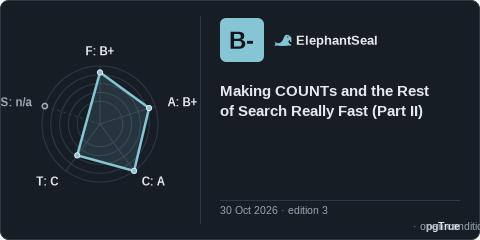
<a href="https://pgtrue.postgres.ai/shared/brief/a8523bc1-2bb0-4889-97b5-39ba11e0cf4c"><img src="https://pgtrue.postgres.ai/badge/a8523bc1-2bb0-4889-97b5-39ba11e0cf4c/wide.svg?v=13&amp;theme=dark" alt="pgTrue fact-check" width="480" height="240" loading="lazy" decoding="async" style="display:inline-block;width:480px;height:240px"></a>
https://pgtrue.postgres.ai/badge/a8523bc1-2bb0-4889-97b5-39ba11e0cf4c/wide.svg?v=13&theme=dark
.. image:: https://pgtrue.postgres.ai/badge/a8523bc1-2bb0-4889-97b5-39ba11e0cf4c/wide.svg?v=13&theme=dark
   :target: https://pgtrue.postgres.ai/shared/brief/a8523bc1-2bb0-4889-97b5-39ba11e0cf4c
   :alt: pgTrue fact-check
   :width: 480
   :height: 240
[![pgTrue fact-check](https://pgtrue.postgres.ai/badge/a8523bc1-2bb0-4889-97b5-39ba11e0cf4c/wide.svg?v=13)](https://pgtrue.postgres.ai/shared/brief/a8523bc1-2bb0-4889-97b5-39ba11e0cf4c)
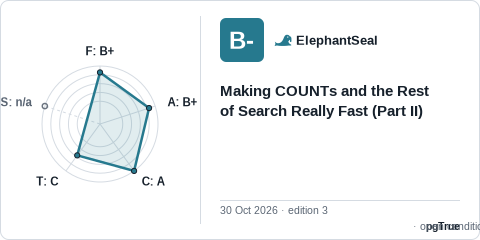
<a href="https://pgtrue.postgres.ai/shared/brief/a8523bc1-2bb0-4889-97b5-39ba11e0cf4c"><img src="https://pgtrue.postgres.ai/badge/a8523bc1-2bb0-4889-97b5-39ba11e0cf4c/wide.svg?v=13" alt="pgTrue fact-check" width="480" height="240" loading="lazy" decoding="async" style="display:inline-block;width:480px;height:240px"></a>
https://pgtrue.postgres.ai/badge/a8523bc1-2bb0-4889-97b5-39ba11e0cf4c/wide.svg?v=13
.. image:: https://pgtrue.postgres.ai/badge/a8523bc1-2bb0-4889-97b5-39ba11e0cf4c/wide.svg?v=13
   :target: https://pgtrue.postgres.ai/shared/brief/a8523bc1-2bb0-4889-97b5-39ba11e0cf4c
   :alt: pgTrue fact-check
   :width: 480
   :height: 240

Click the snippet to select all of it, then copy. Where SVG is stripped, as in some email clients and feed readers, change .svg to .png. PNG uses the light theme for Auto. For Markdown PNG embeds, use the HTML snippet where supported to preserve the display size.

Optional colours: append &color=26798E or &labelColor=333C47 after a theme query (use ? for the first parameter). Use 3- or 6-digit hex.

For pages with a light background.

For pages with a dark background. The ElephantSeal gets a thin edge so it does not blend in.

Auto follows the reader's light or dark setting where the host supports it, and shows the light ElephantSeal where it does not.

On a light page
On a dark page

Making COUNTs and the Rest of Search Really Fast (Part II) (opens in new tab)

paradedb.com
Check before you follow it: 2 claims are wrong.
0
inaccuracy
0
dangerous-recipe
2
misleading
0
imprecise
0
transcription
0
aged
0
withdrawn
11
verified-accurate

Central claim not verified: COUNT optimizations and comparative performance for filtered and time-sorted search queries. We could not verify this. The article gives a method to reproduce it.

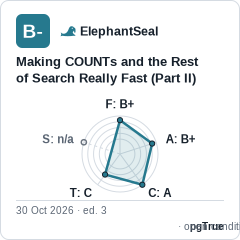
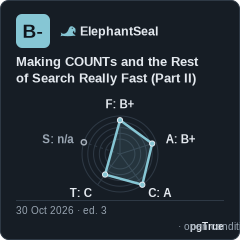
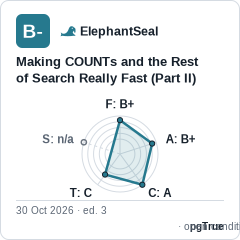
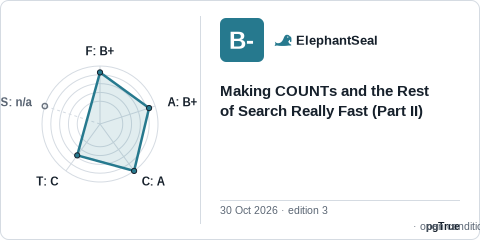
Factual B+ · Applicable B+ · Consistent A · Transparent C · Safe —

ReportTechnical fact-check, edition 3 pgTrue versionaudited with v1.0.14 (approx.) · regraded with v1.1.3 Issued EditionUpdated after review. Corrections are listed below. SubmittedSubmitted by the PostgresAI team. Author responseNo written reply from the author. We re-audited this article 1 time; see Revisions below. Policy: right-of-reply and corrections policy.

InaccuraciesNone in this edition.

Dangerous or recipe bugsNone in this edition.

Misleading / imprecise

F1

Misleading: “…the TIN and B-tree indexes must independently produce all their matches before they are…”

MISLEADINGFactual · partly holds after review

Claim ledger

Article says
…the TIN and B-tree indexes must independently produce all their matches before they are combined…
What is true
REL_18_6 indices.sgml:688–691 documents choosing one index despite other available indexes. execScan.h:223 evaluates residual qualifications. These alternatives undermine the article's categorical wording about mixed filters. The cited excerpts do not establish which plans TIN 1.0.4 used in the benchmarks.
So what
Inspect EXPLAIN (ANALYZE, BUFFERS) and compare a single-index scan with residual filtering before changing search engines.

Source

Source · REL_18_6 · doc/src/sgml/indices.sgml:688-691BY</literal> clause. For this reason, and because each additional index scan adds extra time, the planner will sometimes choose to use a simple index scan even though additional indexes are available that could have been used as well.
In the article · section “Is There a Fundamental Architecture Difference?”

In the article

excerpt · section “Is There a Fundamental Architecture Difference?” · as fetched 2026-10-19 · open in article ↗ (opens in new tab)

Is There a Fundamental Architecture Difference?

That distinction matters for both filtering and sorting. For queries with both text and non-text filters, the TIN and B-tree indexes must independently produce all their matches before they are combined. This misses opportunities to avoid large amounts of work: the B-tree doesn’t know which documents match the text query, so it can collect millions of matches that the intersection will later discard. For other sort orders, such as sorting by time, TIN cannot coordinate text matching with time ordering. Postgres must order the matches outside the index rather than letting the search track the newest 10 matches as it goes.

All sources and excerpts · 2
Evidence BY</literal> clause. For this reason, and because each additional index scan adds extra time, the planner will sometimes choose to use a simple index scan even though additional indexes are available that could have been used as well.
Evidence if (qual == NULL || ExecQual(qual, econtext))
How the review tested this

Review: The article's wording can describe its measured plans. The excerpts support alternative PostgreSQL plans but do not establish bitmap-intersection behavior or TIN's actual plans.

F2

The time-sort baseline uses a B-tree with different null ordering

MISLEADINGApplicable · holds up after review

Claim ledger

Article says
…CREATE INDEX hn_items_time ON public.hn_items USING btree ("time");…
What is true
The default time B-tree supplies ASC NULLS LAST or DESC NULLS FIRST. The query requests DESC NULLS LAST. REL_18_6 indices.sgml:612-615 documents a matching alternative. This mismatch prevents the baseline from establishing an unavoidable sorting limitation. Test a matching index before choosing an engine from this result.
So what
Benchmark a B-tree on time DESC NULLS LAST and inspect its execution plan before attributing external sorting to TIN's architecture.
Charitable reading
The article accurately records its chosen index. The defect concerns using this configuration to explain an unavoidable sorting limitation.

Source

Source · REL_18_6 · doc/src/sgml/indices.sgml:593-595By default, B-tree indexes store their entries in ascending order with nulls last (table TID is treated as a tiebreaker column among otherwise equal entries). This means that a forward scan of an
In the article · section “Is There a Fundamental Architecture Difference?”

In the article

excerpt · section “Is There a Fundamental Architecture Difference?” · as fetched 2026-10-19 · open in article ↗ (opens in new tab)

Is There a Fundamental Architecture Difference?

CREATE INDEX hn_items_text_bm25_idx ON public.hn_items USING tin (text) WITH (initial_segment_count = '4' ); CREATE INDEX hn_items_score ON public.hn_items USING btree (score); CREATE INDEX hn_items_time ON public.hn_items USING btree ("time");
All sources and excerpts · 2
Evidence By default, B-tree indexes store their entries in ascending order with nulls last (table TID is treated as a tiebreaker column among otherwise equal entries). This means that a forward scan of an
Evidence An index stored in ascending order with nulls first can satisfy either <literal>ORDER BY x ASC NULLS FIRST</literal> or <literal>ORDER BY x DESC NULLS LAST</literal> depending on which direction it is scanned in.
How the review tested this

Review: We tested whether backward scanning supplies the requested ordering. The documented null ordering still differs. The finding appropriately avoids assigning any measured speedup to this mismatch. Testing a matching index is concrete. We checked whether backward scanning supplies the requested ordering. The default index supplies DESC NULLS FIRST. The query requests DESC NULLS LAST. The finding does not attribute a measured performance penalty to this mismatch.

Verified accurate

F8

TIN documents CTIDs as its native document identifiers

ACCURATEFactual · holds up after review

Claim ledger

Article says
…TIN can skip because its document index is ctid…
What is true
TIN's September 16, 2026 launch documentation says it directly uses PostgreSQL CTIDs as document identifiers. That design avoids a separate sequential-document-ID-to-CTID mapping. It still requires visibility handling for heap pages that are not all-visible.
Charitable reading
The article says TIN avoids a separate document-ID-to-CTID mapping. It does not say TIN avoids every visibility check.

Source

Source · https://planetscale.com/blog/introducing-tinInstead, TIN directly uses Postgres' ctid value as a document identifier.
In the article · section “Optimization 1: Segment Partitioning”

In the article

excerpt · section “Optimization 1: Segment Partitioning” · as fetched 2026-10-19 · open in article ↗ (opens in new tab)

Optimization 1: Segment Partitioning

When profiling this query visibility checking accounted for over 80% of our page accesses. This makes sense because for every match, we need to fetch and decode its ctid value (which TIN can skip because its document index is ctid ).

Data structure Share of page accesses Visibility map + stored CTIDs 1382 (81%) Everything else (postings, metadata, etc.) 325 (19%)
All sources and excerpts · 1
EvidenceInstead, TIN directly uses Postgres' ctid value as a document identifier.
How the review tested this

Review: We tested whether the finding conflates CTID mapping with visibility checking. It separates them and limits verification to the launch documentation. E-21 matches that page. We tested whether the article claims to eliminate visibility checking. Its parenthesis concerns identifier conversion. The launch documentation expressly identifies CTIDs as native document identifiers. The finding limits itself to that documented architecture.

F11

The installation link provides local setup instructions

ACCURATEFactual · holds up after review

Claim ledger

Article says
…you can run ParadeDB locally using our getting-started guide…
What is true
The linked guide provides Docker and Postgres.app installation instructions. Its current page identifies documentation version v0.26.2.
Charitable reading
The claim promises local installation instructions. It does not promise the benchmark's development build.

Source

Source · https://docs.paradedb.com/documentation/getting-started/installGet started locally with our Curlbash installer, Docker, or Postgres.app.
In the article · section “Closing Thoughts”

In the article

excerpt · section “Closing Thoughts” · as fetched 2026-10-19 · open in article ↗ (opens in new tab)

Closing Thoughts

If you’d like to test these queries on your own data, you can run ParadeDB locally using our getting-started guide .

All sources and excerpts · 1
EvidenceGet started locally with our Curlbash installer, Docker, or Postgres.app.
How the review tested this

Review: We checked the installation page and tested the benchmark-build interpretation. The finding verifies local setup instructions without promising the benchmark build. We tested whether the link promises the benchmark build. It promises local installation. The fetched guide supplies local installation options, and the finding identifies its current documentation version.

F12

The quotation preserves the launch post's words

ACCURATEFactual · holds up after review

Claim ledger

Article says
…all of those things while also handling joins, complicated WHERE clauses across full-text and other column types.
What is true
The September 16, 2026 launch post contains the quoted wording about joins and mixed WHERE clauses. This verifies quotation fidelity, not TIN's implementation.
Charitable reading
The article quotes an excerpt. It ends the excerpt before the original sentence's remaining requirements.

Source

Source · https://planetscale.com/blog/introducing-tinall of those things while also handling joins, complicated WHERE clauses across full-text and other column types,
In the article · section “3. Top K search ordered by time”

In the article

excerpt · section “3. Top K search ordered by time” · as fetched 2026-10-19 · open in article ↗ (opens in new tab)

3. Top K search ordered by time

“ A good text index in Postgres must support all of those things while also handling joins, complicated WHERE clauses across full-text and other column types.”

All sources and excerpts · 1
Evidenceall of those things while also handling joins, complicated WHERE clauses across full-text and other column types,
How the review tested this

Review: We compared the original continuation with the excerpt. The words match. The finding acknowledges the changed terminal punctuation and does not infer implementation support. We compared the quoted words and the source continuation. The words match. Ending the excerpt with a period does not change its claim about joins and mixed filters. The finding already records the punctuation difference.

F13

The launch post reports approximately 10,000 queries per second

ACCURATEFactual · holds up after review · also flagged 1 more time

Claim ledger

Article says
…the TIN launch post reported throughput closer to 10,000 queries per second…
What is true
The launch table reports 10,260 queries per second for read-only Wikipedia disjunction COUNT queries. The article's rounded attribution matches.
Charitable reading
The article rounds a published throughput result. It does not claim an independent reproduction.

Source

Source · https://planetscale.com/blog/introducing-tinTIN │ 10,260 │ 2ms │ 1.7
In the article · section “Closing Thoughts”

In the article

excerpt · section “Closing Thoughts” · as fetched 2026-10-19 · open in article ↗ (opens in new tab)

Closing Thoughts

In this client-side Wikipedia COUNT run, k6 reported a p50 of 3.6ms for TIN versus 1.6ms for ParadeDB. At latencies this small, the extra network time on TIN’s path materially changed the result. We knew TIN was being inflated by network latency more than ParadeDB, so we stopped using our benchmarker for this comparison and started investigating approaches that would remove the network differences. We also knew that the TIN launch post reported throughput closer to 10,000 queries per second, much higher than the roughly 2,000 we measured.

All sources and excerpts · 1
EvidenceTIN │ 10,260 │ 2ms │ 1.7
How the review tested this

Review: We checked the table entry and workload qualification. The 10,260 QPS entry supports the rounded attribution. The finding does not claim workload equivalence. We checked the table's workload label. The 10,260 QPS result concerns read-only disjunction counts. The finding preserves that qualification and verifies attribution rather than workload equivalence.

F14

The original benchmark client ran on the database host

ACCURATEFactual · holds up after review

Claim ledger

Article says
PlanetScale benchmarks do not have this issue because they can run both systems locally…
What is true
The September 16, 2026 launch post places the benchmark client and target server on the same EC2 instance. That supports the article's topology comparison.
Charitable reading
The claim concerns unequal remote network paths. Local execution does not eliminate every communication cost.

Source

Source · https://planetscale.com/blog/introducing-tinWe ran the Benchmarker on the same EC2 instance as the target Postgres server
In the article · section “Closing Thoughts”

In the article

excerpt · section “Closing Thoughts” · as fetched 2026-10-19 · open in article ↗ (opens in new tab)

Closing Thoughts

We moved to using a more exotic server-side PL/pgSQL benchmarking approach that records the throughput and latency measurements for these workloads without any network traversal. This removes network overhead from the measurements. We don’t love using another tool, but it’s the only way we could accurately compare the systems without PlanetScale being unfairly penalized for both higher lag and jitter. 3 Interestingly, even though this approach is fairer, there was very little difference in the final ratios. PlanetScale benchmarks do not have this issue because they can run both systems locally ( pg_search is open source).

All sources and excerpts · 1
EvidenceWe ran the Benchmarker on the same EC2 instance as the target Postgres server
How the review tested this

Review: We tested whether host placement proves zero communication overhead. The finding avoids that inference and verifies only the documented topology. We tested whether local execution proves zero communication overhead. It does not, but the finding claims only the documented topology. The launch post places the client and target server on the same instance.

F15

Wikipedia COUNT throughput ratio rounds correctly

ACCURATEFactual · holds up after review

Claim ledger

Article says
…ParadeDB ( 2.0 x faster) 5353.3 QPS…
What is true
The displayed Wikipedia COUNT throughput ratio rounds to 2.0× (derived: 5,353.3 QPS / 2,645.8 QPS).
Charitable reading
The 2.0× label rounds the throughput ratio to one decimal place.

Checked for internal consistency: the evidence is the article itself.

In the article

In the article

excerpt · as fetched 2026-10-19 · open in article ↗ (opens in new tab)

ParadeDB ( 2.0 x faster) 5353.3 QPS TIN 2645.8 QPS ↑ Higher is better

How the review tested this

Review: We recalculated the displayed ratio: 5,353.3 QPS divided by 2,645.8 QPS rounds to 2.0×. The finding verifies arithmetic only. We recalculated 5353.3 / 2645.8 = 2.0233. The displayed ratio rounds to 2.0. This verifies arithmetic without validating measurements.

F16

Filtered COUNT throughput ratio rounds correctly

ACCURATEFactual · holds up after review

Claim ledger

Article says
…ParadeDB ( 10.0 x faster) 777.3 QPS…
What is true
The displayed filtered COUNT throughput ratio rounds to 10.0× (derived: 777.3 QPS / 77.6 QPS).
Charitable reading
The ratio uses the chart's decimal throughput values before rounding.

Checked for internal consistency: the evidence is the article itself.

In the article · section “1. Filtered count”

In the article

excerpt · section “1. Filtered count” · as fetched 2026-10-19 · open in article ↗ (opens in new tab)

1. Filtered count

ParadeDB ( 10.0 x faster) 777.3 QPS TIN 77.6 QPS ↑ Higher is better

How the review tested this

Review: We recalculated using the chart values. Dividing 777.3 QPS by 77.6 QPS rounds to 10.0×. We recalculated 777.3 / 77.6 = 10.0168. The displayed ratio rounds to 10.0. The integer prose rates also match the chart after rounding.

F17

Filtered BM25 throughput ratio rounds correctly

ACCURATEFactual · holds up after review

Claim ledger

Article says
…ParadeDB ( 11.6 x faster) 820.4 QPS…
What is true
The displayed filtered BM25 throughput ratio rounds to 11.6× (derived: 820.4 QPS / 70.5 QPS).
Charitable reading
The ratio uses the chart's decimal throughput values rather than the rounded prose rates.

Checked for internal consistency: the evidence is the article itself.

In the article · section “2. Filtered Top K by BM25 relevance”

In the article

excerpt · section “2. Filtered Top K by BM25 relevance” · as fetched 2026-10-19 · open in article ↗ (opens in new tab)

2. Filtered Top K by BM25 relevance

ParadeDB ( 11.6 x faster) 820.4 QPS TIN 70.5 QPS ↑ Higher is better

How the review tested this

Review: We tested whether rounded prose rates caused a discrepancy. The chart's 820.4 QPS divided by 70.5 QPS rounds to 11.6×. We recalculated from the decimal chart rates rather than rounded prose. The ratio 820.4 / 70.5 = 11.6369 rounds to 11.6.

F18

Time-sorted throughput ratio rounds correctly

ACCURATEFactual · holds up after review

Claim ledger

Article says
…ParadeDB ( 21.7 x faster) 377.8 QPS…
What is true
The displayed time-sorted throughput ratio rounds to 21.7× (derived: 377.8 QPS / 17.4 QPS).
Charitable reading
The 21.7× result uses 17.4 QPS, which the prose rounds to 17 QPS.

Checked for internal consistency: the evidence is the article itself.

In the article · section “3. Top K search ordered by time”

In the article

excerpt · section “3. Top K search ordered by time” · as fetched 2026-10-19 · open in article ↗ (opens in new tab)

3. Top K search ordered by time

ParadeDB ( 21.7 x faster) 377.8 QPS TIN 17.4 QPS ↑ Higher is better

How the review tested this

Review: We recalculated using decimal rates rather than rounded prose. Dividing 377.8 QPS by 17.4 QPS rounds to 21.7×. We tested the apparent mismatch from dividing rounded prose rates. The chart gives 377.8 / 17.4 = 21.7126, which rounds to 21.7.

F19

Page-access percentages match the table

ACCURATEFactual · holds up after review

Claim ledger

Article says
…Visibility map + stored CTIDs 1382 (81%)…
What is true
Visibility accesses represent 81% of the displayed total (derived: 1,382 accesses / 1,707 accesses). Other accesses represent 19% (derived: 325 accesses / 1,707 accesses).
Charitable reading
The table rounds each category's share to a whole percentage point.

Checked for internal consistency: the evidence is the article itself.

In the article · section “Optimization 1: Segment Partitioning”

In the article

excerpt · section “Optimization 1: Segment Partitioning” · as fetched 2026-10-19 · open in article ↗ (opens in new tab)

Optimization 1: Segment Partitioning

Data structure Share of page accesses Visibility map + stored CTIDs 1382 (81%) Everything else (postings, metadata, etc.) 325 (19%)
How the review tested this

Review: We summed 1,382 and 325 page accesses. Their shares of 1,707 accesses round to 81% and 19%. We recalculated both shares using 1,707 total accesses. The results are 80.96% and 19.04%. Both displayed percentages round correctly.

F20

Approximate buffer-access reduction is consistent

ACCURATEFactual · holds up after review

Claim ledger

Article says
…from over 7,500 to just under 400…
What is true
The approximate endpoints support a reduction near 95% (derived: 100 × (1 − 400 accesses / 7,500 accesses)). The boundary calculation gives 94.7%.
Charitable reading
The 95% figure summarizes approximate endpoints rather than asserting an exact percentage.

Checked for internal consistency: the evidence is the article itself.

In the article

In the article

Article · exact quote · open in article ↗ (opens in new tab)…from over 7,500 to just under 400…
How the review tested this

Review: We tested exact and approximate readings. The boundary calculation gives 94.7%, consistent with approximately 95%. The finding acknowledges that the endpoints are approximate. We tested whether the approximate endpoints contradict 95%. Their boundary calculation gives 94.67%, which rounds to 95%. The finding does not infer an exact reduction.

Notes

6 not graded: findings no reader would act on differently
F4

Note: “If every page in the range is marked all-visible, we can skip visibility checking…”

NOTEpartly holds after review

Claim ledger

Article says
If every page in the range is marked all-visible, we can skip visibility checking…
What is true
In v0.26.1, heap.rs:554–555 tests for empty dirty-block ranges. aggregate/exec.rs:97–99 then omits the document visibility filter. These excerpts corroborate the conditional mechanism. They do not verify benchmark commit a637cbee55a987807325e445b00c31ae64ef7241.

Source

Source · paradedb@v0.26.1 · pg_search/src/postgres/heap.rs:554-555self.dirty_blocks_for_segment(segment, first..last + 1) .is_some_and(|blocks| blocks.is_empty())

Not graded: no reader would act differently on it.

In the article

In the article

Article · exact quote · open in article ↗ (opens in new tab)If every page in the range is marked all-visible, we can skip visibility checking…
All sources and excerpts · 2
Evidence self.dirty_blocks_for_segment(segment, first..last + 1) .is_some_and(|blocks| blocks.is_empty())

Version note: Checked release 0.26.1. The article identifies benchmark commit a637cbee55a987807325e445b00c31ae64ef7241.

Evidence if checker.is_segment_all_visible(segment_ord).unwrap_or(false) { return None; }

Version note: Checked release 0.26.1.

How the review tested this

Review: We checked the conditional reading and release identity. The excerpts support the shortcut in v0.26.1. They do not verify the benchmark commit. We checked the visibility shortcut and its consumer. Both support the conditional mechanism in v0.26.1. The source citation acknowledges a different benchmark commit. That supports corroboration rather than verification of the benchmark implementation.

F5

Note: “…check the visibility map up front, then look up document ranges only for pages that need…”

NOTEpartly holds after review

Claim ledger

Article says
…check the visibility map up front, then look up document ranges only for pages that need checking…
What is true
In v0.26.1, ctid_map/mod.rs:19–22 describes compressed boundaries. heap.rs:740–747 maps dirty-block ranges to document ranges. This corroborates the described mechanism in that release. It does not verify benchmark commit a637cbee55a987807325e445b00c31ae64ef7241.

Source

Source · paradedb@v0.26.1 · pg_search/src/index/ctid_map/mod.rs:19-22//! Boundaries are one nullable Tantivy column in `.ctid_map`. Restartable iterators scan //! and deduplicate the final CTIDs without buffering the column. BlockwiseLinearV2 //! compresses values in 512-value blocks and reads them lazily; the nullable index is //! loaded on the first boundary lookup. A final boundary marks the end of the documents.

Not graded: no reader would act differently on it.

In the article

In the article

Article · exact quote · open in article ↗ (opens in new tab)…check the visibility map up front, then look up document ranges only for pages that need checking…
All sources and excerpts · 2
Evidence//! Boundaries are one nullable Tantivy column in `.ctid_map`. Restartable iterators scan //! and deduplicate the final CTIDs without buffering the column. BlockwiseLinearV2 //! compresses values in 512-value blocks and reads them lazily; the nullable index is //! loaded on the first boundary lookup. A final boundary marks the end of the documents.

Version note: Checked release 0.26.1.

Evidence let Some(block_ranges) = self.dirty_blocks_for_segment(segment, map.block_range()) else { return Ok(None); }; const RANGES_PER_BATCH: usize = 128; let mut ranges = Vec::new(); for blocks in block_ranges.chunks(RANGES_PER_BATCH) { ranges.extend(map.doc_id_ranges_for_blocks(blocks)?);

Version note: Checked release 0.26.1.

How the review tested this

Review: We checked whether the excerpts show both stored boundaries and their consumer. They do, but only for v0.26.1. We checked the compressed boundaries and dirty-block conversion. The mechanism exists in v0.26.1. Those citations do not establish its implementation at the article's benchmark commit.

F6

Note: “…Each segment already stores the minimum and maximum ctid…”

NOTEpartly holds after review

Claim ledger

Article says
…Each segment already stores the minimum and maximum ctid…
What is true
In v0.26.1, reader/index.rs:643–649 obtains CTID extrema and converts them into an inclusive heap-block range. This supports availability of segment bounds in that release. It does not verify benchmark commit a637cbee55a987807325e445b00c31ae64ef7241.

Source

Source · paradedb@v0.26.1 · pg_search/src/index/reader/index.rs:643-649 (ctids.min_value(), ctids.max_value()) }; let first = BlockNumber::try_from(min >> 16).context("heap block number exceeds BlockNumber")?; let last = BlockNumber::try_from(max >> 16).context("heap block number exceeds BlockNumber")?; Ok(Some(first..=last))

Not graded: no reader would act differently on it.

In the article

In the article

Article · exact quote · open in article ↗ (opens in new tab)…Each segment already stores the minimum and maximum ctid…
All sources and excerpts · 1
Evidence (ctids.min_value(), ctids.max_value()) }; let first = BlockNumber::try_from(min >> 16).context("heap block number exceeds BlockNumber")?; let last = BlockNumber::try_from(max >> 16).context("heap block number exceeds BlockNumber")?; Ok(Some(first..=last))

Version note: Checked release 0.26.1.

How the review tested this

Review: We checked whether obtaining bounds proves the benchmark implementation. E-17 supports the block-range calculation only in v0.26.1. We checked the minimum and maximum CTID conversion. The code supports block-range extraction in v0.26.1. It does not verify the benchmark commit.

F7

Note: “…our segments are already sorted by ctid…”

NOTEpartly holds after review

Claim ledger

Article says
…our segments are already sorted by ctid…
What is true
In v0.26.1, options.rs:956–962 defaults segment ordering to ascending CTID. That ordering groups documents from the same heap block. The excerpt does not verify this default in benchmark commit a637cbee55a987807325e445b00c31ae64ef7241.

Source

Source · paradedb@v0.26.1 · pg_search/src/postgres/options.rs:956-962if sort_by_str.is_empty() { // Default: sort segments by ctid ascending so they're laid out in // heap (tid) order unless the user explicitly opts out with 'none'. return vec![SortByField::new( FieldName::from(CTID_FIELD_NAME), SortByDirection::Asc, )];

Not graded: no reader would act differently on it.

In the article

In the article

Article · exact quote · open in article ↗ (opens in new tab)…our segments are already sorted by ctid…
All sources and excerpts · 2
Evidence if sort_by_str.is_empty() { // Default: sort segments by ctid ascending so they're laid out in // heap (tid) order unless the user explicitly opts out with 'none'. return vec![SortByField::new( FieldName::from(CTID_FIELD_NAME), SortByDirection::Asc, )];

Version note: Checked release 0.26.1.

Evidence * ip_blkid tells us which block, ip_posid tells us which entry in * the linp (ItemIdData) array we want.
How the review tested this

Review: We tested the configurable-default objection. The article's configuration does not contradict the default. The remaining limitation is the different implementation version. We tested the configurable-order objection. The article describes its default configuration, so that objection fails. However, options.rs verifies the default at v0.26.1 rather than the benchmark commit.

F9

Note: “…lets us split up segments by the values of one or more columns…”

NOTEpartly holds after review

Claim ledger

Article says
…lets us split up segments by the values of one or more columns…
What is true
In v0.26.1, pg_search/src/index/kdtree.rs:99–103 accepts multiple field names and checks sample dimensionality. This corroborates multidimensional partition construction in that release. It does not verify benchmark commit a637cbee55a987807325e445b00c31ae64ef7241.

Source

Source · paradedb@v0.26.1 · pg_search/src/index/kdtree.rs:99-103pub fn from_sample(dims: Vec<FieldName>, sample: Vec<Point>, target_partitions: usize) -> Self { let ndims = dims.len(); debug_assert!( sample.iter().all(|p| p.len() == ndims), "every sample point must have one value per partition_by field"

Not graded: no reader would act differently on it.

In the article

In the article

Article · exact quote · open in article ↗ (opens in new tab)…lets us split up segments by the values of one or more columns…
All sources and excerpts · 1
Evidence pub fn from_sample(dims: Vec<FieldName>, sample: Vec<Point>, target_partitions: usize) -> Self { let ndims = dims.len(); debug_assert!( sample.iter().all(|p| p.len() == ndims), "every sample point must have one value per partition_by field"

Version note: This release corroborates the feature. It does not identify the benchmark binary.

How the review tested this

Review: We checked whether multiple dimensions appear in the interface. They do. The release excerpt cannot establish the benchmark commit's implementation. We checked whether the dimensions vector actually represents partition fields. The source confirms that relationship. Its v0.26.1 implementation corroborates capability without verifying the benchmark commit.

F10

Note: “…ParadeDB is able to index all of those columns together in one index.”

NOTEpartly holds after review

Claim ledger

Article says
…ParadeDB is able to index all of those columns together in one index.
What is true
In v0.26.1, pg_search/src/postgres/mod.rs:115 enables the access method's multicolumn capability flag. That flag alone does not verify the displayed text, score, and time index. It also does not verify benchmark commit a637cbee55a987807325e445b00c31ae64ef7241.

Source

Source · paradedb@v0.26.1 · pg_search/src/postgres/mod.rs:115-115amroutine.amcanmulticol = true;

Not graded: no reader would act differently on it.

In the article

In the article

Article · exact quote · open in article ↗ (opens in new tab)…ParadeDB is able to index all of those columns together in one index.
All sources and excerpts · 1
Evidence amroutine.amcanmulticol = true;
How the review tested this

Review: We tested the capability flag's reach. It establishes advertised multicolumn support, not the specific column combination or benchmark implementation. We checked the access-method flag. It confirms multicolumn capability in v0.26.1. That release differs from the benchmark commit, so the accuracy badge exceeds the version check.

More in this report

Section checks · 8 sections

Section checks

AspectGradeFindingsCoverage
OverviewA1 verified-accurate100% of claims (1 of 1, plus 12 that need data we do not have)
Segment partitioningA1 verified-accurate78% of claims (11 of 14, plus 9 that need data we do not have)
DocId mapA2 verified-accurate88% of claims (8 of 9, plus 4 that need data we do not have)
Search workloadsA4 verified-accurate100% of claims (4 of 4, plus 13 that need data we do not have)
Index architectureB+1 misleading100% of claims (4 of 4, plus 9 that need data we do not have)
Index definitionsB+1 misleading100% of claims (3 of 3, plus 4 that need data we do not have)
ClosingA1 verified-accurate100% of claims (1 of 1, plus 1 that need data we do not have)
Benchmark methodA2 verified-accurate100% of claims (3 of 3, plus 11 that need data we do not have)
Coverage and assessment · Checked 35 of 39 Postgres claims across 11 sections

Central claim not verified. The findings check CTID mechanisms and displayed arithmetic, but do not establish the benchmarked speedups or bitmap-posting optimization.

We did not check everything in this article. What we did not check is listed below, in the words we recorded at the time. None of it moved the letter. We never charge our own limits to the article.

What we did not check

  • We did not inspect benchmark commit a637cbee55a987807325e445b00c31ae64ef7241 or TIN 1.0.4's implementation.
  • We did not reproduce the throughput, latency, or buffer-access measurements.
  • We did not verify the graphs' bucket reconstruction, smoothing, or percentile calculations.
  • We did not verify the 10% bitmap threshold or the REINDEX requirement.
  • We did not verify the displayed SQL against its original rendered code blocks.
  • We did not verify segment range disjointness under concurrent writes or compaction.
  • We did not verify the server-side benchmark's timing implementation or measured execution plans.
  • We did not reproduce the performance measurements or verify the clean-table state.
  • We did not verify the TIN 1.0.4 binary, the reported main-branch binary, or later TIN releases.
  • We did not verify hardware equivalence between the two benchmark environments.
  • We did not verify TIN's single-column restriction, ordering capabilities, or benchmark execution plans.
  • We did not verify the original benchmarks' complete workload and index definitions.
  • We could not retrieve the Spooky compaction paper or the linked hosted service.
  • We did not reproduce the throughput, latency, buffer-access, or row-update measurements.
  • We did not verify the 66× maximum across the article’s interactive chart settings.
  • We did not verify the eight-CPU allocation, client counts, or benchmark run durations.
  • We could not quantify the Part I speedup from its available before-and-after measurements.
  • We could not decide whether readers can obtain the benchmark environment.
  • We could not decide whether the published benchmark details are complete.
Checked 35 of 39 Postgres claims across 11 sections
  • Overview: 1 of 1 Postgres claims checked, plus 12 that need data we do not have; not counted: 5 not a claim
  • Segment partitioning: 11 of 14 Postgres claims checked, plus 9 that need data we do not have; not counted: 4 product or opinion, 1 not a claim; not checked: 3 for other reasons
  • DocId map: 8 of 9 Postgres claims checked, plus 4 that need data we do not have; not counted: 1 product or opinion, 2 duplicate, 1 not a claim; not checked: 1 for other reasons
  • Bitmap postings: 5 claims are the author's own account; nothing checkable; not counted: 13 product or opinion, 1 not a claim
  • Search workloads: 4 of 4 Postgres claims checked, plus 13 that need data we do not have; not counted: 3 product or opinion, 11 duplicate, 2 not a claim
  • Benchmark interpretation: 2 claims are the author's own account; nothing checkable; not counted: 13 product or opinion, 2 duplicate
  • Index architecture: 4 of 4 Postgres claims checked, plus 9 that need data we do not have; not counted: 3 product or opinion, 2 not a claim
  • Index definitions: 3 of 3 Postgres claims checked, plus 4 that need data we do not have; not counted: 2 duplicate
  • Closing: 1 of 1 Postgres claims checked, plus 1 that need data we do not have; not counted: 6 product or opinion, 2 not a claim
  • Benchmark method: 3 of 3 Postgres claims checked, plus 11 that need data we do not have; not counted: 8 product or opinion, 5 duplicate, 3 not a claim
  • Versions and hardware: 7 claims are the author's own account; nothing checkable; not counted: 1 product or opinion, 1 duplicate, 2 not a claim

Average of 4 axes: 3.15 · benchmark not reproducible, one step off (no code or raw results) · result B-

Some explanatory text is not shown in this edition; the grade and findings are complete.

Scorecard · the five axes
FACTS scorecard Scorecard radar, 5 axes, bigger is better. Overall B-. Factual B+ · 1 wrong of 13 checked · 0 caveats. Applicable B+ · 1 wrong of 4 checked · 0 caveats. Consistent A · 0 wrong of 13 checked · 0 caveats. Transparent C · 0 wrong of 12 checked · 0 caveats · reproducibility: C (no code or raw results). Safe 2 checked, too few for a letter. B+ 1 wrong of 13 checked · 0 caveatsFactual B+1 wrong of 130 caveats B+ 1 wrong of 4 checked · 0 caveatsApplicable B+1 wrong of 40 caveats A 0 wrong of 13 checked · 0 caveatsConsistent A0 wrong of 130 caveats C 0 wrong of 12 checked · 0 caveats reproducibility: C (no code or raw results)Transparent C0 wrong of 120 caveatsreproducibility: C(no code or rawresults) 2 checked, too few for a letterSafe n/a0 wrong of 20 caveats B-

By topic: Overview — 1 finding, 0 wrong · Segment partitioning — 1 finding, 0 wrong · DocId map — 2 findings, 0 wrong · Search workloads — 4 findings, 0 wrong · Index architecture — 1 finding, 1 wrong · Index definitions — 1 finding, 1 wrong · Closing — 1 finding, 0 wrong · Benchmark method — 2 findings, 0 wrong

Further out is better. Each axis has its own letter, from the wrong claims and caveats among the claims we checked of that kind.

Checked on the FACTS: Factual, Applicable, Consistent, Transparent, Safe. Clockwise: Factual (is it true?), Applicable (does it apply to my setup, today?), Consistent (does it agree with itself?), Transparent (can I check it myself?), Safe (can I run this on prod?).

We checked 13 claims, 12 commands scanned.

AxisLetterWrongCaveatsCheckedCoverage
FactualB+1013assessed: B+ · 1 wrong of 13 checked · 0 caveats
ApplicableB+104assessed: B+ · 1 wrong of 4 checked · 0 caveats
ConsistentA0013assessed: A · 0 wrong of 13 checked · 0 caveats
TransparentC0012assessed: C · 0 wrong of 12 checked · 0 caveats · reproducibility: C (no code or raw results)
Safe—002assessed: 0 wrong · 0 caveats · 2 checked
Topics · 8 topics

Topics

TopicFactualApplicableConsistentTransparentSafe
Overview0 issues 1 checked F150 issues 1 checked0 issues 1 checked
Segment partitioning0 issues 1 checked F190 issues 1 checked0 issues 1 checked
DocId map0 issues 2 checked F8 F200 issues 1 checked0 issues 2 checked0 issues 2 checked
Search workloads0 issues 4 checked F12 F16 F17 F180 issues 1 checked0 issues 4 checked0 issues 4 checked
Index architecture1 issue 1 checked F10 issues 1 checked
Index definitions0 issues 1 checked1 issue 1 checked F20 issues 1 checked0 issues 1 checked
Closing0 issues 1 checked F110 issues 1 checked0 issues 1 checked
Benchmark method0 issues 2 checked F13 F140 issues 1 checked0 issues 2 checked0 issues 2 checked

Issues found among the claims checked, per topic and axis. Each link goes to the finding behind the count.

Revisions: 2 · B+ -> B-

We audited this article 2 times. Each row is the final edition of one audit. Letters and findings of earlier revisions stay readable at their own address.

  1. Revision 1 · 2026-10-14 03:55 UTC · B+ · audit version not recorded · regrade version not recorded

    Article as first submitted. 13 accurate · 1 wrong · 1 caveat.

    ElephantSeal: B+. Open: the central claim is not yet backed by evidence.

    Changes: First audit. Open: F1 “…the TIN and B-tree indexes must independently produce all their matches before they are combined.” (misleading); F2 “Postgres must order the matches outside the index…” (mostly accurate).

  2. Revision 2 · this page · 2026-10-19 08:42 UTC · B- · audited with v1.0.14 (approx.) · regraded with v1.1.3

    Same article text, re-audited. 11 accurate · 2 wrong · 0 caveats.

    ElephantSeal: B-. Open: the benchmark cannot yet be rerun from what is published.

    Changes: No longer reported: “…the TIN and B-tree indexes must independently produce all their matches before they are combined.”; “Postgres must order the matches outside the index…”. New: F1 “…the TIN and B-tree indexes must independently produce all their matches before they are combined…” (misleading); F2 “The time-sort baseline uses a B-tree with different null ordering” (misleading).

Questions and answers

Questions and answers

What is pgTrue?

pgTrue is an independent fact-check of technical Postgres articles, made by PostgresAI. It helps you check advice before you use it.

What does the letter grade mean?

The letter grade summarizes the claims we checked. Five axes show what we checked:

  • Factual: is it true?
  • Applicable: does it apply to my setup, today?
  • Consistent: does it agree with itself?
  • Transparent: can I check it myself?
  • Safe: can I run this in production?

What is the ElephantSeal?

The ElephantSeal is the mark an article earns. It always shows the latest edition. “Open:” lists what is still open.

Can an author reply?

Authors can ask us to correct a finding, reply to it, or withdraw it. Right-of-reply policy.

Paste into your AI assistant to fix the article, then ask for a re-review.

Show the text
Fix the article with this report, then ask pgTrue for a re-review.

# pgTrue report: Making COUNTs and the Rest of Search Really Fast (Part II)

Article title: Making COUNTs and the Rest of Search Really Fast (Part II)
Article URL: https://www.paradedb.com/blog/opening-a-closed-tin-part-2
Report URL: https://pgtrue.postgres.ai/shared/brief/a8523bc1-2bb0-4889-97b5-39ba11e0cf4c
Audited revision: 2 of 2, 2026-10-19 08:42:24 UTC
Overall letter: B-

## Axes

- Factual: B+ · 1 wrong · 13 checked · 0 caveats · assessed
- Applicable: B+ · 1 wrong · 4 checked · 0 caveats · assessed
- Consistent: A · 0 wrong · 13 checked · 0 caveats · assessed
- Transparent: C · 0 wrong · 12 checked · 0 caveats · assessed
- Safe: — · 0 wrong · 2 checked · 0 caveats · assessed

ElephantSeal: B-.
Open conditions: the benchmark cannot yet be rerun from what is published.

## Report metadata

- Report: Technical fact-check, edition 3
- pgTrue version: audited with v1.0.14 (approx.) · regraded with v1.1.3
- Issued: 2026-10-19
- Edition: Updated after review. Corrections are listed below.
- Submitted: Submitted by the PostgresAI team.
- Author response: No written reply from the author. We re-audited this article 1 time; see Revisions below. Policy: [right-of-reply and corrections policy](/pgtrue/security).

## Findings needing a change (2)

### F1 · Misleading · Factual · Misleading: “…the TIN and B-tree indexes must independently produce all their matches before they are…”
Location: excerpt · section “Is There a Fundamental Architecture Difference?” · as fetched 2026-10-19 · [open in article](https://www.paradedb.com/blog/opening-a-closed-tin-part-2#:~:text=the%20TIN%20and%20B%2Dtree%20indexes,matches%20before%20they%20are%20combined)
Article says:
```text
…the TIN and B-tree indexes must independently produce
all their matches before they are combined…
```
What is true:
REL_18_6 indices.sgml:688–691 documents choosing one index despite other available indexes. execScan.h:223 evaluates residual qualifications. These alternatives undermine the article's categorical wording about mixed filters. The cited excerpts do not establish which plans TIN 1.0.4 used in the benchmarks.
So what:
Inspect EXPLAIN (ANALYZE, BUFFERS) and compare a single-index scan with residual filtering before changing search engines.
Review: The article's wording can describe its measured plans. The excerpts support alternative PostgreSQL plans but do not establish bitmap-intersection behavior or TIN's actual plans.

Sources:
- [REL_18_6 · doc/src/sgml/indices.sgml:688-691](https://github.com/postgres/postgres/blob/724edf9bde9d356724ad384a2e196edc3c9f80f7/doc/src/sgml/indices.sgml#L688-L691)
  Excerpt:
  ```text
  BY</literal> clause.  For this reason, and because each additional index scan
   adds extra time, the planner will sometimes choose to use a simple index
   scan even though additional indexes are available that could have been
   used as well.
  ```
- [REL_18_6 · src/include/executor/execScan.h:223-223](https://github.com/postgres/postgres/blob/724edf9bde9d356724ad384a2e196edc3c9f80f7/src/include/executor/execScan.h#L223-L223)
  Excerpt:
  ```text
  if (qual == NULL || ExecQual(qual, econtext))
  ```

Finding URL: https://pgtrue.postgres.ai/shared/brief/a8523bc1-2bb0-4889-97b5-39ba11e0cf4c#F1

### F2 · Misleading · Applicable · The time-sort baseline uses a B-tree with different null ordering
Location: excerpt · section “Is There a Fundamental Architecture Difference?” · as fetched 2026-10-19 · [open in article](https://www.paradedb.com/blog/opening-a-closed-tin-part-2#:~:text=CREATE%20INDEX%20hn_items_time%20ON%20public.hn_items%20USING%20btree%20%28%22time%22%29%3B)
Article says:
```text
…CREATE INDEX hn_items_time ON public.hn_items USING btree ("time");…
```
What is true:
The default time B-tree supplies ASC NULLS LAST or DESC NULLS FIRST. The query requests DESC NULLS LAST. REL_18_6 indices.sgml:612-615 documents a matching alternative. This mismatch prevents the baseline from establishing an unavoidable sorting limitation. Test a matching index before choosing an engine from this result.
So what:
Benchmark a B-tree on time DESC NULLS LAST and inspect its execution plan before attributing external sorting to TIN's architecture.
Charitable reading:
The article accurately records its chosen index. The defect concerns using this configuration to explain an unavoidable sorting limitation.
Review: We tested whether backward scanning supplies the requested ordering. The documented null ordering still differs. The finding appropriately avoids assigning any measured speedup to this mismatch. Testing a matching index is concrete. We checked whether backward scanning supplies the requested ordering. The default index supplies DESC NULLS FIRST. The query requests DESC NULLS LAST. The finding does not attribute a measured performance penalty to this mismatch.

Sources:
- [REL_18_6 · doc/src/sgml/indices.sgml:593-595](https://github.com/postgres/postgres/blob/724edf9bde9d356724ad384a2e196edc3c9f80f7/doc/src/sgml/indices.sgml#L593-L595)
  Excerpt:
  ```text
  By default, B-tree indexes store their entries in ascending order
   with nulls last (table TID is treated as a tiebreaker column among
   otherwise equal entries).  This means that a forward scan of an
  ```
- [REL_18_6 · doc/src/sgml/indices.sgml:612-615](https://github.com/postgres/postgres/blob/724edf9bde9d356724ad384a2e196edc3c9f80f7/doc/src/sgml/indices.sgml#L612-L615)
  Excerpt:
  ```text
  An index stored in ascending order with nulls first can satisfy
   either <literal>ORDER BY x ASC NULLS FIRST</literal> or
   <literal>ORDER BY x DESC NULLS LAST</literal> depending on which direction
   it is scanned in.
  ```

Finding URL: https://pgtrue.postgres.ai/shared/brief/a8523bc1-2bb0-4889-97b5-39ba11e0cf4c#F2

## Verified accurate claims (11)

### F8 · Accurate · Factual · TIN documents CTIDs as its native document identifiers
Location: excerpt · section “Optimization 1: Segment Partitioning” · as fetched 2026-10-19 · [open in article](https://www.paradedb.com/blog/opening-a-closed-tin-part-2#:~:text=TIN%20can%20skip%20because%20its%20document%20index%20is%20ctid)
Article says:
```text
…TIN can skip because its document index is ctid…
```
What is true:
TIN's September 16, 2026 launch documentation says it directly uses PostgreSQL CTIDs as document identifiers. That design avoids a separate sequential-document-ID-to-CTID mapping. It still requires visibility handling for heap pages that are not all-visible.
Charitable reading:
The article says TIN avoids a separate document-ID-to-CTID mapping. It does not say TIN avoids every visibility check.
Review: We tested whether the finding conflates CTID mapping with visibility checking. It separates them and limits verification to the launch documentation. E-21 matches that page. We tested whether the article claims to eliminate visibility checking. Its parenthesis concerns identifier conversion. The launch documentation expressly identifies CTIDs as native document identifiers. The finding limits itself to that documented architecture.

Sources:
- [https://planetscale.com/blog/introducing-tin](https://planetscale.com/blog/introducing-tin)
  Excerpt:
  ```text
  Instead, TIN directly uses Postgres' ctid value as a document identifier.
  ```

Finding URL: https://pgtrue.postgres.ai/shared/brief/a8523bc1-2bb0-4889-97b5-39ba11e0cf4c#F8

### F11 · Accurate · Factual · The installation link provides local setup instructions
Location: excerpt · section “Closing Thoughts” · as fetched 2026-10-19 · [open in article](https://www.paradedb.com/blog/opening-a-closed-tin-part-2#:~:text=you%20can%20run%20ParadeDB%20locally%20using%20our%20getting%2Dstarted%20guide)
Article says:
```text
…you can run ParadeDB locally using our getting-started guide…
```
What is true:
The linked guide provides Docker and Postgres.app installation instructions. Its current page identifies documentation version v0.26.2.
Charitable reading:
The claim promises local installation instructions. It does not promise the benchmark's development build.
Review: We checked the installation page and tested the benchmark-build interpretation. The finding verifies local setup instructions without promising the benchmark build. We tested whether the link promises the benchmark build. It promises local installation. The fetched guide supplies local installation options, and the finding identifies its current documentation version.

Sources:
- [https://docs.paradedb.com/documentation/getting-started/install](https://docs.paradedb.com/documentation/getting-started/install)
  Excerpt:
  ```text
  Get started locally with our Curlbash installer, Docker, or Postgres.app.
  ```

Finding URL: https://pgtrue.postgres.ai/shared/brief/a8523bc1-2bb0-4889-97b5-39ba11e0cf4c#F11

### F12 · Accurate · Factual · The quotation preserves the launch post's words
Location: excerpt · section “3. Top K search ordered by time” · as fetched 2026-10-19 · [open in article](https://www.paradedb.com/blog/opening-a-closed-tin-part-2#:~:text=all%20of%20those%20things%20while,full%2Dtext%20and%20other%20column%20types.)
Article says:
```text
…all of those things while also handling joins, complicated WHERE clauses across full-text and other column types.
```
What is true:
The September 16, 2026 launch post contains the quoted wording about joins and mixed WHERE clauses. This verifies quotation fidelity, not TIN's implementation.
Charitable reading:
The article quotes an excerpt. It ends the excerpt before the original sentence's remaining requirements.
Review: We compared the original continuation with the excerpt. The words match. The finding acknowledges the changed terminal punctuation and does not infer implementation support. We compared the quoted words and the source continuation. The words match. Ending the excerpt with a period does not change its claim about joins and mixed filters. The finding already records the punctuation difference.

Sources:
- [https://planetscale.com/blog/introducing-tin](https://planetscale.com/blog/introducing-tin)
  Excerpt:
  ```text
  all of those things while also handling joins, complicated WHERE clauses across full-text and other column types,
  ```

Finding URL: https://pgtrue.postgres.ai/shared/brief/a8523bc1-2bb0-4889-97b5-39ba11e0cf4c#F12

### F13 · Accurate · Factual · The launch post reports approximately 10,000 queries per second
Location: excerpt · section “Closing Thoughts” · as fetched 2026-10-19 · [open in article](https://www.paradedb.com/blog/opening-a-closed-tin-part-2#:~:text=the%20TIN%20launch%20post%20reported,to%2010%2C000%20queries%20per%20second)
Article says:
```text
…the TIN launch post reported throughput closer to 10,000 queries per second…
```
What is true:
The launch table reports 10,260 queries per second for read-only Wikipedia disjunction COUNT queries. The article's rounded attribution matches.
Charitable reading:
The article rounds a published throughput result. It does not claim an independent reproduction.
Review: We checked the table entry and workload qualification. The 10,260 QPS entry supports the rounded attribution. The finding does not claim workload equivalence. We checked the table's workload label. The 10,260 QPS result concerns read-only disjunction counts. The finding preserves that qualification and verifies attribution rather than workload equivalence.

Sources:
- [https://planetscale.com/blog/introducing-tin](https://planetscale.com/blog/introducing-tin)
  Excerpt:
  ```text
  TIN           │  10,260  │        2ms  │     1.7
  ```

Finding URL: https://pgtrue.postgres.ai/shared/brief/a8523bc1-2bb0-4889-97b5-39ba11e0cf4c#F13

### F14 · Accurate · Factual · The original benchmark client ran on the database host
Location: excerpt · section “Closing Thoughts” · as fetched 2026-10-19 · [open in article](https://www.paradedb.com/blog/opening-a-closed-tin-part-2#:~:text=PlanetScale%20benchmarks%20do%20not%20have,can%20run%20both%20systems%20locally)
Article says:
```text
PlanetScale benchmarks do not have this issue because they can run both systems locally…
```
What is true:
The September 16, 2026 launch post places the benchmark client and target server on the same EC2 instance. That supports the article's topology comparison.
Charitable reading:
The claim concerns unequal remote network paths. Local execution does not eliminate every communication cost.
Review: We tested whether host placement proves zero communication overhead. The finding avoids that inference and verifies only the documented topology. We tested whether local execution proves zero communication overhead. It does not, but the finding claims only the documented topology. The launch post places the client and target server on the same instance.

Sources:
- [https://planetscale.com/blog/introducing-tin](https://planetscale.com/blog/introducing-tin)
  Excerpt:
  ```text
  We ran the Benchmarker on the same EC2 instance as the target Postgres server
  ```

Finding URL: https://pgtrue.postgres.ai/shared/brief/a8523bc1-2bb0-4889-97b5-39ba11e0cf4c#F14

### F15 · Accurate · Factual · Wikipedia COUNT throughput ratio rounds correctly
Location: excerpt · as fetched 2026-10-19 · [open in article](https://www.paradedb.com/blog/opening-a-closed-tin-part-2#:~:text=ParadeDB%20%28%202.0%20x%20faster%29%205353.3%20QPS)
Article says:
```text
…ParadeDB ( 2.0 x faster) 5353.3 QPS…
```
What is true:
The displayed Wikipedia COUNT throughput ratio rounds to 2.0× (derived: 5,353.3 QPS / 2,645.8 QPS).
Charitable reading:
The 2.0× label rounds the throughput ratio to one decimal place.
Explanation: Checked for internal consistency: the evidence is the article itself.
Review: We recalculated the displayed ratio: 5,353.3 QPS divided by 2,645.8 QPS rounds to 2.0×. The finding verifies arithmetic only. We recalculated 5353.3 / 2645.8 = 2.0233. The displayed ratio rounds to 2.0. This verifies arithmetic without validating measurements.

Finding URL: https://pgtrue.postgres.ai/shared/brief/a8523bc1-2bb0-4889-97b5-39ba11e0cf4c#F15

### F16 · Accurate · Factual · Filtered COUNT throughput ratio rounds correctly
Location: excerpt · section “1. Filtered count” · as fetched 2026-10-19 · [open in article](https://www.paradedb.com/blog/opening-a-closed-tin-part-2#:~:text=ParadeDB%20%28%2010.0%20x%20faster%29%20777.3%20QPS)
Article says:
```text
…ParadeDB ( 10.0 x faster) 777.3 QPS…
```
What is true:
The displayed filtered COUNT throughput ratio rounds to 10.0× (derived: 777.3 QPS / 77.6 QPS).
Charitable reading:
The ratio uses the chart's decimal throughput values before rounding.
Explanation: Checked for internal consistency: the evidence is the article itself.
Review: We recalculated using the chart values. Dividing 777.3 QPS by 77.6 QPS rounds to 10.0×. We recalculated 777.3 / 77.6 = 10.0168. The displayed ratio rounds to 10.0. The integer prose rates also match the chart after rounding.

Finding URL: https://pgtrue.postgres.ai/shared/brief/a8523bc1-2bb0-4889-97b5-39ba11e0cf4c#F16

### F17 · Accurate · Factual · Filtered BM25 throughput ratio rounds correctly
Location: excerpt · section “2. Filtered Top K by BM25 relevance” · as fetched 2026-10-19 · [open in article](https://www.paradedb.com/blog/opening-a-closed-tin-part-2#:~:text=ParadeDB%20%28%2011.6%20x%20faster%29%20820.4%20QPS)
Article says:
```text
…ParadeDB ( 11.6 x faster) 820.4 QPS…
```
What is true:
The displayed filtered BM25 throughput ratio rounds to 11.6× (derived: 820.4 QPS / 70.5 QPS).
Charitable reading:
The ratio uses the chart's decimal throughput values rather than the rounded prose rates.
Explanation: Checked for internal consistency: the evidence is the article itself.
Review: We tested whether rounded prose rates caused a discrepancy. The chart's 820.4 QPS divided by 70.5 QPS rounds to 11.6×. We recalculated from the decimal chart rates rather than rounded prose. The ratio 820.4 / 70.5 = 11.6369 rounds to 11.6.

Finding URL: https://pgtrue.postgres.ai/shared/brief/a8523bc1-2bb0-4889-97b5-39ba11e0cf4c#F17

### F18 · Accurate · Factual · Time-sorted throughput ratio rounds correctly
Location: excerpt · section “3. Top K search ordered by time” · as fetched 2026-10-19 · [open in article](https://www.paradedb.com/blog/opening-a-closed-tin-part-2#:~:text=ParadeDB%20%28%2021.7%20x%20faster%29%20377.8%20QPS)
Article says:
```text
…ParadeDB ( 21.7 x faster) 377.8 QPS…
```
What is true:
The displayed time-sorted throughput ratio rounds to 21.7× (derived: 377.8 QPS / 17.4 QPS).
Charitable reading:
The 21.7× result uses 17.4 QPS, which the prose rounds to 17 QPS.
Explanation: Checked for internal consistency: the evidence is the article itself.
Review: We recalculated using decimal rates rather than rounded prose. Dividing 377.8 QPS by 17.4 QPS rounds to 21.7×. We tested the apparent mismatch from dividing rounded prose rates. The chart gives 377.8 / 17.4 = 21.7126, which rounds to 21.7.

Finding URL: https://pgtrue.postgres.ai/shared/brief/a8523bc1-2bb0-4889-97b5-39ba11e0cf4c#F18

### F19 · Accurate · Factual · Page-access percentages match the table
Location: excerpt · section “Optimization 1: Segment Partitioning” · as fetched 2026-10-19 · [open in article](https://www.paradedb.com/blog/opening-a-closed-tin-part-2#:~:text=Visibility%20map%20%2B%20stored%20CTIDs%201382%20%2881%25%29)
Article says:
```text
…Visibility map + stored CTIDs 1382 (81%)…
```
What is true:
Visibility accesses represent 81% of the displayed total (derived: 1,382 accesses / 1,707 accesses). Other accesses represent 19% (derived: 325 accesses / 1,707 accesses).
Charitable reading:
The table rounds each category's share to a whole percentage point.
Explanation: Checked for internal consistency: the evidence is the article itself.
Review: We summed 1,382 and 325 page accesses. Their shares of 1,707 accesses round to 81% and 19%. We recalculated both shares using 1,707 total accesses. The results are 80.96% and 19.04%. Both displayed percentages round correctly.

Finding URL: https://pgtrue.postgres.ai/shared/brief/a8523bc1-2bb0-4889-97b5-39ba11e0cf4c#F19

### F20 · Accurate · Factual · Approximate buffer-access reduction is consistent
Location: Article · exact quote · [open in article](https://www.paradedb.com/blog/opening-a-closed-tin-part-2#:~:text=from%20over%207%2C500%20to%20just%20under%20400)
Article says:
```text
…from over 7,500 to just under 400…
```
What is true:
The approximate endpoints support a reduction near 95% (derived: 100 × (1 − 400 accesses / 7,500 accesses)). The boundary calculation gives 94.7%.
Charitable reading:
The 95% figure summarizes approximate endpoints rather than asserting an exact percentage.
Explanation: Checked for internal consistency: the evidence is the article itself.
Review: We tested exact and approximate readings. The boundary calculation gives 94.7%, consistent with approximately 95%. The finding acknowledges that the endpoints are approximate. We tested whether the approximate endpoints contradict 95%. Their boundary calculation gives 94.67%, which rounds to 95%. The finding does not infer an exact reduction.

Finding URL: https://pgtrue.postgres.ai/shared/brief/a8523bc1-2bb0-4889-97b5-39ba11e0cf4c#F20

## Notes (not graded) (6)

### F4 · Note ·  · Note: “If every page in the range is marked all-visible, we can skip visibility checking…”
Location: Article · exact quote · [open in article](https://www.paradedb.com/blog/opening-a-closed-tin-part-2#:~:text=If%20every%20page%20in%20the,we%20can%20skip%20visibility%20checking)
Article says:
```text
If every page in the range is marked all-visible, we can skip visibility checking…
```
What is true:
In v0.26.1, heap.rs:554–555 tests for empty dirty-block ranges. aggregate/exec.rs:97–99 then omits the document visibility filter. These excerpts corroborate the conditional mechanism. They do not verify benchmark commit a637cbee55a987807325e445b00c31ae64ef7241.
Explanation: Not graded: no reader would act differently on it.
Review: We checked the conditional reading and release identity. The excerpts support the shortcut in v0.26.1. They do not verify the benchmark commit. We checked the visibility shortcut and its consumer. Both support the conditional mechanism in v0.26.1. The source citation acknowledges a different benchmark commit. That supports corroboration rather than verification of the benchmark implementation.

Sources:
- [[email protected] · pg_search/src/postgres/heap.rs:554-555](https://github.com/paradedb/paradedb/blob/529c77e9dffe4bd86b6b7971c019bb26b8eadbfa/pg_search/src/postgres/heap.rs#L554-L555)
  Qualification: Version note: Checked release 0.26.1. The article identifies benchmark commit a637cbee55a987807325e445b00c31ae64ef7241.
  Excerpt:
  ```text
  self.dirty_blocks_for_segment(segment, first..last + 1)
                .is_some_and(|blocks| blocks.is_empty())
  ```
- [[email protected] · pg_search/src/aggregate/exec.rs:97-99](https://github.com/paradedb/paradedb/blob/529c77e9dffe4bd86b6b7971c019bb26b8eadbfa/pg_search/src/aggregate/exec.rs#L97-L99)
  Qualification: Version note: Checked release 0.26.1.
  Excerpt:
  ```text
  if checker.is_segment_all_visible(segment_ord).unwrap_or(false) {
                    return None;
                }
  ```

Finding URL: https://pgtrue.postgres.ai/shared/brief/a8523bc1-2bb0-4889-97b5-39ba11e0cf4c#F4

### F5 · Note ·  · Note: “…check the visibility map up front, then look up document ranges only for pages that need…”
Location: Article · exact quote · [open in article](https://www.paradedb.com/blog/opening-a-closed-tin-part-2#:~:text=check%20the%20visibility%20map%20up,for%20pages%20that%20need%20checking)
Article says:
```text
…check the visibility map up front, then look up document ranges only for pages that need checking…
```
What is true:
In v0.26.1, ctid_map/mod.rs:19–22 describes compressed boundaries. heap.rs:740–747 maps dirty-block ranges to document ranges. This corroborates the described mechanism in that release. It does not verify benchmark commit a637cbee55a987807325e445b00c31ae64ef7241.
Explanation: Not graded: no reader would act differently on it.
Review: We checked whether the excerpts show both stored boundaries and their consumer. They do, but only for v0.26.1. We checked the compressed boundaries and dirty-block conversion. The mechanism exists in v0.26.1. Those citations do not establish its implementation at the article's benchmark commit.

Sources:
- [[email protected] · pg_search/src/index/ctid_map/mod.rs:19-22](https://github.com/paradedb/paradedb/blob/529c77e9dffe4bd86b6b7971c019bb26b8eadbfa/pg_search/src/index/ctid_map/mod.rs#L19-L22)
  Qualification: Version note: Checked release 0.26.1.
  Excerpt:
  ```text
  //! Boundaries are one nullable Tantivy column in `.ctid_map`. Restartable iterators scan
//! and deduplicate the final CTIDs without buffering the column. BlockwiseLinearV2
//! compresses values in 512-value blocks and reads them lazily; the nullable index is
//! loaded on the first boundary lookup. A final boundary marks the end of the documents.
  ```
- [[email protected] · pg_search/src/postgres/heap.rs:740-747](https://github.com/paradedb/paradedb/blob/529c77e9dffe4bd86b6b7971c019bb26b8eadbfa/pg_search/src/postgres/heap.rs#L740-L747)
  Qualification: Version note: Checked release 0.26.1.
  Excerpt:
  ```text
  let Some(block_ranges) = self.dirty_blocks_for_segment(segment, map.block_range())
                else {
                    return Ok(None);
                };
                const RANGES_PER_BATCH: usize = 128;
                let mut ranges = Vec::new();
                for blocks in block_ranges.chunks(RANGES_PER_BATCH) {
                    ranges.extend(map.doc_id_ranges_for_blocks(blocks)?);
  ```

Finding URL: https://pgtrue.postgres.ai/shared/brief/a8523bc1-2bb0-4889-97b5-39ba11e0cf4c#F5

### F6 · Note ·  · Note: “…Each segment already stores the minimum and maximum ctid…”
Location: Article · exact quote · [open in article](https://www.paradedb.com/blog/opening-a-closed-tin-part-2#:~:text=Each%20segment%20already%20stores%20the%20minimum%20and%20maximum%20ctid)
Article says:
```text
…Each segment already stores the minimum and maximum ctid…
```
What is true:
In v0.26.1, reader/index.rs:643–649 obtains CTID extrema and converts them into an inclusive heap-block range. This supports availability of segment bounds in that release. It does not verify benchmark commit a637cbee55a987807325e445b00c31ae64ef7241.
Explanation: Not graded: no reader would act differently on it.
Review: We checked whether obtaining bounds proves the benchmark implementation. E-17 supports the block-range calculation only in v0.26.1. We checked the minimum and maximum CTID conversion. The code supports block-range extraction in v0.26.1. It does not verify the benchmark commit.

Sources:
- [[email protected] · pg_search/src/index/reader/index.rs:643-649](https://github.com/paradedb/paradedb/blob/529c77e9dffe4bd86b6b7971c019bb26b8eadbfa/pg_search/src/index/reader/index.rs#L643-L649)
  Qualification: Version note: Checked release 0.26.1.
  Excerpt:
  ```text
  (ctids.min_value(), ctids.max_value())
        };
        let first =
            BlockNumber::try_from(min >> 16).context("heap block number exceeds BlockNumber")?;
        let last =
            BlockNumber::try_from(max >> 16).context("heap block number exceeds BlockNumber")?;
        Ok(Some(first..=last))
  ```

Finding URL: https://pgtrue.postgres.ai/shared/brief/a8523bc1-2bb0-4889-97b5-39ba11e0cf4c#F6

### F7 · Note ·  · Note: “…our segments are already sorted by ctid…”
Location: Article · exact quote · [open in article](https://www.paradedb.com/blog/opening-a-closed-tin-part-2#:~:text=our%20segments%20are%20already%20sorted%20by%20ctid)
Article says:
```text
…our segments are already sorted by ctid…
```
What is true:
In v0.26.1, options.rs:956–962 defaults segment ordering to ascending CTID. That ordering groups documents from the same heap block. The excerpt does not verify this default in benchmark commit a637cbee55a987807325e445b00c31ae64ef7241.
Explanation: Not graded: no reader would act differently on it.
Review: We tested the configurable-default objection. The article's configuration does not contradict the default. The remaining limitation is the different implementation version. We tested the configurable-order objection. The article describes its default configuration, so that objection fails. However, options.rs verifies the default at v0.26.1 rather than the benchmark commit.

Sources:
- [[email protected] · pg_search/src/postgres/options.rs:956-962](https://github.com/paradedb/paradedb/blob/529c77e9dffe4bd86b6b7971c019bb26b8eadbfa/pg_search/src/postgres/options.rs#L956-L962)
  Qualification: Version note: Checked release 0.26.1.
  Excerpt:
  ```text
  if sort_by_str.is_empty() {
            // Default: sort segments by ctid ascending so they're laid out in
            // heap (tid) order unless the user explicitly opts out with 'none'.
            return vec![SortByField::new(
                FieldName::from(CTID_FIELD_NAME),
                SortByDirection::Asc,
            )];
  ```
- [REL_18_6 · src/include/storage/itemptr.h:25-26](https://github.com/postgres/postgres/blob/724edf9bde9d356724ad384a2e196edc3c9f80f7/src/include/storage/itemptr.h#L25-L26)
  Excerpt:
  ```text
  * ip_blkid tells us which block, ip_posid tells us which entry in
 * the linp (ItemIdData) array we want.
  ```

Finding URL: https://pgtrue.postgres.ai/shared/brief/a8523bc1-2bb0-4889-97b5-39ba11e0cf4c#F7

### F9 · Note ·  · Note: “…lets us split up segments by the values of one or more columns…”
Location: Article · exact quote · [open in article](https://www.paradedb.com/blog/opening-a-closed-tin-part-2#:~:text=lets%20us%20split%20up%20segments,of%20one%20or%20more%20columns)
Article says:
```text
…lets us split up segments by the values of one or more columns…
```
What is true:
In v0.26.1, pg_search/src/index/kdtree.rs:99–103 accepts multiple field names and checks sample dimensionality. This corroborates multidimensional partition construction in that release. It does not verify benchmark commit a637cbee55a987807325e445b00c31ae64ef7241.
Explanation: Not graded: no reader would act differently on it.
Review: We checked whether multiple dimensions appear in the interface. They do. The release excerpt cannot establish the benchmark commit's implementation. We checked whether the dimensions vector actually represents partition fields. The source confirms that relationship. Its v0.26.1 implementation corroborates capability without verifying the benchmark commit.

Sources:
- [[email protected] · pg_search/src/index/kdtree.rs:99-103](https://github.com/paradedb/paradedb/blob/529c77e9dffe4bd86b6b7971c019bb26b8eadbfa/pg_search/src/index/kdtree.rs#L99-L103)
  Qualification: Version note: This release corroborates the feature. It does not identify the benchmark binary.
  Excerpt:
  ```text
  pub fn from_sample(dims: Vec<FieldName>, sample: Vec<Point>, target_partitions: usize) -> Self {
        let ndims = dims.len();
        debug_assert!(
            sample.iter().all(|p| p.len() == ndims),
            "every sample point must have one value per partition_by field"
  ```

Finding URL: https://pgtrue.postgres.ai/shared/brief/a8523bc1-2bb0-4889-97b5-39ba11e0cf4c#F9

### F10 · Note ·  · Note: “…ParadeDB is able to index all of those columns together in one index.”
Location: Article · exact quote · [open in article](https://www.paradedb.com/blog/opening-a-closed-tin-part-2#:~:text=ParadeDB%20is%20able%20to%20index,columns%20together%20in%20one%20index.)
Article says:
```text
…ParadeDB is able to index all
of those columns together in one index.
```
What is true:
In v0.26.1, pg_search/src/postgres/mod.rs:115 enables the access method's multicolumn capability flag. That flag alone does not verify the displayed text, score, and time index. It also does not verify benchmark commit a637cbee55a987807325e445b00c31ae64ef7241.
Explanation: Not graded: no reader would act differently on it.
Review: We tested the capability flag's reach. It establishes advertised multicolumn support, not the specific column combination or benchmark implementation. We checked the access-method flag. It confirms multicolumn capability in v0.26.1. That release differs from the benchmark commit, so the accuracy badge exceeds the version check.

Sources:
- [[email protected] · pg_search/src/postgres/mod.rs:115-115](https://github.com/paradedb/paradedb/blob/529c77e9dffe4bd86b6b7971c019bb26b8eadbfa/pg_search/src/postgres/mod.rs#L115-L115)
  Excerpt:
  ```text
  amroutine.amcanmulticol = true;
  ```

Finding URL: https://pgtrue.postgres.ai/shared/brief/a8523bc1-2bb0-4889-97b5-39ba11e0cf4c#F10

## Withdrawn findings (0)

None.

## Section checks

- Overview · A · 1 verified-accurate · 100% of claims (1 of 1, plus 12 that need data we do not have)
- Segment partitioning · A · 1 verified-accurate · 78% of claims (11 of 14, plus 9 that need data we do not have)
- DocId map · A · 2 verified-accurate · 88% of claims (8 of 9, plus 4 that need data we do not have)
- Search workloads · A · 4 verified-accurate · 100% of claims (4 of 4, plus 13 that need data we do not have)
- Index architecture · B+ · 1 misleading · 100% of claims (4 of 4, plus 9 that need data we do not have)
- Index definitions · B+ · 1 misleading · 100% of claims (3 of 3, plus 4 that need data we do not have)
- Closing · A · 1 verified-accurate · 100% of claims (1 of 1, plus 1 that need data we do not have)
- Benchmark method · A · 2 verified-accurate · 100% of claims (3 of 3, plus 11 that need data we do not have)

## Claim coverage

- Overview: 1 of 1 Postgres claims checked, plus 12 that need data we do not have; not counted: 5 not a claim
- Segment partitioning: 11 of 14 Postgres claims checked, plus 9 that need data we do not have; not counted: 4 product or opinion, 1 not a claim; not checked: 3 for other reasons
- DocId map: 8 of 9 Postgres claims checked, plus 4 that need data we do not have; not counted: 1 product or opinion, 2 duplicate, 1 not a claim; not checked: 1 for other reasons
- Bitmap postings: 5 claims are the author's own account; nothing checkable; not counted: 13 product or opinion, 1 not a claim
- Search workloads: 4 of 4 Postgres claims checked, plus 13 that need data we do not have; not counted: 3 product or opinion, 11 duplicate, 2 not a claim
- Benchmark interpretation: 2 claims are the author's own account; nothing checkable; not counted: 13 product or opinion, 2 duplicate
- Index architecture: 4 of 4 Postgres claims checked, plus 9 that need data we do not have; not counted: 3 product or opinion, 2 not a claim
- Index definitions: 3 of 3 Postgres claims checked, plus 4 that need data we do not have; not counted: 2 duplicate
- Closing: 1 of 1 Postgres claims checked, plus 1 that need data we do not have; not counted: 6 product or opinion, 2 not a claim
- Benchmark method: 3 of 3 Postgres claims checked, plus 11 that need data we do not have; not counted: 8 product or opinion, 5 duplicate, 3 not a claim
- Versions and hardware: 7 claims are the author's own account; nothing checkable; not counted: 1 product or opinion, 1 duplicate, 2 not a claim

## What we did not check

- We did not inspect benchmark commit a637cbee55a987807325e445b00c31ae64ef7241 or TIN 1.0.4's implementation.
- We did not reproduce the throughput, latency, or buffer-access measurements.
- We did not verify the graphs' bucket reconstruction, smoothing, or percentile calculations.
- We did not verify the 10% bitmap threshold or the REINDEX requirement.
- We did not verify the displayed SQL against its original rendered code blocks.
- We did not verify segment range disjointness under concurrent writes or compaction.
- We did not verify the server-side benchmark's timing implementation or measured execution plans.
- We did not reproduce the performance measurements or verify the clean-table state.
- We did not verify the TIN 1.0.4 binary, the reported main-branch binary, or later TIN releases.
- We did not verify hardware equivalence between the two benchmark environments.
- We did not verify TIN's single-column restriction, ordering capabilities, or benchmark execution plans.
- We did not verify the original benchmarks' complete workload and index definitions.
- We could not retrieve the Spooky compaction paper or the linked hosted service.
- We did not reproduce the throughput, latency, buffer-access, or row-update measurements.
- We did not verify the 66× maximum across the article’s interactive chart settings.
- We did not verify the eight-CPU allocation, client counts, or benchmark run durations.
- We could not quantify the Part I speedup from its available before-and-after measurements.
- We could not decide whether readers can obtain the benchmark environment.
- We could not decide whether the published benchmark details are complete.

## Notes

- Central claim not verified. The findings check CTID mechanisms and displayed arithmetic, but do not establish the benchmarked speedups or bitmap-posting optimization.
- We did not check everything in this article. What we did not check is listed below, in the words we recorded at the time. None of it moved the letter. We never charge our own limits to the article.
- Average of 4 axes: 3.15 · benchmark not reproducible, one step off (no code or raw results) · result B-
- Some explanatory text is not shown in this edition; the grade and findings are complete.
- Some checks did not happen for this edition, and each one we know of is listed above.
- Checked against: github.com/postgres/postgres REL_18_6 at commit 724edf9bde9d356724ad384a2e196edc3c9f80f7 (pinned target); github.com/paradedb/paradedb v0.26.1 at commit 529c77e9dffe4bd86b6b7971c019bb26b8eadbfa (pinned target); https://docs.paradedb.com/documentation/getting-started/install (fetched 2026-10-19T08:44:27.786010Z); https://planetscale.com/blog/introducing-tin (fetched 2026-10-19T08:44:30.716722Z); https://www.paradedb.com/blog/opening-a-closed-tin (fetched 2026-10-19T08:44:19.043925Z); https://www.paradedb.com/blog/optimizing-top-k (fetched 2026-10-19T08:44:23.231280Z); https://www.paradedb.com/blog/what-we-think-about-when-we-think-about-benchmarking (fetched 2026-10-19T08:44:21.478011Z).
- Article captured 2026-10-19T08:42:24.289865Z · SHA-256 03eff49655b6535ac1543b7902e71200937099523343ba3864d29fe8d9c8748e · Text extracted from the article's HTML.
- Policy SHA-256 ceedf2e1ab659c3916c120483f879edfa34d7ac069535a11126d5a19c3381ce6 · Grading rules SHA-256 6fb334e79d6b9e7ed81d3238cc10d9de602ff87ed65ff2fa781f53bac5798765.
- The article gives October 13, 2026 without a time. We list midnight UTC.
- The implementation checks cover v0.26.1. We did not inspect benchmark commit a637cbee55a987807325e445b00c31ae64ef7241 or TIN 1.0.4's implementation.
- We did not reproduce the throughput, latency, buffer-access, or row-update measurements.
- We did not verify the server-side timing implementation, measured execution plans, or clean-table state.
- We did not verify graph reconstruction, smoothing, percentile calculations, or the 66× maximum across interactive chart settings.
- We did not verify hardware equivalence, CPU allocation, client counts, or run durations.
- We did not verify the 10% bitmap threshold or the REINDEX requirement.
- We did not verify segment range disjointness under concurrent writes or compaction.
- We did not verify TIN's single-column restriction or ordering capabilities.
- We did not verify the original benchmarks' complete workload and index definitions.
- We did not compare the extracted SQL with its original rendered code blocks.
- We could not retrieve the Spooky compaction paper or the linked hosted service.
- We could not quantify the Part I speedup from its available before-and-after measurements.
- source: the article names no postgres release, so it was read at REL_18_6, the latest release when it was published
- source: the article names no paradedb release, so it was read at v0.26.1, the latest release when it was published
- 2 fetched pages are not listed above, because our policy does not allow linking them.
- withheld: F3 — this finding failed a check this edition requires.
- review: the findings were written by one model and reviewed independently by a different model.
- 2026-10-30: Regraded under the current grading rules: the letter is the average of the axis letters, with every cap stated under it.
- 3 passages in this edition fell short of our own plain-English rules.
- Built from the article text captured above, 2 pinned source trees, and 5 fetched pages.
- 13 survived · 7 weakened · 0 withdrawn.

## Revision history

- [Revision 1](https://pgtrue.postgres.ai/shared/brief/a8523bc1-2bb0-4889-97b5-39ba11e0cf4c?v=2) · 2026-10-14 03:55 UTC · B+ · audit version not recorded · regrade version not recorded
  Article as first submitted. 13 accurate · 1 wrong · 1 caveat.
  ElephantSeal: B+. Open: the central claim is not yet backed by evidence.
  Changes: First audit. Open: F1 “…the TIN and B-tree indexes must independently produce all their matches before they are combined.” (misleading); F2 “Postgres must order the matches outside the index…” (mostly accurate).
- [Revision 2](https://pgtrue.postgres.ai/shared/brief/a8523bc1-2bb0-4889-97b5-39ba11e0cf4c?v=5) · this page · 2026-10-19 08:42 UTC · B- · audited with v1.0.14 (approx.) · regraded with v1.1.3
  Same article text, re-audited. 11 accurate · 2 wrong · 0 caveats.
  ElephantSeal: B-. Open: the benchmark cannot yet be rerun from what is published.
  Changes: No longer reported: “…the TIN and B-tree indexes must independently produce all their matches before they are combined.”; “Postgres must order the matches outside the index…”. New: F1 “…the TIN and B-tree indexes must independently produce all their matches before they are combined…” (misleading); F2 “The time-sort baseline uses a B-tree with different null ordering” (misleading).

Updated your article? Request a correction. A new edition appears at this address.