Limited beta · What is this?

pgTrue is under active development: reports may contain significant mistakes, inaccuracies, or bugs. Please report anything you find to pgtrue@postgres.ai.

pgTrue is an independent fact-check of technical Postgres articles. Read the questions and answers.

pgTrue fact-check

ElephantSeal ALimited coverageOpen: central claim not checked

Embed

The ElephantSeal always shows this report's latest edition and links here. Copies cached elsewhere may update later.

[![pgTrue fact-check](https://pgtrue.postgres.ai/badge/7f229734-014f-4b90-8723-5a2faf614ecc.svg?v=13&theme=light)](https://pgtrue.postgres.ai/shared/brief/7f229734-014f-4b90-8723-5a2faf614ecc)
<a href="https://pgtrue.postgres.ai/shared/brief/7f229734-014f-4b90-8723-5a2faf614ecc"><img src="https://pgtrue.postgres.ai/badge/7f229734-014f-4b90-8723-5a2faf614ecc.svg?v=13&amp;theme=light" alt="pgTrue fact-check" width="90" height="20" loading="lazy" decoding="async" style="display:inline-block;width:90px;height:20px"></a>
https://pgtrue.postgres.ai/badge/7f229734-014f-4b90-8723-5a2faf614ecc.svg?v=13&theme=light
.. image:: https://pgtrue.postgres.ai/badge/7f229734-014f-4b90-8723-5a2faf614ecc.svg?v=13&theme=light
   :target: https://pgtrue.postgres.ai/shared/brief/7f229734-014f-4b90-8723-5a2faf614ecc
   :alt: pgTrue fact-check
   :width: 90
   :height: 20
[![pgTrue fact-check](https://pgtrue.postgres.ai/badge/7f229734-014f-4b90-8723-5a2faf614ecc.svg?v=13&theme=dark)](https://pgtrue.postgres.ai/shared/brief/7f229734-014f-4b90-8723-5a2faf614ecc)
<a href="https://pgtrue.postgres.ai/shared/brief/7f229734-014f-4b90-8723-5a2faf614ecc"><img src="https://pgtrue.postgres.ai/badge/7f229734-014f-4b90-8723-5a2faf614ecc.svg?v=13&amp;theme=dark" alt="pgTrue fact-check" width="90" height="20" loading="lazy" decoding="async" style="display:inline-block;width:90px;height:20px"></a>
https://pgtrue.postgres.ai/badge/7f229734-014f-4b90-8723-5a2faf614ecc.svg?v=13&theme=dark
.. image:: https://pgtrue.postgres.ai/badge/7f229734-014f-4b90-8723-5a2faf614ecc.svg?v=13&theme=dark
   :target: https://pgtrue.postgres.ai/shared/brief/7f229734-014f-4b90-8723-5a2faf614ecc
   :alt: pgTrue fact-check
   :width: 90
   :height: 20
[![pgTrue fact-check](https://pgtrue.postgres.ai/badge/7f229734-014f-4b90-8723-5a2faf614ecc.svg?v=13)](https://pgtrue.postgres.ai/shared/brief/7f229734-014f-4b90-8723-5a2faf614ecc)
<a href="https://pgtrue.postgres.ai/shared/brief/7f229734-014f-4b90-8723-5a2faf614ecc"><img src="https://pgtrue.postgres.ai/badge/7f229734-014f-4b90-8723-5a2faf614ecc.svg?v=13" alt="pgTrue fact-check" width="90" height="20" loading="lazy" decoding="async" style="display:inline-block;width:90px;height:20px"></a>
https://pgtrue.postgres.ai/badge/7f229734-014f-4b90-8723-5a2faf614ecc.svg?v=13
.. image:: https://pgtrue.postgres.ai/badge/7f229734-014f-4b90-8723-5a2faf614ecc.svg?v=13
   :target: https://pgtrue.postgres.ai/shared/brief/7f229734-014f-4b90-8723-5a2faf614ecc
   :alt: pgTrue fact-check
   :width: 90
   :height: 20
[![pgTrue fact-check](https://pgtrue.postgres.ai/badge/7f229734-014f-4b90-8723-5a2faf614ecc/radar.svg?v=13&theme=light)](https://pgtrue.postgres.ai/shared/brief/7f229734-014f-4b90-8723-5a2faf614ecc)
<a href="https://pgtrue.postgres.ai/shared/brief/7f229734-014f-4b90-8723-5a2faf614ecc"><img src="https://pgtrue.postgres.ai/badge/7f229734-014f-4b90-8723-5a2faf614ecc/radar.svg?v=13&amp;theme=light" alt="pgTrue fact-check" width="240" height="240" loading="lazy" decoding="async" style="display:inline-block;width:240px;height:240px"></a>
https://pgtrue.postgres.ai/badge/7f229734-014f-4b90-8723-5a2faf614ecc/radar.svg?v=13&theme=light
.. image:: https://pgtrue.postgres.ai/badge/7f229734-014f-4b90-8723-5a2faf614ecc/radar.svg?v=13&theme=light
   :target: https://pgtrue.postgres.ai/shared/brief/7f229734-014f-4b90-8723-5a2faf614ecc
   :alt: pgTrue fact-check
   :width: 240
   :height: 240
[![pgTrue fact-check](https://pgtrue.postgres.ai/badge/7f229734-014f-4b90-8723-5a2faf614ecc/radar.svg?v=13&theme=dark)](https://pgtrue.postgres.ai/shared/brief/7f229734-014f-4b90-8723-5a2faf614ecc)
<a href="https://pgtrue.postgres.ai/shared/brief/7f229734-014f-4b90-8723-5a2faf614ecc"><img src="https://pgtrue.postgres.ai/badge/7f229734-014f-4b90-8723-5a2faf614ecc/radar.svg?v=13&amp;theme=dark" alt="pgTrue fact-check" width="240" height="240" loading="lazy" decoding="async" style="display:inline-block;width:240px;height:240px"></a>
https://pgtrue.postgres.ai/badge/7f229734-014f-4b90-8723-5a2faf614ecc/radar.svg?v=13&theme=dark
.. image:: https://pgtrue.postgres.ai/badge/7f229734-014f-4b90-8723-5a2faf614ecc/radar.svg?v=13&theme=dark
   :target: https://pgtrue.postgres.ai/shared/brief/7f229734-014f-4b90-8723-5a2faf614ecc
   :alt: pgTrue fact-check
   :width: 240
   :height: 240
[![pgTrue fact-check](https://pgtrue.postgres.ai/badge/7f229734-014f-4b90-8723-5a2faf614ecc/radar.svg?v=13)](https://pgtrue.postgres.ai/shared/brief/7f229734-014f-4b90-8723-5a2faf614ecc)
<a href="https://pgtrue.postgres.ai/shared/brief/7f229734-014f-4b90-8723-5a2faf614ecc"><img src="https://pgtrue.postgres.ai/badge/7f229734-014f-4b90-8723-5a2faf614ecc/radar.svg?v=13" alt="pgTrue fact-check" width="240" height="240" loading="lazy" decoding="async" style="display:inline-block;width:240px;height:240px"></a>
https://pgtrue.postgres.ai/badge/7f229734-014f-4b90-8723-5a2faf614ecc/radar.svg?v=13
.. image:: https://pgtrue.postgres.ai/badge/7f229734-014f-4b90-8723-5a2faf614ecc/radar.svg?v=13
   :target: https://pgtrue.postgres.ai/shared/brief/7f229734-014f-4b90-8723-5a2faf614ecc
   :alt: pgTrue fact-check
   :width: 240
   :height: 240
[![pgTrue fact-check](https://pgtrue.postgres.ai/badge/7f229734-014f-4b90-8723-5a2faf614ecc/wide.svg?v=13&theme=light)](https://pgtrue.postgres.ai/shared/brief/7f229734-014f-4b90-8723-5a2faf614ecc)
<a href="https://pgtrue.postgres.ai/shared/brief/7f229734-014f-4b90-8723-5a2faf614ecc"><img src="https://pgtrue.postgres.ai/badge/7f229734-014f-4b90-8723-5a2faf614ecc/wide.svg?v=13&amp;theme=light" alt="pgTrue fact-check" width="480" height="240" loading="lazy" decoding="async" style="display:inline-block;width:480px;height:240px"></a>
https://pgtrue.postgres.ai/badge/7f229734-014f-4b90-8723-5a2faf614ecc/wide.svg?v=13&theme=light
.. image:: https://pgtrue.postgres.ai/badge/7f229734-014f-4b90-8723-5a2faf614ecc/wide.svg?v=13&theme=light
   :target: https://pgtrue.postgres.ai/shared/brief/7f229734-014f-4b90-8723-5a2faf614ecc
   :alt: pgTrue fact-check
   :width: 480
   :height: 240
[![pgTrue fact-check](https://pgtrue.postgres.ai/badge/7f229734-014f-4b90-8723-5a2faf614ecc/wide.svg?v=13&theme=dark)](https://pgtrue.postgres.ai/shared/brief/7f229734-014f-4b90-8723-5a2faf614ecc)
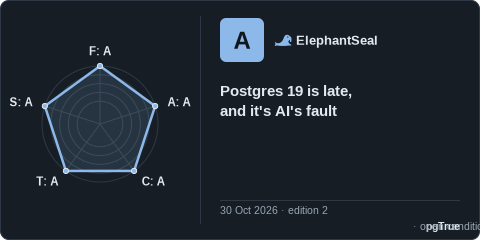
<a href="https://pgtrue.postgres.ai/shared/brief/7f229734-014f-4b90-8723-5a2faf614ecc"><img src="https://pgtrue.postgres.ai/badge/7f229734-014f-4b90-8723-5a2faf614ecc/wide.svg?v=13&amp;theme=dark" alt="pgTrue fact-check" width="480" height="240" loading="lazy" decoding="async" style="display:inline-block;width:480px;height:240px"></a>
https://pgtrue.postgres.ai/badge/7f229734-014f-4b90-8723-5a2faf614ecc/wide.svg?v=13&theme=dark
.. image:: https://pgtrue.postgres.ai/badge/7f229734-014f-4b90-8723-5a2faf614ecc/wide.svg?v=13&theme=dark
   :target: https://pgtrue.postgres.ai/shared/brief/7f229734-014f-4b90-8723-5a2faf614ecc
   :alt: pgTrue fact-check
   :width: 480
   :height: 240
[![pgTrue fact-check](https://pgtrue.postgres.ai/badge/7f229734-014f-4b90-8723-5a2faf614ecc/wide.svg?v=13)](https://pgtrue.postgres.ai/shared/brief/7f229734-014f-4b90-8723-5a2faf614ecc)
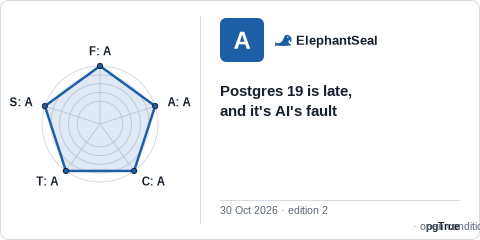
<a href="https://pgtrue.postgres.ai/shared/brief/7f229734-014f-4b90-8723-5a2faf614ecc"><img src="https://pgtrue.postgres.ai/badge/7f229734-014f-4b90-8723-5a2faf614ecc/wide.svg?v=13" alt="pgTrue fact-check" width="480" height="240" loading="lazy" decoding="async" style="display:inline-block;width:480px;height:240px"></a>
https://pgtrue.postgres.ai/badge/7f229734-014f-4b90-8723-5a2faf614ecc/wide.svg?v=13
.. image:: https://pgtrue.postgres.ai/badge/7f229734-014f-4b90-8723-5a2faf614ecc/wide.svg?v=13
   :target: https://pgtrue.postgres.ai/shared/brief/7f229734-014f-4b90-8723-5a2faf614ecc
   :alt: pgTrue fact-check
   :width: 480
   :height: 240

Click the snippet to select all of it, then copy. Where SVG is stripped, as in some email clients and feed readers, change .svg to .png. PNG uses the light theme for Auto. For Markdown PNG embeds, use the HTML snippet where supported to preserve the display size.

Optional colours: append &color=26798E or &labelColor=333C47 after a theme query (use ? for the first parameter). Use 3- or 6-digit hex.

For pages with a light background.

For pages with a dark background. The ElephantSeal gets a thin edge so it does not blend in.

Auto follows the reader's light or dark setting where the host supports it, and shows the light ElephantSeal where it does not.

On a light page
On a dark page

Postgres 19 is late, and it's AI's fault (opens in new tab)

neon.com
Sound as far as we checked.
0
inaccuracy
0
dangerous-recipe
0
misleading
0
imprecise
0
transcription
0
aged
0
withdrawn
6
verified-accurate

Central claim not verified: whether increased AI-assisted bug discovery delayed PostgreSQL 19 and increased maintenance work. We could not verify this, and the article gives no method to reproduce it.

Factual A · Applicable A · Consistent A · Transparent A · Safe A

ReportTechnical fact-check, edition 2 pgTrue versionaudited with v1.1.3 Issued EditionUpdated after review. Corrections are listed below. SubmittedSubmitted by the PostgresAI team. Author responseNo written reply from the author. We re-audited this article 1 time; see Revisions below. Policy: right-of-reply and corrections policy.

The PostgreSQL 19 feature removals match the beta 4 announcement. Verify the claimed AI cause of the delay separately before changing release plans.

InaccuraciesNone in this edition.

Dangerous or recipe bugsNone in this edition.

Misleading / impreciseNone in this edition.

Verified accurate

F1

Recent release dates fit approximate mid-month boundaries

ACCURATEFactual · holds up after review

Claim ledger

Article says
…no earlier than the middle of September, and no later than the middle of October…
What is true
PostgreSQL 9.6–18 release dates range from September 14 to October 18. The official release table supports approximate mid-month boundaries.
Charitable reading
Middle names an approximate period rather than a fixed September 15–October 15 interval.

Source

Source · https://www.postgresql.org/support/versioning/16 16.15 Yes September 14, 2023 November 9, 2028

Review correction: see "How the review tested this" below.

In the article · section “Subscribe to our changelog”

In the article

excerpt · section “Subscribe to our changelog” · as fetched 2026-10-30 · open in article ↗ (opens in new tab)

Subscribe to our changelog

Over the past decade, the timing of PostgreSQL major releases has become very predictable: no earlier than the middle of September, and no later than the middle of October. This year is going to be different. PostgreSQL 19 most likely won’t be released until November, and it’s not impossible that the project could decide to postpone the release further.

All sources and excerpts · 2
Evidence16 16.15 Yes September 14, 2023 November 9, 2028
Evidence11 11.22 No October 18, 2018 November 9, 2023
How the review tested this

Review: We tested strict September 15–October 15 boundaries against the release table. F1 expressly uses approximate boundaries. September 14 and October 18 support that reading. We tested September 14 and October 18 against the article's approximate mid-month boundaries. Both fit that charitable reading.

F2

PostgreSQL 19 beta 4 removed temporal updates and deletes

ACCURATEFactual · holds up after review

Claim ledger

Article says
…UPDATE/DELETE FOR PORTION OF…
What is true
The September 24, 2026 beta 4 announcement explicitly lists removal of FOR PORTION OF updates and deletes.
Charitable reading
The article describes removal from PostgreSQL 19, without claiming permanent rejection.

Source

Source · https://www.postgresql.org/about/news/postgresql-19-beta-4-released-3386/Revert support for temporal updates/deletes provided by the FOR PORTION OF clause.

Review correction: see "How the review tested this" below.

In the article · section “Subscribe to our changelog”

In the article

excerpt · section “Subscribe to our changelog” · as fetched 2026-10-30 · open in article ↗ (opens in new tab)

Subscribe to our changelog

Moreover, this year, several rather large features were reverted quite late in the beta period: UPDATE/DELETE FOR PORTION OF, SQL Property Graph Queries (SQL/PGQ), and ALTER TABLE ... MERGE PARTITION/SPLIT PARTITION were all reverted between August 27 and September 15. While major feature reverts are not especially uncommon immediately after feature freeze, which each year occurs on April 8, it is unusual to see multiple major features get pulled from the release at such a late date. So, what happened?

All sources and excerpts · 1
EvidenceRevert support for temporal updates/deletes provided by the FOR PORTION OF clause.
How the review tested this

Review: We checked whether F2 improperly verified the individual revert date. It verifies removal only. The PostgreSQL 19 beta 4 announcement explicitly confirms temporal update/delete removal. We checked whether the beta 4 announcement merely proposed removal. It explicitly lists the temporal update/delete revert. F2 does not certify its individual date.

F3

PostgreSQL 19 beta 4 removed SQL/PGQ

ACCURATEFactual · holds up after review

Claim ledger

Article says
…SQL Property Graph Queries (SQL/PGQ)…
What is true
The September 24, 2026 beta 4 announcement explicitly lists removal of SQL/PGQ support.
Charitable reading
The article describes removal from PostgreSQL 19, without claiming permanent rejection.

Source

Source · https://www.postgresql.org/about/news/postgresql-19-beta-4-released-3386/Revert SQL/PGQ (property graph query) support.

Review correction: see "How the review tested this" below.

In the article · section “Subscribe to our changelog”

In the article

excerpt · section “Subscribe to our changelog” · as fetched 2026-10-30 · open in article ↗ (opens in new tab)

Subscribe to our changelog

Moreover, this year, several rather large features were reverted quite late in the beta period: UPDATE/DELETE FOR PORTION OF, SQL Property Graph Queries (SQL/PGQ), and ALTER TABLE ... MERGE PARTITION/SPLIT PARTITION were all reverted between August 27 and September 15. While major feature reverts are not especially uncommon immediately after feature freeze, which each year occurs on April 8, it is unusual to see multiple major features get pulled from the release at such a late date. So, what happened?

All sources and excerpts · 1
EvidenceRevert SQL/PGQ (property graph query) support.
How the review tested this

Review: We checked whether F3 confused removal from PostgreSQL 19 with permanent rejection. It makes no permanent-rejection claim. The beta 4 announcement explicitly confirms SQL/PGQ removal. We checked whether SQL/PGQ removal referred to another release. The PostgreSQL 19 beta 4 announcement explicitly confirms it.

F4

PostgreSQL 19 beta 4 removed partition merging and splitting

ACCURATEFactual · holds up after review

Claim ledger

Article says
…ALTER TABLE ... MERGE PARTITION/SPLIT PARTITION…
What is true
The September 24, 2026 beta 4 announcement explicitly lists removal of MERGE PARTITIONS and SPLIT PARTITIONS.
Charitable reading
The article abbreviates the partition operations rather than providing runnable SQL.

Source

Source · https://www.postgresql.org/about/news/postgresql-19-beta-4-released-3386/Revert ALTER TABLE ... MERGE PARTITIONS and ALTER TABLE ... SPLIT PARTITIONS .

Review correction: see "How the review tested this" below.

In the article · section “Subscribe to our changelog”

In the article

excerpt · section “Subscribe to our changelog” · as fetched 2026-10-30 · open in article ↗ (opens in new tab)

Subscribe to our changelog

Moreover, this year, several rather large features were reverted quite late in the beta period: UPDATE/DELETE FOR PORTION OF, SQL Property Graph Queries (SQL/PGQ), and ALTER TABLE ... MERGE PARTITION/SPLIT PARTITION were all reverted between August 27 and September 15. While major feature reverts are not especially uncommon immediately after feature freeze, which each year occurs on April 8, it is unusual to see multiple major features get pulled from the release at such a late date. So, what happened?

All sources and excerpts · 1
EvidenceRevert ALTER TABLE ... MERGE PARTITIONS and ALTER TABLE ... SPLIT PARTITIONS .
How the review tested this

Review: We tested the singular/plural wording difference and the scope of the removal claim. The article abbreviates feature names. The beta 4 announcement confirms both partition operations were removed. We checked both partition operations and the singular/plural wording difference. The announcement confirms both removals. The article supplies an abbreviation, not runnable SQL.

F5

The stated stable-branch totals imply more than 60% growth

ACCURATEFactual · holds up after review

Claim ledger

Article says
…the number of back-patched commits jumped by more than 60%…
What is true
The reported count rises from 724 commits to 1,169 commits, a 61.5% increase (derived: (1,169 − 724) / 724). The article's 60% threshold matches its stated inputs.
Charitable reading
We checked the percentage against the stated branch totals without treating those totals as independently verified.

Checked for internal consistency: the evidence is the article itself.

Review correction: see "How the review tested this" below.

In the article

In the article

Article · exact quote · open in article ↗ (opens in new tab)…the number of back-patched commits jumped by more than 60%…
How the review tested this

Review: We recalculated growth using 724 commits as the denominator: 61.464%. F5 correctly rounds to 61.5%. It explicitly limits verification to the stated inputs. We recalculated growth using 724 commits as the denominator. The increase is 61.5%. F5 explicitly limits verification to the stated inputs.

F6

The stated prior-release totals imply more than 74% growth

ACCURATEFactual · holds up after review

Claim ledger

Article says
…also to at least one prior release jumped by more than 74% in a single year…
What is true
The reported count rises from 248 commits to 433 commits, a 74.6% increase (derived: (433 − 248) / 248). The article's 74% threshold matches its stated inputs.
Charitable reading
We checked the year-over-year comparison between the two stated prior-release branch totals.

Checked for internal consistency: the evidence is the article itself.

Review correction: see "How the review tested this" below.

In the article

In the article

Article · exact quote · open in article ↗ (opens in new tab)…also to at least one prior release jumped by more than 74% in a single year…
How the review tested this

Review: We recalculated growth using 248 commits as the denominator: 74.597%. F6 correctly rounds to 74.6%. It does not claim independent verification of branch histories. We checked the branch-year pairing and recalculated growth from 248 to 433 commits. The increase is 74.6%. F6 does not certify branch histories.

More in this report

Section checks · 2 sections

Section checks

AspectGradeFindingsCoverageWhy
Release timingA4 verified-accurate100% of claims (2 of 2, plus 5 that need data we do not have)Official release records support approximate seasonal timing and the PostgreSQL 19 feature removals.
Bug-fix countsA2 verified-accurate100% of claims (2 of 2, plus 7 that need data we do not have)The stated inputs yield increases of 61.5% and 74.6%. We checked the calculations, not the underlying commit totals.
Coverage and assessment · Checked 4 of 4 Postgres claims across 7 sections

Central claim not verified. We checked release background and percentage calculations, but did not establish why PostgreSQL 19 was delayed.

We did not check everything in this article. What we did not check is listed below, in the words we recorded at the time. None of it moved the letter. We never charge our own limits to the article.

Part of this audit returned no findings, so our coverage of the article is thinner than usual.

What we did not check

  • The article contains no PostgreSQL mechanism, default, definition, recipe, or configuration recommendation for us to verify.
  • We did not check PostgreSQL 19 release timing, feature reversions, commit counts, or the explanation for the delay.
  • We have no primary-source quotations for this examination, so we cannot report five independent quotation checks.
  • We did not verify the individual feature revert dates between August 27 and September 15, 2026.
  • We did not establish a final PostgreSQL 19 release date or verify the November forecast.
  • We did not independently verify how AI-assisted bug reports affected PostgreSQL 19 release timing.
  • We did not reach the linked branch histories or the committer list.
  • We did not verify the article's account of the CVS conversion.
  • We could not independently verify the six branch commit totals reported for 2025 and 2026.
  • We did not verify which counted commits appeared on both master and stable branches.
  • We did not verify the dates behind the article's 30-year repository history and earlier code history.
  • Safe: we did not complete every applicable check.
  • Transparent: we did not finish checking whether the article discloses the author's interest.
  • We could not decide whether the article contains a material benchmark.
  • We could not decide whether the evidence backs the central claim.

Script checks

  • No fenced or preformatted code blocks were identified. Inline snippets and other setup instructions were not checked for syntax.
Checked 4 of 4 Postgres claims across 7 sections
  • Title and metadata: no checkable claims; not counted: 1 product or opinion, 3 not a claim
  • Release timing: 2 of 2 Postgres claims checked, plus 5 that need data we do not have; not counted: 6 product or opinion, 2 duplicate, 1 not a claim
  • Code history and bugs: 3 claims are the author's own account; nothing checkable; not counted: 8 product or opinion, 1 duplicate
  • Bug-fix counts: 2 of 2 Postgres claims checked, plus 7 that need data we do not have; not counted: 6 product or opinion, 1 not a claim
  • Developer workload: no checkable claims; not counted: 8 product or opinion, 1 duplicate, 1 not a claim
  • Outlook: no checkable claims; not counted: 16 product or opinion, 2 duplicate, 2 not a claim
  • Footer: no checkable claims; not counted: 2 product or opinion, 2 duplicate, 5 not a claim

Average of 5 axes: 4 · result A

The checked release background is accurate. Official records support approximate mid-month release boundaries and PostgreSQL 19's feature removals. We found no defect in those claims.

The stated commit totals yield increases of 61.5% and 74.6%. These arithmetic checks establish no causal link between AI-assisted bug discovery and PostgreSQL 19's delay. The central explanation remains unchecked.

Some explanatory text is not shown in this edition; the grade and findings are complete.

Scorecard · the five axes
FACTS scorecard Scorecard radar, 5 axes, bigger is better. Overall A. Factual A · 0 wrong of 6 checked · 0 caveats. Applicable A · 0 wrong of 6 checked · 0 caveats. Consistent A · 0 wrong of 6 checked · 0 caveats. Transparent A · 0 wrong of 6 checked · 0 caveats. Safe A · 0 checked. A 0 wrong of 6 checked · 0 caveatsFactual A0 wrong of 60 caveats A 0 wrong of 6 checked · 0 caveatsApplicable A0 wrong of 60 caveats A 0 wrong of 6 checked · 0 caveatsConsistent A0 wrong of 60 caveats A 0 wrong of 6 checked · 0 caveatsTransparent A0 wrong of 60 caveats A 0 checkedSafe A0 checked A

By topic: Release timing — 4 findings, 0 wrong · Bug-fix counts — 2 findings, 0 wrong

Further out is better. Each axis has its own letter, from the wrong claims and caveats among the claims we checked of that kind.

Checked on the FACTS: Factual, Applicable, Consistent, Transparent, Safe. Clockwise: Factual (is it true?), Applicable (does it apply to my setup, today?), Consistent (does it agree with itself?), Transparent (can I check it myself?), Safe (can I run this on prod?).

We checked 6 claims.

AxisLetterWrongCaveatsCheckedCoverage
FactualA006assessed: A · 0 wrong of 6 checked · 0 caveats
ApplicableA006assessed: A · 0 wrong of 6 checked · 0 caveats
ConsistentA006assessed: A · 0 wrong of 6 checked · 0 caveats
TransparentA006assessed: A · 0 wrong of 6 checked · 0 caveats
SafeA000partly assessed
Topics · 2 topics

Topics

TopicFactualApplicableConsistentTransparentSafe
Release timing0 issues 4 checked F1 F2 F3 F40 issues 3 checked0 issues 4 checked0 issues 4 checked
Bug-fix counts0 issues 2 checked F5 F60 issues 2 checked0 issues 2 checked

Issues found among the claims checked, per topic and axis. Each link goes to the finding behind the count.

Revisions: 2 · A -> A

We audited this article 2 times. Each row is the final edition of one audit. Letters and findings of earlier revisions stay readable at their own address.

  1. Revision 1 · 2026-10-29 00:55 UTC · A · audited with v1.0.20 (approx.)

    Article as first submitted. 4 accurate · 0 wrong · 0 caveats.

    ElephantSeal: A.

    Changes: First audit. Open: none.

  2. Revision 2 · this page · 2026-10-30 12:17 UTC · A · audited with v1.1.3

    Same article text, re-audited. 6 accurate · 0 wrong · 0 caveats.

    ElephantSeal: A. Open: central claim not checked.

    Changes: No change in findings.

First impression
Questions and answers

Questions and answers

What is pgTrue?

pgTrue is an independent fact-check of technical Postgres articles, made by PostgresAI. It helps you check advice before you use it.

What does the letter grade mean?

The letter grade summarizes the claims we checked. Five axes show what we checked:

  • Factual: is it true?
  • Applicable: does it apply to my setup, today?
  • Consistent: does it agree with itself?
  • Transparent: can I check it myself?
  • Safe: can I run this in production?

What is the ElephantSeal?

The ElephantSeal is the mark an article earns. It always shows the latest edition. “Open:” lists what is still open.

Can an author reply?

Authors can ask us to correct a finding, reply to it, or withdraw it. Right-of-reply policy.

Paste into your AI assistant to fix the article, then ask for a re-review.

Show the text
Fix the article with this report, then ask pgTrue for a re-review.

# pgTrue report: Postgres 19 is late, and it's AI's fault

Article title: Postgres 19 is late, and it's AI's fault
Article URL: https://neon.com/blog/postgres-19-is-late-and-its-ais-fault
Report URL: https://pgtrue.postgres.ai/shared/brief/7f229734-014f-4b90-8723-5a2faf614ecc
Audited revision: 2 of 2, 2026-10-30 12:17:48 UTC
Overall letter: A

## Axes

- Factual: A · 0 wrong · 6 checked · 0 caveats · assessed
- Applicable: A · 0 wrong · 6 checked · 0 caveats · assessed
- Consistent: A · 0 wrong · 6 checked · 0 caveats · assessed
- Transparent: A · 0 wrong · 6 checked · 0 caveats · assessed
- Safe: A · 0 wrong · 0 checked · 0 caveats · partly assessed

ElephantSeal: A.
Open conditions: central claim not checked.

## Report metadata

- Report: Technical fact-check, edition 2
- pgTrue version: audited with v1.1.3
- Issued: 2026-10-30
- Edition: Updated after review. Corrections are listed below.
- Submitted: Submitted by the PostgresAI team.
- Author response: No written reply from the author. We re-audited this article 1 time; see Revisions below. Policy: [right-of-reply and corrections policy](/pgtrue/security).

## Findings needing a change (0)

None.

## Verified accurate claims (6)

### F1 · Accurate · Factual · Recent release dates fit approximate mid-month boundaries
Location: excerpt · section “Subscribe to our changelog” · as fetched 2026-10-30 · [open in article](https://neon.com/blog/postgres-19-is-late-and-its-ais-fault#:~:text=no%20earlier%20than%20the%20middle,than%20the%20middle%20of%20October)
Article says:
```text
…no earlier than the middle of September, and no later than the middle of October…
```
What is true:
PostgreSQL 9.6–18 release dates range from September 14 to October 18. The official release table supports approximate mid-month boundaries.
Charitable reading:
Middle names an approximate period rather than a fixed September 15–October 15 interval.
Review: We tested strict September 15–October 15 boundaries against the release table. F1 expressly uses approximate boundaries. September 14 and October 18 support that reading. We tested September 14 and October 18 against the article's approximate mid-month boundaries. Both fit that charitable reading.

Sources:
- [https://www.postgresql.org/support/versioning/](https://www.postgresql.org/support/versioning/)
  Excerpt:
  ```text
  16 16.15 Yes September 14, 2023 November 9, 2028
  ```
- [https://www.postgresql.org/support/versioning/](https://www.postgresql.org/support/versioning/)
  Excerpt:
  ```text
  11 11.22 No October 18, 2018 November 9, 2023
  ```

Finding URL: https://pgtrue.postgres.ai/shared/brief/7f229734-014f-4b90-8723-5a2faf614ecc#F1

### F2 · Accurate · Factual · PostgreSQL 19 beta 4 removed temporal updates and deletes
Location: excerpt · section “Subscribe to our changelog” · as fetched 2026-10-30 · [open in article](https://neon.com/blog/postgres-19-is-late-and-its-ais-fault#:~:text=UPDATE%2FDELETE%20FOR%20PORTION%20OF)
Article says:
```text
…UPDATE/DELETE FOR PORTION OF…
```
What is true:
The September 24, 2026 beta 4 announcement explicitly lists removal of FOR PORTION OF updates and deletes.
Charitable reading:
The article describes removal from PostgreSQL 19, without claiming permanent rejection.
Review: We checked whether F2 improperly verified the individual revert date. It verifies removal only. The PostgreSQL 19 beta 4 announcement explicitly confirms temporal update/delete removal. We checked whether the beta 4 announcement merely proposed removal. It explicitly lists the temporal update/delete revert. F2 does not certify its individual date.

Sources:
- [https://www.postgresql.org/about/news/postgresql-19-beta-4-released-3386/](https://www.postgresql.org/about/news/postgresql-19-beta-4-released-3386/)
  Excerpt:
  ```text
  Revert support for temporal updates/deletes provided by the FOR PORTION OF clause.
  ```

Finding URL: https://pgtrue.postgres.ai/shared/brief/7f229734-014f-4b90-8723-5a2faf614ecc#F2

### F3 · Accurate · Factual · PostgreSQL 19 beta 4 removed SQL/PGQ
Location: excerpt · section “Subscribe to our changelog” · as fetched 2026-10-30 · [open in article](https://neon.com/blog/postgres-19-is-late-and-its-ais-fault#:~:text=SQL%20Property%20Graph%20Queries%20%28SQL%2FPGQ%29)
Article says:
```text
…SQL Property Graph Queries (SQL/PGQ)…
```
What is true:
The September 24, 2026 beta 4 announcement explicitly lists removal of SQL/PGQ support.
Charitable reading:
The article describes removal from PostgreSQL 19, without claiming permanent rejection.
Review: We checked whether F3 confused removal from PostgreSQL 19 with permanent rejection. It makes no permanent-rejection claim. The beta 4 announcement explicitly confirms SQL/PGQ removal. We checked whether SQL/PGQ removal referred to another release. The PostgreSQL 19 beta 4 announcement explicitly confirms it.

Sources:
- [https://www.postgresql.org/about/news/postgresql-19-beta-4-released-3386/](https://www.postgresql.org/about/news/postgresql-19-beta-4-released-3386/)
  Excerpt:
  ```text
  Revert SQL/PGQ (property graph query) support.
  ```

Finding URL: https://pgtrue.postgres.ai/shared/brief/7f229734-014f-4b90-8723-5a2faf614ecc#F3

### F4 · Accurate · Factual · PostgreSQL 19 beta 4 removed partition merging and splitting
Location: excerpt · section “Subscribe to our changelog” · as fetched 2026-10-30 · [open in article](https://neon.com/blog/postgres-19-is-late-and-its-ais-fault#:~:text=ALTER%20TABLE,MERGE%20PARTITION%2FSPLIT%20PARTITION)
Article says:
```text
…ALTER TABLE ... MERGE PARTITION/SPLIT PARTITION…
```
What is true:
The September 24, 2026 beta 4 announcement explicitly lists removal of MERGE PARTITIONS and SPLIT PARTITIONS.
Charitable reading:
The article abbreviates the partition operations rather than providing runnable SQL.
Review: We tested the singular/plural wording difference and the scope of the removal claim. The article abbreviates feature names. The beta 4 announcement confirms both partition operations were removed. We checked both partition operations and the singular/plural wording difference. The announcement confirms both removals. The article supplies an abbreviation, not runnable SQL.

Sources:
- [https://www.postgresql.org/about/news/postgresql-19-beta-4-released-3386/](https://www.postgresql.org/about/news/postgresql-19-beta-4-released-3386/)
  Excerpt:
  ```text
  Revert ALTER TABLE ... MERGE PARTITIONS and ALTER TABLE ... SPLIT PARTITIONS .
  ```

Finding URL: https://pgtrue.postgres.ai/shared/brief/7f229734-014f-4b90-8723-5a2faf614ecc#F4

### F5 · Accurate · Factual · The stated stable-branch totals imply more than 60% growth
Location: Article · exact quote · [open in article](https://neon.com/blog/postgres-19-is-late-and-its-ais-fault#:~:text=the%20number%20of%20back%2Dpatched%20commits%20jumped%20by%20more%20than%2060%25)
Article says:
```text
…the number of back-patched commits jumped by more than 60%…
```
What is true:
The reported count rises from 724 commits to 1,169 commits, a 61.5% increase (derived: (1,169 − 724) / 724). The article's 60% threshold matches its stated inputs.
Charitable reading:
We checked the percentage against the stated branch totals without treating those totals as independently verified.
Explanation: Checked for internal consistency: the evidence is the article itself.
Review: We recalculated growth using 724 commits as the denominator: 61.464%. F5 correctly rounds to 61.5%. It explicitly limits verification to the stated inputs. We recalculated growth using 724 commits as the denominator. The increase is 61.5%. F5 explicitly limits verification to the stated inputs.

Finding URL: https://pgtrue.postgres.ai/shared/brief/7f229734-014f-4b90-8723-5a2faf614ecc#F5

### F6 · Accurate · Factual · The stated prior-release totals imply more than 74% growth
Location: Article · exact quote · [open in article](https://neon.com/blog/postgres-19-is-late-and-its-ais-fault#:~:text=also%20to%20at%20least%20one,74%25%20in%20a%20single%20year)
Article says:
```text
…also to at least one prior release jumped by more than 74% in a single year…
```
What is true:
The reported count rises from 248 commits to 433 commits, a 74.6% increase (derived: (433 − 248) / 248). The article's 74% threshold matches its stated inputs.
Charitable reading:
We checked the year-over-year comparison between the two stated prior-release branch totals.
Explanation: Checked for internal consistency: the evidence is the article itself.
Review: We recalculated growth using 248 commits as the denominator: 74.597%. F6 correctly rounds to 74.6%. It does not claim independent verification of branch histories. We checked the branch-year pairing and recalculated growth from 248 to 433 commits. The increase is 74.6%. F6 does not certify branch histories.

Finding URL: https://pgtrue.postgres.ai/shared/brief/7f229734-014f-4b90-8723-5a2faf614ecc#F6

## Notes (not graded) (0)

None.

## Withdrawn findings (0)

None.

## Section checks

- Release timing · A · 4 verified-accurate · 100% of claims (2 of 2, plus 5 that need data we do not have) · Official release records support approximate seasonal timing and the PostgreSQL 19 feature removals.
- Bug-fix counts · A · 2 verified-accurate · 100% of claims (2 of 2, plus 7 that need data we do not have) · The stated inputs yield increases of 61.5% and 74.6%. We checked the calculations, not the underlying commit totals.

## Claim coverage

- Title and metadata: no checkable claims; not counted: 1 product or opinion, 3 not a claim
- Release timing: 2 of 2 Postgres claims checked, plus 5 that need data we do not have; not counted: 6 product or opinion, 2 duplicate, 1 not a claim
- Code history and bugs: 3 claims are the author's own account; nothing checkable; not counted: 8 product or opinion, 1 duplicate
- Bug-fix counts: 2 of 2 Postgres claims checked, plus 7 that need data we do not have; not counted: 6 product or opinion, 1 not a claim
- Developer workload: no checkable claims; not counted: 8 product or opinion, 1 duplicate, 1 not a claim
- Outlook: no checkable claims; not counted: 16 product or opinion, 2 duplicate, 2 not a claim
- Footer: no checkable claims; not counted: 2 product or opinion, 2 duplicate, 5 not a claim

## What we did not check

- The article contains no PostgreSQL mechanism, default, definition, recipe, or configuration recommendation for us to verify.
- We did not check PostgreSQL 19 release timing, feature reversions, commit counts, or the explanation for the delay.
- We have no primary-source quotations for this examination, so we cannot report five independent quotation checks.
- We did not verify the individual feature revert dates between August 27 and September 15, 2026.
- We did not establish a final PostgreSQL 19 release date or verify the November forecast.
- We did not independently verify how AI-assisted bug reports affected PostgreSQL 19 release timing.
- We did not reach the linked branch histories or the committer list.
- We did not verify the article's account of the CVS conversion.
- We could not independently verify the six branch commit totals reported for 2025 and 2026.
- We did not verify which counted commits appeared on both master and stable branches.
- We did not verify the dates behind the article's 30-year repository history and earlier code history.
- Safe: we did not complete every applicable check.
- Transparent: interest disclosed check did not finish.
- We could not decide whether the article contains a material benchmark.
- We could not decide whether the evidence backs the central claim.
- No fenced or preformatted code blocks were identified. Inline snippets and other setup instructions were not checked for syntax.

## Notes

- Central claim not verified. We checked release background and percentage calculations, but did not establish why PostgreSQL 19 was delayed.
- We did not check everything in this article. What we did not check is listed below, in the words we recorded at the time. None of it moved the letter. We never charge our own limits to the article.
- Part of this audit returned no findings, so our coverage of the article is thinner than usual.
- Average of 5 axes: 4 · result A
- The checked release background is accurate. Official records support approximate mid-month release boundaries and PostgreSQL 19's feature removals. We found no defect in those claims.
- The stated commit totals yield increases of 61.5% and 74.6%. These arithmetic checks establish no causal link between AI-assisted bug discovery and PostgreSQL 19's delay. The central explanation remains unchecked.
- Some explanatory text is not shown in this edition; the grade and findings are complete.
- Some checks did not happen for this edition, and each one we know of is listed above.
- Checked against: github.com/postgres/postgres REL_19_STABLE@6621f2b062 at commit 6621f2b062e20d8d2ea2cc225b2509ec9fca45a8 (pinned target); github.com/pgq/pgq v3.5.2 at commit be3d2cee3fc7279d9e1480b19cfddb8a62c1450d (pinned target); https://neon.com/blog (fetched 2026-10-30T12:18:15.117107Z); https://neon.com/blog/building-with-stripe-data-pipeline-and-neon-backend (fetched 2026-10-30T12:18:35.826487Z); https://neon.com/blog/neon-docs-search-lakebase-search (fetched 2026-10-30T12:18:41.900310Z); https://neon.com/blog/stripe-data-pipeline-realtime-sync-to-postgres (fetched 2026-10-30T12:18:43.040786Z); https://www.postgresql.org/about/news/postgresql-19-beta-1-released-3313/ (fetched 2026-10-30T12:18:23.414136Z); https://www.postgresql.org/about/news/postgresql-19-beta-4-released-3386/ (fetched 2026-10-30T12:18:25.904270Z); https://www.postgresql.org/docs/current/bug-reporting.html (fetched 2026-10-30T12:18:34.237404Z); https://www.postgresql.org/support/versioning/ (fetched 2026-10-30T12:18:30.236654Z).
- Article captured 2026-10-30T12:17:48.341571Z · SHA-256 703ad4fc63f9eece40652caf6f0e6aa1c19e97af5296791c7cc8c9298d823ec2 · Text extracted from the article's HTML.
- Policy SHA-256 41314fc5e4a054a587ad8d71db400cac6d3851c35b5003f5cf65c82270334739 · Grading rules SHA-256 6fb334e79d6b9e7ed81d3238cc10d9de602ff87ed65ff2fa781f53bac5798765.
- We did not independently verify how AI-assisted bug reports affected PostgreSQL 19 release timing.
- We did not establish a final PostgreSQL 19 release date or verify the November forecast.
- We verified feature removals, but not their individual revert dates between August 27 and September 15, 2026.
- We could not independently verify the branch commit totals or which commits appeared on both master and stable branches.
- We did not reach the linked branch histories or the committer list.
- We did not verify the repository's age, the earlier code history, or the account of the CVS conversion.
- The article gives October 21, 2026 without a time. We list that date at midnight UTC.
- article target version: bound to the most-cited major; also named 18 (2×), 17 (1×)
- source: pgq names no release in the article, so it was read at 3.5.2, the latest at fetch time
- review: the findings were written by one model and reviewed independently by a different model.
- Built from the article text captured above, 2 pinned source trees, and 8 fetched pages.
- 6 survived · 0 weakened · 0 withdrawn.

## Edition changes

- F1 · recalibrated.
- F2 · recalibrated.
- F3 · recalibrated.
- F4 · recalibrated.
- F5 · recalibrated.
- F6 · recalibrated.

## Revision history

- [Revision 1](https://pgtrue.postgres.ai/shared/brief/7f229734-014f-4b90-8723-5a2faf614ecc?v=2) · 2026-10-29 00:55 UTC · A · audited with v1.0.20 (approx.)
  Article as first submitted. 4 accurate · 0 wrong · 0 caveats.
  ElephantSeal: A.
  Changes: First audit. Open: none.
- [Revision 2](https://pgtrue.postgres.ai/shared/brief/7f229734-014f-4b90-8723-5a2faf614ecc?v=4) · this page · 2026-10-30 12:17 UTC · A · audited with v1.1.3
  Same article text, re-audited. 6 accurate · 0 wrong · 0 caveats.
  ElephantSeal: A. Open: central claim not checked.
  Changes: No change in findings.

Updated your article? Request a correction. A new edition appears at this address.