Limited beta · What is this?

pgTrue is under active development: reports may contain significant mistakes, inaccuracies, or bugs. Please report anything you find to pgtrue@postgres.ai.

pgTrue is an independent fact-check of technical Postgres articles. Read the questions and answers.

pgTrue fact-check

ElephantSeal ALimited coverage

Embed

The ElephantSeal always shows this report's latest edition and links here. Copies cached elsewhere may update later.

[![pgTrue fact-check](https://pgtrue.postgres.ai/badge/7d12a85c-8537-48f4-b25c-14684a519eaf.svg?v=13&theme=light)](https://pgtrue.postgres.ai/shared/brief/7d12a85c-8537-48f4-b25c-14684a519eaf)
<a href="https://pgtrue.postgres.ai/shared/brief/7d12a85c-8537-48f4-b25c-14684a519eaf"><img src="https://pgtrue.postgres.ai/badge/7d12a85c-8537-48f4-b25c-14684a519eaf.svg?v=13&amp;theme=light" alt="pgTrue fact-check" width="90" height="20" loading="lazy" decoding="async" style="display:inline-block;width:90px;height:20px"></a>
https://pgtrue.postgres.ai/badge/7d12a85c-8537-48f4-b25c-14684a519eaf.svg?v=13&theme=light
.. image:: https://pgtrue.postgres.ai/badge/7d12a85c-8537-48f4-b25c-14684a519eaf.svg?v=13&theme=light
   :target: https://pgtrue.postgres.ai/shared/brief/7d12a85c-8537-48f4-b25c-14684a519eaf
   :alt: pgTrue fact-check
   :width: 90
   :height: 20
[![pgTrue fact-check](https://pgtrue.postgres.ai/badge/7d12a85c-8537-48f4-b25c-14684a519eaf.svg?v=13&theme=dark)](https://pgtrue.postgres.ai/shared/brief/7d12a85c-8537-48f4-b25c-14684a519eaf)
<a href="https://pgtrue.postgres.ai/shared/brief/7d12a85c-8537-48f4-b25c-14684a519eaf"><img src="https://pgtrue.postgres.ai/badge/7d12a85c-8537-48f4-b25c-14684a519eaf.svg?v=13&amp;theme=dark" alt="pgTrue fact-check" width="90" height="20" loading="lazy" decoding="async" style="display:inline-block;width:90px;height:20px"></a>
https://pgtrue.postgres.ai/badge/7d12a85c-8537-48f4-b25c-14684a519eaf.svg?v=13&theme=dark
.. image:: https://pgtrue.postgres.ai/badge/7d12a85c-8537-48f4-b25c-14684a519eaf.svg?v=13&theme=dark
   :target: https://pgtrue.postgres.ai/shared/brief/7d12a85c-8537-48f4-b25c-14684a519eaf
   :alt: pgTrue fact-check
   :width: 90
   :height: 20
[![pgTrue fact-check](https://pgtrue.postgres.ai/badge/7d12a85c-8537-48f4-b25c-14684a519eaf.svg?v=13)](https://pgtrue.postgres.ai/shared/brief/7d12a85c-8537-48f4-b25c-14684a519eaf)
<a href="https://pgtrue.postgres.ai/shared/brief/7d12a85c-8537-48f4-b25c-14684a519eaf"><img src="https://pgtrue.postgres.ai/badge/7d12a85c-8537-48f4-b25c-14684a519eaf.svg?v=13" alt="pgTrue fact-check" width="90" height="20" loading="lazy" decoding="async" style="display:inline-block;width:90px;height:20px"></a>
https://pgtrue.postgres.ai/badge/7d12a85c-8537-48f4-b25c-14684a519eaf.svg?v=13
.. image:: https://pgtrue.postgres.ai/badge/7d12a85c-8537-48f4-b25c-14684a519eaf.svg?v=13
   :target: https://pgtrue.postgres.ai/shared/brief/7d12a85c-8537-48f4-b25c-14684a519eaf
   :alt: pgTrue fact-check
   :width: 90
   :height: 20
[![pgTrue fact-check](https://pgtrue.postgres.ai/badge/7d12a85c-8537-48f4-b25c-14684a519eaf/radar.svg?v=13&theme=light)](https://pgtrue.postgres.ai/shared/brief/7d12a85c-8537-48f4-b25c-14684a519eaf)
<a href="https://pgtrue.postgres.ai/shared/brief/7d12a85c-8537-48f4-b25c-14684a519eaf"><img src="https://pgtrue.postgres.ai/badge/7d12a85c-8537-48f4-b25c-14684a519eaf/radar.svg?v=13&amp;theme=light" alt="pgTrue fact-check" width="240" height="240" loading="lazy" decoding="async" style="display:inline-block;width:240px;height:240px"></a>
https://pgtrue.postgres.ai/badge/7d12a85c-8537-48f4-b25c-14684a519eaf/radar.svg?v=13&theme=light
.. image:: https://pgtrue.postgres.ai/badge/7d12a85c-8537-48f4-b25c-14684a519eaf/radar.svg?v=13&theme=light
   :target: https://pgtrue.postgres.ai/shared/brief/7d12a85c-8537-48f4-b25c-14684a519eaf
   :alt: pgTrue fact-check
   :width: 240
   :height: 240
[![pgTrue fact-check](https://pgtrue.postgres.ai/badge/7d12a85c-8537-48f4-b25c-14684a519eaf/radar.svg?v=13&theme=dark)](https://pgtrue.postgres.ai/shared/brief/7d12a85c-8537-48f4-b25c-14684a519eaf)
<a href="https://pgtrue.postgres.ai/shared/brief/7d12a85c-8537-48f4-b25c-14684a519eaf"><img src="https://pgtrue.postgres.ai/badge/7d12a85c-8537-48f4-b25c-14684a519eaf/radar.svg?v=13&amp;theme=dark" alt="pgTrue fact-check" width="240" height="240" loading="lazy" decoding="async" style="display:inline-block;width:240px;height:240px"></a>
https://pgtrue.postgres.ai/badge/7d12a85c-8537-48f4-b25c-14684a519eaf/radar.svg?v=13&theme=dark
.. image:: https://pgtrue.postgres.ai/badge/7d12a85c-8537-48f4-b25c-14684a519eaf/radar.svg?v=13&theme=dark
   :target: https://pgtrue.postgres.ai/shared/brief/7d12a85c-8537-48f4-b25c-14684a519eaf
   :alt: pgTrue fact-check
   :width: 240
   :height: 240
[![pgTrue fact-check](https://pgtrue.postgres.ai/badge/7d12a85c-8537-48f4-b25c-14684a519eaf/radar.svg?v=13)](https://pgtrue.postgres.ai/shared/brief/7d12a85c-8537-48f4-b25c-14684a519eaf)
<a href="https://pgtrue.postgres.ai/shared/brief/7d12a85c-8537-48f4-b25c-14684a519eaf"><img src="https://pgtrue.postgres.ai/badge/7d12a85c-8537-48f4-b25c-14684a519eaf/radar.svg?v=13" alt="pgTrue fact-check" width="240" height="240" loading="lazy" decoding="async" style="display:inline-block;width:240px;height:240px"></a>
https://pgtrue.postgres.ai/badge/7d12a85c-8537-48f4-b25c-14684a519eaf/radar.svg?v=13
.. image:: https://pgtrue.postgres.ai/badge/7d12a85c-8537-48f4-b25c-14684a519eaf/radar.svg?v=13
   :target: https://pgtrue.postgres.ai/shared/brief/7d12a85c-8537-48f4-b25c-14684a519eaf
   :alt: pgTrue fact-check
   :width: 240
   :height: 240
[![pgTrue fact-check](https://pgtrue.postgres.ai/badge/7d12a85c-8537-48f4-b25c-14684a519eaf/wide.svg?v=13&theme=light)](https://pgtrue.postgres.ai/shared/brief/7d12a85c-8537-48f4-b25c-14684a519eaf)
<a href="https://pgtrue.postgres.ai/shared/brief/7d12a85c-8537-48f4-b25c-14684a519eaf"><img src="https://pgtrue.postgres.ai/badge/7d12a85c-8537-48f4-b25c-14684a519eaf/wide.svg?v=13&amp;theme=light" alt="pgTrue fact-check" width="480" height="240" loading="lazy" decoding="async" style="display:inline-block;width:480px;height:240px"></a>
https://pgtrue.postgres.ai/badge/7d12a85c-8537-48f4-b25c-14684a519eaf/wide.svg?v=13&theme=light
.. image:: https://pgtrue.postgres.ai/badge/7d12a85c-8537-48f4-b25c-14684a519eaf/wide.svg?v=13&theme=light
   :target: https://pgtrue.postgres.ai/shared/brief/7d12a85c-8537-48f4-b25c-14684a519eaf
   :alt: pgTrue fact-check
   :width: 480
   :height: 240
[![pgTrue fact-check](https://pgtrue.postgres.ai/badge/7d12a85c-8537-48f4-b25c-14684a519eaf/wide.svg?v=13&theme=dark)](https://pgtrue.postgres.ai/shared/brief/7d12a85c-8537-48f4-b25c-14684a519eaf)
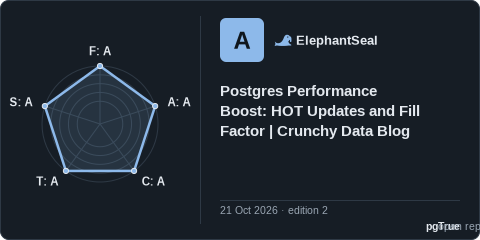
<a href="https://pgtrue.postgres.ai/shared/brief/7d12a85c-8537-48f4-b25c-14684a519eaf"><img src="https://pgtrue.postgres.ai/badge/7d12a85c-8537-48f4-b25c-14684a519eaf/wide.svg?v=13&amp;theme=dark" alt="pgTrue fact-check" width="480" height="240" loading="lazy" decoding="async" style="display:inline-block;width:480px;height:240px"></a>
https://pgtrue.postgres.ai/badge/7d12a85c-8537-48f4-b25c-14684a519eaf/wide.svg?v=13&theme=dark
.. image:: https://pgtrue.postgres.ai/badge/7d12a85c-8537-48f4-b25c-14684a519eaf/wide.svg?v=13&theme=dark
   :target: https://pgtrue.postgres.ai/shared/brief/7d12a85c-8537-48f4-b25c-14684a519eaf
   :alt: pgTrue fact-check
   :width: 480
   :height: 240
[![pgTrue fact-check](https://pgtrue.postgres.ai/badge/7d12a85c-8537-48f4-b25c-14684a519eaf/wide.svg?v=13)](https://pgtrue.postgres.ai/shared/brief/7d12a85c-8537-48f4-b25c-14684a519eaf)
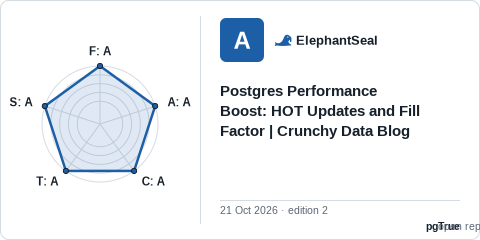
<a href="https://pgtrue.postgres.ai/shared/brief/7d12a85c-8537-48f4-b25c-14684a519eaf"><img src="https://pgtrue.postgres.ai/badge/7d12a85c-8537-48f4-b25c-14684a519eaf/wide.svg?v=13" alt="pgTrue fact-check" width="480" height="240" loading="lazy" decoding="async" style="display:inline-block;width:480px;height:240px"></a>
https://pgtrue.postgres.ai/badge/7d12a85c-8537-48f4-b25c-14684a519eaf/wide.svg?v=13
.. image:: https://pgtrue.postgres.ai/badge/7d12a85c-8537-48f4-b25c-14684a519eaf/wide.svg?v=13
   :target: https://pgtrue.postgres.ai/shared/brief/7d12a85c-8537-48f4-b25c-14684a519eaf
   :alt: pgTrue fact-check
   :width: 480
   :height: 240

Click the snippet to select all of it, then copy. Where SVG is stripped, as in some email clients and feed readers, change .svg to .png. PNG uses the light theme for Auto. For Markdown PNG embeds, use the HTML snippet where supported to preserve the display size.

Optional colours: append &color=26798E or &labelColor=333C47 after a theme query (use ? for the first parameter). Use 3- or 6-digit hex.

For pages with a light background.

For pages with a dark background. The ElephantSeal gets a thin edge so it does not blend in.

Auto follows the reader's light or dark setting where the host supports it, and shows the light ElephantSeal where it does not.

On a light page
On a dark page

Postgres Performance Boost: HOT Updates and Fill Factor | Crunchy Data Blog (opens in new tab)

crunchydata.com
Broadly sound as far as we checked. Read the caveats below.
0
inaccuracy
0
dangerous-recipe
0
misleading
1
imprecise
0
transcription
0
aged
0
withdrawn
14
verified-accurate

Factual A · Applicable A · Consistent A · Transparent A · Safe A

ReportTechnical fact-check, edition 2 Issued EditionUpdated after review. Corrections are listed below. SubmittedSubmitted by the PostgresAI team. Author responseNo written reply from the author. We re-audited this article 3 times; see Revisions below. Policy: right-of-reply and corrections policy. pgTrue versionaudited with v1.0.17 (approx.)

InaccuraciesNone in this edition.

Dangerous or recipe bugsNone in this edition.

Misleading / imprecise

F1

Imprecise: “…Postgres will skip the update to the index IF you aren’t updating the index key…”

IMPRECISEFactual · partly holds after review

Claim ledger

Article says
…Postgres will skip the update to the index IF you aren’t updating the index key…
What is true
The article’s summary broadly restricts changes to indexed data, but “index key” is too narrow. REL_16_2 src/backend/utils/cache/relcache.c:5315-5318 includes non-key columns among HOT dependencies. Expression inputs and partial-index predicates also count. Check these dependencies before lowering fillfactor to improve HOT eligibility.
So what
Inspect INCLUDE columns, expression inputs, and partial-index predicates before choosing which indexes to change or lowering fillfactor.

Source

Source · REL_16_2 · src/backend/utils/cache/relcache.c:5315-5318* Since we have covering indexes with non-key columns, we must * handle them accurately here. non-key columns must be added into * hotblockingattrs or summarizedattrs, since they are in index, * and update shouldn't miss them.

Review correction: see "How the review tested this" below.

In the article · section “HOT updates and indexes”

In the article

excerpt · section “HOT updates and indexes” · as fetched 2026-10-21 · open in article ↗ (opens in new tab)

HOT updates and indexes

So the way this normally works in PostgreSQL without HOT updates is if you have a table that is indexed, and one row(tuple) is updated, the update must be applied to the index. For HOT updates, Postgres will skip the update to the index IF you aren’t updating the index key.

All sources and excerpts · 3
Evidence * Since we have covering indexes with non-key columns, we must * handle them accurately here. non-key columns must be added into * hotblockingattrs or summarizedattrs, since they are in index, * and update shouldn't miss them.

Version note: Publication-era PostgreSQL 16.2.

Evidence /* Collect all attributes used in expressions, too */ pull_varattnos(indexExpressions, 1, attrs); /* Collect all attributes in the index predicate, too */ pull_varattnos(indexPredicate, 1, attrs);

Version note: Publication-era PostgreSQL 16.2.

Evidence * Since we have covering indexes with non-key columns, we must * handle them accurately here. non-key columns must be added into * hotblockingattrs or summarizedattrs, since they are in index, * and update shouldn't miss them.

Version note: PostgreSQL 19 comparison.

How the review tested this

Review: We tested the broader reading against the article’s summary. That summary restricts changes to indexed data, which mitigates the key-only wording. INCLUDE columns remain a concrete omission. The evidence supports imprecision rather than an unqualified factual error. We tested whether index key informally includes every index dependency. INCLUDE columns provide a concrete counterexample. The broader summary does not correct the stated key-only test. Inspecting dependencies before changing fillfactor prevents wasted tuning work.

Verified accurate

F2

HOT links row versions on one heap page

ACCURATEFactual · holds up after review

Claim ledger

Article says
Postgres also adds a HOT chain link from the old row to the new row…
What is true
HOT stores the successor on the same heap page. The old tuple's t_ctid links to that successor. src/backend/access/heap/README.HOT:62-63 describes this link. Index dependencies must also permit HOT.
Charitable reading
The article explains the index restriction in its following section. We read the same-page description with that condition.

Source

Source · REL_16_2 · src/backend/access/heap/README.HOT:62-63The prior row version is marked HEAP_HOT_UPDATED, and (as always in an update chain) its t_ctid field links forward to the newer version.

Review correction: see "How the review tested this" below.

In the article · section “Heap Only Tuple (HOT) updates”

In the article

excerpt · section “Heap Only Tuple (HOT) updates” · as fetched 2026-10-21 · open in article ↗ (opens in new tab)

Heap Only Tuple (HOT) updates

With HOT updates, if the updated row can still fit on the same data page as the original row, Postgres adds a new row on the same page, while keeping the old row data since it may still be in use by other processes. Postgres also adds a HOT chain link from the old row to the new row, so it can find the new row when a HOT update occurs.

All sources and excerpts · 3
EvidenceThe prior row version is marked HEAP_HOT_UPDATED, and (as always in an update chain) its t_ctid field links forward to the newer version.

Version note: Publication-era PostgreSQL 16.2.

Evidence if (!bms_overlap(modified_attrs, hot_attrs)) { use_hot_update = true;

Version note: The article's PostgreSQL 16 feature floor.

Evidence if (!bms_overlap(modified_attrs, hot_attrs)) { use_hot_update = true;

Version note: PostgreSQL 19 comparison.

How the review tested this

Review: We tested whether same-page placement alone suffices. F2 preserves the index-dependency condition. The source confirms the t_ctid link. We tested whether the finding treats same-page placement as sufficient alone. It explicitly retains index eligibility restrictions. The source confirms the forward t_ctid link.

F3

PostgreSQL 16 permits HOT changes to BRIN-indexed columns

ACCURATEFactual · holds up after review

Claim ledger

Article says
This allows columns indexed with BRIN to be updated and still have HOT updates occur.
What is true
PostgreSQL 16 permits HOT when only BRIN-indexed columns change and the successor fits the same page. src/backend/access/heap/heapam.c:3691-3710 implements that distinction. BRIN summarizes block ranges. PostgreSQL can still update the BRIN summary.
Charitable reading
The BRIN exception concerns HOT eligibility. It does not promise that BRIN summaries require no maintenance.

Source

Source · REL_16_2 · src/backend/access/heap/README.HOT:41-46and unique reference to a tuple. These indexes still need to be notified of the new column data, but don't need a new HOT chain to be established.

Review correction: see "How the review tested this" below.

In the article

In the article

Article · exact quote · open in article ↗ (opens in new tab)This allows columns indexed with BRIN to be updated and still have HOT updates occur.
All sources and excerpts · 3
Evidenceand unique reference to a tuple. These indexes still need to be notified of the new column data, but don't need a new HOT chain to be established.

Version note: Publication-era PostgreSQL 16.2.

Evidence if (!bms_overlap(modified_attrs, hot_attrs)) { use_hot_update = true;

Version note: The article's PostgreSQL 16 feature floor.

Evidence if (!bms_overlap(modified_attrs, hot_attrs)) { use_hot_update = true;

Version note: PostgreSQL 19 comparison.

How the review tested this

Review: We checked whether BRIN still requires maintenance. F3 explicitly preserves summary updates. PostgreSQL 16 separates those updates from HOT blockers. We checked whether BRIN maintenance contradicts HOT eligibility. The code permits HOT while separately requesting summary maintenance. The finding preserves both conditions.

F4

The table fillfactor default is 100

ACCURATEFactual · holds up after review

Claim ledger

Article says
Postgres uses a default fill factor of 100 for tables.
What is true
The table default is fillfactor=100. Accepted settings range from 10 to 100. doc/src/sgml/ref/create_table.sgml:1447-1455 documents the range and reserved update space. PostgreSQL 19 retains these settings.
Charitable reading
The value describes target occupancy. It does not promise that every page contains exactly that percentage of tuple bytes.

Source

Source · REL_16_2 · doc/src/sgml/ref/create_table.sgml:1447-1458The fillfactor for a table is a percentage between 10 and 100. 100 (complete packing) is the default. When a smaller fillfactor

Review correction: see "How the review tested this" below.

In the article

In the article

Article · exact quote · open in article ↗ (opens in new tab)Postgres uses a default fill factor of 100 for tables.
All sources and excerpts · 2
Evidence The fillfactor for a table is a percentage between 10 and 100. 100 (complete packing) is the default. When a smaller fillfactor

Version note: Publication-era PostgreSQL 16.2 documentation.

Evidence The fillfactor for a table is a percentage between 10 and 100. 100 (complete packing) is the default. When a smaller fillfactor

Version note: PostgreSQL 19 comparison.

How the review tested this

Review: We checked table settings against possible index-default confusion. The table documentation specifies 100 as the default and 10–100 as valid settings. We checked table defaults against index-specific settings. Both cited documentation versions explicitly give the table default as 100.

F5

Lower fillfactor reserves space that can enable HOT

ACCURATEFactual · holds up after review

Claim ledger

Article says
By lowering the fill factor, you increase the chances…
What is true
Lower fillfactor reserves insertion-time space for updates. src/backend/access/heap/hio.c:539-554 includes that reserve when selecting insertion pages. More free space improves same-page update chances. Lower occupancy can also increase the number of pages a scan reads.
Charitable reading
The article says lower fillfactor increases the likelihood of HOT. It does not guarantee HOT for every update.

Source

Source · REL_16_2 · doc/src/sgml/ref/create_table.sgml:1447-1458The fillfactor for a table is a percentage between 10 and 100. 100 (complete packing) is the default. When a smaller fillfactor

Review correction: see "How the review tested this" below.

In the article

In the article

Article · exact quote · open in article ↗ (opens in new tab)By lowering the fill factor, you increase the chances…
All sources and excerpts · 5
Evidence The fillfactor for a table is a percentage between 10 and 100. 100 (complete packing) is the default. When a smaller fillfactor

Version note: Publication-era PostgreSQL 16.2 documentation.

Evidence increase the likelihood of sufficient page space for <acronym>HOT</acronym> updates by decreasing a table's <link linkend="reloption-fillfactor"><literal>fillfactor</literal></link>.

Version note: Publication-era PostgreSQL 16.2 documentation.

Evidence /* Compute desired extra freespace due to fillfactor option */ saveFreeSpace = RelationGetTargetPageFreeSpace(relation, HEAP_DEFAULT_FILLFACTOR);

Version note: Publication-era PostgreSQL 16.2.

Evidence The fillfactor for a table is a percentage between 10 and 100. 100 (complete packing) is the default. When a smaller fillfactor

Version note: PostgreSQL 19 comparison.

Evidence The fillfactor for a table is a percentage between 10 and 100. 100 (complete packing) is the default. When a smaller fillfactor is specified, <command>INSERT</command> operations pack table pages only to the indicated percentage; the remaining space on each page is reserved for updating rows on that page.
How the review tested this

Review: We tested whether F5 promises HOT or exact page occupancy. It promises neither. The insertion code computes reserved space, with exceptions for large tuples. We tested whether the finding guarantees HOT or immediate free-space redistribution. It promises increased chances only. The insertion code computes a fillfactor reserve, and documentation supports the mechanism.

F6

The statistics query selects the HOT-update counter

ACCURATEFactual · holds up after review

Claim ledger

Article says
…n_tup_hot_upd AS hot_updates…
What is true
pg_stat_user_tables exposes n_tup_hot_upd and n_tup_upd. The latter includes HOT updates. src/backend/catalog/system_views.sql:664-667 defines these counters. The query's ORDER BY hot_updates DESC correctly sorts by its output alias.
Charitable reading
The query reports cumulative counts. The article does not claim that its output measures a per-second rate or a HOT percentage.

Source

Source · REL_16_2 · src/backend/catalog/system_views.sql:664-667pg_stat_get_tuples_inserted(C.oid) AS n_tup_ins, pg_stat_get_tuples_updated(C.oid) AS n_tup_upd, pg_stat_get_tuples_deleted(C.oid) AS n_tup_del, pg_stat_get_tuples_hot_updated(C.oid) AS n_tup_hot_upd,

Review correction: see "How the review tested this" below.

In the article · section “Measuring HOT updates”

In the article

excerpt · section “Measuring HOT updates” · as fetched 2026-10-21 · open in article ↗ (opens in new tab)

Measuring HOT updates

SELECT
    relname AS table_name,
    seq_scan AS sequential_scans,
    idx_scan AS index_scans,
    n_tup_ins AS inserts,
    n_tup_upd AS updates,
    n_tup_hot_upd AS hot_updates
FROM
    pg_stat_user_tables
ORDER BY
    hot_updates DESC;
All sources and excerpts · 3
Evidence pg_stat_get_tuples_inserted(C.oid) AS n_tup_ins, pg_stat_get_tuples_updated(C.oid) AS n_tup_upd, pg_stat_get_tuples_deleted(C.oid) AS n_tup_del, pg_stat_get_tuples_hot_updated(C.oid) AS n_tup_hot_upd,

Version note: Publication-era PostgreSQL 16.2.

Evidence Number of rows <link linkend="storage-hot">HOT updated</link>.

Version note: Publication-era PostgreSQL 16.2 documentation.

Evidence pg_stat_get_tuples_inserted(C.oid) AS n_tup_ins, pg_stat_get_tuples_updated(C.oid) AS n_tup_upd, pg_stat_get_tuples_deleted(C.oid) AS n_tup_del, pg_stat_get_tuples_hot_updated(C.oid) AS n_tup_hot_upd,

Version note: PostgreSQL 19 comparison.

How the review tested this

Review: We checked counter names, whether total updates include HOT, and the output alias. The query and counter interpretation agree. We checked counter names, HOT inclusion in total updates, and the output alias. The view definitions and monitoring documentation support the finding. It claims counts, not rates.

F7

ALTER TABLE changes the fillfactor setting

ACCURATEFactual · holds up after review

Claim ledger

Article says
…ALTER TABLE my_table SET (FILLFACTOR = 80);…
What is true
ALTER TABLE changes fillfactor to 80. It does not immediately redistribute existing rows. doc/src/sgml/ref/alter_table.sgml:779-787 documents this distinction. Existing packed pages can require a table rewrite before they have the requested free-space distribution.
Charitable reading
The article promises to change the setting. It does not explicitly promise to redistribute existing rows immediately.

Source

Source · REL_16_2 · doc/src/sgml/ref/alter_table.sgml:779-787for details on the available parameters. Note that the table contents will not be modified immediately by this command; depending on the parameter you might need to rewrite the table to get the desired effects.

Review correction: see "How the review tested this" below.

In the article

In the article

Article · exact quote · open in article ↗ (opens in new tab)…ALTER TABLE my_table SET (FILLFACTOR = 80);…
All sources and excerpts · 2
Evidence for details on the available parameters. Note that the table contents will not be modified immediately by this command; depending on the parameter you might need to rewrite the table to get the desired effects.

Version note: Publication-era PostgreSQL 16.2 documentation.

Evidence will not be modified immediately by this command; depending on the parameter you might need to rewrite the table to get the desired effects.

Version note: PostgreSQL 19 comparison.

How the review tested this

Review: We tested whether the article promises an immediate rewrite. It only changes the setting. F7 correctly distinguishes that operation from redistributing rows. We tested whether the command promises an immediate rewrite. The article promises a setting change only. Both documentation versions confirm that existing contents do not change immediately.

F8

BRIN compatibility with HOT starts in PostgreSQL 16

ACCURATEFactual · holds up after review

Claim ledger

Article says
…Prior to Postgres 16, any index on an updated column would block updates from being HOT.
What is true
PostgreSQL 16.0 release notes explicitly allow HOT updates when only BRIN-indexed columns change. PostgreSQL 15 requires unchanged indexed values. The pinned PostgreSQL 19 source retains the summarizing-index exception.
Charitable reading
An updated indexed column means its stored value changes. Assigning an unchanged value does not establish this restriction.

Source

Source · REL_16_0 · doc/src/sgml/release-16.sgml:587-588Allow <link linkend="storage-hot"><acronym>HOT</acronym></link> updates if only <literal>BRIN</literal>-indexed columns are updated

Review correction: see "How the review tested this" below.

In the article

In the article

Article · exact quote · open in article ↗ (opens in new tab)…Prior to Postgres 16, any index on an updated column would block updates from being HOT.
All sources and excerpts · 3
Evidence Allow <link linkend="storage-hot"><acronym>HOT</acronym></link> updates if only <literal>BRIN</literal>-indexed columns are updated

Version note: Checked the article’s PostgreSQL 16 version floor.

EvidenceHOT solves this problem for a restricted but useful special case: where a tuple is repeatedly updated in ways that do not change its indexed columns.

Version note: Checked the release preceding PostgreSQL 16.

EvidenceSecond, where the modified columns are only used in indexes that do not contain tuple IDs, but maintain summaries of the indexed data by block.
How the review tested this

Review: We tested unchanged-value assignments as a counterexample. F8 explicitly limits its reading to changed values. PostgreSQL 16 release notes establish the BRIN exception. We checked the PostgreSQL 15 boundary and assignments that preserve stored values. The finding explicitly distinguishes unchanged assignments. PostgreSQL 16 release notes establish the BRIN exception.

F9

HOT preserves row versions that concurrent transactions can still see

ACCURATEFactual · holds up after review

Claim ledger

Article says
…the old row data since it may still be in use by other processes…
What is true
README.HOT:82–83 permits reclaiming the old tuple after no transaction can see it. HOT does not discard a version that an active snapshot still needs.
Charitable reading
The article describes retaining versions needed by concurrent transactions, rather than retaining every version permanently.

Source

Source · REL_19_STABLE@48b43081e5 · src/backend/access/heap/README.HOT:82-83Eventually, tuple 1 will no longer be visible to any transaction. At that point its space could be reclaimed, but its line pointer cannot,

Review correction: see "How the review tested this" below.

In the article · section “Heap Only Tuple (HOT) updates”

In the article

excerpt · section “Heap Only Tuple (HOT) updates” · as fetched 2026-10-21 · open in article ↗ (opens in new tab)

Heap Only Tuple (HOT) updates

With HOT updates, if the updated row can still fit on the same data page as the original row, Postgres adds a new row on the same page, while keeping the old row data since it may still be in use by other processes. Postgres also adds a HOT chain link from the old row to the new row, so it can find the new row when a HOT update occurs.

All sources and excerpts · 1
EvidenceEventually, tuple 1 will no longer be visible to any transaction. At that point its space could be reclaimed, but its line pointer cannot,
How the review tested this

Review: We tested whether retaining row versions means permanent retention. F9 limits retention to visibility needs. PostgreSQL 16.2 contains the same reclamation explanation. We checked whether retained line pointers imply retained tuple data forever. The source permits reclaiming tuple space after visibility ends. The finding makes that distinction.

F10

Updates that disrupt physical correlation can weaken BRIN filtering

ACCURATEFactual · holds up after review

Claim ledger

Article says
…changing the value very much as that could reduce the effectiveness of the BRIN…
What is true
brin.sgml:16–18 describes BRIN’s intended correlation between column values and physical location. Updates that disrupt this correlation can reduce filtering effectiveness.
Charitable reading
The article says large value changes could reduce effectiveness. It does not claim that magnitude alone determines BRIN performance.

Source

Source · REL_19_STABLE@48b43081e5 · doc/src/sgml/brin.sgml:16-18<acronym>BRIN</acronym> is designed for handling very large tables in which certain columns have some natural correlation with their physical location within the table.

Review correction: see "How the review tested this" below.

In the article

In the article

Article · exact quote · open in article ↗ (opens in new tab)…changing the value very much as that could reduce the effectiveness of the BRIN…
All sources and excerpts · 1
Evidence <acronym>BRIN</acronym> is designed for handling very large tables in which certain columns have some natural correlation with their physical location within the table.
How the review tested this

Review: We tested whether large changes always harm BRIN. Neither the article nor F10 makes that claim. PostgreSQL 16.2 documents the same correlation premise. We tested whether value-change magnitude alone determines BRIN effectiveness. The article says it could reduce effectiveness. The finding correctly ties that possibility to disrupted physical correlation.

F11

Verified accurate: “…how often updates are being performed on a table and how many of them are HOT updates…”

ACCURATEFactual · holds up after review

Claim ledger

Article says
…how often updates are being performed on a table and how many of them are HOT updates…
What is true
monitoring.sgml:4322–4327 defines n_tup_hot_upd as the HOT-updated row count. The HOT documentation identifies pg_stat_all_tables as the view for monitoring HOT and non-HOT updates.

Source

Source · REL_16_2 · doc/src/sgml/monitoring.sgml:4852-4953Number of rows <link linkend="storage-hot">HOT updated</link>.

Review correction: see "How the review tested this" below.

In the article

In the article

Article · exact quote · open in article ↗ (opens in new tab)…how often updates are being performed on a table and how many of them are HOT updates…
All sources and excerpts · 3
Evidence Number of rows <link linkend="storage-hot">HOT updated</link>.

Version note: Publication-era PostgreSQL 16.2 documentation.

Evidence <structfield>n_tup_hot_upd</structfield> <type>bigint</type> </para> <para> Number of rows <link linkend="storage-hot">HOT updated</link>. These are updates where no successor versions are required in indexes.
EvidenceThe system view pg_stat_all_tables allows monitoring of the occurrence of HOT and non-HOT updates.
How the review tested this

Review: We tested the distinction between cumulative counts and rates. F11 preserves it. The publication-era documentation independently confirms the HOT counter. We tested whether how often requires a time-normalized rate. The article requests counts and displays counters. The finding correctly limits its endorsement to those counts.

F12

HOT avoids redundant index entries and their maintenance

ACCURATEFactual · holds up after review

Claim ledger

Article says
…HOT updates reduce the amount of disk I/O…
What is true
README.HOT:48–50 documents smaller indexes and faster searches from avoiding duplicate index entries. Avoiding those insertions also removes their processing and I/O work. Application savings depend on the workload.
Charitable reading
The article describes reduced update overhead. It does not give a benchmark result or guarantee application throughput.

Source

Source · REL_19_STABLE@48b43081e5 · src/backend/access/heap/README.HOT:48-50An additional property of HOT is that it reduces index size by avoiding the creation of identically-keyed index entries. This improves search speeds.

Review correction: see "How the review tested this" below.

In the article

In the article

Article · exact quote · open in article ↗ (opens in new tab)…HOT updates reduce the amount of disk I/O…
All sources and excerpts · 1
EvidenceAn additional property of HOT is that it reduces index size by avoiding the creation of identically-keyed index entries. This improves search speeds.
How the review tested this

Review: We tested whether F12 turns avoided index work into guaranteed throughput. It explicitly makes application savings workload-dependent. PostgreSQL 16.2 contains the same explanation. We checked whether avoided index entries prove a throughput guarantee. The finding claims avoided maintenance work only and preserves workload dependence. The source supports that mechanism.

F13

HOT can reduce WAL volume

ACCURATEFactual · holds up after review

Claim ledger

Article says
…they reduce IOPs, WAL…
What is true
heapam.c:9063–9065 documents WAL savings from logging changed portions of same-page tuple versions. HOT also avoids redundant index entries. These mechanisms support the article’s general WAL claim.
Charitable reading
The article describes a general resource benefit. It does not promise fewer WAL bytes for every individual update.

Source

Source · REL_19_STABLE@48b43081e5 · src/backend/access/heap/README.HOT:48-50An additional property of HOT is that it reduces index size by avoiding the creation of identically-keyed index entries. This improves search speeds.

Review correction: see "How the review tested this" below.

In the article

In the article

Article · exact quote · open in article ↗ (opens in new tab)…they reduce IOPs, WAL…
All sources and excerpts · 2
EvidenceAn additional property of HOT is that it reduces index size by avoiding the creation of identically-keyed index entries. This improves search speeds.
Evidence * If the old and new tuple are on the same page, we only need to log the * parts of the new tuple that were changed. That saves on the amount of * WAL we need to write.
How the review tested this

Review: We checked logical logging and full-page-image exceptions. Same-page WAL compression also benefits non-HOT updates. F13 claims possible savings, not an exclusive or universal benefit. We tested whether same-page WAL savings uniquely identify HOT. They do not, but the finding claims no exclusivity. Avoided index entries separately support possible WAL savings.

F14

Verified accurate: “…it leaves 30% of the page empty to accommodate future updates to existing rows…”

ACCURATEFactual · holds up after review

Claim ledger

Article says
…it leaves 30% of the page empty to accommodate future updates to existing rows…
What is true
A 70% table fill factor targets 30% free page space (derived: 100% - 70%). src/include/utils/rel.h:392 computes the same complement.

Source

Source · REL_16_2 · doc/src/sgml/ref/create_table.sgml:1447-1458The fillfactor for a table is a percentage between 10 and 100. 100 (complete packing) is the default. When a smaller fillfactor

Review correction: see "How the review tested this" below.

In the article

In the article

Article · exact quote · open in article ↗ (opens in new tab)…it leaves 30% of the page empty to accommodate future updates to existing rows…
All sources and excerpts · 2
Evidence The fillfactor for a table is a percentage between 10 and 100. 100 (complete packing) is the default. When a smaller fillfactor

Version note: Publication-era PostgreSQL 16.2 documentation.

Evidence (BLCKSZ * (100 - RelationGetFillFactor(relation, defaultff)) / 100)
How the review tested this

Review: We recalculated the 30% target and tested exact-occupancy interpretations. F14 correctly states a target. PostgreSQL 16.2 uses the same complement formula. We checked the complement calculation and exact-occupancy interpretation. The result is 30% target free space (derived: 100% - 70%). The finding promises a target only.

F15

Verified accurate: “The value ranges from 10 to 100…”

ACCURATEFactual · holds up after review

Claim ledger

Article says
The value ranges from 10 to 100…
What is true
Table fill factor accepts 10% through 100%. src/include/utils/rel.h:361 defines the minimum. src/backend/access/common/reloptions.c:197 registers the maximum. The default is 100%.

Source

Source · REL_16_2 · doc/src/sgml/ref/create_table.sgml:1447-1458The fillfactor for a table is a percentage between 10 and 100. 100 (complete packing) is the default. When a smaller fillfactor

Review correction: see "How the review tested this" below.

In the article

In the article

Article · exact quote · open in article ↗ (opens in new tab)The value ranges from 10 to 100…
All sources and excerpts · 3
Evidence The fillfactor for a table is a percentage between 10 and 100. 100 (complete packing) is the default. When a smaller fillfactor

Version note: Publication-era PostgreSQL 16.2 documentation.

Evidence#define HEAP_MIN_FILLFACTOR 10 #define HEAP_DEFAULT_FILLFACTOR 100
Evidence HEAP_DEFAULT_FILLFACTOR, HEAP_MIN_FILLFACTOR, 100
How the review tested this

Review: We checked heap settings separately from index settings. PostgreSQL 16.2 confirms the same 10–100 range and default of 100. We checked heap settings separately from index settings. The constants and option registration confirm minimum 10, maximum 100, and default 100.

More in this report

Section checks · 8 sections

Section checks

AspectGradeFindingsCoverage
IndexesA1 imprecise · 1 verified-accurate100% of claims (6 of 6)
HOT updatesA2 verified-accurate100% of claims (7 of 7)
Postgres 16 and BRINA3 verified-accurate100% of claims (8 of 8)
Fill factorA2 verified-accurate100% of claims (15 of 15)
ConfigurationA2 verified-accurate100% of claims (12 of 12)
HOT and fill factorA1 verified-accurate100% of claims (1 of 1)
MeasurementA2 verified-accurate100% of claims (13 of 13, plus 5 that need data we do not have)
SummaryA1 verified-accurate100% of claims (4 of 4)
Coverage and assessment · Checked 73 of 73 Postgres claims across 11 sections

A — the findings address the article's main subject. What we did not check is listed below. We checked HOT eligibility, PostgreSQL 16 BRIN behavior, fillfactor configuration, and the statistics query against source and documentation.

We did not check everything in this article. What we did not check is listed below, in the words we recorded at the time. None of it moved the letter. We never charge our own limits to the article.

What we did not check

  • We did not validate the suggested fillfactor settings against workload measurements.
  • We did not check the unspecified bloat queries or their warning thresholds.
  • We did not check the article’s bloat estimates or warning thresholds because it names no estimator or monitoring system.
  • We did not reach the author’s social profile or the linked BRIN introduction.
  • We did not run the CREATE TABLE, ALTER TABLE, or HOT statistics examples.
Checked 73 of 73 Postgres claims across 11 sections
  • Introduction: 4 of 4 Postgres claims checked; not counted: 2 product or opinion, 1 duplicate, 4 not a claim
  • HOT updates: 7 of 7 Postgres claims checked; not counted: 1 not a claim
  • Indexes: 6 of 6 Postgres claims checked; not counted: 1 not a claim
  • Postgres 16 and BRIN: 8 of 8 Postgres claims checked; not counted: 1 not a claim
  • Fill factor: 15 of 15 Postgres claims checked; not counted: 1 not a claim
  • Configuration: 12 of 12 Postgres claims checked; not counted: 1 duplicate, 1 not a claim
  • HOT and fill factor: 1 of 1 Postgres claims checked; not counted: 3 duplicate, 1 not a claim
  • Workload choices: 3 of 3 Postgres claims checked, plus 2 that need data we do not have; not counted: 1 product or opinion, 1 duplicate, 1 not a claim
  • Measurement: 13 of 13 Postgres claims checked, plus 5 that need data we do not have; not counted: 1 product or opinion, 1 duplicate, 1 not a claim
  • Summary: 4 of 4 Postgres claims checked; not counted: 8 duplicate, 1 not a claim
  • Footer: no checkable claims; not counted: 1 product or opinion, 4 not a claim

Average of 5 axes: 4 · result A

Some explanatory text is not shown in this edition; the grade and findings are complete.

Scorecard · the five axes
FACTS scorecard Scorecard radar, 5 axes, bigger is better. Overall A. Factual A · 0 wrong of 15 checked · 1 caveat. Applicable A · 0 wrong of 5 checked · 0 caveats. Consistent A · 0 wrong of 15 checked · 0 caveats. Transparent A · 0 wrong of 5 checked · 0 caveats. Safe A · 0 wrong of 9 checked · 0 caveats. Factual A0 wrong of 151 caveat Applicable A0 wrong of 50 caveats Consistent A0 wrong of 150 caveats Transparent A0 wrong of 50 caveats Safe A0 wrong of 90 caveats

By topic: Indexes — 2 findings, 0 wrong · HOT updates — 2 findings, 0 wrong · Postgres 16 and BRIN — 3 findings, 0 wrong · Fill factor — 2 findings, 0 wrong · Configuration — 2 findings, 0 wrong · HOT and fill factor — 1 finding, 0 wrong · Measurement — 2 findings, 0 wrong · Summary — 1 finding, 0 wrong

Further out is better. Each axis has its own letter, from the wrong claims and caveats among the claims we checked of that kind.

Checked on the FACTS: Factual, Applicable, Consistent, Transparent, Safe. Clockwise: Factual (is it true?), Applicable (does it apply to my setup, today?), Consistent (does it agree with itself?), Transparent (can I check it myself?), Safe (can I run this on prod?).

We checked 15 claims, 3 commands scanned.

AxisLetterWrongCaveatsCheckedCoverage
FactualA0115assessed: A · 0 wrong of 15 checked · 1 caveat
ApplicableA005assessed: A · 0 wrong of 5 checked · 0 caveats
ConsistentA0015assessed: A · 0 wrong of 15 checked · 0 caveats
TransparentA005assessed: A · 0 wrong of 5 checked · 0 caveats
SafeA009assessed: A · 0 wrong of 9 checked · 0 caveats
Topics · 8 topics

Topics

TopicFactualApplicableConsistentTransparentSafe
Indexes1 issue 2 checked F1 F120 issues 1 checked0 issues 2 checked
HOT updates0 issues 2 checked F2 F90 issues 2 checked
Postgres 16 and BRIN0 issues 3 checked F3 F8 F100 issues 2 checked0 issues 3 checked0 issues 2 checked
Fill factor0 issues 2 checked F4 F140 issues 2 checked0 issues 1 checked
Configuration0 issues 2 checked F7 F150 issues 2 checked0 issues 1 checked
HOT and fill factor0 issues 1 checked F50 issues 1 checked0 issues 1 checked
Measurement0 issues 2 checked F6 F110 issues 2 checked0 issues 1 checked
Summary0 issues 1 checked F130 issues 1 checked0 issues 1 checked

Issues found among the claims checked, per topic and axis. Each link goes to the finding behind the count.

Revisions: 4 · A -> Not assessed -> A -> A

We audited this article 4 times. Each row is the final edition of one audit. Letters and findings of earlier revisions stay readable at their own address.

  1. Revision 1 · 2026-09-12 22:07 UTC · A · audit version not recorded · regrade version not recorded

    Article as first submitted. 9 accurate · 0 wrong · 1 caveat.

    ElephantSeal: A.

    Changes: First audit. Open: F1 “HOT eligibility includes non-key index columns” (mostly accurate).

  2. Revision 2 · 2026-10-19 06:26 UTC · Not assessed · audited with v1.0.14 (approx.)

    Same article text, re-audited. 1 accurate · 0 wrong · 0 caveats.

    ElephantSeal: Not assessed.

    Changes: No longer reported: “HOT eligibility includes non-key index columns”. New: none.

  3. Revision 3 · 2026-10-19 20:44 UTC · A · audited with v1.0.16 (approx.)

    Same article text, re-audited. 11 accurate · 0 wrong · 1 caveat.

    ElephantSeal: A.

    Changes: No longer reported: none. New: F1 “Unchanged index keys alone do not establish HOT eligibility” (mostly accurate).

  4. Revision 4 · this page · 2026-10-21 05:00 UTC · A · audited with v1.0.17 (approx.)

    Same article text, re-audited. 14 accurate · 0 wrong · 1 caveat.

    ElephantSeal: A.

    Changes: No change in findings.

First impression
Questions and answers

Questions and answers

What is pgTrue?

pgTrue is an independent fact-check of technical Postgres articles, made by PostgresAI. It helps you check advice before you use it.

What does the letter grade mean?

The letter grade summarizes the claims we checked. Five axes show what we checked:

  • Factual: is it true?
  • Applicable: does it apply to my setup, today?
  • Consistent: does it agree with itself?
  • Transparent: can I check it myself?
  • Safe: can I run this in production?

What is the ElephantSeal?

The ElephantSeal is the mark an article earns. It always shows the latest edition. “Open:” lists what is still open.

Can an author reply?

Authors can ask us to correct a finding, reply to it, or withdraw it. Right-of-reply policy.

Paste into your AI assistant to fix the article, then ask for a re-review.

Show the text
Fix the article with this report, then ask pgTrue for a re-review.

# pgTrue report: Postgres Performance Boost: HOT Updates and Fill Factor \| Crunchy Data Blog

Article title: Postgres Performance Boost: HOT Updates and Fill Factor \| Crunchy Data Blog
Article URL: https://www.crunchydata.com/blog/postgres-performance-boost-hot-updates-and-fill-factor
Report URL: https://pgtrue.postgres.ai/shared/brief/7d12a85c-8537-48f4-b25c-14684a519eaf
Audited revision: 4 of 4, 2026-10-21 05:00:39 UTC
Overall letter: A

## Axes

- Factual: A · 0 wrong · 15 checked · 1 caveats · assessed
- Applicable: A · 0 wrong · 5 checked · 0 caveats · assessed
- Consistent: A · 0 wrong · 15 checked · 0 caveats · assessed
- Transparent: A · 0 wrong · 5 checked · 0 caveats · assessed
- Safe: A · 0 wrong · 9 checked · 0 caveats · assessed

ElephantSeal: A.

## Report metadata

- Report: Technical fact-check, edition 2
- Issued: 2026-10-21
- Edition: Updated after review. Corrections are listed below.
- Submitted: Submitted by the PostgresAI team.
- Author response: No written reply from the author. We re-audited this article 3 times; see Revisions below. Policy: [right-of-reply and corrections policy](/pgtrue/security).
- pgTrue version: audited with v1.0.17 (approx.)

## Findings needing a change (1)

### F1 · Imprecise · Factual · Imprecise: “…Postgres will skip the update to the index IF you aren’t updating the index key…”
Location: excerpt · section “HOT updates and indexes” · as fetched 2026-10-21 · [open in article](https://www.crunchydata.com/blog/postgres-performance-boost-hot-updates-and-fill-factor#:~:text=Postgres%20will%20skip%20the%20update,aren%E2%80%99t%20updating%20the%20index%20key)
Article says:
```text
…Postgres will skip the update to the index IF you aren’t updating the index key…
```
What is true:
The article’s summary broadly restricts changes to indexed data, but “index key” is too narrow. REL_16_2 src/backend/utils/cache/relcache.c:5315-5318 includes non-key columns among HOT dependencies. Expression inputs and partial-index predicates also count. Check these dependencies before lowering fillfactor to improve HOT eligibility.
So what:
Inspect INCLUDE columns, expression inputs, and partial-index predicates before choosing which indexes to change or lowering fillfactor.
Review: We tested the broader reading against the article’s summary. That summary restricts changes to indexed data, which mitigates the key-only wording. INCLUDE columns remain a concrete omission. The evidence supports imprecision rather than an unqualified factual error. We tested whether index key informally includes every index dependency. INCLUDE columns provide a concrete counterexample. The broader summary does not correct the stated key-only test. Inspecting dependencies before changing fillfactor prevents wasted tuning work.

Sources:
- [REL_16_2 · src/backend/utils/cache/relcache.c:5315-5318](https://github.com/postgres/postgres/blob/b78fa8547d02fc72ace679fb4d5289dccdbfc781/src/backend/utils/cache/relcache.c#L5315-L5318)
  Qualification: Version note: Publication-era PostgreSQL 16.2.
  Excerpt:
  ```text
  * Since we have covering indexes with non-key columns, we must
			 * handle them accurately here. non-key columns must be added into
			 * hotblockingattrs or summarizedattrs, since they are in index,
			 * and update shouldn't miss them.
  ```
- [REL_16_2 · src/backend/utils/cache/relcache.c:5347-5351](https://github.com/postgres/postgres/blob/b78fa8547d02fc72ace679fb4d5289dccdbfc781/src/backend/utils/cache/relcache.c#L5347-L5351)
  Qualification: Version note: Publication-era PostgreSQL 16.2.
  Excerpt:
  ```text
  /* Collect all attributes used in expressions, too */
		pull_varattnos(indexExpressions, 1, attrs);

		/* Collect all attributes in the index predicate, too */
		pull_varattnos(indexPredicate, 1, attrs);
  ```
- [REL_19_STABLE@48b43081e5 · src/backend/utils/cache/relcache.c:5451-5454](https://github.com/postgres/postgres/blob/48b43081e550f9e4b04e1184ed6d3fed4f850691/src/backend/utils/cache/relcache.c#L5451-L5454)
  Qualification: Version note: PostgreSQL 19 comparison.
  Excerpt:
  ```text
  * Since we have covering indexes with non-key columns, we must
			 * handle them accurately here. non-key columns must be added into
			 * hotblockingattrs or summarizedattrs, since they are in index,
			 * and update shouldn't miss them.
  ```

Finding URL: https://pgtrue.postgres.ai/shared/brief/7d12a85c-8537-48f4-b25c-14684a519eaf#F1

## Verified accurate claims (14)

### F2 · Accurate · Factual · HOT links row versions on one heap page
Location: excerpt · section “Heap Only Tuple (HOT) updates” · as fetched 2026-10-21 · [open in article](https://www.crunchydata.com/blog/postgres-performance-boost-hot-updates-and-fill-factor#:~:text=Postgres%20also%20adds%20a%20HOT,row%20to%20the%20new%20row)
Article says:
```text
Postgres also adds a HOT chain link from the old row to the new row…
```
What is true:
HOT stores the successor on the same heap page. The old tuple's t_ctid links to that successor. src/backend/access/heap/README.HOT:62-63 describes this link. Index dependencies must also permit HOT.
Charitable reading:
The article explains the index restriction in its following section. We read the same-page description with that condition.
Review: We tested whether same-page placement alone suffices. F2 preserves the index-dependency condition. The source confirms the t_ctid link. We tested whether the finding treats same-page placement as sufficient alone. It explicitly retains index eligibility restrictions. The source confirms the forward t_ctid link.

Sources:
- [REL_16_2 · src/backend/access/heap/README.HOT:62-63](https://github.com/postgres/postgres/blob/b78fa8547d02fc72ace679fb4d5289dccdbfc781/src/backend/access/heap/README.HOT#L62-L63)
  Qualification: Version note: Publication-era PostgreSQL 16.2.
  Excerpt:
  ```text
  The prior row version is marked HEAP_HOT_UPDATED, and (as always in an
update chain) its t_ctid field links forward to the newer version.
  ```
- [REL_16_0 · src/backend/access/heap/heapam.c:3685-3711](https://github.com/postgres/postgres/blob/c372fbbd8e911f2412b80a8c39d7079366565d67/src/backend/access/heap/heapam.c#L3685-L3711)
  Qualification: Version note: The article's PostgreSQL 16 feature floor.
  Excerpt:
  ```text
  if (!bms_overlap(modified_attrs, hot_attrs))
		{
			use_hot_update = true;
  ```
- [REL_19_STABLE@48b43081e5 · src/backend/access/heap/heapam.c:4080-4099](https://github.com/postgres/postgres/blob/48b43081e550f9e4b04e1184ed6d3fed4f850691/src/backend/access/heap/heapam.c#L4080-L4099)
  Qualification: Version note: PostgreSQL 19 comparison.
  Excerpt:
  ```text
  if (!bms_overlap(modified_attrs, hot_attrs))
		{
			use_hot_update = true;
  ```

Finding URL: https://pgtrue.postgres.ai/shared/brief/7d12a85c-8537-48f4-b25c-14684a519eaf#F2

### F3 · Accurate · Factual · PostgreSQL 16 permits HOT changes to BRIN-indexed columns
Location: Article · exact quote · [open in article](https://www.crunchydata.com/blog/postgres-performance-boost-hot-updates-and-fill-factor#:~:text=This%20allows%20columns%20indexed%20with,still%20have%20HOT%20updates%20occur.)
Article says:
```text
This allows columns indexed with BRIN to be updated and still have HOT updates occur.
```
What is true:
PostgreSQL 16 permits HOT when only BRIN-indexed columns change and the successor fits the same page. src/backend/access/heap/heapam.c:3691-3710 implements that distinction. BRIN summarizes block ranges. PostgreSQL can still update the BRIN summary.
Charitable reading:
The BRIN exception concerns HOT eligibility. It does not promise that BRIN summaries require no maintenance.
Review: We checked whether BRIN still requires maintenance. F3 explicitly preserves summary updates. PostgreSQL 16 separates those updates from HOT blockers. We checked whether BRIN maintenance contradicts HOT eligibility. The code permits HOT while separately requesting summary maintenance. The finding preserves both conditions.

Sources:
- [REL_16_2 · src/backend/access/heap/README.HOT:41-46](https://github.com/postgres/postgres/blob/b78fa8547d02fc72ace679fb4d5289dccdbfc781/src/backend/access/heap/README.HOT#L41-L46)
  Qualification: Version note: Publication-era PostgreSQL 16.2.
  Excerpt:
  ```text
  and unique reference to a tuple.  These indexes still need to be notified
of the new column data, but don't need a new HOT chain to be established.
  ```
- [REL_16_0 · src/backend/access/heap/heapam.c:3685-3711](https://github.com/postgres/postgres/blob/c372fbbd8e911f2412b80a8c39d7079366565d67/src/backend/access/heap/heapam.c#L3685-L3711)
  Qualification: Version note: The article's PostgreSQL 16 feature floor.
  Excerpt:
  ```text
  if (!bms_overlap(modified_attrs, hot_attrs))
		{
			use_hot_update = true;
  ```
- [REL_19_STABLE@48b43081e5 · src/backend/access/heap/heapam.c:4080-4099](https://github.com/postgres/postgres/blob/48b43081e550f9e4b04e1184ed6d3fed4f850691/src/backend/access/heap/heapam.c#L4080-L4099)
  Qualification: Version note: PostgreSQL 19 comparison.
  Excerpt:
  ```text
  if (!bms_overlap(modified_attrs, hot_attrs))
		{
			use_hot_update = true;
  ```

Finding URL: https://pgtrue.postgres.ai/shared/brief/7d12a85c-8537-48f4-b25c-14684a519eaf#F3

### F4 · Accurate · Factual · The table fillfactor default is 100
Location: Article · exact quote · [open in article](https://www.crunchydata.com/blog/postgres-performance-boost-hot-updates-and-fill-factor#:~:text=Postgres%20uses%20a%20default%20fill%20factor%20of%20100%20for%20tables.)
Article says:
```text
Postgres uses a default fill factor of 100 for tables.
```
What is true:
The table default is fillfactor=100. Accepted settings range from 10 to 100. doc/src/sgml/ref/create_table.sgml:1447-1455 documents the range and reserved update space. PostgreSQL 19 retains these settings.
Charitable reading:
The value describes target occupancy. It does not promise that every page contains exactly that percentage of tuple bytes.
Review: We checked table settings against possible index-default confusion. The table documentation specifies 100 as the default and 10–100 as valid settings. We checked table defaults against index-specific settings. Both cited documentation versions explicitly give the table default as 100.

Sources:
- [REL_16_2 · doc/src/sgml/ref/create_table.sgml:1447-1458](https://github.com/postgres/postgres/blob/b78fa8547d02fc72ace679fb4d5289dccdbfc781/doc/src/sgml/ref/create_table.sgml#L1447-L1458)
  Qualification: Version note: Publication-era PostgreSQL 16.2 documentation.
  Excerpt:
  ```text
  The fillfactor for a table is a percentage between 10 and 100.
      100 (complete packing) is the default.  When a smaller fillfactor
  ```
- [REL_19_STABLE@48b43081e5 · doc/src/sgml/ref/create_table.sgml:1614-1625](https://github.com/postgres/postgres/blob/48b43081e550f9e4b04e1184ed6d3fed4f850691/doc/src/sgml/ref/create_table.sgml#L1614-L1625)
  Qualification: Version note: PostgreSQL 19 comparison.
  Excerpt:
  ```text
  The fillfactor for a table is a percentage between 10 and 100.
      100 (complete packing) is the default.  When a smaller fillfactor
  ```

Finding URL: https://pgtrue.postgres.ai/shared/brief/7d12a85c-8537-48f4-b25c-14684a519eaf#F4

### F5 · Accurate · Factual · Lower fillfactor reserves space that can enable HOT
Location: Article · exact quote · [open in article](https://www.crunchydata.com/blog/postgres-performance-boost-hot-updates-and-fill-factor#:~:text=By%20lowering%20the%20fill%20factor%2C%20you%20increase%20the%20chances)
Article says:
```text
By lowering the fill factor, you increase the chances…
```
What is true:
Lower fillfactor reserves insertion-time space for updates. src/backend/access/heap/hio.c:539-554 includes that reserve when selecting insertion pages. More free space improves same-page update chances. Lower occupancy can also increase the number of pages a scan reads.
Charitable reading:
The article says lower fillfactor increases the likelihood of HOT. It does not guarantee HOT for every update.
Review: We tested whether F5 promises HOT or exact page occupancy. It promises neither. The insertion code computes reserved space, with exceptions for large tuples. We tested whether the finding guarantees HOT or immediate free-space redistribution. It promises increased chances only. The insertion code computes a fillfactor reserve, and documentation supports the mechanism.

Sources:
- [REL_16_2 · doc/src/sgml/ref/create_table.sgml:1447-1458](https://github.com/postgres/postgres/blob/b78fa8547d02fc72ace679fb4d5289dccdbfc781/doc/src/sgml/ref/create_table.sgml#L1447-L1458)
  Qualification: Version note: Publication-era PostgreSQL 16.2 documentation.
  Excerpt:
  ```text
  The fillfactor for a table is a percentage between 10 and 100.
      100 (complete packing) is the default.  When a smaller fillfactor
  ```
- [REL_16_2 · doc/src/sgml/storage.sgml:1135-1137](https://github.com/postgres/postgres/blob/b78fa8547d02fc72ace679fb4d5289dccdbfc781/doc/src/sgml/storage.sgml#L1135-L1137)
  Qualification: Version note: Publication-era PostgreSQL 16.2 documentation.
  Excerpt:
  ```text
  increase the likelihood of sufficient page space for
  <acronym>HOT</acronym> updates by decreasing a table's <link
  linkend="reloption-fillfactor"><literal>fillfactor</literal></link>.
  ```
- [REL_16_2 · src/backend/access/heap/hio.c:539-554](https://github.com/postgres/postgres/blob/b78fa8547d02fc72ace679fb4d5289dccdbfc781/src/backend/access/heap/hio.c#L539-L554)
  Qualification: Version note: Publication-era PostgreSQL 16.2.
  Excerpt:
  ```text
  /* Compute desired extra freespace due to fillfactor option */
	saveFreeSpace = RelationGetTargetPageFreeSpace(relation,
												   HEAP_DEFAULT_FILLFACTOR);
  ```
- [REL_19_STABLE@48b43081e5 · doc/src/sgml/ref/create_table.sgml:1614-1625](https://github.com/postgres/postgres/blob/48b43081e550f9e4b04e1184ed6d3fed4f850691/doc/src/sgml/ref/create_table.sgml#L1614-L1625)
  Qualification: Version note: PostgreSQL 19 comparison.
  Excerpt:
  ```text
  The fillfactor for a table is a percentage between 10 and 100.
      100 (complete packing) is the default.  When a smaller fillfactor
  ```
- [REL_19_STABLE@48b43081e5 · doc/src/sgml/ref/create_table.sgml:1614-1620](https://github.com/postgres/postgres/blob/48b43081e550f9e4b04e1184ed6d3fed4f850691/doc/src/sgml/ref/create_table.sgml#L1614-L1620)
  Excerpt:
  ```text
  The fillfactor for a table is a percentage between 10 and 100.
      100 (complete packing) is the default.  When a smaller fillfactor
      is specified, <command>INSERT</command> operations pack table pages only
      to the indicated percentage; the remaining space on each page is
      reserved for updating rows on that page.
  ```

Finding URL: https://pgtrue.postgres.ai/shared/brief/7d12a85c-8537-48f4-b25c-14684a519eaf#F5

### F6 · Accurate · Factual · The statistics query selects the HOT-update counter
Location: excerpt · section “Measuring HOT updates” · as fetched 2026-10-21 · [open in article](https://www.crunchydata.com/blog/postgres-performance-boost-hot-updates-and-fill-factor#:~:text=n_tup_hot_upd%20AS%20hot_updates)
Article says:
```text
…n_tup_hot_upd AS hot_updates…
```
What is true:
pg_stat_user_tables exposes n_tup_hot_upd and n_tup_upd. The latter includes HOT updates. src/backend/catalog/system_views.sql:664-667 defines these counters. The query's ORDER BY hot_updates DESC correctly sorts by its output alias.
Charitable reading:
The query reports cumulative counts. The article does not claim that its output measures a per-second rate or a HOT percentage.
Review: We checked counter names, whether total updates include HOT, and the output alias. The query and counter interpretation agree. We checked counter names, HOT inclusion in total updates, and the output alias. The view definitions and monitoring documentation support the finding. It claims counts, not rates.

Sources:
- [REL_16_2 · src/backend/catalog/system_views.sql:664-667](https://github.com/postgres/postgres/blob/b78fa8547d02fc72ace679fb4d5289dccdbfc781/src/backend/catalog/system_views.sql#L664-L667)
  Qualification: Version note: Publication-era PostgreSQL 16.2.
  Excerpt:
  ```text
  pg_stat_get_tuples_inserted(C.oid) AS n_tup_ins,
            pg_stat_get_tuples_updated(C.oid) AS n_tup_upd,
            pg_stat_get_tuples_deleted(C.oid) AS n_tup_del,
            pg_stat_get_tuples_hot_updated(C.oid) AS n_tup_hot_upd,
  ```
- [REL_16_2 · doc/src/sgml/monitoring.sgml:4852-4953](https://github.com/postgres/postgres/blob/b78fa8547d02fc72ace679fb4d5289dccdbfc781/doc/src/sgml/monitoring.sgml#L4852-L4953)
  Qualification: Version note: Publication-era PostgreSQL 16.2 documentation.
  Excerpt:
  ```text
  Number of rows <link linkend="storage-hot">HOT updated</link>.
  ```
- [REL_19_STABLE@48b43081e5 · src/backend/catalog/system_views.sql:729-732](https://github.com/postgres/postgres/blob/48b43081e550f9e4b04e1184ed6d3fed4f850691/src/backend/catalog/system_views.sql#L729-L732)
  Qualification: Version note: PostgreSQL 19 comparison.
  Excerpt:
  ```text
  pg_stat_get_tuples_inserted(C.oid) AS n_tup_ins,
            pg_stat_get_tuples_updated(C.oid) AS n_tup_upd,
            pg_stat_get_tuples_deleted(C.oid) AS n_tup_del,
            pg_stat_get_tuples_hot_updated(C.oid) AS n_tup_hot_upd,
  ```

Finding URL: https://pgtrue.postgres.ai/shared/brief/7d12a85c-8537-48f4-b25c-14684a519eaf#F6

### F7 · Accurate · Factual · ALTER TABLE changes the fillfactor setting
Location: Article · exact quote · [open in article](https://www.crunchydata.com/blog/postgres-performance-boost-hot-updates-and-fill-factor#:~:text=ALTER%20TABLE%20my_table%20SET%20%28FILLFACTOR%20%3D%2080%29%3B)
Article says:
```text
…ALTER TABLE my_table SET (FILLFACTOR = 80);…
```
What is true:
ALTER TABLE changes fillfactor to 80. It does not immediately redistribute existing rows. doc/src/sgml/ref/alter_table.sgml:779-787 documents this distinction. Existing packed pages can require a table rewrite before they have the requested free-space distribution.
Charitable reading:
The article promises to change the setting. It does not explicitly promise to redistribute existing rows immediately.
Review: We tested whether the article promises an immediate rewrite. It only changes the setting. F7 correctly distinguishes that operation from redistributing rows. We tested whether the command promises an immediate rewrite. The article promises a setting change only. Both documentation versions confirm that existing contents do not change immediately.

Sources:
- [REL_16_2 · doc/src/sgml/ref/alter_table.sgml:779-787](https://github.com/postgres/postgres/blob/b78fa8547d02fc72ace679fb4d5289dccdbfc781/doc/src/sgml/ref/alter_table.sgml#L779-L787)
  Qualification: Version note: Publication-era PostgreSQL 16.2 documentation.
  Excerpt:
  ```text
  for details on the available parameters.  Note that the table contents
      will not be modified immediately by this command; depending on the
      parameter you might need to rewrite the table to get the desired effects.
  ```
- [REL_19_STABLE@48b43081e5 · doc/src/sgml/ref/alter_table.sgml:869-878](https://github.com/postgres/postgres/blob/48b43081e550f9e4b04e1184ed6d3fed4f850691/doc/src/sgml/ref/alter_table.sgml#L869-L878)
  Qualification: Version note: PostgreSQL 19 comparison.
  Excerpt:
  ```text
  will not be modified immediately by this command; depending on the
      parameter you might need to rewrite the table to get the desired effects.
  ```

Finding URL: https://pgtrue.postgres.ai/shared/brief/7d12a85c-8537-48f4-b25c-14684a519eaf#F7

### F8 · Accurate · Factual · BRIN compatibility with HOT starts in PostgreSQL 16
Location: Article · exact quote · [open in article](https://www.crunchydata.com/blog/postgres-performance-boost-hot-updates-and-fill-factor#:~:text=Prior%20to%20Postgres%2016%2C%20any,block%20updates%20from%20being%20HOT.)
Article says:
```text
…Prior to Postgres 16, any index on an updated column would block updates from being HOT.
```
What is true:
PostgreSQL 16.0 release notes explicitly allow HOT updates when only BRIN-indexed columns change. PostgreSQL 15 requires unchanged indexed values. The pinned PostgreSQL 19 source retains the summarizing-index exception.
Charitable reading:
An updated indexed column means its stored value changes. Assigning an unchanged value does not establish this restriction.
Review: We tested unchanged-value assignments as a counterexample. F8 explicitly limits its reading to changed values. PostgreSQL 16 release notes establish the BRIN exception. We checked the PostgreSQL 15 boundary and assignments that preserve stored values. The finding explicitly distinguishes unchanged assignments. PostgreSQL 16 release notes establish the BRIN exception.

Sources:
- [REL_16_0 · doc/src/sgml/release-16.sgml:587-588](https://github.com/postgres/postgres/blob/c372fbbd8e911f2412b80a8c39d7079366565d67/doc/src/sgml/release-16.sgml#L587-L588)
  Qualification: Version note: Checked the article’s PostgreSQL 16 version floor.
  Excerpt:
  ```text
  Allow <link linkend="storage-hot"><acronym>HOT</acronym></link>
        updates if only <literal>BRIN</literal>-indexed columns are updated
  ```
- [REL_15_0 · src/backend/access/heap/README.HOT:34-36](https://github.com/postgres/postgres/blob/2a7ce2e2ce474504a707ec03e128fde66cfb8b48/src/backend/access/heap/README.HOT#L34-L36)
  Qualification: Version note: Checked the release preceding PostgreSQL 16.
  Excerpt:
  ```text
  HOT solves this problem for a restricted but useful special case:
where a tuple is repeatedly updated in ways that do not change its
indexed columns.
  ```
- [REL_19_STABLE@48b43081e5 · src/backend/access/heap/README.HOT:41-42](https://github.com/postgres/postgres/blob/48b43081e550f9e4b04e1184ed6d3fed4f850691/src/backend/access/heap/README.HOT#L41-L42)
  Excerpt:
  ```text
  Second, where the modified columns are only used in indexes that do not
contain tuple IDs, but maintain summaries of the indexed data by block.
  ```

Finding URL: https://pgtrue.postgres.ai/shared/brief/7d12a85c-8537-48f4-b25c-14684a519eaf#F8

### F9 · Accurate · Factual · HOT preserves row versions that concurrent transactions can still see
Location: excerpt · section “Heap Only Tuple (HOT) updates” · as fetched 2026-10-21 · [open in article](https://www.crunchydata.com/blog/postgres-performance-boost-hot-updates-and-fill-factor#:~:text=the%20old%20row%20data%20since,in%20use%20by%20other%20processes)
Article says:
```text
…the old row data since it may still be in use by other processes…
```
What is true:
README.HOT:82–83 permits reclaiming the old tuple after no transaction can see it. HOT does not discard a version that an active snapshot still needs.
Charitable reading:
The article describes retaining versions needed by concurrent transactions, rather than retaining every version permanently.
Review: We tested whether retaining row versions means permanent retention. F9 limits retention to visibility needs. PostgreSQL 16.2 contains the same reclamation explanation. We checked whether retained line pointers imply retained tuple data forever. The source permits reclaiming tuple space after visibility ends. The finding makes that distinction.

Sources:
- [REL_19_STABLE@48b43081e5 · src/backend/access/heap/README.HOT:82-83](https://github.com/postgres/postgres/blob/48b43081e550f9e4b04e1184ed6d3fed4f850691/src/backend/access/heap/README.HOT#L82-L83)
  Excerpt:
  ```text
  Eventually, tuple 1 will no longer be visible to any transaction.
At that point its space could be reclaimed, but its line pointer cannot,
  ```

Finding URL: https://pgtrue.postgres.ai/shared/brief/7d12a85c-8537-48f4-b25c-14684a519eaf#F9

### F10 · Accurate · Factual · Updates that disrupt physical correlation can weaken BRIN filtering
Location: Article · exact quote · [open in article](https://www.crunchydata.com/blog/postgres-performance-boost-hot-updates-and-fill-factor#:~:text=changing%20the%20value%20very%20much,the%20effectiveness%20of%20the%20BRIN)
Article says:
```text
…changing the value very much as that could reduce the effectiveness of the BRIN…
```
What is true:
brin.sgml:16–18 describes BRIN’s intended correlation between column values and physical location. Updates that disrupt this correlation can reduce filtering effectiveness.
Charitable reading:
The article says large value changes could reduce effectiveness. It does not claim that magnitude alone determines BRIN performance.
Review: We tested whether large changes always harm BRIN. Neither the article nor F10 makes that claim. PostgreSQL 16.2 documents the same correlation premise. We tested whether value-change magnitude alone determines BRIN effectiveness. The article says it could reduce effectiveness. The finding correctly ties that possibility to disrupted physical correlation.

Sources:
- [REL_19_STABLE@48b43081e5 · doc/src/sgml/brin.sgml:16-18](https://github.com/postgres/postgres/blob/48b43081e550f9e4b04e1184ed6d3fed4f850691/doc/src/sgml/brin.sgml#L16-L18)
  Excerpt:
  ```text
  <acronym>BRIN</acronym> is designed for handling very large tables
  in which certain columns have some natural correlation with their
  physical location within the table.
  ```

Finding URL: https://pgtrue.postgres.ai/shared/brief/7d12a85c-8537-48f4-b25c-14684a519eaf#F10

### F11 · Accurate · Factual · Verified accurate: “…how often updates are being performed on a table and how many of them are HOT updates…”
Location: Article · exact quote · [open in article](https://www.crunchydata.com/blog/postgres-performance-boost-hot-updates-and-fill-factor#:~:text=how%20often%20updates%20are%20being,of%20them%20are%20HOT%20updates)
Article says:
```text
…how often updates are being performed on a table and how many of them are HOT updates…
```
What is true:
monitoring.sgml:4322–4327 defines n_tup_hot_upd as the HOT-updated row count. The HOT documentation identifies pg_stat_all_tables as the view for monitoring HOT and non-HOT updates.
Review: We tested the distinction between cumulative counts and rates. F11 preserves it. The publication-era documentation independently confirms the HOT counter. We tested whether how often requires a time-normalized rate. The article requests counts and displays counters. The finding correctly limits its endorsement to those counts.

Sources:
- [REL_16_2 · doc/src/sgml/monitoring.sgml:4852-4953](https://github.com/postgres/postgres/blob/b78fa8547d02fc72ace679fb4d5289dccdbfc781/doc/src/sgml/monitoring.sgml#L4852-L4953)
  Qualification: Version note: Publication-era PostgreSQL 16.2 documentation.
  Excerpt:
  ```text
  Number of rows <link linkend="storage-hot">HOT updated</link>.
  ```
- [REL_19_STABLE@48b43081e5 · doc/src/sgml/monitoring.sgml:4322-4327](https://github.com/postgres/postgres/blob/48b43081e550f9e4b04e1184ed6d3fed4f850691/doc/src/sgml/monitoring.sgml#L4322-L4327)
  Excerpt:
  ```text
  <structfield>n_tup_hot_upd</structfield> <type>bigint</type>
      </para>
      <para>
       Number of rows <link linkend="storage-hot">HOT updated</link>.
       These are updates where no successor versions are required in
       indexes.
  ```
- [https://www.postgresql.org/docs/current/storage-hot.html](https://www.postgresql.org/docs/current/storage-hot.html)
  Excerpt:
  ```text
  The system view pg_stat_all_tables allows monitoring of the occurrence of HOT and non-HOT updates.
  ```

Finding URL: https://pgtrue.postgres.ai/shared/brief/7d12a85c-8537-48f4-b25c-14684a519eaf#F11

### F12 · Accurate · Factual · HOT avoids redundant index entries and their maintenance
Location: Article · exact quote · [open in article](https://www.crunchydata.com/blog/postgres-performance-boost-hot-updates-and-fill-factor#:~:text=HOT%20updates%20reduce%20the%20amount%20of%20disk%20I%2FO)
Article says:
```text
…HOT updates reduce the amount of disk I/O…
```
What is true:
README.HOT:48–50 documents smaller indexes and faster searches from avoiding duplicate index entries. Avoiding those insertions also removes their processing and I/O work. Application savings depend on the workload.
Charitable reading:
The article describes reduced update overhead. It does not give a benchmark result or guarantee application throughput.
Review: We tested whether F12 turns avoided index work into guaranteed throughput. It explicitly makes application savings workload-dependent. PostgreSQL 16.2 contains the same explanation. We checked whether avoided index entries prove a throughput guarantee. The finding claims avoided maintenance work only and preserves workload dependence. The source supports that mechanism.

Sources:
- [REL_19_STABLE@48b43081e5 · src/backend/access/heap/README.HOT:48-50](https://github.com/postgres/postgres/blob/48b43081e550f9e4b04e1184ed6d3fed4f850691/src/backend/access/heap/README.HOT#L48-L50)
  Excerpt:
  ```text
  An additional property of HOT is that it reduces index size by avoiding
the creation of identically-keyed index entries.  This improves search
speeds.
  ```

Finding URL: https://pgtrue.postgres.ai/shared/brief/7d12a85c-8537-48f4-b25c-14684a519eaf#F12

### F13 · Accurate · Factual · HOT can reduce WAL volume
Location: Article · exact quote · [open in article](https://www.crunchydata.com/blog/postgres-performance-boost-hot-updates-and-fill-factor#:~:text=they%20reduce%20IOPs%2C%20WAL)
Article says:
```text
…they reduce IOPs, WAL…
```
What is true:
heapam.c:9063–9065 documents WAL savings from logging changed portions of same-page tuple versions. HOT also avoids redundant index entries. These mechanisms support the article’s general WAL claim.
Charitable reading:
The article describes a general resource benefit. It does not promise fewer WAL bytes for every individual update.
Review: We checked logical logging and full-page-image exceptions. Same-page WAL compression also benefits non-HOT updates. F13 claims possible savings, not an exclusive or universal benefit. We tested whether same-page WAL savings uniquely identify HOT. They do not, but the finding claims no exclusivity. Avoided index entries separately support possible WAL savings.

Sources:
- [REL_19_STABLE@48b43081e5 · src/backend/access/heap/README.HOT:48-50](https://github.com/postgres/postgres/blob/48b43081e550f9e4b04e1184ed6d3fed4f850691/src/backend/access/heap/README.HOT#L48-L50)
  Excerpt:
  ```text
  An additional property of HOT is that it reduces index size by avoiding
the creation of identically-keyed index entries.  This improves search
speeds.
  ```
- [REL_19_STABLE@48b43081e5 · src/backend/access/heap/heapam.c:9063-9065](https://github.com/postgres/postgres/blob/48b43081e550f9e4b04e1184ed6d3fed4f850691/src/backend/access/heap/heapam.c#L9063-L9065)
  Excerpt:
  ```text
  * If the old and new tuple are on the same page, we only need to log the
	 * parts of the new tuple that were changed.  That saves on the amount of
	 * WAL we need to write.
  ```

Finding URL: https://pgtrue.postgres.ai/shared/brief/7d12a85c-8537-48f4-b25c-14684a519eaf#F13

### F14 · Accurate · Factual · Verified accurate: “…it leaves 30% of the page empty to accommodate future updates to existing rows…”
Location: Article · exact quote · [open in article](https://www.crunchydata.com/blog/postgres-performance-boost-hot-updates-and-fill-factor#:~:text=it%20leaves%2030%25%20of%20the,future%20updates%20to%20existing%20rows)
Article says:
```text
…it leaves 30% of the page empty to accommodate future updates to existing rows…
```
What is true:
A 70% table fill factor targets 30% free page space (derived: 100% - 70%). src/include/utils/rel.h:392 computes the same complement.
Review: We recalculated the 30% target and tested exact-occupancy interpretations. F14 correctly states a target. PostgreSQL 16.2 uses the same complement formula. We checked the complement calculation and exact-occupancy interpretation. The result is 30% target free space (derived: 100% - 70%). The finding promises a target only.

Sources:
- [REL_16_2 · doc/src/sgml/ref/create_table.sgml:1447-1458](https://github.com/postgres/postgres/blob/b78fa8547d02fc72ace679fb4d5289dccdbfc781/doc/src/sgml/ref/create_table.sgml#L1447-L1458)
  Qualification: Version note: Publication-era PostgreSQL 16.2 documentation.
  Excerpt:
  ```text
  The fillfactor for a table is a percentage between 10 and 100.
      100 (complete packing) is the default.  When a smaller fillfactor
  ```
- [REL_19_STABLE@48b43081e5 · src/include/utils/rel.h:392-392](https://github.com/postgres/postgres/blob/48b43081e550f9e4b04e1184ed6d3fed4f850691/src/include/utils/rel.h#L392-L392)
  Excerpt:
  ```text
  (BLCKSZ * (100 - RelationGetFillFactor(relation, defaultff)) / 100)
  ```

Finding URL: https://pgtrue.postgres.ai/shared/brief/7d12a85c-8537-48f4-b25c-14684a519eaf#F14

### F15 · Accurate · Factual · Verified accurate: “The value ranges from 10 to 100…”
Location: Article · exact quote · [open in article](https://www.crunchydata.com/blog/postgres-performance-boost-hot-updates-and-fill-factor#:~:text=The%20value%20ranges%20from%2010%20to%20100)
Article says:
```text
The value ranges from 10 to 100…
```
What is true:
Table fill factor accepts 10% through 100%. src/include/utils/rel.h:361 defines the minimum. src/backend/access/common/reloptions.c:197 registers the maximum. The default is 100%.
Review: We checked heap settings separately from index settings. PostgreSQL 16.2 confirms the same 10–100 range and default of 100. We checked heap settings separately from index settings. The constants and option registration confirm minimum 10, maximum 100, and default 100.

Sources:
- [REL_16_2 · doc/src/sgml/ref/create_table.sgml:1447-1458](https://github.com/postgres/postgres/blob/b78fa8547d02fc72ace679fb4d5289dccdbfc781/doc/src/sgml/ref/create_table.sgml#L1447-L1458)
  Qualification: Version note: Publication-era PostgreSQL 16.2 documentation.
  Excerpt:
  ```text
  The fillfactor for a table is a percentage between 10 and 100.
      100 (complete packing) is the default.  When a smaller fillfactor
  ```
- [REL_19_STABLE@48b43081e5 · src/include/utils/rel.h:361-362](https://github.com/postgres/postgres/blob/48b43081e550f9e4b04e1184ed6d3fed4f850691/src/include/utils/rel.h#L361-L362)
  Excerpt:
  ```text
  #define HEAP_MIN_FILLFACTOR			10
#define HEAP_DEFAULT_FILLFACTOR		100
  ```
- [REL_19_STABLE@48b43081e5 · src/backend/access/common/reloptions.c:197-197](https://github.com/postgres/postgres/blob/48b43081e550f9e4b04e1184ed6d3fed4f850691/src/backend/access/common/reloptions.c#L197-L197)
  Excerpt:
  ```text
  HEAP_DEFAULT_FILLFACTOR, HEAP_MIN_FILLFACTOR, 100
  ```

Finding URL: https://pgtrue.postgres.ai/shared/brief/7d12a85c-8537-48f4-b25c-14684a519eaf#F15

## Notes (not graded) (0)

None.

## Withdrawn findings (0)

None.

## Section checks

- Indexes · A · 1 imprecise · 1 verified-accurate · 100% of claims (6 of 6)
- HOT updates · A · 2 verified-accurate · 100% of claims (7 of 7)
- Postgres 16 and BRIN · A · 3 verified-accurate · 100% of claims (8 of 8)
- Fill factor · A · 2 verified-accurate · 100% of claims (15 of 15)
- Configuration · A · 2 verified-accurate · 100% of claims (12 of 12)
- HOT and fill factor · A · 1 verified-accurate · 100% of claims (1 of 1)
- Measurement · A · 2 verified-accurate · 100% of claims (13 of 13, plus 5 that need data we do not have)
- Summary · A · 1 verified-accurate · 100% of claims (4 of 4)

## Claim coverage

- Introduction: 4 of 4 Postgres claims checked; not counted: 2 product or opinion, 1 duplicate, 4 not a claim
- HOT updates: 7 of 7 Postgres claims checked; not counted: 1 not a claim
- Indexes: 6 of 6 Postgres claims checked; not counted: 1 not a claim
- Postgres 16 and BRIN: 8 of 8 Postgres claims checked; not counted: 1 not a claim
- Fill factor: 15 of 15 Postgres claims checked; not counted: 1 not a claim
- Configuration: 12 of 12 Postgres claims checked; not counted: 1 duplicate, 1 not a claim
- HOT and fill factor: 1 of 1 Postgres claims checked; not counted: 3 duplicate, 1 not a claim
- Workload choices: 3 of 3 Postgres claims checked, plus 2 that need data we do not have; not counted: 1 product or opinion, 1 duplicate, 1 not a claim
- Measurement: 13 of 13 Postgres claims checked, plus 5 that need data we do not have; not counted: 1 product or opinion, 1 duplicate, 1 not a claim
- Summary: 4 of 4 Postgres claims checked; not counted: 8 duplicate, 1 not a claim
- Footer: no checkable claims; not counted: 1 product or opinion, 4 not a claim

## What we did not check

- We did not validate the suggested fillfactor settings against workload measurements.
- We did not check the unspecified bloat queries or their warning thresholds.
- We did not check the article’s bloat estimates or warning thresholds because it names no estimator or monitoring system.
- We did not reach the author’s social profile or the linked BRIN introduction.
- We did not run the CREATE TABLE, ALTER TABLE, or HOT statistics examples.

## Notes

- A — the findings address the article's main subject. What we did not check is listed below. We checked HOT eligibility, PostgreSQL 16 BRIN behavior, fillfactor configuration, and the statistics query against source and documentation.
- We did not check everything in this article. What we did not check is listed below, in the words we recorded at the time. None of it moved the letter. We never charge our own limits to the article.
- Average of 5 axes: 4 · result A
- Some explanatory text is not shown in this edition; the grade and findings are complete.
- Some checks did not happen for this edition, and each one we know of is listed above.
- Checked against: github.com/postgres/postgres REL_19_STABLE@48b43081e5 at commit 48b43081e550f9e4b04e1184ed6d3fed4f850691 (pinned target); github.com/pgvector/pgvector v0.8.7 at commit f37c13f68b57d2c3472b2214fbcff699d6d34876 (pinned target); https://www.crunchydata.com/blog/author/elizabeth-christensen (fetched 2026-10-21T05:00:53.588304Z); https://www.crunchydata.com/blog/author/stephen-frost (fetched 2026-10-21T05:01:05.172941Z); https://www.crunchydata.com/blog/british-columbia-and-time-zone-changes (fetched 2026-10-21T05:00:59.274524Z); https://www.crunchydata.com/blog/hybrid-vector-search (fetched 2026-10-21T05:00:57.118727Z); https://www.crunchydata.com/blog/postgres-19-compression-from-pglz-to-lz4 (fetched 2026-10-21T05:00:58.379565Z); https://www.crunchydata.com/blog/postgres-19-how-our-advice-has-changed-since-we-wrote-it (fetched 2026-10-21T05:00:55.816360Z); https://www.crunchydata.com/blog/postgres-calculations-and-the-ambiguity-of-null (fetched 2026-10-21T05:00:54.729611Z); https://www.crunchydata.com/blog/topic/production-postgres (fetched 2026-10-21T05:01:00.272432Z); https://www.postgresql.org/docs/current/storage-hot.html (fetched 2026-10-21T05:01:03.185648Z).
- Article captured 2026-10-21T05:00:39.782658Z · SHA-256 82d16dc6ecd2c19730b9e69ee51706a5d51a63370bc28d980eb39b15938c5bff · Text extracted from the article's HTML.
- Policy SHA-256 4abe41d688c65b00f64af7b1934b7717581b3c7b55f04f416b0eb941b5e61934 · Grading rules SHA-256 6fb334e79d6b9e7ed81d3238cc10d9de602ff87ed65ff2fa781f53bac5798765.
- We did not validate the suggested fillfactor settings against workload measurements.
- We did not check the unspecified bloat estimators or their warning thresholds.
- We did not reach the author's social profile or the linked BRIN introduction.
- We did not run the CREATE TABLE, ALTER TABLE, or HOT statistics examples.
- The article gives March 13, 2024 without a time. We list that date at midnight UTC.
- article target version: bound to the most-cited major; also named 16 (4×)
- source: pgvector names no release in the article, so it was read at 0.8.7, the latest at fetch time
- review: the findings were written by one model and reviewed independently by a different model.
- 5 passages in this edition fell short of our own plain-English rules.
- Built from the article text captured above, 2 pinned source trees, and 9 fetched pages.
- 14 survived · 1 weakened · 0 withdrawn.

## Edition changes

- F1 · weakened.
- F2 · recalibrated.
- F3 · recalibrated.
- F4 · recalibrated.
- F5 · recalibrated.
- F6 · recalibrated.
- F7 · recalibrated.
- F8 · recalibrated.
- F9 · recalibrated.
- F10 · recalibrated.
- F11 · recalibrated.
- F12 · recalibrated.
- F13 · recalibrated.
- F14 · recalibrated.
- F15 · recalibrated.

## Revision history

- [Revision 1](https://pgtrue.postgres.ai/shared/brief/7d12a85c-8537-48f4-b25c-14684a519eaf?v=45) · 2026-09-12 22:07 UTC · A · audit version not recorded · regrade version not recorded
  Article as first submitted. 9 accurate · 0 wrong · 1 caveat.
  ElephantSeal: A.
  Changes: First audit. Open: F1 “HOT eligibility includes non-key index columns” (mostly accurate).
- [Revision 2](https://pgtrue.postgres.ai/shared/brief/7d12a85c-8537-48f4-b25c-14684a519eaf?v=48) · 2026-10-19 06:26 UTC · Not assessed · audited with v1.0.14 (approx.)
  Same article text, re-audited. 1 accurate · 0 wrong · 0 caveats.
  ElephantSeal: Not assessed.
  Changes: No longer reported: “HOT eligibility includes non-key index columns”. New: none.
- [Revision 3](https://pgtrue.postgres.ai/shared/brief/7d12a85c-8537-48f4-b25c-14684a519eaf?v=50) · 2026-10-19 20:44 UTC · A · audited with v1.0.16 (approx.)
  Same article text, re-audited. 11 accurate · 0 wrong · 1 caveat.
  ElephantSeal: A.
  Changes: No longer reported: none. New: F1 “Unchanged index keys alone do not establish HOT eligibility” (mostly accurate).
- [Revision 4](https://pgtrue.postgres.ai/shared/brief/7d12a85c-8537-48f4-b25c-14684a519eaf?v=52) · this page · 2026-10-21 05:00 UTC · A · audited with v1.0.17 (approx.)
  Same article text, re-audited. 14 accurate · 0 wrong · 1 caveat.
  ElephantSeal: A.
  Changes: No change in findings.

Updated your article? Request a correction. A new edition appears at this address.