Limited beta · What is this?

pgTrue is under active development: reports may contain significant mistakes, inaccuracies, or bugs. Please report anything you find to pgtrue@postgres.ai.

pgTrue is an independent fact-check of technical Postgres articles. Read the questions and answers.

pgTrue fact-check

ElephantSeal BLimited coverageOpen: the benchmark cannot yet be rerun from what is published

Embed

The ElephantSeal always shows this report's latest edition and links here. Copies cached elsewhere may update later.

[![pgTrue fact-check](https://pgtrue.postgres.ai/badge/6cecd4fc-77f6-4cc6-8c5a-2c812ce26978.svg?v=13&theme=light)](https://pgtrue.postgres.ai/shared/brief/6cecd4fc-77f6-4cc6-8c5a-2c812ce26978)
<a href="https://pgtrue.postgres.ai/shared/brief/6cecd4fc-77f6-4cc6-8c5a-2c812ce26978"><img src="https://pgtrue.postgres.ai/badge/6cecd4fc-77f6-4cc6-8c5a-2c812ce26978.svg?v=13&amp;theme=light" alt="pgTrue fact-check" width="90" height="20" loading="lazy" decoding="async" style="display:inline-block;width:90px;height:20px"></a>
https://pgtrue.postgres.ai/badge/6cecd4fc-77f6-4cc6-8c5a-2c812ce26978.svg?v=13&theme=light
.. image:: https://pgtrue.postgres.ai/badge/6cecd4fc-77f6-4cc6-8c5a-2c812ce26978.svg?v=13&theme=light
   :target: https://pgtrue.postgres.ai/shared/brief/6cecd4fc-77f6-4cc6-8c5a-2c812ce26978
   :alt: pgTrue fact-check
   :width: 90
   :height: 20
[![pgTrue fact-check](https://pgtrue.postgres.ai/badge/6cecd4fc-77f6-4cc6-8c5a-2c812ce26978.svg?v=13&theme=dark)](https://pgtrue.postgres.ai/shared/brief/6cecd4fc-77f6-4cc6-8c5a-2c812ce26978)
<a href="https://pgtrue.postgres.ai/shared/brief/6cecd4fc-77f6-4cc6-8c5a-2c812ce26978"><img src="https://pgtrue.postgres.ai/badge/6cecd4fc-77f6-4cc6-8c5a-2c812ce26978.svg?v=13&amp;theme=dark" alt="pgTrue fact-check" width="90" height="20" loading="lazy" decoding="async" style="display:inline-block;width:90px;height:20px"></a>
https://pgtrue.postgres.ai/badge/6cecd4fc-77f6-4cc6-8c5a-2c812ce26978.svg?v=13&theme=dark
.. image:: https://pgtrue.postgres.ai/badge/6cecd4fc-77f6-4cc6-8c5a-2c812ce26978.svg?v=13&theme=dark
   :target: https://pgtrue.postgres.ai/shared/brief/6cecd4fc-77f6-4cc6-8c5a-2c812ce26978
   :alt: pgTrue fact-check
   :width: 90
   :height: 20
[![pgTrue fact-check](https://pgtrue.postgres.ai/badge/6cecd4fc-77f6-4cc6-8c5a-2c812ce26978.svg?v=13)](https://pgtrue.postgres.ai/shared/brief/6cecd4fc-77f6-4cc6-8c5a-2c812ce26978)
<a href="https://pgtrue.postgres.ai/shared/brief/6cecd4fc-77f6-4cc6-8c5a-2c812ce26978"><img src="https://pgtrue.postgres.ai/badge/6cecd4fc-77f6-4cc6-8c5a-2c812ce26978.svg?v=13" alt="pgTrue fact-check" width="90" height="20" loading="lazy" decoding="async" style="display:inline-block;width:90px;height:20px"></a>
https://pgtrue.postgres.ai/badge/6cecd4fc-77f6-4cc6-8c5a-2c812ce26978.svg?v=13
.. image:: https://pgtrue.postgres.ai/badge/6cecd4fc-77f6-4cc6-8c5a-2c812ce26978.svg?v=13
   :target: https://pgtrue.postgres.ai/shared/brief/6cecd4fc-77f6-4cc6-8c5a-2c812ce26978
   :alt: pgTrue fact-check
   :width: 90
   :height: 20
[![pgTrue fact-check](https://pgtrue.postgres.ai/badge/6cecd4fc-77f6-4cc6-8c5a-2c812ce26978/radar.svg?v=13&theme=light)](https://pgtrue.postgres.ai/shared/brief/6cecd4fc-77f6-4cc6-8c5a-2c812ce26978)
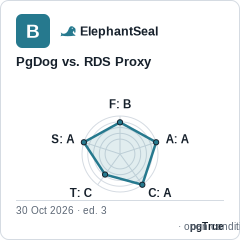
<a href="https://pgtrue.postgres.ai/shared/brief/6cecd4fc-77f6-4cc6-8c5a-2c812ce26978"><img src="https://pgtrue.postgres.ai/badge/6cecd4fc-77f6-4cc6-8c5a-2c812ce26978/radar.svg?v=13&amp;theme=light" alt="pgTrue fact-check" width="240" height="240" loading="lazy" decoding="async" style="display:inline-block;width:240px;height:240px"></a>
https://pgtrue.postgres.ai/badge/6cecd4fc-77f6-4cc6-8c5a-2c812ce26978/radar.svg?v=13&theme=light
.. image:: https://pgtrue.postgres.ai/badge/6cecd4fc-77f6-4cc6-8c5a-2c812ce26978/radar.svg?v=13&theme=light
   :target: https://pgtrue.postgres.ai/shared/brief/6cecd4fc-77f6-4cc6-8c5a-2c812ce26978
   :alt: pgTrue fact-check
   :width: 240
   :height: 240
[![pgTrue fact-check](https://pgtrue.postgres.ai/badge/6cecd4fc-77f6-4cc6-8c5a-2c812ce26978/radar.svg?v=13&theme=dark)](https://pgtrue.postgres.ai/shared/brief/6cecd4fc-77f6-4cc6-8c5a-2c812ce26978)
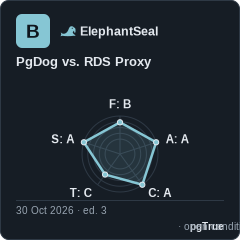
<a href="https://pgtrue.postgres.ai/shared/brief/6cecd4fc-77f6-4cc6-8c5a-2c812ce26978"><img src="https://pgtrue.postgres.ai/badge/6cecd4fc-77f6-4cc6-8c5a-2c812ce26978/radar.svg?v=13&amp;theme=dark" alt="pgTrue fact-check" width="240" height="240" loading="lazy" decoding="async" style="display:inline-block;width:240px;height:240px"></a>
https://pgtrue.postgres.ai/badge/6cecd4fc-77f6-4cc6-8c5a-2c812ce26978/radar.svg?v=13&theme=dark
.. image:: https://pgtrue.postgres.ai/badge/6cecd4fc-77f6-4cc6-8c5a-2c812ce26978/radar.svg?v=13&theme=dark
   :target: https://pgtrue.postgres.ai/shared/brief/6cecd4fc-77f6-4cc6-8c5a-2c812ce26978
   :alt: pgTrue fact-check
   :width: 240
   :height: 240
[![pgTrue fact-check](https://pgtrue.postgres.ai/badge/6cecd4fc-77f6-4cc6-8c5a-2c812ce26978/radar.svg?v=13)](https://pgtrue.postgres.ai/shared/brief/6cecd4fc-77f6-4cc6-8c5a-2c812ce26978)
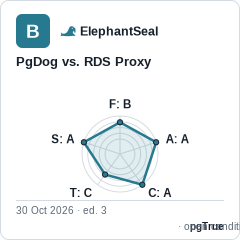
<a href="https://pgtrue.postgres.ai/shared/brief/6cecd4fc-77f6-4cc6-8c5a-2c812ce26978"><img src="https://pgtrue.postgres.ai/badge/6cecd4fc-77f6-4cc6-8c5a-2c812ce26978/radar.svg?v=13" alt="pgTrue fact-check" width="240" height="240" loading="lazy" decoding="async" style="display:inline-block;width:240px;height:240px"></a>
https://pgtrue.postgres.ai/badge/6cecd4fc-77f6-4cc6-8c5a-2c812ce26978/radar.svg?v=13
.. image:: https://pgtrue.postgres.ai/badge/6cecd4fc-77f6-4cc6-8c5a-2c812ce26978/radar.svg?v=13
   :target: https://pgtrue.postgres.ai/shared/brief/6cecd4fc-77f6-4cc6-8c5a-2c812ce26978
   :alt: pgTrue fact-check
   :width: 240
   :height: 240
[![pgTrue fact-check](https://pgtrue.postgres.ai/badge/6cecd4fc-77f6-4cc6-8c5a-2c812ce26978/wide.svg?v=13&theme=light)](https://pgtrue.postgres.ai/shared/brief/6cecd4fc-77f6-4cc6-8c5a-2c812ce26978)
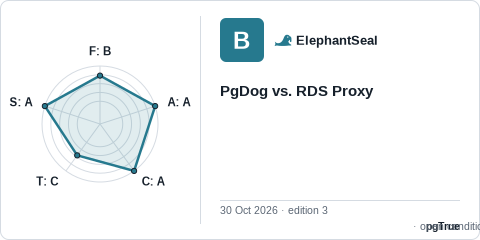
<a href="https://pgtrue.postgres.ai/shared/brief/6cecd4fc-77f6-4cc6-8c5a-2c812ce26978"><img src="https://pgtrue.postgres.ai/badge/6cecd4fc-77f6-4cc6-8c5a-2c812ce26978/wide.svg?v=13&amp;theme=light" alt="pgTrue fact-check" width="480" height="240" loading="lazy" decoding="async" style="display:inline-block;width:480px;height:240px"></a>
https://pgtrue.postgres.ai/badge/6cecd4fc-77f6-4cc6-8c5a-2c812ce26978/wide.svg?v=13&theme=light
.. image:: https://pgtrue.postgres.ai/badge/6cecd4fc-77f6-4cc6-8c5a-2c812ce26978/wide.svg?v=13&theme=light
   :target: https://pgtrue.postgres.ai/shared/brief/6cecd4fc-77f6-4cc6-8c5a-2c812ce26978
   :alt: pgTrue fact-check
   :width: 480
   :height: 240
[![pgTrue fact-check](https://pgtrue.postgres.ai/badge/6cecd4fc-77f6-4cc6-8c5a-2c812ce26978/wide.svg?v=13&theme=dark)](https://pgtrue.postgres.ai/shared/brief/6cecd4fc-77f6-4cc6-8c5a-2c812ce26978)
<a href="https://pgtrue.postgres.ai/shared/brief/6cecd4fc-77f6-4cc6-8c5a-2c812ce26978"><img src="https://pgtrue.postgres.ai/badge/6cecd4fc-77f6-4cc6-8c5a-2c812ce26978/wide.svg?v=13&amp;theme=dark" alt="pgTrue fact-check" width="480" height="240" loading="lazy" decoding="async" style="display:inline-block;width:480px;height:240px"></a>
https://pgtrue.postgres.ai/badge/6cecd4fc-77f6-4cc6-8c5a-2c812ce26978/wide.svg?v=13&theme=dark
.. image:: https://pgtrue.postgres.ai/badge/6cecd4fc-77f6-4cc6-8c5a-2c812ce26978/wide.svg?v=13&theme=dark
   :target: https://pgtrue.postgres.ai/shared/brief/6cecd4fc-77f6-4cc6-8c5a-2c812ce26978
   :alt: pgTrue fact-check
   :width: 480
   :height: 240
[![pgTrue fact-check](https://pgtrue.postgres.ai/badge/6cecd4fc-77f6-4cc6-8c5a-2c812ce26978/wide.svg?v=13)](https://pgtrue.postgres.ai/shared/brief/6cecd4fc-77f6-4cc6-8c5a-2c812ce26978)
<a href="https://pgtrue.postgres.ai/shared/brief/6cecd4fc-77f6-4cc6-8c5a-2c812ce26978"><img src="https://pgtrue.postgres.ai/badge/6cecd4fc-77f6-4cc6-8c5a-2c812ce26978/wide.svg?v=13" alt="pgTrue fact-check" width="480" height="240" loading="lazy" decoding="async" style="display:inline-block;width:480px;height:240px"></a>
https://pgtrue.postgres.ai/badge/6cecd4fc-77f6-4cc6-8c5a-2c812ce26978/wide.svg?v=13
.. image:: https://pgtrue.postgres.ai/badge/6cecd4fc-77f6-4cc6-8c5a-2c812ce26978/wide.svg?v=13
   :target: https://pgtrue.postgres.ai/shared/brief/6cecd4fc-77f6-4cc6-8c5a-2c812ce26978
   :alt: pgTrue fact-check
   :width: 480
   :height: 240

Click the snippet to select all of it, then copy. Where SVG is stripped, as in some email clients and feed readers, change .svg to .png. PNG uses the light theme for Auto. For Markdown PNG embeds, use the HTML snippet where supported to preserve the display size.

Optional colours: append &color=26798E or &labelColor=333C47 after a theme query (use ? for the first parameter). Use 3- or 6-digit hex.

For pages with a light background.

For pages with a dark background. The ElephantSeal gets a thin edge so it does not blend in.

Auto follows the reader's light or dark setting where the host supports it, and shows the light ElephantSeal where it does not.

On a light page
On a dark page

PgDog vs. RDS Proxy (opens in new tab)

pgdog.dev
Check before you follow it: 2 claims are wrong.
1
inaccuracy
0
dangerous-recipe
1
misleading
0
imprecise
0
transcription
0
aged
0
withdrawn
8
verified-accurate

Central claim not verified: choosing PgDog over RDS Proxy based on connection pinning, scaling, and performance. We could not verify this. The article gives a method to reproduce it.

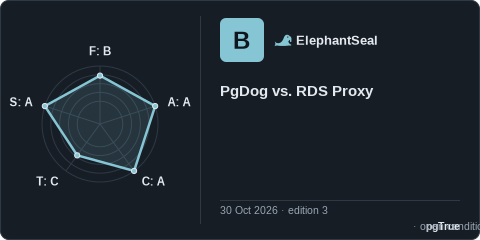
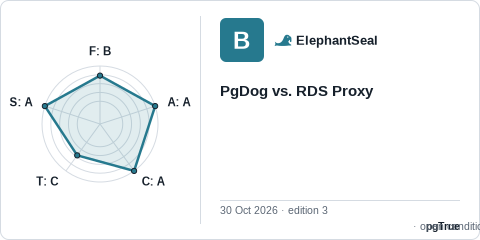
Factual B · Applicable A · Consistent A · Transparent C · Safe A

ReportTechnical fact-check, edition 3 pgTrue versionaudited with v1.0.14 (approx.) · regraded with v1.1.3 Issued EditionUpdated after review. Corrections are listed below. SubmittedSubmitted by the PostgresAI team. Author responseNo written reply from the author. We re-audited this article 5 times; see Revisions below. Policy: right-of-reply and corrections policy.

Inaccuracies

F1

PgDog can pin sessions holding advisory locks

INACCURATEFactual · holds up after review

Claim ledger

Article says
…PgDog doesn’t pin connections…
What is true
PgDog v0.1.53 can pin connections. check_lock() locks the backend when tracked advisory locks exist. Connection::done() prevents locked connections from returning to the pool. SET replay avoids one pinning trigger, but PgDog does not eliminate pinning generally.
So what
Include advisory-lock sessions when sizing PgDog pools before replacing RDS Proxy to eliminate pinning.
Charitable reading
The SET-specific explanation is correct. The introductory claim covers connection pinning generally and gives no advisory-lock exception.

Source

Source · pgdog@v0.1.53 · pgdog/src/frontend/client/query_engine/lock.rs:7-11// The presence of advisory locks or manual pin // indicates we cannot release the backend. let locked = self.advisory_locks.locked() || self.manual_lock; self.backend.lock(locked);
In the article

In the article

Article · exact quote · open in article ↗ (opens in new tab)…PgDog doesn’t pin connections…
All sources and excerpts · 5
Evidence // The presence of advisory locks or manual pin // indicates we cannot release the backend. let locked = self.advisory_locks.locked() || self.manual_lock; self.backend.lock(locked);
Evidence // The presence of advisory locks or manual pin // indicates we cannot release the backend. let locked = self.advisory_locks.locked() || self.manual_lock; self.backend.lock(locked); self.stats.locked(locked);
EvidencePgDog is able to detect advisory lock usage and will pin the server connection to the client connection
Evidence // The presence of advisory locks or manual pin // indicates we cannot release the backend. let locked = self.advisory_locks.locked() || self.manual_lock; self.backend.lock(locked);
Evidence /// We are done and can disconnect from this server. pub(crate) fn done(&self) -> bool { self.binding.done() && !self.binding.is_locked() } /// Lock this connection to the client, preventing it's /// release back into the pool. pub(crate) fn lock(&mut self, lock: bool) { self.binding.set_locked(lock); if lock { self.binding.dirty();
How the review tested this

Review: We tested the SET-only reading and the parser-configuration exception. F1 already limits its mechanism to tracked locks. Neither exception rescues the unconditional introduction. Accounting for pinned sessions changes pool sizing. We tested the SET-only reading. E-1 makes an unrestricted claim. v0.1.53 locks tracked advisory-lock backends and prevents their release. The finding says pinning can occur, without claiming every configuration detects locks. Pool sizing names a concrete decision. Wasted work fits the evidence.

Dangerous or recipe bugsNone in this edition.

Misleading / imprecise

F2

SELECT 1 does not isolate proxy performance

MISLEADINGFactual · holds up after review

Claim ledger

Article says
This ensured that Postgres performance was not a factor…
What is true
SELECT 1 still requires PostgreSQL execution. src/backend/tcop/postgres.c:1190 performs analysis and planning in the simple-query path. Line 1274 executes the portal. The pgbench documentation also identifies protocol-dependent server work. The query reduces database work without proving that PostgreSQL performance contributes nothing.
So what
Compare a direct PostgreSQL baseline and record server utilization and pgbench protocol mode before attributing the speedup to proxies.
Charitable reading
SELECT 1 minimizes database work. Minimizing that work does not establish that PostgreSQL performance cannot affect the result.

Source

Source · REL_18_6 · src/backend/tcop/postgres.c:1065-1065parsetree_list = pg_parse_query(query_string);
In the article

In the article

Article · exact quote · open in article ↗ (opens in new tab)This ensured that Postgres performance was not a factor…
All sources and excerpts · 5
Evidence parsetree_list = pg_parse_query(query_string);
Evidence (void) PortalRun(portal, FETCH_ALL, true, /* always top level */ receiver, receiver, &qc);
Evidence querytree_list = pg_analyze_and_rewrite_fixedparams(parsetree, query_string, NULL, 0, NULL); plantree_list = pg_plan_queries(querytree_list, query_string, CURSOR_OPT_PARALLEL_OK, NULL);
Evidence (void) PortalRun(portal, FETCH_ALL, true, /* always top level */ receiver, receiver, &qc);
Evidence In the <literal>prepared</literal> mode, <application>pgbench</application> reuses the parse analysis result starting from the second query iteration, so <application>pgbench</application> runs faster than in other modes.
How the review tested this

Review: We tested whether SELECT 1 means negligible database work and whether prepared mode avoids repeated analysis. F2 acknowledges reduced work and protocol differences. It challenges isolation, not the reported 2× measurement. The baseline comparison is a concrete corrective action. We tested whether minimizing database work supports the benchmark explanation. REL_18_6 still analyzes, plans, and executes simple queries. E-7 confirms protocol-dependent work. The finding challenges isolation without rejecting the reported 2× result. A direct baseline and utilization measurements name concrete checks.

Verified accurate

F3

PgDog records and replays session parameters

ACCURATEFactual · holds up after review

Claim ledger

Article says
It handles SET automatically by “transplanting” the session state between Postgres connections.
What is true
PgDog v0.1.53 records SET values in client parameters. Server::link_client() compares client and backend parameters. It constructs RESET queries and SET queries to synchronize the backend before reuse.
Charitable reading
The passage describes session-parameter replay rather than transferring every kind of session object.

Source

Source · pgdog@v0.1.53 · pgdog/src/backend/server.rs:706-716// Compare client and server params. let mut executed = if !params.identical(&self.client_params) { // Construct client parameter SET queries. let tracked = params.tracked_and_different(&self.client_params); // Construct RESET queries to reset any current params // to their default values. let mut queries = self.client_params.reset_queries(params); // Combine both to create a new, fresh session state // on this connection. queries.extend(tracked.set_queries(false));
In the article

In the article

Article · exact quote · open in article ↗ (opens in new tab)It handles SET automatically by “transplanting” the session state between Postgres connections.
All sources and excerpts · 2
Evidence // Compare client and server params. let mut executed = if !params.identical(&self.client_params) { // Construct client parameter SET queries. let tracked = params.tracked_and_different(&self.client_params); // Construct RESET queries to reset any current params // to their default values. let mut queries = self.client_params.reset_queries(params); // Combine both to create a new, fresh session state // on this connection. queries.extend(tracked.set_queries(false));
Evidence if let Some(value) = param.value.clone() { if context.in_transaction() { context .params .insert_transaction(&param.name, value, param.local); } else { context.params.insert(&param.name, value);
How the review tested this

Review: We tested whether F3 promises transfer of every session object. Its correction covers parameters only. SET capture and backend synchronization support that narrower reading. We checked whether F3 treats all session objects as transferable. Its wording covers parameters. E-9 records SET values. E-10 constructs RESET and SET queries from client/backend differences. Both passages match v0.1.53.

F4

PgDog uses a SET detection shortcut

ACCURATEFactual · holds up after review

Claim ledger

Article says
…to quickly detect common statements, like SET…
What is true
pgdog/src/frontend/regex_parser.rs:12 includes SET and RESET patterns. use_parser() checks a bounded query prefix with regular expressions. That check determines whether the request enables full parsing.
Charitable reading
The claim concerns a shortcut for common statements, without promising that every statement avoids full parsing.

Source

Source · pgdog@v0.1.53 · pgdog/src/frontend/regex_parser.rs:12-14static CMD_BASE: &[&str] = &[ "(RE)?SET", "BEGIN", "COMMIT", "ROLLBACK", "LISTEN", "UNLISTEN", "NOTIFY", ];
In the article

In the article

Article · exact quote · open in article ↗ (opens in new tab)…to quickly detect common statements, like SET…
All sources and excerpts · 2
Evidencestatic CMD_BASE: &[&str] = &[ "(RE)?SET", "BEGIN", "COMMIT", "ROLLBACK", "LISTEN", "UNLISTEN", "NOTIFY", ];
Evidence if (with_locks || session_control) && let Ok(Some(query)) = request.query() { let prefix = truncate_utf8(query.query(), self.limit); if with_locks { return CMD_RE_ADVISORY.is_match(prefix); } else { return CMD_RE.is_match(prefix); }
How the review tested this

Review: We checked whether the shortcut replaces SQL parsing or only selects requests for parsing. F4 describes the latter correctly. It makes no unsupported latency or maximum-query-size claim. We checked whether the shortcut bypasses parsing universally. F4 makes no such claim. E-12 includes SET/RESET patterns. E-13 tests a bounded prefix to decide whether parsing should run. The narrow implementation claim survives.

F5

PgDog pool clones share synchronized state

ACCURATEFactual · holds up after review

Claim ledger

Article says
…while sharing just one connection pool.
What is true
PgDog v0.1.53 defines Pool as a cloneable Arc<InnerSync>. InnerSync contains Mutex<Inner>. Pool clones share the same synchronized connection-pool state.
Charitable reading
One connection pool means workers share an eligible pool. It does not mean every database and user shares one backend pool.

Source

Source · pgdog@v0.1.53 · pgdog/src/backend/pool/pool_impl.rs:36-45/// Connection pool. #[derive(Clone)] pub struct Pool { inner: Arc<InnerSync>, } pub(crate) struct InnerSync { pub(super) comms: Comms, pub(super) addr: Address, pub(super) inner: Mutex<Inner>,
In the article

In the article

Article · exact quote · open in article ↗ (opens in new tab)…while sharing just one connection pool.
All sources and excerpts · 1
Evidence/// Connection pool. #[derive(Clone)] pub struct Pool { inner: Arc<InnerSync>, } pub(crate) struct InnerSync { pub(super) comms: Comms, pub(super) addr: Address, pub(super) inner: Mutex<Inner>,
How the review tested this

Review: We tested the reading that all users and databases share one global pool. F5 expressly excludes that reading. Pool clones share Arc-owned state protected by Mutex. We tested whether F5 claims one pool across all users and databases. Its qualification excludes that interpretation. E-15 defines cloneable Pool objects around Arc<InnerSync>, with Mutex<Inner>. The finding confines verification to shared pool state.

F6

Transaction pooling reuses eligible backend connections

ACCURATEFactual · holds up after review

Claim ledger

Article says
…multiplexing thousands of app connections with just a handful of Postgres connections.
What is true
PgDog v0.1.53 releases completed backend connections outside session mode when no requests remain. Another client can reuse those connections. Locked backends remain attached. The mechanism permits more client connections than backend connections.
Charitable reading
Thousands describes the multiplexing model's capacity, not a workload-independent throughput guarantee.

Source

Source · pgdog@v0.1.53 · pgdog/src/frontend/client/query_engine/query.rs:293-300if self.backend.done() { let changed_params = self.backend.changed_params(); // Release the connection back into the pool before flushing data to client. // Flushing can take a minute and we don't want to block the connection from being reused. if !self.backend.session_mode() && context.requests_left == 0 { self.backend.disconnect(); }
In the article

In the article

Article · exact quote · open in article ↗ (opens in new tab)…multiplexing thousands of app connections with just a handful of Postgres connections.
All sources and excerpts · 2
Evidence if self.backend.done() { let changed_params = self.backend.changed_params(); // Release the connection back into the pool before flushing data to client. // Flushing can take a minute and we don't want to block the connection from being reused. if !self.backend.session_mode() && context.requests_left == 0 { self.backend.disconnect(); }
Evidence /// We are done and can disconnect from this server. pub(crate) fn done(&self) -> bool { self.binding.done() && !self.binding.is_locked() } /// Lock this connection to the client, preventing it's /// release back into the pool. pub(crate) fn lock(&mut self, lock: bool) { self.binding.set_locked(lock); if lock { self.binding.dirty();
How the review tested this

Review: We tested whether F6 treats thousands of clients as measured capacity. It verifies reuse mechanics and explicitly excludes a capacity measurement. The release conditions and locked-backend exception match the code. We checked whether F6 verifies an unmeasured client-capacity guarantee. It verifies backend reuse and explicitly excludes capacity measurements. E-17 releases eligible connections outside session mode. E-3 excludes locked connections. Those conditions support the stated mechanism.

F7

Pinning prevents backend reuse by other clients

ACCURATEFactual · holds up after review

Claim ledger

Article says
…Connection pinning automatically disables transaction pooling for app connections…
What is true
PgDog v0.1.53 implements pinning by locking a backend to its client. Connection::done() returns false while that binding remains locked. The backend cannot return to the shared pool between that client's transactions.
Charitable reading
The sentence describes pooling behavior for affected connections. It does not claim that pinning changes the global pooler configuration.

Source

Source · pgdog@v0.1.53 · pgdog/src/backend/pool/connection/mod.rs:425-435/// We are done and can disconnect from this server. pub(crate) fn done(&self) -> bool { self.binding.done() && !self.binding.is_locked() } /// Lock this connection to the client, preventing it's /// release back into the pool. pub(crate) fn lock(&mut self, lock: bool) { self.binding.set_locked(lock); if lock { self.binding.dirty();
In the article

In the article

Article · exact quote · open in article ↗ (opens in new tab)…Connection pinning automatically disables transaction pooling for app connections…
All sources and excerpts · 1
Evidence /// We are done and can disconnect from this server. pub(crate) fn done(&self) -> bool { self.binding.done() && !self.binding.is_locked() } /// Lock this connection to the client, preventing it's /// release back into the pool. pub(crate) fn lock(&mut self, lock: bool) { self.binding.set_locked(lock); if lock { self.binding.dirty();
How the review tested this

Review: We tested whether F7 verifies RDS Proxy triggers using PgDog code. It verifies only the generic pinning mechanism. Connection::done() prevents reuse while the binding remains locked. We tested whether F7 improperly verifies RDS Proxy triggers through PgDog code. It confines verification to the generic pinning definition. E-3 prevents locked backends from returning to the pool. The finding leaves individual RDS Proxy triggers unverified.

F8

PgDog publishes an open source edition

ACCURATEFactual · holds up after review

Claim ledger

Article says
PgDog is free and open source…
What is true
PgDog v0.1.53 includes the GNU Affero General Public License version 3. LICENSE:1–2 confirms the license identifier.
Charitable reading
The claim concerns the open source edition, not enterprise licensing.

Source

Source · pgdog@v0.1.53 · LICENSE:1-2GNU AFFERO GENERAL PUBLIC LICENSE Version 3, 19 November 2007
In the article

In the article

Article · exact quote · open in article ↗ (opens in new tab)PgDog is free and open source…
All sources and excerpts · 1
EvidenceGNU AFFERO GENERAL PUBLIC LICENSE Version 3, 19 November 2007
How the review tested this

Review: We checked the license identifier and release commit. F8 verifies the open source edition without extending that claim to enterprise offerings. We checked the publication release rather than relying on current marketing. LICENSE:1–2 identifies AGPL version 3 at the cited commit. F8 verifies the open source edition and makes no claim about enterprise licensing.

F9

PgDog documents Helm and ECS installation options

ACCURATEFactual · holds up after review

Claim ledger

Article says
…Our Helm chart AWS ECS Terraform module (experimental)…
What is true
The installation page documents a Helm chart and an ECS Terraform module. It labels the ECS module a new project. These deployment options remain documented as of October 19, 2026.
Charitable reading
The deployment list claims these installation methods exist. It does not promise equivalent operational maturity.

Source

Source · https://docs.pgdog.dev/installation/We recently added a Terraform module to deploy PgDog on AWS ECS. It works with the same Docker image as our Helm chart
In the article

In the article

Article · exact quote · open in article ↗ (opens in new tab)…Our Helm chart AWS ECS Terraform module (experimental)…
All sources and excerpts · 1
EvidenceWe recently added a Terraform module to deploy PgDog on AWS ECS. It works with the same Docker image as our Helm chart
How the review tested this

Review: We tested whether October documentation proves August availability or production readiness. F9 limits its conclusion to documented options on October 19, 2026. The installation page supports both options. We checked the full installation page for both options. It documents Helm and ECS Terraform. F9 dates verification to October 19, 2026. It does not establish historical availability or production readiness.

F10

PgDog advertises commercial support

ACCURATEFactual · holds up after review

Claim ledger

Article says
We offer commercial support…
What is true
The enterprise page advertises direct engineer access and SLA-backed support. The commercial support offering remains advertised as of October 19, 2026.
Charitable reading
The quoted clause concerns the availability of commercial support. P0 contract terms require a separate check.

Source

Source · https://pgdog.dev/enterpriseDirect access to the engineers who build PgDog.
In the article

In the article

Article · exact quote · open in article ↗ (opens in new tab)We offer commercial support…
All sources and excerpts · 1
EvidenceDirect access to the engineers who build PgDog.
How the review tested this

Review: We checked whether advertised support establishes P0 contract terms or actual service delivery. F10 excludes both. The enterprise page supports its dated statement about advertised engineer access and SLA-backed support. We checked whether F10 verifies P0 terms or actual support delivery. It verifies advertising only. The enterprise page advertises engineer access and SLA-backed support. Its October 19, 2026 qualification confines the conclusion to that date.

More in this report

Section checks · 8 sections

Section checks

AspectGradeFindingsCoverage
IntroductionB+1 inaccuracy100% of claims (1 of 1, plus 1 that need data we do not have)
Connection pinningA1 verified-accurate100% of claims (1 of 1, plus 8 that need data we do not have)
Transaction modeA2 verified-accurate60% of claims (3 of 5, plus 5 that need data we do not have)
Query lengthA1 verified-accurate100% of claims (1 of 1, plus 5 that need data we do not have)
AutoscalingA1 verified-accurate50% of claims (1 of 2, plus 1 that need data we do not have)provisional
PerformanceB+1 misleading · 1 verified-accurate100% of claims (2 of 2, plus 3 that need data we do not have)
DeploymentA1 verified-accurateno checkable claims
ClosingA1 verified-accurateno checkable claims
Coverage and assessment · Checked 9 of 14 Postgres claims across 10 sections; 1 section below half

Central claim not verified. We checked PgDog pooling mechanisms but did not establish the RDS Proxy scaling comparison or reported 2× performance advantage.

We did not check everything in this article. What we did not check is listed below, in the words we recorded at the time. None of it moved the letter. We never charge our own limits to the article.

What we did not check

  • We did not verify RDS Proxy’s pinning rules, autoscaling internals, or per-instance pool architecture.
  • We did not verify the 1 GB parser limit or complete PostgreSQL syntax compatibility.
  • We did not reproduce the SELECT 1 measurements or verify the reported 99.99% uptime.
  • We did not check the Helm chart’s CPU allocation and availability-zone placement.
  • We did not verify how additional PostgreSQL connections affect kernel scheduling under the benchmark workload.
  • We did not verify the article’s RDS Proxy pinning rules, feature compatibility, or internal scaling architecture.
  • We did not reproduce the benchmarks or verify the reported customer production speedups.
  • We did not verify PgDog’s universal parser compatibility or its claimed 1 GB query limit.
  • We did not verify the claimed 99.99% uptime or the Helm chart’s scheduling and resource behavior.
  • We could not retrieve the linked Stack Exchange answer or scheduling page.
  • We verified that PgDog advertises commercial support, but we did not verify its P0 contract terms.
  • We did not establish historical changes to the unversioned installation and enterprise pages.
  • We did not inspect the benchmark figure or recompute the reported 2× speedup.
  • We did not verify the reported 99.99% uptime or reproduce the performance and client-capacity measurements.
  • We did not verify the 16 KB pinning threshold or the parser's 1 GB input limit.
  • Section “Autoscaling”: we checked 1 of 3 checkable claims.
  • Section “RDS Proxy scaling”: we checked 0 of 8 checkable claims.
  • We could not decide whether the evidence backs the central claim.
  • We could not decide whether the published benchmark details are complete.
Checked 9 of 14 Postgres claims across 10 sections; 1 section below half
  • Introduction: 1 of 1 Postgres claims checked, plus 1 that need data we do not have; not counted: 7 product or opinion, 5 not a claim
  • Connection pinning: 1 of 1 Postgres claims checked, plus 8 that need data we do not have; not counted: 1 product or opinion, 1 duplicate, 2 not a claim
  • Transaction mode: 3 of 5 Postgres claims checked, plus 5 that need data we do not have; not counted: 4 product or opinion, 1 duplicate, 1 not a claim; not checked: 2 for other reasons
  • Query length: 1 of 1 Postgres claims checked, plus 5 that need data we do not have; not counted: 8 product or opinion, 1 duplicate, 2 not a claim
  • Autoscaling: 1 of 2 Postgres claims checked, plus 1 that need data we do not have; not counted: 10 product or opinion, 1 not a claim; not checked: 1 for other reasons
  • RDS Proxy scaling: 0 of 2 Postgres claims checked, plus 6 that need data we do not have; not counted: 3 product or opinion, 1 not a claim; not checked: 2 for other reasons
  • High availability: no checkable claims; not counted: 11 product or opinion, 1 not a claim
  • Performance: 2 of 2 Postgres claims checked, plus 3 that need data we do not have; not counted: 8 product or opinion, 1 duplicate, 2 not a claim
  • Deployment: no checkable claims; not counted: 12 product or opinion, 2 not a claim
  • Closing: no checkable claims; not counted: 6 product or opinion, 3 not a claim

Average of 5 axes: 3.4 · benchmark not reproducible, one step off (no versions) · result B

Some explanatory text is not shown in this edition; the grade and findings are complete.

Scorecard · the five axes
FACTS scorecard Scorecard radar, 5 axes, bigger is better. Overall B. Factual B · 2 wrong of 10 checked · 0 caveats. Applicable A · 0 wrong of 3 checked · 0 caveats. Consistent A · 0 wrong of 10 checked · 0 caveats. Transparent C · 0 wrong of 3 checked · 0 caveats · reproducibility: C (no versions). Safe A · 0 wrong of 6 checked · 0 caveats. B 2 wrong of 10 checked · 0 caveatsFactual B2 wrong of 100 caveats A 0 wrong of 3 checked · 0 caveatsApplicable A0 wrong of 30 caveats A 0 wrong of 10 checked · 0 caveatsConsistent A0 wrong of 100 caveats C 0 wrong of 3 checked · 0 caveats reproducibility: C (no versions)Transparent C0 wrong of 30 caveatsreproducibility: C(no versions) A 0 wrong of 6 checked · 0 caveatsSafe A0 wrong of 60 caveats B

By topic: Introduction — 1 finding, 1 wrong · Connection pinning — 1 finding, 0 wrong · Transaction mode — 2 findings, 0 wrong · Query length — 1 finding, 0 wrong · Autoscaling — 1 finding, 0 wrong · Performance — 2 findings, 1 wrong · Deployment — 1 finding, 0 wrong · Closing — 1 finding, 0 wrong

Further out is better. Each axis has its own letter, from the wrong claims and caveats among the claims we checked of that kind.

Checked on the FACTS: Factual, Applicable, Consistent, Transparent, Safe. Clockwise: Factual (is it true?), Applicable (does it apply to my setup, today?), Consistent (does it agree with itself?), Transparent (can I check it myself?), Safe (can I run this on prod?).

We checked 10 claims, 3 commands scanned.

AxisLetterWrongCaveatsCheckedCoverage
FactualB2010assessed: B · 2 wrong of 10 checked · 0 caveats
ApplicableA003assessed: A · 0 wrong of 3 checked · 0 caveats
ConsistentA0010assessed: A · 0 wrong of 10 checked · 0 caveats
TransparentC003assessed: C · 0 wrong of 3 checked · 0 caveats · reproducibility: C (no versions)
SafeA006assessed: A · 0 wrong of 6 checked · 0 caveats
Topics · 8 topics

Topics

TopicFactualApplicableConsistentTransparentSafe
Introduction1 issue 1 checked F10 issues 1 checked0 issues 1 checked
Connection pinning0 issues 1 checked F70 issues 1 checked0 issues 1 checked
Transaction mode0 issues 2 checked F3 F60 issues 1 checked0 issues 2 checked
Query length0 issues 1 checked F40 issues 1 checked
Autoscaling0 issues 1 checked F50 issues 1 checked
Performance1 issue 2 checked F2 F80 issues 2 checked0 issues 1 checked
Deployment0 issues 1 checked F90 issues 1 checked0 issues 1 checked
Closing0 issues 1 checked F100 issues 1 checked0 issues 1 checked

Issues found among the claims checked, per topic and axis. Each link goes to the finding behind the count.

Revisions: 6 · Not assessed -> Not assessed -> Not assessed -> Not assessed -> B -> B

We audited this article 6 times. Each row is the final edition of one audit. Letters and findings of earlier revisions stay readable at their own address.

  1. Revision 1 · Not assessed · audit version not recorded

    Details unavailable.

    ElephantSeal: Not assessed.

  2. Revision 2 · Not assessed · audit version not recorded

    Details unavailable.

    ElephantSeal: Not assessed.

  3. Revision 3 · Not assessed · audit version not recorded

    Details unavailable.

    ElephantSeal: Not assessed.

  4. Revision 4 · Not assessed · audit version not recorded

    Details unavailable.

    ElephantSeal: Not assessed.

  5. Revision 5 · 2026-10-02 00:00 UTC · B · audit version not recorded · regrade version not recorded

    Same article text, re-audited. 5 accurate · 1 wrong · 1 caveat.

    ElephantSeal: B. Open: the central claim is not yet backed by evidence.

    Changes: Details unavailable.

  6. Revision 6 · this page · 2026-10-19 07:30 UTC · B · audited with v1.0.14 (approx.) · regraded with v1.1.3

    Same article text, re-audited. 8 accurate · 2 wrong · 0 caveats.

    ElephantSeal: B. Open: the benchmark cannot yet be rerun from what is published.

    Changes: No longer reported: “…Postgres performance was not a factor…”. New: F2 “SELECT 1 does not isolate proxy performance” (misleading).

Questions and answers

Questions and answers

What is pgTrue?

pgTrue is an independent fact-check of technical Postgres articles, made by PostgresAI. It helps you check advice before you use it.

What does the letter grade mean?

The letter grade summarizes the claims we checked. Five axes show what we checked:

  • Factual: is it true?
  • Applicable: does it apply to my setup, today?
  • Consistent: does it agree with itself?
  • Transparent: can I check it myself?
  • Safe: can I run this in production?

What is the ElephantSeal?

The ElephantSeal is the mark an article earns. It always shows the latest edition. “Open:” lists what is still open.

Can an author reply?

Authors can ask us to correct a finding, reply to it, or withdraw it. Right-of-reply policy.

Paste into your AI assistant to fix the article, then ask for a re-review.

Show the text
Fix the article with this report, then ask pgTrue for a re-review.

# pgTrue report: PgDog vs. RDS Proxy

Article title: PgDog vs. RDS Proxy
Article URL: https://pgdog.dev/blog/pgdog-vs-rds-proxy
Report URL: https://pgtrue.postgres.ai/shared/brief/6cecd4fc-77f6-4cc6-8c5a-2c812ce26978
Audited revision: 6 of 6, 2026-10-19 07:30:18 UTC
Overall letter: B

## Axes

- Factual: B · 2 wrong · 10 checked · 0 caveats · assessed
- Applicable: A · 0 wrong · 3 checked · 0 caveats · assessed
- Consistent: A · 0 wrong · 10 checked · 0 caveats · assessed
- Transparent: C · 0 wrong · 3 checked · 0 caveats · assessed
- Safe: A · 0 wrong · 6 checked · 0 caveats · assessed

ElephantSeal: B.
Open conditions: the benchmark cannot yet be rerun from what is published.

## Report metadata

- Report: Technical fact-check, edition 3
- pgTrue version: audited with v1.0.14 (approx.) · regraded with v1.1.3
- Issued: 2026-10-19
- Edition: Updated after review. Corrections are listed below.
- Submitted: Submitted by the PostgresAI team.
- Author response: No written reply from the author. We re-audited this article 5 times; see Revisions below. Policy: [right-of-reply and corrections policy](/pgtrue/security).

## Findings needing a change (2)

### F1 · Inaccurate · Factual · PgDog can pin sessions holding advisory locks
Location: Article · exact quote · [open in article](https://pgdog.dev/blog/pgdog-vs-rds-proxy#:~:text=PgDog%20doesn%E2%80%99t%20pin%20connections)
Article says:
```text
…PgDog doesn’t pin connections…
```
What is true:
PgDog v0.1.53 can pin connections. check_lock() locks the backend when tracked advisory locks exist. Connection::done() prevents locked connections from returning to the pool. SET replay avoids one pinning trigger, but PgDog does not eliminate pinning generally.
So what:
Include advisory-lock sessions when sizing PgDog pools before replacing RDS Proxy to eliminate pinning.
Charitable reading:
The SET-specific explanation is correct. The introductory claim covers connection pinning generally and gives no advisory-lock exception.
Review: We tested the SET-only reading and the parser-configuration exception. F1 already limits its mechanism to tracked locks. Neither exception rescues the unconditional introduction. Accounting for pinned sessions changes pool sizing. We tested the SET-only reading. E-1 makes an unrestricted claim. v0.1.53 locks tracked advisory-lock backends and prevents their release. The finding says pinning can occur, without claiming every configuration detects locks. Pool sizing names a concrete decision. Wasted work fits the evidence.

Sources:
- [[email protected] · pgdog/src/frontend/client/query_engine/lock.rs:7-11](https://github.com/pgdogdev/pgdog/blob/f43943b2eb7011623a14c12a20c83e5d7644078b/pgdog/src/frontend/client/query_engine/lock.rs#L7-L11)
  Excerpt:
  ```text
  // The presence of advisory locks or manual pin
        // indicates we cannot release the backend.
        let locked = self.advisory_locks.locked() || self.manual_lock;

        self.backend.lock(locked);
  ```
- [[email protected] · pgdog/src/frontend/client/query_engine/lock.rs:7-12](https://github.com/pgdogdev/pgdog/blob/f43943b2eb7011623a14c12a20c83e5d7644078b/pgdog/src/frontend/client/query_engine/lock.rs#L7-L12)
  Excerpt:
  ```text
  // The presence of advisory locks or manual pin
        // indicates we cannot release the backend.
        let locked = self.advisory_locks.locked() || self.manual_lock;

        self.backend.lock(locked);
        self.stats.locked(locked);
  ```
- [https://docs.pgdog.dev/features/connection-pooler/transaction-mode/](https://docs.pgdog.dev/features/connection-pooler/transaction-mode/)
  Excerpt:
  ```text
  PgDog is able to detect advisory lock usage and will pin the server connection to the client connection
  ```
- [[email protected] · pgdog/src/frontend/client/query_engine/lock.rs:7-11](https://github.com/pgdogdev/pgdog/blob/f43943b2eb7011623a14c12a20c83e5d7644078b/pgdog/src/frontend/client/query_engine/lock.rs#L7-L11)
  Excerpt:
  ```text
  // The presence of advisory locks or manual pin
        // indicates we cannot release the backend.
        let locked = self.advisory_locks.locked() || self.manual_lock;

        self.backend.lock(locked);
  ```
- [[email protected] · pgdog/src/backend/pool/connection/mod.rs:425-435](https://github.com/pgdogdev/pgdog/blob/f43943b2eb7011623a14c12a20c83e5d7644078b/pgdog/src/backend/pool/connection/mod.rs#L425-L435)
  Excerpt:
  ```text
  /// We are done and can disconnect from this server.
    pub(crate) fn done(&self) -> bool {
        self.binding.done() && !self.binding.is_locked()
    }

    /// Lock this connection to the client, preventing it's
    /// release back into the pool.
    pub(crate) fn lock(&mut self, lock: bool) {
        self.binding.set_locked(lock);
        if lock {
            self.binding.dirty();
  ```

Finding URL: https://pgtrue.postgres.ai/shared/brief/6cecd4fc-77f6-4cc6-8c5a-2c812ce26978#F1

### F2 · Misleading · Factual · SELECT 1 does not isolate proxy performance
Location: Article · exact quote · [open in article](https://pgdog.dev/blog/pgdog-vs-rds-proxy#:~:text=This%20ensured%20that%20Postgres%20performance%20was%20not%20a%20factor)
Article says:
```text
This ensured that Postgres performance was not a factor…
```
What is true:
SELECT 1 still requires PostgreSQL execution. src/backend/tcop/postgres.c:1190 performs analysis and planning in the simple-query path. Line 1274 executes the portal. The pgbench documentation also identifies protocol-dependent server work. The query reduces database work without proving that PostgreSQL performance contributes nothing.
So what:
Compare a direct PostgreSQL baseline and record server utilization and pgbench protocol mode before attributing the speedup to proxies.
Charitable reading:
SELECT 1 minimizes database work. Minimizing that work does not establish that PostgreSQL performance cannot affect the result.
Review: We tested whether SELECT 1 means negligible database work and whether prepared mode avoids repeated analysis. F2 acknowledges reduced work and protocol differences. It challenges isolation, not the reported 2× measurement. The baseline comparison is a concrete corrective action. We tested whether minimizing database work supports the benchmark explanation. REL_18_6 still analyzes, plans, and executes simple queries. E-7 confirms protocol-dependent work. The finding challenges isolation without rejecting the reported 2× result. A direct baseline and utilization measurements name concrete checks.

Sources:
- [REL_18_6 · src/backend/tcop/postgres.c:1065-1065](https://github.com/postgres/postgres/blob/724edf9bde9d356724ad384a2e196edc3c9f80f7/src/backend/tcop/postgres.c#L1065-L1065)
  Excerpt:
  ```text
  parsetree_list = pg_parse_query(query_string);
  ```
- [REL_18_6 · src/backend/tcop/postgres.c:1274-1279](https://github.com/postgres/postgres/blob/724edf9bde9d356724ad384a2e196edc3c9f80f7/src/backend/tcop/postgres.c#L1274-L1279)
  Excerpt:
  ```text
  (void) PortalRun(portal,
						 FETCH_ALL,
						 true,	/* always top level */
						 receiver,
						 receiver,
						 &qc);
  ```
- [REL_18_6 · src/backend/tcop/postgres.c:1190-1194](https://github.com/postgres/postgres/blob/724edf9bde9d356724ad384a2e196edc3c9f80f7/src/backend/tcop/postgres.c#L1190-L1194)
  Excerpt:
  ```text
  querytree_list = pg_analyze_and_rewrite_fixedparams(parsetree, query_string,
															NULL, 0, NULL);

		plantree_list = pg_plan_queries(querytree_list, query_string,
										CURSOR_OPT_PARALLEL_OK, NULL);
  ```
- [REL_18_6 · src/backend/tcop/postgres.c:1274-1279](https://github.com/postgres/postgres/blob/724edf9bde9d356724ad384a2e196edc3c9f80f7/src/backend/tcop/postgres.c#L1274-L1279)
  Excerpt:
  ```text
  (void) PortalRun(portal,
						 FETCH_ALL,
						 true,	/* always top level */
						 receiver,
						 receiver,
						 &qc);
  ```
- [REL_18_6 · doc/src/sgml/ref/pgbench.sgml:567-570](https://github.com/postgres/postgres/blob/724edf9bde9d356724ad384a2e196edc3c9f80f7/doc/src/sgml/ref/pgbench.sgml#L567-L570)
  Excerpt:
  ```text
  In the <literal>prepared</literal> mode, <application>pgbench</application>
        reuses the parse analysis result starting from the second query
        iteration, so <application>pgbench</application> runs faster
        than in other modes.
  ```

Finding URL: https://pgtrue.postgres.ai/shared/brief/6cecd4fc-77f6-4cc6-8c5a-2c812ce26978#F2

## Verified accurate claims (8)

### F3 · Accurate · Factual · PgDog records and replays session parameters
Location: Article · exact quote · [open in article](https://pgdog.dev/blog/pgdog-vs-rds-proxy#:~:text=It%20handles%20SET%20automatically%20by,session%20state%20between%20Postgres%20connections.)
Article says:
```text
It handles SET automatically by “transplanting” the session state between Postgres connections.
```
What is true:
PgDog v0.1.53 records SET values in client parameters. Server::link_client() compares client and backend parameters. It constructs RESET queries and SET queries to synchronize the backend before reuse.
Charitable reading:
The passage describes session-parameter replay rather than transferring every kind of session object.
Review: We tested whether F3 promises transfer of every session object. Its correction covers parameters only. SET capture and backend synchronization support that narrower reading. We checked whether F3 treats all session objects as transferable. Its wording covers parameters. E-9 records SET values. E-10 constructs RESET and SET queries from client/backend differences. Both passages match v0.1.53.

Sources:
- [[email protected] · pgdog/src/backend/server.rs:706-716](https://github.com/pgdogdev/pgdog/blob/f43943b2eb7011623a14c12a20c83e5d7644078b/pgdog/src/backend/server.rs#L706-L716)
  Excerpt:
  ```text
  // Compare client and server params.
        let mut executed = if !params.identical(&self.client_params) {
            // Construct client parameter SET queries.
            let tracked = params.tracked_and_different(&self.client_params);
            // Construct RESET queries to reset any current params
            // to their default values.
            let mut queries = self.client_params.reset_queries(params);

            // Combine both to create a new, fresh session state
            // on this connection.
            queries.extend(tracked.set_queries(false));
  ```
- [[email protected] · pgdog/src/frontend/client/query_engine/set.rs:29-35](https://github.com/pgdogdev/pgdog/blob/f43943b2eb7011623a14c12a20c83e5d7644078b/pgdog/src/frontend/client/query_engine/set.rs#L29-L35)
  Excerpt:
  ```text
  if let Some(value) = param.value.clone() {
                if context.in_transaction() {
                    context
                        .params
                        .insert_transaction(&param.name, value, param.local);
                } else {
                    context.params.insert(&param.name, value);
  ```

Finding URL: https://pgtrue.postgres.ai/shared/brief/6cecd4fc-77f6-4cc6-8c5a-2c812ce26978#F3

### F4 · Accurate · Factual · PgDog uses a SET detection shortcut
Location: Article · exact quote · [open in article](https://pgdog.dev/blog/pgdog-vs-rds-proxy#:~:text=to%20quickly%20detect%20common%20statements%2C%20like%20SET)
Article says:
```text
…to quickly detect common statements, like SET…
```
What is true:
pgdog/src/frontend/regex_parser.rs:12 includes SET and RESET patterns. use_parser() checks a bounded query prefix with regular expressions. That check determines whether the request enables full parsing.
Charitable reading:
The claim concerns a shortcut for common statements, without promising that every statement avoids full parsing.
Review: We checked whether the shortcut replaces SQL parsing or only selects requests for parsing. F4 describes the latter correctly. It makes no unsupported latency or maximum-query-size claim. We checked whether the shortcut bypasses parsing universally. F4 makes no such claim. E-12 includes SET/RESET patterns. E-13 tests a bounded prefix to decide whether parsing should run. The narrow implementation claim survives.

Sources:
- [[email protected] · pgdog/src/frontend/regex_parser.rs:12-14](https://github.com/pgdogdev/pgdog/blob/f43943b2eb7011623a14c12a20c83e5d7644078b/pgdog/src/frontend/regex_parser.rs#L12-L14)
  Excerpt:
  ```text
  static CMD_BASE: &[&str] = &[
    "(RE)?SET", "BEGIN", "COMMIT", "ROLLBACK", "LISTEN", "UNLISTEN", "NOTIFY",
];
  ```
- [[email protected] · pgdog/src/frontend/regex_parser.rs:67-75](https://github.com/pgdogdev/pgdog/blob/f43943b2eb7011623a14c12a20c83e5d7644078b/pgdog/src/frontend/regex_parser.rs#L67-L75)
  Excerpt:
  ```text
  if (with_locks || session_control)
            && let Ok(Some(query)) = request.query()
        {
            let prefix = truncate_utf8(query.query(), self.limit);
            if with_locks {
                return CMD_RE_ADVISORY.is_match(prefix);
            } else {
                return CMD_RE.is_match(prefix);
            }
  ```

Finding URL: https://pgtrue.postgres.ai/shared/brief/6cecd4fc-77f6-4cc6-8c5a-2c812ce26978#F4

### F5 · Accurate · Factual · PgDog pool clones share synchronized state
Location: Article · exact quote · [open in article](https://pgdog.dev/blog/pgdog-vs-rds-proxy#:~:text=while%20sharing%20just%20one%20connection%20pool.)
Article says:
```text
…while sharing just one connection pool.
```
What is true:
PgDog v0.1.53 defines Pool as a cloneable Arc\<InnerSync\>. InnerSync contains Mutex\<Inner\>. Pool clones share the same synchronized connection-pool state.
Charitable reading:
One connection pool means workers share an eligible pool. It does not mean every database and user shares one backend pool.
Review: We tested the reading that all users and databases share one global pool. F5 expressly excludes that reading. Pool clones share Arc-owned state protected by Mutex. We tested whether F5 claims one pool across all users and databases. Its qualification excludes that interpretation. E-15 defines cloneable Pool objects around Arc\<InnerSync\>, with Mutex\<Inner\>. The finding confines verification to shared pool state.

Sources:
- [[email protected] · pgdog/src/backend/pool/pool_impl.rs:36-45](https://github.com/pgdogdev/pgdog/blob/f43943b2eb7011623a14c12a20c83e5d7644078b/pgdog/src/backend/pool/pool_impl.rs#L36-L45)
  Excerpt:
  ```text
  /// Connection pool.
#[derive(Clone)]
pub struct Pool {
    inner: Arc<InnerSync>,
}

pub(crate) struct InnerSync {
    pub(super) comms: Comms,
    pub(super) addr: Address,
    pub(super) inner: Mutex<Inner>,
  ```

Finding URL: https://pgtrue.postgres.ai/shared/brief/6cecd4fc-77f6-4cc6-8c5a-2c812ce26978#F5

### F6 · Accurate · Factual · Transaction pooling reuses eligible backend connections
Location: Article · exact quote · [open in article](https://pgdog.dev/blog/pgdog-vs-rds-proxy#:~:text=multiplexing%20thousands%20of%20app%20connections,a%20handful%20of%20Postgres%20connections.)
Article says:
```text
…multiplexing thousands of app connections with just a handful of Postgres connections.
```
What is true:
PgDog v0.1.53 releases completed backend connections outside session mode when no requests remain. Another client can reuse those connections. Locked backends remain attached. The mechanism permits more client connections than backend connections.
Charitable reading:
Thousands describes the multiplexing model's capacity, not a workload-independent throughput guarantee.
Review: We tested whether F6 treats thousands of clients as measured capacity. It verifies reuse mechanics and explicitly excludes a capacity measurement. The release conditions and locked-backend exception match the code. We checked whether F6 verifies an unmeasured client-capacity guarantee. It verifies backend reuse and explicitly excludes capacity measurements. E-17 releases eligible connections outside session mode. E-3 excludes locked connections. Those conditions support the stated mechanism.

Sources:
- [[email protected] · pgdog/src/frontend/client/query_engine/query.rs:293-300](https://github.com/pgdogdev/pgdog/blob/f43943b2eb7011623a14c12a20c83e5d7644078b/pgdog/src/frontend/client/query_engine/query.rs#L293-L300)
  Excerpt:
  ```text
  if self.backend.done() {
            let changed_params = self.backend.changed_params();

            // Release the connection back into the pool before flushing data to client.
            // Flushing can take a minute and we don't want to block the connection from being reused.
            if !self.backend.session_mode() && context.requests_left == 0 {
                self.backend.disconnect();
            }
  ```
- [[email protected] · pgdog/src/backend/pool/connection/mod.rs:425-435](https://github.com/pgdogdev/pgdog/blob/f43943b2eb7011623a14c12a20c83e5d7644078b/pgdog/src/backend/pool/connection/mod.rs#L425-L435)
  Excerpt:
  ```text
  /// We are done and can disconnect from this server.
    pub(crate) fn done(&self) -> bool {
        self.binding.done() && !self.binding.is_locked()
    }

    /// Lock this connection to the client, preventing it's
    /// release back into the pool.
    pub(crate) fn lock(&mut self, lock: bool) {
        self.binding.set_locked(lock);
        if lock {
            self.binding.dirty();
  ```

Finding URL: https://pgtrue.postgres.ai/shared/brief/6cecd4fc-77f6-4cc6-8c5a-2c812ce26978#F6

### F7 · Accurate · Factual · Pinning prevents backend reuse by other clients
Location: Article · exact quote · [open in article](https://pgdog.dev/blog/pgdog-vs-rds-proxy#:~:text=Connection%20pinning%20automatically%20disables%20transaction%20pooling%20for%20app%20connections)
Article says:
```text
…Connection pinning automatically disables transaction pooling for app connections…
```
What is true:
PgDog v0.1.53 implements pinning by locking a backend to its client. Connection::done() returns false while that binding remains locked. The backend cannot return to the shared pool between that client's transactions.
Charitable reading:
The sentence describes pooling behavior for affected connections. It does not claim that pinning changes the global pooler configuration.
Review: We tested whether F7 verifies RDS Proxy triggers using PgDog code. It verifies only the generic pinning mechanism. Connection::done() prevents reuse while the binding remains locked. We tested whether F7 improperly verifies RDS Proxy triggers through PgDog code. It confines verification to the generic pinning definition. E-3 prevents locked backends from returning to the pool. The finding leaves individual RDS Proxy triggers unverified.

Sources:
- [[email protected] · pgdog/src/backend/pool/connection/mod.rs:425-435](https://github.com/pgdogdev/pgdog/blob/f43943b2eb7011623a14c12a20c83e5d7644078b/pgdog/src/backend/pool/connection/mod.rs#L425-L435)
  Excerpt:
  ```text
  /// We are done and can disconnect from this server.
    pub(crate) fn done(&self) -> bool {
        self.binding.done() && !self.binding.is_locked()
    }

    /// Lock this connection to the client, preventing it's
    /// release back into the pool.
    pub(crate) fn lock(&mut self, lock: bool) {
        self.binding.set_locked(lock);
        if lock {
            self.binding.dirty();
  ```

Finding URL: https://pgtrue.postgres.ai/shared/brief/6cecd4fc-77f6-4cc6-8c5a-2c812ce26978#F7

### F8 · Accurate · Factual · PgDog publishes an open source edition
Location: Article · exact quote · [open in article](https://pgdog.dev/blog/pgdog-vs-rds-proxy#:~:text=PgDog%20is%20free%20and%20open%20source)
Article says:
```text
PgDog is free and open source…
```
What is true:
PgDog v0.1.53 includes the GNU Affero General Public License version 3. LICENSE:1–2 confirms the license identifier.
Charitable reading:
The claim concerns the open source edition, not enterprise licensing.
Review: We checked the license identifier and release commit. F8 verifies the open source edition without extending that claim to enterprise offerings. We checked the publication release rather than relying on current marketing. LICENSE:1–2 identifies AGPL version 3 at the cited commit. F8 verifies the open source edition and makes no claim about enterprise licensing.

Sources:
- [[email protected] · LICENSE:1-2](https://github.com/pgdogdev/pgdog/blob/f43943b2eb7011623a14c12a20c83e5d7644078b/LICENSE#L1-L2)
  Excerpt:
  ```text
  GNU AFFERO GENERAL PUBLIC LICENSE
   Version 3, 19 November 2007
  ```

Finding URL: https://pgtrue.postgres.ai/shared/brief/6cecd4fc-77f6-4cc6-8c5a-2c812ce26978#F8

### F9 · Accurate · Factual · PgDog documents Helm and ECS installation options
Location: Article · exact quote · [open in article](https://pgdog.dev/blog/pgdog-vs-rds-proxy#:~:text=Our%20Helm%20chart%20AWS%20ECS%20Terraform%20module%20%28experimental%29)
Article says:
```text
…Our Helm chart AWS ECS Terraform module (experimental)…
```
What is true:
The installation page documents a Helm chart and an ECS Terraform module. It labels the ECS module a new project. These deployment options remain documented as of October 19, 2026.
Charitable reading:
The deployment list claims these installation methods exist. It does not promise equivalent operational maturity.
Review: We tested whether October documentation proves August availability or production readiness. F9 limits its conclusion to documented options on October 19, 2026. The installation page supports both options. We checked the full installation page for both options. It documents Helm and ECS Terraform. F9 dates verification to October 19, 2026. It does not establish historical availability or production readiness.

Sources:
- [https://docs.pgdog.dev/installation/](https://docs.pgdog.dev/installation/)
  Excerpt:
  ```text
  We recently added a Terraform module to deploy PgDog on AWS ECS. It works with the same Docker image as our Helm chart
  ```

Finding URL: https://pgtrue.postgres.ai/shared/brief/6cecd4fc-77f6-4cc6-8c5a-2c812ce26978#F9

### F10 · Accurate · Factual · PgDog advertises commercial support
Location: Article · exact quote · [open in article](https://pgdog.dev/blog/pgdog-vs-rds-proxy#:~:text=We%20offer%20commercial%20support)
Article says:
```text
We offer commercial support…
```
What is true:
The enterprise page advertises direct engineer access and SLA-backed support. The commercial support offering remains advertised as of October 19, 2026.
Charitable reading:
The quoted clause concerns the availability of commercial support. P0 contract terms require a separate check.
Review: We checked whether advertised support establishes P0 contract terms or actual service delivery. F10 excludes both. The enterprise page supports its dated statement about advertised engineer access and SLA-backed support. We checked whether F10 verifies P0 terms or actual support delivery. It verifies advertising only. The enterprise page advertises engineer access and SLA-backed support. Its October 19, 2026 qualification confines the conclusion to that date.

Sources:
- [https://pgdog.dev/enterprise](https://pgdog.dev/enterprise)
  Excerpt:
  ```text
  Direct access to the engineers who build PgDog.
  ```

Finding URL: https://pgtrue.postgres.ai/shared/brief/6cecd4fc-77f6-4cc6-8c5a-2c812ce26978#F10

## Notes (not graded) (0)

None.

## Withdrawn findings (0)

None.

## Section checks

- Introduction · B+ · 1 inaccuracy · 100% of claims (1 of 1, plus 1 that need data we do not have)
- Connection pinning · A · 1 verified-accurate · 100% of claims (1 of 1, plus 8 that need data we do not have)
- Transaction mode · A · 2 verified-accurate · 60% of claims (3 of 5, plus 5 that need data we do not have)
- Query length · A · 1 verified-accurate · 100% of claims (1 of 1, plus 5 that need data we do not have)
- Autoscaling · A · 1 verified-accurate · 50% of claims (1 of 2, plus 1 that need data we do not have) provisional
- Performance · B+ · 1 misleading · 1 verified-accurate · 100% of claims (2 of 2, plus 3 that need data we do not have)
- Deployment · A · 1 verified-accurate · no checkable claims
- Closing · A · 1 verified-accurate · no checkable claims

## Claim coverage

- Introduction: 1 of 1 Postgres claims checked, plus 1 that need data we do not have; not counted: 7 product or opinion, 5 not a claim
- Connection pinning: 1 of 1 Postgres claims checked, plus 8 that need data we do not have; not counted: 1 product or opinion, 1 duplicate, 2 not a claim
- Transaction mode: 3 of 5 Postgres claims checked, plus 5 that need data we do not have; not counted: 4 product or opinion, 1 duplicate, 1 not a claim; not checked: 2 for other reasons
- Query length: 1 of 1 Postgres claims checked, plus 5 that need data we do not have; not counted: 8 product or opinion, 1 duplicate, 2 not a claim
- Autoscaling: 1 of 2 Postgres claims checked, plus 1 that need data we do not have; not counted: 10 product or opinion, 1 not a claim; not checked: 1 for other reasons
- RDS Proxy scaling: 0 of 2 Postgres claims checked, plus 6 that need data we do not have; not counted: 3 product or opinion, 1 not a claim; not checked: 2 for other reasons
- High availability: no checkable claims; not counted: 11 product or opinion, 1 not a claim
- Performance: 2 of 2 Postgres claims checked, plus 3 that need data we do not have; not counted: 8 product or opinion, 1 duplicate, 2 not a claim
- Deployment: no checkable claims; not counted: 12 product or opinion, 2 not a claim
- Closing: no checkable claims; not counted: 6 product or opinion, 3 not a claim

## What we did not check

- We did not verify RDS Proxy’s pinning rules, autoscaling internals, or per-instance pool architecture.
- We did not verify the 1 GB parser limit or complete PostgreSQL syntax compatibility.
- We did not reproduce the SELECT 1 measurements or verify the reported 99.99% uptime.
- We did not check the Helm chart’s CPU allocation and availability-zone placement.
- We did not verify how additional PostgreSQL connections affect kernel scheduling under the benchmark workload.
- We did not verify the article’s RDS Proxy pinning rules, feature compatibility, or internal scaling architecture.
- We did not reproduce the benchmarks or verify the reported customer production speedups.
- We did not verify PgDog’s universal parser compatibility or its claimed 1 GB query limit.
- We did not verify the claimed 99.99% uptime or the Helm chart’s scheduling and resource behavior.
- We could not retrieve the linked Stack Exchange answer or scheduling page.
- We verified that PgDog advertises commercial support, but we did not verify its P0 contract terms.
- We did not establish historical changes to the unversioned installation and enterprise pages.
- We did not inspect the benchmark figure or recompute the reported 2× speedup.
- We did not verify the reported 99.99% uptime or reproduce the performance and client-capacity measurements.
- We did not verify the 16 KB pinning threshold or the parser's 1 GB input limit.
- Section “Autoscaling”: we checked 1 of 3 checkable claims.
- Section “RDS Proxy scaling”: we checked 0 of 8 checkable claims.
- We could not decide whether the evidence backs the central claim.
- We could not decide whether the published benchmark details are complete.

## Notes

- Central claim not verified. We checked PgDog pooling mechanisms but did not establish the RDS Proxy scaling comparison or reported 2× performance advantage.
- We did not check everything in this article. What we did not check is listed below, in the words we recorded at the time. None of it moved the letter. We never charge our own limits to the article.
- Average of 5 axes: 3.4 · benchmark not reproducible, one step off (no versions) · result B
- Some explanatory text is not shown in this edition; the grade and findings are complete.
- Some checks did not happen for this edition, and each one we know of is listed above.
- Checked against: github.com/postgres/postgres REL_18_6 at commit 724edf9bde9d356724ad384a2e196edc3c9f80f7 (pinned target); github.com/pgdogdev/pgdog v0.1.53 at commit f43943b2eb7011623a14c12a20c83e5d7644078b (pinned target); https://docs.pgdog.dev/features/connection-pooler/transaction-mode/ (fetched 2026-10-19T07:30:37.249582Z); https://docs.pgdog.dev/installation/ (fetched 2026-10-19T07:30:39.845761Z); https://pgdog.dev/enterprise (fetched 2026-10-19T07:30:47.078800Z).
- Article captured 2026-10-19T07:30:18.306082Z · SHA-256 8e39d79047b53ffc374da81becaa1871d88a5e512ec379d8234ecaff127d2a20 · Text extracted from the article's HTML.
- Policy SHA-256 97ca0ac3bad668317a25d08f00eafbe8af284a8739d37a7f9fb83dc285604e97 · Grading rules SHA-256 6fb334e79d6b9e7ed81d3238cc10d9de602ff87ed65ff2fa781f53bac5798765.
- We did not verify RDS Proxy’s pinning triggers, autoscaling behavior, or per-instance pool architecture.
- We did not verify PgDog’s 1 GB query limit or complete PostgreSQL syntax compatibility.
- We did not inspect the benchmark figure or recompute the reported 2× speedup.
- We did not reproduce the SELECT 1 measurements, customer speedups, or client-capacity measurements.
- We did not verify the reported 99.99% uptime or the Helm chart’s CPU allocation and availability-zone placement.
- We did not check how additional PostgreSQL connections affect kernel scheduling under the benchmark workload.
- We could not retrieve the linked Stack Exchange answer or scheduling page.
- We did not verify P0 support contract terms or historical changes to the installation and enterprise pages.
- The article gives August 17, 2026, without a time. We list that date at midnight UTC.
- source: the article names no postgres release, so it was read at REL_18_6, the latest release when it was published
- source: the article names no pgdog release, so it was read at v0.1.53, the latest release when it was published
- 3 fetched pages are not listed above, because our policy does not allow linking them.
- review: the findings were written by one model and reviewed independently by a different model.
- 2026-10-30: Regraded under the current grading rules: the letter is the average of the axis letters, with every cap stated under it.
- 2 passages in this edition fell short of our own plain-English rules.
- Built from the article text captured above, 2 pinned source trees, and 3 fetched pages.
- 10 survived · 0 weakened · 0 withdrawn.

## Revision history

- [Revision 1](https://pgtrue.postgres.ai/shared/brief/6cecd4fc-77f6-4cc6-8c5a-2c812ce26978?v=2) · Not assessed · audit version not recorded
  Details unavailable.
  ElephantSeal: Not assessed.
- [Revision 2](https://pgtrue.postgres.ai/shared/brief/6cecd4fc-77f6-4cc6-8c5a-2c812ce26978?v=5) · Not assessed · audit version not recorded
  Details unavailable.
  ElephantSeal: Not assessed.
- [Revision 3](https://pgtrue.postgres.ai/shared/brief/6cecd4fc-77f6-4cc6-8c5a-2c812ce26978?v=7) · Not assessed · audit version not recorded
  Details unavailable.
  ElephantSeal: Not assessed.
- [Revision 4](https://pgtrue.postgres.ai/shared/brief/6cecd4fc-77f6-4cc6-8c5a-2c812ce26978?v=9) · Not assessed · audit version not recorded
  Details unavailable.
  ElephantSeal: Not assessed.
- [Revision 5](https://pgtrue.postgres.ai/shared/brief/6cecd4fc-77f6-4cc6-8c5a-2c812ce26978?v=33) · 2026-10-02 00:00 UTC · B · audit version not recorded · regrade version not recorded
  Same article text, re-audited. 5 accurate · 1 wrong · 1 caveat.
  ElephantSeal: B. Open: the central claim is not yet backed by evidence.
  Changes: Details unavailable.
- [Revision 6](https://pgtrue.postgres.ai/shared/brief/6cecd4fc-77f6-4cc6-8c5a-2c812ce26978?v=39) · this page · 2026-10-19 07:30 UTC · B · audited with v1.0.14 (approx.) · regraded with v1.1.3
  Same article text, re-audited. 8 accurate · 2 wrong · 0 caveats.
  ElephantSeal: B. Open: the benchmark cannot yet be rerun from what is published.
  Changes: No longer reported: “…Postgres performance was not a factor…”. New: F2 “SELECT 1 does not isolate proxy performance” (misleading).

Updated your article? Request a correction. A new edition appears at this address.