Limited beta · What is this?

pgTrue is under active development: reports may contain significant mistakes, inaccuracies, or bugs. Please report anything you find to pgtrue@postgres.ai.

pgTrue is an independent fact-check of technical Postgres articles. Read the questions and answers.

pgTrue fact-check

ElephantSeal A-Limited coverage

Embed

The ElephantSeal always shows this report's latest edition and links here. Copies cached elsewhere may update later.

[![pgTrue fact-check](https://pgtrue.postgres.ai/badge/571f87b8-0152-4347-a6d4-2434a0c4dbd7.svg?v=13&theme=light)](https://pgtrue.postgres.ai/shared/brief/571f87b8-0152-4347-a6d4-2434a0c4dbd7)
<a href="https://pgtrue.postgres.ai/shared/brief/571f87b8-0152-4347-a6d4-2434a0c4dbd7"><img src="https://pgtrue.postgres.ai/badge/571f87b8-0152-4347-a6d4-2434a0c4dbd7.svg?v=13&amp;theme=light" alt="pgTrue fact-check" width="90" height="20" loading="lazy" decoding="async" style="display:inline-block;width:90px;height:20px"></a>
https://pgtrue.postgres.ai/badge/571f87b8-0152-4347-a6d4-2434a0c4dbd7.svg?v=13&theme=light
.. image:: https://pgtrue.postgres.ai/badge/571f87b8-0152-4347-a6d4-2434a0c4dbd7.svg?v=13&theme=light
   :target: https://pgtrue.postgres.ai/shared/brief/571f87b8-0152-4347-a6d4-2434a0c4dbd7
   :alt: pgTrue fact-check
   :width: 90
   :height: 20
[![pgTrue fact-check](https://pgtrue.postgres.ai/badge/571f87b8-0152-4347-a6d4-2434a0c4dbd7.svg?v=13&theme=dark)](https://pgtrue.postgres.ai/shared/brief/571f87b8-0152-4347-a6d4-2434a0c4dbd7)
<a href="https://pgtrue.postgres.ai/shared/brief/571f87b8-0152-4347-a6d4-2434a0c4dbd7"><img src="https://pgtrue.postgres.ai/badge/571f87b8-0152-4347-a6d4-2434a0c4dbd7.svg?v=13&amp;theme=dark" alt="pgTrue fact-check" width="90" height="20" loading="lazy" decoding="async" style="display:inline-block;width:90px;height:20px"></a>
https://pgtrue.postgres.ai/badge/571f87b8-0152-4347-a6d4-2434a0c4dbd7.svg?v=13&theme=dark
.. image:: https://pgtrue.postgres.ai/badge/571f87b8-0152-4347-a6d4-2434a0c4dbd7.svg?v=13&theme=dark
   :target: https://pgtrue.postgres.ai/shared/brief/571f87b8-0152-4347-a6d4-2434a0c4dbd7
   :alt: pgTrue fact-check
   :width: 90
   :height: 20
[![pgTrue fact-check](https://pgtrue.postgres.ai/badge/571f87b8-0152-4347-a6d4-2434a0c4dbd7.svg?v=13)](https://pgtrue.postgres.ai/shared/brief/571f87b8-0152-4347-a6d4-2434a0c4dbd7)
<a href="https://pgtrue.postgres.ai/shared/brief/571f87b8-0152-4347-a6d4-2434a0c4dbd7"><img src="https://pgtrue.postgres.ai/badge/571f87b8-0152-4347-a6d4-2434a0c4dbd7.svg?v=13" alt="pgTrue fact-check" width="90" height="20" loading="lazy" decoding="async" style="display:inline-block;width:90px;height:20px"></a>
https://pgtrue.postgres.ai/badge/571f87b8-0152-4347-a6d4-2434a0c4dbd7.svg?v=13
.. image:: https://pgtrue.postgres.ai/badge/571f87b8-0152-4347-a6d4-2434a0c4dbd7.svg?v=13
   :target: https://pgtrue.postgres.ai/shared/brief/571f87b8-0152-4347-a6d4-2434a0c4dbd7
   :alt: pgTrue fact-check
   :width: 90
   :height: 20
[![pgTrue fact-check](https://pgtrue.postgres.ai/badge/571f87b8-0152-4347-a6d4-2434a0c4dbd7/radar.svg?v=13&theme=light)](https://pgtrue.postgres.ai/shared/brief/571f87b8-0152-4347-a6d4-2434a0c4dbd7)
<a href="https://pgtrue.postgres.ai/shared/brief/571f87b8-0152-4347-a6d4-2434a0c4dbd7"><img src="https://pgtrue.postgres.ai/badge/571f87b8-0152-4347-a6d4-2434a0c4dbd7/radar.svg?v=13&amp;theme=light" alt="pgTrue fact-check" width="240" height="240" loading="lazy" decoding="async" style="display:inline-block;width:240px;height:240px"></a>
https://pgtrue.postgres.ai/badge/571f87b8-0152-4347-a6d4-2434a0c4dbd7/radar.svg?v=13&theme=light
.. image:: https://pgtrue.postgres.ai/badge/571f87b8-0152-4347-a6d4-2434a0c4dbd7/radar.svg?v=13&theme=light
   :target: https://pgtrue.postgres.ai/shared/brief/571f87b8-0152-4347-a6d4-2434a0c4dbd7
   :alt: pgTrue fact-check
   :width: 240
   :height: 240
[![pgTrue fact-check](https://pgtrue.postgres.ai/badge/571f87b8-0152-4347-a6d4-2434a0c4dbd7/radar.svg?v=13&theme=dark)](https://pgtrue.postgres.ai/shared/brief/571f87b8-0152-4347-a6d4-2434a0c4dbd7)

<a href="https://pgtrue.postgres.ai/shared/brief/571f87b8-0152-4347-a6d4-2434a0c4dbd7"><img src="https://pgtrue.postgres.ai/badge/571f87b8-0152-4347-a6d4-2434a0c4dbd7/radar.svg?v=13&amp;theme=dark" alt="pgTrue fact-check" width="240" height="240" loading="lazy" decoding="async" style="display:inline-block;width:240px;height:240px"></a>
https://pgtrue.postgres.ai/badge/571f87b8-0152-4347-a6d4-2434a0c4dbd7/radar.svg?v=13&theme=dark
.. image:: https://pgtrue.postgres.ai/badge/571f87b8-0152-4347-a6d4-2434a0c4dbd7/radar.svg?v=13&theme=dark
   :target: https://pgtrue.postgres.ai/shared/brief/571f87b8-0152-4347-a6d4-2434a0c4dbd7
   :alt: pgTrue fact-check
   :width: 240
   :height: 240
[![pgTrue fact-check](https://pgtrue.postgres.ai/badge/571f87b8-0152-4347-a6d4-2434a0c4dbd7/radar.svg?v=13)](https://pgtrue.postgres.ai/shared/brief/571f87b8-0152-4347-a6d4-2434a0c4dbd7)
<a href="https://pgtrue.postgres.ai/shared/brief/571f87b8-0152-4347-a6d4-2434a0c4dbd7"><img src="https://pgtrue.postgres.ai/badge/571f87b8-0152-4347-a6d4-2434a0c4dbd7/radar.svg?v=13" alt="pgTrue fact-check" width="240" height="240" loading="lazy" decoding="async" style="display:inline-block;width:240px;height:240px"></a>
https://pgtrue.postgres.ai/badge/571f87b8-0152-4347-a6d4-2434a0c4dbd7/radar.svg?v=13
.. image:: https://pgtrue.postgres.ai/badge/571f87b8-0152-4347-a6d4-2434a0c4dbd7/radar.svg?v=13
   :target: https://pgtrue.postgres.ai/shared/brief/571f87b8-0152-4347-a6d4-2434a0c4dbd7
   :alt: pgTrue fact-check
   :width: 240
   :height: 240
[![pgTrue fact-check](https://pgtrue.postgres.ai/badge/571f87b8-0152-4347-a6d4-2434a0c4dbd7/wide.svg?v=13&theme=light)](https://pgtrue.postgres.ai/shared/brief/571f87b8-0152-4347-a6d4-2434a0c4dbd7)
<a href="https://pgtrue.postgres.ai/shared/brief/571f87b8-0152-4347-a6d4-2434a0c4dbd7"><img src="https://pgtrue.postgres.ai/badge/571f87b8-0152-4347-a6d4-2434a0c4dbd7/wide.svg?v=13&amp;theme=light" alt="pgTrue fact-check" width="480" height="240" loading="lazy" decoding="async" style="display:inline-block;width:480px;height:240px"></a>
https://pgtrue.postgres.ai/badge/571f87b8-0152-4347-a6d4-2434a0c4dbd7/wide.svg?v=13&theme=light
.. image:: https://pgtrue.postgres.ai/badge/571f87b8-0152-4347-a6d4-2434a0c4dbd7/wide.svg?v=13&theme=light
   :target: https://pgtrue.postgres.ai/shared/brief/571f87b8-0152-4347-a6d4-2434a0c4dbd7
   :alt: pgTrue fact-check
   :width: 480
   :height: 240
[![pgTrue fact-check](https://pgtrue.postgres.ai/badge/571f87b8-0152-4347-a6d4-2434a0c4dbd7/wide.svg?v=13&theme=dark)](https://pgtrue.postgres.ai/shared/brief/571f87b8-0152-4347-a6d4-2434a0c4dbd7)
<a href="https://pgtrue.postgres.ai/shared/brief/571f87b8-0152-4347-a6d4-2434a0c4dbd7"><img src="https://pgtrue.postgres.ai/badge/571f87b8-0152-4347-a6d4-2434a0c4dbd7/wide.svg?v=13&amp;theme=dark" alt="pgTrue fact-check" width="480" height="240" loading="lazy" decoding="async" style="display:inline-block;width:480px;height:240px"></a>
https://pgtrue.postgres.ai/badge/571f87b8-0152-4347-a6d4-2434a0c4dbd7/wide.svg?v=13&theme=dark
.. image:: https://pgtrue.postgres.ai/badge/571f87b8-0152-4347-a6d4-2434a0c4dbd7/wide.svg?v=13&theme=dark
   :target: https://pgtrue.postgres.ai/shared/brief/571f87b8-0152-4347-a6d4-2434a0c4dbd7
   :alt: pgTrue fact-check
   :width: 480
   :height: 240
[![pgTrue fact-check](https://pgtrue.postgres.ai/badge/571f87b8-0152-4347-a6d4-2434a0c4dbd7/wide.svg?v=13)](https://pgtrue.postgres.ai/shared/brief/571f87b8-0152-4347-a6d4-2434a0c4dbd7)
<a href="https://pgtrue.postgres.ai/shared/brief/571f87b8-0152-4347-a6d4-2434a0c4dbd7"><img src="https://pgtrue.postgres.ai/badge/571f87b8-0152-4347-a6d4-2434a0c4dbd7/wide.svg?v=13" alt="pgTrue fact-check" width="480" height="240" loading="lazy" decoding="async" style="display:inline-block;width:480px;height:240px"></a>
https://pgtrue.postgres.ai/badge/571f87b8-0152-4347-a6d4-2434a0c4dbd7/wide.svg?v=13
.. image:: https://pgtrue.postgres.ai/badge/571f87b8-0152-4347-a6d4-2434a0c4dbd7/wide.svg?v=13
   :target: https://pgtrue.postgres.ai/shared/brief/571f87b8-0152-4347-a6d4-2434a0c4dbd7
   :alt: pgTrue fact-check
   :width: 480
   :height: 240

Click the snippet to select all of it, then copy. Where SVG is stripped, as in some email clients and feed readers, change .svg to .png. PNG uses the light theme for Auto. For Markdown PNG embeds, use the HTML snippet where supported to preserve the display size.

Optional colours: append &color=26798E or &labelColor=333C47 after a theme query (use ? for the first parameter). Use 3- or 6-digit hex.

For pages with a light background.

For pages with a dark background. The ElephantSeal gets a thin edge so it does not blend in.

Auto follows the reader's light or dark setting where the host supports it, and shows the light ElephantSeal where it does not.

On a light page
On a dark page

When Patroni Silently Deletes Your Replication Slots (opens in new tab)

stormatics.tech
Check before you follow it: 1 claim is wrong.
0
inaccuracy
0
dangerous-recipe
1
misleading
0
imprecise
0
transcription
0
aged
0
withdrawn
6
verified-accurate

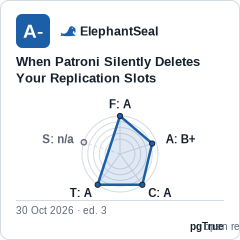
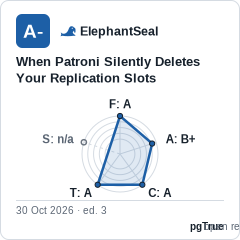
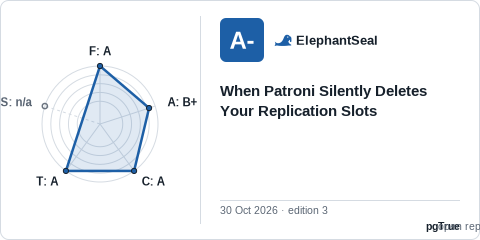
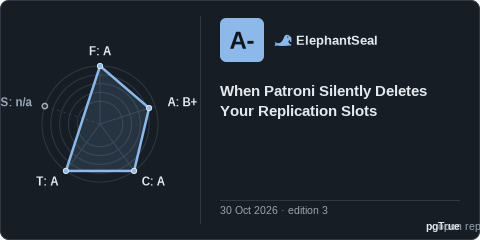
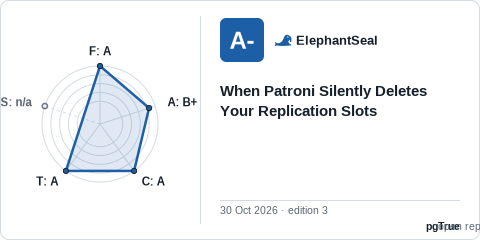
Factual A · Applicable B+ · Consistent A · Transparent A · Safe —

ReportTechnical fact-check, edition 3 pgTrue versionaudited with v1.0.17 (approx.) · regraded with v1.1.3 Issued EditionUpdated after review. Corrections are listed below. SubmittedSubmitted by the PostgresAI team. Author responseNo written reply from the author. We re-audited this article 4 times; see Revisions below. Policy: right-of-reply and corrections policy.

InaccuraciesNone in this edition.

Dangerous or recipe bugsNone in this edition.

Misleading / imprecise

F8

Editing bootstrap.dcs does not protect slots in an existing cluster

MISLEADINGApplicable · holds up after review

Claim ledger

Article says
…bootstrap: dcs: ignore_slots: type: logical…
What is true
Editing bootstrap.dcs does not update an existing cluster. Patroni 4.1.3 documents this in docs/yaml_configuration.rst:66–68. Use patronictl edit-config or the REST API. Following the displayed configuration scope leaves the migration slots without the intended protection.
So what
Set ignore_slots in the existing cluster's dynamic configuration with patronictl edit-config or the REST API.
Charitable reading
The example can initialize a fresh cluster. The article presents it as a fix during an existing migration.

Source

Source · patroni@v4.1.3 · patroni/postgresql/slots.py:368-371for name in set(self._replication_slots) - set(slots): if not global_config.is_paused and not self.ignore_replication_slot(cluster, name): logger.info("Trying to drop unknown replication slot '%s'", name) self._drop_replication_slot(name)
In the article · section “The Fix: ignore_slots”

In the article

excerpt · section “The Fix: ignore_slots” · as fetched 2026-10-21 · open in article ↗ (opens in new tab)

The Fix: ignore_slots

bootstrap: dcs: ignore_slots: type: logical
All sources and excerpts · 3
Evidence for name in set(self._replication_slots) - set(slots): if not global_config.is_paused and not self.ignore_replication_slot(cluster, name): logger.info("Trying to drop unknown replication slot '%s'", name) self._drop_replication_slot(name)
Evidence Once Patroni has initialized the cluster for the first time and settings have been stored in the DCS, all future changes to the ``bootstrap.dcs`` section of the YAML configuration will not take any effect! If you want to change them please use either :ref:`patronictl_edit_config` or the Patroni :ref:`REST API <rest_api>`.
Evidence The values configured under ``bootstrap.dcs`` are only used when bootstrapping a fresh cluster.
How the review tested this

Review: We considered whether applying the configuration meant a separate dynamic update. That could explain success, but the displayed bootstrap.dcs example omits that step. The concrete replacement action and wasted-work consequence remain supported. We considered fresh-cluster initialization and the unspecified application step. The example explicitly uses bootstrap.dcs during an existing migration. E-18 rejects subsequent edits there. The replacement command and wasted-work consequence are concrete.

Verified accurate

F4

ignore_slots matches externally managed replication slots

ACCURATEFactual · holds up after review

Claim ledger

Article says
Patroni supports a configuration option called ignore_slots…
What is true
Patroni v4.1.3 implements ignore_slots matching in patroni/postgresql/slots.py:307-315. Matchers can constrain name, database, plugin, and type. The unknown-slot cleanup branch skips matching slots at lines 368-371.
Charitable reading
We checked the option's existence and matching behavior separately from the proposed configuration location.

Source

Source · patroni@v4.1.3 · patroni/postgresql/slots.py:368-371for name in set(self._replication_slots) - set(slots): if not global_config.is_paused and not self.ignore_replication_slot(cluster, name): logger.info("Trying to drop unknown replication slot '%s'", name) self._drop_replication_slot(name)
In the article · section “The Fix: ignore_slots”

In the article

excerpt · section “The Fix: ignore_slots” · as fetched 2026-10-21 · open in article ↗ (opens in new tab)

The Fix: ignore_slots

The solution was to tell Patroni about our replication slots so it would leave them alone. Patroni supports a configuration option called ignore_slots in the config.yml file. You can use this to list the slots Patroni should never touch, even if it does not manage them.

bootstrap: dcs: ignore_slots: type: logical
All sources and excerpts · 3
Evidence for name in set(self._replication_slots) - set(slots): if not global_config.is_paused and not self.ignore_replication_slot(cluster, name): logger.info("Trying to drop unknown replication slot '%s'", name) self._drop_replication_slot(name)
Evidence- **ignore\_slots**: list of sets of replication slot properties for which Patroni should ignore matching slots. This configuration/feature/etc. is useful when some replication slots are managed outside of Patroni. Any subset of matching properties will cause a slot to be ignored.
Evidence slot = self._replication_slots[name] if cluster.config: for matcher in global_config.ignore_slots_matchers: if ( (matcher.get("name") is None or matcher["name"] == name) and all(not matcher.get(a) or matcher[a] == slot.get(a) for a in ('database', 'plugin', 'type')) ): return True
How the review tested this

Review: We checked whether matching requires a slot name or additional logical-slot properties. It does not. The code supports type-only matching and skips matching unknown slots. We tested whether matching requires a slot name. E-9 permits omitted names and type-only matching. F4 correctly limits protection to unknown-slot cleanup.

F5

Unused replication slots can retain WAL and exhaust storage

ACCURATEFactual · holds up after review

Claim ledger

Article says
…they can block WAL cleanup…
What is true
Replication slots retain required WAL without a connected consumer. REL_18_4 documents this in doc/src/sgml/logicaldecoding.sgml:351-355. doc/src/sgml/high-availability.sgml:953-955 warns that retained WAL can exhaust pg_wal storage.
Charitable reading
The article says slots can block cleanup. It does not claim every slot exhausts storage.

Source

Source · REL_18_4 · doc/src/sgml/logicaldecoding.sgml:351-355Replication slots persist across crashes and know nothing about the state of their consumer(s). They will prevent removal of required resources even when there is no connection using them. This consumes storage because neither required WAL nor required rows from the system catalogs can be removed by <command>VACUUM</command> as long as they are required by a replication
In the article · section “The Real Culprit: Patroni”

In the article

excerpt · section “The Real Culprit: Patroni” · as fetched 2026-10-21 · open in article ↗ (opens in new tab)

The Real Culprit: Patroni

This behavior exists because Patroni is designed to have full control over the cluster. It does not want stale or unknown slots hanging around, since they can block WAL cleanup and cause disk to fill up. That makes sense from a cluster management perspective, but it can really catch you off guard during a migration.

All sources and excerpts · 2
Evidence Replication slots persist across crashes and know nothing about the state of their consumer(s). They will prevent removal of required resources even when there is no connection using them. This consumes storage because neither required WAL nor required rows from the system catalogs can be removed by <command>VACUUM</command> as long as they are required by a replication
Evidence Beware that replication slots can cause the server to retain so many WAL segments that they fill up the space allocated for <literal>pg_wal</literal>.
How the review tested this

Review: We checked whether configurable WAL limits defeat the claim. They do not defeat its conditional wording. Both retention without consumers and possible storage exhaustion appear in REL_18_4. We checked whether retention requires a connected consumer and whether exhaustion is inevitable. E-12 supports disconnected retention. The article and finding both describe a possibility.

F6

Persistent replication slots survive server restarts

ACCURATEFactual · holds up after review

Claim ledger

Article says
…permanent slots are supposed to survive restarts…
What is true
Persistent replication slots outlive their connections and survive crashes. REL_18_4 states this in doc/src/sgml/logicaldecoding.sgml:285-287. A restart alone does not explain removal of an established persistent slot.
Charitable reading
The claim describes persistence across restart. It does not promise immunity from administrative deletion.

Source

Source · REL_18_4 · doc/src/sgml/logicaldecoding.sgml:285-287A replication slot has an identifier that is unique across all databases in a <productname>PostgreSQL</productname> cluster. Slots persist independently of the connection using them and are crash-safe.
In the article

In the article

Article · exact quote · open in article ↗ (opens in new tab)…permanent slots are supposed to survive restarts…
All sources and excerpts · 2
Evidence A replication slot has an identifier that is unique across all databases in a <productname>PostgreSQL</productname> cluster. Slots persist independently of the connection using them and are crash-safe.
Evidence * Slots need to be permanent (to allow restarts), crash-safe, and allocatable
How the review tested this

Review: We tested persistence against crash recovery and administrative deletion. The finding correctly limits itself to established persistent slots. It does not establish the incident's cause. We distinguished normal restart persistence from immunity to administrative deletion. E-15 supports persistence and crash safety. F6 makes no claim about the incident's cause.

F7

Temporary replication slots disappear when their session finishes

ACCURATEFactual · holds up after review

Claim ledger

Article says
Temporary slots are expected to disappear after a session ends…
What is true
Temporary replication slots are not saved to disk. PostgreSQL drops them on error or session completion. REL_18_4 documents both conditions in doc/src/sgml/protocol.sgml:2261-2263.
Charitable reading
The article identifies session termination as an expected removal condition, without excluding earlier removal on error.

Source

Source · REL_18_4 · doc/src/sgml/protocol.sgml:2261-2263Specify that this replication slot is a temporary one. Temporary slots are not saved to disk and are automatically dropped on error or when the session has finished.
In the article

In the article

Article · exact quote · open in article ↗ (opens in new tab)Temporary slots are expected to disappear after a session ends…
All sources and excerpts · 2
Evidence Specify that this replication slot is a temporary one. Temporary slots are not saved to disk and are automatically dropped on error or when the session has finished.
EvidenceSlots marked TEMPORARY will be dropped at the end of a session * or on error.
How the review tested this

Review: We checked whether removal on error contradicts the session-end statement. It does not. Both source references confirm session completion as a removal condition. We checked whether earlier removal on error contradicts the article. The article does not exclude that condition. E-17 confirms removal when the session finishes.

F9

Replication slots can exhaust WAL storage

ACCURATEFactual · holds up after review

Claim ledger

Article says
…cause disk to fill up…
What is true
Replication slots can retain enough WAL to exhaust its allocated storage. REL_18_4 doc/src/sgml/high-availability.sgml:953 warns about this risk.
Charitable reading
The article says slots can exhaust storage. It does not claim every retained slot causes exhaustion.

Source

Source · REL_18_4 · doc/src/sgml/high-availability.sgml:953-955Beware that replication slots can cause the server to retain so many WAL segments that they fill up the space allocated for <literal>pg_wal</literal>.
In the article · section “The Real Culprit: Patroni”

In the article

excerpt · section “The Real Culprit: Patroni” · as fetched 2026-10-21 · open in article ↗ (opens in new tab)

The Real Culprit: Patroni

This behavior exists because Patroni is designed to have full control over the cluster. It does not want stale or unknown slots hanging around, since they can block WAL cleanup and cause disk to fill up. That makes sense from a cluster management perspective, but it can really catch you off guard during a migration.

All sources and excerpts · 1
Evidence Beware that replication slots can cause the server to retain so many WAL segments that they fill up the space allocated for <literal>pg_wal</literal>.
How the review tested this

Review: We checked whether the claim promises inevitable exhaustion. Its surrounding sentence says can. E-24 supports that possibility, although F5 already verifies it. We checked whether the warning concerns allocated WAL storage rather than inevitable whole-disk exhaustion. F9 uses the narrower scope. E-24 supports it.

F10

Patroni implements unknown-slot cleanup

ACCURATEFactual · holds up after review

Claim ledger

Article says
…this is actually a known behavior…
What is true
Patroni can delete unknown replication slots. Version v4.1.3 patroni/postgresql/slots.py:368 checks unknown slots against pause state and ignore rules before attempting deletion.
Charitable reading
This check confirms that unknown-slot cleanup exists. It does not establish what happened in the reported incident.

Source

Source · patroni@v4.1.3 · patroni/postgresql/slots.py:368-371for name in set(self._replication_slots) - set(slots): if not global_config.is_paused and not self.ignore_replication_slot(cluster, name): logger.info("Trying to drop unknown replication slot '%s'", name) self._drop_replication_slot(name)
In the article

In the article

Article · exact quote · open in article ↗ (opens in new tab)…this is actually a known behavior…
All sources and excerpts · 1
Evidence for name in set(self._replication_slots) - set(slots): if not global_config.is_paused and not self.ignore_replication_slot(cluster, name): logger.info("Trying to drop unknown replication slot '%s'", name) self._drop_replication_slot(name)
How the review tested this

Review: We checked whether the finding proves restart-specific behavior or the reported incident. It claims neither. E-26 confirms conditional unknown-slot deletion. We checked whether cleanup existence proves restart-specific causation. It does not. F10 verifies only the cleanup mechanism and preserves its pause and ignore conditions.

Notes

2 not graded: findings no reader would act on differently
F2

Note: “…list the slots Patroni should never touch, even if it does not manage them…”

NOTEpartly holds after review

Claim ledger

Article says
…list the slots Patroni should never touch, even if it does not manage them…
What is true
ignore_slots protects the article's unregistered slots from unknown-slot cleanup. Patroni v4.1.3 can still drop inactive slots with conflicting configured attributes at patroni/postgresql/slots.py:373-379. This exception requires a slots definition absent from the article's setup. The dynamic-configuration documentation also describes matching slots as ignored.
So what
Remove conflicting entries from dynamic slots configuration before relying on ignore_slots for externally managed migration slots.

Source

Source · patroni@v4.1.3 · patroni/postgresql/slots.py:368-371for name in set(self._replication_slots) - set(slots): if not global_config.is_paused and not self.ignore_replication_slot(cluster, name): logger.info("Trying to drop unknown replication slot '%s'", name) self._drop_replication_slot(name)

Not graded: no reader would act differently on it.

In the article · section “The Fix: ignore_slots”

In the article

excerpt · section “The Fix: ignore_slots” · as fetched 2026-10-21 · open in article ↗ (opens in new tab)

The Fix: ignore_slots

The solution was to tell Patroni about our replication slots so it would leave them alone. Patroni supports a configuration option called ignore_slots in the config.yml file. You can use this to list the slots Patroni should never touch, even if it does not manage them.

bootstrap: dcs: ignore_slots: type: logical
All sources and excerpts · 4
Evidence for name in set(self._replication_slots) - set(slots): if not global_config.is_paused and not self.ignore_replication_slot(cluster, name): logger.info("Trying to drop unknown replication slot '%s'", name) self._drop_replication_slot(name)
Evidence- **ignore\_slots**: list of sets of replication slot properties for which Patroni should ignore matching slots. This configuration/feature/etc. is useful when some replication slots are managed outside of Patroni. Any subset of matching properties will cause a slot to be ignored.
Evidence # drop slots with matching names but attributes that do not match, e.g. `plugin` or `database`. for name, value in slots.items(): if name in self._replication_slots and not compare_slots(value, self._replication_slots[name]): logger.info("Trying to drop replication slot '%s' because value is changing from %s to %s", name, self._replication_slots[name], value) if self.drop_replication_slot(name) == (False, True): self._replication_slots.pop(name)
Evidence slot = self._replication_slots[name] if cluster.config: for matcher in global_config.ignore_slots_matchers: if ( (matcher.get("name") is None or matcher["name"] == name) and all(not matcher.get(a) or matcher[a] == slot.get(a) for a in ('database', 'plugin', 'type')) ): return True
How the review tested this

Review: The conflicting-definition branch exists, but the article describes unregistered slots. E-19 also describes ignore_slots protection broadly. The proposed action addresses a different configuration. Retain the exception as a note. The conflicting-attributes branch exists. However, E-19 gives the same broad assurance as the article. The article describes unregistered migration slots. F2 introduces a conflicting managed-slot definition. Retain that exception as a note.

F3

Patroni excludes temporary and native failover slots

NOTEholds up after review

Claim ledger

Article says
…it drops all replication slots that it does not recognize as its own…
What is true
Patroni v4.1.3 excludes temporary slots from discovery on PostgreSQL 10 and later. It also excludes native failover slots on PostgreSQL 17 and later. patroni/postgresql/slots.py:276-279 constructs those filters. The article's word all omits these exceptions.
Charitable reading
The description fits ordinary unmanaged persistent slots. It does not cover every replication slot.

Source

Source · patroni@v4.1.3 · patroni/postgresql/slots.py:276-279filter_columns = tuple(fltr for fltr, major in (('temporary', 100000), ('failover', 170000)) if self._postgresql.major_version >= major) where_filter = ' AND '.join(map(lambda col: f'NOT {col}', filter_columns)) where_condition = f' WHERE {where_filter}' if where_filter else ''

Not graded: no reader would act differently on it.

In the article

In the article

Article · exact quote · open in article ↗ (opens in new tab)…it drops all replication slots that it does not recognize as its own…
All sources and excerpts · 1
Evidence filter_columns = tuple(fltr for fltr, major in (('temporary', 100000), ('failover', 170000)) if self._postgresql.major_version >= major) where_filter = ' AND '.join(map(lambda col: f'NOT {col}', filter_columns)) where_condition = f' WHERE {where_filter}' if where_filter else ''
How the review tested this

Review: We tested the charitable reading that all refers to the incident's ordinary persistent slots. The filters confirm both exceptions. A note preserves that scope without grading the omission. We checked whether the version thresholds actually exclude both slot classes. The query filters confirm both exceptions. Note severity respects the article's ordinary persistent-slot context.

More in this report

Section checks · 3 sections

Section checks

AspectGradeFindingsCoverage
Restart incidentA2 verified-accurate100% of claims (2 of 2, plus 7 that need data we do not have)
Patroni cleanupA3 verified-accurate100% of claims (5 of 5, plus 4 that need data we do not have)
ignore_slots fixB+1 misleading · 1 verified-accurate100% of claims (8 of 8, plus 1 that need data we do not have)
Coverage and assessment · Checked 17 of 17 Postgres claims across 8 sections

A- — the findings address the article's main subject. What we did not check is listed below. The checks directly test Patroni v4.1.3 slot cleanup, ignore_slots protection, and configuration changes for existing clusters.

We did not check everything in this article. What we did not check is listed below, in the words we recorded at the time. None of it moved the letter. We never charge our own limits to the article.

What we did not check

  • We did not verify the incident's logs, slot definitions, or configuration changes.
  • We did not verify the YAML example's original indentation or list markers.
  • We did not verify the migration topology, replication method, slot creation, or configuration history from incident records.
  • We could not verify the article's PostgreSQL and Patroni log descriptions.
  • We did not establish changes after Patroni 4.1.3.
  • We did not reach the article's shortened link.
  • We did not verify the reported restart, slot disappearance, log contents, lag, or successful recovery without the incident records.
  • We did not verify the original YAML indentation and list markers from the article's extracted text.
  • We could not decide whether the evidence backs the central claim.
Checked 17 of 17 Postgres claims across 8 sections
  • Introduction: 3 claims are the author's own account; nothing checkable; not counted: 4 not a claim
  • Setup: 1 of 1 Postgres claims checked, plus 4 that need data we do not have; not counted: 1 product or opinion, 2 duplicate, 2 not a claim
  • Restart incident: 2 of 2 Postgres claims checked, plus 7 that need data we do not have; not counted: 1 product or opinion, 2 not a claim
  • Patroni cleanup: 5 of 5 Postgres claims checked, plus 4 that need data we do not have; not counted: 4 product or opinion, 1 duplicate, 2 not a claim
  • ignore_slots fix: 8 of 8 Postgres claims checked, plus 1 that need data we do not have; not counted: 1 product or opinion, 1 not a claim
  • Takeaways: 1 of 1 Postgres claims checked; not counted: 2 product or opinion, 1 duplicate, 2 not a claim
  • Service promotion: no checkable claims; not counted: 5 product or opinion
  • Navigation: no checkable claims; not counted: 2 not a claim

Average of 4 axes: 3.83 · result A-

Some explanatory text is not shown in this edition; the grade and findings are complete.

Scorecard · the five axes
FACTS scorecard Scorecard radar, 5 axes, bigger is better. Overall A-. Factual A · 0 wrong of 7 checked · 0 caveats. Applicable B+ · 1 wrong of 6 checked · 0 caveats. Consistent A · 0 wrong of 7 checked · 0 caveats. Transparent A · 0 wrong of 5 checked · 0 caveats. Safe 2 checked, too few for a letter. A 0 wrong of 7 checked · 0 caveatsFactual A0 wrong of 70 caveats B+ 1 wrong of 6 checked · 0 caveatsApplicable B+1 wrong of 60 caveats A 0 wrong of 7 checked · 0 caveatsConsistent A0 wrong of 70 caveats A 0 wrong of 5 checked · 0 caveatsTransparent A0 wrong of 50 caveats 2 checked, too few for a letterSafe n/a0 wrong of 20 caveats A-

By topic: Restart incident — 2 findings, 0 wrong · Patroni cleanup — 3 findings, 0 wrong · ignore_slots fix — 2 findings, 1 wrong

Further out is better. Each axis has its own letter, from the wrong claims and caveats among the claims we checked of that kind.

Checked on the FACTS: Factual, Applicable, Consistent, Transparent, Safe. Clockwise: Factual (is it true?), Applicable (does it apply to my setup, today?), Consistent (does it agree with itself?), Transparent (can I check it myself?), Safe (can I run this on prod?).

We checked 7 claims.

AxisLetterWrongCaveatsCheckedCoverage
FactualA007assessed: A · 0 wrong of 7 checked · 0 caveats
ApplicableB+106assessed: B+ · 1 wrong of 6 checked · 0 caveats
ConsistentA007assessed: A · 0 wrong of 7 checked · 0 caveats
TransparentA005assessed: A · 0 wrong of 5 checked · 0 caveats
Safe—002assessed: 0 wrong · 0 caveats · 2 checked
Topics · 3 topics

Topics

TopicFactualApplicableConsistentTransparentSafe
Restart incident0 issues 2 checked F6 F70 issues 1 checked0 issues 2 checked0 issues 2 checked
Patroni cleanup0 issues 3 checked F5 F9 F100 issues 3 checked0 issues 3 checked0 issues 2 checked
ignore_slots fix0 issues 2 checked F41 issue 2 checked F80 issues 2 checked0 issues 1 checked

Issues found among the claims checked, per topic and axis. Each link goes to the finding behind the count.

Revisions: 5 · D+ -> A- -> A- -> D+ -> A-

We audited this article 5 times. Each row is the final edition of one audit. Letters and findings of earlier revisions stay readable at their own address.

  1. Revision 1 · 2026-10-16 12:29 UTC · D+ · audited with v1.0.8 (approx.)

    Article as first submitted. 4 accurate · 1 wrong · 1 caveat.

    ElephantSeal: D+.

    Changes: First audit. Open: F1 “Changing bootstrap.dcs does not protect slots in an existing cluster” (dangerous); F2 “Patroni does not drop every unrecognized slot” (mostly accurate).

  2. Revision 2 · 2026-10-18 17:54 UTC · A- · audited with v1.0.11 (approx.)

    Same article text, re-audited. 4 accurate · 1 wrong · 0 caveats.

    ElephantSeal: A-.

    Changes: No longer reported: “Changing bootstrap.dcs does not protect slots in an existing cluster”; “Patroni does not drop every unrecognized slot”. New: F6 “…bootstrap: dcs: ignore_slots: type: logical…” (misleading).

  3. Revision 3 · 2026-10-18 21:51 UTC · A- · audited with v1.0.12 (approx.)

    Same article text, re-audited. 4 accurate · 1 wrong · 0 caveats.

    ElephantSeal: A-.

    Changes: No longer reported: “…bootstrap: dcs: ignore_slots: type: logical…”. New: F7 “The displayed bootstrap.dcs change does not update an existing cluster” (misleading).

  4. Revision 4 · 2026-10-19 03:28 UTC · D+ · audited with v1.0.13 (approx.)

    Same article text, re-audited. 9 accurate · 2 wrong · 0 caveats.

    ElephantSeal: D+.

    Changes: No longer reported: “The displayed bootstrap.dcs change does not update an existing cluster”. New: F1 “Editing bootstrap.dcs does not protect slots in an existing cluster” (dangerous); F2 “Patroni excludes native failover slots from unknown-slot cleanup” (misleading).

  5. Revision 5 · this page · 2026-10-21 03:56 UTC · A- · audited with v1.0.17 (approx.) · regraded with v1.1.3

    Same article text, re-audited. 6 accurate · 1 wrong · 0 caveats.

    ElephantSeal: A-.

    Changes: No longer reported: “Editing bootstrap.dcs does not protect slots in an existing cluster”; “Patroni excludes native failover slots from unknown-slot cleanup”. New: F8 “Editing bootstrap.dcs does not protect slots in an existing cluster” (misleading).

Questions and answers

Questions and answers

What is pgTrue?

pgTrue is an independent fact-check of technical Postgres articles, made by PostgresAI. It helps you check advice before you use it.

What does the letter grade mean?

The letter grade summarizes the claims we checked. Five axes show what we checked:

  • Factual: is it true?
  • Applicable: does it apply to my setup, today?
  • Consistent: does it agree with itself?
  • Transparent: can I check it myself?
  • Safe: can I run this in production?

What is the ElephantSeal?

The ElephantSeal is the mark an article earns. It always shows the latest edition. “Open:” lists what is still open.

Can an author reply?

Authors can ask us to correct a finding, reply to it, or withdraw it. Right-of-reply policy.

Paste into your AI assistant to fix the article, then ask for a re-review.

Show the text
Fix the article with this report, then ask pgTrue for a re-review.

# pgTrue report: When Patroni Silently Deletes Your Replication Slots

Article title: When Patroni Silently Deletes Your Replication Slots
Article URL: https://stormatics.tech/blogs/when-patroni-silently-deletes-your-replication-slots
Report URL: https://pgtrue.postgres.ai/shared/brief/571f87b8-0152-4347-a6d4-2434a0c4dbd7
Audited revision: 5 of 5, 2026-10-21 03:56:23 UTC
Overall letter: A-

## Axes

- Factual: A · 0 wrong · 7 checked · 0 caveats · assessed
- Applicable: B+ · 1 wrong · 6 checked · 0 caveats · assessed
- Consistent: A · 0 wrong · 7 checked · 0 caveats · assessed
- Transparent: A · 0 wrong · 5 checked · 0 caveats · assessed
- Safe: — · 0 wrong · 2 checked · 0 caveats · assessed

ElephantSeal: A-.

## Report metadata

- Report: Technical fact-check, edition 3
- pgTrue version: audited with v1.0.17 (approx.) · regraded with v1.1.3
- Issued: 2026-10-21
- Edition: Updated after review. Corrections are listed below.
- Submitted: Submitted by the PostgresAI team.
- Author response: No written reply from the author. We re-audited this article 4 times; see Revisions below. Policy: [right-of-reply and corrections policy](/pgtrue/security).

## Findings needing a change (1)

### F8 · Misleading · Applicable · Editing bootstrap.dcs does not protect slots in an existing cluster
Location: excerpt · section “The Fix: ignore_slots” · as fetched 2026-10-21 · [open in article](https://stormatics.tech/blogs/when-patroni-silently-deletes-your-replication-slots#:~:text=bootstrap%3A%20dcs%3A%20ignore_slots%3A%20type%3A%20logical)
Article says:
```text
…bootstrap: dcs: ignore_slots: type: logical…
```
What is true:
Editing bootstrap.dcs does not update an existing cluster. Patroni 4.1.3 documents this in docs/yaml_configuration.rst:66–68. Use patronictl edit-config or the REST API. Following the displayed configuration scope leaves the migration slots without the intended protection.
So what:
Set ignore_slots in the existing cluster's dynamic configuration with patronictl edit-config or the REST API.
Charitable reading:
The example can initialize a fresh cluster. The article presents it as a fix during an existing migration.
Review: We considered whether applying the configuration meant a separate dynamic update. That could explain success, but the displayed bootstrap.dcs example omits that step. The concrete replacement action and wasted-work consequence remain supported. We considered fresh-cluster initialization and the unspecified application step. The example explicitly uses bootstrap.dcs during an existing migration. E-18 rejects subsequent edits there. The replacement command and wasted-work consequence are concrete.

Sources:
- [[email protected] · patroni/postgresql/slots.py:368-371](https://github.com/patroni/patroni/blob/d35409952f970d7f33d36d8f868eb20fc1e2a7f7/patroni/postgresql/slots.py#L368-L371)
  Excerpt:
  ```text
  for name in set(self._replication_slots) - set(slots):
            if not global_config.is_paused and not self.ignore_replication_slot(cluster, name):
                logger.info("Trying to drop unknown replication slot '%s'", name)
                self._drop_replication_slot(name)
  ```
- [[email protected] · docs/yaml_configuration.rst:66-68](https://github.com/patroni/patroni/blob/d35409952f970d7f33d36d8f868eb20fc1e2a7f7/docs/yaml_configuration.rst#L66-L68)
  Excerpt:
  ```text
  Once Patroni has initialized the cluster for the first time and settings have been stored in the DCS, all future
    changes to the ``bootstrap.dcs`` section of the YAML configuration will not take any effect! If you want to change
    them please use either :ref:`patronictl_edit_config` or the Patroni :ref:`REST API <rest_api>`.
  ```
- [[email protected] · docs/faq.rst:126-126](https://github.com/patroni/patroni/blob/d35409952f970d7f33d36d8f868eb20fc1e2a7f7/docs/faq.rst#L126-L126)
  Excerpt:
  ```text
  The values configured under ``bootstrap.dcs`` are only used when bootstrapping a fresh cluster.
  ```

Finding URL: https://pgtrue.postgres.ai/shared/brief/571f87b8-0152-4347-a6d4-2434a0c4dbd7#F8

## Verified accurate claims (6)

### F4 · Accurate · Factual · ignore_slots matches externally managed replication slots
Location: excerpt · section “The Fix: ignore_slots” · as fetched 2026-10-21 · [open in article](https://stormatics.tech/blogs/when-patroni-silently-deletes-your-replication-slots#:~:text=Patroni%20supports%20a%20configuration%20option%20called%20ignore_slots)
Article says:
```text
Patroni supports a configuration option called ignore_slots…
```
What is true:
Patroni v4.1.3 implements ignore_slots matching in patroni/postgresql/slots.py:307-315. Matchers can constrain name, database, plugin, and type. The unknown-slot cleanup branch skips matching slots at lines 368-371.
Charitable reading:
We checked the option's existence and matching behavior separately from the proposed configuration location.
Review: We checked whether matching requires a slot name or additional logical-slot properties. It does not. The code supports type-only matching and skips matching unknown slots. We tested whether matching requires a slot name. E-9 permits omitted names and type-only matching. F4 correctly limits protection to unknown-slot cleanup.

Sources:
- [[email protected] · patroni/postgresql/slots.py:368-371](https://github.com/patroni/patroni/blob/d35409952f970d7f33d36d8f868eb20fc1e2a7f7/patroni/postgresql/slots.py#L368-L371)
  Excerpt:
  ```text
  for name in set(self._replication_slots) - set(slots):
            if not global_config.is_paused and not self.ignore_replication_slot(cluster, name):
                logger.info("Trying to drop unknown replication slot '%s'", name)
                self._drop_replication_slot(name)
  ```
- [[email protected] · docs/dynamic_configuration.rst:69-69](https://github.com/patroni/patroni/blob/d35409952f970d7f33d36d8f868eb20fc1e2a7f7/docs/dynamic_configuration.rst#L69-L69)
  Excerpt:
  ```text
  -  **ignore\_slots**: list of sets of replication slot properties for which Patroni should ignore matching slots. This configuration/feature/etc. is useful when some replication slots are managed outside of Patroni. Any subset of matching properties will cause a slot to be ignored.
  ```
- [[email protected] · patroni/postgresql/slots.py:307-315](https://github.com/patroni/patroni/blob/d35409952f970d7f33d36d8f868eb20fc1e2a7f7/patroni/postgresql/slots.py#L307-L315)
  Excerpt:
  ```text
  slot = self._replication_slots[name]
        if cluster.config:
            for matcher in global_config.ignore_slots_matchers:
                if (
                        (matcher.get("name") is None or matcher["name"] == name)
                        and all(not matcher.get(a) or matcher[a] == slot.get(a)
                                for a in ('database', 'plugin', 'type'))
                ):
                    return True
  ```

Finding URL: https://pgtrue.postgres.ai/shared/brief/571f87b8-0152-4347-a6d4-2434a0c4dbd7#F4

### F5 · Accurate · Factual · Unused replication slots can retain WAL and exhaust storage
Location: excerpt · section “The Real Culprit: Patroni” · as fetched 2026-10-21 · [open in article](https://stormatics.tech/blogs/when-patroni-silently-deletes-your-replication-slots#:~:text=they%20can%20block%20WAL%20cleanup)
Article says:
```text
…they can block WAL cleanup…
```
What is true:
Replication slots retain required WAL without a connected consumer. REL_18_4 documents this in doc/src/sgml/logicaldecoding.sgml:351-355. doc/src/sgml/high-availability.sgml:953-955 warns that retained WAL can exhaust pg_wal storage.
Charitable reading:
The article says slots can block cleanup. It does not claim every slot exhausts storage.
Review: We checked whether configurable WAL limits defeat the claim. They do not defeat its conditional wording. Both retention without consumers and possible storage exhaustion appear in REL_18_4. We checked whether retention requires a connected consumer and whether exhaustion is inevitable. E-12 supports disconnected retention. The article and finding both describe a possibility.

Sources:
- [REL_18_4 · doc/src/sgml/logicaldecoding.sgml:351-355](https://github.com/postgres/postgres/blob/f5cc81719e6da4cbdb1f797c48b693e91018153a/doc/src/sgml/logicaldecoding.sgml#L351-L355)
  Excerpt:
  ```text
  Replication slots persist across crashes and know nothing about the state
      of their consumer(s). They will prevent removal of required resources
      even when there is no connection using them. This consumes storage
      because neither required WAL nor required rows from the system catalogs
      can be removed by <command>VACUUM</command> as long as they are required by a replication
  ```
- [REL_18_4 · doc/src/sgml/high-availability.sgml:953-955](https://github.com/postgres/postgres/blob/f5cc81719e6da4cbdb1f797c48b693e91018153a/doc/src/sgml/high-availability.sgml#L953-L955)
  Excerpt:
  ```text
  Beware that replication slots can cause the server to retain so
     many WAL segments that they fill up the space allocated for
     <literal>pg_wal</literal>.
  ```

Finding URL: https://pgtrue.postgres.ai/shared/brief/571f87b8-0152-4347-a6d4-2434a0c4dbd7#F5

### F6 · Accurate · Factual · Persistent replication slots survive server restarts
Location: Article · exact quote · [open in article](https://stormatics.tech/blogs/when-patroni-silently-deletes-your-replication-slots#:~:text=permanent%20slots%20are%20supposed%20to%20survive%20restarts)
Article says:
```text
…permanent slots are supposed to survive restarts…
```
What is true:
Persistent replication slots outlive their connections and survive crashes. REL_18_4 states this in doc/src/sgml/logicaldecoding.sgml:285-287. A restart alone does not explain removal of an established persistent slot.
Charitable reading:
The claim describes persistence across restart. It does not promise immunity from administrative deletion.
Review: We tested persistence against crash recovery and administrative deletion. The finding correctly limits itself to established persistent slots. It does not establish the incident's cause. We distinguished normal restart persistence from immunity to administrative deletion. E-15 supports persistence and crash safety. F6 makes no claim about the incident's cause.

Sources:
- [REL_18_4 · doc/src/sgml/logicaldecoding.sgml:285-287](https://github.com/postgres/postgres/blob/f5cc81719e6da4cbdb1f797c48b693e91018153a/doc/src/sgml/logicaldecoding.sgml#L285-L287)
  Excerpt:
  ```text
  A replication slot has an identifier that is unique across all databases
     in a <productname>PostgreSQL</productname> cluster. Slots persist
     independently of the connection using them and are crash-safe.
  ```
- [REL_18_4 · src/backend/replication/slot.c:19-19](https://github.com/postgres/postgres/blob/f5cc81719e6da4cbdb1f797c48b693e91018153a/src/backend/replication/slot.c#L19-L19)
  Excerpt:
  ```text
  * Slots need to be permanent (to allow restarts), crash-safe, and allocatable
  ```

Finding URL: https://pgtrue.postgres.ai/shared/brief/571f87b8-0152-4347-a6d4-2434a0c4dbd7#F6

### F7 · Accurate · Factual · Temporary replication slots disappear when their session finishes
Location: Article · exact quote · [open in article](https://stormatics.tech/blogs/when-patroni-silently-deletes-your-replication-slots#:~:text=Temporary%20slots%20are%20expected%20to%20disappear%20after%20a%20session%20ends)
Article says:
```text
Temporary slots are expected to disappear after a session ends…
```
What is true:
Temporary replication slots are not saved to disk. PostgreSQL drops them on error or session completion. REL_18_4 documents both conditions in doc/src/sgml/protocol.sgml:2261-2263.
Charitable reading:
The article identifies session termination as an expected removal condition, without excluding earlier removal on error.
Review: We checked whether removal on error contradicts the session-end statement. It does not. Both source references confirm session completion as a removal condition. We checked whether earlier removal on error contradicts the article. The article does not exclude that condition. E-17 confirms removal when the session finishes.

Sources:
- [REL_18_4 · doc/src/sgml/protocol.sgml:2261-2263](https://github.com/postgres/postgres/blob/f5cc81719e6da4cbdb1f797c48b693e91018153a/doc/src/sgml/protocol.sgml#L2261-L2263)
  Excerpt:
  ```text
  Specify that this replication slot is a temporary one. Temporary
          slots are not saved to disk and are automatically dropped on error
          or when the session has finished.
  ```
- [REL_18_4 · src/include/replication/slot.h:28-29](https://github.com/postgres/postgres/blob/f5cc81719e6da4cbdb1f797c48b693e91018153a/src/include/replication/slot.h#L28-L29)
  Excerpt:
  ```text
  Slots marked TEMPORARY will be dropped at the end of a session
 * or on error.
  ```

Finding URL: https://pgtrue.postgres.ai/shared/brief/571f87b8-0152-4347-a6d4-2434a0c4dbd7#F7

### F9 · Accurate · Factual · Replication slots can exhaust WAL storage
Location: excerpt · section “The Real Culprit: Patroni” · as fetched 2026-10-21 · [open in article](https://stormatics.tech/blogs/when-patroni-silently-deletes-your-replication-slots#:~:text=cause%20disk%20to%20fill%20up)
Article says:
```text
…cause disk to fill up…
```
What is true:
Replication slots can retain enough WAL to exhaust its allocated storage. REL_18_4 doc/src/sgml/high-availability.sgml:953 warns about this risk.
Charitable reading:
The article says slots can exhaust storage. It does not claim every retained slot causes exhaustion.
Review: We checked whether the claim promises inevitable exhaustion. Its surrounding sentence says can. E-24 supports that possibility, although F5 already verifies it. We checked whether the warning concerns allocated WAL storage rather than inevitable whole-disk exhaustion. F9 uses the narrower scope. E-24 supports it.

Sources:
- [REL_18_4 · doc/src/sgml/high-availability.sgml:953-955](https://github.com/postgres/postgres/blob/f5cc81719e6da4cbdb1f797c48b693e91018153a/doc/src/sgml/high-availability.sgml#L953-L955)
  Excerpt:
  ```text
  Beware that replication slots can cause the server to retain so
     many WAL segments that they fill up the space allocated for
     <literal>pg_wal</literal>.
  ```

Finding URL: https://pgtrue.postgres.ai/shared/brief/571f87b8-0152-4347-a6d4-2434a0c4dbd7#F9

### F10 · Accurate · Factual · Patroni implements unknown-slot cleanup
Location: Article · exact quote · [open in article](https://stormatics.tech/blogs/when-patroni-silently-deletes-your-replication-slots#:~:text=this%20is%20actually%20a%20known%20behavior)
Article says:
```text
…this is actually a known behavior…
```
What is true:
Patroni can delete unknown replication slots. Version v4.1.3 patroni/postgresql/slots.py:368 checks unknown slots against pause state and ignore rules before attempting deletion.
Charitable reading:
This check confirms that unknown-slot cleanup exists. It does not establish what happened in the reported incident.
Review: We checked whether the finding proves restart-specific behavior or the reported incident. It claims neither. E-26 confirms conditional unknown-slot deletion. We checked whether cleanup existence proves restart-specific causation. It does not. F10 verifies only the cleanup mechanism and preserves its pause and ignore conditions.

Sources:
- [[email protected] · patroni/postgresql/slots.py:368-371](https://github.com/patroni/patroni/blob/d35409952f970d7f33d36d8f868eb20fc1e2a7f7/patroni/postgresql/slots.py#L368-L371)
  Excerpt:
  ```text
  for name in set(self._replication_slots) - set(slots):
            if not global_config.is_paused and not self.ignore_replication_slot(cluster, name):
                logger.info("Trying to drop unknown replication slot '%s'", name)
                self._drop_replication_slot(name)
  ```

Finding URL: https://pgtrue.postgres.ai/shared/brief/571f87b8-0152-4347-a6d4-2434a0c4dbd7#F10

## Notes (not graded) (2)

### F2 · Note ·  · Note: “…list the slots Patroni should never touch, even if it does not manage them…”
Location: excerpt · section “The Fix: ignore_slots” · as fetched 2026-10-21 · [open in article](https://stormatics.tech/blogs/when-patroni-silently-deletes-your-replication-slots#:~:text=list%20the%20slots%20Patroni%20should,it%20does%20not%20manage%20them)
Article says:
```text
…list the slots Patroni should never touch, even if it does not manage them…
```
What is true:
ignore_slots protects the article's unregistered slots from unknown-slot cleanup. Patroni v4.1.3 can still drop inactive slots with conflicting configured attributes at patroni/postgresql/slots.py:373-379. This exception requires a slots definition absent from the article's setup. The dynamic-configuration documentation also describes matching slots as ignored.
So what:
Remove conflicting entries from dynamic slots configuration before relying on ignore_slots for externally managed migration slots.
Explanation: Not graded: no reader would act differently on it.
Review: The conflicting-definition branch exists, but the article describes unregistered slots. E-19 also describes ignore_slots protection broadly. The proposed action addresses a different configuration. Retain the exception as a note. The conflicting-attributes branch exists. However, E-19 gives the same broad assurance as the article. The article describes unregistered migration slots. F2 introduces a conflicting managed-slot definition. Retain that exception as a note.

Sources:
- [[email protected] · patroni/postgresql/slots.py:368-371](https://github.com/patroni/patroni/blob/d35409952f970d7f33d36d8f868eb20fc1e2a7f7/patroni/postgresql/slots.py#L368-L371)
  Excerpt:
  ```text
  for name in set(self._replication_slots) - set(slots):
            if not global_config.is_paused and not self.ignore_replication_slot(cluster, name):
                logger.info("Trying to drop unknown replication slot '%s'", name)
                self._drop_replication_slot(name)
  ```
- [[email protected] · docs/dynamic_configuration.rst:69-69](https://github.com/patroni/patroni/blob/d35409952f970d7f33d36d8f868eb20fc1e2a7f7/docs/dynamic_configuration.rst#L69-L69)
  Excerpt:
  ```text
  -  **ignore\_slots**: list of sets of replication slot properties for which Patroni should ignore matching slots. This configuration/feature/etc. is useful when some replication slots are managed outside of Patroni. Any subset of matching properties will cause a slot to be ignored.
  ```
- [[email protected] · patroni/postgresql/slots.py:373-379](https://github.com/patroni/patroni/blob/d35409952f970d7f33d36d8f868eb20fc1e2a7f7/patroni/postgresql/slots.py#L373-L379)
  Excerpt:
  ```text
  # drop slots with matching names but attributes that do not match, e.g. `plugin` or `database`.
        for name, value in slots.items():
            if name in self._replication_slots and not compare_slots(value, self._replication_slots[name]):
                logger.info("Trying to drop replication slot '%s' because value is changing from %s to %s",
                            name, self._replication_slots[name], value)
                if self.drop_replication_slot(name) == (False, True):
                    self._replication_slots.pop(name)
  ```
- [[email protected] · patroni/postgresql/slots.py:307-315](https://github.com/patroni/patroni/blob/d35409952f970d7f33d36d8f868eb20fc1e2a7f7/patroni/postgresql/slots.py#L307-L315)
  Excerpt:
  ```text
  slot = self._replication_slots[name]
        if cluster.config:
            for matcher in global_config.ignore_slots_matchers:
                if (
                        (matcher.get("name") is None or matcher["name"] == name)
                        and all(not matcher.get(a) or matcher[a] == slot.get(a)
                                for a in ('database', 'plugin', 'type'))
                ):
                    return True
  ```

Finding URL: https://pgtrue.postgres.ai/shared/brief/571f87b8-0152-4347-a6d4-2434a0c4dbd7#F2

### F3 · Note ·  · Patroni excludes temporary and native failover slots
Location: Article · exact quote · [open in article](https://stormatics.tech/blogs/when-patroni-silently-deletes-your-replication-slots#:~:text=it%20drops%20all%20replication%20slots,not%20recognize%20as%20its%20own)
Article says:
```text
…it drops all replication slots that it does not recognize as its own…
```
What is true:
Patroni v4.1.3 excludes temporary slots from discovery on PostgreSQL 10 and later. It also excludes native failover slots on PostgreSQL 17 and later. patroni/postgresql/slots.py:276-279 constructs those filters. The article's word all omits these exceptions.
Charitable reading:
The description fits ordinary unmanaged persistent slots. It does not cover every replication slot.
Explanation: Not graded: no reader would act differently on it.
Review: We tested the charitable reading that all refers to the incident's ordinary persistent slots. The filters confirm both exceptions. A note preserves that scope without grading the omission. We checked whether the version thresholds actually exclude both slot classes. The query filters confirm both exceptions. Note severity respects the article's ordinary persistent-slot context.

Sources:
- [[email protected] · patroni/postgresql/slots.py:276-279](https://github.com/patroni/patroni/blob/d35409952f970d7f33d36d8f868eb20fc1e2a7f7/patroni/postgresql/slots.py#L276-L279)
  Excerpt:
  ```text
  filter_columns = tuple(fltr for fltr, major in (('temporary', 100000), ('failover', 170000))
                                   if self._postgresql.major_version >= major)
            where_filter = ' AND '.join(map(lambda col: f'NOT {col}', filter_columns))
            where_condition = f' WHERE {where_filter}' if where_filter else ''
  ```

Finding URL: https://pgtrue.postgres.ai/shared/brief/571f87b8-0152-4347-a6d4-2434a0c4dbd7#F3

## Withdrawn findings (0)

None.

## Section checks

- Restart incident · A · 2 verified-accurate · 100% of claims (2 of 2, plus 7 that need data we do not have)
- Patroni cleanup · A · 3 verified-accurate · 100% of claims (5 of 5, plus 4 that need data we do not have)
- ignore_slots fix · B+ · 1 misleading · 1 verified-accurate · 100% of claims (8 of 8, plus 1 that need data we do not have)

## Claim coverage

- Introduction: 3 claims are the author's own account; nothing checkable; not counted: 4 not a claim
- Setup: 1 of 1 Postgres claims checked, plus 4 that need data we do not have; not counted: 1 product or opinion, 2 duplicate, 2 not a claim
- Restart incident: 2 of 2 Postgres claims checked, plus 7 that need data we do not have; not counted: 1 product or opinion, 2 not a claim
- Patroni cleanup: 5 of 5 Postgres claims checked, plus 4 that need data we do not have; not counted: 4 product or opinion, 1 duplicate, 2 not a claim
- ignore_slots fix: 8 of 8 Postgres claims checked, plus 1 that need data we do not have; not counted: 1 product or opinion, 1 not a claim
- Takeaways: 1 of 1 Postgres claims checked; not counted: 2 product or opinion, 1 duplicate, 2 not a claim
- Service promotion: no checkable claims; not counted: 5 product or opinion
- Navigation: no checkable claims; not counted: 2 not a claim

## What we did not check

- We did not verify the incident's logs, slot definitions, or configuration changes.
- We did not verify the YAML example's original indentation or list markers.
- We did not verify the migration topology, replication method, slot creation, or configuration history from incident records.
- We could not verify the article's PostgreSQL and Patroni log descriptions.
- We did not establish changes after Patroni 4.1.3.
- We did not reach the article's shortened link.
- We did not verify the reported restart, slot disappearance, log contents, lag, or successful recovery without the incident records.
- We did not verify the original YAML indentation and list markers from the article's extracted text.
- We could not decide whether the evidence backs the central claim.

## Notes

- A- — the findings address the article's main subject. What we did not check is listed below. The checks directly test Patroni v4.1.3 slot cleanup, ignore_slots protection, and configuration changes for existing clusters.
- We did not check everything in this article. What we did not check is listed below, in the words we recorded at the time. None of it moved the letter. We never charge our own limits to the article.
- Average of 4 axes: 3.83 · result A-
- Some explanatory text is not shown in this edition; the grade and findings are complete.
- Some checks did not happen for this edition, and each one we know of is listed above.
- Checked against: github.com/postgres/postgres REL_18_4 at commit f5cc81719e6da4cbdb1f797c48b693e91018153a (pinned target); github.com/patroni/patroni v4.1.3 at commit d35409952f970d7f33d36d8f868eb20fc1e2a7f7 (pinned target); https://stormatics.tech/author/semabtariq (fetched 2026-10-21T03:56:41.767584Z); https://stormatics.tech/blogs/file-descriptors-the-os-limit-that-takes-down-postgresql (fetched 2026-10-21T03:56:55.109985Z); https://stormatics.tech/blogs/how-to-run-logical-replication-on-a-production-postgresql-cluster (fetched 2026-10-21T03:56:56.524636Z); https://stormatics.tech/category/blogs (fetched 2026-10-21T03:56:44.947697Z); https://stormatics.tech/category/semabs-planet-postgresql (fetched 2026-10-21T03:56:47.890151Z); https://stormatics.tech/category/service-high-availability-and-disaster-recovery (fetched 2026-10-21T03:56:50.928216Z).
- Article captured 2026-10-21T03:56:23.551648Z · SHA-256 38fd5a3e82a8317e7bdbaece11a8d063e7169b7b1c4c9fb12dc1da0ba3169195 · Text extracted from the article's HTML.
- Policy SHA-256 0790293807c1ac8e6032dde39eb30189198229d851c3daf034d2c483ce9ace2c · Grading rules SHA-256 6fb334e79d6b9e7ed81d3238cc10d9de602ff87ed65ff2fa781f53bac5798765.
- We did not verify the reported migration, restart, slot disappearance, logs, or recovery without incident records.
- We did not verify the YAML example's original indentation or list markers from the extracted article text.
- We checked Patroni v4.1.3 and PostgreSQL REL_18_4. We did not establish behavior changes after those versions.
- We did not reach the article's shortened link.
- source: the article names no postgres release, so it was read at REL_18_4, the latest release when it was published
- source: the article names no patroni release, so it was read at v4.1.3, the latest release when it was published
- review: the findings were written by one model and reviewed independently by a different model.
- 2026-10-30: Regraded under the current grading rules: the letter is the average of the axis letters, with every cap stated under it.
- 3 passages in this edition fell short of our own plain-English rules.
- Built from the article text captured above, 2 pinned source trees, and 6 fetched pages.
- 8 survived · 1 weakened · 0 withdrawn.

## Revision history

- [Revision 1](https://pgtrue.postgres.ai/shared/brief/571f87b8-0152-4347-a6d4-2434a0c4dbd7?v=2) · 2026-10-16 12:29 UTC · D+ · audited with v1.0.8 (approx.)
  Article as first submitted. 4 accurate · 1 wrong · 1 caveat.
  ElephantSeal: D+.
  Changes: First audit. Open: F1 “Changing bootstrap.dcs does not protect slots in an existing cluster” (dangerous); F2 “Patroni does not drop every unrecognized slot” (mostly accurate).
- [Revision 2](https://pgtrue.postgres.ai/shared/brief/571f87b8-0152-4347-a6d4-2434a0c4dbd7?v=4) · 2026-10-18 17:54 UTC · A- · audited with v1.0.11 (approx.)
  Same article text, re-audited. 4 accurate · 1 wrong · 0 caveats.
  ElephantSeal: A-.
  Changes: No longer reported: “Changing bootstrap.dcs does not protect slots in an existing cluster”; “Patroni does not drop every unrecognized slot”. New: F6 “…bootstrap: dcs: ignore_slots: type: logical…” (misleading).
- [Revision 3](https://pgtrue.postgres.ai/shared/brief/571f87b8-0152-4347-a6d4-2434a0c4dbd7?v=6) · 2026-10-18 21:51 UTC · A- · audited with v1.0.12 (approx.)
  Same article text, re-audited. 4 accurate · 1 wrong · 0 caveats.
  ElephantSeal: A-.
  Changes: No longer reported: “…bootstrap: dcs: ignore_slots: type: logical…”. New: F7 “The displayed bootstrap.dcs change does not update an existing cluster” (misleading).
- [Revision 4](https://pgtrue.postgres.ai/shared/brief/571f87b8-0152-4347-a6d4-2434a0c4dbd7?v=8) · 2026-10-19 03:28 UTC · D+ · audited with v1.0.13 (approx.)
  Same article text, re-audited. 9 accurate · 2 wrong · 0 caveats.
  ElephantSeal: D+.
  Changes: No longer reported: “The displayed bootstrap.dcs change does not update an existing cluster”. New: F1 “Editing bootstrap.dcs does not protect slots in an existing cluster” (dangerous); F2 “Patroni excludes native failover slots from unknown-slot cleanup” (misleading).
- [Revision 5](https://pgtrue.postgres.ai/shared/brief/571f87b8-0152-4347-a6d4-2434a0c4dbd7?v=11) · this page · 2026-10-21 03:56 UTC · A- · audited with v1.0.17 (approx.) · regraded with v1.1.3
  Same article text, re-audited. 6 accurate · 1 wrong · 0 caveats.
  ElephantSeal: A-.
  Changes: No longer reported: “Editing bootstrap.dcs does not protect slots in an existing cluster”; “Patroni excludes native failover slots from unknown-slot cleanup”. New: F8 “Editing bootstrap.dcs does not protect slots in an existing cluster” (misleading).

Updated your article? Request a correction. A new edition appears at this address.