Limited beta · What is this?

pgTrue is under active development: reports may contain significant mistakes, inaccuracies, or bugs. Please report anything you find to pgtrue@postgres.ai.

pgTrue is an independent fact-check of technical Postgres articles. Read the questions and answers.

pgTrue fact-check

ElephantSeal A-Limited coverageOpen: the production risk is not yet fixed or warned about

Embed

The ElephantSeal always shows this report's latest edition and links here. Copies cached elsewhere may update later.

[![pgTrue fact-check](https://pgtrue.postgres.ai/badge/4238af86-351b-4d90-bb6e-607a071035e4.svg?v=13&theme=light)](https://pgtrue.postgres.ai/shared/brief/4238af86-351b-4d90-bb6e-607a071035e4)
<a href="https://pgtrue.postgres.ai/shared/brief/4238af86-351b-4d90-bb6e-607a071035e4"><img src="https://pgtrue.postgres.ai/badge/4238af86-351b-4d90-bb6e-607a071035e4.svg?v=13&amp;theme=light" alt="pgTrue fact-check" width="90" height="20" loading="lazy" decoding="async" style="display:inline-block;width:90px;height:20px"></a>
https://pgtrue.postgres.ai/badge/4238af86-351b-4d90-bb6e-607a071035e4.svg?v=13&theme=light
.. image:: https://pgtrue.postgres.ai/badge/4238af86-351b-4d90-bb6e-607a071035e4.svg?v=13&theme=light
   :target: https://pgtrue.postgres.ai/shared/brief/4238af86-351b-4d90-bb6e-607a071035e4
   :alt: pgTrue fact-check
   :width: 90
   :height: 20
[![pgTrue fact-check](https://pgtrue.postgres.ai/badge/4238af86-351b-4d90-bb6e-607a071035e4.svg?v=13&theme=dark)](https://pgtrue.postgres.ai/shared/brief/4238af86-351b-4d90-bb6e-607a071035e4)
<a href="https://pgtrue.postgres.ai/shared/brief/4238af86-351b-4d90-bb6e-607a071035e4"><img src="https://pgtrue.postgres.ai/badge/4238af86-351b-4d90-bb6e-607a071035e4.svg?v=13&amp;theme=dark" alt="pgTrue fact-check" width="90" height="20" loading="lazy" decoding="async" style="display:inline-block;width:90px;height:20px"></a>
https://pgtrue.postgres.ai/badge/4238af86-351b-4d90-bb6e-607a071035e4.svg?v=13&theme=dark
.. image:: https://pgtrue.postgres.ai/badge/4238af86-351b-4d90-bb6e-607a071035e4.svg?v=13&theme=dark
   :target: https://pgtrue.postgres.ai/shared/brief/4238af86-351b-4d90-bb6e-607a071035e4
   :alt: pgTrue fact-check
   :width: 90
   :height: 20
[![pgTrue fact-check](https://pgtrue.postgres.ai/badge/4238af86-351b-4d90-bb6e-607a071035e4.svg?v=13)](https://pgtrue.postgres.ai/shared/brief/4238af86-351b-4d90-bb6e-607a071035e4)
<a href="https://pgtrue.postgres.ai/shared/brief/4238af86-351b-4d90-bb6e-607a071035e4"><img src="https://pgtrue.postgres.ai/badge/4238af86-351b-4d90-bb6e-607a071035e4.svg?v=13" alt="pgTrue fact-check" width="90" height="20" loading="lazy" decoding="async" style="display:inline-block;width:90px;height:20px"></a>
https://pgtrue.postgres.ai/badge/4238af86-351b-4d90-bb6e-607a071035e4.svg?v=13
.. image:: https://pgtrue.postgres.ai/badge/4238af86-351b-4d90-bb6e-607a071035e4.svg?v=13
   :target: https://pgtrue.postgres.ai/shared/brief/4238af86-351b-4d90-bb6e-607a071035e4
   :alt: pgTrue fact-check
   :width: 90
   :height: 20
[![pgTrue fact-check](https://pgtrue.postgres.ai/badge/4238af86-351b-4d90-bb6e-607a071035e4/radar.svg?v=13&theme=light)](https://pgtrue.postgres.ai/shared/brief/4238af86-351b-4d90-bb6e-607a071035e4)

<a href="https://pgtrue.postgres.ai/shared/brief/4238af86-351b-4d90-bb6e-607a071035e4"><img src="https://pgtrue.postgres.ai/badge/4238af86-351b-4d90-bb6e-607a071035e4/radar.svg?v=13&amp;theme=light" alt="pgTrue fact-check" width="240" height="240" loading="lazy" decoding="async" style="display:inline-block;width:240px;height:240px"></a>
https://pgtrue.postgres.ai/badge/4238af86-351b-4d90-bb6e-607a071035e4/radar.svg?v=13&theme=light
.. image:: https://pgtrue.postgres.ai/badge/4238af86-351b-4d90-bb6e-607a071035e4/radar.svg?v=13&theme=light
   :target: https://pgtrue.postgres.ai/shared/brief/4238af86-351b-4d90-bb6e-607a071035e4
   :alt: pgTrue fact-check
   :width: 240
   :height: 240
[![pgTrue fact-check](https://pgtrue.postgres.ai/badge/4238af86-351b-4d90-bb6e-607a071035e4/radar.svg?v=13&theme=dark)](https://pgtrue.postgres.ai/shared/brief/4238af86-351b-4d90-bb6e-607a071035e4)

<a href="https://pgtrue.postgres.ai/shared/brief/4238af86-351b-4d90-bb6e-607a071035e4"><img src="https://pgtrue.postgres.ai/badge/4238af86-351b-4d90-bb6e-607a071035e4/radar.svg?v=13&amp;theme=dark" alt="pgTrue fact-check" width="240" height="240" loading="lazy" decoding="async" style="display:inline-block;width:240px;height:240px"></a>
https://pgtrue.postgres.ai/badge/4238af86-351b-4d90-bb6e-607a071035e4/radar.svg?v=13&theme=dark
.. image:: https://pgtrue.postgres.ai/badge/4238af86-351b-4d90-bb6e-607a071035e4/radar.svg?v=13&theme=dark
   :target: https://pgtrue.postgres.ai/shared/brief/4238af86-351b-4d90-bb6e-607a071035e4
   :alt: pgTrue fact-check
   :width: 240
   :height: 240
[![pgTrue fact-check](https://pgtrue.postgres.ai/badge/4238af86-351b-4d90-bb6e-607a071035e4/radar.svg?v=13)](https://pgtrue.postgres.ai/shared/brief/4238af86-351b-4d90-bb6e-607a071035e4)

<a href="https://pgtrue.postgres.ai/shared/brief/4238af86-351b-4d90-bb6e-607a071035e4"><img src="https://pgtrue.postgres.ai/badge/4238af86-351b-4d90-bb6e-607a071035e4/radar.svg?v=13" alt="pgTrue fact-check" width="240" height="240" loading="lazy" decoding="async" style="display:inline-block;width:240px;height:240px"></a>
https://pgtrue.postgres.ai/badge/4238af86-351b-4d90-bb6e-607a071035e4/radar.svg?v=13
.. image:: https://pgtrue.postgres.ai/badge/4238af86-351b-4d90-bb6e-607a071035e4/radar.svg?v=13
   :target: https://pgtrue.postgres.ai/shared/brief/4238af86-351b-4d90-bb6e-607a071035e4
   :alt: pgTrue fact-check
   :width: 240
   :height: 240
[![pgTrue fact-check](https://pgtrue.postgres.ai/badge/4238af86-351b-4d90-bb6e-607a071035e4/wide.svg?v=13&theme=light)](https://pgtrue.postgres.ai/shared/brief/4238af86-351b-4d90-bb6e-607a071035e4)
<a href="https://pgtrue.postgres.ai/shared/brief/4238af86-351b-4d90-bb6e-607a071035e4"><img src="https://pgtrue.postgres.ai/badge/4238af86-351b-4d90-bb6e-607a071035e4/wide.svg?v=13&amp;theme=light" alt="pgTrue fact-check" width="480" height="240" loading="lazy" decoding="async" style="display:inline-block;width:480px;height:240px"></a>
https://pgtrue.postgres.ai/badge/4238af86-351b-4d90-bb6e-607a071035e4/wide.svg?v=13&theme=light
.. image:: https://pgtrue.postgres.ai/badge/4238af86-351b-4d90-bb6e-607a071035e4/wide.svg?v=13&theme=light
   :target: https://pgtrue.postgres.ai/shared/brief/4238af86-351b-4d90-bb6e-607a071035e4
   :alt: pgTrue fact-check
   :width: 480
   :height: 240
[![pgTrue fact-check](https://pgtrue.postgres.ai/badge/4238af86-351b-4d90-bb6e-607a071035e4/wide.svg?v=13&theme=dark)](https://pgtrue.postgres.ai/shared/brief/4238af86-351b-4d90-bb6e-607a071035e4)
<a href="https://pgtrue.postgres.ai/shared/brief/4238af86-351b-4d90-bb6e-607a071035e4"><img src="https://pgtrue.postgres.ai/badge/4238af86-351b-4d90-bb6e-607a071035e4/wide.svg?v=13&amp;theme=dark" alt="pgTrue fact-check" width="480" height="240" loading="lazy" decoding="async" style="display:inline-block;width:480px;height:240px"></a>
https://pgtrue.postgres.ai/badge/4238af86-351b-4d90-bb6e-607a071035e4/wide.svg?v=13&theme=dark
.. image:: https://pgtrue.postgres.ai/badge/4238af86-351b-4d90-bb6e-607a071035e4/wide.svg?v=13&theme=dark
   :target: https://pgtrue.postgres.ai/shared/brief/4238af86-351b-4d90-bb6e-607a071035e4
   :alt: pgTrue fact-check
   :width: 480
   :height: 240
[![pgTrue fact-check](https://pgtrue.postgres.ai/badge/4238af86-351b-4d90-bb6e-607a071035e4/wide.svg?v=13)](https://pgtrue.postgres.ai/shared/brief/4238af86-351b-4d90-bb6e-607a071035e4)
<a href="https://pgtrue.postgres.ai/shared/brief/4238af86-351b-4d90-bb6e-607a071035e4"><img src="https://pgtrue.postgres.ai/badge/4238af86-351b-4d90-bb6e-607a071035e4/wide.svg?v=13" alt="pgTrue fact-check" width="480" height="240" loading="lazy" decoding="async" style="display:inline-block;width:480px;height:240px"></a>
https://pgtrue.postgres.ai/badge/4238af86-351b-4d90-bb6e-607a071035e4/wide.svg?v=13
.. image:: https://pgtrue.postgres.ai/badge/4238af86-351b-4d90-bb6e-607a071035e4/wide.svg?v=13
   :target: https://pgtrue.postgres.ai/shared/brief/4238af86-351b-4d90-bb6e-607a071035e4
   :alt: pgTrue fact-check
   :width: 480
   :height: 240

Click the snippet to select all of it, then copy. Where SVG is stripped, as in some email clients and feed readers, change .svg to .png. PNG uses the light theme for Auto. For Markdown PNG embeds, use the HTML snippet where supported to preserve the display size.

Optional colours: append &color=26798E or &labelColor=333C47 after a theme query (use ? for the first parameter). Use 3- or 6-digit hex.

For pages with a light background.

For pages with a dark background. The ElephantSeal gets a thin edge so it does not blend in.

Auto follows the reader's light or dark setting where the host supports it, and shows the light ElephantSeal where it does not.

On a light page
On a dark page

Why PostgreSQL Became 50% Slower on Linux 7.0 (opens in new tab)

medium.com
Check before you follow it: 1 claim is wrong.
1
inaccuracy
0
dangerous-recipe
0
misleading
1
imprecise
0
transcription
0
aged
0
withdrawn
5
verified-accurate

Central claim not verified: the reported Linux 7.0 PostgreSQL throughput regression, its scheduling mechanism, and proposed mitigations. We could not verify this, and the article gives no method to reproduce it.

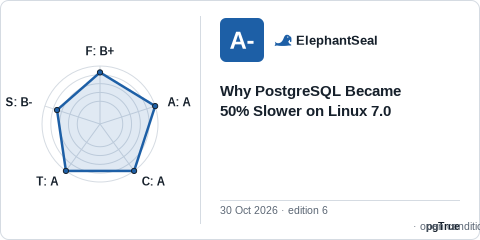
Factual B+ · Applicable A · Consistent A · Transparent A · Safe B−

ReportTechnical fact-check, edition 6 pgTrue versionaudit version not recorded · regraded with v1.1.3 Issued EditionUpdated after review. Corrections are listed below. SubmittedSubmitted by an anonymous third party. Author responseNo written reply from the author. See Revisions below. Policy: right-of-reply and corrections policy.

Inaccuracies

F1

A backend crash can terminate other connections

INACCURATEFactual · holds up after review

Claim ledger

Article says
…one crashed backend doesn’t take down other connections…
What is true
A backend crash can terminate other sessions. PostgreSQL 18.6's HandleChildCrash invokes fatal-error handling in src/backend/postmaster/postmaster.c:2784–2792. The same path logs termination of other active server processes. Process separation does not guarantee uninterrupted connections after a backend crash.
Charitable reading
Ordinary SQL errors and clean session exits can remain local. The passage explicitly discusses backend crashes.

Source

Source · REL_18_6 · src/backend/postmaster/postmaster.c:2784-2792LogChildExit(LOG, procname, pid, exitstatus); ereport(LOG, (errmsg("terminating any other active server processes"))); /* * Switch into error state. The crashed process has already been removed * from ActiveChildList. */ HandleFatalError(PMQUIT_FOR_CRASH, true);
In the article · section “Fix 3: moving from processes to threads”

In the article

excerpt · section “Fix 3: moving from processes to threads” · as fetched 2026-10-05 · open in article ↗ (opens in new tab)

Fix 3: moving from processes to threads

The community has debated this for years, and it’s a huge change. A lot of Postgres code relies on global variables where each process has its own copy, and all of that would have to change. Many extensions could break. And crash isolation gets weaker: today, one crashed backend doesn’t take down other connections, but with threads, one bad crash could take down the whole server.

All sources and excerpts · 2
Evidence LogChildExit(LOG, procname, pid, exitstatus); ereport(LOG, (errmsg("terminating any other active server processes"))); /* * Switch into error state. The crashed process has already been removed * from ActiveChildList. */ HandleFatalError(PMQUIT_FOR_CRASH, true);

Version note: The article names no PostgreSQL release. We checked the pinned PostgreSQL 18.6 source.

How the review tested this

Review: We re-read src/backend/postmaster/postmaster.c:2762-2793 at REL_18_6. HandleChildCrash logs "terminating any other active server processes" and calls HandleFatalError(PMQUIT_FOR_CRASH, true) on the first backend crash. The article quote is exact, including the curly apostrophe. Charitable reading tried: the postmaster survives and restarts, so the server as a whole stays up. That does not rescue the words "doesn't take down other connections", because every other session is terminated. Clean FATAL exits do not trigger this path, but the article says "crashed". Severity inaccuracy stands. We tested whether the passage meant ordinary SQL errors. Its explicit crash comparison defeats that reading. HandleChildCrash invokes fatal-error handling and logs termination of other processes. The finding correctly says crashes can terminate connections.

Dangerous or recipe bugsNone in this edition.

Misleading / imprecise

F2

Imprecise: “A spinlock doesn’t sleep.”

IMPRECISEFactual · partly holds after review

Claim ledger

Article says
A spinlock doesn’t sleep.
What is true
The article's definition describes a textbook spinlock. PostgreSQL's spinlock waiters do sleep: src/backend/storage/lmgr/s_lock.c:131-149 at REL_18_6 calls pg_usleep after spins_per_delay failed spins, with exponential backoff. The article names the backoff but not the sleep, so its picture of hundreds of waiters continuously burning CPU is overstated.

Source

Source · REL_18_6 · src/backend/storage/lmgr/s_lock.c:131-138/* Block the process every spins_per_delay tries */ if (++(status->spins) >= spins_per_delay) { if (++(status->delays) > NUM_DELAYS) s_lock_stuck(status->file, status->line, status->func); if (status->cur_delay == 0) /* first time to delay? */ status->cur_delay = MIN_DELAY_USEC;
In the article · section “Mutex vs spinlock”

In the article

excerpt · section “Mutex vs spinlock” · as fetched 2026-10-05 · open in article ↗ (opens in new tab)

Mutex vs spinlock

A spinlock doesn’t sleep. It stays on the CPU and keeps checking: free yet? free yet? The moment the lock is released, you grab it, with no context switch. The price is wasted CPU while you spin.

All sources and excerpts · 2
Evidence /* Block the process every spins_per_delay tries */ if (++(status->spins) >= spins_per_delay) { if (++(status->delays) > NUM_DELAYS) s_lock_stuck(status->file, status->line, status->func); if (status->cur_delay == 0) /* first time to delay? */ status->cur_delay = MIN_DELAY_USEC;
Evidence pgstat_report_wait_start(WAIT_EVENT_SPIN_DELAY); pg_usleep(status->cur_delay);
How the review tested this

Review: The source is read correctly: s_lock.c:131-149 at REL_18_6 calls pg_usleep after spins_per_delay failed spins, with exponential backoff. But the quoted span "A spinlock doesn't sleep." is the article's textbook definition of a spinlock, which is correct as a definition. The article then says PostgreSQL "backs off a little more after every failed try (exponential backoff)", which matches the mechanism in outline. The defect is narrower than charged: the article omits that PostgreSQL's backoff is a sleep, so contended waiters stop burning CPU after about spins_per_delay tries. Charging misleading against a correct generic definition overextends. Imprecise fits. We tested the generic spinlock explanation against its surrounding qualification. The article explicitly acknowledges backoff and bounded spinning. E-5 confirms sleeping, but the omitted implementation detail warrants a narrower correction.

Verified accurate

F3

PostgreSQL creates a backend process per connection

ACCURATEFactual · holds up after review

Claim ledger

Article says
For every new client, it creates a brand-new OS process…
What is true
PostgreSQL creates a backend process for each direct connection. PostgreSQL 18.6 documents this architecture in doc/src/sgml/arch-dev.sgml:123–125.
Charitable reading
The passage describes direct database connections, without an intervening connection pool.

Source

Source · REL_18_6 · doc/src/sgml/arch-dev.sgml:123-125As we do not know ahead of time how many connections will be made, we have to use a <quote>supervisor process</quote> that spawns a new backend process every time a connection is requested. This supervisor
In the article · section “How Postgres handles connections”

In the article

excerpt · section “How Postgres handles connections” · as fetched 2026-10-05 · open in article ↗ (opens in new tab)

How Postgres handles connections

Postgres starts a main process called the postmaster, which listens on port 5432. For every new client, it creates a brand-new OS process, called a backend process. So 1,000 connections means 1,000 separate processes.

All sources and excerpts · 2
Evidence As we do not know ahead of time how many connections will be made, we have to use a <quote>supervisor process</quote> that spawns a new backend process every time a connection is requested. This supervisor
How the review tested this

Review: We re-read doc/src/sgml/arch-dev.sgml:118-130 at REL_18_6. It states the process-per-user model and that the postmaster spawns a new backend process for every connection request. The article quote is exact. Nothing in the finding goes beyond the documentation. We tested connection pooling as a counterexample. The finding already limits its statement to direct connections. The architecture documentation explicitly describes creating a backend process for each requested connection.

F4

Free-buffer selection uses a spinlock

ACCURATEFactual · holds up after review

Claim ledger

Article says
Postgres uses spinlocks for tiny, fast jobs inside shared buffers, like picking a free page.
What is true
PostgreSQL 18.6 takes buffer_strategy_lock when removing a buffer from the free list. src/backend/storage/buffer/freelist.c:272–285 shows the acquisition and list update.
Charitable reading
The article gives free-buffer selection as an example. It does not say every selection takes this lock.

Source

Source · REL_18_6 · src/backend/storage/buffer/freelist.c:272-285/* Acquire the spinlock to remove element from the freelist */ SpinLockAcquire(&StrategyControl->buffer_strategy_lock); if (StrategyControl->firstFreeBuffer < 0) { SpinLockRelease(&StrategyControl->buffer_strategy_lock); break; } buf = GetBufferDescriptor(StrategyControl->firstFreeBuffer); Assert(buf->freeNext != FREENEXT_NOT_IN_LIST); /* Unconditionally remove buffer from freelist */ StrategyControl->firstFreeBuffer = buf->freeNext;
In the article · section “Mutex vs spinlock”

In the article

excerpt · section “Mutex vs spinlock” · as fetched 2026-10-05 · open in article ↗ (opens in new tab)

Mutex vs spinlock

Postgres uses spinlocks for tiny, fast jobs inside shared buffers, like picking a free page. It’s careful about it too: it backs off a little more after every failed try (exponential backoff), so it doesn’t spin forever.

All sources and excerpts · 1
Evidence /* Acquire the spinlock to remove element from the freelist */ SpinLockAcquire(&StrategyControl->buffer_strategy_lock); if (StrategyControl->firstFreeBuffer < 0) { SpinLockRelease(&StrategyControl->buffer_strategy_lock); break; } buf = GetBufferDescriptor(StrategyControl->firstFreeBuffer); Assert(buf->freeNext != FREENEXT_NOT_IN_LIST); /* Unconditionally remove buffer from freelist */ StrategyControl->firstFreeBuffer = buf->freeNext;
How the review tested this

Review: We re-read src/backend/storage/buffer/freelist.c:260-300 at REL_18_6. StrategyGetBuffer takes buffer_strategy_lock with SpinLockAcquire to pop a free buffer. The article quote is exact. The finding is scoped to 18.6 and does not claim this path caused the regression. We did not check whether the development branch the April 2026 benchmark likely ran still has a buffer freelist. We checked whether every buffer selection requires this lock. The surrounding code permits other paths. The finding correctly restricts its claim to removing a buffer from the free list.

F5

huge_pages=on enforces huge-page use

ACCURATEFactual · holds up after review

Claim ledger

Article says
…set huge_pages = on in postgresql.conf…
What is true
huge_pages=on enforces huge-page use. PostgreSQL 18.6 documents this in doc/src/sgml/runtime.sgml:1490–1494. The server fails to start when too few huge pages are available.
Charitable reading
The next clause explicitly requires reserving huge pages in the operating system.

Source

Source · REL_18_6 · doc/src/sgml/runtime.sgml:1490-1494to fall back to normal pages on failure. To enforce the use of huge pages, you can set <xref linkend="guc-huge-pages"/> to <literal>on</literal> in <filename>postgresql.conf</filename>. Note that with this setting <productname>PostgreSQL</productname> will fail to start if not enough huge pages are available.
In the article · section “Fix 1: huge pages”

In the article

excerpt · section “Fix 1: huge pages” · as fetched 2026-10-05 · open in article ↗ (opens in new tab)

Fix 1: huge pages

To enable it, set huge_pages = on in postgresql.conf and reserve huge pages in the OS with vm.nr_hugepages .

All sources and excerpts · 2
Evidence to fall back to normal pages on failure. To enforce the use of huge pages, you can set <xref linkend="guc-huge-pages"/> to <literal>on</literal> in <filename>postgresql.conf</filename>. Note that with this setting <productname>PostgreSQL</productname> will fail to start if not enough huge pages are available.
Evidence Controls whether huge pages are requested for the main shared memory area. Valid values are <literal>try</literal> (the default), <literal>on</literal>, and <literal>off</literal>. This parameter can only be set at server start. With <varname>huge_pages</varname> set to <literal>try</literal>, the server will try to request huge pages, but fall back to the default if that fails. With <literal>on</literal>, failure to request huge pages will prevent the server from starting up. With <literal>off</literal>,
How the review tested this

Review: We re-read doc/src/sgml/runtime.sgml:1486-1495 at REL_18_6. It says huge_pages=on enforces huge pages and the server fails to start if too few are available. The config.sgml citation agrees. The article quote is exact, and the article also tells the reader to reserve pages with vm.nr_hugepages, matching runtime.sgml:1456. We checked fallback behavior and the reservation prerequisite. The article requires operating-system reservation. Documentation confirms that on prevents startup when huge pages are unavailable. The finding makes no performance guarantee.

F6

The 512-page and 256-block size ratios are correct

ACCURATEFactual · holds up after review

Claim ledger

Article says
Huge pages are 2 MB instead of 4 KB, which is 512 times bigger.
What is true
A 2 MiB page spans 512 pages of 4 KiB and 256 PostgreSQL blocks of 8 KiB. PostgreSQL 18.6 documents the huge-page example and default block size. Both ratios follow directly (derived: 2,048 / 4 and 2,048 / 8).
Charitable reading
Read KB and MB as binary memory units. Read the example as using 2 MiB huge pages and default PostgreSQL blocks.

Source

Source · REL_18_6 · doc/src/sgml/runtime.sgml:1441-1441Hugepagesize: 2048 kB
In the article · section “Fix 1: huge pages”

In the article

excerpt · section “Fix 1: huge pages” · as fetched 2026-10-05 · open in article ↗ (opens in new tab)

Fix 1: huge pages

Huge pages are 2 MB instead of 4 KB, which is 512 times bigger. The same 400 GB needs about 200,000 entries instead of about 100 million. That’s 512 times fewer page faults, and 512 times fewer chances of a bad preemption.

All sources and excerpts · 2
EvidenceHugepagesize: 2048 kB

Version note: The documentation gives this huge-page size as an example.

EvidencePGAC_ARG_REQ(with, blocksize, [BLOCKSIZE], [set table block size in kB [8]],

Version note: 8 KiB is the default build configuration.

How the review tested this

Review: We recomputed: 2048 KiB / 4 KiB = 512 and 2048 KiB / 8 KiB = 256. runtime.sgml:1441 shows Hugepagesize 2048 kB as the example and configure.ac:253-255 sets the default block size to 8 kB. Both article quotes are exact. The finding rests on two article spans plus source, as an arithmetic claim requires. We tested binary units, configurable block sizes, and the distinction between capacity and faults. The stated assumptions yield 512 base pages and 256 default blocks. The finding verifies ratios without verifying fault counts.

F7

The approximate page counts for 400 GB are consistent

ACCURATEFactual · holds up after review

Claim ledger

Article says
…400 GB of shared buffers and 4 KB pages needs about 100 million page table entries…
What is true
400 GB spans about 98 million 4 KiB pages or 191,000 2 MiB pages. Interpreting 400 GB as 400 GiB gives about 105 million or 205,000 pages. Both interpretations support the article’s rounded estimates of 100 million and 200,000 entries.
Charitable reading
The article says approximately. Both decimal GB and binary GiB produce the stated rounded page counts.

Source

Source · REL_18_6 · doc/src/sgml/runtime.sgml:1441-1441Hugepagesize: 2048 kB
In the article · section “Why one process per connection made it so much worse”

In the article

excerpt · section “Why one process per connection made it so much worse” · as fetched 2026-10-05 · open in article ↗ (opens in new tab)

Why one process per connection made it so much worse

Now look at the numbers. A big server with 400 GB of shared buffers and 4 KB pages needs about 100 million page table entries, and that’s per process. Multiply by 1,000 connections. Every fault is a trip into kernel mode, and every trip is another chance for a lock holder to get preempted at the worst moment.

All sources and excerpts · 1
EvidenceHugepagesize: 2048 kB

Version note: The documentation gives this huge-page size as an example.

How the review tested this

Review: We recomputed: 400e9 B / 4096 B = 97.7 million and 400 GiB / 4 KiB = 104.9 million. 400e9 B / 2 MiB = 190,735 and 400 GiB / 2 MiB = 204,800. Both round to the article's 100 million and 200,000. Both article quotes are exact. The report's caveat that this counts mappings for the full buffer size, not pages a backend actually touches, is correct and keeps the finding within its evidence. We recalculated both unit interpretations. Decimal capacity yields approximately 97.7 million base pages and 191,000 huge pages. Binary capacity yields approximately 105 million and 205,000 pages. The finding verifies approximate capacity counts, not populated mappings.

More in this report

Coverage and assessment

Central claim not verified. We checked PostgreSQL mechanisms and page-size arithmetic, but could not verify the Linux 7.0 regression or its proposed cause.

We did not check everything in this article. What we did not check is listed below, in the words we recorded at the time. None of it moved the letter. We never charge our own limits to the article.

What we did not check

  • We did not verify the Linux 7.0 scheduling changes, rseq behavior, or the reported regression's cause.
  • We did not reproduce the reported 50% throughput loss or its disappearance with huge pages.
  • We did not verify the per-process page-fault counts or the claimed 512-fold reduction.
  • We did not verify the MySQL and SQL Server comparisons or the history of PostgreSQL's proposed thread migration.
  • We did not verify the Linux 7.0 benchmark, its April 2026 attribution, or the reported huge-page result.
  • We did not verify PREEMPT_LAZY defaults, the rseq discussion, or subsequent changes to either feature.
  • We could not retrieve the cited video or mailing-list discussion to check five independent external quotations or sources.
  • We did not verify the MySQL and SQL Server connection-model comparisons.
  • We did not verify the reported 50% throughput loss against original benchmark results.
  • We did not verify the claimed 512-fold reduction in actual page faults or preemption opportunities.
  • We did not finish checking who measured the benchmark.
  • Factual: we did not complete every applicable check.
  • Transparent: we did not complete every applicable check.
  • Safe: we did not complete every applicable check.
  • We could not decide whether the article depends on finding F1.

Average of 5 axes: 3.6 · result A-

Some explanatory text is not shown in this edition; the grade and findings are complete.

Scorecard · the five axes
FACTS scorecard Scorecard radar, 5 axes, bigger is better. Overall A-. Factual B+ · 1 wrong of 7 checked · 1 caveat. Applicable A · 0 wrong of 4 checked · 0 caveats. Consistent A · 0 wrong of 7 checked · 0 caveats. Transparent A · 0 wrong of 2 checked · 0 caveats · reproducibility: A (no answered defects). Safe B- · 0 wrong of 4 checked · 0 caveats · 4 unwarned risks. B+ 1 wrong of 7 checked · 1 caveatFactual B+1 wrong of 71 caveat A 0 wrong of 4 checked · 0 caveatsApplicable A0 wrong of 40 caveats A 0 wrong of 7 checked · 0 caveatsConsistent A0 wrong of 70 caveats A 0 wrong of 2 checked · 0 caveats reproducibility: A (no answered defects)Transparent A0 wrong of 20 caveatsreproducibility: A(no answereddefects) B- 0 wrong of 4 checked · 0 caveats 4 unwarned risksSafe B-0 wrong of 40 caveats4 unwarned risks A-
Further out is better. Each axis has its own letter, from the wrong claims and caveats among the claims we checked of that kind.

Checked on the FACTS: Factual, Applicable, Consistent, Transparent, Safe. Clockwise: Factual (is it true?), Applicable (does it apply to my setup, today?), Consistent (does it agree with itself?), Transparent (can I check it myself?), Safe (can I run this on prod?).

We checked 7 claims.

AxisLetterWrongCaveatsCheckedCoverage
FactualB+117partly assessed: B+ · 1 wrong of 7 checked · 1 caveat · partly assessed
ApplicableA004assessed: A · 0 wrong of 4 checked · 0 caveats
ConsistentA007assessed: A · 0 wrong of 7 checked · 0 caveats
TransparentA002partly assessed: A · 0 wrong of 2 checked · 0 caveats · reproducibility: A (no answered defects) · partly assessed
SafeB-004partly assessed: B- · 0 wrong of 4 checked · 0 caveats · 4 unwarned risks · partly assessed

Safe. Recommended for production with no warning about data loss, downtime or a missing prerequisite: “Press enter or click to view image in full size Fix 1: huge pages Andres Freund, a well-known Postgres developer, put it simply in the discussion: if you’re running hundreds of gigabytes of shared buffers, you shouldn’t be on 4 KB pages.” · “Turn on huge pages.” · “To enable it, set huge_pages = on in postgresql.conf and reserve huge pages in the OS with vm.nr_hugepages .” · “If you run Postgres with large shared buffers, turn on huge pages.”

Revisions: 1 · A-

We audited this article 1 time. Each row is the final edition of one audit. Letters and findings of earlier revisions stay readable at their own address.

  1. Revision 1 · this page · 2026-10-05 05:27 UTC · A- · audit version not recorded · regraded with v1.1.3

    Article as first submitted. 5 accurate · 1 wrong · 1 caveat.

    ElephantSeal: A-. Open: the production risk is not yet fixed or warned about.

    Changes: First audit. Open: F1 “A backend crash can terminate other connections” (false); F2 “A spinlock doesn’t sleep.” (mostly accurate).

Questions and answers

Questions and answers

What is pgTrue?

pgTrue is an independent fact-check of technical Postgres articles, made by PostgresAI. It helps you check advice before you use it.

What does the letter grade mean?

The letter grade summarizes the claims we checked. Five axes show what we checked:

  • Factual: is it true?
  • Applicable: does it apply to my setup, today?
  • Consistent: does it agree with itself?
  • Transparent: can I check it myself?
  • Safe: can I run this in production?

What is the ElephantSeal?

The ElephantSeal is the mark an article earns. It always shows the latest edition. “Open:” lists what is still open.

Can an author reply?

Authors can ask us to correct a finding, reply to it, or withdraw it. Right-of-reply policy.

Paste into your AI assistant to fix the article, then ask for a re-review.

Show the text
Fix the article with this report, then ask pgTrue for a re-review.

# pgTrue report: Why PostgreSQL Became 50% Slower on Linux 7.0

Article title: Why PostgreSQL Became 50% Slower on Linux 7.0
Article URL: https://medium.com/@ankitrajthakur803/why-postgresql-became-50-slower-on-linux-7-0-300da155501c
Report URL: https://pgtrue.postgres.ai/shared/brief/4238af86-351b-4d90-bb6e-607a071035e4
Audited revision: 1 of 1, 2026-10-05 05:27:37 UTC
Overall letter: A-

## Axes

- Factual: B+ · 1 wrong · 7 checked · 1 caveats · partly assessed
- Applicable: A · 0 wrong · 4 checked · 0 caveats · assessed
- Consistent: A · 0 wrong · 7 checked · 0 caveats · assessed
- Transparent: A · 0 wrong · 2 checked · 0 caveats · partly assessed
- Safe: B- · 0 wrong · 4 checked · 0 caveats · partly assessed

ElephantSeal: A-.
Open conditions: the production risk is not yet fixed or warned about.

## Report metadata

- Report: Technical fact-check, edition 6
- pgTrue version: audit version not recorded · regraded with v1.1.3
- Issued: 2026-10-05
- Edition: Updated after review. Corrections are listed below.
- Submitted: Submitted by an anonymous third party.
- Author response: No written reply from the author. See Revisions below. Policy: [right-of-reply and corrections policy](/pgtrue/security).

## Findings needing a change (2)

### F1 · Inaccurate · Factual · A backend crash can terminate other connections
Location: excerpt · section “Fix 3: moving from processes to threads” · as fetched 2026-10-05 · [open in article](https://medium.com/@ankitrajthakur803/why-postgresql-became-50-slower-on-linux-7-0-300da155501c#:~:text=one%20crashed%20backend%20doesn%E2%80%99t%20take%20down%20other%20connections)
Article says:
```text
…one crashed backend doesn’t take down other connections…
```
What is true:
A backend crash can terminate other sessions. PostgreSQL 18.6's HandleChildCrash invokes fatal-error handling in src/backend/postmaster/postmaster.c:2784–2792. The same path logs termination of other active server processes. Process separation does not guarantee uninterrupted connections after a backend crash.
Charitable reading:
Ordinary SQL errors and clean session exits can remain local. The passage explicitly discusses backend crashes.
Review: We re-read src/backend/postmaster/postmaster.c:2762-2793 at REL_18_6. HandleChildCrash logs "terminating any other active server processes" and calls HandleFatalError(PMQUIT_FOR_CRASH, true) on the first backend crash. The article quote is exact, including the curly apostrophe. Charitable reading tried: the postmaster survives and restarts, so the server as a whole stays up. That does not rescue the words "doesn't take down other connections", because every other session is terminated. Clean FATAL exits do not trigger this path, but the article says "crashed". Severity inaccuracy stands. We tested whether the passage meant ordinary SQL errors. Its explicit crash comparison defeats that reading. HandleChildCrash invokes fatal-error handling and logs termination of other processes. The finding correctly says crashes can terminate connections.

Sources:
- [REL_18_6 · src/backend/postmaster/postmaster.c:2784-2792](https://github.com/postgres/postgres/blob/724edf9bde9d356724ad384a2e196edc3c9f80f7/src/backend/postmaster/postmaster.c#L2784-L2792)
  Excerpt:
  ```text
  LogChildExit(LOG, procname, pid, exitstatus);
	ereport(LOG,
			(errmsg("terminating any other active server processes")));

	/*
	 * Switch into error state. The crashed process has already been removed
	 * from ActiveChildList.
	 */
	HandleFatalError(PMQUIT_FOR_CRASH, true);
  ```
- [REL_18_6 · src/backend/postmaster/postmaster.c:2784-2792](https://github.com/postgres/postgres/blob/724edf9bde9d356724ad384a2e196edc3c9f80f7/src/backend/postmaster/postmaster.c#L2784-L2792)
  Qualification: Version note: The article names no PostgreSQL release. We checked the pinned PostgreSQL 18.6 source.
  Excerpt:
  ```text
  LogChildExit(LOG, procname, pid, exitstatus);
	ereport(LOG,
			(errmsg("terminating any other active server processes")));

	/*
	 * Switch into error state. The crashed process has already been removed
	 * from ActiveChildList.
	 */
	HandleFatalError(PMQUIT_FOR_CRASH, true);
  ```

Finding URL: https://pgtrue.postgres.ai/shared/brief/4238af86-351b-4d90-bb6e-607a071035e4#F1

### F2 · Imprecise · Factual · Imprecise: “A spinlock doesn’t sleep.”
Location: excerpt · section “Mutex vs spinlock” · as fetched 2026-10-05 · [open in article](https://medium.com/@ankitrajthakur803/why-postgresql-became-50-slower-on-linux-7-0-300da155501c#:~:text=A%20spinlock%20doesn%E2%80%99t%20sleep.)
Article says:
```text
A spinlock doesn’t sleep.
```
What is true:
The article's definition describes a textbook spinlock. PostgreSQL's spinlock waiters do sleep: src/backend/storage/lmgr/s_lock.c:131-149 at REL_18_6 calls pg_usleep after spins_per_delay failed spins, with exponential backoff. The article names the backoff but not the sleep, so its picture of hundreds of waiters continuously burning CPU is overstated.
Review: The source is read correctly: s_lock.c:131-149 at REL_18_6 calls pg_usleep after spins_per_delay failed spins, with exponential backoff. But the quoted span "A spinlock doesn't sleep." is the article's textbook definition of a spinlock, which is correct as a definition. The article then says PostgreSQL "backs off a little more after every failed try (exponential backoff)", which matches the mechanism in outline. The defect is narrower than charged: the article omits that PostgreSQL's backoff is a sleep, so contended waiters stop burning CPU after about spins_per_delay tries. Charging misleading against a correct generic definition overextends. Imprecise fits. We tested the generic spinlock explanation against its surrounding qualification. The article explicitly acknowledges backoff and bounded spinning. E-5 confirms sleeping, but the omitted implementation detail warrants a narrower correction.

Sources:
- [REL_18_6 · src/backend/storage/lmgr/s_lock.c:131-138](https://github.com/postgres/postgres/blob/724edf9bde9d356724ad384a2e196edc3c9f80f7/src/backend/storage/lmgr/s_lock.c#L131-L138)
  Excerpt:
  ```text
  /* Block the process every spins_per_delay tries */
	if (++(status->spins) >= spins_per_delay)
	{
		if (++(status->delays) > NUM_DELAYS)
			s_lock_stuck(status->file, status->line, status->func);

		if (status->cur_delay == 0) /* first time to delay? */
			status->cur_delay = MIN_DELAY_USEC;
  ```
- [REL_18_6 · src/backend/storage/lmgr/s_lock.c:148-149](https://github.com/postgres/postgres/blob/724edf9bde9d356724ad384a2e196edc3c9f80f7/src/backend/storage/lmgr/s_lock.c#L148-L149)
  Excerpt:
  ```text
  pgstat_report_wait_start(WAIT_EVENT_SPIN_DELAY);
		pg_usleep(status->cur_delay);
  ```

Finding URL: https://pgtrue.postgres.ai/shared/brief/4238af86-351b-4d90-bb6e-607a071035e4#F2

## Verified accurate claims (5)

### F3 · Accurate · Factual · PostgreSQL creates a backend process per connection
Location: excerpt · section “How Postgres handles connections” · as fetched 2026-10-05 · [open in article](https://medium.com/@ankitrajthakur803/why-postgresql-became-50-slower-on-linux-7-0-300da155501c#:~:text=For%20every%20new%20client%2C%20it%20creates%20a%20brand%2Dnew%20OS%20process)
Article says:
```text
For every new client, it creates a brand-new OS process…
```
What is true:
PostgreSQL creates a backend process for each direct connection. PostgreSQL 18.6 documents this architecture in doc/src/sgml/arch-dev.sgml:123–125.
Charitable reading:
The passage describes direct database connections, without an intervening connection pool.
Review: We re-read doc/src/sgml/arch-dev.sgml:118-130 at REL_18_6. It states the process-per-user model and that the postmaster spawns a new backend process for every connection request. The article quote is exact. Nothing in the finding goes beyond the documentation. We tested connection pooling as a counterexample. The finding already limits its statement to direct connections. The architecture documentation explicitly describes creating a backend process for each requested connection.

Sources:
- [REL_18_6 · doc/src/sgml/arch-dev.sgml:123-125](https://github.com/postgres/postgres/blob/724edf9bde9d356724ad384a2e196edc3c9f80f7/doc/src/sgml/arch-dev.sgml#L123-L125)
  Excerpt:
  ```text
  As we do not know ahead of time how many connections will be made,
    we have to use a <quote>supervisor process</quote> that spawns a new
    backend process every time a connection is requested. This supervisor
  ```

Finding URL: https://pgtrue.postgres.ai/shared/brief/4238af86-351b-4d90-bb6e-607a071035e4#F3

### F4 · Accurate · Factual · Free-buffer selection uses a spinlock
Location: excerpt · section “Mutex vs spinlock” · as fetched 2026-10-05 · [open in article](https://medium.com/@ankitrajthakur803/why-postgresql-became-50-slower-on-linux-7-0-300da155501c#:~:text=Postgres%20uses%20spinlocks%20for%20tiny%2C,like%20picking%20a%20free%20page.)
Article says:
```text
Postgres uses spinlocks for tiny, fast jobs inside shared buffers, like picking a free page.
```
What is true:
PostgreSQL 18.6 takes buffer_strategy_lock when removing a buffer from the free list. src/backend/storage/buffer/freelist.c:272–285 shows the acquisition and list update.
Charitable reading:
The article gives free-buffer selection as an example. It does not say every selection takes this lock.
Review: We re-read src/backend/storage/buffer/freelist.c:260-300 at REL_18_6. StrategyGetBuffer takes buffer_strategy_lock with SpinLockAcquire to pop a free buffer. The article quote is exact. The finding is scoped to 18.6 and does not claim this path caused the regression. We did not check whether the development branch the April 2026 benchmark likely ran still has a buffer freelist. We checked whether every buffer selection requires this lock. The surrounding code permits other paths. The finding correctly restricts its claim to removing a buffer from the free list.

Sources:
- [REL_18_6 · src/backend/storage/buffer/freelist.c:272-285](https://github.com/postgres/postgres/blob/724edf9bde9d356724ad384a2e196edc3c9f80f7/src/backend/storage/buffer/freelist.c#L272-L285)
  Excerpt:
  ```text
  /* Acquire the spinlock to remove element from the freelist */
			SpinLockAcquire(&StrategyControl->buffer_strategy_lock);

			if (StrategyControl->firstFreeBuffer < 0)
			{
				SpinLockRelease(&StrategyControl->buffer_strategy_lock);
				break;
			}

			buf = GetBufferDescriptor(StrategyControl->firstFreeBuffer);
			Assert(buf->freeNext != FREENEXT_NOT_IN_LIST);

			/* Unconditionally remove buffer from freelist */
			StrategyControl->firstFreeBuffer = buf->freeNext;
  ```

Finding URL: https://pgtrue.postgres.ai/shared/brief/4238af86-351b-4d90-bb6e-607a071035e4#F4

### F5 · Accurate · Factual · huge_pages=on enforces huge-page use
Location: excerpt · section “Fix 1: huge pages” · as fetched 2026-10-05 · [open in article](https://medium.com/@ankitrajthakur803/why-postgresql-became-50-slower-on-linux-7-0-300da155501c#:~:text=set%20huge_pages%20%3D%20on%20in%20postgresql.conf)
Article says:
```text
…set huge_pages = on in postgresql.conf…
```
What is true:
huge_pages=on enforces huge-page use. PostgreSQL 18.6 documents this in doc/src/sgml/runtime.sgml:1490–1494. The server fails to start when too few huge pages are available.
Charitable reading:
The next clause explicitly requires reserving huge pages in the operating system.
Review: We re-read doc/src/sgml/runtime.sgml:1486-1495 at REL_18_6. It says huge_pages=on enforces huge pages and the server fails to start if too few are available. The config.sgml citation agrees. The article quote is exact, and the article also tells the reader to reserve pages with vm.nr_hugepages, matching runtime.sgml:1456. We checked fallback behavior and the reservation prerequisite. The article requires operating-system reservation. Documentation confirms that on prevents startup when huge pages are unavailable. The finding makes no performance guarantee.

Sources:
- [REL_18_6 · doc/src/sgml/runtime.sgml:1490-1494](https://github.com/postgres/postgres/blob/724edf9bde9d356724ad384a2e196edc3c9f80f7/doc/src/sgml/runtime.sgml#L1490-L1494)
  Excerpt:
  ```text
  to fall back to normal pages on failure. To enforce the use of huge
    pages, you can set <xref linkend="guc-huge-pages"/>
    to <literal>on</literal> in <filename>postgresql.conf</filename>.
    Note that with this setting <productname>PostgreSQL</productname> will fail to
    start if not enough huge pages are available.
  ```
- [REL_18_6 · doc/src/sgml/config.sgml:1780-1787](https://github.com/postgres/postgres/blob/724edf9bde9d356724ad384a2e196edc3c9f80f7/doc/src/sgml/config.sgml#L1780-L1787)
  Excerpt:
  ```text
  Controls whether huge pages are requested for the main shared memory
        area. Valid values are <literal>try</literal> (the default),
        <literal>on</literal>, and <literal>off</literal>.
        This parameter can only be set at server start. With
        <varname>huge_pages</varname> set to <literal>try</literal>, the
        server will try to request huge pages, but fall back to the default if
        that fails. With <literal>on</literal>, failure to request huge pages
        will prevent the server from starting up. With <literal>off</literal>,
  ```

Finding URL: https://pgtrue.postgres.ai/shared/brief/4238af86-351b-4d90-bb6e-607a071035e4#F5

### F6 · Accurate · Factual · The 512-page and 256-block size ratios are correct
Location: excerpt · section “Fix 1: huge pages” · as fetched 2026-10-05 · [open in article](https://medium.com/@ankitrajthakur803/why-postgresql-became-50-slower-on-linux-7-0-300da155501c#:~:text=Huge%20pages%20are%202%20MB,which%20is%20512%20times%20bigger.)
Article says:
```text
Huge pages are 2 MB instead of 4 KB, which is 512 times bigger.
```
What is true:
A 2 MiB page spans 512 pages of 4 KiB and 256 PostgreSQL blocks of 8 KiB. PostgreSQL 18.6 documents the huge-page example and default block size. Both ratios follow directly (derived: 2,048 / 4 and 2,048 / 8).
Charitable reading:
Read KB and MB as binary memory units. Read the example as using 2 MiB huge pages and default PostgreSQL blocks.
Review: We recomputed: 2048 KiB / 4 KiB = 512 and 2048 KiB / 8 KiB = 256. runtime.sgml:1441 shows Hugepagesize 2048 kB as the example and configure.ac:253-255 sets the default block size to 8 kB. Both article quotes are exact. The finding rests on two article spans plus source, as an arithmetic claim requires. We tested binary units, configurable block sizes, and the distinction between capacity and faults. The stated assumptions yield 512 base pages and 256 default blocks. The finding verifies ratios without verifying fault counts.

Sources:
- [REL_18_6 · doc/src/sgml/runtime.sgml:1441-1441](https://github.com/postgres/postgres/blob/724edf9bde9d356724ad384a2e196edc3c9f80f7/doc/src/sgml/runtime.sgml#L1441-L1441)
  Qualification: Version note: The documentation gives this huge-page size as an example.
  Excerpt:
  ```text
  Hugepagesize:       2048 kB
  ```
- [REL_18_6 · configure.ac:253-253](https://github.com/postgres/postgres/blob/724edf9bde9d356724ad384a2e196edc3c9f80f7/configure.ac#L253-L253)
  Qualification: Version note: 8 KiB is the default build configuration.
  Excerpt:
  ```text
  PGAC_ARG_REQ(with, blocksize, [BLOCKSIZE], [set table block size in kB [8]],
  ```

Finding URL: https://pgtrue.postgres.ai/shared/brief/4238af86-351b-4d90-bb6e-607a071035e4#F6

### F7 · Accurate · Factual · The approximate page counts for 400 GB are consistent
Location: excerpt · section “Why one process per connection made it so much worse” · as fetched 2026-10-05 · [open in article](https://medium.com/@ankitrajthakur803/why-postgresql-became-50-slower-on-linux-7-0-300da155501c#:~:text=400%20GB%20of%20shared%20buffers,100%20million%20page%20table%20entries)
Article says:
```text
…400 GB of shared buffers and 4 KB pages needs about 100 million page table entries…
```
What is true:
400 GB spans about 98 million 4 KiB pages or 191,000 2 MiB pages. Interpreting 400 GB as 400 GiB gives about 105 million or 205,000 pages. Both interpretations support the article’s rounded estimates of 100 million and 200,000 entries.
Charitable reading:
The article says approximately. Both decimal GB and binary GiB produce the stated rounded page counts.
Review: We recomputed: 400e9 B / 4096 B = 97.7 million and 400 GiB / 4 KiB = 104.9 million. 400e9 B / 2 MiB = 190,735 and 400 GiB / 2 MiB = 204,800. Both round to the article's 100 million and 200,000. Both article quotes are exact. The report's caveat that this counts mappings for the full buffer size, not pages a backend actually touches, is correct and keeps the finding within its evidence. We recalculated both unit interpretations. Decimal capacity yields approximately 97.7 million base pages and 191,000 huge pages. Binary capacity yields approximately 105 million and 205,000 pages. The finding verifies approximate capacity counts, not populated mappings.

Sources:
- [REL_18_6 · doc/src/sgml/runtime.sgml:1441-1441](https://github.com/postgres/postgres/blob/724edf9bde9d356724ad384a2e196edc3c9f80f7/doc/src/sgml/runtime.sgml#L1441-L1441)
  Qualification: Version note: The documentation gives this huge-page size as an example.
  Excerpt:
  ```text
  Hugepagesize:       2048 kB
  ```

Finding URL: https://pgtrue.postgres.ai/shared/brief/4238af86-351b-4d90-bb6e-607a071035e4#F7

## Notes (not graded) (0)

None.

## Withdrawn findings (0)

None.

## Section checks


## What we did not check

- We did not verify the Linux 7.0 scheduling changes, rseq behavior, or the reported regression's cause.
- We did not reproduce the reported 50% throughput loss or its disappearance with huge pages.
- We did not verify the per-process page-fault counts or the claimed 512-fold reduction.
- We did not verify the MySQL and SQL Server comparisons or the history of PostgreSQL's proposed thread migration.
- We did not verify the Linux 7.0 benchmark, its April 2026 attribution, or the reported huge-page result.
- We did not verify PREEMPT_LAZY defaults, the rseq discussion, or subsequent changes to either feature.
- We could not retrieve the cited video or mailing-list discussion to check five independent external quotations or sources.
- We did not verify the MySQL and SQL Server connection-model comparisons.
- We did not verify the reported 50% throughput loss against original benchmark results.
- We did not verify the claimed 512-fold reduction in actual page faults or preemption opportunities.
- reproducibility: provenance check did not finish
- Factual: we did not complete every applicable check.
- Transparent: we did not complete every applicable check.
- Safe: we did not complete every applicable check.
- We could not decide whether the article depends on finding F1.

## Notes

- Central claim not verified. We checked PostgreSQL mechanisms and page-size arithmetic, but could not verify the Linux 7.0 regression or its proposed cause.
- We did not check everything in this article. What we did not check is listed below, in the words we recorded at the time. None of it moved the letter. We never charge our own limits to the article.
- Average of 5 axes: 3.6 · result A-
- Some explanatory text is not shown in this edition; the grade and findings are complete.
- Some checks did not happen for this edition, and each one we know of is listed above.
- Checked against: github.com/postgres/postgres REL_18_6 at commit 724edf9bde9d356724ad384a2e196edc3c9f80f7 (pinned target).
- Article captured 2026-10-05T05:27:37.711055Z · SHA-256 8b2cbed5acd6ce89c5de0acfb71a7e005c9be90dea2d79c5be4c1dd27004f4ce · Text extracted from the article's HTML.
- Policy SHA-256 7c2aa682a65eaffe54591cda717a0f8adbbdb3a09ba5a585d07eeed493325949 · Grading rules SHA-256 6fb334e79d6b9e7ed81d3238cc10d9de602ff87ed65ff2fa781f53bac5798765.
- gate: proceeded with reason codes COST_REVIEW
- The article displays “1 day ago” without a calendar date. We did not establish an exact publication date.
- The article names no PostgreSQL release. We checked PostgreSQL 18.6.
- We did not verify the Linux 7.0 scheduling changes, PREEMPT_LAZY defaults, rseq behavior, or the reported regression's cause.
- We did not reproduce the reported 50% throughput loss or its disappearance with huge pages.
- We did not verify the benchmark's April 2026 attribution.
- We did not verify the claimed 512-fold reduction in actual page faults or preemption opportunities.
- We could not retrieve the cited video or mailing-list discussion. Five independent external quotations or sources were unavailable.
- We did not verify the comparisons with other databases or the history of PostgreSQL's proposed thread migration.
- source: the article names no postgres release, so it was read at REL_18_6, the latest release when it was published
- review: the findings were written by one system and reviewed independently by a second system from a different maker.
- 2026-10-13: grade rule update: central claim not verified caps the letter.
- 2026-10-13: Regraded: the overall letter no longer has a central-claim cap. An unverified central claim now lowers the Transparent axis, and the Elephant Seal is withheld..
- 2026-10-13: Regraded: the letter is now set by how many issues stand open (wrong, misleading, caveats), not by their share of the findings filed..
- 2026-10-30: Regraded under the current grading rules: the letter is the average of the axis letters, with every cap stated under it.
- 1 passage in this edition fell short of our own plain-English rules.
- Built from the article text captured above and one pinned source tree.
- 6 survived · 1 weakened · 0 withdrawn.

## Revision history

- [Revision 1](https://pgtrue.postgres.ai/shared/brief/4238af86-351b-4d90-bb6e-607a071035e4?v=29) · this page · 2026-10-05 05:27 UTC · A- · audit version not recorded · regraded with v1.1.3
  Article as first submitted. 5 accurate · 1 wrong · 1 caveat.
  ElephantSeal: A-. Open: the production risk is not yet fixed or warned about.
  Changes: First audit. Open: F1 “A backend crash can terminate other connections” (false); F2 “A spinlock doesn’t sleep.” (mostly accurate).

Updated your article? Request a correction. A new edition appears at this address.