Limited beta · What is this?

pgTrue is under active development: reports may contain significant mistakes, inaccuracies, or bugs. Please report anything you find to pgtrue@postgres.ai.

pgTrue is an independent fact-check of technical Postgres articles. Read the questions and answers.

pgTrue fact-check

ElephantSeal BLimited coverageOpen: the benchmark cannot yet be rerun from what is published

Embed

The ElephantSeal always shows this report's latest edition and links here. Copies cached elsewhere may update later.

[![pgTrue fact-check](https://pgtrue.postgres.ai/badge/3fb887ba-4a90-461d-b0be-e3156710fa67.svg?v=13&theme=light)](https://pgtrue.postgres.ai/shared/brief/3fb887ba-4a90-461d-b0be-e3156710fa67)
<a href="https://pgtrue.postgres.ai/shared/brief/3fb887ba-4a90-461d-b0be-e3156710fa67"><img src="https://pgtrue.postgres.ai/badge/3fb887ba-4a90-461d-b0be-e3156710fa67.svg?v=13&amp;theme=light" alt="pgTrue fact-check" width="90" height="20" loading="lazy" decoding="async" style="display:inline-block;width:90px;height:20px"></a>
https://pgtrue.postgres.ai/badge/3fb887ba-4a90-461d-b0be-e3156710fa67.svg?v=13&theme=light
.. image:: https://pgtrue.postgres.ai/badge/3fb887ba-4a90-461d-b0be-e3156710fa67.svg?v=13&theme=light
   :target: https://pgtrue.postgres.ai/shared/brief/3fb887ba-4a90-461d-b0be-e3156710fa67
   :alt: pgTrue fact-check
   :width: 90
   :height: 20
[![pgTrue fact-check](https://pgtrue.postgres.ai/badge/3fb887ba-4a90-461d-b0be-e3156710fa67.svg?v=13&theme=dark)](https://pgtrue.postgres.ai/shared/brief/3fb887ba-4a90-461d-b0be-e3156710fa67)
<a href="https://pgtrue.postgres.ai/shared/brief/3fb887ba-4a90-461d-b0be-e3156710fa67"><img src="https://pgtrue.postgres.ai/badge/3fb887ba-4a90-461d-b0be-e3156710fa67.svg?v=13&amp;theme=dark" alt="pgTrue fact-check" width="90" height="20" loading="lazy" decoding="async" style="display:inline-block;width:90px;height:20px"></a>
https://pgtrue.postgres.ai/badge/3fb887ba-4a90-461d-b0be-e3156710fa67.svg?v=13&theme=dark
.. image:: https://pgtrue.postgres.ai/badge/3fb887ba-4a90-461d-b0be-e3156710fa67.svg?v=13&theme=dark
   :target: https://pgtrue.postgres.ai/shared/brief/3fb887ba-4a90-461d-b0be-e3156710fa67
   :alt: pgTrue fact-check
   :width: 90
   :height: 20
[![pgTrue fact-check](https://pgtrue.postgres.ai/badge/3fb887ba-4a90-461d-b0be-e3156710fa67.svg?v=13)](https://pgtrue.postgres.ai/shared/brief/3fb887ba-4a90-461d-b0be-e3156710fa67)
<a href="https://pgtrue.postgres.ai/shared/brief/3fb887ba-4a90-461d-b0be-e3156710fa67"><img src="https://pgtrue.postgres.ai/badge/3fb887ba-4a90-461d-b0be-e3156710fa67.svg?v=13" alt="pgTrue fact-check" width="90" height="20" loading="lazy" decoding="async" style="display:inline-block;width:90px;height:20px"></a>
https://pgtrue.postgres.ai/badge/3fb887ba-4a90-461d-b0be-e3156710fa67.svg?v=13
.. image:: https://pgtrue.postgres.ai/badge/3fb887ba-4a90-461d-b0be-e3156710fa67.svg?v=13
   :target: https://pgtrue.postgres.ai/shared/brief/3fb887ba-4a90-461d-b0be-e3156710fa67
   :alt: pgTrue fact-check
   :width: 90
   :height: 20
[![pgTrue fact-check](https://pgtrue.postgres.ai/badge/3fb887ba-4a90-461d-b0be-e3156710fa67/radar.svg?v=13&theme=light)](https://pgtrue.postgres.ai/shared/brief/3fb887ba-4a90-461d-b0be-e3156710fa67)
<a href="https://pgtrue.postgres.ai/shared/brief/3fb887ba-4a90-461d-b0be-e3156710fa67"><img src="https://pgtrue.postgres.ai/badge/3fb887ba-4a90-461d-b0be-e3156710fa67/radar.svg?v=13&amp;theme=light" alt="pgTrue fact-check" width="240" height="240" loading="lazy" decoding="async" style="display:inline-block;width:240px;height:240px"></a>
https://pgtrue.postgres.ai/badge/3fb887ba-4a90-461d-b0be-e3156710fa67/radar.svg?v=13&theme=light
.. image:: https://pgtrue.postgres.ai/badge/3fb887ba-4a90-461d-b0be-e3156710fa67/radar.svg?v=13&theme=light
   :target: https://pgtrue.postgres.ai/shared/brief/3fb887ba-4a90-461d-b0be-e3156710fa67
   :alt: pgTrue fact-check
   :width: 240
   :height: 240
[![pgTrue fact-check](https://pgtrue.postgres.ai/badge/3fb887ba-4a90-461d-b0be-e3156710fa67/radar.svg?v=13&theme=dark)](https://pgtrue.postgres.ai/shared/brief/3fb887ba-4a90-461d-b0be-e3156710fa67)
<a href="https://pgtrue.postgres.ai/shared/brief/3fb887ba-4a90-461d-b0be-e3156710fa67"><img src="https://pgtrue.postgres.ai/badge/3fb887ba-4a90-461d-b0be-e3156710fa67/radar.svg?v=13&amp;theme=dark" alt="pgTrue fact-check" width="240" height="240" loading="lazy" decoding="async" style="display:inline-block;width:240px;height:240px"></a>
https://pgtrue.postgres.ai/badge/3fb887ba-4a90-461d-b0be-e3156710fa67/radar.svg?v=13&theme=dark
.. image:: https://pgtrue.postgres.ai/badge/3fb887ba-4a90-461d-b0be-e3156710fa67/radar.svg?v=13&theme=dark
   :target: https://pgtrue.postgres.ai/shared/brief/3fb887ba-4a90-461d-b0be-e3156710fa67
   :alt: pgTrue fact-check
   :width: 240
   :height: 240
[![pgTrue fact-check](https://pgtrue.postgres.ai/badge/3fb887ba-4a90-461d-b0be-e3156710fa67/radar.svg?v=13)](https://pgtrue.postgres.ai/shared/brief/3fb887ba-4a90-461d-b0be-e3156710fa67)
<a href="https://pgtrue.postgres.ai/shared/brief/3fb887ba-4a90-461d-b0be-e3156710fa67"><img src="https://pgtrue.postgres.ai/badge/3fb887ba-4a90-461d-b0be-e3156710fa67/radar.svg?v=13" alt="pgTrue fact-check" width="240" height="240" loading="lazy" decoding="async" style="display:inline-block;width:240px;height:240px"></a>
https://pgtrue.postgres.ai/badge/3fb887ba-4a90-461d-b0be-e3156710fa67/radar.svg?v=13
.. image:: https://pgtrue.postgres.ai/badge/3fb887ba-4a90-461d-b0be-e3156710fa67/radar.svg?v=13
   :target: https://pgtrue.postgres.ai/shared/brief/3fb887ba-4a90-461d-b0be-e3156710fa67
   :alt: pgTrue fact-check
   :width: 240
   :height: 240
[![pgTrue fact-check](https://pgtrue.postgres.ai/badge/3fb887ba-4a90-461d-b0be-e3156710fa67/wide.svg?v=13&theme=light)](https://pgtrue.postgres.ai/shared/brief/3fb887ba-4a90-461d-b0be-e3156710fa67)
<a href="https://pgtrue.postgres.ai/shared/brief/3fb887ba-4a90-461d-b0be-e3156710fa67"><img src="https://pgtrue.postgres.ai/badge/3fb887ba-4a90-461d-b0be-e3156710fa67/wide.svg?v=13&amp;theme=light" alt="pgTrue fact-check" width="480" height="240" loading="lazy" decoding="async" style="display:inline-block;width:480px;height:240px"></a>
https://pgtrue.postgres.ai/badge/3fb887ba-4a90-461d-b0be-e3156710fa67/wide.svg?v=13&theme=light
.. image:: https://pgtrue.postgres.ai/badge/3fb887ba-4a90-461d-b0be-e3156710fa67/wide.svg?v=13&theme=light
   :target: https://pgtrue.postgres.ai/shared/brief/3fb887ba-4a90-461d-b0be-e3156710fa67
   :alt: pgTrue fact-check
   :width: 480
   :height: 240
[![pgTrue fact-check](https://pgtrue.postgres.ai/badge/3fb887ba-4a90-461d-b0be-e3156710fa67/wide.svg?v=13&theme=dark)](https://pgtrue.postgres.ai/shared/brief/3fb887ba-4a90-461d-b0be-e3156710fa67)
<a href="https://pgtrue.postgres.ai/shared/brief/3fb887ba-4a90-461d-b0be-e3156710fa67"><img src="https://pgtrue.postgres.ai/badge/3fb887ba-4a90-461d-b0be-e3156710fa67/wide.svg?v=13&amp;theme=dark" alt="pgTrue fact-check" width="480" height="240" loading="lazy" decoding="async" style="display:inline-block;width:480px;height:240px"></a>
https://pgtrue.postgres.ai/badge/3fb887ba-4a90-461d-b0be-e3156710fa67/wide.svg?v=13&theme=dark
.. image:: https://pgtrue.postgres.ai/badge/3fb887ba-4a90-461d-b0be-e3156710fa67/wide.svg?v=13&theme=dark
   :target: https://pgtrue.postgres.ai/shared/brief/3fb887ba-4a90-461d-b0be-e3156710fa67
   :alt: pgTrue fact-check
   :width: 480
   :height: 240
[![pgTrue fact-check](https://pgtrue.postgres.ai/badge/3fb887ba-4a90-461d-b0be-e3156710fa67/wide.svg?v=13)](https://pgtrue.postgres.ai/shared/brief/3fb887ba-4a90-461d-b0be-e3156710fa67)
<a href="https://pgtrue.postgres.ai/shared/brief/3fb887ba-4a90-461d-b0be-e3156710fa67"><img src="https://pgtrue.postgres.ai/badge/3fb887ba-4a90-461d-b0be-e3156710fa67/wide.svg?v=13" alt="pgTrue fact-check" width="480" height="240" loading="lazy" decoding="async" style="display:inline-block;width:480px;height:240px"></a>
https://pgtrue.postgres.ai/badge/3fb887ba-4a90-461d-b0be-e3156710fa67/wide.svg?v=13
.. image:: https://pgtrue.postgres.ai/badge/3fb887ba-4a90-461d-b0be-e3156710fa67/wide.svg?v=13
   :target: https://pgtrue.postgres.ai/shared/brief/3fb887ba-4a90-461d-b0be-e3156710fa67
   :alt: pgTrue fact-check
   :width: 480
   :height: 240

Click the snippet to select all of it, then copy. Where SVG is stripped, as in some email clients and feed readers, change .svg to .png. PNG uses the light theme for Auto. For Markdown PNG embeds, use the HTML snippet where supported to preserve the display size.

Optional colours: append &color=26798E or &labelColor=333C47 after a theme query (use ? for the first parameter). Use 3- or 6-digit hex.

For pages with a light background.

For pages with a dark background. The ElephantSeal gets a thin edge so it does not blend in.

Auto follows the reader's light or dark setting where the host supports it, and shows the light ElephantSeal where it does not.

On a light page
On a dark page

A 2.5x faster Postgres parser with Claude Code (opens in new tab)

multigres.com
Sound as far as we checked.
0
inaccuracy
0
dangerous-recipe
0
misleading
0
imprecise
0
transcription
0
aged
0
withdrawn
12
verified-accurate

Central claim not verified: building a PostgreSQL parser in eight weeks and achieving a reported 2.5× speedup. We could not verify this, and the article gives no method to reproduce it.

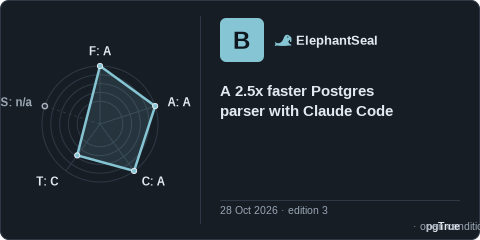
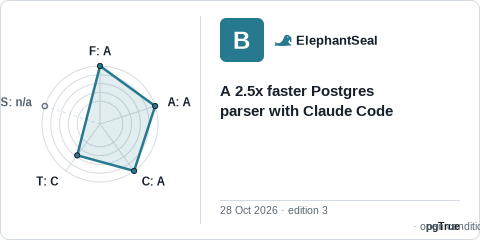
Factual A · Applicable A · Consistent A · Transparent C · Safe —

ReportTechnical fact-check, edition 3 Issued EditionUpdated after review. Corrections are listed below. SubmittedSubmitted by the PostgresAI team. Author responseNo written reply from the author. We re-audited this article 3 times; see Revisions below. Policy: right-of-reply and corrections policy. pgTrue versionaudited with v1.0.14 (approx.) · regraded with v1.0.19 (approx.)

InaccuraciesNone in this edition.

Dangerous or recipe bugsNone in this edition.

Misleading / impreciseNone in this edition.

Verified accurate

F2

SELECT can write through a function

ACCURATEFactual · holds up after review

Claim ledger

Article says
Call a non-read-only function and you've got a write operation.
What is true
PostgreSQL 18.1 permits VOLATILE functions to modify the database. src/backend/executor/functions.c:747 rejects writing statements inside read-only SQL functions. The article correctly warns against classifying every SELECT as read-only.
Charitable reading
Non-read-only means a function that performs writes here. It does not mean every VOLATILE function writes.

Source

Source · REL_18_1 · doc/src/sgml/xfunc.sgml:1620-1632A <literal>VOLATILE</literal> function can do anything, including modifying the database. It can return different results on successive calls with
In the article · section “Why build a parser at all?”

In the article

excerpt · section “Why build a parser at all?” · as fetched 2026-10-19 · open in article ↗ (opens in new tab)

Why build a parser at all?

Say a user sends select * from orders where customer_id = 12345 . Multigres needs to know: Which table is it hitting? What's the filter? Is it a read or a write? (Yes, a select can write! Call a non-read-only function and you've got a write operation.) The answers determine which database server handles the query.

All sources and excerpts · 2
Evidence A <literal>VOLATILE</literal> function can do anything, including modifying the database. It can return different results on successive calls with
Evidence if (fcache->func->readonly_func && !CommandIsReadOnly(stmt)) ereport(ERROR,
How the review tested this

Review: We tested whether F2 confuses permission to write with guaranteed writes. It says SELECT can write, which both cited ranges support. We tested whether F2 equates VOLATILE with always writing. It does not. PostgreSQL permits modifying functions, which supports the narrower claim that SELECT can write.

F3

The example SELECT uses valid PostgreSQL syntax

ACCURATEFactual · holds up after review

Claim ledger

Article says
…select * from orders where customer_id = 12345…
What is true
The example selects all columns from orders and retains rows where customer_id equals 12345. PostgreSQL 18.1 documents these SELECT and WHERE behaviors in doc/src/sgml/queries.sgml:41 and :957.
Charitable reading
The example assumes orders exists and customer_id supports comparison with 12345.

Source

Source · REL_18_1 · doc/src/sgml/queries.sgml:27-65SELECT * FROM table1;
In the article · section “Why build a parser at all?”

In the article

excerpt · section “Why build a parser at all?” · as fetched 2026-10-19 · open in article ↗ (opens in new tab)

Why build a parser at all?

Say a user sends select * from orders where customer_id = 12345 . Multigres needs to know: Which table is it hitting? What's the filter? Is it a read or a write? (Yes, a select can write! Call a non-read-only function and you've got a write operation.) The answers determine which database server handles the query.

All sources and excerpts · 2
EvidenceSELECT * FROM table1;
Evidence condition. If the result of the condition is true, the row is kept in the output table, otherwise (i.e., if the result is false or null) it is discarded. The search condition typically
How the review tested this

Review: We checked SELECT expansion and WHERE filtering. The example is valid under its stated table and column assumptions. We checked SELECT expansion and WHERE filtering. Missing tables or incompatible column types would prevent execution. F3 explicitly assumes a suitable schema and verifies syntax.

F4

pg_query_go provides a Go SQL parsing API

ACCURATEFactual · holds up after review

Claim ledger

Article says
…a Go library for parsing Postgres: pg_query_go…
What is true
Multigres imports pg_query_go/v6 and invokes pg_query.Parse(query). go/common/parser/parse_benchmark_test.go:81 confirms the parsing API used for comparison.
Charitable reading
This check covers the library's parsing API, not its parser extraction or build dependencies.

Source

Source · multigres@main@0624835d57 · go/common/parser/parse_benchmark_test.go:25-190pg_query "github.com/pganalyze/pg_query_go/v6"
In the article · section “Why build a parser at all?”

In the article

excerpt · section “Why build a parser at all?” · as fetched 2026-10-19 · open in article ↗ (opens in new tab)

Why build a parser at all?

There's already a Go library for parsing Postgres: pg_query_go , which extracts the parser directly from Postgres source code. It works. We contemplated using it initially. But that would have required us to rely on cgo. That means cross-compilation headaches, platform-specific builds, and a runtime dependency on C libraries. And there's a real performance penalty, cgo calls have overhead that adds up fast when parsing is on the hot path, and for point queries, every microsecond matters.

All sources and excerpts · 2
Evidence pg_query "github.com/pganalyze/pg_query_go/v6"
Evidence result, err := pg_query.Parse(query)
How the review tested this

Review: We checked the import and Parse invocation. F4 verifies the parsing API without claiming to verify extraction or runtime dependencies. We checked whether the import alone supports F4. The benchmark also calls pg_query.Parse(query). F4 verifies the parsing API without extending that evidence to build dependencies.

F5

JsonOutput's description and historical line reference match

ACCURATEFactual · holds up after review

Claim ledger

Article says
…**JsonOutput** - JSON output specification ( `src/include/nodes/parsenodes.h:1751` )…
What is true
PostgreSQL 17.0 defines JsonOutput at src/include/nodes/parsenodes.h:1751. Its comment identifies the JSON output clause.
Charitable reading
The checklist records historical source locations. Its line numbers need not match PostgreSQL 18.1.

Source

Source · REL_17_0 · src/include/nodes/parsenodes.h:1747-1792 * JsonOutput - * representation of JSON output clause (RETURNING type [FORMAT format]) */ typedef struct JsonOutput
In the article · section “My system: the directory that ran the project”

In the article

excerpt · section “My system: the directory that ran the project” · as fetched 2026-10-19 · open in article ↗ (opens in new tab)

My system: the directory that ran the project

### JSON Nodes - [ ] **JsonOutput** - JSON output specification ( `src/include/nodes/parsenodes.h:1751` ) - [ ] **JsonArgument** - JSON function argument ( `src/include/nodes/parsenodes.h:1762` ) - [ ] **JsonFuncExpr** - JSON function expression ( `src/include/nodes/parsenodes.h:1785` ) - [ ] **JsonTable** - JSON_TABLE ( `src/include/nodes/parsenodes.h:1821` )
All sources and excerpts · 1
Evidence * JsonOutput - * representation of JSON output clause (RETURNING type [FORMAT format]) */ typedef struct JsonOutput

Version note: The article's line reference matches PostgreSQL 17.0.

How the review tested this

Review: We checked for release confusion. PostgreSQL 17.0 places JsonOutput at line 1751 and describes the JSON output clause. We checked the historical release instead of requiring PostgreSQL 18.1 line numbers. REL_17_0 defines JsonOutput at line 1751. Its comment supports the description.

F6

JsonArgument's description and historical line reference match

ACCURATEFactual · holds up after review

Claim ledger

Article says
…**JsonArgument** - JSON function argument ( `src/include/nodes/parsenodes.h:1762` )…
What is true
PostgreSQL 17.0 defines JsonArgument at src/include/nodes/parsenodes.h:1762. The struct represents an argument from a JSON PASSING clause.
Charitable reading
JSON function argument is a short description of an argument from the JSON PASSING clause.

Source

Source · REL_17_0 · src/include/nodes/parsenodes.h:1747-1792 * JsonArgument - * representation of argument from JSON PASSING clause */ typedef struct JsonArgument
In the article · section “My system: the directory that ran the project”

In the article

excerpt · section “My system: the directory that ran the project” · as fetched 2026-10-19 · open in article ↗ (opens in new tab)

My system: the directory that ran the project

### JSON Nodes - [ ] **JsonOutput** - JSON output specification ( `src/include/nodes/parsenodes.h:1751` ) - [ ] **JsonArgument** - JSON function argument ( `src/include/nodes/parsenodes.h:1762` ) - [ ] **JsonFuncExpr** - JSON function expression ( `src/include/nodes/parsenodes.h:1785` ) - [ ] **JsonTable** - JSON_TABLE ( `src/include/nodes/parsenodes.h:1821` )
All sources and excerpts · 1
Evidence * JsonArgument - * representation of argument from JSON PASSING clause */ typedef struct JsonArgument

Version note: The article's line reference matches PostgreSQL 17.0.

How the review tested this

Review: We checked the historical location and description. JsonArgument starts at line 1762 and represents a JSON PASSING argument. We checked whether the short description misidentifies JsonArgument. REL_17_0 defines it at line 1762 for JSON PASSING arguments. F6 states that narrower meaning.

F7

JsonFuncExpr's description and historical line reference match

ACCURATEFactual · holds up after review

Claim ledger

Article says
…**JsonFuncExpr** - JSON function expression ( `src/include/nodes/parsenodes.h:1785` )…
What is true
PostgreSQL 17.0 defines JsonFuncExpr at src/include/nodes/parsenodes.h:1785. Its comment identifies untransformed SQL/JSON query-function expressions.
Charitable reading
The checklist summarizes an untransformed SQL/JSON function expression.

Source

Source · REL_17_0 · src/include/nodes/parsenodes.h:1747-1792 * JsonFuncExpr - * untransformed representation of function expressions for * SQL/JSON query functions */ typedef struct JsonFuncExpr
In the article · section “My system: the directory that ran the project”

In the article

excerpt · section “My system: the directory that ran the project” · as fetched 2026-10-19 · open in article ↗ (opens in new tab)

My system: the directory that ran the project

### JSON Nodes - [ ] **JsonOutput** - JSON output specification ( `src/include/nodes/parsenodes.h:1751` ) - [ ] **JsonArgument** - JSON function argument ( `src/include/nodes/parsenodes.h:1762` ) - [ ] **JsonFuncExpr** - JSON function expression ( `src/include/nodes/parsenodes.h:1785` ) - [ ] **JsonTable** - JSON_TABLE ( `src/include/nodes/parsenodes.h:1821` )
All sources and excerpts · 1
Evidence * JsonFuncExpr - * untransformed representation of function expressions for * SQL/JSON query functions */ typedef struct JsonFuncExpr

Version note: The article's line reference matches PostgreSQL 17.0.

How the review tested this

Review: We checked whether the description confuses transformed and raw expressions. F7 correctly identifies the untransformed JsonFuncExpr at line 1785. We checked the distinction between transformed expressions and grammar nodes. REL_17_0 identifies JsonFuncExpr as untransformed SQL/JSON query-function expressions at line 1785. F7 preserves that distinction.

F8

JsonTable's description and historical line reference match

ACCURATEFactual · holds up after review

Claim ledger

Article says
…**JsonTable** - JSON_TABLE ( `src/include/nodes/parsenodes.h:1821` )…
What is true
PostgreSQL 17.0 defines JsonTable at src/include/nodes/parsenodes.h:1821. The struct represents untransformed JSON_TABLE syntax.
Charitable reading
The reference belongs to the historical checklist rather than the latest release.

Source

Source · REL_17_0 · src/include/nodes/parsenodes.h:1817-1835 * JsonTable - * untransformed representation of JSON_TABLE */ typedef struct JsonTable
In the article · section “My system: the directory that ran the project”

In the article

excerpt · section “My system: the directory that ran the project” · as fetched 2026-10-19 · open in article ↗ (opens in new tab)

My system: the directory that ran the project

### JSON Nodes - [ ] **JsonOutput** - JSON output specification ( `src/include/nodes/parsenodes.h:1751` ) - [ ] **JsonArgument** - JSON function argument ( `src/include/nodes/parsenodes.h:1762` ) - [ ] **JsonFuncExpr** - JSON function expression ( `src/include/nodes/parsenodes.h:1785` ) - [ ] **JsonTable** - JSON_TABLE ( `src/include/nodes/parsenodes.h:1821` )
All sources and excerpts · 1
Evidence * JsonTable - * untransformed representation of JSON_TABLE */ typedef struct JsonTable

Version note: The article's line reference matches PostgreSQL 17.0.

How the review tested this

Review: We checked the historical version rather than requiring current line numbers. PostgreSQL 17.0 defines JsonTable at line 1821. We checked the historical line reference and node description. REL_17_0 defines JsonTable at line 1821 as untransformed JSON_TABLE. F8 makes no claim about later line numbers.

F9

NodeList provides the node abstraction that []Node lacks

ACCURATEFactual · holds up after review

Claim ledger

Article says
NodeList itself also implements Node…
What is true
go/common/parser/ast/nodes.go:957 defines NodeList with an embedded BaseNode and []Node items. Pointer methods supply String and SqlString. A bare []Node lacks the methods required by Node.
Charitable reading
The article distinguishes the NodeList struct from the unnamed []Node slice type.

Source

Source · multigres@main@0624835d57 · go/common/parser/ast/nodes.go:890-910type Node interface { // NodeTag returns the type tag for this node NodeTag() NodeTag
In the article · section “Example 1 (the type system subtlety):”

In the article

excerpt · section “Example 1 (the type system subtlety):” · as fetched 2026-10-19 · open in article ↗ (opens in new tab)

Example 1 (the type system subtlety):

Here's a concrete example. In Go, I had a Node interface that all AST nodes implement, and a NodeList type for holding sequences of nodes. NodeList itself also implements Node —that's important because sometimes you need to nest lists within the tree.

All sources and excerpts · 2
Evidencetype Node interface { // NodeTag returns the type tag for this node NodeTag() NodeTag
Evidencetype NodeList struct { BaseNode Items []Node // List of nodes }
How the review tested this

Review: We checked pointer receivers and interface requirements. F9 identifies pointer methods, and the article explicitly contrasts *NodeList with []Node. We checked pointer receivers against the Node interface. F9 correctly names pointer methods. The article's surrounding example uses *NodeList. A bare []Node lacks the required methods.

F10

PostgreSQL regression SQL exists at the stated path

ACCURATEFactual · holds up after review

Claim ledger

Article says
The Postgres source tree includes extensive SQL test files in src/test/regress/sql/…
What is true
src/test/regress/sql/constraints.sql contains SQL regression cases. Multigres documents converted PostgreSQL regression queries in go/common/parser/testdata/postgres/README.md:3.
Charitable reading
Running extracted statements through a parser does not mean executing PostgreSQL's full regression harness.

Source

Source · REL_18_1 · src/test/regress/sql/constraints.sql:37-52-- syntax errors -- test for extraneous comma CREATE TABLE error_tbl (i int DEFAULT (100, ));
In the article · section “Trust, but verify: the discipline of working with AI”

In the article

excerpt · section “Trust, but verify: the discipline of working with AI” · as fetched 2026-10-19 · open in article ↗ (opens in new tab)

Trust, but verify: the discipline of working with AI

Second: I ported Postgres's own regression tests. The Postgres source tree includes extensive SQL test files in src/test/regress/sql/ . I wrote a script to extract the queries and run them through our parser. Thousands of queries, covering edge cases the Postgres team has accumulated over decades.

All sources and excerpts · 2
Evidence-- syntax errors -- test for extraneous comma CREATE TABLE error_tbl (i int DEFAULT (100, ));
EvidenceThis directory contains JSON test files converted from PostgreSQL's regression test suite for use with the multigres parser.
How the review tested this

Review: We checked whether F10 equates converted queries with executing the regression harness. It verifies only the SQL files and documented conversion. We checked whether F10 confuses converted SQL with running PostgreSQL's regression harness. It does not. constraints.sql exists, and the README documents converted regression queries.

F11

Regression tests include SQL intended to fail parsing

ACCURATEFactual · holds up after review

Claim ledger

Article says
Some were tests that were supposed to fail, checking that invalid syntax was rejected.
What is true
PostgreSQL 18.1 labels syntax-error cases in src/test/regress/sql/constraints.sql:42. One case includes an extraneous comma in a DEFAULT expression.
Charitable reading
Some expected failures test parser rejection. Other regression failures test later processing stages.

Source

Source · REL_18_1 · src/test/regress/sql/constraints.sql:37-52-- syntax errors -- test for extraneous comma CREATE TABLE error_tbl (i int DEFAULT (100, ));
In the article · section “Trust, but verify: the discipline of working with AI”

In the article

excerpt · section “Trust, but verify: the discipline of working with AI” · as fetched 2026-10-19 · open in article ↗ (opens in new tab)

Trust, but verify: the discipline of working with AI

When tests failed, I investigated each one. Some failures were bugs in our parser, we fixed those. Some were tests that were supposed to fail, checking that invalid syntax was rejected. I confirmed each of those too.

Query Type Multigres pg_query_go Speedup Simple SELECT 1.6μs 3.1μs 2x Complex SELECT 3.2μs 11.0μs 3.5x CREATE TABLE 7.7μs 26.4μs 3.5x
All sources and excerpts · 1
Evidence-- syntax errors -- test for extraneous comma CREATE TABLE error_tbl (i int DEFAULT (100, ));
How the review tested this

Review: We checked whether the example fails during parsing or later execution. constraints.sql explicitly labels the extraneous-comma case a syntax error. We tested whether the example fails during later execution instead of parsing. constraints.sql labels the extraneous-comma case as a syntax error. F11 only claims some tests check syntax rejection.

F12

The reported suite timings support the 2.5× ratio

ACCURATEFactual · holds up after review

Claim ledger

Article says
That's 2.5x faster…
What is true
The displayed suite timings imply 2.52× (derived: 366 ms / 145 ms). That rounds to 2.5×. We checked the arithmetic, not the elapsed times.
Charitable reading
The 2.5× figure denotes a runtime ratio rounded to two significant figures.

Checked for internal consistency: the evidence is the article itself.

In the article · section “Trust, but verify: the discipline of working with AI”

In the article

excerpt · section “Trust, but verify: the discipline of working with AI” · as fetched 2026-10-19 · open in article ↗ (opens in new tab)

Trust, but verify: the discipline of working with AI

Across the full regression test suite, thousands of queries, Multigres parses in 145ms versus pg_query_go's 366ms. That's 2.5x faster, with no cgo overhead and no cross-compilation headaches.

How the review tested this

Review: We recalculated 366 ms / 145 ms as 2.524×. F12 correctly rounds to 2.5× and expressly excludes timing verification. We recalculated 366 ms / 145 ms as 2.524. This rounds to 2.5. F12 explicitly verifies arithmetic without verifying the measurements.

F13

The simple SELECT timings support the rounded 2× ratio

ACCURATEFactual · holds up after review

Claim ledger

Article says
…Simple SELECT 1.6μs 3.1μs…
What is true
The simple SELECT timings imply 1.94× (derived: 3.1 μs / 1.6 μs). That rounds to 2×.
Charitable reading
The simple SELECT speedup uses one significant figure.

Checked for internal consistency: the evidence is the article itself.

In the article · section “Trust, but verify: the discipline of working with AI”

In the article

excerpt · section “Trust, but verify: the discipline of working with AI” · as fetched 2026-10-19 · open in article ↗ (opens in new tab)

Trust, but verify: the discipline of working with AI

Query Type Multigres pg_query_go Speedup Simple SELECT 1.6μs 3.1μs 2x Complex SELECT 3.2μs 11.0μs 3.5x CREATE TABLE 7.7μs 26.4μs 3.5x
How the review tested this

Review: We recalculated 3.1 μs / 1.6 μs as 1.9375×. The displayed 2× ratio is valid at one significant figure. We recalculated 3.1 μs / 1.6 μs as 1.9375. The displayed 2× follows at one significant figure. F13 does not verify either timing.

Notes

3 not graded: findings no reader would act on differently
F1

Multigres omits PostgreSQL's duplicate-trigger-event rejection

NOTEholds up after review

Claim ledger

Article says
…when we say "Postgres-compatible grammar," we mean it.
What is true
Multigres leaves the duplicate-event check empty in go/common/parser/postgres.go:34998. PostgreSQL rejects overlapping trigger events in src/backend/parser/gram.y:6086. Parsing acceptance alone cannot validate this syntax. The article acknowledges that bugs may remain.
So what
Add duplicate-trigger-event rejection before using Multigres parsing as a PostgreSQL syntax validator.
Charitable reading
The article explicitly anticipates remaining bugs. Its compatibility statement does not promise identical behavior for every input.

Source

Source · REL_18_1 · src/backend/parser/gram.y:6078-6093if (events1 & events2) parser_yyerror("duplicate trigger events specified");

Not graded: no reader would act differently on it.

In the article · section “Trust, but verify: the discipline of working with AI”

In the article

excerpt · section “Trust, but verify: the discipline of working with AI” · as fetched 2026-10-19 · open in article ↗ (opens in new tab)

Trust, but verify: the discipline of working with AI

The result: 71.2% code coverage, validation against the real Postgres test suite, and confidence that when we say "Postgres-compatible grammar," we mean it. Will we find bugs? Probably. I'm 71.2% sure we won't 😝. But I wouldn't have fared any better writing it by hand. The test coverage would look the same.

Query Type Multigres pg_query_go Speedup Simple SELECT 1.6μs 3.1μs 2x Complex SELECT 3.2μs 11.0μs 3.5x CREATE TABLE 7.7μs 26.4μs 3.5x
All sources and excerpts · 2
Evidence if (events1 & events2) parser_yyerror("duplicate trigger events specified");
Evidence if events1&events2 != 0 { // TODO: Generate parse error for duplicate trigger events }
How the review tested this

Review: We checked the generated action against PostgreSQL's rejection branch. The empty duplicate-event check exists. Note severity respects the article's acknowledgment of remaining bugs. We checked both grammar actions and considered the article's acknowledgment of remaining bugs. PostgreSQL rejects overlapping events. Multigres leaves that check empty. The note preserves the article's caveat.

F14

The suite benchmark excludes expected-error cases

NOTEholds up after review

Claim ledger

Article says
…Across the full regression test suite…
What is true
The benchmark excludes cases with expected errors. go/common/parser/parse_benchmark_test.go:119-128 skips every case whose Error field is nonempty. The phrase “full regression test suite” omits this filter. The comparison does not cover rejection latency for those cases.
So what
Benchmark rejected SQL separately before estimating latency for workloads containing invalid queries.
Charitable reading
Full can mean all converted cases expected to succeed. We record the exclusion as a scope note.

Source

Source · multigres@main@0624835d57 · go/common/parser/parse_benchmark_test.go:119-128for _, test := range tests { // Skip queries that are expected to fail if test.Error != "" { skippedCount++ continue } if test.Query != "" { allQueries = append(allQueries, test.Query) }

Not graded: knowing this would not change what a reader does.

In the article · section “Trust, but verify: the discipline of working with AI”

In the article

excerpt · section “Trust, but verify: the discipline of working with AI” · as fetched 2026-10-19 · open in article ↗ (opens in new tab)

Trust, but verify: the discipline of working with AI

Across the full regression test suite, thousands of queries, Multigres parses in 145ms versus pg_query_go's 366ms. That's 2.5x faster, with no cgo overhead and no cross-compilation headaches.

All sources and excerpts · 1
Evidence for _, test := range tests { // Skip queries that are expected to fail if test.Error != "" { skippedCount++ continue } if test.Query != "" { allQueries = append(allQueries, test.Query) }
How the review tested this

Review: We checked whether expected-error cases enter the timed corpus. The loader excludes them. Note severity avoids claiming an unsupported effect on speedup. We considered whether full means all successful converted cases. The loader still explicitly excludes nonempty Error fields. F14 records that scope without claiming the filter changes the speed ratio.

F15

Rounded table inputs do not determine the 3.5× ratios

NOTEholds up after review

Claim ledger

Article says
…Complex SELECT 3.2μs 11.0μs 3.5x…
What is true
The complex SELECT inputs yield 3.44× (derived: 11.0 μs / 3.2 μs). CREATE TABLE yields 3.43× (derived: 26.4 μs / 7.7 μs). Both round to 3.4×. Unrounded inputs could still produce ratios rounding to 3.5×.
So what
Use unrounded benchmark results before comparing differences smaller than 0.1×.
Charitable reading
Both 3.5× figures can result from unrounded timings consistent with the displayed precision.

Not graded: knowing this would not change what a reader does.

Checked for internal consistency: the evidence is the article itself.

In the article · section “Trust, but verify: the discipline of working with AI”

In the article

excerpt · section “Trust, but verify: the discipline of working with AI” · as fetched 2026-10-19 · open in article ↗ (opens in new tab)

Trust, but verify: the discipline of working with AI

Query Type Multigres pg_query_go Speedup Simple SELECT 1.6μs 3.1μs 2x Complex SELECT 3.2μs 11.0μs 3.5x CREATE TABLE 7.7μs 26.4μs 3.5x
How the review tested this

Review: We recalculated both ratios and checked rounding intervals. Unrounded timings consistent with each row can yield 3.5×. F15 already preserves that caveat. We recalculated both ratios and tested timing values within their rounding intervals. Each displayed ratio can reach 3.5× before timing rounding. F15 correctly avoids charging a numerical error.

More in this report

Section checks · 5 sections

Section checks

AspectGradeFindingsCoverage
Why a parserA3 verified-accurate100% of claims (5 of 5, plus 1 that need data we do not have)
CoordinationA4 verified-accurate100% of claims (4 of 4)
Expertise and errorsA1 verified-accurate1 checked · 1 need data we do not have
VerificationA2 verified-accurate100% of claims (2 of 2, plus 1 that need data we do not have)
PerformanceA2 verified-accurate100% of claims (5 of 5, plus 7 that need data we do not have)
Coverage and assessment · Checked 16 of 16 Postgres claims across 7 sections

Central claim not verified. F9–F14 check parser structure, test scope, and arithmetic, but do not establish the eight-week development comparison or measured speedup.

We did not check everything in this article. What we did not check is listed below, in the words we recorded at the time. None of it moved the letter. We never charge our own limits to the article.

What we did not check

  • We did not reproduce the parsing times or 71.2% coverage measurement.
  • We did not compare every Multigres grammar rule with PostgreSQL.
  • We could not verify pg_query_go parser extraction and build requirements against its versioned implementation.
  • We did not establish whether PostgreSQL provides any reusable standalone deparser for raw parser trees.
  • We did not check the article's PostgreSQL internals against PostgreSQL 18.1 source.
  • We did not inspect the parser's imported regression tests or verify their expected failures.
  • We did not establish which parser features changed after February 5, 2026.
  • We did not reproduce the parser benchmarks or independently verify the development timeline.
  • We did not verify five distinct article claims with usable primary citations.
  • We did not reproduce the parser timings or the 71.2% coverage measurement.
  • We did not verify the 287,786-line and 304-file totals or the development-duration comparison.
  • We did not establish the regression corpus's query count or historical breadth.
  • We could not decide whether readers can obtain the benchmark environment.
  • We could not decide whether the published benchmark details are complete.
Checked 16 of 16 Postgres claims across 7 sections
  • Introduction: 1 claim is the author's own account; nothing checkable; not counted: 22 product or opinion, 2 duplicate, 7 not a claim
  • Why a parser: 5 of 5 Postgres claims checked, plus 1 that need data we do not have; not counted: 40 product or opinion, 1 duplicate, 2 not a claim
  • Coordination: 4 of 4 Postgres claims checked; not counted: 24 product or opinion, 1 duplicate, 3 not a claim
  • Expertise and errors: 1 checked, plus 1 that need data we do not have; not counted: 34 product or opinion, 3 duplicate, 5 not a claim
  • Verification: 2 of 2 Postgres claims checked, plus 1 that need data we do not have; not counted: 18 product or opinion, 2 duplicate, 2 not a claim
  • Performance: 5 of 5 Postgres claims checked, plus 7 that need data we do not have; not counted: 6 product or opinion, 2 duplicate, 2 not a claim
  • Future workflow: no checkable claims; not counted: 8 product or opinion, 4 duplicate, 1 not a claim

Average of 4 axes: 3.5 · benchmark not reproducible, one step off (no hardware) · result B

Some explanatory text is not shown in this edition; the grade and findings are complete.

Scorecard · the five axes
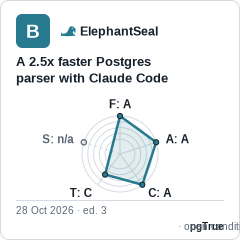
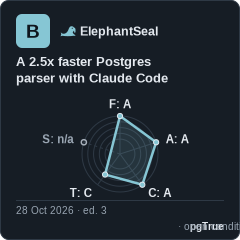
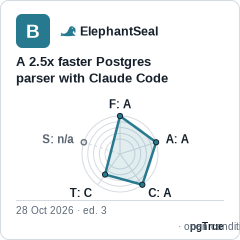
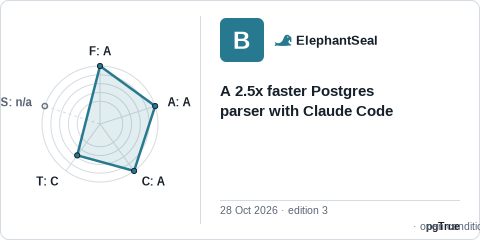
FACTS scorecard Scorecard radar, 5 axes, bigger is better. Overall B. Factual A · 0 wrong of 12 checked · 0 caveats. Applicable A · 0 wrong of 6 checked · 0 caveats. Consistent A · 0 wrong of 12 checked · 0 caveats. Transparent C · 0 wrong of 3 checked · 0 caveats · reproducibility: C (no hardware). Safe not applicable (n/a). A 0 wrong of 12 checked · 0 caveatsFactual A0 wrong of 120 caveats A 0 wrong of 6 checked · 0 caveatsApplicable A0 wrong of 60 caveats A 0 wrong of 12 checked · 0 caveatsConsistent A0 wrong of 120 caveats C 0 wrong of 3 checked · 0 caveats reproducibility: C (no hardware)Transparent C0 wrong of 30 caveatsreproducibility: C(no hardware) not applicable (n/a), nothing to checkSafe n/anothingto check

By topic: Why a parser — 3 findings, 0 wrong · Coordination — 4 findings, 0 wrong · Expertise and errors — 1 finding, 0 wrong · Verification — 2 findings, 0 wrong · Performance — 2 findings, 0 wrong

Further out is better. Each axis has its own letter, from the wrong claims and caveats among the claims we checked of that kind.

Checked on the FACTS: Factual, Applicable, Consistent, Transparent, Safe. Clockwise: Factual (is it true?), Applicable (does it apply to my setup, today?), Consistent (does it agree with itself?), Transparent (can I check it myself?), Safe (can I run this on prod?).

We checked 12 claims.

AxisLetterWrongCaveatsCheckedCoverage
FactualA0012assessed: A · 0 wrong of 12 checked · 0 caveats
ApplicableA006assessed: A · 0 wrong of 6 checked · 0 caveats
ConsistentA0012assessed: A · 0 wrong of 12 checked · 0 caveats
TransparentC003assessed: C · 0 wrong of 3 checked · 0 caveats · reproducibility: C (no hardware)
Safe—000not applicable
Topics · 5 topics

Topics

TopicFactualApplicableConsistentTransparentSafe
Why a parser0 issues 3 checked F2 F3 F40 issues 1 checked0 issues 3 checked0 issues 1 checked
Coordination0 issues 4 checked F5 F6 F7 F80 issues 4 checked0 issues 4 checked
Expertise and errors0 issues 1 checked F90 issues 1 checked
Verification0 issues 2 checked F10 F110 issues 2 checked
Performance0 issues 2 checked F12 F130 issues 1 checked0 issues 2 checked0 issues 2 checked

Issues found among the claims checked, per topic and axis. Each link goes to the finding behind the count.

Revisions: 4 · Not assessed -> Not assessed -> A -> B

We audited this article 4 times. Each row is the final edition of one audit. Letters and findings of earlier revisions stay readable at their own address.

  1. Revision 1 · Not assessed · audit version not recorded

    Details unavailable.

    ElephantSeal: Not assessed.

  2. Revision 2 · Not assessed · audit version not recorded

    Details unavailable.

    ElephantSeal: Not assessed.

  3. Revision 3 · 2026-10-01 05:51 UTC · A · audit version not recorded · regrade version not recorded

    Same article text, re-audited. 5 accurate · 0 wrong · 2 caveats.

    ElephantSeal: A. Open: the central claim is not yet backed by evidence.

    Changes: Details unavailable.

  4. Revision 4 · this page · 2026-10-19 07:24 UTC · B · audited with v1.0.14 (approx.) · regraded with v1.0.19 (approx.)

    Same article text, re-audited. 12 accurate · 0 wrong · 0 caveats.

    ElephantSeal: B. Open: the benchmark cannot yet be rerun from what is published.

    Changes: No longer reported: “Grammar compatibility omits PostgreSQL's duplicate-trigger-event check”; “…Across the full regression test suite…”. New: none.

Questions and answers

Questions and answers

What is pgTrue?

pgTrue is an independent fact-check of technical Postgres articles, made by PostgresAI. It helps you check advice before you use it.

What does the letter grade mean?

The letter grade summarizes the claims we checked. Five axes show what we checked:

  • Factual: is it true?
  • Applicable: does it apply to my setup, today?
  • Consistent: does it agree with itself?
  • Transparent: can I check it myself?
  • Safe: can I run this in production?

What is the ElephantSeal?

The ElephantSeal is the mark an article earns. It always shows the latest edition. “Open:” lists what is still open.

Can an author reply?

Authors can ask us to correct a finding, reply to it, or withdraw it. Right-of-reply policy.

Paste into your AI assistant to fix the article, then ask for a re-review.

Show the text
Fix the article with this report, then ask pgTrue for a re-review.

# pgTrue report: A 2.5x faster Postgres parser with Claude Code

Article title: A 2.5x faster Postgres parser with Claude Code
Article URL: https://multigres.com/blog/ai-parser-engineering
Report URL: https://pgtrue.postgres.ai/shared/brief/3fb887ba-4a90-461d-b0be-e3156710fa67
Audited revision: 4 of 4, 2026-10-19 07:24:38 UTC
Overall letter: B

## Axes

- Factual: A · 0 wrong · 12 checked · 0 caveats · assessed
- Applicable: A · 0 wrong · 6 checked · 0 caveats · assessed
- Consistent: A · 0 wrong · 12 checked · 0 caveats · assessed
- Transparent: C · 0 wrong · 3 checked · 0 caveats · assessed
- Safe: — · 0 wrong · 0 checked · 0 caveats · not applicable

ElephantSeal: B.
Open conditions: the benchmark cannot yet be rerun from what is published.

## Report metadata

- Report: Technical fact-check, edition 3
- Issued: 2026-10-19
- Edition: Updated after review. Corrections are listed below.
- Submitted: Submitted by the PostgresAI team.
- Author response: No written reply from the author. We re-audited this article 3 times; see Revisions below. Policy: [right-of-reply and corrections policy](/pgtrue/security).
- pgTrue version: audited with v1.0.14 (approx.) · regraded with v1.0.19 (approx.)

## Findings needing a change (0)

None.

## Verified accurate claims (12)

### F2 · Accurate · Factual · SELECT can write through a function
Location: excerpt · section “Why build a parser at all?” · as fetched 2026-10-19 · [open in article](https://multigres.com/blog/ai-parser-engineering#:~:text=Call%20a%20non%2Dread%2Donly%20function%20and%20you%27ve%20got%20a%20write%20operation.)
Article says:
```text
Call a non-read-only function and you've got a write operation.
```
What is true:
PostgreSQL 18.1 permits VOLATILE functions to modify the database. src/backend/executor/functions.c:747 rejects writing statements inside read-only SQL functions. The article correctly warns against classifying every SELECT as read-only.
Charitable reading:
Non-read-only means a function that performs writes here. It does not mean every VOLATILE function writes.
Review: We tested whether F2 confuses permission to write with guaranteed writes. It says SELECT can write, which both cited ranges support. We tested whether F2 equates VOLATILE with always writing. It does not. PostgreSQL permits modifying functions, which supports the narrower claim that SELECT can write.

Sources:
- [REL_18_1 · doc/src/sgml/xfunc.sgml:1620-1632](https://github.com/postgres/postgres/blob/4b324845ba5d24682b9b3708a769f00d160afbd7/doc/src/sgml/xfunc.sgml#L1620-L1632)
  Excerpt:
  ```text
  A <literal>VOLATILE</literal> function can do anything, including modifying
      the database.  It can return different results on successive calls with
  ```
- [REL_18_1 · src/backend/executor/functions.c:738-756](https://github.com/postgres/postgres/blob/4b324845ba5d24682b9b3708a769f00d160afbd7/src/backend/executor/functions.c#L738-L756)
  Excerpt:
  ```text
  if (fcache->func->readonly_func && !CommandIsReadOnly(stmt))
			ereport(ERROR,
  ```

Finding URL: https://pgtrue.postgres.ai/shared/brief/3fb887ba-4a90-461d-b0be-e3156710fa67#F2

### F3 · Accurate · Factual · The example SELECT uses valid PostgreSQL syntax
Location: excerpt · section “Why build a parser at all?” · as fetched 2026-10-19 · [open in article](https://multigres.com/blog/ai-parser-engineering#:~:text=select%20%2A%20from%20orders%20where%20customer_id%20%3D%2012345)
Article says:
```text
…select * from orders where customer_id = 12345…
```
What is true:
The example selects all columns from orders and retains rows where customer_id equals 12345. PostgreSQL 18.1 documents these SELECT and WHERE behaviors in doc/src/sgml/queries.sgml:41 and :957.
Charitable reading:
The example assumes orders exists and customer_id supports comparison with 12345.
Review: We checked SELECT expansion and WHERE filtering. The example is valid under its stated table and column assumptions. We checked SELECT expansion and WHERE filtering. Missing tables or incompatible column types would prevent execution. F3 explicitly assumes a suitable schema and verifies syntax.

Sources:
- [REL_18_1 · doc/src/sgml/queries.sgml:27-65](https://github.com/postgres/postgres/blob/4b324845ba5d24682b9b3708a769f00d160afbd7/doc/src/sgml/queries.sgml#L27-L65)
  Excerpt:
  ```text
  SELECT * FROM table1;
  ```
- [REL_18_1 · doc/src/sgml/queries.sgml:951-972](https://github.com/postgres/postgres/blob/4b324845ba5d24682b9b3708a769f00d160afbd7/doc/src/sgml/queries.sgml#L951-L972)
  Excerpt:
  ```text
  condition.  If the result of the condition is true, the row is
    kept in the output table, otherwise (i.e., if the result is
    false or null) it is discarded.  The search condition typically
  ```

Finding URL: https://pgtrue.postgres.ai/shared/brief/3fb887ba-4a90-461d-b0be-e3156710fa67#F3

### F4 · Accurate · Factual · pg_query_go provides a Go SQL parsing API
Location: excerpt · section “Why build a parser at all?” · as fetched 2026-10-19 · [open in article](https://multigres.com/blog/ai-parser-engineering#:~:text=a%20Go%20library%20for%20parsing%20Postgres%3A%20pg_query_go)
Article says:
```text
…a Go library for parsing Postgres: pg_query_go…
```
What is true:
Multigres imports pg_query_go/v6 and invokes pg_query.Parse(query). go/common/parser/parse_benchmark_test.go:81 confirms the parsing API used for comparison.
Charitable reading:
This check covers the library's parsing API, not its parser extraction or build dependencies.
Review: We checked the import and Parse invocation. F4 verifies the parsing API without claiming to verify extraction or runtime dependencies. We checked whether the import alone supports F4. The benchmark also calls pg_query.Parse(query). F4 verifies the parsing API without extending that evidence to build dependencies.

Sources:
- [multigres@main@0624835d57 · go/common/parser/parse_benchmark_test.go:25-190](https://github.com/multigres/multigres/blob/0624835d578241c2e70805244937c3dd46fc44b5/go/common/parser/parse_benchmark_test.go#L25-L190)
  Excerpt:
  ```text
  pg_query "github.com/pganalyze/pg_query_go/v6"
  ```
- [multigres@main@0624835d57 · go/common/parser/parse_benchmark_test.go:80-86](https://github.com/multigres/multigres/blob/0624835d578241c2e70805244937c3dd46fc44b5/go/common/parser/parse_benchmark_test.go#L80-L86)
  Excerpt:
  ```text
  result, err := pg_query.Parse(query)
  ```

Finding URL: https://pgtrue.postgres.ai/shared/brief/3fb887ba-4a90-461d-b0be-e3156710fa67#F4

### F5 · Accurate · Factual · JsonOutput's description and historical line reference match
Location: excerpt · section “My system: the directory that ran the project” · as fetched 2026-10-19 · [open in article](https://multigres.com/blog/ai-parser-engineering#:~:text=%2A%2AJsonOutput%2A%2A%20%2D%20JSON%20output%20specification%20%28%20%60src%2Finclude%2Fnodes%2Fparsenodes.h%3A1751%60%20%29)
Article says:
```text
…**JsonOutput** - JSON output specification ( `src/include/nodes/parsenodes.h:1751` )…
```
What is true:
PostgreSQL 17.0 defines JsonOutput at src/include/nodes/parsenodes.h:1751. Its comment identifies the JSON output clause.
Charitable reading:
The checklist records historical source locations. Its line numbers need not match PostgreSQL 18.1.
Review: We checked for release confusion. PostgreSQL 17.0 places JsonOutput at line 1751 and describes the JSON output clause. We checked the historical release instead of requiring PostgreSQL 18.1 line numbers. REL_17_0 defines JsonOutput at line 1751. Its comment supports the description.

Sources:
- [REL_17_0 · src/include/nodes/parsenodes.h:1747-1792](https://github.com/postgres/postgres/blob/d7ec59a63d745ba74fba0e280bbf85dc6d1caa3e/src/include/nodes/parsenodes.h#L1747-L1792)
  Qualification: Version note: The article's line reference matches PostgreSQL 17.0.
  Excerpt:
  ```text
  * JsonOutput -
 *		representation of JSON output clause (RETURNING type [FORMAT format])
 */
typedef struct JsonOutput
  ```

Finding URL: https://pgtrue.postgres.ai/shared/brief/3fb887ba-4a90-461d-b0be-e3156710fa67#F5

### F6 · Accurate · Factual · JsonArgument's description and historical line reference match
Location: excerpt · section “My system: the directory that ran the project” · as fetched 2026-10-19 · [open in article](https://multigres.com/blog/ai-parser-engineering#:~:text=%2A%2AJsonArgument%2A%2A%20%2D%20JSON%20function%20argument%20%28%20%60src%2Finclude%2Fnodes%2Fparsenodes.h%3A1762%60%20%29)
Article says:
```text
…**JsonArgument** - JSON function argument ( `src/include/nodes/parsenodes.h:1762` )…
```
What is true:
PostgreSQL 17.0 defines JsonArgument at src/include/nodes/parsenodes.h:1762. The struct represents an argument from a JSON PASSING clause.
Charitable reading:
JSON function argument is a short description of an argument from the JSON PASSING clause.
Review: We checked the historical location and description. JsonArgument starts at line 1762 and represents a JSON PASSING argument. We checked whether the short description misidentifies JsonArgument. REL_17_0 defines it at line 1762 for JSON PASSING arguments. F6 states that narrower meaning.

Sources:
- [REL_17_0 · src/include/nodes/parsenodes.h:1747-1792](https://github.com/postgres/postgres/blob/d7ec59a63d745ba74fba0e280bbf85dc6d1caa3e/src/include/nodes/parsenodes.h#L1747-L1792)
  Qualification: Version note: The article's line reference matches PostgreSQL 17.0.
  Excerpt:
  ```text
  * JsonArgument -
 *		representation of argument from JSON PASSING clause
 */
typedef struct JsonArgument
  ```

Finding URL: https://pgtrue.postgres.ai/shared/brief/3fb887ba-4a90-461d-b0be-e3156710fa67#F6

### F7 · Accurate · Factual · JsonFuncExpr's description and historical line reference match
Location: excerpt · section “My system: the directory that ran the project” · as fetched 2026-10-19 · [open in article](https://multigres.com/blog/ai-parser-engineering#:~:text=%2A%2AJsonFuncExpr%2A%2A%20%2D%20JSON%20function%20expression%20%28%20%60src%2Finclude%2Fnodes%2Fparsenodes.h%3A1785%60%20%29)
Article says:
```text
…**JsonFuncExpr** - JSON function expression ( `src/include/nodes/parsenodes.h:1785` )…
```
What is true:
PostgreSQL 17.0 defines JsonFuncExpr at src/include/nodes/parsenodes.h:1785. Its comment identifies untransformed SQL/JSON query-function expressions.
Charitable reading:
The checklist summarizes an untransformed SQL/JSON function expression.
Review: We checked whether the description confuses transformed and raw expressions. F7 correctly identifies the untransformed JsonFuncExpr at line 1785. We checked the distinction between transformed expressions and grammar nodes. REL_17_0 identifies JsonFuncExpr as untransformed SQL/JSON query-function expressions at line 1785. F7 preserves that distinction.

Sources:
- [REL_17_0 · src/include/nodes/parsenodes.h:1747-1792](https://github.com/postgres/postgres/blob/d7ec59a63d745ba74fba0e280bbf85dc6d1caa3e/src/include/nodes/parsenodes.h#L1747-L1792)
  Qualification: Version note: The article's line reference matches PostgreSQL 17.0.
  Excerpt:
  ```text
  * JsonFuncExpr -
 *		untransformed representation of function expressions for
 *		SQL/JSON query functions
 */
typedef struct JsonFuncExpr
  ```

Finding URL: https://pgtrue.postgres.ai/shared/brief/3fb887ba-4a90-461d-b0be-e3156710fa67#F7

### F8 · Accurate · Factual · JsonTable's description and historical line reference match
Location: excerpt · section “My system: the directory that ran the project” · as fetched 2026-10-19 · [open in article](https://multigres.com/blog/ai-parser-engineering#:~:text=%2A%2AJsonTable%2A%2A%20%2D%20JSON_TABLE%20%28%20%60src%2Finclude%2Fnodes%2Fparsenodes.h%3A1821%60%20%29)
Article says:
```text
…**JsonTable** - JSON_TABLE ( `src/include/nodes/parsenodes.h:1821` )…
```
What is true:
PostgreSQL 17.0 defines JsonTable at src/include/nodes/parsenodes.h:1821. The struct represents untransformed JSON_TABLE syntax.
Charitable reading:
The reference belongs to the historical checklist rather than the latest release.
Review: We checked the historical version rather than requiring current line numbers. PostgreSQL 17.0 defines JsonTable at line 1821. We checked the historical line reference and node description. REL_17_0 defines JsonTable at line 1821 as untransformed JSON_TABLE. F8 makes no claim about later line numbers.

Sources:
- [REL_17_0 · src/include/nodes/parsenodes.h:1817-1835](https://github.com/postgres/postgres/blob/d7ec59a63d745ba74fba0e280bbf85dc6d1caa3e/src/include/nodes/parsenodes.h#L1817-L1835)
  Qualification: Version note: The article's line reference matches PostgreSQL 17.0.
  Excerpt:
  ```text
  * JsonTable -
 *		untransformed representation of JSON_TABLE
 */
typedef struct JsonTable
  ```

Finding URL: https://pgtrue.postgres.ai/shared/brief/3fb887ba-4a90-461d-b0be-e3156710fa67#F8

### F9 · Accurate · Factual · NodeList provides the node abstraction that \[\]Node lacks
Location: excerpt · section “Example 1 (the type system subtlety):” · as fetched 2026-10-19 · [open in article](https://multigres.com/blog/ai-parser-engineering#:~:text=NodeList%20itself%20also%20implements%20Node)
Article says:
```text
NodeList itself also implements Node…
```
What is true:
go/common/parser/ast/nodes.go:957 defines NodeList with an embedded BaseNode and \[\]Node items. Pointer methods supply String and SqlString. A bare \[\]Node lacks the methods required by Node.
Charitable reading:
The article distinguishes the NodeList struct from the unnamed \[\]Node slice type.
Review: We checked pointer receivers and interface requirements. F9 identifies pointer methods, and the article explicitly contrasts \*NodeList with \[\]Node. We checked pointer receivers against the Node interface. F9 correctly names pointer methods. The article's surrounding example uses \*NodeList. A bare \[\]Node lacks the required methods.

Sources:
- [multigres@main@0624835d57 · go/common/parser/ast/nodes.go:890-910](https://github.com/multigres/multigres/blob/0624835d578241c2e70805244937c3dd46fc44b5/go/common/parser/ast/nodes.go#L890-L910)
  Excerpt:
  ```text
  type Node interface {
	// NodeTag returns the type tag for this node
	NodeTag() NodeTag
  ```
- [multigres@main@0624835d57 · go/common/parser/ast/nodes.go:950-990](https://github.com/multigres/multigres/blob/0624835d578241c2e70805244937c3dd46fc44b5/go/common/parser/ast/nodes.go#L950-L990)
  Excerpt:
  ```text
  type NodeList struct {
	BaseNode
	Items []Node // List of nodes
}
  ```

Finding URL: https://pgtrue.postgres.ai/shared/brief/3fb887ba-4a90-461d-b0be-e3156710fa67#F9

### F10 · Accurate · Factual · PostgreSQL regression SQL exists at the stated path
Location: excerpt · section “Trust, but verify: the discipline of working with AI” · as fetched 2026-10-19 · [open in article](https://multigres.com/blog/ai-parser-engineering#:~:text=The%20Postgres%20source%20tree%20includes,SQL%20test%20files%20in%20src%2Ftest%2Fregress%2Fsql%2F)
Article says:
```text
The Postgres source tree includes extensive SQL test files in src/test/regress/sql/…
```
What is true:
src/test/regress/sql/constraints.sql contains SQL regression cases. Multigres documents converted PostgreSQL regression queries in go/common/parser/testdata/postgres/README.md:3.
Charitable reading:
Running extracted statements through a parser does not mean executing PostgreSQL's full regression harness.
Review: We checked whether F10 equates converted queries with executing the regression harness. It verifies only the SQL files and documented conversion. We checked whether F10 confuses converted SQL with running PostgreSQL's regression harness. It does not. constraints.sql exists, and the README documents converted regression queries.

Sources:
- [REL_18_1 · src/test/regress/sql/constraints.sql:37-52](https://github.com/postgres/postgres/blob/4b324845ba5d24682b9b3708a769f00d160afbd7/src/test/regress/sql/constraints.sql#L37-L52)
  Excerpt:
  ```text
  -- syntax errors
--  test for extraneous comma
CREATE TABLE error_tbl (i int DEFAULT (100, ));
  ```
- [multigres@main@0624835d57 · go/common/parser/testdata/postgres/README.md:1-60](https://github.com/multigres/multigres/blob/0624835d578241c2e70805244937c3dd46fc44b5/go/common/parser/testdata/postgres/README.md#L1-L60)
  Excerpt:
  ```text
  This directory contains JSON test files converted from PostgreSQL's regression test suite for use with the multigres parser.
  ```

Finding URL: https://pgtrue.postgres.ai/shared/brief/3fb887ba-4a90-461d-b0be-e3156710fa67#F10

### F11 · Accurate · Factual · Regression tests include SQL intended to fail parsing
Location: excerpt · section “Trust, but verify: the discipline of working with AI” · as fetched 2026-10-19 · [open in article](https://multigres.com/blog/ai-parser-engineering#:~:text=Some%20were%20tests%20that%20were,that%20invalid%20syntax%20was%20rejected.)
Article says:
```text
Some were tests that were supposed to fail, checking that invalid syntax was rejected.
```
What is true:
PostgreSQL 18.1 labels syntax-error cases in src/test/regress/sql/constraints.sql:42. One case includes an extraneous comma in a DEFAULT expression.
Charitable reading:
Some expected failures test parser rejection. Other regression failures test later processing stages.
Review: We checked whether the example fails during parsing or later execution. constraints.sql explicitly labels the extraneous-comma case a syntax error. We tested whether the example fails during later execution instead of parsing. constraints.sql labels the extraneous-comma case as a syntax error. F11 only claims some tests check syntax rejection.

Sources:
- [REL_18_1 · src/test/regress/sql/constraints.sql:37-52](https://github.com/postgres/postgres/blob/4b324845ba5d24682b9b3708a769f00d160afbd7/src/test/regress/sql/constraints.sql#L37-L52)
  Excerpt:
  ```text
  -- syntax errors
--  test for extraneous comma
CREATE TABLE error_tbl (i int DEFAULT (100, ));
  ```

Finding URL: https://pgtrue.postgres.ai/shared/brief/3fb887ba-4a90-461d-b0be-e3156710fa67#F11

### F12 · Accurate · Factual · The reported suite timings support the 2.5× ratio
Location: excerpt · section “Trust, but verify: the discipline of working with AI” · as fetched 2026-10-19 · [open in article](https://multigres.com/blog/ai-parser-engineering#:~:text=That%27s%202.5x%20faster)
Article says:
```text
That's 2.5x faster…
```
What is true:
The displayed suite timings imply 2.52× (derived: 366 ms / 145 ms). That rounds to 2.5×. We checked the arithmetic, not the elapsed times.
Charitable reading:
The 2.5× figure denotes a runtime ratio rounded to two significant figures.
Explanation: Checked for internal consistency: the evidence is the article itself.
Review: We recalculated 366 ms / 145 ms as 2.524×. F12 correctly rounds to 2.5× and expressly excludes timing verification. We recalculated 366 ms / 145 ms as 2.524. This rounds to 2.5. F12 explicitly verifies arithmetic without verifying the measurements.

Finding URL: https://pgtrue.postgres.ai/shared/brief/3fb887ba-4a90-461d-b0be-e3156710fa67#F12

### F13 · Accurate · Factual · The simple SELECT timings support the rounded 2× ratio
Location: excerpt · section “Trust, but verify: the discipline of working with AI” · as fetched 2026-10-19 · [open in article](https://multigres.com/blog/ai-parser-engineering#:~:text=Simple%20SELECT%201.6%CE%BCs%203.1%CE%BCs)
Article says:
```text
…Simple SELECT 1.6μs 3.1μs…
```
What is true:
The simple SELECT timings imply 1.94× (derived: 3.1 μs / 1.6 μs). That rounds to 2×.
Charitable reading:
The simple SELECT speedup uses one significant figure.
Explanation: Checked for internal consistency: the evidence is the article itself.
Review: We recalculated 3.1 μs / 1.6 μs as 1.9375×. The displayed 2× ratio is valid at one significant figure. We recalculated 3.1 μs / 1.6 μs as 1.9375. The displayed 2× follows at one significant figure. F13 does not verify either timing.

Finding URL: https://pgtrue.postgres.ai/shared/brief/3fb887ba-4a90-461d-b0be-e3156710fa67#F13

## Notes (not graded) (3)

### F1 · Note ·  · Multigres omits PostgreSQL's duplicate-trigger-event rejection
Location: excerpt · section “Trust, but verify: the discipline of working with AI” · as fetched 2026-10-19 · [open in article](https://multigres.com/blog/ai-parser-engineering#:~:text=when%20we%20say%20%22Postgres%2Dcompatible%20grammar%2C%22%20we%20mean%20it.)
Article says:
```text
…when we say "Postgres-compatible grammar," we mean it.
```
What is true:
Multigres leaves the duplicate-event check empty in go/common/parser/postgres.go:34998. PostgreSQL rejects overlapping trigger events in src/backend/parser/gram.y:6086. Parsing acceptance alone cannot validate this syntax. The article acknowledges that bugs may remain.
So what:
Add duplicate-trigger-event rejection before using Multigres parsing as a PostgreSQL syntax validator.
Charitable reading:
The article explicitly anticipates remaining bugs. Its compatibility statement does not promise identical behavior for every input.
Explanation: Not graded: no reader would act differently on it.
Review: We checked the generated action against PostgreSQL's rejection branch. The empty duplicate-event check exists. Note severity respects the article's acknowledgment of remaining bugs. We checked both grammar actions and considered the article's acknowledgment of remaining bugs. PostgreSQL rejects overlapping events. Multigres leaves that check empty. The note preserves the article's caveat.

Sources:
- [REL_18_1 · src/backend/parser/gram.y:6078-6093](https://github.com/postgres/postgres/blob/4b324845ba5d24682b9b3708a769f00d160afbd7/src/backend/parser/gram.y#L6078-L6093)
  Excerpt:
  ```text
  if (events1 & events2)
						parser_yyerror("duplicate trigger events specified");
  ```
- [multigres@main@0624835d57 · go/common/parser/postgres.go:34996-35004](https://github.com/multigres/multigres/blob/0624835d578241c2e70805244937c3dd46fc44b5/go/common/parser/postgres.go#L34996-L35004)
  Excerpt:
  ```text
  if events1&events2 != 0 {
				// TODO: Generate parse error for duplicate trigger events
			}
  ```

Finding URL: https://pgtrue.postgres.ai/shared/brief/3fb887ba-4a90-461d-b0be-e3156710fa67#F1

### F14 · Note ·  · The suite benchmark excludes expected-error cases
Location: excerpt · section “Trust, but verify: the discipline of working with AI” · as fetched 2026-10-19 · [open in article](https://multigres.com/blog/ai-parser-engineering#:~:text=Across%20the%20full%20regression%20test%20suite)
Article says:
```text
…Across the full regression test suite…
```
What is true:
The benchmark excludes cases with expected errors. go/common/parser/parse_benchmark_test.go:119-128 skips every case whose Error field is nonempty. The phrase “full regression test suite” omits this filter. The comparison does not cover rejection latency for those cases.
So what:
Benchmark rejected SQL separately before estimating latency for workloads containing invalid queries.
Charitable reading:
Full can mean all converted cases expected to succeed. We record the exclusion as a scope note.
Explanation: Not graded: knowing this would not change what a reader does.
Review: We checked whether expected-error cases enter the timed corpus. The loader excludes them. Note severity avoids claiming an unsupported effect on speedup. We considered whether full means all successful converted cases. The loader still explicitly excludes nonempty Error fields. F14 records that scope without claiming the filter changes the speed ratio.

Sources:
- [multigres@main@0624835d57 · go/common/parser/parse_benchmark_test.go:119-128](https://github.com/multigres/multigres/blob/0624835d578241c2e70805244937c3dd46fc44b5/go/common/parser/parse_benchmark_test.go#L119-L128)
  Excerpt:
  ```text
  for _, test := range tests {
				// Skip queries that are expected to fail
				if test.Error != "" {
					skippedCount++
					continue
				}

				if test.Query != "" {
					allQueries = append(allQueries, test.Query)
				}
  ```

Finding URL: https://pgtrue.postgres.ai/shared/brief/3fb887ba-4a90-461d-b0be-e3156710fa67#F14

### F15 · Note ·  · Rounded table inputs do not determine the 3.5× ratios
Location: excerpt · section “Trust, but verify: the discipline of working with AI” · as fetched 2026-10-19 · [open in article](https://multigres.com/blog/ai-parser-engineering#:~:text=Complex%20SELECT%203.2%CE%BCs%2011.0%CE%BCs%203.5x)
Article says:
```text
…Complex SELECT 3.2μs 11.0μs 3.5x…
```
What is true:
The complex SELECT inputs yield 3.44× (derived: 11.0 μs / 3.2 μs). CREATE TABLE yields 3.43× (derived: 26.4 μs / 7.7 μs). Both round to 3.4×. Unrounded inputs could still produce ratios rounding to 3.5×.
So what:
Use unrounded benchmark results before comparing differences smaller than 0.1×.
Charitable reading:
Both 3.5× figures can result from unrounded timings consistent with the displayed precision.
Explanation: Not graded: knowing this would not change what a reader does.
Explanation: Checked for internal consistency: the evidence is the article itself.
Review: We recalculated both ratios and checked rounding intervals. Unrounded timings consistent with each row can yield 3.5×. F15 already preserves that caveat. We recalculated both ratios and tested timing values within their rounding intervals. Each displayed ratio can reach 3.5× before timing rounding. F15 correctly avoids charging a numerical error.

Finding URL: https://pgtrue.postgres.ai/shared/brief/3fb887ba-4a90-461d-b0be-e3156710fa67#F15

## Withdrawn findings (0)

None.

## Section checks

- Why a parser · A · 3 verified-accurate · 100% of claims (5 of 5, plus 1 that need data we do not have)
- Coordination · A · 4 verified-accurate · 100% of claims (4 of 4)
- Expertise and errors · A · 1 verified-accurate · 1 checked · 1 need data we do not have
- Verification · A · 2 verified-accurate · 100% of claims (2 of 2, plus 1 that need data we do not have)
- Performance · A · 2 verified-accurate · 100% of claims (5 of 5, plus 7 that need data we do not have)

## Claim coverage

- Introduction: 1 claim is the author's own account; nothing checkable; not counted: 22 product or opinion, 2 duplicate, 7 not a claim
- Why a parser: 5 of 5 Postgres claims checked, plus 1 that need data we do not have; not counted: 40 product or opinion, 1 duplicate, 2 not a claim
- Coordination: 4 of 4 Postgres claims checked; not counted: 24 product or opinion, 1 duplicate, 3 not a claim
- Expertise and errors: 1 checked, plus 1 that need data we do not have; not counted: 34 product or opinion, 3 duplicate, 5 not a claim
- Verification: 2 of 2 Postgres claims checked, plus 1 that need data we do not have; not counted: 18 product or opinion, 2 duplicate, 2 not a claim
- Performance: 5 of 5 Postgres claims checked, plus 7 that need data we do not have; not counted: 6 product or opinion, 2 duplicate, 2 not a claim
- Future workflow: no checkable claims; not counted: 8 product or opinion, 4 duplicate, 1 not a claim

## What we did not check

- We did not reproduce the parsing times or 71.2% coverage measurement.
- We did not compare every Multigres grammar rule with PostgreSQL.
- We could not verify pg_query_go parser extraction and build requirements against its versioned implementation.
- We did not establish whether PostgreSQL provides any reusable standalone deparser for raw parser trees.
- We did not check the article's PostgreSQL internals against PostgreSQL 18.1 source.
- We did not inspect the parser's imported regression tests or verify their expected failures.
- We did not establish which parser features changed after February 5, 2026.
- We did not reproduce the parser benchmarks or independently verify the development timeline.
- We did not verify five distinct article claims with usable primary citations.
- We did not reproduce the parser timings or the 71.2% coverage measurement.
- We did not verify the 287,786-line and 304-file totals or the development-duration comparison.
- We did not establish the regression corpus's query count or historical breadth.
- We could not decide whether readers can obtain the benchmark environment.
- We could not decide whether the published benchmark details are complete.

## Notes

- Central claim not verified. F9–F14 check parser structure, test scope, and arithmetic, but do not establish the eight-week development comparison or measured speedup.
- We did not check everything in this article. What we did not check is listed below, in the words we recorded at the time. None of it moved the letter. We never charge our own limits to the article.
- Average of 4 axes: 3.5 · benchmark not reproducible, one step off (no hardware) · result B
- Some explanatory text is not shown in this edition; the grade and findings are complete.
- Some checks did not happen for this edition, and each one we know of is listed above.
- Checked against: github.com/postgres/postgres REL_18_1 at commit 4b324845ba5d24682b9b3708a769f00d160afbd7 (pinned target); github.com/multigres/multigres main@0624835d57 at commit 0624835d578241c2e70805244937c3dd46fc44b5 (pinned target); https://multigres.com/ (fetched 2026-10-19T07:24:53.454777Z).
- Article captured 2026-10-19T07:24:38.348050Z · SHA-256 4dca5ca0bc66aef81d67dbc819352b394dc1f350b779c5cf16f4b6e8281fc7df · Text extracted from the article's HTML.
- Policy SHA-256 b10109001dc6731e88ee9c864c24302bb2512b8a28a0059edc47c8ac55aeb6e4 · Grading rules SHA-256 6fb334e79d6b9e7ed81d3238cc10d9de602ff87ed65ff2fa781f53bac5798765.
- gate: proceeded with reason codes HIGH_INJECTION
- We did not reproduce the parser timings or the 71.2% coverage measurement.
- We did not verify the 287,786-line and 304-file totals or independently establish the development-duration comparison.
- We did not compare every Multigres grammar rule with PostgreSQL.
- We did not establish the regression corpus's query count or historical breadth.
- We did not verify pg_query_go's parser extraction and build requirements against its versioned implementation.
- We did not establish whether PostgreSQL provides a reusable standalone deparser for raw parser trees.
- We did not establish which parser features changed after February 5, 2026.
- The article gives a date without a time. We list midnight UTC.
- source: multigres had no release when the article was published, so it was read at main@0624835d57, the commit its main branch was at that day
- source: the article names no postgres release, so it was read at REL_18_1, the latest release when it was published
- 4 fetched pages are not listed above, because our policy does not allow linking them.
- review: the findings were written by one model and reviewed independently by a different model.
- 2026-10-28: Regraded under the current grading rules: the letter is the average of the axis letters, with every cap stated under it.
- 3 passages in this edition fell short of our own plain-English rules.
- Built from the article text captured above, 2 pinned source trees, and one fetched page.
- 15 survived · 0 weakened · 0 withdrawn.

## Revision history

- [Revision 1](https://pgtrue.postgres.ai/shared/brief/3fb887ba-4a90-461d-b0be-e3156710fa67?v=2) · Not assessed · audit version not recorded
  Details unavailable.
  ElephantSeal: Not assessed.
- [Revision 2](https://pgtrue.postgres.ai/shared/brief/3fb887ba-4a90-461d-b0be-e3156710fa67?v=7) · Not assessed · audit version not recorded
  Details unavailable.
  ElephantSeal: Not assessed.
- [Revision 3](https://pgtrue.postgres.ai/shared/brief/3fb887ba-4a90-461d-b0be-e3156710fa67?v=31) · 2026-10-01 05:51 UTC · A · audit version not recorded · regrade version not recorded
  Same article text, re-audited. 5 accurate · 0 wrong · 2 caveats.
  ElephantSeal: A. Open: the central claim is not yet backed by evidence.
  Changes: Details unavailable.
- [Revision 4](https://pgtrue.postgres.ai/shared/brief/3fb887ba-4a90-461d-b0be-e3156710fa67?v=38) · this page · 2026-10-19 07:24 UTC · B · audited with v1.0.14 (approx.) · regraded with v1.0.19 (approx.)
  Same article text, re-audited. 12 accurate · 0 wrong · 0 caveats.
  ElephantSeal: B. Open: the benchmark cannot yet be rerun from what is published.
  Changes: No longer reported: “Grammar compatibility omits PostgreSQL's duplicate-trigger-event check”; “…Across the full regression test suite…”. New: none.

Updated your article? Request a correction. A new edition appears at this address.