Limited beta · What is this?

pgTrue is under active development: reports may contain significant mistakes, inaccuracies, or bugs. Please report anything you find to pgtrue@postgres.ai.

pgTrue is an independent fact-check of technical Postgres articles. Read the questions and answers.

pgTrue fact-check

ElephantSeal BLimited coverageOpen: the benchmark cannot yet be rerun from what is published

Embed

The ElephantSeal always shows this report's latest edition and links here. Copies cached elsewhere may update later.

[![pgTrue fact-check](https://pgtrue.postgres.ai/badge/21d3c75d-5017-44b9-8817-e48966f265cd.svg?v=13&theme=light)](https://pgtrue.postgres.ai/shared/brief/21d3c75d-5017-44b9-8817-e48966f265cd)
<a href="https://pgtrue.postgres.ai/shared/brief/21d3c75d-5017-44b9-8817-e48966f265cd"><img src="https://pgtrue.postgres.ai/badge/21d3c75d-5017-44b9-8817-e48966f265cd.svg?v=13&amp;theme=light" alt="pgTrue fact-check" width="90" height="20" loading="lazy" decoding="async" style="display:inline-block;width:90px;height:20px"></a>
https://pgtrue.postgres.ai/badge/21d3c75d-5017-44b9-8817-e48966f265cd.svg?v=13&theme=light
.. image:: https://pgtrue.postgres.ai/badge/21d3c75d-5017-44b9-8817-e48966f265cd.svg?v=13&theme=light
   :target: https://pgtrue.postgres.ai/shared/brief/21d3c75d-5017-44b9-8817-e48966f265cd
   :alt: pgTrue fact-check
   :width: 90
   :height: 20
[![pgTrue fact-check](https://pgtrue.postgres.ai/badge/21d3c75d-5017-44b9-8817-e48966f265cd.svg?v=13&theme=dark)](https://pgtrue.postgres.ai/shared/brief/21d3c75d-5017-44b9-8817-e48966f265cd)
<a href="https://pgtrue.postgres.ai/shared/brief/21d3c75d-5017-44b9-8817-e48966f265cd"><img src="https://pgtrue.postgres.ai/badge/21d3c75d-5017-44b9-8817-e48966f265cd.svg?v=13&amp;theme=dark" alt="pgTrue fact-check" width="90" height="20" loading="lazy" decoding="async" style="display:inline-block;width:90px;height:20px"></a>
https://pgtrue.postgres.ai/badge/21d3c75d-5017-44b9-8817-e48966f265cd.svg?v=13&theme=dark
.. image:: https://pgtrue.postgres.ai/badge/21d3c75d-5017-44b9-8817-e48966f265cd.svg?v=13&theme=dark
   :target: https://pgtrue.postgres.ai/shared/brief/21d3c75d-5017-44b9-8817-e48966f265cd
   :alt: pgTrue fact-check
   :width: 90
   :height: 20
[![pgTrue fact-check](https://pgtrue.postgres.ai/badge/21d3c75d-5017-44b9-8817-e48966f265cd.svg?v=13)](https://pgtrue.postgres.ai/shared/brief/21d3c75d-5017-44b9-8817-e48966f265cd)
<a href="https://pgtrue.postgres.ai/shared/brief/21d3c75d-5017-44b9-8817-e48966f265cd"><img src="https://pgtrue.postgres.ai/badge/21d3c75d-5017-44b9-8817-e48966f265cd.svg?v=13" alt="pgTrue fact-check" width="90" height="20" loading="lazy" decoding="async" style="display:inline-block;width:90px;height:20px"></a>
https://pgtrue.postgres.ai/badge/21d3c75d-5017-44b9-8817-e48966f265cd.svg?v=13
.. image:: https://pgtrue.postgres.ai/badge/21d3c75d-5017-44b9-8817-e48966f265cd.svg?v=13
   :target: https://pgtrue.postgres.ai/shared/brief/21d3c75d-5017-44b9-8817-e48966f265cd
   :alt: pgTrue fact-check
   :width: 90
   :height: 20
[![pgTrue fact-check](https://pgtrue.postgres.ai/badge/21d3c75d-5017-44b9-8817-e48966f265cd/radar.svg?v=13&theme=light)](https://pgtrue.postgres.ai/shared/brief/21d3c75d-5017-44b9-8817-e48966f265cd)
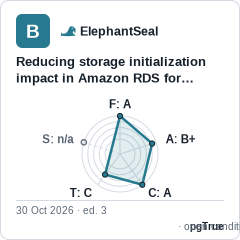
<a href="https://pgtrue.postgres.ai/shared/brief/21d3c75d-5017-44b9-8817-e48966f265cd"><img src="https://pgtrue.postgres.ai/badge/21d3c75d-5017-44b9-8817-e48966f265cd/radar.svg?v=13&amp;theme=light" alt="pgTrue fact-check" width="240" height="240" loading="lazy" decoding="async" style="display:inline-block;width:240px;height:240px"></a>
https://pgtrue.postgres.ai/badge/21d3c75d-5017-44b9-8817-e48966f265cd/radar.svg?v=13&theme=light
.. image:: https://pgtrue.postgres.ai/badge/21d3c75d-5017-44b9-8817-e48966f265cd/radar.svg?v=13&theme=light
   :target: https://pgtrue.postgres.ai/shared/brief/21d3c75d-5017-44b9-8817-e48966f265cd
   :alt: pgTrue fact-check
   :width: 240
   :height: 240
[![pgTrue fact-check](https://pgtrue.postgres.ai/badge/21d3c75d-5017-44b9-8817-e48966f265cd/radar.svg?v=13&theme=dark)](https://pgtrue.postgres.ai/shared/brief/21d3c75d-5017-44b9-8817-e48966f265cd)
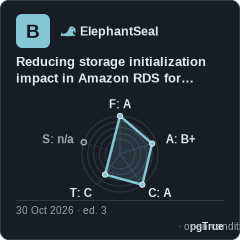
<a href="https://pgtrue.postgres.ai/shared/brief/21d3c75d-5017-44b9-8817-e48966f265cd"><img src="https://pgtrue.postgres.ai/badge/21d3c75d-5017-44b9-8817-e48966f265cd/radar.svg?v=13&amp;theme=dark" alt="pgTrue fact-check" width="240" height="240" loading="lazy" decoding="async" style="display:inline-block;width:240px;height:240px"></a>
https://pgtrue.postgres.ai/badge/21d3c75d-5017-44b9-8817-e48966f265cd/radar.svg?v=13&theme=dark
.. image:: https://pgtrue.postgres.ai/badge/21d3c75d-5017-44b9-8817-e48966f265cd/radar.svg?v=13&theme=dark
   :target: https://pgtrue.postgres.ai/shared/brief/21d3c75d-5017-44b9-8817-e48966f265cd
   :alt: pgTrue fact-check
   :width: 240
   :height: 240
[![pgTrue fact-check](https://pgtrue.postgres.ai/badge/21d3c75d-5017-44b9-8817-e48966f265cd/radar.svg?v=13)](https://pgtrue.postgres.ai/shared/brief/21d3c75d-5017-44b9-8817-e48966f265cd)
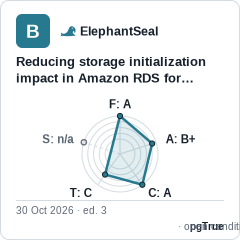
<a href="https://pgtrue.postgres.ai/shared/brief/21d3c75d-5017-44b9-8817-e48966f265cd"><img src="https://pgtrue.postgres.ai/badge/21d3c75d-5017-44b9-8817-e48966f265cd/radar.svg?v=13" alt="pgTrue fact-check" width="240" height="240" loading="lazy" decoding="async" style="display:inline-block;width:240px;height:240px"></a>
https://pgtrue.postgres.ai/badge/21d3c75d-5017-44b9-8817-e48966f265cd/radar.svg?v=13
.. image:: https://pgtrue.postgres.ai/badge/21d3c75d-5017-44b9-8817-e48966f265cd/radar.svg?v=13
   :target: https://pgtrue.postgres.ai/shared/brief/21d3c75d-5017-44b9-8817-e48966f265cd
   :alt: pgTrue fact-check
   :width: 240
   :height: 240
[![pgTrue fact-check](https://pgtrue.postgres.ai/badge/21d3c75d-5017-44b9-8817-e48966f265cd/wide.svg?v=13&theme=light)](https://pgtrue.postgres.ai/shared/brief/21d3c75d-5017-44b9-8817-e48966f265cd)
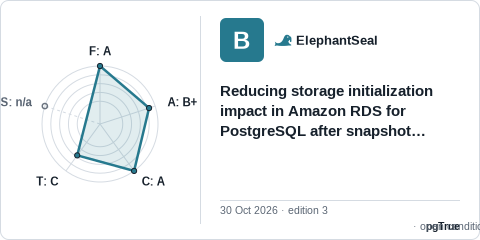
<a href="https://pgtrue.postgres.ai/shared/brief/21d3c75d-5017-44b9-8817-e48966f265cd"><img src="https://pgtrue.postgres.ai/badge/21d3c75d-5017-44b9-8817-e48966f265cd/wide.svg?v=13&amp;theme=light" alt="pgTrue fact-check" width="480" height="240" loading="lazy" decoding="async" style="display:inline-block;width:480px;height:240px"></a>
https://pgtrue.postgres.ai/badge/21d3c75d-5017-44b9-8817-e48966f265cd/wide.svg?v=13&theme=light
.. image:: https://pgtrue.postgres.ai/badge/21d3c75d-5017-44b9-8817-e48966f265cd/wide.svg?v=13&theme=light
   :target: https://pgtrue.postgres.ai/shared/brief/21d3c75d-5017-44b9-8817-e48966f265cd
   :alt: pgTrue fact-check
   :width: 480
   :height: 240
[![pgTrue fact-check](https://pgtrue.postgres.ai/badge/21d3c75d-5017-44b9-8817-e48966f265cd/wide.svg?v=13&theme=dark)](https://pgtrue.postgres.ai/shared/brief/21d3c75d-5017-44b9-8817-e48966f265cd)
<a href="https://pgtrue.postgres.ai/shared/brief/21d3c75d-5017-44b9-8817-e48966f265cd"><img src="https://pgtrue.postgres.ai/badge/21d3c75d-5017-44b9-8817-e48966f265cd/wide.svg?v=13&amp;theme=dark" alt="pgTrue fact-check" width="480" height="240" loading="lazy" decoding="async" style="display:inline-block;width:480px;height:240px"></a>
https://pgtrue.postgres.ai/badge/21d3c75d-5017-44b9-8817-e48966f265cd/wide.svg?v=13&theme=dark
.. image:: https://pgtrue.postgres.ai/badge/21d3c75d-5017-44b9-8817-e48966f265cd/wide.svg?v=13&theme=dark
   :target: https://pgtrue.postgres.ai/shared/brief/21d3c75d-5017-44b9-8817-e48966f265cd
   :alt: pgTrue fact-check
   :width: 480
   :height: 240
[![pgTrue fact-check](https://pgtrue.postgres.ai/badge/21d3c75d-5017-44b9-8817-e48966f265cd/wide.svg?v=13)](https://pgtrue.postgres.ai/shared/brief/21d3c75d-5017-44b9-8817-e48966f265cd)
<a href="https://pgtrue.postgres.ai/shared/brief/21d3c75d-5017-44b9-8817-e48966f265cd"><img src="https://pgtrue.postgres.ai/badge/21d3c75d-5017-44b9-8817-e48966f265cd/wide.svg?v=13" alt="pgTrue fact-check" width="480" height="240" loading="lazy" decoding="async" style="display:inline-block;width:480px;height:240px"></a>
https://pgtrue.postgres.ai/badge/21d3c75d-5017-44b9-8817-e48966f265cd/wide.svg?v=13
.. image:: https://pgtrue.postgres.ai/badge/21d3c75d-5017-44b9-8817-e48966f265cd/wide.svg?v=13
   :target: https://pgtrue.postgres.ai/shared/brief/21d3c75d-5017-44b9-8817-e48966f265cd
   :alt: pgTrue fact-check
   :width: 480
   :height: 240

Click the snippet to select all of it, then copy. Where SVG is stripped, as in some email clients and feed readers, change .svg to .png. PNG uses the light theme for Auto. For Markdown PNG embeds, use the HTML snippet where supported to preserve the display size.

Optional colours: append &color=26798E or &labelColor=333C47 after a theme query (use ? for the first parameter). Use 3- or 6-digit hex.

For pages with a light background.

For pages with a dark background. The ElephantSeal gets a thin edge so it does not blend in.

Auto follows the reader's light or dark setting where the host supports it, and shows the light ElephantSeal where it does not.

On a light page
On a dark page

Reducing storage initialization impact in Amazon RDS for PostgreSQL after snapshot restore | Amazon Web Services (opens in new tab)

aws.amazon.com
Check before you follow it: 1 claim is wrong.
0
inaccuracy
0
dangerous-recipe
1
misleading
2
imprecise
0
transcription
0
aged
0
withdrawn
14
verified-accurate

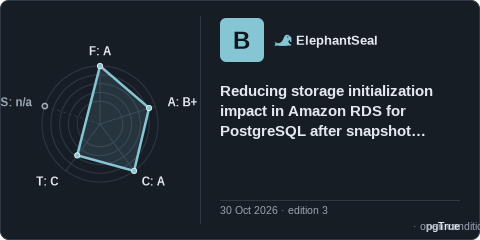
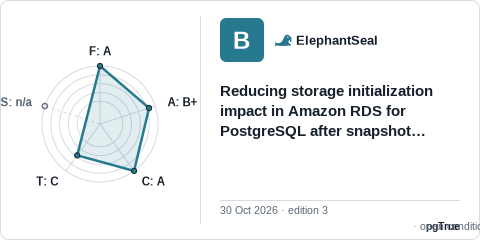
Factual A · Applicable B+ · Consistent A · Transparent C · Safe —

ReportTechnical fact-check, edition 3 pgTrue versionaudited with v1.0.17 (approx.) · regraded with v1.1.3 Issued EditionUpdated after review. Corrections are listed below. SubmittedSubmitted by the PostgresAI team. Author responseNo written reply from the author. We re-audited this article 4 times; see Revisions below. Policy: right-of-reply and corrections policy.

InaccuraciesNone in this edition.

Dangerous or recipe bugsNone in this edition.

Misleading / imprecise

F1

COUNT(*) does not guarantee heap hydration

MISLEADINGApplicable · holds up after review

Claim ledger

Article says
…SELECT * / COUNT(*) Heap only No…
What is true
COUNT(*) can scan an index instead of the heap. PostgreSQL 18.6 skips heap fetches for all-visible pages during index-only scans. The count can finish while heap blocks remain untouched.
So what
Use pg_prewarm on the heap instead of COUNT(*) when heap hydration is required.
Charitable reading
An unfiltered SELECT * can scan heap data. COUNT(*) has a different access path and cannot share that guarantee.

Source

Source · REL_18_6 · doc/src/sgml/func.sgml:22714-22717will require effort proportional to the size of the table: <productname>PostgreSQL</productname> will need to scan either the entire table or the entirety of an index that includes all rows in the table.
In the article · section “Approaches to reduce lazy loading time”

In the article

excerpt · section “Approaches to reduce lazy loading time” · as fetched 2026-10-21 · open in article ↗ (opens in new tab)

Approaches to reduce lazy loading time

Technique Hydrates heap Hydrates indexes Hydrates TOAST Speed Recommended when pg_prewarm Targeted Targeted Targeted Fast Critical tables/indexes SELECT * / COUNT(*) Heap only No Partial Medium Heap-only hydration needed VACUUM ANALYZE Partial Partial Partial Medium Statistics refresh is primary goal export using pg_dump All heap No All heap Medium Full database heap hydration in one operation
All sources and excerpts · 2
Evidence will require effort proportional to the size of the table: <productname>PostgreSQL</productname> will need to scan either the entire table or the entirety of an index that includes all rows in the table.
Evidence * We can skip the heap fetch if the TID references a heap page on * which all tuples are known visible to everybody. In any case, * we'll use the index tuple not the heap tuple as the data source.
How the review tested this

Review: We tested whether COUNT(*) necessarily reads heap pages. E-2 permits an index scan, and E-3 permits skipping heap fetches. We tested whether the table merely describes sequential scans. E-1 explicitly includes COUNT(*). E-2 and E-3 permit index-only execution without heap reads.

F2

Imprecise: “…depends entirely on the dead-tuple ratio…”

IMPRECISEApplicable · partly holds after review

Claim ledger

Article says
…depends entirely on the dead-tuple ratio…
What is true
VACUUM hydration also depends on visibility-map state and freezing requirements. REL_18_6 src/backend/access/heap/vacuumlazy.c:54 permits eager scans of otherwise skippable pages. The article correctly recommends pg_prewarm over VACUUM for complete hydration.
So what
Use pg_prewarm for hydration. Estimate VACUUM reads from visibility-map and freezing state rather than dead-tuple ratio alone.

Source

Source · REL_18_6 · src/backend/access/heap/visibilitymap.c:25-28* The visibility map is a bitmap with two bits (all-visible and all-frozen) * per heap page. A set all-visible bit means that all tuples on the page are * known visible to all transactions, and therefore the page doesn't need to * be vacuumed.
In the article · section “What VACUUM actually does (and does not do)”

In the article

excerpt · section “What VACUUM actually does (and does not do)” · as fetched 2026-10-21 · open in article ↗ (opens in new tab)

What VACUUM actually does (and does not do)

VACUUM isn’t reliable for hydration. How much it helps depends entirely on the dead-tuple ratio when the snapshot was taken.

All sources and excerpts · 2
Evidence * The visibility map is a bitmap with two bits (all-visible and all-frozen) * per heap page. A set all-visible bit means that all tuples on the page are * known visible to all transactions, and therefore the page doesn't need to * be vacuumed.
Evidence * A normal vacuum may also scan skippable pages in an effort to freeze them * and decrease the backlog of all-visible but not all-frozen pages that have * to be processed by the next aggressive vacuum. These are referred to as * eagerly scanned pages.
How the review tested this

Review: We checked the surrounding recommendation against E-5. The dead-tuple explanation excludes freezing, but the recommendation against VACUUM for complete hydration remains sound. We considered the article's sound recommendation against VACUUM hydration. E-5 still disproves dependence entirely on dead tuples.

F3

Explicit statistics targets can control the ANALYZE sample

IMPRECISEApplicable · holds up after review

Claim ledger

Article says
The sample size is proportional to the default_statistics_target parameter…
What is true
default_statistics_target applies when a column has no explicit target. ANALYZE also considers targets from extended-statistics objects. Changing the default alone need not change the requested sample.
So what
Check column and extended-statistics targets before changing default_statistics_target to control ANALYZE sampling.
Charitable reading
The proportional relationship applies to ordinary columns that use the default target. Explicit targets change that relationship.

Source

Source · REL_18_6 · src/backend/commands/analyze.c:513-521/* * Look at extended statistics objects too, as those may define custom * statistics target. So we may need to sample more rows and then build * the statistics with enough detail. */ minrows = ComputeExtStatisticsRows(onerel, attr_cnt, vacattrstats); if (targrows < minrows) targrows = minrows;
In the article · section “What ANALYZE actually does”

In the article

excerpt · section “What ANALYZE actually does” · as fetched 2026-10-21 · open in article ↗ (opens in new tab)

What ANALYZE actually does

ANALYZE collects statistics for the query planner by sampling a limited subset of table rows. It does not perform a full sequential scan. Even for tables with hundreds of millions of rows, ANALYZE reads only a small fraction of pages. The sample size is proportional to the default_statistics_target parameter (default: 100) and does not scale with table size.

Operation Hydration value Other value VACUUM Limited – Skips all visible pages Reclaims dead tuples, updates FSM ANALYZE Minimal – Samples only Refreshes planner statistics
All sources and excerpts · 3
Evidence /* * Look at extended statistics objects too, as those may define custom * statistics target. So we may need to sample more rows and then build * the statistics with enough detail. */ minrows = ComputeExtStatisticsRows(onerel, attr_cnt, vacattrstats); if (targrows < minrows) targrows = minrows;
Evidence Sets the default statistics target for table columns without a column-specific target set via <command>ALTER TABLE SET STATISTICS</command>.
Evidence /* If the attstattarget column is negative, use the default value */ if (stats->attstattarget < 0) stats->attstattarget = default_statistics_target;
How the review tested this

Review: We tested the default-settings reading. It explains ordinary behavior, but E-8 and E-27 establish overrides affecting the proposed setting change. We tested the ordinary-default reading. E-8 confirms that case, but explicit column and extended-statistics targets limit the unqualified proportionality claim.

Verified accurate

F4

The prewarming modes use the described cache paths

ACCURATEFactual · holds up after review

Claim ledger

Article says
…buffer Loads into PostgreSQL shared_buffers…
What is true
Buffer mode loads shared_buffers. Read mode synchronously reads blocks outside shared_buffers. Prefetch mode issues operating-system hints and does not wait for completion. The mode table distinguishes these paths.
Charitable reading
The mode table scopes shared_buffers loading to buffer mode. Its introductory cache description can include the operating-system cache.

Source

Source · REL_18_6 · contrib/pg_prewarm/pg_prewarm.c:240-240* In buffer mode, we actually pull the data into shared_buffers.
In the article · section “pg_prewarm modes”

In the article

excerpt · section “pg_prewarm modes” · as fetched 2026-10-21 · open in article ↗ (opens in new tab)

pg_prewarm modes

Mode I/O behavior Recommended for prefetch Asynchronous – Queues multiple I/O requests in parallel Fastest for hydration read Synchronous – One block at a time Sequential reads. Moderate speed buffer Loads into PostgreSQL shared_buffers Cache warming post-hydration
All sources and excerpts · 3
Evidence * In buffer mode, we actually pull the data into shared_buffers.
Evidence * In prefetch mode, we just hint the OS to read the blocks, but we * don't know whether it really does it, and we don't wait for it to * finish.
Evidence * In read mode, we actually read the blocks, but not into shared * buffers. This is more portable than prefetch mode (it works * everywhere) and is synchronous.
How the review tested this

Review: We checked whether F4 promises completed prefetch reads or superior speed. Its wording makes neither claim and matches all three source branches. We checked whether prefetch guarantees completed reads. E-11 denies that guarantee, and the finding preserves the distinction from buffer and read modes.

F5

Verified accurate: “…JOIN pg_index idx ON idx.indrelid = t.oid…”

ACCURATEFactual · partly holds after review

Claim ledger

Article says
…JOIN pg_index idx ON idx.indrelid = t.oid…
What is true
pg_class.reltoastrelid identifies the TOAST table. relnamespace references pg_namespace.oid. The quoted join matches pg_index.indrelid to t.oid. pg_index.indexrelid identifies the index.

Source

Source · REL_18_6 · src/include/catalog/pg_class.h:74-75/* OID of toast table; 0 if none */ Oid reltoastrelid BKI_DEFAULT(0) BKI_LOOKUP_OPT(pg_class);
In the article

In the article

Article · exact quote · open in article ↗ (opens in new tab)…JOIN pg_index idx ON idx.indrelid = t.oid…
All sources and excerpts · 4
Evidence /* OID of toast table; 0 if none */ Oid reltoastrelid BKI_DEFAULT(0) BKI_LOOKUP_OPT(pg_class);
Evidence NameData relname; /* OID of namespace containing this class */ Oid relnamespace BKI_DEFAULT(pg_catalog) BKI_LOOKUP(pg_namespace);
EvidenceCATALOG(pg_namespace,2615,NamespaceRelationId) { Oid oid; /* oid */ NameData nspname;
Evidence Oid indexrelid BKI_LOOKUP(pg_class); /* OID of the index */ Oid indrelid BKI_LOOKUP(pg_class); /* OID of the relation it
How the review tested this

Review: We checked field ownership and join direction. The catalog definitions support those claims. E-13 quotes no name filters, so the final sentence exceeds the cited excerpts.

F6

pg_prewarm checks SELECT privilege

ACCURATEFactual · holds up after review

Claim ledger

Article says
…must have SELECT privilege on the target tables.
What is true
contrib/pg_prewarm/pg_prewarm.c:149–151 checks ACL_SELECT before prewarming. A failed check raises a permission error.
Charitable reading
The sentence states a required privilege. It does not promise that a grant on one relation authorizes every target.

Source

Source · REL_18_6 · contrib/pg_prewarm/pg_prewarm.c:149-151aclresult = pg_class_aclcheck(privOid, GetUserId(), ACL_SELECT); if (aclresult != ACLCHECK_OK) aclcheck_error(aclresult, get_relkind_objtype(rel->rd_rel->relkind), get_rel_name(relOid));
In the article · section “Sample commands for prewarming a table and its associated objects”

In the article

excerpt · section “Sample commands for prewarming a table and its associated objects” · as fetched 2026-10-21 · open in article ↗ (opens in new tab)

Sample commands for prewarming a table and its associated objects

Permission requirement: The user running pg_prewarm must have SELECT privilege on the target tables.

All sources and excerpts · 1
Evidence aclresult = pg_class_aclcheck(privOid, GetUserId(), ACL_SELECT); if (aclresult != ACLCHECK_OK) aclcheck_error(aclresult, get_relkind_objtype(rel->rd_rel->relkind), get_rel_name(relOid));
How the review tested this

Review: We tested whether F6 confuses required privileges with sufficient authorization for every object. It only verifies the ACL_SELECT check. We tested whether E-18 promises sufficient privileges for every target. It states a requirement. E-19 checks ACL_SELECT and raises an error on failure.

F7

ANALYZE samples blocks and rows

ACCURATEFactual · holds up after review

Claim ledger

Article says
…ANALYZE collects statistics for the query planner by sampling a limited subset of table rows.
What is true
ANALYZE first samples blocks, then rows within those blocks. Small relations can have every block read. default_statistics_target defaults to 100.
Charitable reading
The surrounding discussion concerns large tables. Small relations can have every block sampled.

Source

Source · REL_18_6 · src/backend/commands/analyze.c:1177-1181* As of May 2004 we use a new two-stage method: Stage one selects up * to targrows random blocks (or all blocks, if there aren't so many). * Stage two scans these blocks and uses the Vitter algorithm to create * a random sample of targrows rows (or less, if there are less in the * sample of blocks).
In the article · section “What ANALYZE actually does”

In the article

excerpt · section “What ANALYZE actually does” · as fetched 2026-10-21 · open in article ↗ (opens in new tab)

What ANALYZE actually does

ANALYZE collects statistics for the query planner by sampling a limited subset of table rows. It does not perform a full sequential scan. Even for tables with hundreds of millions of rows, ANALYZE reads only a small fraction of pages. The sample size is proportional to the default_statistics_target parameter (default: 100) and does not scale with table size.

Operation Hydration value Other value VACUUM Limited – Skips all visible pages Reclaims dead tuples, updates FSM ANALYZE Minimal – Samples only Refreshes planner statistics
All sources and excerpts · 3
Evidence * As of May 2004 we use a new two-stage method: Stage one selects up * to targrows random blocks (or all blocks, if there aren't so many). * Stage two scans these blocks and uses the Vitter algorithm to create * a random sample of targrows rows (or less, if there are less in the * sample of blocks).
Evidence &default_statistics_target, 100, 1, MAX_STATISTICS_TARGET,
Evidence /* If the attstattarget column is negative, use the default value */ if (stats->attstattarget < 0) stats->attstattarget = default_statistics_target;
How the review tested this

Review: We tested small relations as a counterexample. F7 already includes that exception, and E-22 confirms the default of 100. We checked the small-table exception. E-21 permits sampling every block, and the finding states that exception. E-22 confirms the default target of 100.

F8

Visibility-map and VACUUM maintenance descriptions match the source

ACCURATEFactual · holds up after review

Claim ledger

Article says
…tracks which pages contain only visible tuples.
What is true
The visibility map records all-visible and all-frozen state per heap page. VACUUM reclaims dead tuples and updates the free-space map.
Charitable reading
Visible means visible to all transactions for the visibility-map bit. It does not mean visible to one query.

Source

Source · REL_18_6 · src/backend/access/heap/visibilitymap.c:25-28* The visibility map is a bitmap with two bits (all-visible and all-frozen) * per heap page. A set all-visible bit means that all tuples on the page are * known visible to all transactions, and therefore the page doesn't need to * be vacuumed.
In the article · section “What VACUUM actually does (and does not do)”

In the article

excerpt · section “What VACUUM actually does (and does not do)” · as fetched 2026-10-21 · open in article ↗ (opens in new tab)

What VACUUM actually does (and does not do)

PostgreSQL maintains a visibility map alongside each table that tracks which pages contain only visible tuples. Standard VACUUM typically skips pages marked as visible. On mostly static tables, the visibility map marks the majority of pages as visible. VACUUM generally skips them, hydrating very few blocks.

All sources and excerpts · 3
Evidence * The visibility map is a bitmap with two bits (all-visible and all-frozen) * per heap page. A set all-visible bit means that all tuples on the page are * known visible to all transactions, and therefore the page doesn't need to * be vacuumed.
Evidence * vacuum scans the blocks of the relation referred to by the TIDs in the TID * store and reaps the corresponding dead items, freeing that space for future * tuples.
Evidence * In between phases, vacuum updates the freespace map (every * VACUUM_FSM_EVERY_PAGES).
How the review tested this

Review: We checked whether F8 endorses skipping every visible page. It verifies map contents and maintenance operations without endorsing that broader claim. We tested whether visible means visible to one query. E-24 specifies all transactions. E-25 and E-26 support tuple reclamation and free-space-map updates.

F9

RDS documents background initialization after snapshot restore

ACCURATEFactual · holds up after review

Claim ledger

Article says
Lazy loading applies to snapshot restores…
What is true
RDS documents background storage initialization after snapshot restore. The instance remains available during initialization. The same documentation lists PITR, read replica creation, and Single-AZ to Multi-AZ conversion.
Charitable reading
Availability means after the restore creates an accessible instance, before all storage blocks finish loading.

Source

Source · https://docs.aws.amazon.com/AmazonRDS/latest/UserGuide/accessing-monitoring.htmlFor other workflows that hydrate volumes from Amazon S3 (such as point-in-time recovery, snapshot restore, read replica creation, and Single-AZ to Multi-AZ conversion), the DB instance status remains **available** while initialization runs in the background.
In the article

In the article

Article · exact quote · open in article ↗ (opens in new tab)Lazy loading applies to snapshot restores…
All sources and excerpts · 1
EvidenceFor other workflows that hydrate volumes from Amazon S3 (such as point-in-time recovery, snapshot restore, read replica creation, and Single-AZ to Multi-AZ conversion), the DB instance status remains **available** while initialization runs in the background.
How the review tested this

Review: We checked whether availability applies before instance creation. F9 confines availability to background initialization, matching E-29. We checked whether availability applies during instance creation. E-29 concerns background initialization after restoration. The finding does not promise access throughout creation.

F10

EBS FSR initializes restored volumes at creation

ACCURATEFactual · holds up after review

Claim ledger

Article says
…fully initializing a volume at creation time…
What is true
The EBS guide states that FSR creates a fully initialized volume. It eliminates the first-access block latency described in the article.
Charitable reading
This check concerns EBS FSR behavior, separate from whether RDS exposes FSR.

Source

Source · https://docs.aws.amazon.com/ebs/latest/userguide/ebs-fast-snapshot-restore.htmlAmazon EBS fast snapshot restore (FSR) enables you to create a volume from a snapshot that is fully initialized at creation. This eliminates the latency of I/O operations on a block when it is accessed for the first time.
In the article

In the article

Article · exact quote · open in article ↗ (opens in new tab)…fully initializing a volume at creation time…
All sources and excerpts · 1
EvidenceAmazon EBS fast snapshot restore (FSR) enables you to create a volume from a snapshot that is fully initialized at creation. This eliminates the latency of I/O operations on a block when it is accessed for the first time.
How the review tested this

Review: We checked whether F10 extends EBS behavior to RDS availability. It does not, and E-31 directly supports initialization at creation. We tested whether the finding also endorses RDS availability of FSR. It addresses EBS behavior alone. E-31 directly supports initialization at creation.

F11

pg_prewarm prefetch issues asynchronous requests

ACCURATEFactual · holds up after review

Claim ledger

Article says
…prefetch Asynchronous – Queues multiple I/O requests in parallel…
What is true
PostgreSQL 18 documents asynchronous operating-system requests for prefetch mode. Platforms without prefetch support raise an error. This confirms request behavior, not RDS hydration completion.
Charitable reading
Parallel means issuing asynchronous requests, rather than guaranteeing concurrent physical reads or completion.

Source

Source · https://www.postgresql.org/docs/current/pgprewarm.htmlprefetch issues asynchronous prefetch requests to the operating system, if this is supported, or throws an error otherwise.
In the article · section “pg_prewarm modes”

In the article

excerpt · section “pg_prewarm modes” · as fetched 2026-10-21 · open in article ↗ (opens in new tab)

pg_prewarm modes

Mode I/O behavior Recommended for prefetch Asynchronous – Queues multiple I/O requests in parallel Fastest for hydration read Synchronous – One block at a time Sequential reads. Moderate speed buffer Loads into PostgreSQL shared_buffers Cache warming post-hydration
All sources and excerpts · 1
Evidenceprefetch issues asynchronous prefetch requests to the operating system, if this is supported, or throws an error otherwise.
How the review tested this

Review: We tested whether asynchronous requests imply concurrent physical reads. F11 explicitly limits verification to requests and preserves the platform exception. We tested whether asynchronous requests prove parallel physical reads or completed hydration. E-33 establishes requests only. The finding expressly preserves that limit.

F12

RDS documents both initialization progress fields

ACCURATEFactual · holds up after review

Claim ledger

Article says
…StorageOperationStatus (returns Initializing while in progress)…
What is true
RDS documents StorageOperationStatus and StorageOperationPercentProgress for initialization progress per volume. StorageOperationStatus uses Initializing during initialization. This check does not verify the article's CLI response path.
Charitable reading
This check verifies field names and the initialization status value, separate from their JSON location.

Source

Source · https://docs.aws.amazon.com/AmazonRDS/latest/UserGuide/accessing-monitoring.htmlTo monitor initialization progress per volume in all cases, use the `StorageOperationStatus` and `StorageOperationPercentProgress` fields in the [DescribeDBInstances](https://docs.aws.amazon.com/AmazonRDS/latest/APIReference/API_DescribeDBInstances.html) response. During initialization, `StorageOperationStatus` is set to `Initializing`.
In the article

In the article

Article · exact quote · open in article ↗ (opens in new tab)…StorageOperationStatus (returns Initializing while in progress)…
All sources and excerpts · 1
EvidenceTo monitor initialization progress per volume in all cases, use the `StorageOperationStatus` and `StorageOperationPercentProgress` fields in the [DescribeDBInstances](https://docs.aws.amazon.com/AmazonRDS/latest/APIReference/API_DescribeDBInstances.html) response. During initialization, `StorageOperationStatus` is set to `Initializing`.
How the review tested this

Review: We checked whether field existence validates the CLI response path. F12 expressly excludes that inference and matches E-35. We checked whether field-name verification also validates the CLI response path. The finding excludes that claim. E-35 supports both names and Initializing.

F13

The visibility map records all-visible heap pages

ACCURATEFactual · holds up after review

Claim ledger

Article says
…PostgreSQL maintains a visibility map alongside each table that tracks which pages contain only visible tuples.
What is true
PostgreSQL 18 documents a visibility map for each heap relation. Its all-visible bit identifies pages whose tuples are visible to all active transactions. A separate bit records all-frozen pages.
Charitable reading
The article describes the all-visible bit, rather than enumerating both visibility-map bits.

Source

Source · https://www.postgresql.org/docs/current/storage-vm.htmlEach heap relation has a Visibility Map (VM) to keep track of which pages contain only tuples that are known to be visible to all active transactions; it also keeps track of which pages contain only frozen tuples.
In the article · section “What VACUUM actually does (and does not do)”

In the article

excerpt · section “What VACUUM actually does (and does not do)” · as fetched 2026-10-21 · open in article ↗ (opens in new tab)

What VACUUM actually does (and does not do)

PostgreSQL maintains a visibility map alongside each table that tracks which pages contain only visible tuples. Standard VACUUM typically skips pages marked as visible. On mostly static tables, the visibility map marks the majority of pages as visible. VACUUM generally skips them, hydrating very few blocks.

All sources and excerpts · 1
EvidenceEach heap relation has a Visibility Map (VM) to keep track of which pages contain only tuples that are known to be visible to all active transactions; it also keeps track of which pages contain only frozen tuples.
How the review tested this

Review: We tested whether visibility means visibility to one query. F13 correctly requires visibility to all active transactions. We checked whether the article's description excludes the frozen bit. It describes the visible bit without denying another. E-37 supports the finding.

F14

TOAST storage has its own index

ACCURATEFactual · holds up after review

Claim ledger

Article says
…the TOAST table, and the TOAST index.
What is true
PostgreSQL 18 documents a unique TOAST index on chunk_id and chunk_seq. The article correctly treats the TOAST table and its index as separate objects.
Charitable reading
This check concerns the separate TOAST index, rather than whether four objects provide complete storage hydration.

Source

Source · https://www.postgresql.org/docs/current/storage-toast.htmlA unique index on chunk_id and chunk_seq provides fast retrieval of the values.
In the article · section “Sample commands for prewarming a table and its associated objects”

In the article

excerpt · section “Sample commands for prewarming a table and its associated objects” · as fetched 2026-10-21 · open in article ↗ (opens in new tab)

Sample commands for prewarming a table and its associated objects

A complete prewarm requires warming four components: the table heap (main data), the table’s indexes, the TOAST table, and the TOAST index.

All sources and excerpts · 1
EvidenceA unique index on chunk_id and chunk_seq provides fast retrieval of the values.
How the review tested this

Review: We checked whether F14 validates complete storage hydration. Its narrower claim only establishes the separate TOAST index, which E-39 confirms. We tested whether separate TOAST objects establish complete storage hydration. The finding makes no such claim. E-39 confirms the separate unique index.

F16

The large-scan durations support approximately 13×

ACCURATEFactual · holds up after review

Claim ledger

Article says
…44 sec 571 sec…
What is true
The printed scan durations imply a 13.0× runtime ratio (derived: 571 seconds / 44 seconds). The approximately 13× label agrees.
Charitable reading
The tilde permits rounding the runtime ratio to 13×.

Checked for internal consistency: the evidence is the article itself.

In the article

In the article

Article · exact quote · open in article ↗ (opens in new tab)…44 sec 571 sec…
How the review tested this

Review: We recalculated 571 seconds divided by 44 seconds: 12.98×. F16 verifies rounding without endorsing the underlying measurements. We recalculated 571 seconds / 44 seconds = 12.98×. E-43 rounds correctly to 13×. The finding does not verify the measurements.

F17

The join durations support approximately 12×

ACCURATEFactual · holds up after review

Claim ledger

Article says
…123 sec 1,531 sec…
What is true
The printed join durations imply a 12.4× runtime ratio (derived: 1,531 seconds / 123 seconds). The approximately 12× label agrees.
Charitable reading
The tilde permits rounding the runtime ratio to 12×.

Checked for internal consistency: the evidence is the article itself.

In the article

In the article

Article · exact quote · open in article ↗ (opens in new tab)…123 sec 1,531 sec…
How the review tested this

Review: We recalculated 1,531 seconds divided by 123 seconds: 12.45×. The approximate 12× label survives ordinary rounding. We recalculated 1,531 seconds / 123 seconds = 12.45×. E-45 reasonably rounds to 12×. The finding does not verify the measurements.

F18

The 15× latency comparison fits the printed range

ACCURATEFactual · holds up after review

Claim ledger

Article says
…2–3 ms Up to 40 ms…
What is true
Comparing 40 ms against 2–3 ms gives ratios from 13.3× to 20×. Approximately 15× fits that range. This establishes numerical compatibility, not a measured average reduction.
Charitable reading
The approximately 15× label can describe a comparison within the stated latency range.

Checked for internal consistency: the evidence is the article itself.

In the article

In the article

Article · exact quote · open in article ↗ (opens in new tab)…2–3 ms Up to 40 ms…
How the review tested this

Review: We tested whether comparing a maximum with a range proves average improvement. F18 excludes that inference and correctly establishes numerical compatibility. We tested whether maximum latency proves an average reduction. It does not. The finding limits itself to numerical compatibility: 15× lies between 13.3× and 20×.

Notes

1 not graded: findings no reader would act on differently
F15

Note: “…--query…”

NOTEpartly holds after review

Claim ledger

Article says
…--query 'DBInstances[0].{StorageOperationStatus:StorageOperationStatus,StorageOperationPercentProgress:StorageOperationPercentProgress}'…
What is true
The query projects 2 fields, but the sample displays 3 columns with different names. Matching that layout requires an instance identifier and aliases. This comparison establishes a presentation mismatch, not whether the progress values are available.
So what
Include DBInstanceIdentifier and alias the progress field as Progress to obtain the displayed three-column layout.

Not graded: no reader would act differently on it.

Checked for internal consistency: the evidence is the article itself.

In the article

In the article

Article · exact quote · open in article ↗ (opens in new tab)…--query 'DBInstances[0].{StorageOperationStatus:StorageOperationStatus,StorageOperationPercentProgress:StorageOperationPercentProgress}'…
How the review tested this

Review: E-40 and E-41 prove mismatched columns. F15's proposed change only reproduces a display layout, so the demonstrated consequence is cosmetic. We compared the projection with the headers. The mismatch holds, but adding identifiers and aliases changes presentation. E-40 and E-41 establish no operational cost.

More in this report

Section checks · 9 sections

Section checks

AspectGradeFindingsCoverage
Storage initializationA2 verified-accurate100% of claims (9 of 9, plus 9 that need data we do not have)
Approach comparisonB+1 misleading14% of claims (1 of 7, plus 4 that need data we do not have)provisional
PrewarmingA2 verified-accurate100% of claims (6 of 6, plus 2 that need data we do not have)
Prewarming recipeA3 verified-accurate100% of claims (26 of 26)
VacuumA1 imprecise · 2 verified-accurate62% of claims (5 of 8, plus 1 that need data we do not have)
AnalyzeA1 imprecise · 1 verified-accurate71% of claims (5 of 7, plus 1 that need data we do not have)
MonitoringA1 verified-accurateno checkable claims
Monitoring recipeAnoneno checkable claims
Query resultsA3 verified-accurate100% of claims (3 of 3, plus 4 that need data we do not have)
Coverage and assessment · Checked 55 of 66 Postgres claims across 16 sections; 1 section below half

B — the findings address the article's main subject. What we did not check is listed below. We checked pg_prewarm modes and targeting, VACUUM and ANALYZE limitations, RDS initialization behavior, and progress field names.

We did not check everything in this article. What we did not check is listed below, in the words we recorded at the time. None of it moved the letter. We never charge our own limits to the article.

What we did not check

  • We did not verify the RDS background-copying mechanism, initialization API fields, or CLI output.
  • We did not reproduce the measurements or verify the test's controlled variables.
  • We did not inspect the article's two latency graphs.
  • We did not establish the comparative hydration speeds or the workload-specific benefits of io1/io2 storage.
  • We did not reproduce the hydration times or query measurements the article displays.
  • We did not read Figures 1 and 2.
  • We did not verify the CLI response structure, displayed output, or removal of completed initialization fields.
  • We did not verify FSR availability on RDS-managed volumes.
  • We did not check historical documentation for changes since October 14, 2026.
  • We did not check query execution, VACUUM, ANALYZE, or pg_dump behavior against PostgreSQL 18.6.
  • We did not verify the io1/io2 recommendation against storage and instance throughput limits.
  • We did not reproduce the query runtimes, hydration progress, or latency measurements.
  • We did not read Figures 1 and 2 to check their plotted values and measurement windows.
  • We did not verify the benchmark instances' configurations or their common snapshot.
  • We did not verify pg_prewarm's speed ranking against the other listed techniques.
  • We did not establish the fraction of pages ANALYZE reads in tables containing hundreds of millions of rows.
  • Safe: we did not complete every applicable check.
  • Section “Approach comparison”: we checked 1 of 11 checkable claims.
  • We could not decide whether readers can obtain the benchmark environment.
  • We could not decide whether the published benchmark details are complete.
Checked 55 of 66 Postgres claims across 16 sections; 1 section below half
  • Introduction: no checkable claims; not counted: 3 not a claim
  • Storage initialization: 9 of 9 Postgres claims checked, plus 9 that need data we do not have; not counted: 4 product or opinion, 1 duplicate
  • Approach comparison: 1 of 7 Postgres claims checked, plus 4 that need data we do not have; not checked: 6 for other reasons
  • Prewarming: 6 of 6 Postgres claims checked, plus 2 that need data we do not have; not counted: 1 product or opinion, 2 duplicate
  • Prewarming recipe: 26 of 26 Postgres claims checked; not counted: 3 duplicate
  • Vacuum: 5 of 8 Postgres claims checked, plus 1 that need data we do not have; not counted: 1 duplicate; not checked: 3 for other reasons
  • Analyze: 5 of 7 Postgres claims checked, plus 1 that need data we do not have; not counted: 1 duplicate; not checked: 2 for other reasons
  • Monitoring: no checkable claims; not counted: 6 product or opinion
  • Monitoring recipe: no checkable claims; not counted: 6 product or opinion
  • Test setup: 8 claims are the author's own account; nothing checkable; not counted: 1 not a claim
  • Hydration results: 3 claims are the author's own account; nothing checkable; not counted: 4 duplicate
  • Query results: 3 of 3 Postgres claims checked, plus 4 that need data we do not have
  • Latency graphs: 9 claims are the author's own account; nothing checkable; not counted: 1 duplicate
  • Test limitations: 2 claims are the author's own account; nothing checkable
  • Recommendations: 1 claim is the author's own account; nothing checkable; not counted: 4 product or opinion, 5 duplicate
  • Authors: no checkable claims; not counted: 11 not a claim

Average of 4 axes: 3.33 · benchmark not reproducible, one step off (no versions) · result B

Some explanatory text is not shown in this edition; the grade and findings are complete.

Scorecard · the five axes
FACTS scorecard Scorecard radar, 5 axes, bigger is better. Overall B. Factual A · 0 wrong of 17 checked · 0 caveats. Applicable B+ · 1 wrong of 13 checked · 2 caveats. Consistent A · 0 wrong of 17 checked · 0 caveats. Transparent C · 0 wrong of 6 checked · 0 caveats · reproducibility: C (no versions). Safe not applicable (n/a). A 0 wrong of 17 checked · 0 caveatsFactual A0 wrong of 170 caveats B+ 1 wrong of 13 checked · 2 caveatsApplicable B+1 wrong of 132 caveats A 0 wrong of 17 checked · 0 caveatsConsistent A0 wrong of 170 caveats C 0 wrong of 6 checked · 0 caveats reproducibility: C (no versions)Transparent C0 wrong of 60 caveatsreproducibility: C(no versions) not applicable (n/a), 6 commands scanned none riskySafe n/a6 commands scannednone risky B

By topic: Storage initialization — 2 findings, 0 wrong · Approach comparison — 1 finding, 1 wrong · Prewarming — 2 findings, 0 wrong · Prewarming recipe — 3 findings, 0 wrong · Vacuum — 3 findings, 0 wrong · Analyze — 2 findings, 0 wrong · Monitoring — 1 finding, 0 wrong · Query results — 3 findings, 0 wrong

Further out is better. Each axis has its own letter, from the wrong claims and caveats among the claims we checked of that kind.

Checked on the FACTS: Factual, Applicable, Consistent, Transparent, Safe. Clockwise: Factual (is it true?), Applicable (does it apply to my setup, today?), Consistent (does it agree with itself?), Transparent (can I check it myself?), Safe (can I run this on prod?).

We checked 17 claims, 6 commands scanned.

AxisLetterWrongCaveatsCheckedCoverage
FactualA0017assessed: A · 0 wrong of 17 checked · 0 caveats
ApplicableB+1213assessed: B+ · 1 wrong of 13 checked · 2 caveats
ConsistentA0017assessed: A · 0 wrong of 17 checked · 0 caveats
TransparentC006assessed: C · 0 wrong of 6 checked · 0 caveats · reproducibility: C (no versions)
Safe—000partly assessed
Topics · 9 topics

Topics

TopicFactualApplicableConsistentTransparentSafe
Storage initialization0 issues 2 checked F9 F100 issues 2 checked0 issues 2 checked0 issues 2 checked
Approach comparison0 issues 1 checked1 issue 1 checked F10 issues 1 checked
Prewarming0 issues 2 checked F4 F110 issues 1 checked0 issues 2 checked0 issues 1 checked
Prewarming recipe0 issues 3 checked F5 F6 F140 issues 2 checked0 issues 3 checked0 issues 1 checked
Vacuum0 issues 3 checked F8 F131 issue 1 checked F20 issues 3 checked0 issues 1 checked
Analyze0 issues 2 checked F71 issue 2 checked F30 issues 2 checked
Monitoring0 issues 1 checked F120 issues 1 checked0 issues 1 checked0 issues 1 checked
Monitoring recipe
Query results0 issues 3 checked F16 F17 F180 issues 3 checked0 issues 3 checked

Issues found among the claims checked, per topic and axis. Each link goes to the finding behind the count.

Revisions: 5 · B- -> B -> B- -> B -> B

We audited this article 5 times. Each row is the final edition of one audit. Letters and findings of earlier revisions stay readable at their own address.

  1. Revision 1 · 2026-10-16 12:18 UTC · B- · audited with v1.0.8 (approx.)

    Article as first submitted. 10 accurate · 2 wrong · 2 caveats.

    ElephantSeal: B-. Open: the benchmark cannot yet be rerun from what is published.

    Changes: First audit. Open: F2 “VACUUM hydration also depends on freezing” (false); F1 “COUNT(*) does not guarantee heap hydration” (misleading); F12 “RDS removes both fields when hydration is complete.” (mostly accurate); F11 “The CLI output does not match the displayed query” (misquoted).

  2. Revision 2 · 2026-10-18 17:54 UTC · B · audited with v1.0.11 (approx.)

    Same article text, re-audited. 7 accurate · 1 wrong · 1 caveat.

    ElephantSeal: B. Open: the benchmark cannot yet be rerun from what is published.

    Changes: No longer reported: “VACUUM hydration also depends on freezing”; “RDS removes both fields when hydration is complete.”; “The CLI output does not match the displayed query”. New: F8 “Column statistics targets can override the default sample target” (mostly accurate).

  3. Revision 3 · 2026-10-18 21:51 UTC · B- · audited with v1.0.12 (approx.)

    Same article text, re-audited. 10 accurate · 2 wrong · 2 caveats.

    ElephantSeal: B-. Open: the benchmark cannot yet be rerun from what is published.

    Changes: No longer reported: “…SELECT * / COUNT(*) Heap only No Partial…”; “Column statistics targets can override the default sample target”. New: F1 “COUNT(*) does not guarantee heap hydration” (false); F2 “Dead-tuple ratio alone does not determine VACUUM hydration” (misleading); F7 “ANALYZE sampling uses effective targets, not always default_statistics_target” (mostly accurate); F8 “The sample table does not match its query” (misquoted).

  4. Revision 4 · 2026-10-19 03:27 UTC · B · audited with v1.0.13 (approx.)

    Same article text, re-audited. 16 accurate · 1 wrong · 2 caveats.

    ElephantSeal: B. Open: the benchmark cannot yet be rerun from what is published.

    Changes: No longer reported: “Dead-tuple ratio alone does not determine VACUUM hydration”; “ANALYZE sampling uses effective targets, not always default_statistics_target”. New: F3 “default_statistics_target does not always control the ANALYZE sample” (mostly accurate).

  5. Revision 5 · this page · 2026-10-21 03:56 UTC · B · audited with v1.0.17 (approx.) · regraded with v1.1.3

    Same article text, re-audited. 14 accurate · 1 wrong · 2 caveats.

    ElephantSeal: B. Open: the benchmark cannot yet be rerun from what is published.

    Changes: No longer reported: “COUNT(*) can read an index instead of the heap”; “CLI sample has three columns for a two-field query”. New: F1 “COUNT(*) does not guarantee heap hydration” (misleading); F2 “…depends entirely on the dead-tuple ratio…” (mostly accurate).

Questions and answers

Questions and answers

What is pgTrue?

pgTrue is an independent fact-check of technical Postgres articles, made by PostgresAI. It helps you check advice before you use it.

What does the letter grade mean?

The letter grade summarizes the claims we checked. Five axes show what we checked:

  • Factual: is it true?
  • Applicable: does it apply to my setup, today?
  • Consistent: does it agree with itself?
  • Transparent: can I check it myself?
  • Safe: can I run this in production?

What is the ElephantSeal?

The ElephantSeal is the mark an article earns. It always shows the latest edition. “Open:” lists what is still open.

Can an author reply?

Authors can ask us to correct a finding, reply to it, or withdraw it. Right-of-reply policy.

Paste into your AI assistant to fix the article, then ask for a re-review.

Show the text
Fix the article with this report, then ask pgTrue for a re-review.

# pgTrue report: Reducing storage initialization impact in Amazon RDS for PostgreSQL after snapshot restore \| Amazon Web Services

Article title: Reducing storage initialization impact in Amazon RDS for PostgreSQL after snapshot restore \| Amazon Web Services
Article URL: https://aws.amazon.com/blogs/database/reducing-storage-initialization-impact-in-amazon-rds-for-postgresql-after-snapshot-restore
Report URL: https://pgtrue.postgres.ai/shared/brief/21d3c75d-5017-44b9-8817-e48966f265cd
Audited revision: 5 of 5, 2026-10-21 03:56:08 UTC
Overall letter: B

## Axes

- Factual: A · 0 wrong · 17 checked · 0 caveats · assessed
- Applicable: B+ · 1 wrong · 13 checked · 2 caveats · assessed
- Consistent: A · 0 wrong · 17 checked · 0 caveats · assessed
- Transparent: C · 0 wrong · 6 checked · 0 caveats · assessed
- Safe: — · 0 wrong · 0 checked · 0 caveats · partly assessed

ElephantSeal: B.
Open conditions: the benchmark cannot yet be rerun from what is published.

## Report metadata

- Report: Technical fact-check, edition 3
- pgTrue version: audited with v1.0.17 (approx.) · regraded with v1.1.3
- Issued: 2026-10-21
- Edition: Updated after review. Corrections are listed below.
- Submitted: Submitted by the PostgresAI team.
- Author response: No written reply from the author. We re-audited this article 4 times; see Revisions below. Policy: [right-of-reply and corrections policy](/pgtrue/security).

## Findings needing a change (3)

### F1 · Misleading · Applicable · COUNT(\*) does not guarantee heap hydration
Location: excerpt · section “Approaches to reduce lazy loading time” · as fetched 2026-10-21 · [open in article](https://aws.amazon.com/blogs/database/reducing-storage-initialization-impact-in-amazon-rds-for-postgresql-after-snapshot-restore#:~:text=SELECT%20%2A%20%2F%20COUNT%28%2A%29%20Heap%20only%20No)
Article says:
```text
…SELECT * / COUNT(*) Heap only No…
```
What is true:
COUNT(\*) can scan an index instead of the heap. PostgreSQL 18.6 skips heap fetches for all-visible pages during index-only scans. The count can finish while heap blocks remain untouched.
So what:
Use pg_prewarm on the heap instead of COUNT(\*) when heap hydration is required.
Charitable reading:
An unfiltered SELECT \* can scan heap data. COUNT(\*) has a different access path and cannot share that guarantee.
Review: We tested whether COUNT(\*) necessarily reads heap pages. E-2 permits an index scan, and E-3 permits skipping heap fetches. We tested whether the table merely describes sequential scans. E-1 explicitly includes COUNT(\*). E-2 and E-3 permit index-only execution without heap reads.

Sources:
- [REL_18_6 · doc/src/sgml/func.sgml:22714-22717](https://github.com/postgres/postgres/blob/724edf9bde9d356724ad384a2e196edc3c9f80f7/doc/src/sgml/func.sgml#L22714-L22717)
  Excerpt:
  ```text
  will require effort proportional to the size of the table:
    <productname>PostgreSQL</productname> will need to scan either the
    entire table or the entirety of an index that includes all rows in
    the table.
  ```
- [REL_18_6 · src/backend/executor/nodeIndexonlyscan.c:129-131](https://github.com/postgres/postgres/blob/724edf9bde9d356724ad384a2e196edc3c9f80f7/src/backend/executor/nodeIndexonlyscan.c#L129-L131)
  Excerpt:
  ```text
  * We can skip the heap fetch if the TID references a heap page on
		 * which all tuples are known visible to everybody.  In any case,
		 * we'll use the index tuple not the heap tuple as the data source.
  ```

Finding URL: https://pgtrue.postgres.ai/shared/brief/21d3c75d-5017-44b9-8817-e48966f265cd#F1

### F2 · Imprecise · Applicable · Imprecise: “…depends entirely on the dead-tuple ratio…”
Location: excerpt · section “What VACUUM actually does (and does not do)” · as fetched 2026-10-21 · [open in article](https://aws.amazon.com/blogs/database/reducing-storage-initialization-impact-in-amazon-rds-for-postgresql-after-snapshot-restore#:~:text=depends%20entirely%20on%20the%20dead%2Dtuple%20ratio)
Article says:
```text
…depends entirely on the dead-tuple ratio…
```
What is true:
VACUUM hydration also depends on visibility-map state and freezing requirements. REL_18_6 src/backend/access/heap/vacuumlazy.c:54 permits eager scans of otherwise skippable pages. The article correctly recommends pg_prewarm over VACUUM for complete hydration.
So what:
Use pg_prewarm for hydration. Estimate VACUUM reads from visibility-map and freezing state rather than dead-tuple ratio alone.
Review: We checked the surrounding recommendation against E-5. The dead-tuple explanation excludes freezing, but the recommendation against VACUUM for complete hydration remains sound. We considered the article's sound recommendation against VACUUM hydration. E-5 still disproves dependence entirely on dead tuples.

Sources:
- [REL_18_6 · src/backend/access/heap/visibilitymap.c:25-28](https://github.com/postgres/postgres/blob/724edf9bde9d356724ad384a2e196edc3c9f80f7/src/backend/access/heap/visibilitymap.c#L25-L28)
  Excerpt:
  ```text
  * The visibility map is a bitmap with two bits (all-visible and all-frozen)
 * per heap page. A set all-visible bit means that all tuples on the page are
 * known visible to all transactions, and therefore the page doesn't need to
 * be vacuumed.
  ```
- [REL_18_6 · src/backend/access/heap/vacuumlazy.c:54-57](https://github.com/postgres/postgres/blob/724edf9bde9d356724ad384a2e196edc3c9f80f7/src/backend/access/heap/vacuumlazy.c#L54-L57)
  Excerpt:
  ```text
  * A normal vacuum may also scan skippable pages in an effort to freeze them
 * and decrease the backlog of all-visible but not all-frozen pages that have
 * to be processed by the next aggressive vacuum. These are referred to as
 * eagerly scanned pages.
  ```

Finding URL: https://pgtrue.postgres.ai/shared/brief/21d3c75d-5017-44b9-8817-e48966f265cd#F2

### F3 · Imprecise · Applicable · Explicit statistics targets can control the ANALYZE sample
Location: excerpt · section “What ANALYZE actually does” · as fetched 2026-10-21 · [open in article](https://aws.amazon.com/blogs/database/reducing-storage-initialization-impact-in-amazon-rds-for-postgresql-after-snapshot-restore#:~:text=The%20sample%20size%20is%20proportional%20to%20the%20default_statistics_target%20parameter)
Article says:
```text
The sample size is proportional to the default_statistics_target parameter…
```
What is true:
default_statistics_target applies when a column has no explicit target. ANALYZE also considers targets from extended-statistics objects. Changing the default alone need not change the requested sample.
So what:
Check column and extended-statistics targets before changing default_statistics_target to control ANALYZE sampling.
Charitable reading:
The proportional relationship applies to ordinary columns that use the default target. Explicit targets change that relationship.
Review: We tested the default-settings reading. It explains ordinary behavior, but E-8 and E-27 establish overrides affecting the proposed setting change. We tested the ordinary-default reading. E-8 confirms that case, but explicit column and extended-statistics targets limit the unqualified proportionality claim.

Sources:
- [REL_18_6 · src/backend/commands/analyze.c:513-521](https://github.com/postgres/postgres/blob/724edf9bde9d356724ad384a2e196edc3c9f80f7/src/backend/commands/analyze.c#L513-L521)
  Excerpt:
  ```text
  /*
	 * Look at extended statistics objects too, as those may define custom
	 * statistics target. So we may need to sample more rows and then build
	 * the statistics with enough detail.
	 */
	minrows = ComputeExtStatisticsRows(onerel, attr_cnt, vacattrstats);

	if (targrows < minrows)
		targrows = minrows;
  ```
- [REL_18_6 · doc/src/sgml/config.sgml:6443-6445](https://github.com/postgres/postgres/blob/724edf9bde9d356724ad384a2e196edc3c9f80f7/doc/src/sgml/config.sgml#L6443-L6445)
  Excerpt:
  ```text
  Sets the default statistics target for table columns without
        a column-specific target set via <command>ALTER TABLE
        SET STATISTICS</command>.
  ```
- [REL_18_6 · src/backend/commands/analyze.c:1897-1899](https://github.com/postgres/postgres/blob/724edf9bde9d356724ad384a2e196edc3c9f80f7/src/backend/commands/analyze.c#L1897-L1899)
  Excerpt:
  ```text
  /* If the attstattarget column is negative, use the default value */
	if (stats->attstattarget < 0)
		stats->attstattarget = default_statistics_target;
  ```

Finding URL: https://pgtrue.postgres.ai/shared/brief/21d3c75d-5017-44b9-8817-e48966f265cd#F3

## Verified accurate claims (14)

### F4 · Accurate · Factual · The prewarming modes use the described cache paths
Location: excerpt · section “pg_prewarm modes” · as fetched 2026-10-21 · [open in article](https://aws.amazon.com/blogs/database/reducing-storage-initialization-impact-in-amazon-rds-for-postgresql-after-snapshot-restore#:~:text=buffer%20Loads%20into%20PostgreSQL%20shared_buffers)
Article says:
```text
…buffer Loads into PostgreSQL shared_buffers…
```
What is true:
Buffer mode loads shared_buffers. Read mode synchronously reads blocks outside shared_buffers. Prefetch mode issues operating-system hints and does not wait for completion. The mode table distinguishes these paths.
Charitable reading:
The mode table scopes shared_buffers loading to buffer mode. Its introductory cache description can include the operating-system cache.
Review: We checked whether F4 promises completed prefetch reads or superior speed. Its wording makes neither claim and matches all three source branches. We checked whether prefetch guarantees completed reads. E-11 denies that guarantee, and the finding preserves the distinction from buffer and read modes.

Sources:
- [REL_18_6 · contrib/pg_prewarm/pg_prewarm.c:240-240](https://github.com/postgres/postgres/blob/724edf9bde9d356724ad384a2e196edc3c9f80f7/contrib/pg_prewarm/pg_prewarm.c#L240-L240)
  Excerpt:
  ```text
  * In buffer mode, we actually pull the data into shared_buffers.
  ```
- [REL_18_6 · contrib/pg_prewarm/pg_prewarm.c:199-201](https://github.com/postgres/postgres/blob/724edf9bde9d356724ad384a2e196edc3c9f80f7/contrib/pg_prewarm/pg_prewarm.c#L199-L201)
  Excerpt:
  ```text
  * In prefetch mode, we just hint the OS to read the blocks, but we
		 * don't know whether it really does it, and we don't wait for it to
		 * finish.
  ```
- [REL_18_6 · contrib/pg_prewarm/pg_prewarm.c:223-225](https://github.com/postgres/postgres/blob/724edf9bde9d356724ad384a2e196edc3c9f80f7/contrib/pg_prewarm/pg_prewarm.c#L223-L225)
  Excerpt:
  ```text
  * In read mode, we actually read the blocks, but not into shared
		 * buffers.  This is more portable than prefetch mode (it works
		 * everywhere) and is synchronous.
  ```

Finding URL: https://pgtrue.postgres.ai/shared/brief/21d3c75d-5017-44b9-8817-e48966f265cd#F4

### F5 · Accurate · Factual · Verified accurate: “…JOIN pg_index idx ON idx.indrelid = t.oid…”
Location: Article · exact quote · [open in article](https://aws.amazon.com/blogs/database/reducing-storage-initialization-impact-in-amazon-rds-for-postgresql-after-snapshot-restore#:~:text=JOIN%20pg_index%20idx%20ON%20idx.indrelid%20%3D%20t.oid)
Article says:
```text
…JOIN pg_index idx ON idx.indrelid = t.oid…
```
What is true:
pg_class.reltoastrelid identifies the TOAST table. relnamespace references pg_namespace.oid. The quoted join matches pg_index.indrelid to t.oid. pg_index.indexrelid identifies the index.
Review: We checked field ownership and join direction. The catalog definitions support those claims. E-13 quotes no name filters, so the final sentence exceeds the cited excerpts.

Sources:
- [REL_18_6 · src/include/catalog/pg_class.h:74-75](https://github.com/postgres/postgres/blob/724edf9bde9d356724ad384a2e196edc3c9f80f7/src/include/catalog/pg_class.h#L74-L75)
  Excerpt:
  ```text
  /* OID of toast table; 0 if none */
	Oid			reltoastrelid BKI_DEFAULT(0) BKI_LOOKUP_OPT(pg_class);
  ```
- [REL_18_6 · src/include/catalog/pg_class.h:38-41](https://github.com/postgres/postgres/blob/724edf9bde9d356724ad384a2e196edc3c9f80f7/src/include/catalog/pg_class.h#L38-L41)
  Excerpt:
  ```text
  NameData	relname;

	/* OID of namespace containing this class */
	Oid			relnamespace BKI_DEFAULT(pg_catalog) BKI_LOOKUP(pg_namespace);
  ```
- [REL_18_6 · src/include/catalog/pg_namespace.h:35-39](https://github.com/postgres/postgres/blob/724edf9bde9d356724ad384a2e196edc3c9f80f7/src/include/catalog/pg_namespace.h#L35-L39)
  Excerpt:
  ```text
  CATALOG(pg_namespace,2615,NamespaceRelationId)
{
	Oid			oid;			/* oid */

	NameData	nspname;
  ```
- [REL_18_6 · src/include/catalog/pg_index.h:31-32](https://github.com/postgres/postgres/blob/724edf9bde9d356724ad384a2e196edc3c9f80f7/src/include/catalog/pg_index.h#L31-L32)
  Excerpt:
  ```text
  Oid			indexrelid BKI_LOOKUP(pg_class);	/* OID of the index */
	Oid			indrelid BKI_LOOKUP(pg_class);	/* OID of the relation it
  ```

Finding URL: https://pgtrue.postgres.ai/shared/brief/21d3c75d-5017-44b9-8817-e48966f265cd#F5

### F6 · Accurate · Factual · pg_prewarm checks SELECT privilege
Location: excerpt · section “Sample commands for prewarming a table and its associated objects” · as fetched 2026-10-21 · [open in article](https://aws.amazon.com/blogs/database/reducing-storage-initialization-impact-in-amazon-rds-for-postgresql-after-snapshot-restore#:~:text=must%20have%20SELECT%20privilege%20on%20the%20target%20tables.)
Article says:
```text
…must have SELECT privilege on the target tables.
```
What is true:
contrib/pg_prewarm/pg_prewarm.c:149–151 checks ACL_SELECT before prewarming. A failed check raises a permission error.
Charitable reading:
The sentence states a required privilege. It does not promise that a grant on one relation authorizes every target.
Review: We tested whether F6 confuses required privileges with sufficient authorization for every object. It only verifies the ACL_SELECT check. We tested whether E-18 promises sufficient privileges for every target. It states a requirement. E-19 checks ACL_SELECT and raises an error on failure.

Sources:
- [REL_18_6 · contrib/pg_prewarm/pg_prewarm.c:149-151](https://github.com/postgres/postgres/blob/724edf9bde9d356724ad384a2e196edc3c9f80f7/contrib/pg_prewarm/pg_prewarm.c#L149-L151)
  Excerpt:
  ```text
  aclresult = pg_class_aclcheck(privOid, GetUserId(), ACL_SELECT);
	if (aclresult != ACLCHECK_OK)
		aclcheck_error(aclresult, get_relkind_objtype(rel->rd_rel->relkind), get_rel_name(relOid));
  ```

Finding URL: https://pgtrue.postgres.ai/shared/brief/21d3c75d-5017-44b9-8817-e48966f265cd#F6

### F7 · Accurate · Factual · ANALYZE samples blocks and rows
Location: excerpt · section “What ANALYZE actually does” · as fetched 2026-10-21 · [open in article](https://aws.amazon.com/blogs/database/reducing-storage-initialization-impact-in-amazon-rds-for-postgresql-after-snapshot-restore#:~:text=ANALYZE%20collects%20statistics%20for%20the,limited%20subset%20of%20table%20rows.)
Article says:
```text
…ANALYZE collects statistics for the query planner by sampling a limited subset of table rows.
```
What is true:
ANALYZE first samples blocks, then rows within those blocks. Small relations can have every block read. default_statistics_target defaults to 100.
Charitable reading:
The surrounding discussion concerns large tables. Small relations can have every block sampled.
Review: We tested small relations as a counterexample. F7 already includes that exception, and E-22 confirms the default of 100. We checked the small-table exception. E-21 permits sampling every block, and the finding states that exception. E-22 confirms the default target of 100.

Sources:
- [REL_18_6 · src/backend/commands/analyze.c:1177-1181](https://github.com/postgres/postgres/blob/724edf9bde9d356724ad384a2e196edc3c9f80f7/src/backend/commands/analyze.c#L1177-L1181)
  Excerpt:
  ```text
  * As of May 2004 we use a new two-stage method:  Stage one selects up
 * to targrows random blocks (or all blocks, if there aren't so many).
 * Stage two scans these blocks and uses the Vitter algorithm to create
 * a random sample of targrows rows (or less, if there are less in the
 * sample of blocks).
  ```
- [REL_18_6 · src/backend/utils/misc/guc_tables.c:2193-2194](https://github.com/postgres/postgres/blob/724edf9bde9d356724ad384a2e196edc3c9f80f7/src/backend/utils/misc/guc_tables.c#L2193-L2194)
  Excerpt:
  ```text
  &default_statistics_target,
		100, 1, MAX_STATISTICS_TARGET,
  ```
- [REL_18_6 · src/backend/commands/analyze.c:1897-1899](https://github.com/postgres/postgres/blob/724edf9bde9d356724ad384a2e196edc3c9f80f7/src/backend/commands/analyze.c#L1897-L1899)
  Excerpt:
  ```text
  /* If the attstattarget column is negative, use the default value */
	if (stats->attstattarget < 0)
		stats->attstattarget = default_statistics_target;
  ```

Finding URL: https://pgtrue.postgres.ai/shared/brief/21d3c75d-5017-44b9-8817-e48966f265cd#F7

### F8 · Accurate · Factual · Visibility-map and VACUUM maintenance descriptions match the source
Location: excerpt · section “What VACUUM actually does (and does not do)” · as fetched 2026-10-21 · [open in article](https://aws.amazon.com/blogs/database/reducing-storage-initialization-impact-in-amazon-rds-for-postgresql-after-snapshot-restore#:~:text=tracks%20which%20pages%20contain%20only%20visible%20tuples.)
Article says:
```text
…tracks which pages contain only visible tuples.
```
What is true:
The visibility map records all-visible and all-frozen state per heap page. VACUUM reclaims dead tuples and updates the free-space map.
Charitable reading:
Visible means visible to all transactions for the visibility-map bit. It does not mean visible to one query.
Review: We checked whether F8 endorses skipping every visible page. It verifies map contents and maintenance operations without endorsing that broader claim. We tested whether visible means visible to one query. E-24 specifies all transactions. E-25 and E-26 support tuple reclamation and free-space-map updates.

Sources:
- [REL_18_6 · src/backend/access/heap/visibilitymap.c:25-28](https://github.com/postgres/postgres/blob/724edf9bde9d356724ad384a2e196edc3c9f80f7/src/backend/access/heap/visibilitymap.c#L25-L28)
  Excerpt:
  ```text
  * The visibility map is a bitmap with two bits (all-visible and all-frozen)
 * per heap page. A set all-visible bit means that all tuples on the page are
 * known visible to all transactions, and therefore the page doesn't need to
 * be vacuumed.
  ```
- [REL_18_6 · src/backend/access/heap/vacuumlazy.c:11-13](https://github.com/postgres/postgres/blob/724edf9bde9d356724ad384a2e196edc3c9f80f7/src/backend/access/heap/vacuumlazy.c#L11-L13)
  Excerpt:
  ```text
  * vacuum scans the blocks of the relation referred to by the TIDs in the TID
 * store and reaps the corresponding dead items, freeing that space for future
 * tuples.
  ```
- [REL_18_6 · src/backend/access/heap/vacuumlazy.c:31-32](https://github.com/postgres/postgres/blob/724edf9bde9d356724ad384a2e196edc3c9f80f7/src/backend/access/heap/vacuumlazy.c#L31-L32)
  Excerpt:
  ```text
  * In between phases, vacuum updates the freespace map (every
 * VACUUM_FSM_EVERY_PAGES).
  ```

Finding URL: https://pgtrue.postgres.ai/shared/brief/21d3c75d-5017-44b9-8817-e48966f265cd#F8

### F9 · Accurate · Factual · RDS documents background initialization after snapshot restore
Location: Article · exact quote · [open in article](https://aws.amazon.com/blogs/database/reducing-storage-initialization-impact-in-amazon-rds-for-postgresql-after-snapshot-restore#:~:text=Lazy%20loading%20applies%20to%20snapshot%20restores)
Article says:
```text
Lazy loading applies to snapshot restores…
```
What is true:
RDS documents background storage initialization after snapshot restore. The instance remains available during initialization. The same documentation lists PITR, read replica creation, and Single-AZ to Multi-AZ conversion.
Charitable reading:
Availability means after the restore creates an accessible instance, before all storage blocks finish loading.
Review: We checked whether availability applies before instance creation. F9 confines availability to background initialization, matching E-29. We checked whether availability applies during instance creation. E-29 concerns background initialization after restoration. The finding does not promise access throughout creation.

Sources:
- [https://docs.aws.amazon.com/AmazonRDS/latest/UserGuide/accessing-monitoring.html](https://docs.aws.amazon.com/AmazonRDS/latest/UserGuide/accessing-monitoring.html)
  Excerpt:
  ```text
  For other workflows that hydrate volumes from Amazon S3 (such as point-in-time recovery, snapshot restore, read replica creation, and Single-AZ to Multi-AZ conversion), the DB instance status remains **available** while initialization runs in the background.
  ```

Finding URL: https://pgtrue.postgres.ai/shared/brief/21d3c75d-5017-44b9-8817-e48966f265cd#F9

### F10 · Accurate · Factual · EBS FSR initializes restored volumes at creation
Location: Article · exact quote · [open in article](https://aws.amazon.com/blogs/database/reducing-storage-initialization-impact-in-amazon-rds-for-postgresql-after-snapshot-restore#:~:text=fully%20initializing%20a%20volume%20at%20creation%20time)
Article says:
```text
…fully initializing a volume at creation time…
```
What is true:
The EBS guide states that FSR creates a fully initialized volume. It eliminates the first-access block latency described in the article.
Charitable reading:
This check concerns EBS FSR behavior, separate from whether RDS exposes FSR.
Review: We checked whether F10 extends EBS behavior to RDS availability. It does not, and E-31 directly supports initialization at creation. We tested whether the finding also endorses RDS availability of FSR. It addresses EBS behavior alone. E-31 directly supports initialization at creation.

Sources:
- [https://docs.aws.amazon.com/ebs/latest/userguide/ebs-fast-snapshot-restore.html](https://docs.aws.amazon.com/ebs/latest/userguide/ebs-fast-snapshot-restore.html)
  Excerpt:
  ```text
  Amazon EBS fast snapshot restore (FSR) enables you to create a volume from a snapshot that is fully initialized at creation. This eliminates the latency of I/O operations on a block when it is accessed for the first time.
  ```

Finding URL: https://pgtrue.postgres.ai/shared/brief/21d3c75d-5017-44b9-8817-e48966f265cd#F10

### F11 · Accurate · Factual · pg_prewarm prefetch issues asynchronous requests
Location: excerpt · section “pg_prewarm modes” · as fetched 2026-10-21 · [open in article](https://aws.amazon.com/blogs/database/reducing-storage-initialization-impact-in-amazon-rds-for-postgresql-after-snapshot-restore#:~:text=prefetch%20Asynchronous%20%E2%80%93%20Queues%20multiple%20I%2FO%20requests%20in%20parallel)
Article says:
```text
…prefetch Asynchronous – Queues multiple I/O requests in parallel…
```
What is true:
PostgreSQL 18 documents asynchronous operating-system requests for prefetch mode. Platforms without prefetch support raise an error. This confirms request behavior, not RDS hydration completion.
Charitable reading:
Parallel means issuing asynchronous requests, rather than guaranteeing concurrent physical reads or completion.
Review: We tested whether asynchronous requests imply concurrent physical reads. F11 explicitly limits verification to requests and preserves the platform exception. We tested whether asynchronous requests prove parallel physical reads or completed hydration. E-33 establishes requests only. The finding expressly preserves that limit.

Sources:
- [https://www.postgresql.org/docs/current/pgprewarm.html](https://www.postgresql.org/docs/current/pgprewarm.html)
  Excerpt:
  ```text
  prefetch issues asynchronous prefetch requests to the operating system, if this is supported, or throws an error otherwise.
  ```

Finding URL: https://pgtrue.postgres.ai/shared/brief/21d3c75d-5017-44b9-8817-e48966f265cd#F11

### F12 · Accurate · Factual · RDS documents both initialization progress fields
Location: Article · exact quote · [open in article](https://aws.amazon.com/blogs/database/reducing-storage-initialization-impact-in-amazon-rds-for-postgresql-after-snapshot-restore#:~:text=StorageOperationStatus%20%28returns%20Initializing%20while%20in%20progress%29)
Article says:
```text
…StorageOperationStatus (returns Initializing while in progress)…
```
What is true:
RDS documents StorageOperationStatus and StorageOperationPercentProgress for initialization progress per volume. StorageOperationStatus uses Initializing during initialization. This check does not verify the article's CLI response path.
Charitable reading:
This check verifies field names and the initialization status value, separate from their JSON location.
Review: We checked whether field existence validates the CLI response path. F12 expressly excludes that inference and matches E-35. We checked whether field-name verification also validates the CLI response path. The finding excludes that claim. E-35 supports both names and Initializing.

Sources:
- [https://docs.aws.amazon.com/AmazonRDS/latest/UserGuide/accessing-monitoring.html](https://docs.aws.amazon.com/AmazonRDS/latest/UserGuide/accessing-monitoring.html)
  Excerpt:
  ```text
  To monitor initialization progress per volume in all cases, use the `StorageOperationStatus` and `StorageOperationPercentProgress` fields in the [DescribeDBInstances](https://docs.aws.amazon.com/AmazonRDS/latest/APIReference/API_DescribeDBInstances.html) response. During initialization, `StorageOperationStatus` is set to `Initializing`.
  ```

Finding URL: https://pgtrue.postgres.ai/shared/brief/21d3c75d-5017-44b9-8817-e48966f265cd#F12

### F13 · Accurate · Factual · The visibility map records all-visible heap pages
Location: excerpt · section “What VACUUM actually does (and does not do)” · as fetched 2026-10-21 · [open in article](https://aws.amazon.com/blogs/database/reducing-storage-initialization-impact-in-amazon-rds-for-postgresql-after-snapshot-restore#:~:text=PostgreSQL%20maintains%20a%20visibility%20map,pages%20contain%20only%20visible%20tuples.)
Article says:
```text
…PostgreSQL maintains a visibility map alongside each table that tracks which pages contain only visible tuples.
```
What is true:
PostgreSQL 18 documents a visibility map for each heap relation. Its all-visible bit identifies pages whose tuples are visible to all active transactions. A separate bit records all-frozen pages.
Charitable reading:
The article describes the all-visible bit, rather than enumerating both visibility-map bits.
Review: We tested whether visibility means visibility to one query. F13 correctly requires visibility to all active transactions. We checked whether the article's description excludes the frozen bit. It describes the visible bit without denying another. E-37 supports the finding.

Sources:
- [https://www.postgresql.org/docs/current/storage-vm.html](https://www.postgresql.org/docs/current/storage-vm.html)
  Excerpt:
  ```text
  Each heap relation has a Visibility Map (VM) to keep track of which pages contain only tuples that are known to be visible to all active transactions; it also keeps track of which pages contain only frozen tuples.
  ```

Finding URL: https://pgtrue.postgres.ai/shared/brief/21d3c75d-5017-44b9-8817-e48966f265cd#F13

### F14 · Accurate · Factual · TOAST storage has its own index
Location: excerpt · section “Sample commands for prewarming a table and its associated objects” · as fetched 2026-10-21 · [open in article](https://aws.amazon.com/blogs/database/reducing-storage-initialization-impact-in-amazon-rds-for-postgresql-after-snapshot-restore#:~:text=the%20TOAST%20table%2C%20and%20the%20TOAST%20index.)
Article says:
```text
…the TOAST table, and the TOAST index.
```
What is true:
PostgreSQL 18 documents a unique TOAST index on chunk_id and chunk_seq. The article correctly treats the TOAST table and its index as separate objects.
Charitable reading:
This check concerns the separate TOAST index, rather than whether four objects provide complete storage hydration.
Review: We checked whether F14 validates complete storage hydration. Its narrower claim only establishes the separate TOAST index, which E-39 confirms. We tested whether separate TOAST objects establish complete storage hydration. The finding makes no such claim. E-39 confirms the separate unique index.

Sources:
- [https://www.postgresql.org/docs/current/storage-toast.html](https://www.postgresql.org/docs/current/storage-toast.html)
  Excerpt:
  ```text
  A unique index on chunk_id and chunk_seq provides fast retrieval of the values.
  ```

Finding URL: https://pgtrue.postgres.ai/shared/brief/21d3c75d-5017-44b9-8817-e48966f265cd#F14

### F16 · Accurate · Factual · The large-scan durations support approximately 13×
Location: Article · exact quote · [open in article](https://aws.amazon.com/blogs/database/reducing-storage-initialization-impact-in-amazon-rds-for-postgresql-after-snapshot-restore#:~:text=44%20sec%20571%20sec)
Article says:
```text
…44 sec 571 sec…
```
What is true:
The printed scan durations imply a 13.0× runtime ratio (derived: 571 seconds / 44 seconds). The approximately 13× label agrees.
Charitable reading:
The tilde permits rounding the runtime ratio to 13×.
Explanation: Checked for internal consistency: the evidence is the article itself.
Review: We recalculated 571 seconds divided by 44 seconds: 12.98×. F16 verifies rounding without endorsing the underlying measurements. We recalculated 571 seconds / 44 seconds = 12.98×. E-43 rounds correctly to 13×. The finding does not verify the measurements.

Finding URL: https://pgtrue.postgres.ai/shared/brief/21d3c75d-5017-44b9-8817-e48966f265cd#F16

### F17 · Accurate · Factual · The join durations support approximately 12×
Location: Article · exact quote · [open in article](https://aws.amazon.com/blogs/database/reducing-storage-initialization-impact-in-amazon-rds-for-postgresql-after-snapshot-restore#:~:text=123%20sec%201%2C531%20sec)
Article says:
```text
…123 sec 1,531 sec…
```
What is true:
The printed join durations imply a 12.4× runtime ratio (derived: 1,531 seconds / 123 seconds). The approximately 12× label agrees.
Charitable reading:
The tilde permits rounding the runtime ratio to 12×.
Explanation: Checked for internal consistency: the evidence is the article itself.
Review: We recalculated 1,531 seconds divided by 123 seconds: 12.45×. The approximate 12× label survives ordinary rounding. We recalculated 1,531 seconds / 123 seconds = 12.45×. E-45 reasonably rounds to 12×. The finding does not verify the measurements.

Finding URL: https://pgtrue.postgres.ai/shared/brief/21d3c75d-5017-44b9-8817-e48966f265cd#F17

### F18 · Accurate · Factual · The 15× latency comparison fits the printed range
Location: Article · exact quote · [open in article](https://aws.amazon.com/blogs/database/reducing-storage-initialization-impact-in-amazon-rds-for-postgresql-after-snapshot-restore#:~:text=2%E2%80%933%20ms%20Up%20to%2040%20ms)
Article says:
```text
…2–3 ms Up to 40 ms…
```
What is true:
Comparing 40 ms against 2–3 ms gives ratios from 13.3× to 20×. Approximately 15× fits that range. This establishes numerical compatibility, not a measured average reduction.
Charitable reading:
The approximately 15× label can describe a comparison within the stated latency range.
Explanation: Checked for internal consistency: the evidence is the article itself.
Review: We tested whether comparing a maximum with a range proves average improvement. F18 excludes that inference and correctly establishes numerical compatibility. We tested whether maximum latency proves an average reduction. It does not. The finding limits itself to numerical compatibility: 15× lies between 13.3× and 20×.

Finding URL: https://pgtrue.postgres.ai/shared/brief/21d3c75d-5017-44b9-8817-e48966f265cd#F18

## Notes (not graded) (1)

### F15 · Note ·  · Note: “…--query…”
Location: Article · exact quote · [open in article](https://aws.amazon.com/blogs/database/reducing-storage-initialization-impact-in-amazon-rds-for-postgresql-after-snapshot-restore#:~:text=%2D%2Dquery%20%27DBInstances%5B0%5D.%7BStorageOperationStatus%3AStorageOperationStatus%2CStorageOperationPercentProgress%3AStorageOperationPercentProgress%7D%27)
Article says:
```text
…--query 'DBInstances[0].{StorageOperationStatus:StorageOperationStatus,StorageOperationPercentProgress:StorageOperationPercentProgress}'…
```
What is true:
The query projects 2 fields, but the sample displays 3 columns with different names. Matching that layout requires an instance identifier and aliases. This comparison establishes a presentation mismatch, not whether the progress values are available.
So what:
Include DBInstanceIdentifier and alias the progress field as Progress to obtain the displayed three-column layout.
Explanation: Not graded: no reader would act differently on it.
Explanation: Checked for internal consistency: the evidence is the article itself.
Review: E-40 and E-41 prove mismatched columns. F15's proposed change only reproduces a display layout, so the demonstrated consequence is cosmetic. We compared the projection with the headers. The mismatch holds, but adding identifiers and aliases changes presentation. E-40 and E-41 establish no operational cost.

Finding URL: https://pgtrue.postgres.ai/shared/brief/21d3c75d-5017-44b9-8817-e48966f265cd#F15

## Withdrawn findings (0)

None.

## Section checks

- Storage initialization · A · 2 verified-accurate · 100% of claims (9 of 9, plus 9 that need data we do not have)
- Approach comparison · B+ · 1 misleading · 14% of claims (1 of 7, plus 4 that need data we do not have) provisional
- Prewarming · A · 2 verified-accurate · 100% of claims (6 of 6, plus 2 that need data we do not have)
- Prewarming recipe · A · 3 verified-accurate · 100% of claims (26 of 26)
- Vacuum · A · 1 imprecise · 2 verified-accurate · 62% of claims (5 of 8, plus 1 that need data we do not have)
- Analyze · A · 1 imprecise · 1 verified-accurate · 71% of claims (5 of 7, plus 1 that need data we do not have)
- Monitoring · A · 1 verified-accurate · no checkable claims
- Monitoring recipe · A · none · no checkable claims
- Query results · A · 3 verified-accurate · 100% of claims (3 of 3, plus 4 that need data we do not have)

## Claim coverage

- Introduction: no checkable claims; not counted: 3 not a claim
- Storage initialization: 9 of 9 Postgres claims checked, plus 9 that need data we do not have; not counted: 4 product or opinion, 1 duplicate
- Approach comparison: 1 of 7 Postgres claims checked, plus 4 that need data we do not have; not checked: 6 for other reasons
- Prewarming: 6 of 6 Postgres claims checked, plus 2 that need data we do not have; not counted: 1 product or opinion, 2 duplicate
- Prewarming recipe: 26 of 26 Postgres claims checked; not counted: 3 duplicate
- Vacuum: 5 of 8 Postgres claims checked, plus 1 that need data we do not have; not counted: 1 duplicate; not checked: 3 for other reasons
- Analyze: 5 of 7 Postgres claims checked, plus 1 that need data we do not have; not counted: 1 duplicate; not checked: 2 for other reasons
- Monitoring: no checkable claims; not counted: 6 product or opinion
- Monitoring recipe: no checkable claims; not counted: 6 product or opinion
- Test setup: 8 claims are the author's own account; nothing checkable; not counted: 1 not a claim
- Hydration results: 3 claims are the author's own account; nothing checkable; not counted: 4 duplicate
- Query results: 3 of 3 Postgres claims checked, plus 4 that need data we do not have
- Latency graphs: 9 claims are the author's own account; nothing checkable; not counted: 1 duplicate
- Test limitations: 2 claims are the author's own account; nothing checkable
- Recommendations: 1 claim is the author's own account; nothing checkable; not counted: 4 product or opinion, 5 duplicate
- Authors: no checkable claims; not counted: 11 not a claim

## What we did not check

- We did not verify the RDS background-copying mechanism, initialization API fields, or CLI output.
- We did not reproduce the measurements or verify the test's controlled variables.
- We did not inspect the article's two latency graphs.
- We did not establish the comparative hydration speeds or the workload-specific benefits of io1/io2 storage.
- We did not reproduce the hydration times or query measurements the article displays.
- We did not read Figures 1 and 2.
- We did not verify the CLI response structure, displayed output, or removal of completed initialization fields.
- We did not verify FSR availability on RDS-managed volumes.
- We did not check historical documentation for changes since October 14, 2026.
- We did not check query execution, VACUUM, ANALYZE, or pg_dump behavior against PostgreSQL 18.6.
- We did not verify the io1/io2 recommendation against storage and instance throughput limits.
- We did not reproduce the query runtimes, hydration progress, or latency measurements.
- We did not read Figures 1 and 2 to check their plotted values and measurement windows.
- We did not verify the benchmark instances' configurations or their common snapshot.
- We did not verify pg_prewarm's speed ranking against the other listed techniques.
- We did not establish the fraction of pages ANALYZE reads in tables containing hundreds of millions of rows.
- Safe: we did not complete every applicable check.
- Section “Approach comparison”: we checked 1 of 11 checkable claims.
- We could not decide whether readers can obtain the benchmark environment.
- We could not decide whether the published benchmark details are complete.

## Notes

- B — the findings address the article's main subject. What we did not check is listed below. We checked pg_prewarm modes and targeting, VACUUM and ANALYZE limitations, RDS initialization behavior, and progress field names.
- We did not check everything in this article. What we did not check is listed below, in the words we recorded at the time. None of it moved the letter. We never charge our own limits to the article.
- Average of 4 axes: 3.33 · benchmark not reproducible, one step off (no versions) · result B
- Some explanatory text is not shown in this edition; the grade and findings are complete.
- Some checks did not happen for this edition, and each one we know of is listed above.
- Checked against: github.com/postgres/postgres REL_18_6 at commit 724edf9bde9d356724ad384a2e196edc3c9f80f7 (pinned target); https://aws.amazon.com/blogs/database/category/database/amazon-rds/rds-for-postgresql/ (fetched 2026-10-21T03:56:43.082145Z); https://aws.amazon.com/blogs/database/category/learning-levels/advanced-300/ (fetched 2026-10-21T03:56:34.383705Z); https://aws.amazon.com/blogs/database/category/post-types/best-practices/ (fetched 2026-10-21T03:56:39.364765Z); https://aws.amazon.com/cli/ (fetched 2026-10-21T03:56:54.523336Z); https://aws.amazon.com/ebs/ (fetched 2026-10-21T03:56:44.773939Z); https://aws.amazon.com/rds/postgresql/ (fetched 2026-10-21T03:56:43.856843Z); https://aws.amazon.com/s3/ (fetched 2026-10-21T03:56:45.703104Z); https://docs.aws.amazon.com/AmazonRDS/latest/UserGuide/Concepts.DBInstanceClass.Support.html (fetched 2026-10-21T03:56:56.352660Z); https://docs.aws.amazon.com/AmazonRDS/latest/UserGuide/accessing-monitoring.html (fetched 2026-10-21T03:56:53.389876Z); https://docs.aws.amazon.com/AmazonRDS/latest/UserGuide/blue-green-deployments-overview.html (fetched 2026-10-21T03:56:47.404722Z); https://docs.aws.amazon.com/ebs/latest/userguide/ebs-fast-snapshot-restore.html (fetched 2026-10-21T03:56:46.514862Z); https://www.postgresql.org/docs/current/pgprewarm.html (fetched 2026-10-21T03:56:49.117962Z); https://www.postgresql.org/docs/current/storage-fsm.html (fetched 2026-10-21T03:56:52.626970Z); https://www.postgresql.org/docs/current/storage-toast.html (fetched 2026-10-21T03:56:50.393193Z); https://www.postgresql.org/docs/current/storage-vm.html (fetched 2026-10-21T03:56:51.750644Z).
- Article captured 2026-10-21T03:56:08.714518Z · SHA-256 170d48f6fbe9ff6cfcb3eb22dd5c05cb3784788188dcb7bf597f5a94a9404044 · Text extracted from the article's HTML.
- Policy SHA-256 852a1939150b0b14f41b2e81de99d2d6281db079343714415f459d8e44841f76 · Grading rules SHA-256 6fb334e79d6b9e7ed81d3238cc10d9de602ff87ed65ff2fa781f53bac5798765.
- We did not reproduce the displayed hydration times, query runtimes, or latency measurements.
- We did not read Figures 1 and 2 or check their plotted values and measurement windows.
- We did not verify the benchmark instances' configurations, common snapshot, or controlled variables.
- We did not establish pg_prewarm's speed ranking against the other listed techniques.
- We did not verify the CLI response structure, field removal after completion, or displayed runtime output.
- We did not verify FSR availability on RDS-managed volumes.
- We did not verify the io1/io2 recommendation against storage and instance throughput limits.
- We did not check historical documentation for changes since October 14, 2026.
- We did not establish the fraction of pages ANALYZE reads in tables containing hundreds of millions of rows.
- We did not check pg_dump behavior.
- The article gives October 14, 2026, without a time. We list that date at midnight UTC.
- source: the article names no postgres release, so it was read at REL_18_6, the latest release when it was published
- review: the findings were written by one model and reviewed independently by a different model.
- 2026-10-30: Regraded under the current grading rules: the letter is the average of the axis letters, with every cap stated under it.
- 4 passages in this edition fell short of our own plain-English rules.
- Built from the article text captured above, one pinned source tree, and 15 fetched pages.
- 15 survived · 3 weakened · 0 withdrawn.

## Revision history

- [Revision 1](https://pgtrue.postgres.ai/shared/brief/21d3c75d-5017-44b9-8817-e48966f265cd?v=2) · 2026-10-16 12:18 UTC · B- · audited with v1.0.8 (approx.)
  Article as first submitted. 10 accurate · 2 wrong · 2 caveats.
  ElephantSeal: B-. Open: the benchmark cannot yet be rerun from what is published.
  Changes: First audit. Open: F2 “VACUUM hydration also depends on freezing” (false); F1 “COUNT(\*) does not guarantee heap hydration” (misleading); F12 “RDS removes both fields when hydration is complete.” (mostly accurate); F11 “The CLI output does not match the displayed query” (misquoted).
- [Revision 2](https://pgtrue.postgres.ai/shared/brief/21d3c75d-5017-44b9-8817-e48966f265cd?v=4) · 2026-10-18 17:54 UTC · B · audited with v1.0.11 (approx.)
  Same article text, re-audited. 7 accurate · 1 wrong · 1 caveat.
  ElephantSeal: B. Open: the benchmark cannot yet be rerun from what is published.
  Changes: No longer reported: “VACUUM hydration also depends on freezing”; “RDS removes both fields when hydration is complete.”; “The CLI output does not match the displayed query”. New: F8 “Column statistics targets can override the default sample target” (mostly accurate).
- [Revision 3](https://pgtrue.postgres.ai/shared/brief/21d3c75d-5017-44b9-8817-e48966f265cd?v=6) · 2026-10-18 21:51 UTC · B- · audited with v1.0.12 (approx.)
  Same article text, re-audited. 10 accurate · 2 wrong · 2 caveats.
  ElephantSeal: B-. Open: the benchmark cannot yet be rerun from what is published.
  Changes: No longer reported: “…SELECT \* / COUNT(\*) Heap only No Partial…”; “Column statistics targets can override the default sample target”. New: F1 “COUNT(\*) does not guarantee heap hydration” (false); F2 “Dead-tuple ratio alone does not determine VACUUM hydration” (misleading); F7 “ANALYZE sampling uses effective targets, not always default_statistics_target” (mostly accurate); F8 “The sample table does not match its query” (misquoted).
- [Revision 4](https://pgtrue.postgres.ai/shared/brief/21d3c75d-5017-44b9-8817-e48966f265cd?v=8) · 2026-10-19 03:27 UTC · B · audited with v1.0.13 (approx.)
  Same article text, re-audited. 16 accurate · 1 wrong · 2 caveats.
  ElephantSeal: B. Open: the benchmark cannot yet be rerun from what is published.
  Changes: No longer reported: “Dead-tuple ratio alone does not determine VACUUM hydration”; “ANALYZE sampling uses effective targets, not always default_statistics_target”. New: F3 “default_statistics_target does not always control the ANALYZE sample” (mostly accurate).
- [Revision 5](https://pgtrue.postgres.ai/shared/brief/21d3c75d-5017-44b9-8817-e48966f265cd?v=11) · this page · 2026-10-21 03:56 UTC · B · audited with v1.0.17 (approx.) · regraded with v1.1.3
  Same article text, re-audited. 14 accurate · 1 wrong · 2 caveats.
  ElephantSeal: B. Open: the benchmark cannot yet be rerun from what is published.
  Changes: No longer reported: “COUNT(\*) can read an index instead of the heap”; “CLI sample has three columns for a two-field query”. New: F1 “COUNT(\*) does not guarantee heap hydration” (misleading); F2 “…depends entirely on the dead-tuple ratio…” (mostly accurate).

Updated your article? Request a correction. A new edition appears at this address.