Limited beta · What is this?

pgTrue is under active development: reports may contain significant mistakes, inaccuracies, or bugs. Please report anything you find to pgtrue@postgres.ai.

pgTrue is an independent fact-check of technical Postgres articles. Read the questions and answers.

pgTrue fact-check

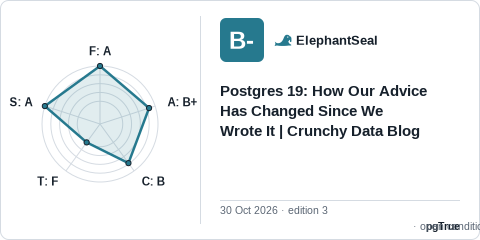
ElephantSeal B-Limited coverageOpen: the benchmark cannot yet be rerun from what is published

Embed

The ElephantSeal always shows this report's latest edition and links here. Copies cached elsewhere may update later.

[![pgTrue fact-check](https://pgtrue.postgres.ai/badge/08524eb1-de3d-4f7b-8c4e-74ff683d9e04.svg?v=13&theme=light)](https://pgtrue.postgres.ai/shared/brief/08524eb1-de3d-4f7b-8c4e-74ff683d9e04)
<a href="https://pgtrue.postgres.ai/shared/brief/08524eb1-de3d-4f7b-8c4e-74ff683d9e04"><img src="https://pgtrue.postgres.ai/badge/08524eb1-de3d-4f7b-8c4e-74ff683d9e04.svg?v=13&amp;theme=light" alt="pgTrue fact-check" width="90" height="20" loading="lazy" decoding="async" style="display:inline-block;width:90px;height:20px"></a>
https://pgtrue.postgres.ai/badge/08524eb1-de3d-4f7b-8c4e-74ff683d9e04.svg?v=13&theme=light
.. image:: https://pgtrue.postgres.ai/badge/08524eb1-de3d-4f7b-8c4e-74ff683d9e04.svg?v=13&theme=light
   :target: https://pgtrue.postgres.ai/shared/brief/08524eb1-de3d-4f7b-8c4e-74ff683d9e04
   :alt: pgTrue fact-check
   :width: 90
   :height: 20
[![pgTrue fact-check](https://pgtrue.postgres.ai/badge/08524eb1-de3d-4f7b-8c4e-74ff683d9e04.svg?v=13&theme=dark)](https://pgtrue.postgres.ai/shared/brief/08524eb1-de3d-4f7b-8c4e-74ff683d9e04)
<a href="https://pgtrue.postgres.ai/shared/brief/08524eb1-de3d-4f7b-8c4e-74ff683d9e04"><img src="https://pgtrue.postgres.ai/badge/08524eb1-de3d-4f7b-8c4e-74ff683d9e04.svg?v=13&amp;theme=dark" alt="pgTrue fact-check" width="90" height="20" loading="lazy" decoding="async" style="display:inline-block;width:90px;height:20px"></a>
https://pgtrue.postgres.ai/badge/08524eb1-de3d-4f7b-8c4e-74ff683d9e04.svg?v=13&theme=dark
.. image:: https://pgtrue.postgres.ai/badge/08524eb1-de3d-4f7b-8c4e-74ff683d9e04.svg?v=13&theme=dark
   :target: https://pgtrue.postgres.ai/shared/brief/08524eb1-de3d-4f7b-8c4e-74ff683d9e04
   :alt: pgTrue fact-check
   :width: 90
   :height: 20
[![pgTrue fact-check](https://pgtrue.postgres.ai/badge/08524eb1-de3d-4f7b-8c4e-74ff683d9e04.svg?v=13)](https://pgtrue.postgres.ai/shared/brief/08524eb1-de3d-4f7b-8c4e-74ff683d9e04)
<a href="https://pgtrue.postgres.ai/shared/brief/08524eb1-de3d-4f7b-8c4e-74ff683d9e04"><img src="https://pgtrue.postgres.ai/badge/08524eb1-de3d-4f7b-8c4e-74ff683d9e04.svg?v=13" alt="pgTrue fact-check" width="90" height="20" loading="lazy" decoding="async" style="display:inline-block;width:90px;height:20px"></a>
https://pgtrue.postgres.ai/badge/08524eb1-de3d-4f7b-8c4e-74ff683d9e04.svg?v=13
.. image:: https://pgtrue.postgres.ai/badge/08524eb1-de3d-4f7b-8c4e-74ff683d9e04.svg?v=13
   :target: https://pgtrue.postgres.ai/shared/brief/08524eb1-de3d-4f7b-8c4e-74ff683d9e04
   :alt: pgTrue fact-check
   :width: 90
   :height: 20
[![pgTrue fact-check](https://pgtrue.postgres.ai/badge/08524eb1-de3d-4f7b-8c4e-74ff683d9e04/radar.svg?v=13&theme=light)](https://pgtrue.postgres.ai/shared/brief/08524eb1-de3d-4f7b-8c4e-74ff683d9e04)
<a href="https://pgtrue.postgres.ai/shared/brief/08524eb1-de3d-4f7b-8c4e-74ff683d9e04"><img src="https://pgtrue.postgres.ai/badge/08524eb1-de3d-4f7b-8c4e-74ff683d9e04/radar.svg?v=13&amp;theme=light" alt="pgTrue fact-check" width="240" height="240" loading="lazy" decoding="async" style="display:inline-block;width:240px;height:240px"></a>
https://pgtrue.postgres.ai/badge/08524eb1-de3d-4f7b-8c4e-74ff683d9e04/radar.svg?v=13&theme=light
.. image:: https://pgtrue.postgres.ai/badge/08524eb1-de3d-4f7b-8c4e-74ff683d9e04/radar.svg?v=13&theme=light
   :target: https://pgtrue.postgres.ai/shared/brief/08524eb1-de3d-4f7b-8c4e-74ff683d9e04
   :alt: pgTrue fact-check
   :width: 240
   :height: 240
[![pgTrue fact-check](https://pgtrue.postgres.ai/badge/08524eb1-de3d-4f7b-8c4e-74ff683d9e04/radar.svg?v=13&theme=dark)](https://pgtrue.postgres.ai/shared/brief/08524eb1-de3d-4f7b-8c4e-74ff683d9e04)

<a href="https://pgtrue.postgres.ai/shared/brief/08524eb1-de3d-4f7b-8c4e-74ff683d9e04"><img src="https://pgtrue.postgres.ai/badge/08524eb1-de3d-4f7b-8c4e-74ff683d9e04/radar.svg?v=13&amp;theme=dark" alt="pgTrue fact-check" width="240" height="240" loading="lazy" decoding="async" style="display:inline-block;width:240px;height:240px"></a>
https://pgtrue.postgres.ai/badge/08524eb1-de3d-4f7b-8c4e-74ff683d9e04/radar.svg?v=13&theme=dark
.. image:: https://pgtrue.postgres.ai/badge/08524eb1-de3d-4f7b-8c4e-74ff683d9e04/radar.svg?v=13&theme=dark
   :target: https://pgtrue.postgres.ai/shared/brief/08524eb1-de3d-4f7b-8c4e-74ff683d9e04
   :alt: pgTrue fact-check
   :width: 240
   :height: 240
[![pgTrue fact-check](https://pgtrue.postgres.ai/badge/08524eb1-de3d-4f7b-8c4e-74ff683d9e04/radar.svg?v=13)](https://pgtrue.postgres.ai/shared/brief/08524eb1-de3d-4f7b-8c4e-74ff683d9e04)
<a href="https://pgtrue.postgres.ai/shared/brief/08524eb1-de3d-4f7b-8c4e-74ff683d9e04"><img src="https://pgtrue.postgres.ai/badge/08524eb1-de3d-4f7b-8c4e-74ff683d9e04/radar.svg?v=13" alt="pgTrue fact-check" width="240" height="240" loading="lazy" decoding="async" style="display:inline-block;width:240px;height:240px"></a>
https://pgtrue.postgres.ai/badge/08524eb1-de3d-4f7b-8c4e-74ff683d9e04/radar.svg?v=13
.. image:: https://pgtrue.postgres.ai/badge/08524eb1-de3d-4f7b-8c4e-74ff683d9e04/radar.svg?v=13
   :target: https://pgtrue.postgres.ai/shared/brief/08524eb1-de3d-4f7b-8c4e-74ff683d9e04
   :alt: pgTrue fact-check
   :width: 240
   :height: 240
[![pgTrue fact-check](https://pgtrue.postgres.ai/badge/08524eb1-de3d-4f7b-8c4e-74ff683d9e04/wide.svg?v=13&theme=light)](https://pgtrue.postgres.ai/shared/brief/08524eb1-de3d-4f7b-8c4e-74ff683d9e04)
<a href="https://pgtrue.postgres.ai/shared/brief/08524eb1-de3d-4f7b-8c4e-74ff683d9e04"><img src="https://pgtrue.postgres.ai/badge/08524eb1-de3d-4f7b-8c4e-74ff683d9e04/wide.svg?v=13&amp;theme=light" alt="pgTrue fact-check" width="480" height="240" loading="lazy" decoding="async" style="display:inline-block;width:480px;height:240px"></a>
https://pgtrue.postgres.ai/badge/08524eb1-de3d-4f7b-8c4e-74ff683d9e04/wide.svg?v=13&theme=light
.. image:: https://pgtrue.postgres.ai/badge/08524eb1-de3d-4f7b-8c4e-74ff683d9e04/wide.svg?v=13&theme=light
   :target: https://pgtrue.postgres.ai/shared/brief/08524eb1-de3d-4f7b-8c4e-74ff683d9e04
   :alt: pgTrue fact-check
   :width: 480
   :height: 240
[![pgTrue fact-check](https://pgtrue.postgres.ai/badge/08524eb1-de3d-4f7b-8c4e-74ff683d9e04/wide.svg?v=13&theme=dark)](https://pgtrue.postgres.ai/shared/brief/08524eb1-de3d-4f7b-8c4e-74ff683d9e04)
<a href="https://pgtrue.postgres.ai/shared/brief/08524eb1-de3d-4f7b-8c4e-74ff683d9e04"><img src="https://pgtrue.postgres.ai/badge/08524eb1-de3d-4f7b-8c4e-74ff683d9e04/wide.svg?v=13&amp;theme=dark" alt="pgTrue fact-check" width="480" height="240" loading="lazy" decoding="async" style="display:inline-block;width:480px;height:240px"></a>
https://pgtrue.postgres.ai/badge/08524eb1-de3d-4f7b-8c4e-74ff683d9e04/wide.svg?v=13&theme=dark
.. image:: https://pgtrue.postgres.ai/badge/08524eb1-de3d-4f7b-8c4e-74ff683d9e04/wide.svg?v=13&theme=dark
   :target: https://pgtrue.postgres.ai/shared/brief/08524eb1-de3d-4f7b-8c4e-74ff683d9e04
   :alt: pgTrue fact-check
   :width: 480
   :height: 240
[![pgTrue fact-check](https://pgtrue.postgres.ai/badge/08524eb1-de3d-4f7b-8c4e-74ff683d9e04/wide.svg?v=13)](https://pgtrue.postgres.ai/shared/brief/08524eb1-de3d-4f7b-8c4e-74ff683d9e04)
<a href="https://pgtrue.postgres.ai/shared/brief/08524eb1-de3d-4f7b-8c4e-74ff683d9e04"><img src="https://pgtrue.postgres.ai/badge/08524eb1-de3d-4f7b-8c4e-74ff683d9e04/wide.svg?v=13" alt="pgTrue fact-check" width="480" height="240" loading="lazy" decoding="async" style="display:inline-block;width:480px;height:240px"></a>
https://pgtrue.postgres.ai/badge/08524eb1-de3d-4f7b-8c4e-74ff683d9e04/wide.svg?v=13
.. image:: https://pgtrue.postgres.ai/badge/08524eb1-de3d-4f7b-8c4e-74ff683d9e04/wide.svg?v=13
   :target: https://pgtrue.postgres.ai/shared/brief/08524eb1-de3d-4f7b-8c4e-74ff683d9e04
   :alt: pgTrue fact-check
   :width: 480
   :height: 240

Click the snippet to select all of it, then copy. Where SVG is stripped, as in some email clients and feed readers, change .svg to .png. PNG uses the light theme for Auto. For Markdown PNG embeds, use the HTML snippet where supported to preserve the display size.

Optional colours: append &color=26798E or &labelColor=333C47 after a theme query (use ? for the first parameter). Use 3- or 6-digit hex.

For pages with a light background.

For pages with a dark background. The ElephantSeal gets a thin edge so it does not blend in.

Auto follows the reader's light or dark setting where the host supports it, and shows the light ElephantSeal where it does not.

On a light page
On a dark page

Postgres 19: How Our Advice Has Changed Since We Wrote It | Crunchy Data Blog (opens in new tab)

crunchydata.com
Check before you follow it: 4 claims are wrong.
0
inaccuracy
0
dangerous-recipe
4
misleading
1
imprecise
0
transcription
1
aged
0
withdrawn
13
verified-accurate

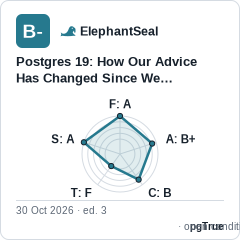
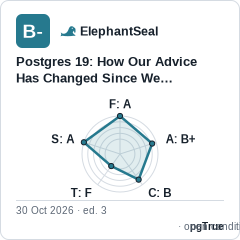
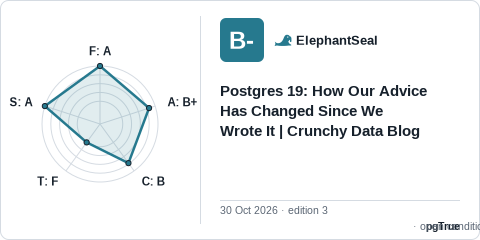
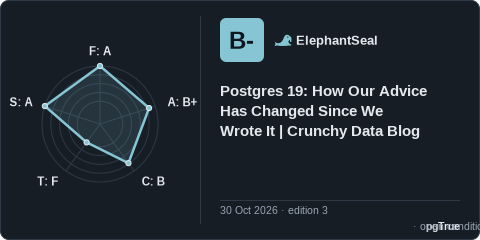
Factual A · Applicable B+ · Consistent B · Transparent F · Safe A

ReportTechnical fact-check, edition 3 pgTrue versionaudited with v1.0.17 (approx.) · regraded with v1.1.3 Issued EditionUpdated after review. Corrections are listed below. SubmittedSubmitted by the PostgresAI team. Author responseNo written reply from the author. We re-audited this article 2 times; see Revisions below. Policy: right-of-reply and corrections policy.

InaccuraciesNone in this edition.

Dangerous or recipe bugsNone in this edition.

Misleading / imprecise

F1

Updates preserve unchanged TOAST values

MISLEADINGConsistent · holds up after review

Claim ledger

Article says
…updating a toasted row rewrites toast chunks…
What is true
Updating another column does not rewrite an unchanged external TOAST value. src/backend/access/table/toast_helper.c:91-96 reuses its reference. Only replacing the toasted value requires new chunks. Avoid unnecessary payload rewrites and do not expect scalar-only updates to change compression.
So what
Update scalar columns without rewriting unchanged toasted payloads. Do not expect scalar-only updates to migrate compression.
Charitable reading
The statement holds when an update changes the toasted value. It says updating the row, which also includes scalar-only updates.

Source

Source · REL_19_STABLE@48b43081e5 · src/backend/access/table/toast_helper.c:91-96 * This attribute isn't changed by this update so we reuse * the original reference to the old value in the new * tuple. */ ttc->ttc_attr[i].tai_colflags |= TOASTCOL_IGNORE; continue;
In the article · section “TOAST: same mechanism, faster default compression”

In the article

excerpt · section “TOAST: same mechanism, faster default compression” · as fetched 2026-10-21 · open in article ↗ (opens in new tab)

TOAST: same mechanism, faster default compression

What we wrote: In Postgres TOAST: The Greatest Thing Since Sliced Bread? (2024), Elizabeth Christensen walked through the 8 kB page, the ~2 kB toast_tuple_target , storage strategies ( PLAIN / EXTENDED / EXTERNAL / MAIN ), and the practical guidance: updating a toasted row rewrites toast chunks, frequent access of compressed values has a cost, and large JSON or text that you query often belongs in a better data model, not in a giant toasted blob.

Version Change 14 LZ4 becomes available via default_toast_compression = 'lz4' or per-column COMPRESSION lz4 19 LZ4 becomes the default ( default_toast_compression flips from pglz to lz4 ); native REPACK (with CONCURRENTLY ) rewrites tables without a long exclusive lock
All sources and excerpts · 1
Evidence * This attribute isn't changed by this update so we reuse * the original reference to the old value in the new * tuple. */ ttc->ttc_attr[i].tai_colflags |= TOASTCOL_IGNORE; continue;
How the review tested this

Review: We tested the reading that updates change the payload. The article says row updates. The source preserves unchanged external references. We tested the reading that updating means replacing the payload. E-1 says row updates. E-2 explicitly reuses unchanged external values. The compression-migration consequence supports wasted-work.

F2

Default partitions prevent concurrent detach

MISLEADINGConsistent · holds up after review

Claim ledger

Article says
For day-to-day rotation, prefer concurrent detach:…
What is true
DETACH PARTITION CONCURRENTLY rejects a parent containing any default partition. src/backend/commands/tablecmds.c:21622-21625 raises that error. PostgreSQL 14 documents the same restriction. The article's combined recommendations cannot run together.
So what
Check for a default partition before scheduling DETACH PARTITION CONCURRENTLY. Use ordinary detach during planned locking when retaining it.
Charitable reading
Concurrent detach works without a default partition. The article also recommends keeping a default partition in the same workflow.

Source

Source · REL_19_STABLE@48b43081e5 · src/backend/commands/tablecmds.c:21622-21625if (concurrent) ereport(ERROR, (errcode(ERRCODE_OBJECT_NOT_IN_PREREQUISITE_STATE), errmsg("cannot detach partitions concurrently when a default partition exists")));
In the article · section “Partitioning: still for lifecycle, now smoother to operate”

In the article

excerpt · section “Partitioning: still for lifecycle, now smoother to operate” · as fetched 2026-10-21 · open in article ↗ (opens in new tab)

Partitioning: still for lifecycle, now smoother to operate

For day-to-day rotation, prefer concurrent detach:

ALTER TABLE iot_thermostat
  DETACH PARTITION iot_thermostat07142022 CONCURRENTLY;
All sources and excerpts · 2
Evidence if (concurrent) ereport(ERROR, (errcode(ERRCODE_OBJECT_NOT_IN_PREREQUISITE_STATE), errmsg("cannot detach partitions concurrently when a default partition exists")));
Evidence <literal>CONCURRENTLY</literal> cannot be run in a transaction block and is not allowed if the partitioned table contains a default partition.

Version note: Checks the article's PostgreSQL 14 version floor.

How the review tested this

Review: We checked whether the recommendations describe separate workflows. Their adjacent placement supports combining them, which PostgreSQL 14 and 19 reject. We checked whether the advice describes separate workflows. The article recommends default partitions immediately after concurrent detach. PostgreSQL 14 documentation and PostgreSQL 19 code confirm the incompatibility.

F3

COPY FREEZE requires creation or truncation in the same subtransaction

MISLEADINGApplicable · holds up after review

Claim ledger

Article says
Prefer FREEZE for empty staging tables that you load once and then promote.
What is true
An empty staging table alone does not qualify for COPY FREEZE. src/backend/commands/copyfrom.c:904-908 requires creation or truncation in the current subtransaction. Creating the table under autocommit and loading it afterward fails this check.
So what
Create or truncate the staging table and run COPY FREEZE in the same subtransaction, before incompatible snapshot or cursor activity.
Charitable reading
The earlier paragraph mentions newly created or truncated tables. Neither paragraph states the required subtransaction boundary.

Source

Source · REL_19_STABLE@48b43081e5 · src/backend/commands/copyfrom.c:904-908if (cstate->rel->rd_createSubid != GetCurrentSubTransactionId() && cstate->rel->rd_newRelfilelocatorSubid != GetCurrentSubTransactionId()) ereport(ERROR, (errcode(ERRCODE_OBJECT_NOT_IN_PREREQUISITE_STATE), errmsg("cannot perform COPY FREEZE because the table was not created or truncated in the current subtransaction")));
In the article · section “Loading data: COPY is still king, and now more resilient”

In the article

excerpt · section “Loading data: COPY is still king, and now more resilient” · as fetched 2026-10-21 · open in article ↗ (opens in new tab)

Loading data: COPY is still king, and now more resilient

Prefer FREEZE for empty staging tables that you load once and then promote. And when you need to export partitioned data or hand JSON to another system, COPY TO handles the parent directly:

COPY events TO STDOUT WITH (FORMAT json);
COPY events TO STDOUT WITH (FORMAT json, FORCE_ARRAY);
All sources and excerpts · 1
Evidence if (cstate->rel->rd_createSubid != GetCurrentSubTransactionId() && cstate->rel->rd_newRelfilelocatorSubid != GetCurrentSubTransactionId()) ereport(ERROR, (errcode(ERRCODE_OBJECT_NOT_IN_PREREQUISITE_STATE), errmsg("cannot perform COPY FREEZE because the table was not created or truncated in the current subtransaction")));
How the review tested this

Review: We checked the earlier creation-or-truncation qualification. It omits the current-subtransaction requirement. The source explicitly rejects tables outside that boundary. We checked the earlier freshly-created-or-truncated qualification. It does not specify the current subtransaction. E-7 rejects an empty staging table created in an earlier transaction.

F11

Concurrent detach cannot coexist with the recommended default partition

MISLEADINGConsistent · holds up after review

Claim ledger

Article says
…ALTER TABLE iot_thermostat DETACH PARTITION iot_thermostat07142022 CONCURRENTLY;…
What is true
PostgreSQL rejects concurrent detach when the parent contains a default partition. tablecmds.c:21625 raises that error. PostgreSQL 14 documents the same restriction. Following both recommendations makes the rotation command fail.
So what
Use ordinary DETACH PARTITION during a maintenance window when the parent contains a default partition.
Charitable reading
Concurrent detach works without a default partition. The article also recommends keeping a default partition in this workflow.

Source

Source · REL_19_STABLE@48b43081e5 · src/backend/commands/tablecmds.c:21625-21625errmsg("cannot detach partitions concurrently when a default partition exists")));
In the article · section “Partitioning: still for lifecycle, now smoother to operate”

In the article

excerpt · section “Partitioning: still for lifecycle, now smoother to operate” · as fetched 2026-10-21 · open in article ↗ (opens in new tab)

Partitioning: still for lifecycle, now smoother to operate

ALTER TABLE iot_thermostat
  DETACH PARTITION iot_thermostat07142022 CONCURRENTLY;
ALTER TABLE events
  MERGE PARTITIONS (events_2024_01, events_2024_02, events_2024_03)
  INTO events_2024_q1;

ALTER TABLE events
  SPLIT PARTITION events_2024_q1 INTO (
    PARTITION events_2024_01 FOR VALUES FROM ('2024-01-01') TO ('2024-02-01'),
    PARTITION events_2024_02 FOR VALUES FROM ('2024-02-01') TO ('2024-03-01'),
    PARTITION events_2024_03 FOR VALUES FROM ('2024-03-01') TO ('2024-04-01')
  );
All sources and excerpts · 2
Evidence errmsg("cannot detach partitions concurrently when a default partition exists")));
Evidence <literal>CONCURRENTLY</literal> cannot be run in a transaction block and is not allowed if the partitioned table contains a default partition.

Version note: The restriction also applies at the article's PostgreSQL 14 version floor.

How the review tested this

Review: We tested concurrent detach without a default partition. That succeeds but does not resolve the combined recommendations. This repeats F2. We checked whether the charge denies concurrent detach generally. It addresses parents with default partitions. Both cited versions reject that combination. It duplicates F2.

F4

LZ4 defaults require compiled LZ4 support

IMPRECISEApplicable · holds up after review

Claim ledger

Article says
On a fresh Postgres 19 cluster, LZ4 is what new toasted values get unless you override it…
What is true
PostgreSQL 19 defaults to LZ4 only when the build includes LZ4 support. src/include/access/toast_compression.h:59-63 selects pglz otherwise. A fresh cluster does not guarantee LZ4 availability.
So what
Check SHOW default_toast_compression before relying on LZ4. Install a build with LZ4 support when that compression method is required.
Charitable reading
Common distributions compile LZ4 support. The statement nevertheless covers every fresh PostgreSQL 19 cluster.

Source

Source · REL_19_STABLE@48b43081e5 · src/include/access/toast_compression.h:59-63#ifdef USE_LZ4 #define DEFAULT_TOAST_COMPRESSION TOAST_LZ4_COMPRESSION #else #define DEFAULT_TOAST_COMPRESSION TOAST_PGLZ_COMPRESSION #endif
In the article · section “TOAST: same mechanism, faster default compression”

In the article

excerpt · section “TOAST: same mechanism, faster default compression” · as fetched 2026-10-21 · open in article ↗ (opens in new tab)

TOAST: same mechanism, faster default compression

Postgres 19 advice: Keep Elizabeth’s modeling advice. Prefer structured columns for hot lookup data when you can. Prefer EXTERNAL when you have already compressed the payload yourself. On a fresh Postgres 19 cluster, LZ4 is what new toasted values get unless you override it, with no extra config step required.

SELECT
  pg_column_size(payload) AS stored_bytes,
  octet_length(payload) AS raw_bytes
FROM events
WHERE length(payload) > 100
LIMIT 5;
All sources and excerpts · 1
Evidence#ifdef USE_LZ4 #define DEFAULT_TOAST_COMPRESSION TOAST_LZ4_COMPRESSION #else #define DEFAULT_TOAST_COMPRESSION TOAST_PGLZ_COMPRESSION #endif
How the review tested this

Review: We considered ordinary builds with LZ4 support. The unconditional cluster claim still omits the explicit pglz fallback. IMPRECISE fits that omission. We tested the common-build reading. E-9 selects pglz without compiled LZ4 support. E-8 does not state that condition. SHOW default_toast_compression provides a concrete corrective action.

Aged since publication

F5

Aged: “…Native MERGE PARTITIONS / SPLIT PARTITION…”

OUTDATEDApplicable · holds up after review · also flagged 1 more time

Claim ledger

Article says
…Native MERGE PARTITIONS / SPLIT PARTITION…
What is true
REL_19_BETA3 supports MERGE PARTITIONS and SPLIT PARTITION. The pinned PostgreSQL 19 grammar and AlterTableType omit both operations. The article accurately described beta functionality, but these recipes no longer parse on the pinned branch.
So what
Replace the merge/split recipes with an explicit replacement-partition migration using supported create, copy, detach, and attach operations.

Source

Source · REL_19_BETA3 · src/backend/parser/gram.y:2500-2501/* ALTER TABLE <name> SPLIT PARTITION <partition_name> INTO () */ | SPLIT PARTITION qualified_name INTO '(' partitions_list ')'
In the article · section “Partitioning: still for lifecycle, now smoother to operate”

In the article

excerpt · section “Partitioning: still for lifecycle, now smoother to operate” · as fetched 2026-10-21 · open in article ↗ (opens in new tab)

Partitioning: still for lifecycle, now smoother to operate

Version Change 14 DETACH PARTITION ... CONCURRENTLY : online detach with lighter locking 15 Cleaner FK behavior when an UPDATE moves a row between partitions 17 Identity columns on partitioned tables; exclusion constraints when they equality-compare the partition key 18 VACUUM / ANALYZE ... ONLY on the parent; NOT VALID FKs on partitioned tables 19 Native MERGE PARTITIONS / SPLIT PARTITION ; COPY TO works on partitioned parents; vacuumdb --analyze-only analyzes partitioned parents by default
All sources and excerpts · 4
Evidence /* ALTER TABLE <name> SPLIT PARTITION <partition_name> INTO () */ | SPLIT PARTITION qualified_name INTO '(' partitions_list ')'

Version note: The article explicitly targets PostgreSQL 19 betas.

Evidence /* ALTER TABLE <name> MERGE PARTITIONS () INTO <partition_name> */ | MERGE PARTITIONS '(' qualified_name_list ')' INTO qualified_name

Version note: Confirms the beta implementation.

Evidence AT_AttachPartition, /* ATTACH PARTITION */ AT_DetachPartition, /* DETACH PARTITION */ AT_DetachPartitionFinalize, /* DETACH PARTITION FINALIZE */ AT_AddIdentity, /* ADD IDENTITY */ AT_SetIdentity, /* SET identity column options */ AT_DropIdentity, /* DROP IDENTITY */ AT_ReAddStatistics, /* internal to commands/tablecmds.c */ } AlterTableType;

Version note: The pinned branch lacks the former merge and split operation types.

Evidencepartition_cmd:

Version note: The complete partition_cmd production contains ATTACH, DETACH, and DETACH FINALIZE alternatives.

How the review tested this

Review: We checked the beta disclaimer and both grammars. Beta 3 accepts both commands. The current production excludes them. OUTDATED preserves publication fairness. We checked the beta disclaimer and both grammars. Beta 3 accepts both commands. The current production omits them. The aged classification preserves publication-time fairness.

Verified accurate

F6

Verified accurate: “ON_ERROR set_null keeps the row and nulls only the bad field…”

ACCURATEFactual · partly holds after review

Claim ledger

Article says
ON_ERROR set_null keeps the row and nulls only the bad field…
What is true
ON_ERROR set_null substitutes NULL after a failed input conversion. src/backend/commands/copyfromparse.c:1082-1107 checks whether a constrained domain accepts NULL before setting the field.

Source

Source · REL_19_STABLE@48b43081e5 · src/backend/commands/copyfromparse.c:1082-1107nulls[m] = true; values[m] = (Datum) 0;
In the article · section “Loading data: COPY is still king, and now more resilient”

In the article

excerpt · section “Loading data: COPY is still king, and now more resilient” · as fetched 2026-10-21 · open in article ↗ (opens in new tab)

Loading data: COPY is still king, and now more resilient

HEADER 2 skips two lead-in lines (title row plus column names, or whatever your export prepends). ON_ERROR set_null keeps the row and nulls only the bad field instead of discarding the whole line. Prefer ON_ERROR ignore when a bad cell should drop the row entirely; pair that with REJECT_LIMIT when you want a hard cap on how many skips you will tolerate:

COPY events (event_id, occurred_at, payload)
FROM STDIN
WITH (
  FORMAT csv,
  HEADER 2,
  DEFAULT '__DEFAULT__',
  ON_ERROR ignore,
  REJECT_LIMIT 1000,
  LOG_VERBOSITY verbose
);
All sources and excerpts · 1
Evidence nulls[m] = true; values[m] = (Datum) 0;
How the review tested this

Review: We tested whether E-15 establishes both constraint caveats. copyfromparse.c:1082-1107 establishes NULL substitution and domain checks. It does not establish table-constraint enforcement.

F7

Direct partitioned COPY TO scans child relations

ACCURATEFactual · holds up after review

Claim ledger

Article says
…COPY TO runs directly on the root relation and pulls rows from all descendants…
What is true
Ordinary COPY TO on a partitioned parent scans its child relations directly. src/backend/commands/copyto.c:1330-1340 opens each child and calls CopyRelationTo. The article's explanation of avoiding the SELECT wrapper matches this path.
Charitable reading
The statement describes the ordinary direct export path. Row security can require a query-based path.

Source

Source · REL_19_STABLE@48b43081e5 · src/backend/commands/copyto.c:1330-1340if (cstate->rel->rd_rel->relkind == RELKIND_PARTITIONED_TABLE) { foreach_oid(child, cstate->partitions) { Relation scan_rel; /* We already got the lock in BeginCopyTo */ scan_rel = table_open(child, NoLock); CopyRelationTo(cstate, scan_rel, cstate->rel, &processed); table_close(scan_rel, NoLock); }
In the article · section “Partitioning: still for lifecycle, now smoother to operate”

In the article

excerpt · section “Partitioning: still for lifecycle, now smoother to operate” · as fetched 2026-10-21 · open in article ↗ (opens in new tab)

Partitioning: still for lifecycle, now smoother to operate

Exporting a partitioned table is simpler too. Before Postgres 19, COPY parent TO ... failed with cannot copy from partitioned table , so you had to wrap it as COPY (SELECT * FROM parent) TO ... or target children one by one. In 19, COPY TO runs directly on the root relation and pulls rows from all descendants, which skips the extra planning and executor overhead of the SELECT wrapper and keeps bulk exports cheaper on CPU and memory.

All sources and excerpts · 1
Evidence if (cstate->rel->rd_rel->relkind == RELKIND_PARTITIONED_TABLE) { foreach_oid(child, cstate->partitions) { Relation scan_rel; /* We already got the lock in BeginCopyTo */ scan_rel = table_open(child, NoLock); CopyRelationTo(cstate, scan_rel, cstate->rel, &processed); table_close(scan_rel, NoLock); }
How the review tested this

Review: We checked whether the finding promises every export uses this path. It specifies ordinary exports. CopyRelationTo directly scans each child. We checked whether the finding promises every export avoids the executor. It limits the claim to ordinary exports. E-17 directly iterates child relations.

F8

PostgreSQL 19 defaults jit to off

ACCURATEFactual · holds up after review

Claim ledger

Article says
…JIT is off by default in Postgres 19…
What is true
The PostgreSQL 19 jit setting defaults to false. src/backend/utils/misc/guc_parameters.dat:1444-1449 sets that boot value. Existing configuration can explicitly enable JIT.
Charitable reading
The claim concerns the built-in default. Existing configuration can override it.

Source

Source · REL_19_STABLE@48b43081e5 · src/backend/utils/misc/guc_parameters.dat:1444-1449{ name => 'jit', type => 'bool', context => 'PGC_USERSET', group => 'QUERY_TUNING_OTHER', short_desc => 'Allow JIT compilation.', flags => 'GUC_EXPLAIN', variable => 'jit_enabled', boot_val => 'false', },
In the article · section “Async I/O: faster scans and vacuum on modern storage”

In the article

excerpt · section “Async I/O: faster scans and vacuum on modern storage” · as fetched 2026-10-21 · open in article ↗ (opens in new tab)

Async I/O: faster scans and vacuum on modern storage

One related default flip: JIT is off by default in Postgres 19 (it had been on since 12). The old cost model was unreliable, so large analytical or parallel scans that used to compile at runtime no longer will unless you turn jit back on. If those workloads matter to you, re-enable explicitly and re-check plans after upgrade.

All sources and excerpts · 1
Evidence{ name => 'jit', type => 'bool', context => 'PGC_USERSET', group => 'QUERY_TUNING_OTHER', short_desc => 'Allow JIT compilation.', flags => 'GUC_EXPLAIN', variable => 'jit_enabled', boot_val => 'false', },
How the review tested this

Review: We tested existing configuration as an exception. The finding distinguishes overrides from the false boot value. We tested configured clusters as a counterexample. The finding distinguishes configuration overrides from the built-in default. E-19 sets the boot value to false.

F9

Verified accurate: “INCLUDE is still how you build a covering index without polluting the sort key.”

ACCURATEFactual · partly holds after review

Claim ledger

Article says
INCLUDE is still how you build a covering index without polluting the sort key.
What is true
INCLUDE adds payload columns without adding search-key columns. doc/src/sgml/indices.sgml:1246-1249 states this distinction.

Source

Source · REL_19_STABLE@48b43081e5 · doc/src/sgml/indices.sgml:1246-1249on, <productname>PostgreSQL</productname> allows you to create an index in which some columns are just <quote>payload</quote> and are not part of the search key. This is done by adding an <literal>INCLUDE</literal> clause listing the extra columns. For example, if you commonly run
In the article

In the article

Article · exact quote · open in article ↗ (opens in new tab)INCLUDE is still how you build a covering index without polluting the sort key.
All sources and excerpts · 1
Evidence on, <productname>PostgreSQL</productname> allows you to create an index in which some columns are just <quote>payload</quote> and are not part of the search key. This is done by adding an <literal>INCLUDE</literal> clause listing the extra columns. For example, if you commonly run
How the review tested this

Review: We checked whether E-21 also establishes visibility-map requirements. indices.sgml:1246-1249 establishes payload versus search-key columns only. The visibility-map explanation falls outside that citation.

F12

The original benchmark reports a BRIN win

ACCURATEFactual · holds up after review

Claim ledger

Article says
Sometimes BRIN won.
What is true
The 2019 benchmark reports BRIN outperforming both the B-tree and parallel sequential scan for one query. The article accurately summarizes that reported outcome.
Charitable reading
The claim reports a historical benchmark result, rather than promising BRIN wins every workload.

Source

Source · https://www.crunchydata.com/blog/postgresql-brin-indexes-big-data-performance-with-minimal-storageThe BRIN index helps this query to outperform its equivalent using the B-tree index and the parallel sequential scan.
In the article

In the article

Article · exact quote · open in article ↗ (opens in new tab)Sometimes BRIN won.
All sources and excerpts · 1
EvidenceThe BRIN index helps this query to outperform its equivalent using the B-tree index and the parallel sequential scan.
How the review tested this

Review: We checked whether F17 contradicts this finding. The original benchmark reports different results at different table sizes. Both summaries hold. We checked whether the historical result became a universal performance claim. E-30 reports one BRIN win. The finding limits accuracy to that reported result.

F13

The covering index tutorial attribution matches the original post

ACCURATEFactual · holds up after review

Claim ledger

Article says
…Jonathan introduced B-tree INCLUDE columns…
What is true
Jonathan S. Katz's September 17, 2018 tutorial demonstrates INCLUDE with the visits index. The article correctly attributes that example.
Charitable reading
Introduced refers to the cited tutorial's explanation of INCLUDE columns.

Source

Source · https://www.crunchydata.com/blog/why-covering-indexes-are-incredibly-helpfulJonathan S. Katz Sep 17, 2018
In the article

In the article

Article · exact quote · open in article ↗ (opens in new tab)…Jonathan introduced B-tree INCLUDE columns…
All sources and excerpts · 2
EvidenceJonathan S. Katz Sep 17, 2018
EvidenceCREATE UNIQUE INDEX visits_visitor_visited_at_geocode_idx ON visits (visitor, visited_at) INCLUDE (geocode);
How the review tested this

Review: We tested whether introduced claims feature authorship. The surrounding sentence describes the tutorial. Its author, date, and example match. We tested whether introduced credits implementation authorship. The article describes a tutorial. Its author, date, and visits index match E-32 and E-33.

F14

PostgreSQL 19 adds COPY ON_ERROR SET_NULL

ACCURATEFactual · holds up after review

Claim ledger

Article says
…ON_ERROR SET_NULL turns invalid values into NULL…
What is true
release-19.sgml:1946 confirms that COPY FROM can set invalid input values to NULL. The article correctly assigns this addition to PostgreSQL 19.
Charitable reading
Invalid values refers to COPY input conversion failures, rather than every possible row constraint failure.

Source

Source · REL_19_STABLE@48b43081e5 · doc/src/sgml/release-19.sgml:1946-1946Allow <link linkend="sql-copy"><command>COPY FROM</command></link> to set invalid input values to <literal>NULL</literal> (Jian He, Kirill Reshke)
In the article

In the article

Article · exact quote · open in article ↗ (opens in new tab)…ON_ERROR SET_NULL turns invalid values into NULL…
All sources and excerpts · 1
EvidenceAllow <link linkend="sql-copy"><command>COPY FROM</command></link> to set invalid input values to <literal>NULL</literal> (Jian He, Kirill Reshke)
How the review tested this

Review: We checked the release attribution and the meaning of invalid input. PostgreSQL 19 release notes support the qualified conversion-error claim. We checked the release attribution against release-19.sgml. E-35 explicitly records invalid-input substitution. The finding does not claim substitution bypasses constraints.

F15

Concurrent REPACK avoids ACCESS EXCLUSIVE during the main rewrite

ACCURATEFactual · holds up after review

Claim ledger

Article says
…native REPACK (with CONCURRENTLY ) rewrites tables without a long exclusive lock…
What is true
repack.sgml:345–347 documents SHARE UPDATE EXCLUSIVE during the main operation. REPACK requests ACCESS EXCLUSIVE for the final file swap. The article's description matches that distinction.
Charitable reading
Without a long exclusive lock describes the main rewrite. It does not promise that REPACK never requests ACCESS EXCLUSIVE.

Source

Source · REL_19_STABLE@48b43081e5 · doc/src/sgml/ref/repack.sgml:345-347<literal>SHARE UPDATE EXCLUSIVE</literal> lock, and the <literal>ACCESS EXCLUSIVE</literal> lock is only acquired during the final phase to swap the table and index files.
In the article · section “TOAST: same mechanism, faster default compression”

In the article

excerpt · section “TOAST: same mechanism, faster default compression” · as fetched 2026-10-21 · open in article ↗ (opens in new tab)

TOAST: same mechanism, faster default compression

Version Change 14 LZ4 becomes available via default_toast_compression = 'lz4' or per-column COMPRESSION lz4 19 LZ4 becomes the default ( default_toast_compression flips from pglz to lz4 ); native REPACK (with CONCURRENTLY ) rewrites tables without a long exclusive lock
All sources and excerpts · 1
Evidence <literal>SHARE UPDATE EXCLUSIVE</literal> lock, and the <literal>ACCESS EXCLUSIVE</literal> lock is only acquired during the final phase to swap the table and index files.
How the review tested this

Review: We tested the final exclusive lock as a counterexample. The finding explicitly reserves that lock for the swap. We tested the final ACCESS EXCLUSIVE lock as a counterexample. E-37 reserves that lock for the swap. The finding limits its claim to the main rewrite.

F16

PostgreSQL 17 supports qualifying partitioned exclusion constraints

ACCURATEFactual · holds up after review

Claim ledger

Article says
…exclusion constraints when they equality-compare the partition key…
What is true
release-17.sgml:15671–15673 permits exclusion constraints when partition key columns compare for equality. Other columns can use exclusion comparisons. The article correctly states the PostgreSQL 17 requirement.
Charitable reading
The equality requirement applies to partition key columns. Other columns can use exclusion comparisons.

Source

Source · REL_17_11 · doc/src/sgml/release-17.sgml:15671-15673As long as exclusion constraints compare partition key columns for equality, other columns can use exclusion constraint-specific comparisons.
In the article · section “Partitioning: still for lifecycle, now smoother to operate”

In the article

excerpt · section “Partitioning: still for lifecycle, now smoother to operate” · as fetched 2026-10-21 · open in article ↗ (opens in new tab)

Partitioning: still for lifecycle, now smoother to operate

Version Change 14 DETACH PARTITION ... CONCURRENTLY : online detach with lighter locking 15 Cleaner FK behavior when an UPDATE moves a row between partitions 17 Identity columns on partitioned tables; exclusion constraints when they equality-compare the partition key 18 VACUUM / ANALYZE ... ONLY on the parent; NOT VALID FKs on partitioned tables 19 Native MERGE PARTITIONS / SPLIT PARTITION ; COPY TO works on partitioned parents; vacuumdb --analyze-only analyzes partitioned parents by default
All sources and excerpts · 1
Evidence As long as exclusion constraints compare partition key columns for equality, other columns can use exclusion constraint-specific comparisons.

Version note: PostgreSQL 17 release notes confirm the article's version floor.

How the review tested this

Review: We checked surrounding release notes for the feature and equality restriction. Both support the PostgreSQL 17 attribution. We checked whether equality must apply to every column. E-39 requires equality for partition keys and permits other exclusion comparisons. The finding preserves that distinction.

F17

Four parallel workers beat BRIN in the cited monthly query

ACCURATEFactual · holds up after review

Claim ledger

Article says
…four workers chewing through the heap beat a clever index.
What is true
The original benchmark reports four launched workers. Its parallel scan took 460 ms, versus 967 ms with BRIN. The article accurately describes that comparison.
Charitable reading
The comparison describes one historical workload, not every BRIN query.

Source

Source · https://www.crunchydata.com/blog/postgresql-brin-indexes-big-data-performance-with-minimal-storageWorkers Launched: 4
In the article

In the article

Article · exact quote · open in article ↗ (opens in new tab)…four workers chewing through the heap beat a clever index.
All sources and excerpts · 3
EvidenceWorkers Launched: 4
EvidenceExecution Time: 459.501 ms
EvidenceExecution Time: 967.445 ms
How the review tested this

Review: We compared query predicates and checked rounding. Both plans cover the same interval. Four workers and 460-versus-967 ms match. We checked query predicates and timing context. The monthly queries match. Four workers launched. Rounding 459.501 ms and 967.445 ms gives the stated 460 ms and 967 ms.

F18

The cited benchmark reports both index sizes correctly

ACCURATEFactual · holds up after review

Claim ledger

Article says
…a 32 kB BRIN versus a 214 MB B-tree on the same timestamp column…
What is true
The original benchmark displays 32 kB for scans_created_at_brin_idx and 214 MB for scans_created_at_idx. Both indexes use created_at.
Charitable reading
The sizes describe the earlier benchmark, not guaranteed sizes for new tables.

Source

Source · https://www.crunchydata.com/blog/postgresql-brin-indexes-big-data-performance-with-minimal-storagepg_size_pretty ---------------- 214 MB
In the article

In the article

Article · exact quote · open in article ↗ (opens in new tab)…a 32 kB BRIN versus a 214 MB B-tree on the same timestamp column…
All sources and excerpts · 2
Evidencepg_size_pretty ---------------- 214 MB
Evidencepg_size_pretty ---------------- 32 kB
How the review tested this

Review: We checked for confusion with the larger benchmark. The 32 kB and 214 MB results belong to the same earlier dataset. We checked the surrounding index definitions. Both use scans.created_at. The displayed sizes match 214 MB and 32 kB. The finding makes no size guarantee.

F19

The default PostgreSQL page contains 8 KiB

ACCURATEFactual · holds up after review

Claim ledger

Article says
…the 8 kB page…
What is true
configure.ac:248–255 defaults blocksize to 8 and assigns BLCKSZ=8192. The article uses PostgreSQL’s customary kB notation for 8 KiB.
Charitable reading
The page size describes the default build. PostgreSQL also supports other compile-time block sizes.

Source

Source · REL_19_STABLE@48b43081e5 · configure.ac:248-255PGAC_ARG_REQ(with, blocksize, [BLOCKSIZE], [set table block size in kB [8]], [blocksize=$withval], [blocksize=8]) case ${blocksize} in 1) BLCKSZ=1024;; 2) BLCKSZ=2048;; 4) BLCKSZ=4096;; 8) BLCKSZ=8192;;
In the article · section “TOAST: same mechanism, faster default compression”

In the article

excerpt · section “TOAST: same mechanism, faster default compression” · as fetched 2026-10-21 · open in article ↗ (opens in new tab)

TOAST: same mechanism, faster default compression

What we wrote: In Postgres TOAST: The Greatest Thing Since Sliced Bread? (2024), Elizabeth Christensen walked through the 8 kB page, the ~2 kB toast_tuple_target , storage strategies ( PLAIN / EXTENDED / EXTERNAL / MAIN ), and the practical guidance: updating a toasted row rewrites toast chunks, frequent access of compressed values has a cost, and large JSON or text that you query often belongs in a better data model, not in a giant toasted blob.

Version Change 14 LZ4 becomes available via default_toast_compression = 'lz4' or per-column COMPRESSION lz4 19 LZ4 becomes the default ( default_toast_compression flips from pglz to lz4 ); native REPACK (with CONCURRENTLY ) rewrites tables without a long exclusive lock
All sources and excerpts · 1
EvidencePGAC_ARG_REQ(with, blocksize, [BLOCKSIZE], [set table block size in kB [8]], [blocksize=$withval], [blocksize=8]) case ${blocksize} in 1) BLCKSZ=1024;; 2) BLCKSZ=2048;; 4) BLCKSZ=4096;; 8) BLCKSZ=8192;;
How the review tested this

Review: We tested alternative compile-time page sizes and decimal units. The finding explicitly describes the default 8,192-byte page. We checked configurable block sizes as a counterexample. E-48 establishes 8 KiB as the default. The article's ordinary TOAST explanation supports that default-build reading.

F21

A default BRIN range covers 1 MiB of heap

ACCURATEFactual · holds up after review

Claim ledger

Article says
The default is 128 (about 1 MB of heap per summary).
What is true
src/include/access/brin.h:40 sets 128 pages per range. Default pages contain 8 KiB. Each range covers 1 MiB of heap (derived: 128 × 8 KiB).
Charitable reading
The approximate MB value follows PostgreSQL’s customary binary size notation.

Source

Source · REL_19_STABLE@48b43081e5 · configure.ac:248-255PGAC_ARG_REQ(with, blocksize, [BLOCKSIZE], [set table block size in kB [8]], [blocksize=$withval], [blocksize=8]) case ${blocksize} in 1) BLCKSZ=1024;; 2) BLCKSZ=2048;; 4) BLCKSZ=4096;; 8) BLCKSZ=8192;;
In the article

In the article

Article · exact quote · open in article ↗ (opens in new tab)The default is 128 (about 1 MB of heap per summary).
All sources and excerpts · 2
EvidencePGAC_ARG_REQ(with, blocksize, [BLOCKSIZE], [set table block size in kB [8]], [blocksize=$withval], [blocksize=8]) case ${blocksize} in 1) BLCKSZ=1024;; 2) BLCKSZ=2048;; 4) BLCKSZ=4096;; 8) BLCKSZ=8192;;
Evidence#define BRIN_DEFAULT_PAGES_PER_RANGE 128
How the review tested this

Review: We recalculated the range size and checked configurable defaults. At 128 pages and 8 KiB per page, the result is 1 MiB. We recalculated the range using default block size. E-52 specifies 128 pages. E-48 specifies 8 KiB per page. Their product is 1 MiB.

Notes

1 not graded: findings no reader would act on differently
F20

Note: “…plan on roughly 2× the table’s disk footprint while the rewrite runs.”

NOTEpartly holds after review

Claim ledger

Article says
…plan on roughly 2× the table’s disk footprint while the rewrite runs.
What is true
REPACK requires free space for the table plus all indexes. doc/src/sgml/ref/repack.sgml:283-285 states that requirement. Roughly 2× applies to their combined footprint. The article does not specify whether its table footprint includes indexes. Include both when estimating rewrite space.

Source

Source · REL_19_STABLE@48b43081e5 · doc/src/sgml/ref/repack.sgml:283-285<command>REPACK</command> creates a temporary copy of the table and all of its indexes, so you need free disk space at least equal to the sum of the table size and the index sizes.

Not graded: no reader would act differently on it.

In the article

In the article

Article · exact quote · open in article ↗ (opens in new tab)…plan on roughly 2× the table’s disk footprint while the rewrite runs.
All sources and excerpts · 1
Evidence <command>REPACK</command> creates a temporary copy of the table and all of its indexes, so you need free disk space at least equal to the sum of the table size and the index sizes.
How the review tested this

Review: The accurate badge assumes table footprint includes indexes. E-49 does not define that term. E-50 separately requires table and index space. Preserve the conditional calculation as a note. We tested heap-only sizing and a strict 2× ceiling. The finding includes indexes and explicitly rejects a universal maximum.

More in this report

Section checks · 6 sections

Section checks

AspectGradeFindingsCoverage
Async I/OA2 verified-accurate46% of claims (13 of 28, plus 3 that need data we do not have)provisional
Loading dataB+1 misleading · 2 verified-accurate54% of claims (20 of 37)provisional
TOASTB+1 misleading · 1 imprecise · 2 verified-accurate47% of claims (17 of 36, plus 5 that need data we do not have)provisional
BRINA3 verified-accurate57% of claims (15 of 26, plus 1 that need data we do not have)provisional
Covering indexesA2 verified-accurate68% of claims (13 of 19)
PartitioningB+2 misleading · 1 aged · 2 verified-accurate44% of claims (22 of 49, plus 1 that need data we do not have)provisional
Coverage and assessment · Checked 103 of 206 Postgres claims across 9 sections; 4 sections below half

B- — the findings address the article's main subject. What we did not check is listed below. We directly checked PostgreSQL 19 loading, compression, rewrites, covering indexes, and partition operations against source and documentation.

We did not check everything in this article. What we did not check is listed below, in the words we recorded at the time. None of it moved the letter. We never charge our own limits to the article.

What we did not check

  • We did not reproduce the article's performance measurements.
  • We did not assess the tuning and modeling recommendations against production workloads.
  • We did not verify the size query without a declared payload column type.
  • We did not finish checking parallel query overlap, ingestion framing, version floors, and initial-sync worker placement.
  • We did not finish checking the article's remaining version history and PostgreSQL behavior claims.
  • We did not reproduce the measurements the article displays.
  • We did not reach the author's social profile.
  • We did not verify the benchmark behind the reported ~3× asynchronous I/O speedup.
  • We did not reproduce the historical BRIN benchmark measurements.
  • Section “Async I/O”: we checked 13 of 31 checkable claims.
  • Section “Loading data”: we checked 20 of 37 checkable claims.
  • Section “TOAST”: we checked 17 of 41 checkable claims.
  • Section “BRIN”: we checked 15 of 27 checkable claims.
  • Section “Partitioning”: we checked 22 of 50 checkable claims.
  • Section “Lasting advice”: we checked 3 of 11 checkable claims.
  • We could not decide whether readers can obtain the benchmark environment.
  • We could not decide whether the published benchmark details are complete.
Checked 103 of 206 Postgres claims across 9 sections; 4 sections below half
  • Introduction: no checkable claims; not counted: 2 product or opinion, 6 not a claim
  • Async I/O: 13 of 28 Postgres claims checked, plus 3 that need data we do not have; not counted: 4 product or opinion, 2 not a claim; not checked: 15 for other reasons
  • Loading data: 20 of 37 Postgres claims checked; not counted: 3 product or opinion, 3 duplicate, 3 not a claim; not checked: 17 for other reasons
  • TOAST: 17 of 36 Postgres claims checked, plus 5 that need data we do not have; not counted: 2 duplicate, 3 not a claim; not checked: 19 for other reasons
  • BRIN: 15 of 26 Postgres claims checked, plus 1 that need data we do not have; not counted: 4 duplicate, 2 not a claim; not checked: 11 for other reasons
  • Covering indexes: 13 of 19 Postgres claims checked; not counted: 1 duplicate, 3 not a claim; not checked: 6 for other reasons
  • Partitioning: 22 of 49 Postgres claims checked, plus 1 that need data we do not have; not counted: 1 product or opinion, 3 duplicate, 3 not a claim; not checked: 27 for other reasons
  • Lasting advice: 3 of 11 Postgres claims checked; not counted: 2 product or opinion, 15 duplicate, 1 not a claim; not checked: 8 for other reasons
  • Page furniture: no checkable claims; not counted: 2 not a claim

Average of 5 axes: 2.86 · benchmark not reproducible, one step off (no source) · result B-

Some explanatory text is not shown in this edition; the grade and findings are complete.

Scorecard · the five axes
FACTS scorecard Scorecard radar, 5 axes, bigger is better. Overall B-. Factual A · 0 wrong of 19 checked · 0 caveats. Applicable B+ · 1 wrong of 13 checked · 2 caveats. Consistent B · 3 wrong of 19 checked · 0 caveats. Transparent F · 0 wrong of 8 checked · 0 caveats · reproducibility: F (no source). Safe A · 0 wrong of 40 checked · 0 caveats. A 0 wrong of 19 checked · 0 caveatsFactual A0 wrong of 190 caveats B+ 1 wrong of 13 checked · 2 caveatsApplicable B+1 wrong of 132 caveats B 3 wrong of 19 checked · 0 caveatsConsistent B3 wrong of 190 caveats F 0 wrong of 8 checked · 0 caveats reproducibility: F (no source)Transparent F0 wrong of 80 caveatsreproducibility: F(no source) A 0 wrong of 40 checked · 0 caveatsSafe A0 wrong of 400 caveats B-

By topic: Async I/O — 2 findings, 0 wrong · Loading data — 3 findings, 1 wrong · TOAST — 4 findings, 1 wrong · BRIN — 3 findings, 0 wrong · Covering indexes — 2 findings, 0 wrong · Partitioning — 5 findings, 2 wrong

Further out is better. Each axis has its own letter, from the wrong claims and caveats among the claims we checked of that kind.

Checked on the FACTS: Factual, Applicable, Consistent, Transparent, Safe. Clockwise: Factual (is it true?), Applicable (does it apply to my setup, today?), Consistent (does it agree with itself?), Transparent (can I check it myself?), Safe (can I run this on prod?).

We checked 19 claims, 12 commands scanned.

AxisLetterWrongCaveatsCheckedCoverage
FactualA0019assessed: A · 0 wrong of 19 checked · 0 caveats
ApplicableB+1213assessed: B+ · 1 wrong of 13 checked · 2 caveats
ConsistentB3019assessed: B · 3 wrong of 19 checked · 0 caveats
TransparentF008assessed: F · 0 wrong of 8 checked · 0 caveats · reproducibility: F (no source)
SafeA0040assessed: A · 0 wrong of 40 checked · 0 caveats
Topics · 6 topics

Topics

TopicFactualApplicableConsistentTransparentSafe
Async I/O0 issues 2 checked F8 F170 issues 2 checked0 issues 2 checked0 issues 1 checked
Loading data0 issues 3 checked F6 F141 issue 2 checked F30 issues 3 checked0 issues 1 checked
TOAST0 issues 4 checked F15 F191 issue 3 checked F41 issue 4 checked F10 issues 1 checked
BRIN0 issues 3 checked F12 F18 F210 issues 3 checked0 issues 3 checked0 issues 2 checked
Covering indexes0 issues 2 checked F9 F130 issues 2 checked0 issues 2 checked
Partitioning0 issues 5 checked F7 F161 issue 3 checked F52 issues 5 checked F2 F110 issues 1 checked

Issues found among the claims checked, per topic and axis. Each link goes to the finding behind the count.

Revisions: 3 · B -> A- -> B-

We audited this article 3 times. Each row is the final edition of one audit. Letters and findings of earlier revisions stay readable at their own address.

  1. Revision 1 · 2026-09-27 04:28 UTC · B · audit version not recorded · regrade version not recorded

    Article as first submitted. 9 accurate · 2 wrong · 1 caveat.

    ElephantSeal: B. Open: the central claim is not yet backed by evidence.

    Changes: First audit. Open: F1 “Concurrent detach cannot coexist with the recommended default partition” (misleading); F2 “Updating another column does not rewrite unchanged TOAST chunks” (misleading); F3 “PostgreSQL 19 defaults to LZ4 only when the build supports it” (mostly accurate).

  2. Revision 2 · 2026-10-19 21:14 UTC · A- · audited with v1.0.16 (approx.)

    Same article text, re-audited. 14 accurate · 2 wrong · 2 caveats.

    ElephantSeal: A-.

    Changes: No longer reported: “Concurrent detach cannot coexist with the recommended default partition”; “Updating another column does not rewrite unchanged TOAST chunks”. New: F2 “UPDATE reuses unchanged out-of-line TOAST values” (false); F1 “Concurrent detach rejects tables with default partitions” (misleading); F4 “MERGE PARTITIONS and SPLIT PARTITION disappeared after beta 3” (outdated).

  3. Revision 3 · this page · 2026-10-21 05:31 UTC · B- · audited with v1.0.17 (approx.) · regraded with v1.1.3

    Same article text, re-audited. 13 accurate · 4 wrong · 2 caveats.

    ElephantSeal: B-. Open: the benchmark cannot yet be rerun from what is published.

    Changes: No longer reported: “UPDATE reuses unchanged out-of-line TOAST values”; “Concurrent detach rejects tables with default partitions”; “The LZ4 default requires compiled LZ4 support”. New: F1 “Updates preserve unchanged TOAST values” (misleading); F2 “Default partitions prevent concurrent detach” (misleading); F3 “COPY FREEZE requires creation or truncation in the same subtransaction” (misleading); F11 “Concurrent detach cannot coexist with the recommended default partition” (misleading); F4 “LZ4 defaults require compiled LZ4 support” (mostly accurate).

Questions and answers

Questions and answers

What is pgTrue?

pgTrue is an independent fact-check of technical Postgres articles, made by PostgresAI. It helps you check advice before you use it.

What does the letter grade mean?

The letter grade summarizes the claims we checked. Five axes show what we checked:

  • Factual: is it true?
  • Applicable: does it apply to my setup, today?
  • Consistent: does it agree with itself?
  • Transparent: can I check it myself?
  • Safe: can I run this in production?

What is the ElephantSeal?

The ElephantSeal is the mark an article earns. It always shows the latest edition. “Open:” lists what is still open.

Can an author reply?

Authors can ask us to correct a finding, reply to it, or withdraw it. Right-of-reply policy.

Paste into your AI assistant to fix the article, then ask for a re-review.

Show the text
Fix the article with this report, then ask pgTrue for a re-review.

# pgTrue report: Postgres 19: How Our Advice Has Changed Since We Wrote It \| Crunchy Data Blog

Article title: Postgres 19: How Our Advice Has Changed Since We Wrote It \| Crunchy Data Blog
Article URL: https://www.crunchydata.com/blog/postgres-19-how-our-advice-has-changed-since-we-wrote-it
Report URL: https://pgtrue.postgres.ai/shared/brief/08524eb1-de3d-4f7b-8c4e-74ff683d9e04
Audited revision: 3 of 3, 2026-10-21 05:31:25 UTC
Overall letter: B-

## Axes

- Factual: A · 0 wrong · 19 checked · 0 caveats · assessed
- Applicable: B+ · 1 wrong · 13 checked · 2 caveats · assessed
- Consistent: B · 3 wrong · 19 checked · 0 caveats · assessed
- Transparent: F · 0 wrong · 8 checked · 0 caveats · assessed
- Safe: A · 0 wrong · 40 checked · 0 caveats · assessed

ElephantSeal: B-.
Open conditions: the benchmark cannot yet be rerun from what is published.

## Report metadata

- Report: Technical fact-check, edition 3
- pgTrue version: audited with v1.0.17 (approx.) · regraded with v1.1.3
- Issued: 2026-10-21
- Edition: Updated after review. Corrections are listed below.
- Submitted: Submitted by the PostgresAI team.
- Author response: No written reply from the author. We re-audited this article 2 times; see Revisions below. Policy: [right-of-reply and corrections policy](/pgtrue/security).

## Findings needing a change (6)

### F1 · Misleading · Consistent · Updates preserve unchanged TOAST values
Location: excerpt · section “TOAST: same mechanism, faster default compression” · as fetched 2026-10-21 · [open in article](https://www.crunchydata.com/blog/postgres-19-how-our-advice-has-changed-since-we-wrote-it#:~:text=updating%20a%20toasted%20row%20rewrites%20toast%20chunks)
Article says:
```text
…updating a toasted row rewrites toast chunks…
```
What is true:
Updating another column does not rewrite an unchanged external TOAST value. src/backend/access/table/toast_helper.c:91-96 reuses its reference. Only replacing the toasted value requires new chunks. Avoid unnecessary payload rewrites and do not expect scalar-only updates to change compression.
So what:
Update scalar columns without rewriting unchanged toasted payloads. Do not expect scalar-only updates to migrate compression.
Charitable reading:
The statement holds when an update changes the toasted value. It says updating the row, which also includes scalar-only updates.
Review: We tested the reading that updates change the payload. The article says row updates. The source preserves unchanged external references. We tested the reading that updating means replacing the payload. E-1 says row updates. E-2 explicitly reuses unchanged external values. The compression-migration consequence supports wasted-work.

Sources:
- [REL_19_STABLE@48b43081e5 · src/backend/access/table/toast_helper.c:91-96](https://github.com/postgres/postgres/blob/48b43081e550f9e4b04e1184ed6d3fed4f850691/src/backend/access/table/toast_helper.c#L91-L96)
  Excerpt:
  ```text
  * This attribute isn't changed by this update so we reuse
					 * the original reference to the old value in the new
					 * tuple.
					 */
					ttc->ttc_attr[i].tai_colflags |= TOASTCOL_IGNORE;
					continue;
  ```

Finding URL: https://pgtrue.postgres.ai/shared/brief/08524eb1-de3d-4f7b-8c4e-74ff683d9e04#F1

### F2 · Misleading · Consistent · Default partitions prevent concurrent detach
Location: excerpt · section “Partitioning: still for lifecycle, now smoother to operate” · as fetched 2026-10-21 · [open in article](https://www.crunchydata.com/blog/postgres-19-how-our-advice-has-changed-since-we-wrote-it#:~:text=For%20day%2Dto%2Dday%20rotation%2C%20prefer%20concurrent%20detach%3A)
Article says:
```text
For day-to-day rotation, prefer concurrent detach:…
```
What is true:
DETACH PARTITION CONCURRENTLY rejects a parent containing any default partition. src/backend/commands/tablecmds.c:21622-21625 raises that error. PostgreSQL 14 documents the same restriction. The article's combined recommendations cannot run together.
So what:
Check for a default partition before scheduling DETACH PARTITION CONCURRENTLY. Use ordinary detach during planned locking when retaining it.
Charitable reading:
Concurrent detach works without a default partition. The article also recommends keeping a default partition in the same workflow.
Review: We checked whether the recommendations describe separate workflows. Their adjacent placement supports combining them, which PostgreSQL 14 and 19 reject. We checked whether the advice describes separate workflows. The article recommends default partitions immediately after concurrent detach. PostgreSQL 14 documentation and PostgreSQL 19 code confirm the incompatibility.

Sources:
- [REL_19_STABLE@48b43081e5 · src/backend/commands/tablecmds.c:21622-21625](https://github.com/postgres/postgres/blob/48b43081e550f9e4b04e1184ed6d3fed4f850691/src/backend/commands/tablecmds.c#L21622-L21625)
  Excerpt:
  ```text
  if (concurrent)
			ereport(ERROR,
					(errcode(ERRCODE_OBJECT_NOT_IN_PREREQUISITE_STATE),
					 errmsg("cannot detach partitions concurrently when a default partition exists")));
  ```
- [REL_14_24 · doc/src/sgml/ref/alter_table.sgml:1043-1044](https://github.com/postgres/postgres/blob/6b3806732b7c5df06bdd0ed150e8a07b4ad62315/doc/src/sgml/ref/alter_table.sgml#L1043-L1044)
  Qualification: Version note: Checks the article's PostgreSQL 14 version floor.
  Excerpt:
  ```text
  <literal>CONCURRENTLY</literal> cannot be run in a transaction block and
      is not allowed if the partitioned table contains a default partition.
  ```

Finding URL: https://pgtrue.postgres.ai/shared/brief/08524eb1-de3d-4f7b-8c4e-74ff683d9e04#F2

### F3 · Misleading · Applicable · COPY FREEZE requires creation or truncation in the same subtransaction
Location: excerpt · section “Loading data: COPY is still king, and now more resilient” · as fetched 2026-10-21 · [open in article](https://www.crunchydata.com/blog/postgres-19-how-our-advice-has-changed-since-we-wrote-it#:~:text=Prefer%20FREEZE%20for%20empty%20staging,load%20once%20and%20then%20promote.)
Article says:
```text
Prefer FREEZE for empty staging tables that you load once and then promote.
```
What is true:
An empty staging table alone does not qualify for COPY FREEZE. src/backend/commands/copyfrom.c:904-908 requires creation or truncation in the current subtransaction. Creating the table under autocommit and loading it afterward fails this check.
So what:
Create or truncate the staging table and run COPY FREEZE in the same subtransaction, before incompatible snapshot or cursor activity.
Charitable reading:
The earlier paragraph mentions newly created or truncated tables. Neither paragraph states the required subtransaction boundary.
Review: We checked the earlier creation-or-truncation qualification. It omits the current-subtransaction requirement. The source explicitly rejects tables outside that boundary. We checked the earlier freshly-created-or-truncated qualification. It does not specify the current subtransaction. E-7 rejects an empty staging table created in an earlier transaction.

Sources:
- [REL_19_STABLE@48b43081e5 · src/backend/commands/copyfrom.c:904-908](https://github.com/postgres/postgres/blob/48b43081e550f9e4b04e1184ed6d3fed4f850691/src/backend/commands/copyfrom.c#L904-L908)
  Excerpt:
  ```text
  if (cstate->rel->rd_createSubid != GetCurrentSubTransactionId() &&
			cstate->rel->rd_newRelfilelocatorSubid != GetCurrentSubTransactionId())
			ereport(ERROR,
					(errcode(ERRCODE_OBJECT_NOT_IN_PREREQUISITE_STATE),
					 errmsg("cannot perform COPY FREEZE because the table was not created or truncated in the current subtransaction")));
  ```

Finding URL: https://pgtrue.postgres.ai/shared/brief/08524eb1-de3d-4f7b-8c4e-74ff683d9e04#F3

### F11 · Misleading · Consistent · Concurrent detach cannot coexist with the recommended default partition
Location: excerpt · section “Partitioning: still for lifecycle, now smoother to operate” · as fetched 2026-10-21 · [open in article](https://www.crunchydata.com/blog/postgres-19-how-our-advice-has-changed-since-we-wrote-it#:~:text=ALTER%20TABLE%20iot_thermostat%20DETACH%20PARTITION%20iot_thermostat07142022%20CONCURRENTLY%3B)
Article says:
```text
…ALTER TABLE iot_thermostat
  DETACH PARTITION iot_thermostat07142022 CONCURRENTLY;…
```
What is true:
PostgreSQL rejects concurrent detach when the parent contains a default partition. tablecmds.c:21625 raises that error. PostgreSQL 14 documents the same restriction. Following both recommendations makes the rotation command fail.
So what:
Use ordinary DETACH PARTITION during a maintenance window when the parent contains a default partition.
Charitable reading:
Concurrent detach works without a default partition. The article also recommends keeping a default partition in this workflow.
Review: We tested concurrent detach without a default partition. That succeeds but does not resolve the combined recommendations. This repeats F2. We checked whether the charge denies concurrent detach generally. It addresses parents with default partitions. Both cited versions reject that combination. It duplicates F2.

Sources:
- [REL_19_STABLE@48b43081e5 · src/backend/commands/tablecmds.c:21625-21625](https://github.com/postgres/postgres/blob/48b43081e550f9e4b04e1184ed6d3fed4f850691/src/backend/commands/tablecmds.c#L21625-L21625)
  Excerpt:
  ```text
  errmsg("cannot detach partitions concurrently when a default partition exists")));
  ```
- [REL_14_24 · doc/src/sgml/ref/alter_table.sgml:1043-1044](https://github.com/postgres/postgres/blob/6b3806732b7c5df06bdd0ed150e8a07b4ad62315/doc/src/sgml/ref/alter_table.sgml#L1043-L1044)
  Qualification: Version note: The restriction also applies at the article's PostgreSQL 14 version floor.
  Excerpt:
  ```text
  <literal>CONCURRENTLY</literal> cannot be run in a transaction block and
      is not allowed if the partitioned table contains a default partition.
  ```

Finding URL: https://pgtrue.postgres.ai/shared/brief/08524eb1-de3d-4f7b-8c4e-74ff683d9e04#F11

### F4 · Imprecise · Applicable · LZ4 defaults require compiled LZ4 support
Location: excerpt · section “TOAST: same mechanism, faster default compression” · as fetched 2026-10-21 · [open in article](https://www.crunchydata.com/blog/postgres-19-how-our-advice-has-changed-since-we-wrote-it#:~:text=On%20a%20fresh%20Postgres%2019,get%20unless%20you%20override%20it)
Article says:
```text
On a fresh Postgres 19 cluster, LZ4 is what new toasted values get unless you override it…
```
What is true:
PostgreSQL 19 defaults to LZ4 only when the build includes LZ4 support. src/include/access/toast_compression.h:59-63 selects pglz otherwise. A fresh cluster does not guarantee LZ4 availability.
So what:
Check SHOW default_toast_compression before relying on LZ4. Install a build with LZ4 support when that compression method is required.
Charitable reading:
Common distributions compile LZ4 support. The statement nevertheless covers every fresh PostgreSQL 19 cluster.
Review: We considered ordinary builds with LZ4 support. The unconditional cluster claim still omits the explicit pglz fallback. IMPRECISE fits that omission. We tested the common-build reading. E-9 selects pglz without compiled LZ4 support. E-8 does not state that condition. SHOW default_toast_compression provides a concrete corrective action.

Sources:
- [REL_19_STABLE@48b43081e5 · src/include/access/toast_compression.h:59-63](https://github.com/postgres/postgres/blob/48b43081e550f9e4b04e1184ed6d3fed4f850691/src/include/access/toast_compression.h#L59-L63)
  Excerpt:
  ```text
  #ifdef USE_LZ4
#define DEFAULT_TOAST_COMPRESSION	TOAST_LZ4_COMPRESSION
#else
#define DEFAULT_TOAST_COMPRESSION	TOAST_PGLZ_COMPRESSION
#endif
  ```

Finding URL: https://pgtrue.postgres.ai/shared/brief/08524eb1-de3d-4f7b-8c4e-74ff683d9e04#F4

### F5 · Outdated · Applicable · Aged: “…Native MERGE PARTITIONS / SPLIT PARTITION…”
Location: excerpt · section “Partitioning: still for lifecycle, now smoother to operate” · as fetched 2026-10-21 · [open in article](https://www.crunchydata.com/blog/postgres-19-how-our-advice-has-changed-since-we-wrote-it#:~:text=Native%20MERGE%20PARTITIONS%20%2F%20SPLIT%20PARTITION)
Article says:
```text
…Native MERGE PARTITIONS / SPLIT PARTITION…
```
What is true:
REL_19_BETA3 supports MERGE PARTITIONS and SPLIT PARTITION. The pinned PostgreSQL 19 grammar and AlterTableType omit both operations. The article accurately described beta functionality, but these recipes no longer parse on the pinned branch.
So what:
Replace the merge/split recipes with an explicit replacement-partition migration using supported create, copy, detach, and attach operations.
Review: We checked the beta disclaimer and both grammars. Beta 3 accepts both commands. The current production excludes them. OUTDATED preserves publication fairness. We checked the beta disclaimer and both grammars. Beta 3 accepts both commands. The current production omits them. The aged classification preserves publication-time fairness.

Sources:
- [REL_19_BETA3 · src/backend/parser/gram.y:2500-2501](https://github.com/postgres/postgres/blob/3638289fb57bdabec00deda98ee9624a35f5d66a/src/backend/parser/gram.y#L2500-L2501)
  Qualification: Version note: The article explicitly targets PostgreSQL 19 betas.
  Excerpt:
  ```text
  /* ALTER TABLE <name> SPLIT PARTITION <partition_name> INTO () */
			| SPLIT PARTITION qualified_name INTO '(' partitions_list ')'
  ```
- [REL_19_BETA3 · src/backend/parser/gram.y:2514-2515](https://github.com/postgres/postgres/blob/3638289fb57bdabec00deda98ee9624a35f5d66a/src/backend/parser/gram.y#L2514-L2515)
  Qualification: Version note: Confirms the beta implementation.
  Excerpt:
  ```text
  /* ALTER TABLE <name> MERGE PARTITIONS () INTO <partition_name> */
			| MERGE PARTITIONS '(' qualified_name_list ')' INTO qualified_name
  ```
- [REL_19_STABLE@48b43081e5 · src/include/nodes/parsenodes.h:2475-2482](https://github.com/postgres/postgres/blob/48b43081e550f9e4b04e1184ed6d3fed4f850691/src/include/nodes/parsenodes.h#L2475-L2482)
  Qualification: Version note: The pinned branch lacks the former merge and split operation types.
  Excerpt:
  ```text
  AT_AttachPartition,			/* ATTACH PARTITION */
	AT_DetachPartition,			/* DETACH PARTITION */
	AT_DetachPartitionFinalize, /* DETACH PARTITION FINALIZE */
	AT_AddIdentity,				/* ADD IDENTITY */
	AT_SetIdentity,				/* SET identity column options */
	AT_DropIdentity,			/* DROP IDENTITY */
	AT_ReAddStatistics,			/* internal to commands/tablecmds.c */
} AlterTableType;
  ```
- [REL_19_STABLE@48b43081e5 · src/backend/parser/gram.y:2395-2436](https://github.com/postgres/postgres/blob/48b43081e550f9e4b04e1184ed6d3fed4f850691/src/backend/parser/gram.y#L2395-L2436)
  Qualification: Version note: The complete partition_cmd production contains ATTACH, DETACH, and DETACH FINALIZE alternatives.
  Excerpt:
  ```text
  partition_cmd:
  ```

Finding URL: https://pgtrue.postgres.ai/shared/brief/08524eb1-de3d-4f7b-8c4e-74ff683d9e04#F5

## Verified accurate claims (13)

### F6 · Accurate · Factual · Verified accurate: “ON_ERROR set_null keeps the row and nulls only the bad field…”
Location: excerpt · section “Loading data: COPY is still king, and now more resilient” · as fetched 2026-10-21 · [open in article](https://www.crunchydata.com/blog/postgres-19-how-our-advice-has-changed-since-we-wrote-it#:~:text=ON_ERROR%20set_null%20keeps%20the%20row,nulls%20only%20the%20bad%20field)
Article says:
```text
ON_ERROR set_null keeps the row and nulls only the bad field…
```
What is true:
ON_ERROR set_null substitutes NULL after a failed input conversion. src/backend/commands/copyfromparse.c:1082-1107 checks whether a constrained domain accepts NULL before setting the field.
Review: We tested whether E-15 establishes both constraint caveats. copyfromparse.c:1082-1107 establishes NULL substitution and domain checks. It does not establish table-constraint enforcement.

Sources:
- [REL_19_STABLE@48b43081e5 · src/backend/commands/copyfromparse.c:1082-1107](https://github.com/postgres/postgres/blob/48b43081e550f9e4b04e1184ed6d3fed4f850691/src/backend/commands/copyfromparse.c#L1082-L1107)
  Excerpt:
  ```text
  nulls[m] = true;
					values[m] = (Datum) 0;
  ```

Finding URL: https://pgtrue.postgres.ai/shared/brief/08524eb1-de3d-4f7b-8c4e-74ff683d9e04#F6

### F7 · Accurate · Factual · Direct partitioned COPY TO scans child relations
Location: excerpt · section “Partitioning: still for lifecycle, now smoother to operate” · as fetched 2026-10-21 · [open in article](https://www.crunchydata.com/blog/postgres-19-how-our-advice-has-changed-since-we-wrote-it#:~:text=COPY%20TO%20runs%20directly%20on,pulls%20rows%20from%20all%20descendants)
Article says:
```text
…COPY TO runs directly on the root relation and pulls rows from all descendants…
```
What is true:
Ordinary COPY TO on a partitioned parent scans its child relations directly. src/backend/commands/copyto.c:1330-1340 opens each child and calls CopyRelationTo. The article's explanation of avoiding the SELECT wrapper matches this path.
Charitable reading:
The statement describes the ordinary direct export path. Row security can require a query-based path.
Review: We checked whether the finding promises every export uses this path. It specifies ordinary exports. CopyRelationTo directly scans each child. We checked whether the finding promises every export avoids the executor. It limits the claim to ordinary exports. E-17 directly iterates child relations.

Sources:
- [REL_19_STABLE@48b43081e5 · src/backend/commands/copyto.c:1330-1340](https://github.com/postgres/postgres/blob/48b43081e550f9e4b04e1184ed6d3fed4f850691/src/backend/commands/copyto.c#L1330-L1340)
  Excerpt:
  ```text
  if (cstate->rel->rd_rel->relkind == RELKIND_PARTITIONED_TABLE)
		{
			foreach_oid(child, cstate->partitions)
			{
				Relation	scan_rel;

				/* We already got the lock in BeginCopyTo */
				scan_rel = table_open(child, NoLock);
				CopyRelationTo(cstate, scan_rel, cstate->rel, &processed);
				table_close(scan_rel, NoLock);
			}
  ```

Finding URL: https://pgtrue.postgres.ai/shared/brief/08524eb1-de3d-4f7b-8c4e-74ff683d9e04#F7

### F8 · Accurate · Factual · PostgreSQL 19 defaults jit to off
Location: excerpt · section “Async I/O: faster scans and vacuum on modern storage” · as fetched 2026-10-21 · [open in article](https://www.crunchydata.com/blog/postgres-19-how-our-advice-has-changed-since-we-wrote-it#:~:text=JIT%20is%20off%20by%20default%20in%20Postgres%2019)
Article says:
```text
…JIT is off by default in Postgres 19…
```
What is true:
The PostgreSQL 19 jit setting defaults to false. src/backend/utils/misc/guc_parameters.dat:1444-1449 sets that boot value. Existing configuration can explicitly enable JIT.
Charitable reading:
The claim concerns the built-in default. Existing configuration can override it.
Review: We tested existing configuration as an exception. The finding distinguishes overrides from the false boot value. We tested configured clusters as a counterexample. The finding distinguishes configuration overrides from the built-in default. E-19 sets the boot value to false.

Sources:
- [REL_19_STABLE@48b43081e5 · src/backend/utils/misc/guc_parameters.dat:1444-1449](https://github.com/postgres/postgres/blob/48b43081e550f9e4b04e1184ed6d3fed4f850691/src/backend/utils/misc/guc_parameters.dat#L1444-L1449)
  Excerpt:
  ```text
  { name => 'jit', type => 'bool', context => 'PGC_USERSET', group => 'QUERY_TUNING_OTHER',
  short_desc => 'Allow JIT compilation.',
  flags => 'GUC_EXPLAIN',
  variable => 'jit_enabled',
  boot_val => 'false',
},
  ```

Finding URL: https://pgtrue.postgres.ai/shared/brief/08524eb1-de3d-4f7b-8c4e-74ff683d9e04#F8

### F9 · Accurate · Factual · Verified accurate: “INCLUDE is still how you build a covering index without polluting the sort key.”
Location: Article · exact quote · [open in article](https://www.crunchydata.com/blog/postgres-19-how-our-advice-has-changed-since-we-wrote-it#:~:text=INCLUDE%20is%20still%20how%20you,without%20polluting%20the%20sort%20key.)
Article says:
```text
INCLUDE is still how you build a covering index without polluting the sort key.
```
What is true:
INCLUDE adds payload columns without adding search-key columns. doc/src/sgml/indices.sgml:1246-1249 states this distinction.
Review: We checked whether E-21 also establishes visibility-map requirements. indices.sgml:1246-1249 establishes payload versus search-key columns only. The visibility-map explanation falls outside that citation.

Sources:
- [REL_19_STABLE@48b43081e5 · doc/src/sgml/indices.sgml:1246-1249](https://github.com/postgres/postgres/blob/48b43081e550f9e4b04e1184ed6d3fed4f850691/doc/src/sgml/indices.sgml#L1246-L1249)
  Excerpt:
  ```text
  on, <productname>PostgreSQL</productname> allows you to create an index
   in which some columns are just <quote>payload</quote> and are not part
   of the search key.  This is done by adding an <literal>INCLUDE</literal>
   clause listing the extra columns.  For example, if you commonly run
  ```

Finding URL: https://pgtrue.postgres.ai/shared/brief/08524eb1-de3d-4f7b-8c4e-74ff683d9e04#F9

### F12 · Accurate · Factual · The original benchmark reports a BRIN win
Location: Article · exact quote · [open in article](https://www.crunchydata.com/blog/postgres-19-how-our-advice-has-changed-since-we-wrote-it#:~:text=Sometimes%20BRIN%20won.)
Article says:
```text
Sometimes BRIN won.
```
What is true:
The 2019 benchmark reports BRIN outperforming both the B-tree and parallel sequential scan for one query. The article accurately summarizes that reported outcome.
Charitable reading:
The claim reports a historical benchmark result, rather than promising BRIN wins every workload.
Review: We checked whether F17 contradicts this finding. The original benchmark reports different results at different table sizes. Both summaries hold. We checked whether the historical result became a universal performance claim. E-30 reports one BRIN win. The finding limits accuracy to that reported result.

Sources:
- [https://www.crunchydata.com/blog/postgresql-brin-indexes-big-data-performance-with-minimal-storage](https://www.crunchydata.com/blog/postgresql-brin-indexes-big-data-performance-with-minimal-storage)
  Excerpt:
  ```text
  The BRIN index helps this query to outperform its equivalent using the B-tree index and the parallel sequential scan.
  ```

Finding URL: https://pgtrue.postgres.ai/shared/brief/08524eb1-de3d-4f7b-8c4e-74ff683d9e04#F12

### F13 · Accurate · Factual · The covering index tutorial attribution matches the original post
Location: Article · exact quote · [open in article](https://www.crunchydata.com/blog/postgres-19-how-our-advice-has-changed-since-we-wrote-it#:~:text=Jonathan%20introduced%20B%2Dtree%20INCLUDE%20columns)
Article says:
```text
…Jonathan introduced B-tree INCLUDE columns…
```
What is true:
Jonathan S. Katz's September 17, 2018 tutorial demonstrates INCLUDE with the visits index. The article correctly attributes that example.
Charitable reading:
Introduced refers to the cited tutorial's explanation of INCLUDE columns.
Review: We tested whether introduced claims feature authorship. The surrounding sentence describes the tutorial. Its author, date, and example match. We tested whether introduced credits implementation authorship. The article describes a tutorial. Its author, date, and visits index match E-32 and E-33.

Sources:
- [https://www.crunchydata.com/blog/why-covering-indexes-are-incredibly-helpful](https://www.crunchydata.com/blog/why-covering-indexes-are-incredibly-helpful)
  Excerpt:
  ```text
  Jonathan S. Katz Sep 17, 2018
  ```
- [https://www.crunchydata.com/blog/why-covering-indexes-are-incredibly-helpful](https://www.crunchydata.com/blog/why-covering-indexes-are-incredibly-helpful)
  Excerpt:
  ```text
  CREATE UNIQUE INDEX visits_visitor_visited_at_geocode_idx ON visits (visitor, visited_at) INCLUDE (geocode);
  ```

Finding URL: https://pgtrue.postgres.ai/shared/brief/08524eb1-de3d-4f7b-8c4e-74ff683d9e04#F13

### F14 · Accurate · Factual · PostgreSQL 19 adds COPY ON_ERROR SET_NULL
Location: Article · exact quote · [open in article](https://www.crunchydata.com/blog/postgres-19-how-our-advice-has-changed-since-we-wrote-it#:~:text=ON_ERROR%20SET_NULL%20turns%20invalid%20values%20into%20NULL)
Article says:
```text
…ON_ERROR SET_NULL turns invalid values into NULL…
```
What is true:
release-19.sgml:1946 confirms that COPY FROM can set invalid input values to NULL. The article correctly assigns this addition to PostgreSQL 19.
Charitable reading:
Invalid values refers to COPY input conversion failures, rather than every possible row constraint failure.
Review: We checked the release attribution and the meaning of invalid input. PostgreSQL 19 release notes support the qualified conversion-error claim. We checked the release attribution against release-19.sgml. E-35 explicitly records invalid-input substitution. The finding does not claim substitution bypasses constraints.

Sources:
- [REL_19_STABLE@48b43081e5 · doc/src/sgml/release-19.sgml:1946-1946](https://github.com/postgres/postgres/blob/48b43081e550f9e4b04e1184ed6d3fed4f850691/doc/src/sgml/release-19.sgml#L1946-L1946)
  Excerpt:
  ```text
  Allow <link linkend="sql-copy"><command>COPY FROM</command></link> to set invalid input values to <literal>NULL</literal> (Jian He, Kirill Reshke)
  ```

Finding URL: https://pgtrue.postgres.ai/shared/brief/08524eb1-de3d-4f7b-8c4e-74ff683d9e04#F14

### F15 · Accurate · Factual · Concurrent REPACK avoids ACCESS EXCLUSIVE during the main rewrite
Location: excerpt · section “TOAST: same mechanism, faster default compression” · as fetched 2026-10-21 · [open in article](https://www.crunchydata.com/blog/postgres-19-how-our-advice-has-changed-since-we-wrote-it#:~:text=native%20REPACK%20%28with%20CONCURRENTLY%20%29,without%20a%20long%20exclusive%20lock)
Article says:
```text
…native REPACK (with CONCURRENTLY ) rewrites tables without a long exclusive lock…
```
What is true:
repack.sgml:345–347 documents SHARE UPDATE EXCLUSIVE during the main operation. REPACK requests ACCESS EXCLUSIVE for the final file swap. The article's description matches that distinction.
Charitable reading:
Without a long exclusive lock describes the main rewrite. It does not promise that REPACK never requests ACCESS EXCLUSIVE.
Review: We tested the final exclusive lock as a counterexample. The finding explicitly reserves that lock for the swap. We tested the final ACCESS EXCLUSIVE lock as a counterexample. E-37 reserves that lock for the swap. The finding limits its claim to the main rewrite.

Sources:
- [REL_19_STABLE@48b43081e5 · doc/src/sgml/ref/repack.sgml:345-347](https://github.com/postgres/postgres/blob/48b43081e550f9e4b04e1184ed6d3fed4f850691/doc/src/sgml/ref/repack.sgml#L345-L347)
  Excerpt:
  ```text
  <literal>SHARE UPDATE EXCLUSIVE</literal> lock, and the
    <literal>ACCESS EXCLUSIVE</literal> lock is only acquired
    during the final phase to swap the table and index files.
  ```

Finding URL: https://pgtrue.postgres.ai/shared/brief/08524eb1-de3d-4f7b-8c4e-74ff683d9e04#F15

### F16 · Accurate · Factual · PostgreSQL 17 supports qualifying partitioned exclusion constraints
Location: excerpt · section “Partitioning: still for lifecycle, now smoother to operate” · as fetched 2026-10-21 · [open in article](https://www.crunchydata.com/blog/postgres-19-how-our-advice-has-changed-since-we-wrote-it#:~:text=exclusion%20constraints%20when%20they%20equality%2Dcompare%20the%20partition%20key)
Article says:
```text
…exclusion constraints when they equality-compare the partition key…
```
What is true:
release-17.sgml:15671–15673 permits exclusion constraints when partition key columns compare for equality. Other columns can use exclusion comparisons. The article correctly states the PostgreSQL 17 requirement.
Charitable reading:
The equality requirement applies to partition key columns. Other columns can use exclusion comparisons.
Review: We checked surrounding release notes for the feature and equality restriction. Both support the PostgreSQL 17 attribution. We checked whether equality must apply to every column. E-39 requires equality for partition keys and permits other exclusion comparisons. The finding preserves that distinction.

Sources:
- [REL_17_11 · doc/src/sgml/release-17.sgml:15671-15673](https://github.com/postgres/postgres/blob/083ac033419f690758508e08c1736089384bbee8/doc/src/sgml/release-17.sgml#L15671-L15673)
  Qualification: Version note: PostgreSQL 17 release notes confirm the article's version floor.
  Excerpt:
  ```text
  As long as exclusion constraints compare partition key columns
      for equality, other columns can use exclusion constraint-specific
      comparisons.
  ```

Finding URL: https://pgtrue.postgres.ai/shared/brief/08524eb1-de3d-4f7b-8c4e-74ff683d9e04#F16

### F17 · Accurate · Factual · Four parallel workers beat BRIN in the cited monthly query
Location: Article · exact quote · [open in article](https://www.crunchydata.com/blog/postgres-19-how-our-advice-has-changed-since-we-wrote-it#:~:text=four%20workers%20chewing%20through%20the%20heap%20beat%20a%20clever%20index.)
Article says:
```text
…four workers chewing through the heap beat a clever index.
```
What is true:
The original benchmark reports four launched workers. Its parallel scan took 460 ms, versus 967 ms with BRIN. The article accurately describes that comparison.
Charitable reading:
The comparison describes one historical workload, not every BRIN query.
Review: We compared query predicates and checked rounding. Both plans cover the same interval. Four workers and 460-versus-967 ms match. We checked query predicates and timing context. The monthly queries match. Four workers launched. Rounding 459.501 ms and 967.445 ms gives the stated 460 ms and 967 ms.

Sources:
- [https://www.crunchydata.com/blog/postgresql-brin-indexes-big-data-performance-with-minimal-storage](https://www.crunchydata.com/blog/postgresql-brin-indexes-big-data-performance-with-minimal-storage)
  Excerpt:
  ```text
  Workers Launched: 4
  ```
- [https://www.crunchydata.com/blog/postgresql-brin-indexes-big-data-performance-with-minimal-storage](https://www.crunchydata.com/blog/postgresql-brin-indexes-big-data-performance-with-minimal-storage)
  Excerpt:
  ```text
  Execution Time: 459.501 ms
  ```
- [https://www.crunchydata.com/blog/postgresql-brin-indexes-big-data-performance-with-minimal-storage](https://www.crunchydata.com/blog/postgresql-brin-indexes-big-data-performance-with-minimal-storage)
  Excerpt:
  ```text
  Execution Time: 967.445 ms
  ```

Finding URL: https://pgtrue.postgres.ai/shared/brief/08524eb1-de3d-4f7b-8c4e-74ff683d9e04#F17

### F18 · Accurate · Factual · The cited benchmark reports both index sizes correctly
Location: Article · exact quote · [open in article](https://www.crunchydata.com/blog/postgres-19-how-our-advice-has-changed-since-we-wrote-it#:~:text=a%2032%20kB%20BRIN%20versus,on%20the%20same%20timestamp%20column)
Article says:
```text
…a 32 kB BRIN versus a 214 MB B-tree on the same timestamp column…
```
What is true:
The original benchmark displays 32 kB for scans_created_at_brin_idx and 214 MB for scans_created_at_idx. Both indexes use created_at.
Charitable reading:
The sizes describe the earlier benchmark, not guaranteed sizes for new tables.
Review: We checked for confusion with the larger benchmark. The 32 kB and 214 MB results belong to the same earlier dataset. We checked the surrounding index definitions. Both use scans.created_at. The displayed sizes match 214 MB and 32 kB. The finding makes no size guarantee.

Sources:
- [https://www.crunchydata.com/blog/postgresql-brin-indexes-big-data-performance-with-minimal-storage](https://www.crunchydata.com/blog/postgresql-brin-indexes-big-data-performance-with-minimal-storage)
  Excerpt:
  ```text
  pg_size_pretty
----------------
 214 MB
  ```
- [https://www.crunchydata.com/blog/postgresql-brin-indexes-big-data-performance-with-minimal-storage](https://www.crunchydata.com/blog/postgresql-brin-indexes-big-data-performance-with-minimal-storage)
  Excerpt:
  ```text
  pg_size_pretty
----------------
 32 kB
  ```

Finding URL: https://pgtrue.postgres.ai/shared/brief/08524eb1-de3d-4f7b-8c4e-74ff683d9e04#F18

### F19 · Accurate · Factual · The default PostgreSQL page contains 8 KiB
Location: excerpt · section “TOAST: same mechanism, faster default compression” · as fetched 2026-10-21 · [open in article](https://www.crunchydata.com/blog/postgres-19-how-our-advice-has-changed-since-we-wrote-it#:~:text=the%208%20kB%20page)
Article says:
```text
…the 8 kB page…
```
What is true:
configure.ac:248–255 defaults blocksize to 8 and assigns BLCKSZ=8192. The article uses PostgreSQL’s customary kB notation for 8 KiB.
Charitable reading:
The page size describes the default build. PostgreSQL also supports other compile-time block sizes.
Review: We tested alternative compile-time page sizes and decimal units. The finding explicitly describes the default 8,192-byte page. We checked configurable block sizes as a counterexample. E-48 establishes 8 KiB as the default. The article's ordinary TOAST explanation supports that default-build reading.

Sources:
- [REL_19_STABLE@48b43081e5 · configure.ac:248-255](https://github.com/postgres/postgres/blob/48b43081e550f9e4b04e1184ed6d3fed4f850691/configure.ac#L248-L255)
  Excerpt:
  ```text
  PGAC_ARG_REQ(with, blocksize, [BLOCKSIZE], [set table block size in kB [8]],
             [blocksize=$withval],
             [blocksize=8])
case ${blocksize} in
  1) BLCKSZ=1024;;
  2) BLCKSZ=2048;;
  4) BLCKSZ=4096;;
  8) BLCKSZ=8192;;
  ```

Finding URL: https://pgtrue.postgres.ai/shared/brief/08524eb1-de3d-4f7b-8c4e-74ff683d9e04#F19

### F21 · Accurate · Factual · A default BRIN range covers 1 MiB of heap
Location: Article · exact quote · [open in article](https://www.crunchydata.com/blog/postgres-19-how-our-advice-has-changed-since-we-wrote-it#:~:text=The%20default%20is%20128%20%28about,MB%20of%20heap%20per%20summary%29.)
Article says:
```text
The default is 128 (about 1 MB of heap per summary).
```
What is true:
src/include/access/brin.h:40 sets 128 pages per range. Default pages contain 8 KiB. Each range covers 1 MiB of heap (derived: 128 × 8 KiB).
Charitable reading:
The approximate MB value follows PostgreSQL’s customary binary size notation.
Review: We recalculated the range size and checked configurable defaults. At 128 pages and 8 KiB per page, the result is 1 MiB. We recalculated the range using default block size. E-52 specifies 128 pages. E-48 specifies 8 KiB per page. Their product is 1 MiB.

Sources:
- [REL_19_STABLE@48b43081e5 · configure.ac:248-255](https://github.com/postgres/postgres/blob/48b43081e550f9e4b04e1184ed6d3fed4f850691/configure.ac#L248-L255)
  Excerpt:
  ```text
  PGAC_ARG_REQ(with, blocksize, [BLOCKSIZE], [set table block size in kB [8]],
             [blocksize=$withval],
             [blocksize=8])
case ${blocksize} in
  1) BLCKSZ=1024;;
  2) BLCKSZ=2048;;
  4) BLCKSZ=4096;;
  8) BLCKSZ=8192;;
  ```
- [REL_19_STABLE@48b43081e5 · src/include/access/brin.h:40-40](https://github.com/postgres/postgres/blob/48b43081e550f9e4b04e1184ed6d3fed4f850691/src/include/access/brin.h#L40-L40)
  Excerpt:
  ```text
  #define BRIN_DEFAULT_PAGES_PER_RANGE	128
  ```

Finding URL: https://pgtrue.postgres.ai/shared/brief/08524eb1-de3d-4f7b-8c4e-74ff683d9e04#F21

## Notes (not graded) (1)

### F20 · Note ·  · Note: “…plan on roughly 2× the table’s disk footprint while the rewrite runs.”
Location: Article · exact quote · [open in article](https://www.crunchydata.com/blog/postgres-19-how-our-advice-has-changed-since-we-wrote-it#:~:text=plan%20on%20roughly%202%C3%97%20the,footprint%20while%20the%20rewrite%20runs.)
Article says:
```text
…plan on roughly 2× the table’s disk footprint while the rewrite runs.
```
What is true:
REPACK requires free space for the table plus all indexes. doc/src/sgml/ref/repack.sgml:283-285 states that requirement. Roughly 2× applies to their combined footprint. The article does not specify whether its table footprint includes indexes. Include both when estimating rewrite space.
Explanation: Not graded: no reader would act differently on it.
Review: The accurate badge assumes table footprint includes indexes. E-49 does not define that term. E-50 separately requires table and index space. Preserve the conditional calculation as a note. We tested heap-only sizing and a strict 2× ceiling. The finding includes indexes and explicitly rejects a universal maximum.

Sources:
- [REL_19_STABLE@48b43081e5 · doc/src/sgml/ref/repack.sgml:283-285](https://github.com/postgres/postgres/blob/48b43081e550f9e4b04e1184ed6d3fed4f850691/doc/src/sgml/ref/repack.sgml#L283-L285)
  Excerpt:
  ```text
  <command>REPACK</command> creates a temporary copy of the table and all
    of its indexes, so you need free disk space at least equal to the sum
    of the table size and the index sizes.
  ```

Finding URL: https://pgtrue.postgres.ai/shared/brief/08524eb1-de3d-4f7b-8c4e-74ff683d9e04#F20

## Withdrawn findings (0)

None.

## Section checks

- Async I/O · A · 2 verified-accurate · 46% of claims (13 of 28, plus 3 that need data we do not have) provisional
- Loading data · B+ · 1 misleading · 2 verified-accurate · 54% of claims (20 of 37) provisional
- TOAST · B+ · 1 misleading · 1 imprecise · 2 verified-accurate · 47% of claims (17 of 36, plus 5 that need data we do not have) provisional
- BRIN · A · 3 verified-accurate · 57% of claims (15 of 26, plus 1 that need data we do not have) provisional
- Covering indexes · A · 2 verified-accurate · 68% of claims (13 of 19)
- Partitioning · B+ · 2 misleading · 1 aged · 2 verified-accurate · 44% of claims (22 of 49, plus 1 that need data we do not have) provisional

## Claim coverage

- Introduction: no checkable claims; not counted: 2 product or opinion, 6 not a claim
- Async I/O: 13 of 28 Postgres claims checked, plus 3 that need data we do not have; not counted: 4 product or opinion, 2 not a claim; not checked: 15 for other reasons
- Loading data: 20 of 37 Postgres claims checked; not counted: 3 product or opinion, 3 duplicate, 3 not a claim; not checked: 17 for other reasons
- TOAST: 17 of 36 Postgres claims checked, plus 5 that need data we do not have; not counted: 2 duplicate, 3 not a claim; not checked: 19 for other reasons
- BRIN: 15 of 26 Postgres claims checked, plus 1 that need data we do not have; not counted: 4 duplicate, 2 not a claim; not checked: 11 for other reasons
- Covering indexes: 13 of 19 Postgres claims checked; not counted: 1 duplicate, 3 not a claim; not checked: 6 for other reasons
- Partitioning: 22 of 49 Postgres claims checked, plus 1 that need data we do not have; not counted: 1 product or opinion, 3 duplicate, 3 not a claim; not checked: 27 for other reasons
- Lasting advice: 3 of 11 Postgres claims checked; not counted: 2 product or opinion, 15 duplicate, 1 not a claim; not checked: 8 for other reasons
- Page furniture: no checkable claims; not counted: 2 not a claim

## What we did not check

- We did not reproduce the article's performance measurements.
- We did not assess the tuning and modeling recommendations against production workloads.
- We did not verify the size query without a declared payload column type.
- We did not finish checking parallel query overlap, ingestion framing, version floors, and initial-sync worker placement.
- We did not finish checking the article's remaining version history and PostgreSQL behavior claims.
- We did not reproduce the measurements the article displays.
- We did not reach the author's social profile.
- We did not verify the benchmark behind the reported ~3× asynchronous I/O speedup.
- We did not reproduce the historical BRIN benchmark measurements.
- Section “Async I/O”: we checked 13 of 31 checkable claims.
- Section “Loading data”: we checked 20 of 37 checkable claims.
- Section “TOAST”: we checked 17 of 41 checkable claims.
- Section “BRIN”: we checked 15 of 27 checkable claims.
- Section “Partitioning”: we checked 22 of 50 checkable claims.
- Section “Lasting advice”: we checked 3 of 11 checkable claims.
- We could not decide whether readers can obtain the benchmark environment.
- We could not decide whether the published benchmark details are complete.

## Notes

- B- — the findings address the article's main subject. What we did not check is listed below. We directly checked PostgreSQL 19 loading, compression, rewrites, covering indexes, and partition operations against source and documentation.
- We did not check everything in this article. What we did not check is listed below, in the words we recorded at the time. None of it moved the letter. We never charge our own limits to the article.
- Average of 5 axes: 2.86 · benchmark not reproducible, one step off (no source) · result B-
- Some explanatory text is not shown in this edition; the grade and findings are complete.
- Some checks did not happen for this edition, and each one we know of is listed above.
- Checked against: github.com/postgres/postgres REL_19_STABLE@48b43081e5 at commit 48b43081e550f9e4b04e1184ed6d3fed4f850691 (pinned target); github.com/pgpartman/pg_partman v5.5.0 at commit f7e83b9c441c7e97066d815bbe14e02a9dc5ff94 (pinned target); github.com/pgvector/pgvector v0.8.7 at commit f37c13f68b57d2c3472b2214fbcff699d6d34876 (pinned target); https://www.crunchydata.com/blog/author/christopher-winslett (fetched 2026-10-21T05:31:44.631793Z); https://www.crunchydata.com/blog/auto-archiving-and-data-retention-management-in-postgres-with-pg_partman (fetched 2026-10-21T05:31:59.123274Z); https://www.crunchydata.com/blog/avoiding-the-pitfalls-of-brin-indexes-in-postgres (fetched 2026-10-21T05:31:54.156782Z); https://www.crunchydata.com/blog/british-columbia-and-time-zone-changes (fetched 2026-10-21T05:31:48.305943Z); https://www.crunchydata.com/blog/fast-csv-and-json-ingestion-in-postgresql-with-copy (fetched 2026-10-21T05:31:51.684485Z); https://www.crunchydata.com/blog/get-excited-about-postgres-18 (fetched 2026-10-21T05:31:50.779374Z); https://www.crunchydata.com/blog/how-to-migrate-from-trigger-based-partitioning-to-native-in-postgresql (fetched 2026-10-21T05:31:57.545119Z); https://www.crunchydata.com/blog/hybrid-vector-search (fetched 2026-10-21T05:31:46.587325Z); https://www.crunchydata.com/blog/native-partitioning-with-postgres (fetched 2026-10-21T05:31:56.607115Z); https://www.crunchydata.com/blog/postgres-19-compression-from-pglz-to-lz4 (fetched 2026-10-21T05:31:47.553058Z); https://www.crunchydata.com/blog/postgres-calculations-and-the-ambiguity-of-null (fetched 2026-10-21T05:31:45.545555Z); https://www.crunchydata.com/blog/postgres-indexing-when-does-brin-win (fetched 2026-10-21T05:31:55.003946Z); https://www.crunchydata.com/blog/postgres-partitioning-with-a-default-partition (fetched 2026-10-21T05:31:58.340932Z); https://www.crunchydata.com/blog/postgres-toast-the-greatest-thing-since-sliced-bread (fetched 2026-10-21T05:31:52.507629Z); https://www.crunchydata.com/blog/postgresql-brin-indexes-big-data-performance-with-minimal-storage (fetched 2026-10-21T05:31:53.358755Z); https://www.crunchydata.com/blog/topic/postgres-19 (fetched 2026-10-21T05:31:49.915717Z); https://www.crunchydata.com/blog/topic/production-postgres (fetched 2026-10-21T05:31:49.144520Z); https://www.crunchydata.com/blog/why-covering-indexes-are-incredibly-helpful (fetched 2026-10-21T05:31:55.776511Z).
- Article captured 2026-10-21T05:31:25.801632Z · SHA-256 6fcd61e49d882d4025bd34df334346233cc5284e92043e79ab416b9633d60fc8 · Text extracted from the article's HTML.
- Policy SHA-256 9731735087761a09768e9e7e9164d40a305130ea5cd290686440bb4d0527288f · Grading rules SHA-256 6fb334e79d6b9e7ed81d3238cc10d9de602ff87ed65ff2fa781f53bac5798765.
- We did not reproduce the article's performance measurements, including the historical BRIN benchmarks.
- We did not verify the reported 3× asynchronous I/O speedup.
- We did not assess tuning and modeling recommendations against production workloads.
- We did not verify the size query because the article does not declare the payload column type.
- We did not finish checking parallel-query overlap, ingestion framing, version floors, or logical replication initial-sync worker placement.
- We did not check every remaining version-history or behavior claim.
- We did not reach the author's social profile.
- The article gives August 18, 2026, without a publication time. We list that date at midnight UTC.
- article target version: bound to the most-cited major; also named 18 (3×), 11 (3×), 17 (2×), 10 (2×), 14 (1×), 12 (1×)
- source: pg_partman names no release in the article, so it was read at 5.5.0, the latest at fetch time
- source: pgvector names no release in the article, so it was read at 0.8.7, the latest at fetch time
- review: the findings were written by one model and reviewed independently by a different model.
- 2026-10-30: Regraded under the current grading rules: the letter is the average of the axis letters, with every cap stated under it.
- 3 passages in this edition fell short of our own plain-English rules.
- Built from the article text captured above, 3 pinned source trees, and 18 fetched pages.
- 18 survived · 3 weakened · 0 withdrawn.

## Revision history

- [Revision 1](https://pgtrue.postgres.ai/shared/brief/08524eb1-de3d-4f7b-8c4e-74ff683d9e04?v=24) · 2026-09-27 04:28 UTC · B · audit version not recorded · regrade version not recorded
  Article as first submitted. 9 accurate · 2 wrong · 1 caveat.
  ElephantSeal: B. Open: the central claim is not yet backed by evidence.
  Changes: First audit. Open: F1 “Concurrent detach cannot coexist with the recommended default partition” (misleading); F2 “Updating another column does not rewrite unchanged TOAST chunks” (misleading); F3 “PostgreSQL 19 defaults to LZ4 only when the build supports it” (mostly accurate).
- [Revision 2](https://pgtrue.postgres.ai/shared/brief/08524eb1-de3d-4f7b-8c4e-74ff683d9e04?v=29) · 2026-10-19 21:14 UTC · A- · audited with v1.0.16 (approx.)
  Same article text, re-audited. 14 accurate · 2 wrong · 2 caveats.
  ElephantSeal: A-.
  Changes: No longer reported: “Concurrent detach cannot coexist with the recommended default partition”; “Updating another column does not rewrite unchanged TOAST chunks”. New: F2 “UPDATE reuses unchanged out-of-line TOAST values” (false); F1 “Concurrent detach rejects tables with default partitions” (misleading); F4 “MERGE PARTITIONS and SPLIT PARTITION disappeared after beta 3” (outdated).
- [Revision 3](https://pgtrue.postgres.ai/shared/brief/08524eb1-de3d-4f7b-8c4e-74ff683d9e04?v=32) · this page · 2026-10-21 05:31 UTC · B- · audited with v1.0.17 (approx.) · regraded with v1.1.3
  Same article text, re-audited. 13 accurate · 4 wrong · 2 caveats.
  ElephantSeal: B-. Open: the benchmark cannot yet be rerun from what is published.
  Changes: No longer reported: “UPDATE reuses unchanged out-of-line TOAST values”; “Concurrent detach rejects tables with default partitions”; “The LZ4 default requires compiled LZ4 support”. New: F1 “Updates preserve unchanged TOAST values” (misleading); F2 “Default partitions prevent concurrent detach” (misleading); F3 “COPY FREEZE requires creation or truncation in the same subtransaction” (misleading); F11 “Concurrent detach cannot coexist with the recommended default partition” (misleading); F4 “LZ4 defaults require compiled LZ4 support” (mostly accurate).

Updated your article? Request a correction. A new edition appears at this address.