Limited beta · What is this?

pgTrue is under active development: reports may contain significant mistakes, inaccuracies, or bugs. Please report anything you find to pgtrue@postgres.ai.

pgTrue is an independent fact-check of technical Postgres articles. Read the questions and answers.

pgTrue fact-check

ElephantSeal BLimited coverageOpen: the benchmark cannot yet be rerun from what is published

Embed

The ElephantSeal always shows this report's latest edition and links here. Copies cached elsewhere may update later.

[![pgTrue fact-check](https://pgtrue.postgres.ai/badge/0226f8cb-fb69-4377-bf78-f11a8767d7aa.svg?v=13&theme=light)](https://pgtrue.postgres.ai/shared/brief/0226f8cb-fb69-4377-bf78-f11a8767d7aa)
<a href="https://pgtrue.postgres.ai/shared/brief/0226f8cb-fb69-4377-bf78-f11a8767d7aa"><img src="https://pgtrue.postgres.ai/badge/0226f8cb-fb69-4377-bf78-f11a8767d7aa.svg?v=13&amp;theme=light" alt="pgTrue fact-check" width="90" height="20" loading="lazy" decoding="async" style="display:inline-block;width:90px;height:20px"></a>
https://pgtrue.postgres.ai/badge/0226f8cb-fb69-4377-bf78-f11a8767d7aa.svg?v=13&theme=light
.. image:: https://pgtrue.postgres.ai/badge/0226f8cb-fb69-4377-bf78-f11a8767d7aa.svg?v=13&theme=light
   :target: https://pgtrue.postgres.ai/shared/brief/0226f8cb-fb69-4377-bf78-f11a8767d7aa
   :alt: pgTrue fact-check
   :width: 90
   :height: 20
[![pgTrue fact-check](https://pgtrue.postgres.ai/badge/0226f8cb-fb69-4377-bf78-f11a8767d7aa.svg?v=13&theme=dark)](https://pgtrue.postgres.ai/shared/brief/0226f8cb-fb69-4377-bf78-f11a8767d7aa)
<a href="https://pgtrue.postgres.ai/shared/brief/0226f8cb-fb69-4377-bf78-f11a8767d7aa"><img src="https://pgtrue.postgres.ai/badge/0226f8cb-fb69-4377-bf78-f11a8767d7aa.svg?v=13&amp;theme=dark" alt="pgTrue fact-check" width="90" height="20" loading="lazy" decoding="async" style="display:inline-block;width:90px;height:20px"></a>
https://pgtrue.postgres.ai/badge/0226f8cb-fb69-4377-bf78-f11a8767d7aa.svg?v=13&theme=dark
.. image:: https://pgtrue.postgres.ai/badge/0226f8cb-fb69-4377-bf78-f11a8767d7aa.svg?v=13&theme=dark
   :target: https://pgtrue.postgres.ai/shared/brief/0226f8cb-fb69-4377-bf78-f11a8767d7aa
   :alt: pgTrue fact-check
   :width: 90
   :height: 20
[![pgTrue fact-check](https://pgtrue.postgres.ai/badge/0226f8cb-fb69-4377-bf78-f11a8767d7aa.svg?v=13)](https://pgtrue.postgres.ai/shared/brief/0226f8cb-fb69-4377-bf78-f11a8767d7aa)
<a href="https://pgtrue.postgres.ai/shared/brief/0226f8cb-fb69-4377-bf78-f11a8767d7aa"><img src="https://pgtrue.postgres.ai/badge/0226f8cb-fb69-4377-bf78-f11a8767d7aa.svg?v=13" alt="pgTrue fact-check" width="90" height="20" loading="lazy" decoding="async" style="display:inline-block;width:90px;height:20px"></a>
https://pgtrue.postgres.ai/badge/0226f8cb-fb69-4377-bf78-f11a8767d7aa.svg?v=13
.. image:: https://pgtrue.postgres.ai/badge/0226f8cb-fb69-4377-bf78-f11a8767d7aa.svg?v=13
   :target: https://pgtrue.postgres.ai/shared/brief/0226f8cb-fb69-4377-bf78-f11a8767d7aa
   :alt: pgTrue fact-check
   :width: 90
   :height: 20
[![pgTrue fact-check](https://pgtrue.postgres.ai/badge/0226f8cb-fb69-4377-bf78-f11a8767d7aa/radar.svg?v=13&theme=light)](https://pgtrue.postgres.ai/shared/brief/0226f8cb-fb69-4377-bf78-f11a8767d7aa)
<a href="https://pgtrue.postgres.ai/shared/brief/0226f8cb-fb69-4377-bf78-f11a8767d7aa"><img src="https://pgtrue.postgres.ai/badge/0226f8cb-fb69-4377-bf78-f11a8767d7aa/radar.svg?v=13&amp;theme=light" alt="pgTrue fact-check" width="240" height="240" loading="lazy" decoding="async" style="display:inline-block;width:240px;height:240px"></a>
https://pgtrue.postgres.ai/badge/0226f8cb-fb69-4377-bf78-f11a8767d7aa/radar.svg?v=13&theme=light
.. image:: https://pgtrue.postgres.ai/badge/0226f8cb-fb69-4377-bf78-f11a8767d7aa/radar.svg?v=13&theme=light
   :target: https://pgtrue.postgres.ai/shared/brief/0226f8cb-fb69-4377-bf78-f11a8767d7aa
   :alt: pgTrue fact-check
   :width: 240
   :height: 240
[![pgTrue fact-check](https://pgtrue.postgres.ai/badge/0226f8cb-fb69-4377-bf78-f11a8767d7aa/radar.svg?v=13&theme=dark)](https://pgtrue.postgres.ai/shared/brief/0226f8cb-fb69-4377-bf78-f11a8767d7aa)
<a href="https://pgtrue.postgres.ai/shared/brief/0226f8cb-fb69-4377-bf78-f11a8767d7aa"><img src="https://pgtrue.postgres.ai/badge/0226f8cb-fb69-4377-bf78-f11a8767d7aa/radar.svg?v=13&amp;theme=dark" alt="pgTrue fact-check" width="240" height="240" loading="lazy" decoding="async" style="display:inline-block;width:240px;height:240px"></a>
https://pgtrue.postgres.ai/badge/0226f8cb-fb69-4377-bf78-f11a8767d7aa/radar.svg?v=13&theme=dark
.. image:: https://pgtrue.postgres.ai/badge/0226f8cb-fb69-4377-bf78-f11a8767d7aa/radar.svg?v=13&theme=dark
   :target: https://pgtrue.postgres.ai/shared/brief/0226f8cb-fb69-4377-bf78-f11a8767d7aa
   :alt: pgTrue fact-check
   :width: 240
   :height: 240
[![pgTrue fact-check](https://pgtrue.postgres.ai/badge/0226f8cb-fb69-4377-bf78-f11a8767d7aa/radar.svg?v=13)](https://pgtrue.postgres.ai/shared/brief/0226f8cb-fb69-4377-bf78-f11a8767d7aa)
<a href="https://pgtrue.postgres.ai/shared/brief/0226f8cb-fb69-4377-bf78-f11a8767d7aa"><img src="https://pgtrue.postgres.ai/badge/0226f8cb-fb69-4377-bf78-f11a8767d7aa/radar.svg?v=13" alt="pgTrue fact-check" width="240" height="240" loading="lazy" decoding="async" style="display:inline-block;width:240px;height:240px"></a>
https://pgtrue.postgres.ai/badge/0226f8cb-fb69-4377-bf78-f11a8767d7aa/radar.svg?v=13
.. image:: https://pgtrue.postgres.ai/badge/0226f8cb-fb69-4377-bf78-f11a8767d7aa/radar.svg?v=13
   :target: https://pgtrue.postgres.ai/shared/brief/0226f8cb-fb69-4377-bf78-f11a8767d7aa
   :alt: pgTrue fact-check
   :width: 240
   :height: 240
[![pgTrue fact-check](https://pgtrue.postgres.ai/badge/0226f8cb-fb69-4377-bf78-f11a8767d7aa/wide.svg?v=13&theme=light)](https://pgtrue.postgres.ai/shared/brief/0226f8cb-fb69-4377-bf78-f11a8767d7aa)
<a href="https://pgtrue.postgres.ai/shared/brief/0226f8cb-fb69-4377-bf78-f11a8767d7aa"><img src="https://pgtrue.postgres.ai/badge/0226f8cb-fb69-4377-bf78-f11a8767d7aa/wide.svg?v=13&amp;theme=light" alt="pgTrue fact-check" width="480" height="240" loading="lazy" decoding="async" style="display:inline-block;width:480px;height:240px"></a>
https://pgtrue.postgres.ai/badge/0226f8cb-fb69-4377-bf78-f11a8767d7aa/wide.svg?v=13&theme=light
.. image:: https://pgtrue.postgres.ai/badge/0226f8cb-fb69-4377-bf78-f11a8767d7aa/wide.svg?v=13&theme=light
   :target: https://pgtrue.postgres.ai/shared/brief/0226f8cb-fb69-4377-bf78-f11a8767d7aa
   :alt: pgTrue fact-check
   :width: 480
   :height: 240
[![pgTrue fact-check](https://pgtrue.postgres.ai/badge/0226f8cb-fb69-4377-bf78-f11a8767d7aa/wide.svg?v=13&theme=dark)](https://pgtrue.postgres.ai/shared/brief/0226f8cb-fb69-4377-bf78-f11a8767d7aa)
<a href="https://pgtrue.postgres.ai/shared/brief/0226f8cb-fb69-4377-bf78-f11a8767d7aa"><img src="https://pgtrue.postgres.ai/badge/0226f8cb-fb69-4377-bf78-f11a8767d7aa/wide.svg?v=13&amp;theme=dark" alt="pgTrue fact-check" width="480" height="240" loading="lazy" decoding="async" style="display:inline-block;width:480px;height:240px"></a>
https://pgtrue.postgres.ai/badge/0226f8cb-fb69-4377-bf78-f11a8767d7aa/wide.svg?v=13&theme=dark
.. image:: https://pgtrue.postgres.ai/badge/0226f8cb-fb69-4377-bf78-f11a8767d7aa/wide.svg?v=13&theme=dark
   :target: https://pgtrue.postgres.ai/shared/brief/0226f8cb-fb69-4377-bf78-f11a8767d7aa
   :alt: pgTrue fact-check
   :width: 480
   :height: 240
[![pgTrue fact-check](https://pgtrue.postgres.ai/badge/0226f8cb-fb69-4377-bf78-f11a8767d7aa/wide.svg?v=13)](https://pgtrue.postgres.ai/shared/brief/0226f8cb-fb69-4377-bf78-f11a8767d7aa)
<a href="https://pgtrue.postgres.ai/shared/brief/0226f8cb-fb69-4377-bf78-f11a8767d7aa"><img src="https://pgtrue.postgres.ai/badge/0226f8cb-fb69-4377-bf78-f11a8767d7aa/wide.svg?v=13" alt="pgTrue fact-check" width="480" height="240" loading="lazy" decoding="async" style="display:inline-block;width:480px;height:240px"></a>
https://pgtrue.postgres.ai/badge/0226f8cb-fb69-4377-bf78-f11a8767d7aa/wide.svg?v=13
.. image:: https://pgtrue.postgres.ai/badge/0226f8cb-fb69-4377-bf78-f11a8767d7aa/wide.svg?v=13
   :target: https://pgtrue.postgres.ai/shared/brief/0226f8cb-fb69-4377-bf78-f11a8767d7aa
   :alt: pgTrue fact-check
   :width: 480
   :height: 240

Click the snippet to select all of it, then copy. Where SVG is stripped, as in some email clients and feed readers, change .svg to .png. PNG uses the light theme for Auto. For Markdown PNG embeds, use the HTML snippet where supported to preserve the display size.

Optional colours: append &color=26798E or &labelColor=333C47 after a theme query (use ? for the first parameter). Use 3- or 6-digit hex.

For pages with a light background.

For pages with a dark background. The ElephantSeal gets a thin edge so it does not blend in.

Auto follows the reader's light or dark setting where the host supports it, and shows the light ElephantSeal where it does not.

On a light page
On a dark page

Introducing WalShadow: Sub-second Postgres replication to ClickHouse from physical WAL (opens in new tab)

clickhouse.com
Sound as far as we checked.
0
inaccuracy
0
dangerous-recipe
0
misleading
0
imprecise
0
transcription
0
aged
0
withdrawn
14
verified-accurate

Central claim not verified: WalShadow's physical-WAL replication architecture, operating requirements, and performance compared with logical replication. We could not verify this. The article gives a method to reproduce it.

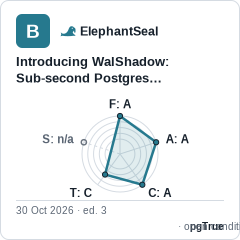
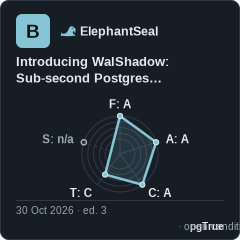
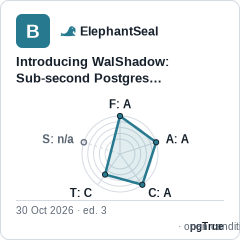
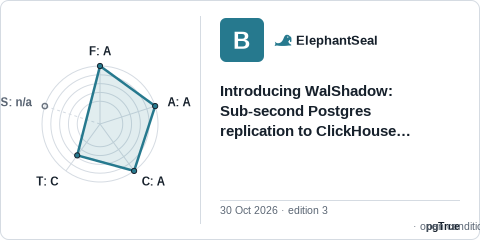
Factual A · Applicable A · Consistent A · Transparent C · Safe —

ReportTechnical fact-check, edition 3 pgTrue versionaudited with v1.0.14 (approx.) · regraded with v1.1.3 Issued EditionUpdated after review. Corrections are listed below. SubmittedSubmitted by the PostgresAI team. Author responseNo written reply from the author. We re-audited this article 2 times; see Revisions below. Policy: right-of-reply and corrections policy.

InaccuraciesNone in this edition.

Dangerous or recipe bugsNone in this edition.

Misleading / impreciseNone in this edition.

Verified accurate

F1

WalShadow consumes physical streaming replication

ACCURATEFactual · holds up after review

Claim ledger

Article says
…the same physical WAL stream used by Postgres replicas…
What is true
WalShadow requests physical WAL through START_REPLICATION. src/source/source_feed.rs:187 explicitly selects PHYSICAL when using a replication slot.
Charitable reading
The claim identifies the replication transport, not identical destination storage or transaction visibility.

Source

Source · walshadow@main@d4353eb126 · src/source/source_feed.rs:187-187format!("START_REPLICATION SLOT {slot} PHYSICAL {lsn} TIMELINE {timeline}")
In the article

In the article

excerpt · as fetched 2026-10-19 · open in article ↗ (opens in new tab)

Unlike traditional CDC based systems, WalShadow doesn’t use Postgres logical replication. It consumes the same physical WAL stream used by Postgres replicas, decodes it outside the source database, and writes ClickHouse-native blocks directly into ClickHouse. The result is a replication architecture that gets close to the latency and throughput of a Postgres physical standby, while making the data immediately available for analytics in ClickHouse.

All sources and excerpts · 1
Evidence format!("START_REPLICATION SLOT {slot} PHYSICAL {lsn} TIMELINE {timeline}")
How the review tested this

Review: We checked whether physical transport implied identical destination semantics. F1 confines verification to START_REPLICATION PHYSICAL, which the source confirms. We checked whether physical transport implied identical destination semantics. F1 confines its claim to START_REPLICATION PHYSICAL, which the pinned source confirms.

F2

PostgreSQL logical streaming performs logical decoding

ACCURATEFactual · holds up after review

Claim ledger

Article says
…asking the source database to decode changes into logical events…
What is true
PostgreSQL 18.6 processes WAL through LogicalDecodingProcessRecord in src/backend/replication/walsender.c:3485. Its documentation describes conversion from storage-level WAL into application-specific changes.
Charitable reading
The sentence describes the source-side logical-decoding architecture used for this comparison.

Source

Source · REL_18_6 · src/backend/replication/walsender.c:3485-3485LogicalDecodingProcessRecord(logical_decoding_ctx, logical_decoding_ctx->reader);
In the article

In the article

Article · exact quote · open in article ↗ (opens in new tab)…asking the source database to decode changes into logical events…
All sources and excerpts · 2
Evidence LogicalDecodingProcessRecord(logical_decoding_ctx, logical_decoding_ctx->reader);
Evidence In <productname>PostgreSQL</productname>, logical decoding is implemented by decoding the contents of the <link linkend="wal">write-ahead log</link>, which describe changes on a storage level, into an application-specific form such as a stream of tuples or SQL statements.
How the review tested this

Review: We checked whether F2 confused physical WAL with logical output. REL_18_6 explicitly processes WAL through logical decoding. We checked whether F2 generalized beyond logical streaming. Its stated scope matches the decoding call and PostgreSQL 18.6 documentation.

F3

PeerDB uses logical replication with pgoutput

ACCURATEFactual · holds up after review

Claim ledger

Article says
…powered by logical replication…
What is true
PeerDB v0.37.7 creates LOGICAL pgoutput replication slots in flow/connectors/postgres/client.go:639. This supports the transport comparison, not the reported latency or throughput.
Charitable reading
The claim concerns PeerDB's PostgreSQL CDC transport, not its measured performance.

Source

Source · peerdb@v0.37.7 · flow/connectors/postgres/client.go:639-639createSlotCommand := fmt.Sprintf("CREATE_REPLICATION_SLOT %s LOGICAL pgoutput%s", common.QuoteIdentifier(slot), optionsString)
In the article

In the article

Article · exact quote · open in article ↗ (opens in new tab)…powered by logical replication…
All sources and excerpts · 1
Evidence createSlotCommand := fmt.Sprintf("CREATE_REPLICATION_SLOT %s LOGICAL pgoutput%s", common.QuoteIdentifier(slot), optionsString)
How the review tested this

Review: We checked whether pgoutput merely appeared in commentary. The v0.37.7 executable path constructs a LOGICAL pgoutput slot command. We checked whether slot creation supported the transport claim. PeerDB v0.37.7 explicitly requests LOGICAL pgoutput. F3 excludes performance validation.

F5

Ordering barriers wait for preceding inserts

ACCURATEFactual · holds up after review

Claim ledger

Article says
…wait for all preceding data to become durable…
What is true
src/emit/pipeline/reorder.rs:466-470 waits for placement, flushes batches, and waits for durability. The truncate path invokes this barrier before applying TRUNCATE.
Charitable reading
The claim concerns ordering barriers for schema changes and truncations, not atomic visibility of every transaction.

Source

Source · walshadow@main@d4353eb126 · src/emit/pipeline/reorder.rs:466-470async fn barrier_fence(&mut self) -> Result<(), SinkError> { self.wait_all_placed().await?; self.flush_all_batcher().await?; self.wait_all_durable().await }
In the article

In the article

Article · exact quote · open in article ↗ (opens in new tab)…wait for all preceding data to become durable…
All sources and excerpts · 2
Evidence async fn barrier_fence(&mut self) -> Result<(), SinkError> { self.wait_all_placed().await?; self.flush_all_batcher().await?; self.wait_all_durable().await }
Evidence self.barrier_fence().await?; self.apply_truncate(&h.described).await?;
How the review tested this

Review: We checked whether the barrier only flushed queued rows. E-15 also waits for durability, and E-16 invokes it before truncation. We checked whether the barrier merely queued preceding writes. E-15 waits for durability, and E-16 invokes it before TRUNCATE.

F6

The four listed schema operations are supported

ACCURATEFactual · holds up after review

Claim ledger

Article says
…ADD COLUMN , RENAME COLUMN , DROP COLUMN , and CREATE TABLE…
What is true
docs/schema-changes.md:10-14 documents CREATE TABLE, ADD COLUMN, RENAME COLUMN, and DROP COLUMN support. Table selection and custom column mappings constrain their destination effects.
Charitable reading
Supporting these operations does not promise automatic handling of every schema change or custom column mapping.

Source

Source · walshadow@main@d4353eb126 · docs/schema-changes.md:10-14| `CREATE TABLE` | creates destination when table matches active scope | | `ADD COLUMN` | adds mapped column automatically | | `ADD COLUMN ... DEFAULT ...` | adds column and carries supported default | | `RENAME COLUMN` | renames destination column unless config pins another target name | | `DROP COLUMN` | drops automatically mapped destination column, custom target mappings can need cleanup |
In the article

In the article

Article · exact quote · open in article ↗ (opens in new tab)…ADD COLUMN , RENAME COLUMN , DROP COLUMN , and CREATE TABLE…
All sources and excerpts · 1
Evidence| `CREATE TABLE` | creates destination when table matches active scope | | `ADD COLUMN` | adds mapped column automatically | | `ADD COLUMN ... DEFAULT ...` | adds column and carries supported default | | `RENAME COLUMN` | renames destination column unless config pins another target name | | `DROP COLUMN` | drops automatically mapped destination column, custom target mappings can need cleanup |
How the review tested this

Review: We checked table-selection and custom-mapping exceptions. F6 includes those restrictions and verifies only the four listed operations. We checked table-selection and custom-mapping exceptions. E-17 documents all four operations. F6 retains those constraints.

F9

WalShadow avoids logical replication slots

ACCURATEFactual · holds up after review

Claim ledger

Article says
…eliminates the need for logical replication slots…
What is true
WalShadow uses physical replication slots rather than logical slots. docs/operations.md:96-99 recommends a physical slot for routine deployments. Eliminating logical slots does not eliminate WAL-retention management.
Charitable reading
The article specifies logical slots. It does not claim that all replication slots disappear.

Source

Source · walshadow@main@d4353eb126 · src/source/source_feed.rs:187-187format!("START_REPLICATION SLOT {slot} PHYSICAL {lsn} TIMELINE {timeline}")
In the article

In the article

Article · exact quote · open in article ↗ (opens in new tab)…eliminates the need for logical replication slots…
All sources and excerpts · 2
Evidence format!("START_REPLICATION SLOT {slot} PHYSICAL {lsn} TIMELINE {timeline}")
EvidenceConfigure a physical replication slot for routine deployments: ```sql SELECT pg_create_physical_replication_slot('walshadow');
How the review tested this

Review: We tested whether physical slots contradicted the article. The article specifies logical slots, and F9 preserves that distinction. We checked whether F9 confused logical slots with all slots. It preserves the distinction. E-10 and E-20 confirm physical-slot use.

F10

WalShadow declares an open-source license

ACCURATEFactual · holds up after review

Claim ledger

Article says
WalShadow is fully open source…
What is true
WalShadow declares AGPL-3.0-only in Cargo.toml:9 at commit d4353eb12627be352a8136f2cec2966b7d100cab.
Charitable reading
The statement describes the project's licensing and public source availability.

Source

Source · walshadow@main@d4353eb126 · Cargo.toml:9-9license = "AGPL-3.0-only"
In the article

In the article

excerpt · as fetched 2026-10-19 · open in article ↗ (opens in new tab)

WalShadow is fully open source and available today on GitHub .

All sources and excerpts · 1
Evidencelicense = "AGPL-3.0-only"
How the review tested this

Review: We checked whether F10 certified every dependency's licensing. Its narrower statement accurately identifies the AGPL-3.0-only manifest declaration. We checked whether F10 claimed a complete licensing audit. It only confirms the AGPL-3.0-only declaration in Cargo.toml:9.

F11

WalShadow's product page confirms private preview

ACCURATEFactual · holds up after review

Claim ledger

Article says
…launching WalShadow in private preview…
What is true
The WalShadow product page advertises private preview access through ClickHouse Cloud.
Charitable reading
The article announces restricted preview access rather than general availability.

Source

Source · https://clickhouse.com/cloud/postgres/walshadowTry WalShadow in Private Preview on ClickHouse Cloud
In the article

In the article

Article · exact quote · open in article ↗ (opens in new tab)…launching WalShadow in private preview…
All sources and excerpts · 1
EvidenceTry WalShadow in Private Preview on ClickHouse Cloud
How the review tested this

Review: We checked whether the page promised general availability or access timing. E-24 confirms private preview only, matching F11. We checked for a general-availability or access-turnaround inference. F11 makes neither. E-24 explicitly advertises private preview.

F12

The PeerDB acquisition reference matches its announcement

ACCURATEFactual · holds up after review

Claim ledger

Article says
…acquisition of PeerDB…
What is true
The linked announcement confirms that the PeerDB team joined ClickHouse.
Charitable reading
The phrase identifies the earlier PeerDB acquisition announcement.

Source

Source · https://clickhouse.com/blog/clickhouse-welcomes-peerdb-adding-the-fastest-postgres-cdc-to-the-fastest-olap-databasewe’re happy to welcome the PeerDB team and community into the ClickHouse family.
In the article

In the article

Article · exact quote · open in article ↗ (opens in new tab)…acquisition of PeerDB…
All sources and excerpts · 1
Evidencewe’re happy to welcome the PeerDB team and community into the ClickHouse family.
How the review tested this

Review: We checked whether F12 inferred acquisition terms. It states only that the team joined, which E-26 confirms. We checked whether E-26 supported only a partnership. The announcement confirms the team's integration. F12 claims no transaction terms.

F13

The Postgres CDC connector launch is documented

ACCURATEFactual · holds up after review

Claim ledger

Article says
…launching Postgres CDC in ClickPipes…
What is true
The linked ClickPipes announcement confirms general availability of its Postgres CDC connector.
Charitable reading
The statement refers to the connector's launch history.

Source

Source · https://clickhouse.com/blog/postgres-cdc-connector-clickpipes-gathe Postgres CDC connector for ClickPipes is now generally available.
In the article

In the article

Article · exact quote · open in article ↗ (opens in new tab)…launching Postgres CDC in ClickPipes…
All sources and excerpts · 1
Evidencethe Postgres CDC connector for ClickPipes is now generally available.
How the review tested this

Review: We checked for confusion between preview and general availability. E-28 explicitly announces general availability of the Postgres CDC connector. We checked whether E-28 described a preview instead of a launch. It explicitly announces general availability of the Postgres CDC connector.

F14

The managed Postgres introduction is documented

ACCURATEFactual · holds up after review

Claim ledger

Article says
…introducing ClickHouse Managed Postgres…
What is true
The linked announcement introduces ClickHouse Managed Postgres. The article accurately describes this as an introduction.
Charitable reading
Introducing the service does not claim general availability.

Source

Source · https://clickhouse.com/blog/postgres-managed-by-clickhouseToday, we're announcing a fast, scalable and an enterprise-grade managed Postgres service natively integrated with ClickHouse
In the article

In the article

Article · exact quote · open in article ↗ (opens in new tab)…introducing ClickHouse Managed Postgres…
All sources and excerpts · 1
EvidenceToday, we're announcing a fast, scalable and an enterprise-grade managed Postgres service natively integrated with ClickHouse
How the review tested this

Review: We checked whether introduction implied general availability. F14 makes no such inference, and E-30 announces the managed service. We checked whether F14 treated introduction as general availability. It does not. E-30 directly announces the managed service.

F15

The workload qualification matches the benchmark guide

ACCURATEFactual · holds up after review

Claim ledger

Article says
Performance will vary by workload…
What is true
bench/README.md:123 requires matching row counts, row width, and source size across comparisons. The article appropriately limits its benchmark's applicability.
Charitable reading
The statement qualifies the benchmark rather than asserting workload-independent performance.

Source

Source · walshadow@main@d4353eb126 · bench/README.md:123-124Repeat with matching mode, rows, width, source size, hardware, PostgreSQL version, daemon config, and sampling flags, use same label for repeats of one revision
In the article

In the article

Article · exact quote · open in article ↗ (opens in new tab)Performance will vary by workload…
All sources and excerpts · 1
EvidenceRepeat with matching mode, rows, width, source size, hardware, PostgreSQL version, daemon config, and sampling flags, use same label for repeats of one revision
How the review tested this

Review: We checked whether comparison guidance verified performance numbers. F15 verifies only workload dependence, consistent with the guide's matching requirements. We checked whether benchmark guidance verified actual results. F15 only confirms workload qualification. E-32 requires matched workloads and configurations.

F16

The reported latency inputs support the 50-fold comparison

ACCURATEFactual · holds up after review

Claim ledger

Article says
…about 50x lower latency in this benchmark…
What is true
The latency ratio is 50 (derived: 10 seconds / 0.20 seconds). The article's 50-fold comparison matches its inputs. We did not independently verify those measurements.
Charitable reading
The article limits the comparison to its benchmark. We checked the ratio using its stated measurements.

Checked for internal consistency: the evidence is the article itself.

In the article

In the article

Article · exact quote · open in article ↗ (opens in new tab)…about 50x lower latency in this benchmark…
How the review tested this

Review: We recalculated 10 seconds divided by 0.20 seconds: 50. F16 explicitly separates arithmetic agreement from measurement verification. We recalculated the ratio: 10 seconds divided by 0.20 seconds equals 50. F16 excludes independent measurement verification.

F17

The reported throughput inputs support approximately 40% of source throughput

ACCURATEFactual · holds up after review

Claim ledger

Article says
…around 40% of the source rate…
What is true
PeerDB's stated throughput equals 41% of source throughput (derived: 120,000 / 290,000 rows per second). The article's approximate 40% agrees. We did not independently verify either throughput measurement.
Charitable reading
The article says around 40%, rather than exactly 40%. That approximation permits the calculated 41%.

Checked for internal consistency: the evidence is the article itself.

In the article

In the article

Article · exact quote · open in article ↗ (opens in new tab)…around 40% of the source rate…
How the review tested this

Review: We recalculated the throughput ratio as 41.4%. The article's approximate 40% permits that rounding, and F17 claims no independent measurement. We recalculated 120,000 / 290,000 as 41%. The article's approximate 40% is fair. F17 excludes independent throughput verification.

Notes

3 not graded: findings no reader would act on differently
F4

Note: “…the time from a transaction committing in Postgres to its rows becoming visible in…”

NOTEpartly holds after review

Claim ledger

Article says
…the time from a transaction committing in Postgres to its rows becoming visible in ClickHouse…
What is true
bench/src/lib.rs:437 starts timing after the source insert returns, then waits for destination visibility. This measures a client-observed approximation. It excludes time between server commit and receipt of the insert response. E-14 does not establish the reported 200 ms result.

Source

Source · walshadow@main@d4353eb126 · bench/src/lib.rs:437-444pg.insert_row(id) .await .with_context(|| format!("insert id={id}"))?; let t_commit = Instant::now(); match wait_visible(dest, id, poll, timeout).await? { Some(_) => { if i >= p.warmup {

Not graded: no reader would act differently on it.

In the article

In the article

Article · exact quote · open in article ↗ (opens in new tab)…the time from a transaction committing in Postgres to its rows becoming visible in ClickHouse…
All sources and excerpts · 1
Evidence pg.insert_row(id) .await .with_context(|| format!("insert id={id}"))?; let t_commit = Instant::now(); match wait_visible(dest, id, poll, timeout).await? { Some(_) => { if i >= p.warmup {
How the review tested this

Review: We tested the client-observation reading. E-14 starts timing after insert completion, so it does not verify the exact commit-to-visible interval. We challenged the difference between server commit and client completion. F4 explicitly describes client observations and does not verify 200 ms.

F7

Physical transport still requires wal_level=logical

NOTEholds up after review

Claim ledger

Article says
The source only needs to ship physical WAL…
What is true
WalShadow requires logical-level WAL despite using physical transport. src/ops/preflight.rs:192-198 records an error for other wal_level values. A source configured only for ordinary physical replication can fail this check.
So what
Set source wal_level=logical before starting WalShadow.
Charitable reading
The sentence describes transport and decoding work. It does not explicitly promise compatibility with wal_level=replica.

Source

Source · walshadow@main@d4353eb126 · src/ops/preflight.rs:192-198let wal_level = scalar_text(input.source_sql, "SHOW wal_level").await?; if wal_level != "logical" { report.errors.push(PreflightError::WalLevel { got: wal_level, expected: "logical", }); }

Not graded: no reader would act differently on it.

In the article

In the article

Article · exact quote · open in article ↗ (opens in new tab)The source only needs to ship physical WAL…
All sources and excerpts · 1
Evidence let wal_level = scalar_text(input.source_sql, "SHOW wal_level").await?; if wal_level != "logical" { report.errors.push(PreflightError::WalLevel { got: wal_level, expected: "logical", }); }
How the review tested this

Review: We read the article as a transport description. F7 correctly remains a note, and preflight explicitly rejects other wal_level values. We read E-7 as a transport description. F7 fairly avoids charging an error. E-18 confirms the wal_level=logical prerequisite.

F8

Note: “…allowing ClickHouse to retain the latest version for each key…”

NOTEpartly holds after review

Claim ledger

Article says
…allowing ClickHouse to retain the latest version for each key…
What is true
docs/destination-tables.md:103 documents FINAL for immediate version resolution. Lines 112–114 also recommend application-specific argMax patterns or downstream materialization. Background merges converge asynchronously. Queries without version resolution can return multiple versions of a source row.
So what
Use FINAL and the documented _is_deleted filter when destination queries require current row state.

Source

Source · walshadow@main@d4353eb126 · docs/destination-tables.md:103-114Use `FINAL` when query must resolve outstanding row versions immediately ```sql SELECT * FROM cdc.orders FINAL WHERE _is_deleted = 0 ORDER BY id; ``` Without `FINAL`, background merges converge versions asynchronously. For large analytical queries, prefer application-specific `argMax` patterns or downstream materialization when `FINAL` cost is too high

Not graded: no reader would act differently on it.

In the article

In the article

Article · exact quote · open in article ↗ (opens in new tab)…allowing ClickHouse to retain the latest version for each key…
All sources and excerpts · 1
EvidenceUse `FINAL` when query must resolve outstanding row versions immediately ```sql SELECT * FROM cdc.orders FINAL WHERE _is_deleted = 0 ORDER BY id; ``` Without `FINAL`, background merges converge versions asynchronously. For large analytical queries, prefer application-specific `argMax` patterns or downstream materialization when `FINAL` cost is too high
How the review tested this

Review: We checked whether FINAL was mandatory. E-19 also recommends argMax patterns or downstream materialization, so F8 overstates that requirement. We tested the charitable convergence reading. F8 accepts it and records immediate version resolution as a note. E-19 supports that distinction.

More in this report

Section checks · 7 sections

Section checks

AspectGradeFindingsCoverage
AnnouncementA3 verified-accurate100% of claims (1 of 1, plus 3 that need data we do not have)
Managed PostgresA1 verified-accurate1 checked · 1 need data we do not have
ArchitectureA3 verified-accurate100% of claims (1 of 1)
Benchmark setupA2 verified-accurate100% of claims (2 of 2, plus 3 that need data we do not have)
LatencyA1 verified-accurate100% of claims (2 of 2, plus 2 that need data we do not have)
ThroughputA1 verified-accurate100% of claims (1 of 1, plus 4 that need data we do not have)
VisionA3 verified-accurateno checkable claims
Coverage and assessment · Checked 7 of 7 Postgres claims across 8 sections

Central claim not verified. We checked WalShadow's architecture and benchmark arithmetic, but did not verify its 200 ms latency, 289,000 rows/second throughput, or source-resource savings.

We did not check everything in this article. What we did not check is listed below, in the words we recorded at the time. None of it moved the letter. We never charge our own limits to the article.

What we did not check

  • We did not measure source resource use or reproduce the latency and throughput benchmarks.
  • We did not verify data fidelity across every PostgreSQL type and transaction pattern.
  • We did not verify the comparison of physical-WAL access across managed PostgreSQL services.
  • We did not independently verify the benchmark results, workload, or regional placement.
  • We did not verify the claim that most managed Postgres services deny physical-WAL access.
  • We did not reach the account signup page.
  • We did not establish the article's publication date or which features changed afterward.
  • We did not verify the c8i.2xlarge hardware specification.
  • We did not independently verify the reported 50 ms, 200 ms, or 10-second latency measurements.
  • We did not independently verify the reported throughput measurements of 120,000, 289,000, or 290,000 rows per second.
  • We did not verify that the benchmark used c8i.2xlarge instances with 8 vCPUs each.
  • Safe: we did not complete every applicable check.
  • Section “Architecture”: our checked-claim count (3) exceeds our extracted total (1); the count needs review.
  • We could not decide whether readers can obtain the benchmark environment.
  • We could not decide whether the published benchmark details are complete.
Checked 7 of 7 Postgres claims across 8 sections
  • Announcement: 1 of 1 Postgres claims checked, plus 3 that need data we do not have; not counted: 20 product or opinion, 1 duplicate, 1 not a claim
  • Managed Postgres: 1 checked, plus 1 that need data we do not have; not counted: 4 product or opinion, 1 duplicate, 2 not a claim
  • Architecture: 1 of 1 Postgres claims checked; not counted: 31 product or opinion, 3 duplicate, 3 not a claim
  • Benchmark setup: 2 of 2 Postgres claims checked, plus 3 that need data we do not have; not counted: 7 product or opinion, 3 not a claim
  • Latency: 2 of 2 Postgres claims checked, plus 2 that need data we do not have; not counted: 2 duplicate
  • Throughput: 1 of 1 Postgres claims checked, plus 4 that need data we do not have; not counted: 1 product or opinion, 5 duplicate
  • Vision: no checkable claims; not counted: 11 product or opinion, 4 duplicate, 1 not a claim
  • Access: no checkable claims; not counted: 7 product or opinion, 1 duplicate, 6 not a claim

Average of 4 axes: 3.5 · benchmark not reproducible, one step off (no versions) · result B

Some explanatory text is not shown in this edition; the grade and findings are complete.

Scorecard · the five axes
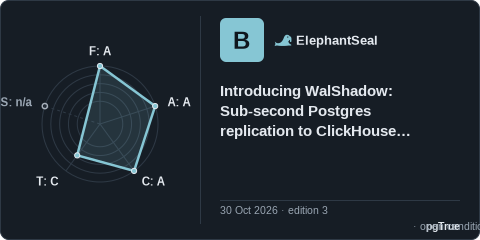
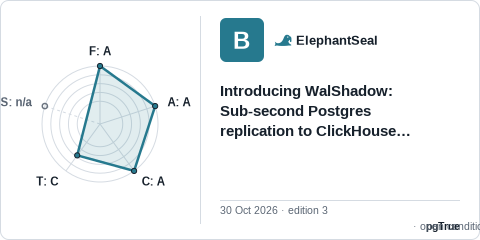
FACTS scorecard Scorecard radar, 5 axes, bigger is better. Overall B. Factual A · 0 wrong of 14 checked · 0 caveats. Applicable A · 0 wrong of 4 checked · 0 caveats. Consistent A · 0 wrong of 14 checked · 0 caveats. Transparent C · 0 wrong of 8 checked · 0 caveats · reproducibility: C (no versions). Safe not applicable (n/a). A 0 wrong of 14 checked · 0 caveatsFactual A0 wrong of 140 caveats A 0 wrong of 4 checked · 0 caveatsApplicable A0 wrong of 40 caveats A 0 wrong of 14 checked · 0 caveatsConsistent A0 wrong of 140 caveats C 0 wrong of 8 checked · 0 caveats reproducibility: C (no versions)Transparent C0 wrong of 80 caveatsreproducibility: C(no versions) not applicable (n/a), nothing to checkSafe n/anothingto check B

By topic: Announcement — 3 findings, 0 wrong · Managed Postgres — 1 finding, 0 wrong · Architecture — 3 findings, 0 wrong · Benchmark setup — 2 findings, 0 wrong · Latency — 1 finding, 0 wrong · Throughput — 1 finding, 0 wrong · Vision — 3 findings, 0 wrong

Further out is better. Each axis has its own letter, from the wrong claims and caveats among the claims we checked of that kind.

Checked on the FACTS: Factual, Applicable, Consistent, Transparent, Safe. Clockwise: Factual (is it true?), Applicable (does it apply to my setup, today?), Consistent (does it agree with itself?), Transparent (can I check it myself?), Safe (can I run this on prod?).

We checked 14 claims.

AxisLetterWrongCaveatsCheckedCoverage
FactualA0014assessed: A · 0 wrong of 14 checked · 0 caveats
ApplicableA004assessed: A · 0 wrong of 4 checked · 0 caveats
ConsistentA0014assessed: A · 0 wrong of 14 checked · 0 caveats
TransparentC008assessed: C · 0 wrong of 8 checked · 0 caveats · reproducibility: C (no versions)
Safe—000partly assessed
Topics · 7 topics

Topics

TopicFactualApplicableConsistentTransparentSafe
Announcement0 issues 3 checked F6 F9 F100 issues 1 checked0 issues 3 checked0 issues 1 checked
Managed Postgres0 issues 1 checked F110 issues 1 checked0 issues 1 checked
Architecture0 issues 3 checked F1 F2 F50 issues 1 checked0 issues 3 checked
Benchmark setup0 issues 2 checked F3 F150 issues 1 checked0 issues 2 checked0 issues 1 checked
Latency0 issues 1 checked F160 issues 1 checked0 issues 1 checked0 issues 1 checked
Throughput0 issues 1 checked F170 issues 1 checked0 issues 1 checked
Vision0 issues 3 checked F12 F13 F140 issues 3 checked0 issues 3 checked

Issues found among the claims checked, per topic and axis. Each link goes to the finding behind the count.

Revisions: 3 · Not assessed -> A- -> B

We audited this article 3 times. Each row is the final edition of one audit. Letters and findings of earlier revisions stay readable at their own address.

  1. Revision 1 · Not assessed · audit version not recorded

    Details unavailable.

    ElephantSeal: Not assessed.

  2. Revision 2 · 2026-09-25 05:46 UTC · A- · audit version not recorded · regrade version not recorded

    Same article text, re-audited. 8 accurate · 0 wrong · 3 caveats.

    ElephantSeal: A-.

    Changes: Details unavailable.

  3. Revision 3 · this page · 2026-10-19 07:36 UTC · B · audited with v1.0.14 (approx.) · regraded with v1.1.3

    Same article text, re-audited. 14 accurate · 0 wrong · 0 caveats.

    ElephantSeal: B. Open: the benchmark cannot yet be rerun from what is published.

    Changes: No longer reported: “The source only needs to ship physical WAL…”; “Some column values still require shadow PostgreSQL conversion”; “Latest-version convergence does not guarantee deduplicated ordinary queries”. New: none.

Questions and answers

Questions and answers

What is pgTrue?

pgTrue is an independent fact-check of technical Postgres articles, made by PostgresAI. It helps you check advice before you use it.

What does the letter grade mean?

The letter grade summarizes the claims we checked. Five axes show what we checked:

  • Factual: is it true?
  • Applicable: does it apply to my setup, today?
  • Consistent: does it agree with itself?
  • Transparent: can I check it myself?
  • Safe: can I run this in production?

What is the ElephantSeal?

The ElephantSeal is the mark an article earns. It always shows the latest edition. “Open:” lists what is still open.

Can an author reply?

Authors can ask us to correct a finding, reply to it, or withdraw it. Right-of-reply policy.

Paste into your AI assistant to fix the article, then ask for a re-review.

Show the text
Fix the article with this report, then ask pgTrue for a re-review.

# pgTrue report: Introducing WalShadow: Sub-second Postgres replication to ClickHouse from physical WAL

Article title: Introducing WalShadow: Sub-second Postgres replication to ClickHouse from physical WAL
Article URL: https://clickhouse.com/blog/introducing-walshadow
Report URL: https://pgtrue.postgres.ai/shared/brief/0226f8cb-fb69-4377-bf78-f11a8767d7aa
Audited revision: 3 of 3, 2026-10-19 07:36:04 UTC
Overall letter: B

## Axes

- Factual: A · 0 wrong · 14 checked · 0 caveats · assessed
- Applicable: A · 0 wrong · 4 checked · 0 caveats · assessed
- Consistent: A · 0 wrong · 14 checked · 0 caveats · assessed
- Transparent: C · 0 wrong · 8 checked · 0 caveats · assessed
- Safe: — · 0 wrong · 0 checked · 0 caveats · partly assessed

ElephantSeal: B.
Open conditions: the benchmark cannot yet be rerun from what is published.

## Report metadata

- Report: Technical fact-check, edition 3
- pgTrue version: audited with v1.0.14 (approx.) · regraded with v1.1.3
- Issued: 2026-10-19
- Edition: Updated after review. Corrections are listed below.
- Submitted: Submitted by the PostgresAI team.
- Author response: No written reply from the author. We re-audited this article 2 times; see Revisions below. Policy: [right-of-reply and corrections policy](/pgtrue/security).

## Findings needing a change (0)

None.

## Verified accurate claims (14)

### F1 · Accurate · Factual · WalShadow consumes physical streaming replication
Location: excerpt · as fetched 2026-10-19 · [open in article](https://clickhouse.com/blog/introducing-walshadow#:~:text=the%20same%20physical%20WAL%20stream%20used%20by%20Postgres%20replicas)
Article says:
```text
…the same physical WAL stream used by Postgres replicas…
```
What is true:
WalShadow requests physical WAL through START_REPLICATION. src/source/source_feed.rs:187 explicitly selects PHYSICAL when using a replication slot.
Charitable reading:
The claim identifies the replication transport, not identical destination storage or transaction visibility.
Review: We checked whether physical transport implied identical destination semantics. F1 confines verification to START_REPLICATION PHYSICAL, which the source confirms. We checked whether physical transport implied identical destination semantics. F1 confines its claim to START_REPLICATION PHYSICAL, which the pinned source confirms.

Sources:
- [walshadow@main@d4353eb126 · src/source/source_feed.rs:187-187](https://github.com/ClickHouse/walshadow/blob/d4353eb12627be352a8136f2cec2966b7d100cab/src/source/source_feed.rs#L187-L187)
  Excerpt:
  ```text
  format!("START_REPLICATION SLOT {slot} PHYSICAL {lsn} TIMELINE {timeline}")
  ```

Finding URL: https://pgtrue.postgres.ai/shared/brief/0226f8cb-fb69-4377-bf78-f11a8767d7aa#F1

### F2 · Accurate · Factual · PostgreSQL logical streaming performs logical decoding
Location: Article · exact quote · [open in article](https://clickhouse.com/blog/introducing-walshadow#:~:text=asking%20the%20source%20database%20to%20decode%20changes%20into%20logical%20events)
Article says:
```text
…asking the source database to decode changes into logical events…
```
What is true:
PostgreSQL 18.6 processes WAL through LogicalDecodingProcessRecord in src/backend/replication/walsender.c:3485. Its documentation describes conversion from storage-level WAL into application-specific changes.
Charitable reading:
The sentence describes the source-side logical-decoding architecture used for this comparison.
Review: We checked whether F2 confused physical WAL with logical output. REL_18_6 explicitly processes WAL through logical decoding. We checked whether F2 generalized beyond logical streaming. Its stated scope matches the decoding call and PostgreSQL 18.6 documentation.

Sources:
- [REL_18_6 · src/backend/replication/walsender.c:3485-3485](https://github.com/postgres/postgres/blob/724edf9bde9d356724ad384a2e196edc3c9f80f7/src/backend/replication/walsender.c#L3485-L3485)
  Excerpt:
  ```text
  LogicalDecodingProcessRecord(logical_decoding_ctx, logical_decoding_ctx->reader);
  ```
- [REL_18_6 · doc/src/sgml/logicaldecoding.sgml:255-258](https://github.com/postgres/postgres/blob/724edf9bde9d356724ad384a2e196edc3c9f80f7/doc/src/sgml/logicaldecoding.sgml#L255-L258)
  Excerpt:
  ```text
  In <productname>PostgreSQL</productname>, logical decoding is implemented
     by decoding the contents of the <link linkend="wal">write-ahead
     log</link>, which describe changes on a storage level, into an
     application-specific form such as a stream of tuples or SQL statements.
  ```

Finding URL: https://pgtrue.postgres.ai/shared/brief/0226f8cb-fb69-4377-bf78-f11a8767d7aa#F2

### F3 · Accurate · Factual · PeerDB uses logical replication with pgoutput
Location: Article · exact quote · [open in article](https://clickhouse.com/blog/introducing-walshadow#:~:text=powered%20by%20logical%20replication)
Article says:
```text
…powered by logical replication…
```
What is true:
PeerDB v0.37.7 creates LOGICAL pgoutput replication slots in flow/connectors/postgres/client.go:639. This supports the transport comparison, not the reported latency or throughput.
Charitable reading:
The claim concerns PeerDB's PostgreSQL CDC transport, not its measured performance.
Review: We checked whether pgoutput merely appeared in commentary. The v0.37.7 executable path constructs a LOGICAL pgoutput slot command. We checked whether slot creation supported the transport claim. PeerDB v0.37.7 explicitly requests LOGICAL pgoutput. F3 excludes performance validation.

Sources:
- [[email protected] · flow/connectors/postgres/client.go:639-639](https://github.com/PeerDB-io/peerdb/blob/0baec50e6b1ddbb3a69ffa79bcd9539a9382aec5/flow/connectors/postgres/client.go#L639-L639)
  Excerpt:
  ```text
  createSlotCommand := fmt.Sprintf("CREATE_REPLICATION_SLOT %s LOGICAL pgoutput%s", common.QuoteIdentifier(slot), optionsString)
  ```

Finding URL: https://pgtrue.postgres.ai/shared/brief/0226f8cb-fb69-4377-bf78-f11a8767d7aa#F3

### F5 · Accurate · Factual · Ordering barriers wait for preceding inserts
Location: Article · exact quote · [open in article](https://clickhouse.com/blog/introducing-walshadow#:~:text=wait%20for%20all%20preceding%20data%20to%20become%20durable)
Article says:
```text
…wait for all preceding data to become durable…
```
What is true:
src/emit/pipeline/reorder.rs:466-470 waits for placement, flushes batches, and waits for durability. The truncate path invokes this barrier before applying TRUNCATE.
Charitable reading:
The claim concerns ordering barriers for schema changes and truncations, not atomic visibility of every transaction.
Review: We checked whether the barrier only flushed queued rows. E-15 also waits for durability, and E-16 invokes it before truncation. We checked whether the barrier merely queued preceding writes. E-15 waits for durability, and E-16 invokes it before TRUNCATE.

Sources:
- [walshadow@main@d4353eb126 · src/emit/pipeline/reorder.rs:466-470](https://github.com/ClickHouse/walshadow/blob/d4353eb12627be352a8136f2cec2966b7d100cab/src/emit/pipeline/reorder.rs#L466-L470)
  Excerpt:
  ```text
  async fn barrier_fence(&mut self) -> Result<(), SinkError> {
        self.wait_all_placed().await?;
        self.flush_all_batcher().await?;
        self.wait_all_durable().await
    }
  ```
- [walshadow@main@d4353eb126 · src/emit/pipeline/reorder.rs:725-726](https://github.com/ClickHouse/walshadow/blob/d4353eb12627be352a8136f2cec2966b7d100cab/src/emit/pipeline/reorder.rs#L725-L726)
  Excerpt:
  ```text
  self.barrier_fence().await?;
                    self.apply_truncate(&h.described).await?;
  ```

Finding URL: https://pgtrue.postgres.ai/shared/brief/0226f8cb-fb69-4377-bf78-f11a8767d7aa#F5

### F6 · Accurate · Factual · The four listed schema operations are supported
Location: Article · exact quote · [open in article](https://clickhouse.com/blog/introducing-walshadow#:~:text=ADD%20COLUMN%20%2C%20RENAME%20COLUMN,COLUMN%20%2C%20and%20CREATE%20TABLE)
Article says:
```text
…ADD COLUMN , RENAME COLUMN , DROP COLUMN , and CREATE TABLE…
```
What is true:
docs/schema-changes.md:10-14 documents CREATE TABLE, ADD COLUMN, RENAME COLUMN, and DROP COLUMN support. Table selection and custom column mappings constrain their destination effects.
Charitable reading:
Supporting these operations does not promise automatic handling of every schema change or custom column mapping.
Review: We checked table-selection and custom-mapping exceptions. F6 includes those restrictions and verifies only the four listed operations. We checked table-selection and custom-mapping exceptions. E-17 documents all four operations. F6 retains those constraints.

Sources:
- [walshadow@main@d4353eb126 · docs/schema-changes.md:10-14](https://github.com/ClickHouse/walshadow/blob/d4353eb12627be352a8136f2cec2966b7d100cab/docs/schema-changes.md#L10-L14)
  Excerpt:
  ```text
  | `CREATE TABLE` | creates destination when table matches active scope |
| `ADD COLUMN` | adds mapped column automatically |
| `ADD COLUMN ... DEFAULT ...` | adds column and carries supported default |
| `RENAME COLUMN` | renames destination column unless config pins another target name |
| `DROP COLUMN` | drops automatically mapped destination column, custom target mappings can need cleanup |
  ```

Finding URL: https://pgtrue.postgres.ai/shared/brief/0226f8cb-fb69-4377-bf78-f11a8767d7aa#F6

### F9 · Accurate · Factual · WalShadow avoids logical replication slots
Location: Article · exact quote · [open in article](https://clickhouse.com/blog/introducing-walshadow#:~:text=eliminates%20the%20need%20for%20logical%20replication%20slots)
Article says:
```text
…eliminates the need for logical replication slots…
```
What is true:
WalShadow uses physical replication slots rather than logical slots. docs/operations.md:96-99 recommends a physical slot for routine deployments. Eliminating logical slots does not eliminate WAL-retention management.
Charitable reading:
The article specifies logical slots. It does not claim that all replication slots disappear.
Review: We tested whether physical slots contradicted the article. The article specifies logical slots, and F9 preserves that distinction. We checked whether F9 confused logical slots with all slots. It preserves the distinction. E-10 and E-20 confirm physical-slot use.

Sources:
- [walshadow@main@d4353eb126 · src/source/source_feed.rs:187-187](https://github.com/ClickHouse/walshadow/blob/d4353eb12627be352a8136f2cec2966b7d100cab/src/source/source_feed.rs#L187-L187)
  Excerpt:
  ```text
  format!("START_REPLICATION SLOT {slot} PHYSICAL {lsn} TIMELINE {timeline}")
  ```
- [walshadow@main@d4353eb126 · docs/operations.md:96-99](https://github.com/ClickHouse/walshadow/blob/d4353eb12627be352a8136f2cec2966b7d100cab/docs/operations.md#L96-L99)
  Excerpt:
  ````text
  Configure a physical replication slot for routine deployments:

```sql
SELECT pg_create_physical_replication_slot('walshadow');
  ````

Finding URL: https://pgtrue.postgres.ai/shared/brief/0226f8cb-fb69-4377-bf78-f11a8767d7aa#F9

### F10 · Accurate · Factual · WalShadow declares an open-source license
Location: excerpt · as fetched 2026-10-19 · [open in article](https://clickhouse.com/blog/introducing-walshadow#:~:text=WalShadow%20is%20fully%20open%20source)
Article says:
```text
WalShadow is fully open source…
```
What is true:
WalShadow declares AGPL-3.0-only in Cargo.toml:9 at commit d4353eb12627be352a8136f2cec2966b7d100cab.
Charitable reading:
The statement describes the project's licensing and public source availability.
Review: We checked whether F10 certified every dependency's licensing. Its narrower statement accurately identifies the AGPL-3.0-only manifest declaration. We checked whether F10 claimed a complete licensing audit. It only confirms the AGPL-3.0-only declaration in Cargo.toml:9.

Sources:
- [walshadow@main@d4353eb126 · Cargo.toml:9-9](https://github.com/ClickHouse/walshadow/blob/d4353eb12627be352a8136f2cec2966b7d100cab/Cargo.toml#L9-L9)
  Excerpt:
  ```text
  license = "AGPL-3.0-only"
  ```

Finding URL: https://pgtrue.postgres.ai/shared/brief/0226f8cb-fb69-4377-bf78-f11a8767d7aa#F10

### F11 · Accurate · Factual · WalShadow's product page confirms private preview
Location: Article · exact quote · [open in article](https://clickhouse.com/blog/introducing-walshadow#:~:text=launching%20WalShadow%20in%20private%20preview)
Article says:
```text
…launching WalShadow in private preview…
```
What is true:
The WalShadow product page advertises private preview access through ClickHouse Cloud.
Charitable reading:
The article announces restricted preview access rather than general availability.
Review: We checked whether the page promised general availability or access timing. E-24 confirms private preview only, matching F11. We checked for a general-availability or access-turnaround inference. F11 makes neither. E-24 explicitly advertises private preview.

Sources:
- [https://clickhouse.com/cloud/postgres/walshadow](https://clickhouse.com/cloud/postgres/walshadow)
  Excerpt:
  ```text
  Try WalShadow in Private Preview on ClickHouse Cloud
  ```

Finding URL: https://pgtrue.postgres.ai/shared/brief/0226f8cb-fb69-4377-bf78-f11a8767d7aa#F11

### F12 · Accurate · Factual · The PeerDB acquisition reference matches its announcement
Location: Article · exact quote · [open in article](https://clickhouse.com/blog/introducing-walshadow#:~:text=acquisition%20of%20PeerDB)
Article says:
```text
…acquisition of PeerDB…
```
What is true:
The linked announcement confirms that the PeerDB team joined ClickHouse.
Charitable reading:
The phrase identifies the earlier PeerDB acquisition announcement.
Review: We checked whether F12 inferred acquisition terms. It states only that the team joined, which E-26 confirms. We checked whether E-26 supported only a partnership. The announcement confirms the team's integration. F12 claims no transaction terms.

Sources:
- [https://clickhouse.com/blog/clickhouse-welcomes-peerdb-adding-the-fastest-postgres-cdc-to-the-fastest-olap-database](https://clickhouse.com/blog/clickhouse-welcomes-peerdb-adding-the-fastest-postgres-cdc-to-the-fastest-olap-database)
  Excerpt:
  ```text
  we’re happy to welcome the PeerDB team and community into the ClickHouse family.
  ```

Finding URL: https://pgtrue.postgres.ai/shared/brief/0226f8cb-fb69-4377-bf78-f11a8767d7aa#F12

### F13 · Accurate · Factual · The Postgres CDC connector launch is documented
Location: Article · exact quote · [open in article](https://clickhouse.com/blog/introducing-walshadow#:~:text=launching%20Postgres%20CDC%20in%20ClickPipes)
Article says:
```text
…launching Postgres CDC in ClickPipes…
```
What is true:
The linked ClickPipes announcement confirms general availability of its Postgres CDC connector.
Charitable reading:
The statement refers to the connector's launch history.
Review: We checked for confusion between preview and general availability. E-28 explicitly announces general availability of the Postgres CDC connector. We checked whether E-28 described a preview instead of a launch. It explicitly announces general availability of the Postgres CDC connector.

Sources:
- [https://clickhouse.com/blog/postgres-cdc-connector-clickpipes-ga](https://clickhouse.com/blog/postgres-cdc-connector-clickpipes-ga)
  Excerpt:
  ```text
  the Postgres CDC connector for ClickPipes is now generally available.
  ```

Finding URL: https://pgtrue.postgres.ai/shared/brief/0226f8cb-fb69-4377-bf78-f11a8767d7aa#F13

### F14 · Accurate · Factual · The managed Postgres introduction is documented
Location: Article · exact quote · [open in article](https://clickhouse.com/blog/introducing-walshadow#:~:text=introducing%20ClickHouse%20Managed%20Postgres)
Article says:
```text
…introducing ClickHouse Managed Postgres…
```
What is true:
The linked announcement introduces ClickHouse Managed Postgres. The article accurately describes this as an introduction.
Charitable reading:
Introducing the service does not claim general availability.
Review: We checked whether introduction implied general availability. F14 makes no such inference, and E-30 announces the managed service. We checked whether F14 treated introduction as general availability. It does not. E-30 directly announces the managed service.

Sources:
- [https://clickhouse.com/blog/postgres-managed-by-clickhouse](https://clickhouse.com/blog/postgres-managed-by-clickhouse)
  Excerpt:
  ```text
  Today, we're announcing a fast, scalable and an enterprise-grade managed Postgres service natively integrated with ClickHouse
  ```

Finding URL: https://pgtrue.postgres.ai/shared/brief/0226f8cb-fb69-4377-bf78-f11a8767d7aa#F14

### F15 · Accurate · Factual · The workload qualification matches the benchmark guide
Location: Article · exact quote · [open in article](https://clickhouse.com/blog/introducing-walshadow#:~:text=Performance%20will%20vary%20by%20workload)
Article says:
```text
Performance will vary by workload…
```
What is true:
bench/README.md:123 requires matching row counts, row width, and source size across comparisons. The article appropriately limits its benchmark's applicability.
Charitable reading:
The statement qualifies the benchmark rather than asserting workload-independent performance.
Review: We checked whether comparison guidance verified performance numbers. F15 verifies only workload dependence, consistent with the guide's matching requirements. We checked whether benchmark guidance verified actual results. F15 only confirms workload qualification. E-32 requires matched workloads and configurations.

Sources:
- [walshadow@main@d4353eb126 · bench/README.md:123-124](https://github.com/ClickHouse/walshadow/blob/d4353eb12627be352a8136f2cec2966b7d100cab/bench/README.md#L123-L124)
  Excerpt:
  ```text
  Repeat with matching mode, rows, width, source size, hardware, PostgreSQL version,
daemon config, and sampling flags, use same label for repeats of one revision
  ```

Finding URL: https://pgtrue.postgres.ai/shared/brief/0226f8cb-fb69-4377-bf78-f11a8767d7aa#F15

### F16 · Accurate · Factual · The reported latency inputs support the 50-fold comparison
Location: Article · exact quote · [open in article](https://clickhouse.com/blog/introducing-walshadow#:~:text=about%2050x%20lower%20latency%20in%20this%20benchmark)
Article says:
```text
…about 50x lower latency in this benchmark…
```
What is true:
The latency ratio is 50 (derived: 10 seconds / 0.20 seconds). The article's 50-fold comparison matches its inputs. We did not independently verify those measurements.
Charitable reading:
The article limits the comparison to its benchmark. We checked the ratio using its stated measurements.
Explanation: Checked for internal consistency: the evidence is the article itself.
Review: We recalculated 10 seconds divided by 0.20 seconds: 50. F16 explicitly separates arithmetic agreement from measurement verification. We recalculated the ratio: 10 seconds divided by 0.20 seconds equals 50. F16 excludes independent measurement verification.

Finding URL: https://pgtrue.postgres.ai/shared/brief/0226f8cb-fb69-4377-bf78-f11a8767d7aa#F16

### F17 · Accurate · Factual · The reported throughput inputs support approximately 40% of source throughput
Location: Article · exact quote · [open in article](https://clickhouse.com/blog/introducing-walshadow#:~:text=around%2040%25%20of%20the%20source%20rate)
Article says:
```text
…around 40% of the source rate…
```
What is true:
PeerDB's stated throughput equals 41% of source throughput (derived: 120,000 / 290,000 rows per second). The article's approximate 40% agrees. We did not independently verify either throughput measurement.
Charitable reading:
The article says around 40%, rather than exactly 40%. That approximation permits the calculated 41%.
Explanation: Checked for internal consistency: the evidence is the article itself.
Review: We recalculated the throughput ratio as 41.4%. The article's approximate 40% permits that rounding, and F17 claims no independent measurement. We recalculated 120,000 / 290,000 as 41%. The article's approximate 40% is fair. F17 excludes independent throughput verification.

Finding URL: https://pgtrue.postgres.ai/shared/brief/0226f8cb-fb69-4377-bf78-f11a8767d7aa#F17

## Notes (not graded) (3)

### F4 · Note ·  · Note: “…the time from a transaction committing in Postgres to its rows becoming visible in…”
Location: Article · exact quote · [open in article](https://clickhouse.com/blog/introducing-walshadow#:~:text=the%20time%20from%20a%20transaction,rows%20becoming%20visible%20in%20ClickHouse)
Article says:
```text
…the time from a transaction committing in Postgres to its rows becoming visible in ClickHouse…
```
What is true:
bench/src/lib.rs:437 starts timing after the source insert returns, then waits for destination visibility. This measures a client-observed approximation. It excludes time between server commit and receipt of the insert response. E-14 does not establish the reported 200 ms result.
Explanation: Not graded: no reader would act differently on it.
Review: We tested the client-observation reading. E-14 starts timing after insert completion, so it does not verify the exact commit-to-visible interval. We challenged the difference between server commit and client completion. F4 explicitly describes client observations and does not verify 200 ms.

Sources:
- [walshadow@main@d4353eb126 · bench/src/lib.rs:437-444](https://github.com/ClickHouse/walshadow/blob/d4353eb12627be352a8136f2cec2966b7d100cab/bench/src/lib.rs#L437-L444)
  Excerpt:
  ```text
  pg.insert_row(id)
            .await
            .with_context(|| format!("insert id={id}"))?;
        let t_commit = Instant::now();

        match wait_visible(dest, id, poll, timeout).await? {
            Some(_) => {
                if i >= p.warmup {
  ```

Finding URL: https://pgtrue.postgres.ai/shared/brief/0226f8cb-fb69-4377-bf78-f11a8767d7aa#F4

### F7 · Note ·  · Physical transport still requires wal_level=logical
Location: Article · exact quote · [open in article](https://clickhouse.com/blog/introducing-walshadow#:~:text=The%20source%20only%20needs%20to%20ship%20physical%20WAL)
Article says:
```text
The source only needs to ship physical WAL…
```
What is true:
WalShadow requires logical-level WAL despite using physical transport. src/ops/preflight.rs:192-198 records an error for other wal_level values. A source configured only for ordinary physical replication can fail this check.
So what:
Set source wal_level=logical before starting WalShadow.
Charitable reading:
The sentence describes transport and decoding work. It does not explicitly promise compatibility with wal_level=replica.
Explanation: Not graded: no reader would act differently on it.
Review: We read the article as a transport description. F7 correctly remains a note, and preflight explicitly rejects other wal_level values. We read E-7 as a transport description. F7 fairly avoids charging an error. E-18 confirms the wal_level=logical prerequisite.

Sources:
- [walshadow@main@d4353eb126 · src/ops/preflight.rs:192-198](https://github.com/ClickHouse/walshadow/blob/d4353eb12627be352a8136f2cec2966b7d100cab/src/ops/preflight.rs#L192-L198)
  Excerpt:
  ```text
  let wal_level = scalar_text(input.source_sql, "SHOW wal_level").await?;
    if wal_level != "logical" {
        report.errors.push(PreflightError::WalLevel {
            got: wal_level,
            expected: "logical",
        });
    }
  ```

Finding URL: https://pgtrue.postgres.ai/shared/brief/0226f8cb-fb69-4377-bf78-f11a8767d7aa#F7

### F8 · Note ·  · Note: “…allowing ClickHouse to retain the latest version for each key…”
Location: Article · exact quote · [open in article](https://clickhouse.com/blog/introducing-walshadow#:~:text=allowing%20ClickHouse%20to%20retain%20the%20latest%20version%20for%20each%20key)
Article says:
```text
…allowing ClickHouse to retain the latest version for each key…
```
What is true:
docs/destination-tables.md:103 documents FINAL for immediate version resolution. Lines 112–114 also recommend application-specific argMax patterns or downstream materialization. Background merges converge asynchronously. Queries without version resolution can return multiple versions of a source row.
So what:
Use FINAL and the documented _is_deleted filter when destination queries require current row state.
Explanation: Not graded: no reader would act differently on it.
Review: We checked whether FINAL was mandatory. E-19 also recommends argMax patterns or downstream materialization, so F8 overstates that requirement. We tested the charitable convergence reading. F8 accepts it and records immediate version resolution as a note. E-19 supports that distinction.

Sources:
- [walshadow@main@d4353eb126 · docs/destination-tables.md:103-114](https://github.com/ClickHouse/walshadow/blob/d4353eb12627be352a8136f2cec2966b7d100cab/docs/destination-tables.md#L103-L114)
  Excerpt:
  ````text
  Use `FINAL` when query must resolve outstanding row versions immediately

```sql
SELECT *
FROM cdc.orders FINAL
WHERE _is_deleted = 0
ORDER BY id;
```

Without `FINAL`, background merges converge versions asynchronously. For large
analytical queries, prefer application-specific `argMax` patterns or downstream
materialization when `FINAL` cost is too high
  ````

Finding URL: https://pgtrue.postgres.ai/shared/brief/0226f8cb-fb69-4377-bf78-f11a8767d7aa#F8

## Withdrawn findings (0)

None.

## Section checks

- Announcement · A · 3 verified-accurate · 100% of claims (1 of 1, plus 3 that need data we do not have)
- Managed Postgres · A · 1 verified-accurate · 1 checked · 1 need data we do not have
- Architecture · A · 3 verified-accurate · 100% of claims (1 of 1)
- Benchmark setup · A · 2 verified-accurate · 100% of claims (2 of 2, plus 3 that need data we do not have)
- Latency · A · 1 verified-accurate · 100% of claims (2 of 2, plus 2 that need data we do not have)
- Throughput · A · 1 verified-accurate · 100% of claims (1 of 1, plus 4 that need data we do not have)
- Vision · A · 3 verified-accurate · no checkable claims

## Claim coverage

- Announcement: 1 of 1 Postgres claims checked, plus 3 that need data we do not have; not counted: 20 product or opinion, 1 duplicate, 1 not a claim
- Managed Postgres: 1 checked, plus 1 that need data we do not have; not counted: 4 product or opinion, 1 duplicate, 2 not a claim
- Architecture: 1 of 1 Postgres claims checked; not counted: 31 product or opinion, 3 duplicate, 3 not a claim
- Benchmark setup: 2 of 2 Postgres claims checked, plus 3 that need data we do not have; not counted: 7 product or opinion, 3 not a claim
- Latency: 2 of 2 Postgres claims checked, plus 2 that need data we do not have; not counted: 2 duplicate
- Throughput: 1 of 1 Postgres claims checked, plus 4 that need data we do not have; not counted: 1 product or opinion, 5 duplicate
- Vision: no checkable claims; not counted: 11 product or opinion, 4 duplicate, 1 not a claim
- Access: no checkable claims; not counted: 7 product or opinion, 1 duplicate, 6 not a claim

## What we did not check

- We did not measure source resource use or reproduce the latency and throughput benchmarks.
- We did not verify data fidelity across every PostgreSQL type and transaction pattern.
- We did not verify the comparison of physical-WAL access across managed PostgreSQL services.
- We did not independently verify the benchmark results, workload, or regional placement.
- We did not verify the claim that most managed Postgres services deny physical-WAL access.
- We did not reach the account signup page.
- We did not establish the article's publication date or which features changed afterward.
- We did not verify the c8i.2xlarge hardware specification.
- We did not independently verify the reported 50 ms, 200 ms, or 10-second latency measurements.
- We did not independently verify the reported throughput measurements of 120,000, 289,000, or 290,000 rows per second.
- We did not verify that the benchmark used c8i.2xlarge instances with 8 vCPUs each.
- Safe: we did not complete every applicable check.
- Section “Architecture”: our checked-claim count (3) exceeds our extracted total (1); the count needs review.
- We could not decide whether readers can obtain the benchmark environment.
- We could not decide whether the published benchmark details are complete.

## Notes

- Central claim not verified. We checked WalShadow's architecture and benchmark arithmetic, but did not verify its 200 ms latency, 289,000 rows/second throughput, or source-resource savings.
- We did not check everything in this article. What we did not check is listed below, in the words we recorded at the time. None of it moved the letter. We never charge our own limits to the article.
- Average of 4 axes: 3.5 · benchmark not reproducible, one step off (no versions) · result B
- Some explanatory text is not shown in this edition; the grade and findings are complete.
- Some checks did not happen for this edition, and each one we know of is listed above.
- Checked against: github.com/postgres/postgres REL_18_6 at commit 724edf9bde9d356724ad384a2e196edc3c9f80f7 (pinned target); github.com/ClickHouse/walshadow main@d4353eb126 at commit d4353eb12627be352a8136f2cec2966b7d100cab (pinned target); github.com/PeerDB-io/peerdb v0.37.7 at commit 0baec50e6b1ddbb3a69ffa79bcd9539a9382aec5 (pinned target); https://clickhouse.com/blog/clickhouse-welcomes-peerdb-adding-the-fastest-postgres-cdc-to-the-fastest-olap-database (fetched 2026-10-19T07:36:31.889546Z); https://clickhouse.com/blog/postgres-cdc-connector-clickpipes-ga (fetched 2026-10-19T07:36:33.044736Z); https://clickhouse.com/blog/postgres-managed-by-clickhouse (fetched 2026-10-19T07:36:33.956615Z); https://clickhouse.com/cloud/postgres/walshadow (fetched 2026-10-19T07:36:26.421715Z).
- Article captured 2026-10-19T07:36:04.618753Z · SHA-256 2705e72bdbedad4adfe86bddea3ac7a96f3ed84efb208ec6d27dabad8ea2b146 · Text extracted from the article's HTML.
- Policy SHA-256 e0930354047e2a8dcf29309596c91e784e85ce5598b44c0671f58dc2adaa46bb · Grading rules SHA-256 6fb334e79d6b9e7ed81d3238cc10d9de602ff87ed65ff2fa781f53bac5798765.
- The article text states no title, author, or publication date. We omit the publication timestamp rather than substitute the retrieval date.
- We did not establish which features changed after publication.
- We did not reproduce the reported 50 ms, 200 ms, or 10-second latency measurements.
- We did not reproduce the reported throughput measurements of 120,000, 289,000, or 290,000 rows/second.
- We did not verify the benchmark workload, regional placement, or c8i.2xlarge hardware specification.
- We did not measure source resource use or verify data fidelity across every PostgreSQL type and transaction pattern.
- We did not verify whether most managed PostgreSQL services deny access to physical WAL.
- We did not reach the account signup page.
- source: walshadow had no release when the article was published, so it was read at main@d4353eb126, the commit its main branch was at that day
- source: the article names no postgres release, so it was read at REL_18_6, the latest release when it was published
- source: the article names no peerdb release, so it was read at v0.37.7, the latest release when it was published
- 4 fetched pages are not listed above, because our policy does not allow linking them.
- review: the findings were written by one model and reviewed independently by a different model.
- 2026-10-30: Regraded under the current grading rules: the letter is the average of the axis letters, with every cap stated under it.
- 7 passages in this edition fell short of our own plain-English rules.
- Built from the article text captured above, 3 pinned source trees, and 4 fetched pages.
- 15 survived · 2 weakened · 0 withdrawn.

## Revision history

- [Revision 1](https://pgtrue.postgres.ai/shared/brief/0226f8cb-fb69-4377-bf78-f11a8767d7aa?v=4) · Not assessed · audit version not recorded
  Details unavailable.
  ElephantSeal: Not assessed.
- [Revision 2](https://pgtrue.postgres.ai/shared/brief/0226f8cb-fb69-4377-bf78-f11a8767d7aa?v=25) · 2026-09-25 05:46 UTC · A- · audit version not recorded · regrade version not recorded
  Same article text, re-audited. 8 accurate · 0 wrong · 3 caveats.
  ElephantSeal: A-.
  Changes: Details unavailable.
- [Revision 3](https://pgtrue.postgres.ai/shared/brief/0226f8cb-fb69-4377-bf78-f11a8767d7aa?v=32) · this page · 2026-10-19 07:36 UTC · B · audited with v1.0.14 (approx.) · regraded with v1.1.3
  Same article text, re-audited. 14 accurate · 0 wrong · 0 caveats.
  ElephantSeal: B. Open: the benchmark cannot yet be rerun from what is published.
  Changes: No longer reported: “The source only needs to ship physical WAL…”; “Some column values still require shadow PostgreSQL conversion”; “Latest-version convergence does not guarantee deduplicated ordinary queries”. New: none.

Updated your article? Request a correction. A new edition appears at this address.